

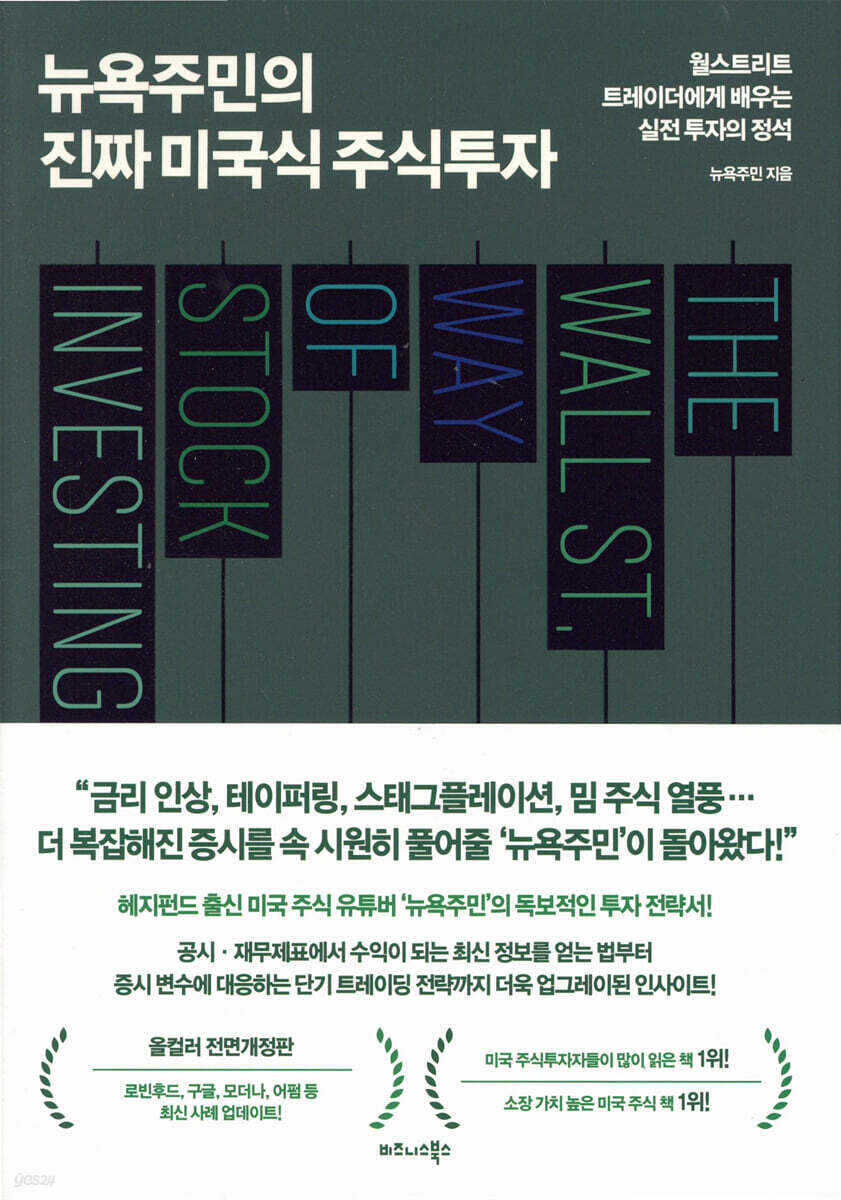
New Yorkers' Authentic American Stock Investment
 |
Description
Book Introduction
“If you start investing in US stocks before reading this book, you’ll be throwing away half your profits!” A completely revised edition, now even more perfected with practical trading skills! The insights of 'New Yorkers' are back, upgraded and more powerful! The fully revised edition of "New Yorker's Real American Stock Investment," an introductory book on American stocks by YouTuber "New Yorker," who has been trading fiercely on Wall Street, the center of the global stock market, through global investment banks such as Citigroup and JP Morgan, as well as private equity funds and hedge funds, has been published. "New Yorker's True American Stock Investment" has established itself as a leading book in the field of American stock investment, offering unparalleled insights based on the experiences of Wall Street traders and a deep understanding of the U.S. stock market. The author, who published a completely revised edition just one year after the first edition, stated that the reason for this was “to include the transitional market situation heading into the post-corona era in the book.” The contents of the first edition are the same as those of the first edition, such as how to find key information directly related to profits in various public disclosures, how to analyze financial statements of IT stocks, REITs, SPACs, and dividend stocks, and how to make profits by utilizing various corporate activities such as IPOs, M&As, spin-outs, and stock splits, but they have been replaced with the latest cases of companies that are currently attracting the attention of the market. Examples include Robinhood's IPO, which attracted individual investors; YouTube's business value revealed through Google's corporate analysis; and Moderna's case, which demonstrated the impact of market sentiment on stock prices. The highlight of this completely revised edition is Chapter 6. This section introduces various examples of how to conduct short-term trading using corporate disclosures and financial statements. It also breaks the stereotype that reading corporate disclosures is only necessary for experts or value investors. Updated with practical US stock investment strategies and up-to-date case studies, "Real American Stock Investment for New Yorkers" will serve as a solid supporter for Korean investors in achieving higher returns. |
- You can preview some of the book's contents.
Preview
index
Before the completely revised edition
Prologue | Why US Stocks?
Chapter 1: Don't Jump into the US Stock Market Unarmed
-The US Stock Market Players You Must Compete Against: The US Stock Market Structure
Buyside, Sellside, and the SEC | The Interests of the Three Players | The First Place for US Stock Market Beginners to Familiarize Yourself with: Corporate IR Sites
Why America is a Stock Investor's Paradise: The IR Culture That Flourished Under American Capitalism
Why do American companies care about investor relations? | Understanding and leveraging investor privileges.
Why America Is Obsessed with Corporate Transparency: The U.S. Disclosure System
What Do US Investors Look For? | The Market Responds to Poor Corporate Disclosure
The principle that price follows value, as proven by history: The necessity of valuation.
Is Value Investing Dead? | How to Uncover Hidden Corporate Intelligence | [Q&A] Are There Thematic or Operational Stocks in US Stocks?
Why Wall Street's Investment Masters Chose Value Investing: The Thorny Path of Value Investing
The True Meaning of Value Investing | The Fundamentals of Value Investing
Chapter 2: Everything You Need to Know About U.S. Corporate Disclosures: Case Studies
-IPO offering information at a glance: S-1, S-11
Looking to invest in IPOs? | How to find the S-1 filing | What you need to know about an IPO filing | Understanding a business model through the S-1 filing: The 'Wall Street standard' established by startups | Understanding the PFOF model that shook up the US retail investor market | The relationship between regulatory risk and stock price | [Q&A] How can I find out a company's IPO schedule and final S-1 filing?
-The most informative annual report: 10-K, Annual Report
There are two types of annual reports | What to look for in a 10-K
The secret to quickly responding to stock price fluctuations: 10-Q and quarterly disclosures
Investors' Attitudes to Earnings Season | How to Check Company Disclosures | Stock Prices Ultimately Reflect Earnings
The Key to Stock Price Direction: Fighting Wall Street Consensus: How Analysts Read the Future
Another Force That Moves Stocks During Earnings Season | How to Check Analyst Consensus
Alarm Clock for Unpredictable Events: 8-K
How to be the first to check corporate news | The types and procedures for bankruptcy in the US are different | What happened after Hertz filed for bankruptcy protection | A real-life version of the 'dumber fool theory' | Why you should read corporate disclosures properly | [Q&A] Is there a way to know when corporate disclosure data is released in real time? | [Q&A] How does a paid-in capital increase affect stock prices in the US? | [Q&A] How is a paid-in capital increase in the US different from that in Korea?
What disclosures must hedge funds read?: DEF-14A (Proxy)
If you want to know more about corporate executives, read: How Much Does Tim Cook Get Paid?
The Hidden Meaning Behind the 5% Equity Rule: 13D, 13G
Why Institutions Buy Large Stake in Companies | Where Did Warren Buffett Invest?
How to leverage market-moving hedge funds for your investments: 13F
Want to know the status of an investment company's holdings? | By the time you see the announcement, it may have already been sold.
What to Learn from Insider Stock Trading: Forms 3, 4, and 5
There's no such thing as "Kardera" in US public filings | What if an insider bought or sold stock?
The first public disclosure to check when M&A news breaks: Merge Presentation, DEFM-14A
Don't miss major stock price-shaking events | Investment opportunities still exist after M&A news | How much can shareholders of an acquired company receive? | Which stock should you buy, the acquiring company or the target company? | All M&A records, S-4 disclosures | [Q&A] What happened to Caesars' stock price after the merger?
Another positive development for the U.S. stock market: corporate spin-offs: Form 10-12B
Why Corporate Spin-Offs Are as Good as M&A | Corporate Spin-Offs Are a Treasury of Stock Value Creation
-The reason we are constantly anxious in the midst of a flood of information: the illusion that investment opportunities are hidden.
The answer lies in public information, not secret information.
Chapter 3: Financial Statements: The More You Know, the More You See, and Investment Returns: The More You See
- Knowing how to read financial statements: Reading financial statements by sector
Before looking at the numbers, let's read the context.
When to Buy and When to Sell Stocks: Finding the Fair Value of Stocks
Defining Cheap and Expensive Stocks | Estimating Fair Value, Not Predicting Future Stock Prices | Current and Should-Be Values | [Q&A] What's the Difference Between Operating Profit, EBIT, and EBITDA? | [Q&A] How Long Are Valuations Valid?
The Trap of a Low PER, the Hidden Meaning Behind a High PER: How to Understand PER
Misconceptions Surrounding the P/E Ratio | PEG: A Beneficial Indicator for High P/E Stocks | PEG's Limitations: Compensating for the Limitations of the P/E Ratio | [Q&A] What's the Difference Between a Price-to-Earnings Ratio and a Price-to-Earnings Ratio?
Companies closely related to the lives of Americans: Consumer Distribution Stocks
The Food Retail Sector as a Defensive Stock | Why Walmart Became a Dividend King | Financial Comparison of Supermarket Chains Albertsons and Kroger | Key Information Hidden in Shareholder Composition
Is there such a thing as too high a price? Growth stocks: IT stocks
IT blue chip stocks that dominate the S&P 500 | The difference between the IT bubble of the 2000s and today's tech stock growth | Understanding the business model before looking at the financial statements | Valuation of tech growth stocks that have achieved business diversification | Step 1: Understanding the business model | Step 2: Estimating sales and operating profit by business segment | Step 3: Estimating the valuation of each business segment, company-wide costs, and calculating the enterprise value | Step 4: Calculating debt and cash from the balance sheet | Step 5: Calculating shareholder value and fair stock price | Estimating the fair stock price in 5 minutes? | The true meaning of fair stock price and practical investment applications
-American-style global hotel industry with separation of ownership and management: Hotel stocks
The Difference Between Hotel Franchises and Hotel REITs | The Growth Model of Hotel Brands | How to Manage Risks Like Economic Downturns | [Q&A] How Do You Calculate Hotel Revenue?
-Owning New York real estate as stock and receiving rent?: REITs
Becoming a shareholder and a building owner simultaneously | How are REIT dividends determined? | What to look for in high-dividend REITs | Performance indicators specific to the real estate industry | [Q&A] What is the business structure of REITs? | [Q&A] How are income taxes different when investing in REITs?
Chapter 4: Checklist for Special Situations in U.S. Stocks
What if the stock I bought goes through an M&A?: The correlation between M&A and stock price.
Why did the stock price of the industry's leading company plummet? | When should I sell stocks targeted by Louis Vuitton, which has swallowed up the entire luxury business? | What if the market changes overnight? | The importance of public disclosure in M&A | [Q&A] How do I invest in luxury companies not listed on the US stock market? | [Q&A] What happens when a company in the S&P 500 is acquired and then liquidated?
US IPO Stocks Dreaming of a Jackpot: What to Know When Investing in Listed Stocks
The US IPO Market: Still Popular Even Despite the Recession | Sites That Provide IPO Schedules | Can Individual Investors Buy IPO Stocks? | Direct Listings: Faster, Easier, and Higher Risk | 6 Dates US IPO Investors Should Know | [Q&A] When Do US Stocks Start Trading After IPO?
Investor Beware of IPO Illusions: IPO Investment Risks
The Shattered Dreams of IPO Early Birds | All Bubbles Only Reveal After Time | [Q&A] Will IPO Stocks Become Short Selling Targets?
Robinhood, the icon of innovation and disruption, goes public: An IPO investment guide
Is IPO investing a game that only benefits institutions? | Robinhood, the game-changer in the IPO market | Several truths from Robinhood's S-1 filing | How to stay ahead of the selling pressure that threatens stock prices
Are there stocks that guarantee your principal?: The Light and Dark Side of SPAC Investing
The Difference Between a SPAC Listing and an IPO | The Hidden Risks of SPACs | The Pros and Cons of SPACs Raising Wall Street Capital | Realistic Exit Timing for SPAC Investments | [Q&A] What are Penny Stocks Compared to SPAC Stocks? | [Q&A] What are OTC Stocks?
Hidden Bonuses of the Spec Structure: Warrants and Leverage
Warrants: The Hidden Bonus of SPACs | How to Maximize Profits with Warrants | The Two Benefits of SPACs: Short-Term Profit Realization and Diversification
Misconceptions and Truths about U.S. Stock Splits: The Impact of Stock Splits on Stock Prices
It's just cutting off a large piece and selling it | Why did Tesla jump 50% after announcing a stock split? | Why Warren Buffett doesn't split stocks | How stock splits affect the Dow | [Q&A] What's the difference between a US stock split and a Korean stock split? | [Q&A] What is a stock consolidation?
Signs of Dividend Reductions and Suspensions: What to Keep in Mind When Investing in Dividend Stocks
Does a high dividend yield indicate a shareholder-friendly company? | Where should I look on financial statements to understand a company's dividend payout ratio? | [Q&A] How do I compare dividend yields across stocks with different dividend patterns?
Why Didn't Stock Prices Rise Despite the Good News?: How to Read Investor Sentiment
Good news already reflected in stock prices has no impact | Stock prices don't lie.
Chapter 5: Realistic U.S. Stock Investment Strategies
Risk Management: Hedges and Options Strategies as a Key to Profitability
The Illusion of Realistic Investment Returns | Determining Your Acceptable Risk First | Risk Management: The Foundation of All Investment Strategies | Misconceptions About Risk Management | Minimum Clicks to Prevent Losses | Put Options as a Downside Protection Strategy
Between the investment world's cool and passion: The correlation between value and growth stocks, and bonds and stocks.
Distinguishing Between Growth and Value Stocks | How to Kill Two Birds at Once | Is a 60% Stock: 40% Bond Portfolio Strategy Worth It? | [Q&A] Which Economic Indicators Should I Look for When Monitoring Market Trends?
Should We Kick the Leverage Out of Wealth?: How Leverage Affects Returns
Leverage: Investor's Friend or Foe? | How to Use Relatively Safe Leveraged ETFs | [Q&A] How Are Leveraged ETFs Structured and Operated?
Can You Trust Goldman Sachs and JP Morgan's Investment Opinions? How to Read Analyst Reports
How to Read Analyst Reports | Target Stock Prices Chasing the Real Stock Price | What's More Important Than Analyst Target Stock Prices | The Meaning of the Gap Between Valuation and Market Price | [Q&A] Can Individual Investors View Analyst Reports? | [Q&A] Do Investment Banks and Securities Firms Use Their Analysts' Investment Opinions for Their Own Benefits?
An investor's biggest enemy is himself: sticking to investment principles.
Investment Principles Tested by Time and the Market | Portfolio Principles for Responding to Volatility | [Q&A] What are the different types of fractional purchases and their pros and cons?
Chapter 6: US Stock Trading Strategies and Fundamentals
-The basics of investment strategies that respond to stock price fluctuations: Catalyst Trading
Investing requires discipline | Why stock prices fluctuate suddenly | How to effectively utilize earnings season
What Drives Markets and Stock Prices?: Macro Trading
What Does Macro Trading Mean for Individual Investors? | Investment Strategies in an Inflationary Environment | Market and Sector Directions Indicated by Bellwether Stocks
The Apple Effect! Stocks That Cry and Laugh at Big Tech News: Trading Strategies to Respond to Constant Variables
Trading Strategies Leveraging Stock Price Synchronization | Trading Strategies for Spotting Stocks That Rise and Fall Using 8-Ks and Headlines | How to Respond to Macro Variables Threatening the Entire Sector
-Key points of earnings season that drive stock prices: Earnings play
Capitalize on Pre-Earnings Season Expectations | Post-Earnings Market Response Strategies
-Can't trade?: The US trading freeze system
What you must check in a volatile market | Volatility Halt | News Halts | Compliance Halts | Circuit Breakers | Reverse traders and short sellers targeting rapidly rising and falling stocks | The controversial short selling break, the American-style uptick rule | [Q&A] Can the uptick rule be triggered consecutively? | [Q&A] If there is no previous day's closing price, won't the circuit breaker be triggered?
A day in the life of a hedge fund trader during earnings season
Appendix | Useful US stock sites as essential references for individual investors
Detailed image

Into the book
In fact, many retail investors in the United States typically read almost all of the disclosures companies provide.
Whenever there are events such as earnings announcements, shareholder meetings, investor days, and analyst days, I also listen directly to conference calls or webcasts where management communicates with market participants.
After the conference, the company provides audio files of all participants' conversations and transcripts of the conversations for anyone to view.
When individual investors read corporate disclosures, it doesn't mean they analyze the company at the level of a professional analyst.
This means that the institutional environment has been established to allow individual investors to fully utilize information, and that such information utilization has become popular.
(syncopation)
Korean investors would do well to be realistic about what it means to invest in U.S. stocks.
Simply put, the opponents Korean investors face in the U.S. stock market are not only institutions but also individual U.S. investors armed with a wealth of information.
Shouldn't we at least have information power on par with that of American individual investors?
---From "Chapter 1: Don't Jump into the US Stock Market Unarmed"
The secret to Robinhood's rapid growth lies in its Payment for Order Flow (PFOF) model, which serves as the foundation for its revenue structure. PFOF (Payment for Order Flow) refers to the revenue generated by Robinhood's customers' buy and sell orders being transferred to market makers like Citadel Securities and Virtue Financial.
For example, if a user buys Google stock, Robinhood passes the order on to Citadel Securities and the commission it receives in return is PFOF.
Robinhood users can trade non-stock products with far greater ease and without any strings attached or restrictions than other securities trading platforms, and this is cited as a major factor in Robinhood's explosive growth.
Robinhood allows you to trade high-risk products like options, leveraged products, and margin trading, which were previously the domain of institutions and Qualified Investors (QIs), with a single click (and a lot of fanfare on screen).
The app's structure, which allows for easy purchase of cryptocurrencies such as Bitcoin and fractional shares, also attracted individual investors and contributed to the explosive trading volume.
(syncopation)
The S-1 report is a treasure trove.
As this is the first report to be disclosed prior to the company's IPO, it is the first report to disclose operating, financial, and accounting information that was previously unknown because it was an unlisted company.
From opaque past performance to valuation and industry analysis, the more you read, the more new information you gain about the company, its business model, and its industry.
---From "Chapter 2: Everything You Need to Know About U.S. Corporate Disclosures Through Case Studies"
When looking at financial statements, it is often said, “Read between the lines.”
This means that you should not just accept and apply the information disclosed by a company, but rather understand the company's intentions and what parts the company is trying to emphasize or hide.
When earnings season arrives, savvy investors don't just look at the numbers; they strive to read the story behind them and the strategic intent of management.
This is the surest way to minimize your chances of losing money.
Taking a good look at the financial performance indicators presented in corporate disclosures means increasing the likelihood of identifying bad companies (those you shouldn't invest in) rather than identifying excellent companies.
Ultimately, "scrutinizing financial statements" involves discerning whether a company is hiding financial weaknesses and how realistic the management's corporate strategies and growth projections are given the current financial and operating situation.
In other words, you need to be able to carefully examine indicators depending on the sector and market conditions to which the company belongs.
---From "Chapter 3: Financial Statements: The More You Know, The More You See, Investment Returns: The More You See"
Let's look at the case of Bill Ackman's Pershing Square Tontine Holdings, a famous activist hedge fund that has been generating a lot of buzz.
Bill Ackman has successfully raised the largest amount of money in U.S. SPAC history, successfully listing on the NYSE and currently trading under the ticker 'PSTH.'
Unlike most other SPACs, it went public at $20 per share and plans to acquire "mature unicorn companies" or unlisted companies in the technology sector that have been hit by COVID-19. It also attracted investors by saying that many of the companies it is looking for are decacorn unlisted companies with valuations of over $10 billion.
PSTH, which was originally trading around $20, its reference price (NAV), surged more than 65% to $32.95 in early 2021 without any significant news.
The first quarter of 2021 was dubbed the SPAC boom, a continuation of the previous year's surge in SPAC IPOs. In particular, the market overheated with explosive demand from individual investors, leading to numerous SPACs trading at multiples of their initial public offering (IPO) prices immediately after listing. PSTH, despite being the largest SPAC in history and the "Bill Ackman effect," continued its rally at the start of the year despite the absence of any mention of a potential M&A target.
The expectation was that “they will soon announce a SPAC merger to acquire a decacorn company.”
(syncopation)
This series of events allows us to consider the timing of SPAC's exit.
As you can see, the SPAC stock price surges the most when the merger is announced, not when the merger is completed. The announcement of the DA can be seen as the most ideal time for a SPAC to generate profits.
---From "Chapter 4 Checklist for Special Situations in US Stocks"
A second common misconception is that risk tolerance is the same as risk-bearing capacity.
Risk tolerance refers to an individual's tendency to accept risk.
This is an indicator of the extent to which one can tolerate uncertainty with a high possibility of loss in pursuit of profit.
This is broadly divided into risk-seeking, neutral, and risk-averse tendencies. The risk tolerance increases as you move towards risk-seeking, and the portfolio strategy for each tendency is completely different.
People with high risk tolerance have a higher proportion of high-risk assets in their portfolio.
In stocks, growth stocks are preferred, and options and leverage are actively utilized in investment products.
There is also a tendency to be relatively insensitive to risk management.
On the other hand, people with low risk tolerance hold a high proportion of assets that control risk, such as bonds and gold.
When it comes to stocks, I prefer dividend stocks and tend to avoid leverage or options trading.
On the other hand, risk tolerance is an objective indicator, not a personal trait.
This refers to the limit of loss that can be borne when risk becomes a reality and a loss occurs in the portfolio.
Of course, this varies depending on an individual's financial ability and overall asset size.
In other words, people with high risk tolerance do not necessarily have high risk-taking abilities.
If you mistake this, the expected return on your investment will be no different from speculation.
---From "Chapter 5 Realistic US Stock Investment Strategies"
It's often mistakenly believed that reading corporate disclosures or studying and understanding companies, industries, and even the market is simply for fundamental, long-term value investing.
“There’s no use wasting time studying that stuff.
You've probably heard a lot of people say, "Don't ask, don't invest."
The return on stocks purchased without knowing anything and following others was much higher than investments made after studying hard, developing a strategy, and executing it.
To be honest, I was just lucky.
Not only is it unsustainable, it's no different from gambling.
To avoid falling into this temptation, we'll explain various trading strategies and techniques, along with case studies, that can help you profit from public announcements.
---From Chapter 6: US Stock Trading Strategies and Fundamentals
Publisher's Review
The return of 'New Yorker,' an American stock YouTuber with a background in JP Morgan, Citigroup, and hedge funds!
From hedge fund trader to analyst instructor!
A fully revised edition packed with industry experience and the core of practical training!
The U.S. stock market is divided into before and after 2020.
Since the COVID-19 crash, the retail investor market has experienced explosive growth, and large-scale quantitative easing policies have created a liquidity-fueled market.
This year, interest in the stock market was hotter than ever, and this naturally led to interest in the U.S. stock market, the largest in the world.
"New Yorker's Real American Stock Investment" is a product of this era and has been a hot topic among Korean investors who are thirsty for in-depth information about the U.S. stock market.
As an introductory book and bible for investing in U.S. stocks, it became a bestseller immediately after its publication and established itself as a representative book in the field of U.S. stocks.
This is because the author, a New York resident with an unparalleled track record as a hedge fund trader and Wall Street insider, worked at Citigroup and JP Morgan, and generously poured into the book insights that can only be gained through professional data, field experience, and practical work.
The flow of change that began a year later, in 2020, continued into 2021.
A series of major events that have caused seismic shifts in the U.S. stock market have erupted, including the war between individual investors and short sellers that triggered the GameStop incident, the meme stock craze, Robinhood's innovative listing process that turned the U.S. IPO market upside down, and Bill Ackman's SPAC stock that raised the largest amount of funds in history.
I couldn't help but reflect this transitional market situation toward the post-corona era in the book.
This is the reason why a completely revised edition was published even though it has only been a year since the first edition was published.
In particular, in this completely revised edition, the author has tried to replace the parts that contained the perspectives of his time investing in the field with realistic and practical content from the perspective of individual investors.
This is in line with the author's transformation from a hedge fund trader and analyst to an instructor responsible for their practical training.
This book incorporates feedback from countless readers who read the first edition, adding practical trading strategies and case studies.
We also revised the valuation part, which was too difficult for individual investors to follow.
The book's length has been increased in an effort to provide more information, and full-color images have been included to enhance readability.
Of course, the core message of this book remains unchanged: the importance of investing based on objective information and principles.
Why US Stocks Again Now?
After the liquidity party, the only ark of wealth that will survive is US stocks!
In a chaotic stock market, the answer to investing lies in corporate disclosures and financial statements!
The Korean stock market, which soared after the March 2020 crash, has been stuck in a trading range since 2021, but the U.S. stock market is different.
During the same period, both the S&P 500 and Nasdaq maintained a steady upward trend.
This is why people shout, ‘American stocks are the best!’
However, the U.S. stock market is also expected to become more chaotic with the end of the liquidity party, the early end of tapering (quantitative easing), interest rate hikes, fears of stagflation beyond inflation, and high volatility.
In times like these, confidence in investing can ultimately be found in objective information provided by companies: corporate disclosures, business reports, and financial statements.
This is the author's ultimate goal in writing this book, and it is also the reason why you should invest in US stocks.
The United States is called a 'stock investor's paradise.'
The amount and scope of information available to investors is enormous.
Financial statements require basic financial and accounting knowledge, but the business performance and future business operation direction are written in a way that even high school students can understand.
The information being disclosed is so vast that you might wonder, 'Is it really necessary to reveal this much?'
Therefore, investing without looking at corporate disclosures or financial statements is riskier when investing in US stocks than in Korean stocks.
This is because American investors know how to utilize publicly available information, while Korean investors are bound to lag behind in that regard.
This is why you must check the public disclosure data when investing in U.S. stocks.
This book explains the types of disclosures that Korean stock investors must review to avoid exposure to these risks, and what they should pay attention to.
Among the public announcements, we will extract only the key information and explain stocks that are receiving a lot of attention using examples.
The author explains how to read US public disclosures and financial statements in a simple way.
There is no need to read all of the company's public disclosure materials.
It's enough to figure out the points that will harm my stock.
It's just a logical battle of learning some simple basic knowledge to make rational decisions.
This book will reveal the criteria by which Wall Street hedge fund traders evaluate companies and the information they react most sensitively to.
"The Post-COVID-19 US Stock Market: What Should We Watch and Where Should We Invest?"
A complete explanation of the latest U.S. stock market and corporate information, as seen through the eyes of a Wall Street trader!
Insights enhanced with practical trading skills and up-to-date case studies!
★Major updates in the fully revised edition
-How can I know the buying and selling direction when the public notice is released?
How does the stock market behave during inflation and stagflation?
-8-K and headlines can help you spot rising and falling stocks.
-Google's valuation method, which has achieved business diversification such as YouTube, search, and cloud
How does the market move around earnings season, and how should we respond?
-The hidden risks of Robinhood's IPO revealed in the S-1 filing
The revised edition, like the first edition, consists of six chapters.
However, to ensure that you can quickly obtain information about the announcement, the theoretical content is placed in the front, and the content related to actual trading is placed in the back.
The case study was changed to focus on companies that are attracting the market's attention in 2021.
Of course, in the parts that explain basic knowledge, symbolic examples were kept intact.
Chapter 1 explains the secrets of how the United States came to occupy 50% of the global capital market and how the world's top value investors, including Warren Buffett and Charlie Munger, were able to amass enormous wealth, based on the United States' advanced financial system and shareholder-friendly market environment.
Here's the answer to why you should keep an eye on the U.S. stock market.
Chapter 2 introduces how to find key information directly related to profits in U.S. corporate disclosures.
This book provides detailed information on the types of disclosures and how to read them, including the 10-K, which allows you to understand a company's business model and risks; the 10-Q, which allows you to quickly respond to stock price fluctuations during earnings season; and the 8-K, which allows you to identify good and bad news ahead of the news, using examples from global companies such as Robinhood, Hertz, Uber, and Tesla.
Chapter 3 covers the core of corporate analysis, from the meaning and application of value multiples, which form the basis of valuation, to how to read financial statements by sector, such as IT stocks, REITs, consumer goods stocks, and hotels.
Through this, you will realize that you can know when to buy and when to sell just by looking at the financial statements.
Chapter 4 explains the types of events that cause rapid stock price volatility, such as Robinhood's IPO, the M&A of Louis Vuitton and Tiffany, the largest-ever SPAC market, and the stock splits of Apple and Tesla, and how to respond to them.
Chapters 5 and 6 introduce the basic knowledge and trading strategies necessary for practical trading.
Chapter 6 in particular is the highlight of the completely revised edition.
This is because it introduces various examples of how to conduct short-term trading using corporate disclosures and financial statements.
This also breaks the stereotype that reading corporate disclosures is only necessary for experts or value investors.
This book explains investment methods that respond to constant variables using public disclosures, such as catalyst trading, macro trading, and earnings plays, using real-world examples.
By following the book's content, you'll learn how investment professionals, seasoned in the U.S. stock market, use information to select stocks to invest in and how they respond to various corporate activities, including earnings announcements, to maximize profits.
You will also be able to see how inflation and stagflation, which have recently emerged as risks, affect the stock market.
Through this book, you can indirectly experience how to interpret and respond to the various issues and events that occur in the U.S. stock market.
This will not only increase your understanding of the U.S. stock market, but also broaden your perspective on reading stock prices and market trends.
This will help Korean investors overcome their fears about U.S. stocks and learn how to arm themselves with information, ultimately leading to higher returns.
GOODS SPECIFICS
- Date of issue: January 11, 2022
- Page count, weight, size: 456 pages | 900g | 165*235*30mm
- ISBN13: 9791162542606
- ISBN10: 1162542608
You may also like
카테고리
korean


korean

![GQ KOREA Mark (Monthly): December [2025]](http://librairie.coreenne.fr/cdn/shop/files/8ef265dbbfbf186523ed75ba7319009d.jpg?v=1765340328&width=3840)


