

Rewriting the world
 |
Description
Book Introduction
A world filled with hatred and exclusion
Rewrite
On Feminist Imagination
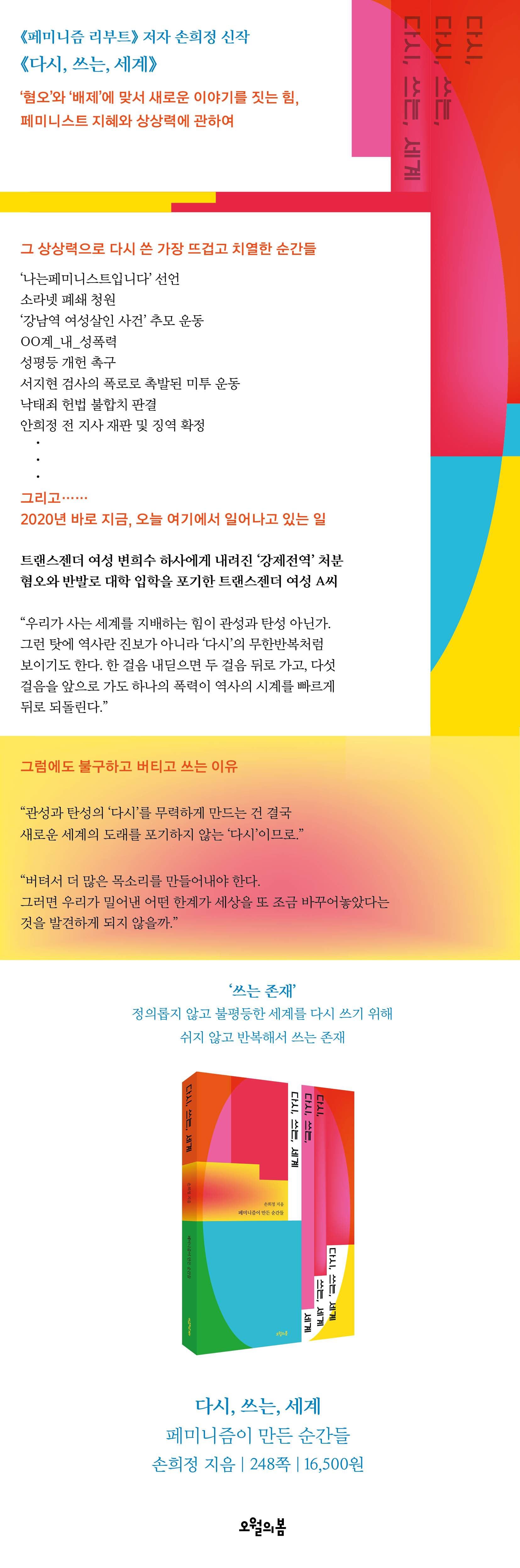
Heejung Son, author of "Feminism Reboot," has returned with her second solo work, "Rewriting the World."
Announcing the era of 'feminism reboot,' he has focused on the voices of contemporary feminists and has communicated with readers through various platforms such as writing, broadcasting, radio, YouTube, and podcasts, and has been active in publishing several books and translations until recently.
In this book, based on columns and articles published over a three-year period from 2016 to 2019, he reflects anew on what the 'act of writing' means to him.
He wants to be remembered as “a being who tirelessly writes over and over again to rewrite an unjust and unequal world,” and proposes rewriting the story of this world filled with hatred and exclusion with feminist wisdom and imagination.
This 'rewriting' is about bringing in the perspectives of various minorities who are marginalized in our society, and only then can feminism expand beyond the position of 'biological women.' This book, 'Rewriting the World,' is a pledge to create a new story by recording the footsteps of the feminist movement over the past three years.
Rewrite
On Feminist Imagination
Heejung Son, author of "Feminism Reboot," has returned with her second solo work, "Rewriting the World."
Announcing the era of 'feminism reboot,' he has focused on the voices of contemporary feminists and has communicated with readers through various platforms such as writing, broadcasting, radio, YouTube, and podcasts, and has been active in publishing several books and translations until recently.
In this book, based on columns and articles published over a three-year period from 2016 to 2019, he reflects anew on what the 'act of writing' means to him.
He wants to be remembered as “a being who tirelessly writes over and over again to rewrite an unjust and unequal world,” and proposes rewriting the story of this world filled with hatred and exclusion with feminist wisdom and imagination.
This 'rewriting' is about bringing in the perspectives of various minorities who are marginalized in our society, and only then can feminism expand beyond the position of 'biological women.' This book, 'Rewriting the World,' is a pledge to create a new story by recording the footsteps of the feminist movement over the past three years.
- You can preview some of the book's contents.
Preview
index
5 · The entity that writes the introduction
1. Men who don't grow up and men's solidarity
19 · Monsters thrive on silence.
23 · 'Father Hwang Jung-min' and the 'Ajusshi Politics' of the Present
27 · From the perspective of gender and disability
31 · Entertainment programs that promote misogyny
35 · Backlash and the misogynistic market
39 · "This is a Korean man."
43 · The "old men" who don't grow up and Hannam Entertainment
46 · 'Bad Guy': Whose Fantasy Is It?
50 · On whose side is time?
53 · To Representative Hong Jun-pyo
57 · 'Post-patriarchy' never came.
61 · A man with his head down, a successful woman?
65 · "Joker": The Birth of an Incel
69 · Come closer, men.
2 In front of harmful words
75 · Is 'dog poison' a hate speech?
One Way to Mark the 30th Anniversary of the 1979-87 Democracy Movement
83 · What is the name of 'Gillaim'?
87 · School of Shame
91 · A feminist president who supported discrimination
95 · Same crime, same investigation, same punishment
99 · How to Respond to Anti-Intellectual Distortions of Meaning
103 · When Feminism and Populism Intersect
107 · Some politicians are more harmful
111 · Is the Republic of Korea a theocracy?
115 · What the 'invisible' shows
119 · The story that 'what you see' will tell you
123 · Let's ask questions with Sergeant A.
3 The World Opened by Fighting
129 · Feminism becomes 'power'
133 · I won't stay still any longer.
138 · Learn from the 'Madam' and the 'Civilized Man'
143 · The World We Met Again
147 · Hesitation is necessary even in a fight.
151 · Menstruation, and a very ordinary right
155 · Everyone, "Now it's dance time."
159 · Condoms are sexy
163 · Questioning the Film Festival's Male Cartel
167 · Small but dramatic, “3 o’clock STOP!”
171 · The Courage to Reclaim Your Face
175 · A Single Person's Trip to Singapore and the Gender Equality Constitutional Amendment
179 · Another Revolution: The Youth Suffrage Movement
183 · Don't be afraid, they're just changing the world.
187 · Adultery by Power: Let's Go Beyond the Narrowest Theory
191 · Riding Nike Feminism
4 Could life have continued on its own?
197 · People who cannot evacuate
201 · The Unmoving Mind, The Blue Butterfly Effect
205 · Be as obscene as you want
209 · The Princess Returns
213 · Why We Persist
217 · An Ensemble of Greatness and Exclusivity, "I Can Speak"
220 · The most poetic thing
224 · When rice blesses us
228 · Feminism that makes a difference
232 · A pig in your arms
236 · Dreaming of a post-revolutionary transition
240 · Woman on Top
244 · Films that Imagine Growing Up in an Age Without Adults
1. Men who don't grow up and men's solidarity
19 · Monsters thrive on silence.
23 · 'Father Hwang Jung-min' and the 'Ajusshi Politics' of the Present
27 · From the perspective of gender and disability
31 · Entertainment programs that promote misogyny
35 · Backlash and the misogynistic market
39 · "This is a Korean man."
43 · The "old men" who don't grow up and Hannam Entertainment
46 · 'Bad Guy': Whose Fantasy Is It?
50 · On whose side is time?
53 · To Representative Hong Jun-pyo
57 · 'Post-patriarchy' never came.
61 · A man with his head down, a successful woman?
65 · "Joker": The Birth of an Incel
69 · Come closer, men.
2 In front of harmful words
75 · Is 'dog poison' a hate speech?
One Way to Mark the 30th Anniversary of the 1979-87 Democracy Movement
83 · What is the name of 'Gillaim'?
87 · School of Shame
91 · A feminist president who supported discrimination
95 · Same crime, same investigation, same punishment
99 · How to Respond to Anti-Intellectual Distortions of Meaning
103 · When Feminism and Populism Intersect
107 · Some politicians are more harmful
111 · Is the Republic of Korea a theocracy?
115 · What the 'invisible' shows
119 · The story that 'what you see' will tell you
123 · Let's ask questions with Sergeant A.
3 The World Opened by Fighting
129 · Feminism becomes 'power'
133 · I won't stay still any longer.
138 · Learn from the 'Madam' and the 'Civilized Man'
143 · The World We Met Again
147 · Hesitation is necessary even in a fight.
151 · Menstruation, and a very ordinary right
155 · Everyone, "Now it's dance time."
159 · Condoms are sexy
163 · Questioning the Film Festival's Male Cartel
167 · Small but dramatic, “3 o’clock STOP!”
171 · The Courage to Reclaim Your Face
175 · A Single Person's Trip to Singapore and the Gender Equality Constitutional Amendment
179 · Another Revolution: The Youth Suffrage Movement
183 · Don't be afraid, they're just changing the world.
187 · Adultery by Power: Let's Go Beyond the Narrowest Theory
191 · Riding Nike Feminism
4 Could life have continued on its own?
197 · People who cannot evacuate
201 · The Unmoving Mind, The Blue Butterfly Effect
205 · Be as obscene as you want
209 · The Princess Returns
213 · Why We Persist
217 · An Ensemble of Greatness and Exclusivity, "I Can Speak"
220 · The most poetic thing
224 · When rice blesses us
228 · Feminism that makes a difference
232 · A pig in your arms
236 · Dreaming of a post-revolutionary transition
240 · Woman on Top
244 · Films that Imagine Growing Up in an Age Without Adults
Detailed image
Into the book
Sergeant Byun Hee-soo was eventually forcibly discharged from the Republic of Korea Army, and a transgender woman who had enrolled at Sookmyung Women's University gave up on enrolling due to transphobia in Korean society.
What pained me most was that the loudest voices in this situation were women who claimed to be feminists.
Feminism has been thinking about who is marginalized and becomes a minority in a society and has expanded along with that minority.
In front of those who edit such feminism to suit their own tastes and practice discrimination in its name, I cannot help but ponder the meaning of 'again' as regression.
--- p.8~9
Monsters thrive on silence.
So now it's the men's turn.
Rather than stepping back and saying, “Soranet is a problem for only a few people, and saying it is a problem for all men is just a generalization error,” we must change the daily routine of “silence and tacit consent” that fosters monsters.
And let us end this tiresome history of violence together.
--- p.22
It's not a problem that popular culture comforts tired men.
However, there is no need to provide that comfort through discrimination and exclusion of others.
What is created in this way is nothing more than a ‘market where misogyny is sold.’
--- p.33
With women yearning for change and beginning their fight, who will share the passage of time? The popularity of time-slip stories, where only men travel through time, may be a sign of men's regression, unable to shape history, rather than of their role as the main actors of history.
It is time to end the narrative of those who seek to reign without growing.
--- p.52
What you must fight against is the privileged men who accumulate their own interests by instilling the fantasy of a 'bean curd' that will never fall, and the patriarchal structure that empowers these men.
Male feminists can.
No, that's an identity essential to survival in this broken world.
--- p.71~72
The birth of a transgender female soldier will be a significant opportunity to dismantle the myths of masculinity and femininity that were formed through the creation of the modern nation-state.
Sergeant A's fight was made possible by the development of the transgender human rights movement.
In this way, ‘gender equality’ comes together with ‘various gender equality.’
--- p.125
It is therefore quite meaningful that Ewha Womans University students sang Girls' Generation's "Into the New World" as a "singing song" during their standoff with the police.
They are literally meeting the world again.
The world we meet again like that cannot be the same as before.
--- p.146
“rooting and shifting”.
This becomes possible when we listen to ‘you’s’ story based on ‘my’ problem.
It is also a courageous undertaking, both in that it requires me to reveal myself fully and in that I must confront the other who has revealed himself.
--- p.173
When the revolution of youth suffrage bears fruit, we will once again encounter a world where democracy has struggled to push its own boundaries and grown a little bigger.
I believe that such an expanded democracy will open up a wider world not only for the parties involved but also for young people.
--- p.181~182
Still, we each live our own 'conditions of slavery' in our own context.
But even when our struggles seem insignificant, we are not standing still.
We must persevere together, listening to each other.
We must persevere and create more voices.
Then, wouldn't we discover that some of the limitations we pushed aside changed the world a little bit?
What pained me most was that the loudest voices in this situation were women who claimed to be feminists.
Feminism has been thinking about who is marginalized and becomes a minority in a society and has expanded along with that minority.
In front of those who edit such feminism to suit their own tastes and practice discrimination in its name, I cannot help but ponder the meaning of 'again' as regression.
--- p.8~9
Monsters thrive on silence.
So now it's the men's turn.
Rather than stepping back and saying, “Soranet is a problem for only a few people, and saying it is a problem for all men is just a generalization error,” we must change the daily routine of “silence and tacit consent” that fosters monsters.
And let us end this tiresome history of violence together.
--- p.22
It's not a problem that popular culture comforts tired men.
However, there is no need to provide that comfort through discrimination and exclusion of others.
What is created in this way is nothing more than a ‘market where misogyny is sold.’
--- p.33
With women yearning for change and beginning their fight, who will share the passage of time? The popularity of time-slip stories, where only men travel through time, may be a sign of men's regression, unable to shape history, rather than of their role as the main actors of history.
It is time to end the narrative of those who seek to reign without growing.
--- p.52
What you must fight against is the privileged men who accumulate their own interests by instilling the fantasy of a 'bean curd' that will never fall, and the patriarchal structure that empowers these men.
Male feminists can.
No, that's an identity essential to survival in this broken world.
--- p.71~72
The birth of a transgender female soldier will be a significant opportunity to dismantle the myths of masculinity and femininity that were formed through the creation of the modern nation-state.
Sergeant A's fight was made possible by the development of the transgender human rights movement.
In this way, ‘gender equality’ comes together with ‘various gender equality.’
--- p.125
It is therefore quite meaningful that Ewha Womans University students sang Girls' Generation's "Into the New World" as a "singing song" during their standoff with the police.
They are literally meeting the world again.
The world we meet again like that cannot be the same as before.
--- p.146
“rooting and shifting”.
This becomes possible when we listen to ‘you’s’ story based on ‘my’ problem.
It is also a courageous undertaking, both in that it requires me to reveal myself fully and in that I must confront the other who has revealed himself.
--- p.173
When the revolution of youth suffrage bears fruit, we will once again encounter a world where democracy has struggled to push its own boundaries and grown a little bigger.
I believe that such an expanded democracy will open up a wider world not only for the parties involved but also for young people.
--- p.181~182
Still, we each live our own 'conditions of slavery' in our own context.
But even when our struggles seem insignificant, we are not standing still.
We must persevere together, listening to each other.
We must persevere and create more voices.
Then, wouldn't we discover that some of the limitations we pushed aside changed the world a little bit?
--- p.215~216
Publisher's Review
Men, what the hell is going on in their world?
The fact that men remain stagnant without growing up is a major theme of this book.
Maybe it all starts here.
Why haven't men grown up over the years? This question not only refers to the reality of men, who don't change or develop, but also to the reality of popular culture, which always portrays men as "young sons."
So, 'father' is imagined as the face of an 'elderly man' in his 70s or 80s (movies [Roaring Currents], [Ode to My Father]), and men in their 40s or 50s are 'students sitting in a classroom wearing school uniforms' (JTBC [Knowing Bros]) or 'young sons' who still need to be cared for even by their elderly mothers (SBS [My Little Old Boy]).
This proves that Korean society is still obsessed with a male-centered view of history.
“The 386 generation men who currently dominate South Korean politics still haven’t been able to symbolically kill their fathers, and so they live in the mental world of a ‘young son’ trapped in an adult’s body.” We are living in an era where the zeitgeist is ‘the uncle who never grows up.’
The actions of some writers who created a webzine with the domain “5959uzuzu.com” (Ogu Ogu Ujjujju) to support Moon Jae-in ahead of the 19th presidential election clearly showed how terrible the spirit of the times was.
Their strong solidarity 'shone through' in protecting former administrator Tak Hyun-min.
But what's more harmful than these 'immature men' is the fact that they are in solidarity with each other.
And this solidarity operates through the imagination of banishing ‘non-men’, including women, to the outside of history.
In that respect, the incident of Soranet, the largest pornography sharing site in Korea, is remembered as an incident that made us question how far that solidarity can go and how much more harm it can cause.
How is it possible that several "rape simulations" are posted daily, let alone "obscene posts"? It's because, on Soranet, crimes against women are glorified.
That is why popular posts that create a buzz are called ‘works of art.’
This very ‘high spirit’ is the essence of Soranet.
In a male-dominated society, women have always been treated as 'gifts' to be exchanged between men.
In that sense, Soranet is closer to the internet version of a male-dominated society that believes that women can be mobilized as a means to achieve solidarity at any time.
How could a place like Soranet exist without that kind of mindset being shared socially?
In an age of hate, 'harmful words' that harm existence.
A distorted solidarity that can only be established by excluding and objectifying someone operates everywhere in the world around us.
It is not only women who are subject to exclusion and hatred; many minorities who are not included in mainstream society, such as sexual minorities, the disabled, and contract workers, are threatened by their very existence.
The author diagnoses that this hatred has now formed a 'market'.
The 2008 financial crisis that originated in the United States led to the Great Recession, which led to a rapid spread of right-wing sentiment around the world, and as a result, a full-blown "hate market" opened up in Korea as well.
“The fact that hate sells also means that hate becomes the nutrient of politics.
The more harsh and poisonous it is, the more attention it attracts, which translates into money and rewards.
And this leads to politics that literally kills lives.”
Above all, ‘homophobia’ is happening vividly before our eyes even at this very moment.
Recently, Sergeant Byun Hee-soo (initially known as Sergeant A) was forcibly discharged by the military authorities for being a transgender woman, and Ms. A, a transgender woman who was accepted to Sookmyung Women's University, also had her admission revoked after fierce controversy arose surrounding her admission.
In the process, criticism is being raised that the university justified discrimination against transgender people by not taking any action and just standing by.
Discrimination and attacks against sexual minorities have been deeply rooted in Korean society.
In particular, conservative Christian forces always engage in hate speech, attacks, and discriminatory acts that go beyond imagination.
They also have great political influence, even eliciting the bizarre statement from President Moon Jae-in, who has declared himself a “feminist president,” that he “does not support homosexuality.”
A "feminist presidential declaration" from a politician who said he "does not support homosexuality." "How can we understand this gap?" Feminism from someone who sold out the rights of minorities to become president.
“Can we trust it?”.
Thanks to a president who was overly conscious of the political influence of conservative Christianity, the enactment of the anti-discrimination law was ultimately abandoned.
Even in 2017, this country gave up on guaranteeing equal rights for everyone to live without discrimination, out of concern for conservative Christianity.
Is the Republic of Korea a theocracy? The anti-discrimination law has been "only being discussed" for ten years.
The 'Fight' took us to another world.
The world is still not an easy place, but the progress feminists have made over the past few years has been remarkable.
They have been fighting against the hatred and exclusion that dominates every aspect of our lives.
The '#IamFeminist' declaration (2015) that started in protest against the absurd and irresponsible remarks made by male feminist critic K in 2015, the movement to shut down the Soranet server (2015), the movement to commemorate the murder of a woman in Gangnam Station (2016), the 'sexual violence_in_○○_world' movement that was sparked by voices denouncing sexual violence in the webtoon and literary worlds and spread to the film, art, and education industries, the MeToo movement that started with prosecutor Seo Ji-hyeon's revelations (2018), the black protests against the abortion law (2016) and the ruling that the 'abortion law' was unconstitutional (2019), the trial (2018-2019) and prison sentence confirmed for former South Chungcheong Province Governor Ahn Hee-jung (2019), etc.
There were feminists in all these moments.
And their fight is opening up a new world.
But the fight was never easy.
The fight was sometimes protracted and there were many times when there was no way forward.
The backlash against feminism also proceeded with considerable intensity.
Some others sent cynicism and ridicule, questioning the intention and sincerity of the fight with cold eyes.
For example, when the slogan “Feminism is money” emerged among women and this led to active consumer movements (a prime example being group viewings of the film [Suffragette] about the women’s suffrage movement), some raised concerns and criticized that feminism was pandering to capitalism.
However, the author emphasizes that it is necessary to recognize that this slogan did not originate from market logic, and therefore, ‘money’ here cannot be simply equated with ‘capital.’
“This movement is based on the recognition that the male-centered field of representation needs to be reorganized.
(…) Misogyny in popular culture has encouraged physical violence against women and justified institutional discrimination.
And until now, female consumers have been willing to open their wallets even for such misogynistic texts.
“Feminism makes money” is also a declaration that we will no longer be an accomplice to patriarchal capitalism.”
In this society, things that become 'commodities' are always things that are accepted as common sense and desirable.
In that sense, that slogan rather becomes a radical question asking what has exchange value in this society.
The real problem may not be this slogan, but the common formula that “men’s money is understood as ‘solidarity’” and “women’s money is reduced to ‘consumption.’”
Why are women's practices of helping and supporting each other so belittled?
Feminism: On the "Heart That Doesn't Stay"
Of course, the feminist movement also has its dilemmas.
The challenge is how to break free from the homogenized category of 'biological woman.'
“It was certainly a noticeable change and a revolution that women who had lived without any awareness of their gender began to realize their own identity and fight against the oppression and absurdity imposed on them,” but at the same time, that awareness also had a reactionary aspect in that it “instilled fear in women again, fixating them within the uniform category of ‘biological women.’”
This is the double meaning of the commemorative space and time called ‘Gangnam Station Exit 10.’
The author argues that a 'dual strategy' is necessary to overcome this dilemma.
Rather than remaining confined to the firm identity (biological female) that has made feminism a "strong movement," it involves connecting with diverse identities, such as disabled people, queers, and immigrants, and transcending those boundaries.
To drive a movement centered on the identity that conditions my reality, but not to remain in that place.
We can call this 'moving by putting down roots'.
“This becomes possible when we listen to ‘you’s’ story based on ‘my’ problem.
It is also a courageous undertaking, both in that it requires me to reveal myself fully and in that I must confront the other who has revealed himself.
This is ‘radical’ in the sense that it ‘radically’ breaks away from the position that society has allowed.”
For example, what about the faces of the women captured in the documentary [Blue Butterfly Effect]?
This film captures the faces of the 'mothers' who were at the center of the struggle against the deployment of THAAD in Seongju, Gyeongbuk.
However, it is important to remember that the attempt to capture the face of the 'mother' here is not intended to impose maternalism on women again.
“It is not simply because of ‘instinctive maternal instinct’ that women, the subjects of physical and emotional labor that sustain life, rise up in the name of ‘mother.’
It is a very real and concrete problem of survival that arises from the conditions of life that are already given.”
And these people do not stay within the 'conditions of life' given to them, but broaden their minds.
“Women in the position of mothers are those who have acquired the heart to care for the weak and strengthen the movement within the roles and positions assigned to them by society.
That is why the movement that started with the thought, 'You're touching my child?!' does not stop there.
In Yongsan, in Miryang, and in the Sewol ferry.
Women began to exercise out of their own pain and continued to expand their minds.
“It means that you gain strength from your ‘mother’ identity, but you don’t stay in that identity alone.”
Nevertheless, hold on and write
Despite all these efforts, the world still seems to be standing still.
No, it seems like we're actually regressing further.
Recently, we heard that transgender woman Sergeant Byun Hee-soo was unfairly discharged, and that Mr. A withdrew his university admission amidst hate speech.
Above all, the fact that the loudest voices in this situation were none other than women who call themselves feminists plunged us into deep despair.
“Feminism has been thinking about who is marginalized and becomes a minority in a society and has expanded along with that minority.
“I cannot help but ponder the ‘again’ as a regression in the face of those who edit such feminism to suit their own tastes and use that name as an excuse to practice discrimination.”
But even so, the author perseveres until the end and does not forget the importance of writing again.
“What ultimately renders powerless the ‘again’ of inertia and elasticity is the ‘again’ that does not give up on the arrival of a new world.”
‘Rewriting’ ultimately means rewriting the ‘story.’
A new story that introduces the perspectives of those outside the center, rather than the 'narrative of exclusion and hatred' that always explains social anxiety as the anxiety of the mainstream/male and points to minorities/women as the cause.
What is needed at this time is feminist wisdom and imagination.
Only in that imagination will we see how tilted this world is.
Now the key is in our hands.
What kind of feminist imagination will you use to tell your story?
The fact that men remain stagnant without growing up is a major theme of this book.
Maybe it all starts here.
Why haven't men grown up over the years? This question not only refers to the reality of men, who don't change or develop, but also to the reality of popular culture, which always portrays men as "young sons."
So, 'father' is imagined as the face of an 'elderly man' in his 70s or 80s (movies [Roaring Currents], [Ode to My Father]), and men in their 40s or 50s are 'students sitting in a classroom wearing school uniforms' (JTBC [Knowing Bros]) or 'young sons' who still need to be cared for even by their elderly mothers (SBS [My Little Old Boy]).
This proves that Korean society is still obsessed with a male-centered view of history.
“The 386 generation men who currently dominate South Korean politics still haven’t been able to symbolically kill their fathers, and so they live in the mental world of a ‘young son’ trapped in an adult’s body.” We are living in an era where the zeitgeist is ‘the uncle who never grows up.’
The actions of some writers who created a webzine with the domain “5959uzuzu.com” (Ogu Ogu Ujjujju) to support Moon Jae-in ahead of the 19th presidential election clearly showed how terrible the spirit of the times was.
Their strong solidarity 'shone through' in protecting former administrator Tak Hyun-min.
But what's more harmful than these 'immature men' is the fact that they are in solidarity with each other.
And this solidarity operates through the imagination of banishing ‘non-men’, including women, to the outside of history.
In that respect, the incident of Soranet, the largest pornography sharing site in Korea, is remembered as an incident that made us question how far that solidarity can go and how much more harm it can cause.
How is it possible that several "rape simulations" are posted daily, let alone "obscene posts"? It's because, on Soranet, crimes against women are glorified.
That is why popular posts that create a buzz are called ‘works of art.’
This very ‘high spirit’ is the essence of Soranet.
In a male-dominated society, women have always been treated as 'gifts' to be exchanged between men.
In that sense, Soranet is closer to the internet version of a male-dominated society that believes that women can be mobilized as a means to achieve solidarity at any time.
How could a place like Soranet exist without that kind of mindset being shared socially?
In an age of hate, 'harmful words' that harm existence.
A distorted solidarity that can only be established by excluding and objectifying someone operates everywhere in the world around us.
It is not only women who are subject to exclusion and hatred; many minorities who are not included in mainstream society, such as sexual minorities, the disabled, and contract workers, are threatened by their very existence.
The author diagnoses that this hatred has now formed a 'market'.
The 2008 financial crisis that originated in the United States led to the Great Recession, which led to a rapid spread of right-wing sentiment around the world, and as a result, a full-blown "hate market" opened up in Korea as well.
“The fact that hate sells also means that hate becomes the nutrient of politics.
The more harsh and poisonous it is, the more attention it attracts, which translates into money and rewards.
And this leads to politics that literally kills lives.”
Above all, ‘homophobia’ is happening vividly before our eyes even at this very moment.
Recently, Sergeant Byun Hee-soo (initially known as Sergeant A) was forcibly discharged by the military authorities for being a transgender woman, and Ms. A, a transgender woman who was accepted to Sookmyung Women's University, also had her admission revoked after fierce controversy arose surrounding her admission.
In the process, criticism is being raised that the university justified discrimination against transgender people by not taking any action and just standing by.
Discrimination and attacks against sexual minorities have been deeply rooted in Korean society.
In particular, conservative Christian forces always engage in hate speech, attacks, and discriminatory acts that go beyond imagination.
They also have great political influence, even eliciting the bizarre statement from President Moon Jae-in, who has declared himself a “feminist president,” that he “does not support homosexuality.”
A "feminist presidential declaration" from a politician who said he "does not support homosexuality." "How can we understand this gap?" Feminism from someone who sold out the rights of minorities to become president.
“Can we trust it?”.
Thanks to a president who was overly conscious of the political influence of conservative Christianity, the enactment of the anti-discrimination law was ultimately abandoned.
Even in 2017, this country gave up on guaranteeing equal rights for everyone to live without discrimination, out of concern for conservative Christianity.
Is the Republic of Korea a theocracy? The anti-discrimination law has been "only being discussed" for ten years.
The 'Fight' took us to another world.
The world is still not an easy place, but the progress feminists have made over the past few years has been remarkable.
They have been fighting against the hatred and exclusion that dominates every aspect of our lives.
The '#IamFeminist' declaration (2015) that started in protest against the absurd and irresponsible remarks made by male feminist critic K in 2015, the movement to shut down the Soranet server (2015), the movement to commemorate the murder of a woman in Gangnam Station (2016), the 'sexual violence_in_○○_world' movement that was sparked by voices denouncing sexual violence in the webtoon and literary worlds and spread to the film, art, and education industries, the MeToo movement that started with prosecutor Seo Ji-hyeon's revelations (2018), the black protests against the abortion law (2016) and the ruling that the 'abortion law' was unconstitutional (2019), the trial (2018-2019) and prison sentence confirmed for former South Chungcheong Province Governor Ahn Hee-jung (2019), etc.
There were feminists in all these moments.
And their fight is opening up a new world.
But the fight was never easy.
The fight was sometimes protracted and there were many times when there was no way forward.
The backlash against feminism also proceeded with considerable intensity.
Some others sent cynicism and ridicule, questioning the intention and sincerity of the fight with cold eyes.
For example, when the slogan “Feminism is money” emerged among women and this led to active consumer movements (a prime example being group viewings of the film [Suffragette] about the women’s suffrage movement), some raised concerns and criticized that feminism was pandering to capitalism.
However, the author emphasizes that it is necessary to recognize that this slogan did not originate from market logic, and therefore, ‘money’ here cannot be simply equated with ‘capital.’
“This movement is based on the recognition that the male-centered field of representation needs to be reorganized.
(…) Misogyny in popular culture has encouraged physical violence against women and justified institutional discrimination.
And until now, female consumers have been willing to open their wallets even for such misogynistic texts.
“Feminism makes money” is also a declaration that we will no longer be an accomplice to patriarchal capitalism.”
In this society, things that become 'commodities' are always things that are accepted as common sense and desirable.
In that sense, that slogan rather becomes a radical question asking what has exchange value in this society.
The real problem may not be this slogan, but the common formula that “men’s money is understood as ‘solidarity’” and “women’s money is reduced to ‘consumption.’”
Why are women's practices of helping and supporting each other so belittled?
Feminism: On the "Heart That Doesn't Stay"
Of course, the feminist movement also has its dilemmas.
The challenge is how to break free from the homogenized category of 'biological woman.'
“It was certainly a noticeable change and a revolution that women who had lived without any awareness of their gender began to realize their own identity and fight against the oppression and absurdity imposed on them,” but at the same time, that awareness also had a reactionary aspect in that it “instilled fear in women again, fixating them within the uniform category of ‘biological women.’”
This is the double meaning of the commemorative space and time called ‘Gangnam Station Exit 10.’
The author argues that a 'dual strategy' is necessary to overcome this dilemma.
Rather than remaining confined to the firm identity (biological female) that has made feminism a "strong movement," it involves connecting with diverse identities, such as disabled people, queers, and immigrants, and transcending those boundaries.
To drive a movement centered on the identity that conditions my reality, but not to remain in that place.
We can call this 'moving by putting down roots'.
“This becomes possible when we listen to ‘you’s’ story based on ‘my’ problem.
It is also a courageous undertaking, both in that it requires me to reveal myself fully and in that I must confront the other who has revealed himself.
This is ‘radical’ in the sense that it ‘radically’ breaks away from the position that society has allowed.”
For example, what about the faces of the women captured in the documentary [Blue Butterfly Effect]?
This film captures the faces of the 'mothers' who were at the center of the struggle against the deployment of THAAD in Seongju, Gyeongbuk.
However, it is important to remember that the attempt to capture the face of the 'mother' here is not intended to impose maternalism on women again.
“It is not simply because of ‘instinctive maternal instinct’ that women, the subjects of physical and emotional labor that sustain life, rise up in the name of ‘mother.’
It is a very real and concrete problem of survival that arises from the conditions of life that are already given.”
And these people do not stay within the 'conditions of life' given to them, but broaden their minds.
“Women in the position of mothers are those who have acquired the heart to care for the weak and strengthen the movement within the roles and positions assigned to them by society.
That is why the movement that started with the thought, 'You're touching my child?!' does not stop there.
In Yongsan, in Miryang, and in the Sewol ferry.
Women began to exercise out of their own pain and continued to expand their minds.
“It means that you gain strength from your ‘mother’ identity, but you don’t stay in that identity alone.”
Nevertheless, hold on and write
Despite all these efforts, the world still seems to be standing still.
No, it seems like we're actually regressing further.
Recently, we heard that transgender woman Sergeant Byun Hee-soo was unfairly discharged, and that Mr. A withdrew his university admission amidst hate speech.
Above all, the fact that the loudest voices in this situation were none other than women who call themselves feminists plunged us into deep despair.
“Feminism has been thinking about who is marginalized and becomes a minority in a society and has expanded along with that minority.
“I cannot help but ponder the ‘again’ as a regression in the face of those who edit such feminism to suit their own tastes and use that name as an excuse to practice discrimination.”
But even so, the author perseveres until the end and does not forget the importance of writing again.
“What ultimately renders powerless the ‘again’ of inertia and elasticity is the ‘again’ that does not give up on the arrival of a new world.”
‘Rewriting’ ultimately means rewriting the ‘story.’
A new story that introduces the perspectives of those outside the center, rather than the 'narrative of exclusion and hatred' that always explains social anxiety as the anxiety of the mainstream/male and points to minorities/women as the cause.
What is needed at this time is feminist wisdom and imagination.
Only in that imagination will we see how tilted this world is.
Now the key is in our hands.
What kind of feminist imagination will you use to tell your story?
GOODS SPECIFICS
- Publication date: February 24, 2020
- Page count, weight, size: 248 pages | 370g | 135*210*20mm
- ISBN13: 9791190422253
- ISBN10: 1190422255
You may also like
카테고리
korean


korean

![GQ KOREA Mark (Monthly): December [2025]](http://librairie.coreenne.fr/cdn/shop/files/8ef265dbbfbf186523ed75ba7319009d.jpg?v=1765340328&width=3840)


