

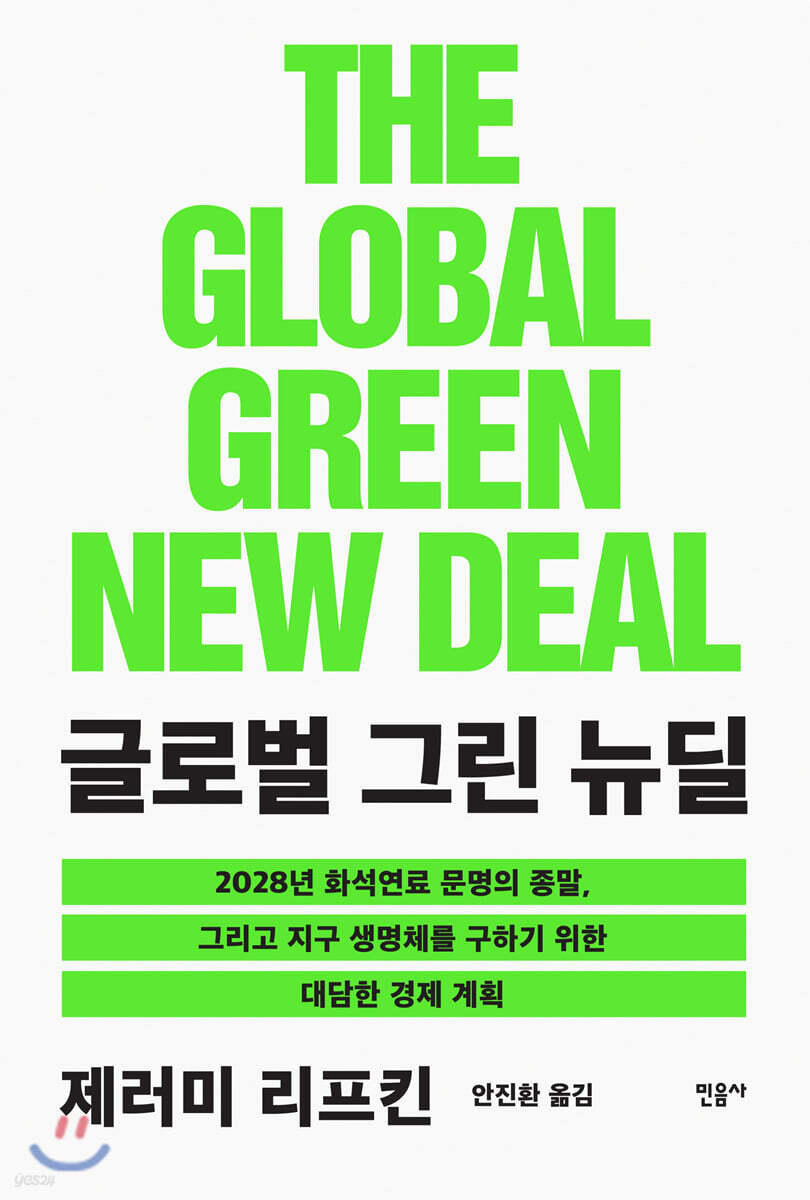
Global Green New Deal
 |
Description
Book Introduction
- A word from MD
-
There is not much time left for humanity.The Earth is in trouble with air pollution, abnormal temperatures, and large-scale wildfires.
Due to global warming, disasters have become more frequent around the world.
Futurist Jeremy Rifkin argues that humanity does not have much time left and must quickly transition from fossil fuels to renewable energy.
A book that encapsulates the present and future of humanity.
February 4, 2020. Social and Political PD Son Min-gyu
Jeremy Rifkin, a world-renowned futurist, released his new book, "The Global Green New Deal," in 2020.
A new work after six years since "Zero Marginal Cost Society" in 2014.
Jeremy Rifkin, the most pioneering futurist of our time, has published 『Global Green New Deal』, a book that addresses the paradigm shift in the global economy in relation to climate change, a major global challenge of our time, by Minumsa.
Natural disasters such as hurricanes and floods, as well as large-scale wildfires that have occurred around the world from Australia and California to the Amazon and Siberia, have become increasingly frequent, resulting in loss of life, property, and destruction of ecosystems.
This is due to global warming caused by human activity, including the burning of fossil fuels. According to the IPCC (Intergovernmental Panel on Climate Change, a scientific panel under the United Nations), the Earth's temperature has already risen by 1 degree Celsius since pre-industrial times, and if it rises by another 0.5 degrees, life on Earth will be at risk.
To avoid this, emissions of global warming gases must be reduced by 45 percent from 2010 levels, which means reforming the global economy, society, and way of life in a way unprecedented in human history.
Rifkin, a pioneering thinker who has proposed a new paradigm for future society through works such as “The End of Work,” “The End of Ownership,” “The Third Industrial Revolution,” and “The Zero Marginal Cost Society,” emphasizes that we are now in a situation where we must radically reset the direction of civilization and that time is running out.
This new work aims to share with the world the blueprint for a carbon-zero smart green infrastructure, an energy revolution and a "Green New Deal" plan that will safely overcome the disaster caused by climate change and create a sustainable future for humanity.
A new work after six years since "Zero Marginal Cost Society" in 2014.
Jeremy Rifkin, the most pioneering futurist of our time, has published 『Global Green New Deal』, a book that addresses the paradigm shift in the global economy in relation to climate change, a major global challenge of our time, by Minumsa.
Natural disasters such as hurricanes and floods, as well as large-scale wildfires that have occurred around the world from Australia and California to the Amazon and Siberia, have become increasingly frequent, resulting in loss of life, property, and destruction of ecosystems.
This is due to global warming caused by human activity, including the burning of fossil fuels. According to the IPCC (Intergovernmental Panel on Climate Change, a scientific panel under the United Nations), the Earth's temperature has already risen by 1 degree Celsius since pre-industrial times, and if it rises by another 0.5 degrees, life on Earth will be at risk.
To avoid this, emissions of global warming gases must be reduced by 45 percent from 2010 levels, which means reforming the global economy, society, and way of life in a way unprecedented in human history.
Rifkin, a pioneering thinker who has proposed a new paradigm for future society through works such as “The End of Work,” “The End of Ownership,” “The Third Industrial Revolution,” and “The Zero Marginal Cost Society,” emphasizes that we are now in a situation where we must radically reset the direction of civilization and that time is running out.
This new work aims to share with the world the blueprint for a carbon-zero smart green infrastructure, an energy revolution and a "Green New Deal" plan that will safely overcome the disaster caused by climate change and create a sustainable future for humanity.
- You can preview some of the book's contents.
Preview
index
introduction
Part 1: The Great Crash: The Race to Departure and Stranded Fossil Fuel Assets
Chapter 1: The problem is infrastructure, stupid!
The Third Industrial Revolution Paradigm
Connect the dots
Who owns the infrastructure?
Google's Dominance and Its Alternatives
Chapter 2: Democratizing Power: The Sun and Wind Are Free
How EU Political Activists Launched the Green New Deal
ICT and Communication Internet
Renewable Energy Internet
Chapter 3: Zero-Carbon Living: Autonomous Vehicles, IoT Buildings, and Smart Ecological Farming
Transportation that approaches zero marginal cost
IoT building
Preparing the American Workforce for the Green Era
Smart Ecological Farming
The Age of Restoration
Chapter 4: The Tipping Point: Around 2028, Fossil Fuel Civilization Collapses
20-20-2 of 2020
Destruction: Beyond the Green Line
What if I ignore the warning?
North America's ignorance
The Curse of Black Gold
The financial world is sounding the alarm
Part 2: The Green New Deal Rising from the Ashes
Chapter 5: Waking Up the Giants: Pension Funds Raising Their Voices
Turn Karl Marx's proposition upside down
From Theory to Practice: The Beginning of a Revolution
Chapter 6: Economic Transformation: The New Social Capitalism
Socially responsible investing takes center stage
How much will it cost?
Find the money
Take back our infrastructure
ESCO: A Business Model for the Green New Deal
Chapter 7: Social Mobilization: Save Life on Earth
Official document from Europe
Think like a species
Three elephants in the room
Twenty-Three Key Initiatives of the Green New Deal
Peer Assembly Governance
Acknowledgements
annotation
Search
Part 1: The Great Crash: The Race to Departure and Stranded Fossil Fuel Assets
Chapter 1: The problem is infrastructure, stupid!
The Third Industrial Revolution Paradigm
Connect the dots
Who owns the infrastructure?
Google's Dominance and Its Alternatives
Chapter 2: Democratizing Power: The Sun and Wind Are Free
How EU Political Activists Launched the Green New Deal
ICT and Communication Internet
Renewable Energy Internet
Chapter 3: Zero-Carbon Living: Autonomous Vehicles, IoT Buildings, and Smart Ecological Farming
Transportation that approaches zero marginal cost
IoT building
Preparing the American Workforce for the Green Era
Smart Ecological Farming
The Age of Restoration
Chapter 4: The Tipping Point: Around 2028, Fossil Fuel Civilization Collapses
20-20-2 of 2020
Destruction: Beyond the Green Line
What if I ignore the warning?
North America's ignorance
The Curse of Black Gold
The financial world is sounding the alarm
Part 2: The Green New Deal Rising from the Ashes
Chapter 5: Waking Up the Giants: Pension Funds Raising Their Voices
Turn Karl Marx's proposition upside down
From Theory to Practice: The Beginning of a Revolution
Chapter 6: Economic Transformation: The New Social Capitalism
Socially responsible investing takes center stage
How much will it cost?
Find the money
Take back our infrastructure
ESCO: A Business Model for the Green New Deal
Chapter 7: Social Mobilization: Save Life on Earth
Official document from Europe
Think like a species
Three elephants in the room
Twenty-Three Key Initiatives of the Green New Deal
Peer Assembly Governance
Acknowledgements
annotation
Search
Publisher's Review
Jeremy Rifkin, a world-renowned futurist, released his new book, "The Global Green New Deal," in 2020.
A new work after six years since "Zero Marginal Cost Society" in 2014.
The most important keyword in 2020 is 'climate change', and the global economy must shift its direction to address it.
· The inevitable end of the fossil fuel civilization and the new energy revolution needed by modern humanity.
In other words, a blueprint for the 'Green New Deal' plan for a sustainable future for humanity.
A clear roadmap for the post-carbon transition of the global economy and a ambitious yet feasible scenario for a green economy that represents the most promising opportunity of the future.
· Green New Deal Smart (Third Industrial Revolution) Green Infrastructure.
Plans to transition from fossil fuels to renewable energy and create new business and job opportunities
· A paradigm shift in the global economy to address climate change.
From the Fossil Fuel Industry to a Zero-Carbon Green Economy
“Global warming caused by humans burning fossil fuels is pushing all life on Earth to the brink of extinction!”
A blueprint for an energy revolution and the "Green New Deal" plan to create a sustainable future for humanity in response to climate change.
Jeremy Rifkin, the most pioneering futurist of our time, has published 『Global Green New Deal』, a book that addresses the paradigm shift in the global economy in relation to climate change, a major global challenge of our time, by Minumsa.
Natural disasters such as hurricanes and floods, as well as large-scale wildfires that have occurred around the world from Australia and California to the Amazon and Siberia, have become increasingly frequent, resulting in loss of life, property, and destruction of ecosystems.
This is due to global warming caused by human activity, including the burning of fossil fuels. According to the IPCC (Intergovernmental Panel on Climate Change, a scientific panel under the United Nations), the Earth's temperature has already risen by 1 degree Celsius since pre-industrial times, and if it rises by another 0.5 degrees, life on Earth will be at risk.
To avoid this, emissions of global warming gases must be reduced by 45 percent from 2010 levels, which means reforming the global economy, society, and way of life in a way unprecedented in human history.
Rifkin, a pioneering thinker who has proposed a new paradigm for future society through works such as “The End of Work,” “The End of Ownership,” “The Third Industrial Revolution,” and “The Zero Marginal Cost Society,” emphasizes that we are now in a situation where we must radically reset the direction of civilization and that time is running out.
This new work aims to share with the world the blueprint for a carbon-zero smart green infrastructure, an energy revolution and a "Green New Deal" plan that will safely overcome the disaster caused by climate change and create a sustainable future for humanity.
We are facing a global emergency.
Scientists say that climate change, caused by our burning of fossil fuels, is pushing species on Earth, including humans, to the brink of the sixth mass extinction.
Yet, most people living today are unaware of this imminent reality, and many are not even aware of it.
In October 2018, the Intergovernmental Panel on Climate Change (IPCC), a scientific panel under the United Nations, issued a dire warning that global warming was accelerating and that life on Earth would soon be endangered by a series of climate events. The IPCC estimated that human activities had already caused the Earth's temperature to rise by 1 degree Celsius above pre-industrial levels, and predicted that if the temperature were to exceed the 1.5 degree threshold, an uncontrollable feedback loop would be formed, and the resulting massive climate events would irreversibly damage the Earth's ecosystem.
- From the preface to “Global Green New Deal”
The Green New Deal, an emergency plan to combat climate change
This book explores a new vision for the future of the world, humanity, our fellow creatures, and our shared planet.
The “Green New Deal” is one such initiative that is rapidly gaining momentum around the world.
The name Green New Deal was coined to emphasize environmentally friendly, green growth, similar to Roosevelt's New Deal policy, which was mobilized to overcome the Great Depression of the 1930s.
Faced with the global emergency caused by climate change, young people around the world, including in the United States and Europe, are leading public opinion on the Green New Deal and setting the agenda for a bold political movement that will revolutionize society.
Millennials, who formed the largest voting group, and Generation Z, who followed suit, are now calling for solutions to the climate change issue.
The End of Fossil Fuel Civilization, Stranded Assets, and New Movements in Major Industries in 2028
“The ‘four major sectors’ most responsible for global warming gas emissions will be decoupled from fossil fuel civilization and combined with emerging renewable energy sources under the Green New Deal.”
While the Green New Deal has emerged as a hot topic of debate, the business community is responding with a corresponding movement that could shake the very foundations of the future global economy.
According to the book, major sectors of the economy are rapidly transitioning away from fossil fuels and toward increasingly affordable solar and wind energy, creating new business opportunities and jobs.
Rifkin predicts that trillions of dollars in stranded assets from the fossil fuel industry and related industries will burst the carbon bubble around 2028, leading to the collapse of the fossil fuel civilization.
That means that within eight years, solar and wind power will become significantly cheaper and will go head-to-head with the fossil fuel industry.
“Stranded assets” include all fossil fuels that remain unexploited because demand is declining; abandoned, decommissioned, or abandoned pipelines, offshore platforms, storage facilities, energy production facilities, reserve power plants, petrochemical processing facilities, and all industries closely tied to the fossil fuel culture.
Rifkin predicts that the four key sectors most responsible for global warming—information and communication technology (ICT) and telecoms, power (energy) and electric utilities, transportation and logistics, and buildings (residential, commercial, industrial, and institutional)—will decouple from the fossil fuel industry and adopt cheaper, newer green energy, stranding $100 trillion in assets within the fossil fuel industry.
The four major sectors that formed the infrastructure of the Second Industrial Revolution have already begun to break away from fossil fuel civilization and reconnect with green energy and clean technologies over the past decade.
According to the book, the world's largest internet companies, including Apple, Google, and Facebook, have begun to take the lead in the task of separating fossil fuels from the "Information & Communications Technology (ICT) sector," which consumes the most energy and electricity and emits the most greenhouse gases among industrial sectors, and reinvesting in green energy.
In April 2018, Apple announced that all of its data centers around the world are now powered by renewable energy.
Google achieved 100 percent renewable energy for its data centers in 2017 and currently operates 20 renewable energy projects, investing a total of $3.5 billion in renewable energy infrastructure.
Facebook also announced that same year that all new data centers it builds will be powered by 100 percent renewable energy.
Meanwhile, major cities around the world are incorporating into their urban planning the prospect that the auto industry will rapidly transition from internal combustion engines powered by fossil fuels to electric vehicles powered by green, renewable electricity.
In April 2019, Los Angeles Mayor Eric Garcetti unveiled a city plan to transform the future of transportation into a zero-emissions economy.
Garcetti has pledged to have 25 percent of all vehicles in Los Angeles electric by 2025 and 80 percent by 2035.
Moreover, the three major changes that are revolutionizing the transportation sector – the transition from gasoline-powered vehicles to electric and fuel-cell vehicles powered by green energy, the shift to car-sharing services, and the introduction of autonomous vehicles – are each revolutionary in their own right and are enough to disrupt the existing transportation sector.
They are combining forces to cause a complete upheaval in mobility and logistics across the globe, leaving stranded assets behind.
The emergence of a carbon bubble and the prospect of stranded fossil fuel assets, coinciding with the global Green New Deal movement, open the possibility of a near-zero carbon infrastructure transition over the next two decades.
Drawing on his experience implementing Green New Deal-style transitions in the European Union and China over the past 25 years, Rifkin presents a groundbreaking vision and action plan to reform the global economy and save life on Earth.
The fossil fuel sector, once seemingly invincible, is now rapidly collapsing before our eyes.
It's happening at a pace and scale that would have been unimaginable just two or three years ago.
We must remain vigilant in our confrontation with the oil industry, and we must also accelerate the task of building a green culture from the ashes of our past.
We must fund the transition to a zero-carbon economy and urge government action in every region and community to move us all into the ecological era together.
What the United States and the world need to achieve this is a “Green New Deal.”
- In the book
It all depends on building infrastructure.
Building a 'Green New Deal Smart (Third Industrial Revolution) Infrastructure'
According to Rifkin, the great economic transformations in history occur when three elements meet: a communication medium, energy (a power source), and a transportation mechanism.
The first industrial revolution occurred in the 19th century when steam-powered printing, the telegraph, coal, and the railway network intertwined to form a universal technology platform for managing society and providing power and mobility.
In the 20th century, the interplay of centralized power, telephone, radio, television, oil, and internal combustion engine vehicles running on national road networks created the foundation for the Second Industrial Revolution.
The first and second industrial revolutions, which were based on fossil fuels, have reached the end of their lifespan, and the third industrial revolution is currently underway in our society.
A digitalized communications Internet, a digitalized renewable energy Internet powered by solar and wind power, and a digitalized transportation and logistics Internet comprised of electric, fuel cell, and autonomous vehicles powered by green energy are interacting and converging.
It is based on the Internet of Things (IoT) platform and is heralding a transformation in modern society and economy.
The infrastructure of the First and Second Industrial Revolutions was designed to be centralized, top-down, and monopolistic, and required vertical integration to create economies of scale and deliver returns to investors.
As a result, today, as the Second Industrial Revolution draws to a close, most of the Fortune Global 500 companies are headquartered in the United States, generating $30 trillion in revenue, equivalent to 37 percent of global GDP, while employing only about 67.7 million people out of a global workforce of 3.5 billion.
The Green New Deal Smart Third Industrial Revolution infrastructure involves design and construction technologies that are quite different from those of the past.
The infrastructure is designed to be decentralized, open, and transparent, focusing on decentralized operations rather than centralized ones, and to achieve network effects rather than being locked down by intellectual property rights.
Finally, decentralized, open, and transparent systems are most efficient and productive when their operations scale horizontally rather than vertically.
In a world where anyone with a smartphone and an internet connection can instantly access millions of businesses, websites, and big data around the world, billions of people around the world can engage directly, both online and offline, with very low fixed costs or near-zero marginal costs in their respective localities.
The key point is that the infrastructure revolution is always a public-private partnership, requiring a sound social market economy that brings together government, industry, and civil society at all levels, with the right mix of public, private, and social capital.
The most profound level of infrastructure, Rifkin argues, is the nexus of technology and society, combining new communication technologies, new energy sources, new modes of transportation and logistics, and newly created environments to enable communities to more efficiently manage their economic activity, social life, and governance, and to empower and motivate them.
The global expansion of the Green New Deal, a new economic development model that will sustain the Earth's ecosystem.
The emergence of the US following the EU and China
Until recently, it was the European Union, with its 508 million people, that led the transition to a zero-carbon green economy.
A similar movement with the same name, the Green New Deal (inspired by Roosevelt's New Deal, the largest public works project in U.S. history, and named for the movement to transition the European economy to a green era) has already been a movement in the EU to address climate change issues for the past decade, becoming a powerful slogan among EU member states' political parties, and in 2019, it even emerged as a key topic in the general elections to elect the President of the European Commission and the Members of the European Parliament, exerting influence.
Then, in recent years, China, with a population of nearly 1.4 billion, emerged with a bang, touting its plans for a post-carbon transition.
The EU and China are at the forefront of this digitally interconnected, green era, decoupling entire industries from the infrastructure of the Second Industrial Revolution and reintegrating them with the emerging infrastructure of the Third. Now, the United States, with its 327 million people, is poised to join them.
Since the November 2018 general elections in the United States, a younger generation of lawmakers has committed themselves to reorienting the economy to address climate change while also creating green businesses and jobs.
On February 7, 2019, Representative Ocasio-Cortez and Senator Ed Markey jointly introduced a Green New Deal resolution.
The list of signatories supporting the resolution includes several major Democratic presidential candidates, including Bernie Sanders, and more than 300 state and local officials, including former Vice President Al Gore.
The Green New Deal is now gaining traction in the United States, fueled by a political revolution led by young voters, particularly the powerful new millennial and Gen Z generations, and gaining traction among progressive politicians.
The 23 key agenda items for building a Green New Deal carbon-zero infrastructure at the end of this book are specific Green New Deal legislation that should be led by the U.S. federal government, such as raising the carbon tax, reducing fossil fuel subsidies, and preparing smart power grid infrastructure. Rifkin's proposal for implementing the plan within the U.S., as well as information and companies in countries seeking to build green infrastructure, should pay close attention to each item.
Because it is a plan that lays the foundation for creating new business and employment opportunities for a sustainable planet and establishing infrastructure to invest in green energy.
Who owns the new infrastructure?
Climate change is forcing humanity to recognize itself as an “endangered species” for the first time in history.
The younger generation, already beginning to realize this, is facing the dangers of environmental issues before the pragmatic and more insensitive older generation.
The Green New Deal is a powerful plea from younger generations—millennials and Gen Z, the dominant demographic in America today—to turn the country around and move forward with an agenda more crucial than ever.
On March 15, 2019, over a million Generation Z students (those born after 1990) walked out of their classrooms and took to the streets in an unprecedented one-day strike.
They joined more than 2,000 protests in 128 countries around the world, standing shoulder to shoulder with their seniors, the millennial generation (those born after 1980).
They protested government indifference to climate change and demanded a global transformation to usher in a post-carbon green era.
The author predicts that the young digital native generation, currently under 40, who are ready and willing to influence politics in the coming decades, will be at the center of the Green New Deal movement and lead the era of zero-carbon ecology.
He is optimistic that a fundamental shift in the perception of Earthlings, led by the younger generation,—that is, becoming stakeholders in the problems of the living, breathing Earth and true participants with a biospheric consciousness—will be the creative breakthrough that will successfully escape the apocalypse caused by climate change.
“We have come to believe that we are the masters of our own destiny and that the Earth is a being that is endlessly given to humanity.
We overlooked the truth that every phenomenon that occurs on the planet Earth, where we live, always comes with an uncertain bill.
We called this period the Age of Progress.
Current climate change is no different than that bill coming due.
We are now at the starting line of a new journey into a new era.
The era of restoration lies before us.
“How we adapt to the realities of this new world will determine the fate of humanity as a species.” - From the book
A new work after six years since "Zero Marginal Cost Society" in 2014.
The most important keyword in 2020 is 'climate change', and the global economy must shift its direction to address it.
· The inevitable end of the fossil fuel civilization and the new energy revolution needed by modern humanity.
In other words, a blueprint for the 'Green New Deal' plan for a sustainable future for humanity.
A clear roadmap for the post-carbon transition of the global economy and a ambitious yet feasible scenario for a green economy that represents the most promising opportunity of the future.
· Green New Deal Smart (Third Industrial Revolution) Green Infrastructure.
Plans to transition from fossil fuels to renewable energy and create new business and job opportunities
· A paradigm shift in the global economy to address climate change.
From the Fossil Fuel Industry to a Zero-Carbon Green Economy
“Global warming caused by humans burning fossil fuels is pushing all life on Earth to the brink of extinction!”
A blueprint for an energy revolution and the "Green New Deal" plan to create a sustainable future for humanity in response to climate change.
Jeremy Rifkin, the most pioneering futurist of our time, has published 『Global Green New Deal』, a book that addresses the paradigm shift in the global economy in relation to climate change, a major global challenge of our time, by Minumsa.
Natural disasters such as hurricanes and floods, as well as large-scale wildfires that have occurred around the world from Australia and California to the Amazon and Siberia, have become increasingly frequent, resulting in loss of life, property, and destruction of ecosystems.
This is due to global warming caused by human activity, including the burning of fossil fuels. According to the IPCC (Intergovernmental Panel on Climate Change, a scientific panel under the United Nations), the Earth's temperature has already risen by 1 degree Celsius since pre-industrial times, and if it rises by another 0.5 degrees, life on Earth will be at risk.
To avoid this, emissions of global warming gases must be reduced by 45 percent from 2010 levels, which means reforming the global economy, society, and way of life in a way unprecedented in human history.
Rifkin, a pioneering thinker who has proposed a new paradigm for future society through works such as “The End of Work,” “The End of Ownership,” “The Third Industrial Revolution,” and “The Zero Marginal Cost Society,” emphasizes that we are now in a situation where we must radically reset the direction of civilization and that time is running out.
This new work aims to share with the world the blueprint for a carbon-zero smart green infrastructure, an energy revolution and a "Green New Deal" plan that will safely overcome the disaster caused by climate change and create a sustainable future for humanity.
We are facing a global emergency.
Scientists say that climate change, caused by our burning of fossil fuels, is pushing species on Earth, including humans, to the brink of the sixth mass extinction.
Yet, most people living today are unaware of this imminent reality, and many are not even aware of it.
In October 2018, the Intergovernmental Panel on Climate Change (IPCC), a scientific panel under the United Nations, issued a dire warning that global warming was accelerating and that life on Earth would soon be endangered by a series of climate events. The IPCC estimated that human activities had already caused the Earth's temperature to rise by 1 degree Celsius above pre-industrial levels, and predicted that if the temperature were to exceed the 1.5 degree threshold, an uncontrollable feedback loop would be formed, and the resulting massive climate events would irreversibly damage the Earth's ecosystem.
- From the preface to “Global Green New Deal”
The Green New Deal, an emergency plan to combat climate change
This book explores a new vision for the future of the world, humanity, our fellow creatures, and our shared planet.
The “Green New Deal” is one such initiative that is rapidly gaining momentum around the world.
The name Green New Deal was coined to emphasize environmentally friendly, green growth, similar to Roosevelt's New Deal policy, which was mobilized to overcome the Great Depression of the 1930s.
Faced with the global emergency caused by climate change, young people around the world, including in the United States and Europe, are leading public opinion on the Green New Deal and setting the agenda for a bold political movement that will revolutionize society.
Millennials, who formed the largest voting group, and Generation Z, who followed suit, are now calling for solutions to the climate change issue.
The End of Fossil Fuel Civilization, Stranded Assets, and New Movements in Major Industries in 2028
“The ‘four major sectors’ most responsible for global warming gas emissions will be decoupled from fossil fuel civilization and combined with emerging renewable energy sources under the Green New Deal.”
While the Green New Deal has emerged as a hot topic of debate, the business community is responding with a corresponding movement that could shake the very foundations of the future global economy.
According to the book, major sectors of the economy are rapidly transitioning away from fossil fuels and toward increasingly affordable solar and wind energy, creating new business opportunities and jobs.
Rifkin predicts that trillions of dollars in stranded assets from the fossil fuel industry and related industries will burst the carbon bubble around 2028, leading to the collapse of the fossil fuel civilization.
That means that within eight years, solar and wind power will become significantly cheaper and will go head-to-head with the fossil fuel industry.
“Stranded assets” include all fossil fuels that remain unexploited because demand is declining; abandoned, decommissioned, or abandoned pipelines, offshore platforms, storage facilities, energy production facilities, reserve power plants, petrochemical processing facilities, and all industries closely tied to the fossil fuel culture.
Rifkin predicts that the four key sectors most responsible for global warming—information and communication technology (ICT) and telecoms, power (energy) and electric utilities, transportation and logistics, and buildings (residential, commercial, industrial, and institutional)—will decouple from the fossil fuel industry and adopt cheaper, newer green energy, stranding $100 trillion in assets within the fossil fuel industry.
The four major sectors that formed the infrastructure of the Second Industrial Revolution have already begun to break away from fossil fuel civilization and reconnect with green energy and clean technologies over the past decade.
According to the book, the world's largest internet companies, including Apple, Google, and Facebook, have begun to take the lead in the task of separating fossil fuels from the "Information & Communications Technology (ICT) sector," which consumes the most energy and electricity and emits the most greenhouse gases among industrial sectors, and reinvesting in green energy.
In April 2018, Apple announced that all of its data centers around the world are now powered by renewable energy.
Google achieved 100 percent renewable energy for its data centers in 2017 and currently operates 20 renewable energy projects, investing a total of $3.5 billion in renewable energy infrastructure.
Facebook also announced that same year that all new data centers it builds will be powered by 100 percent renewable energy.
Meanwhile, major cities around the world are incorporating into their urban planning the prospect that the auto industry will rapidly transition from internal combustion engines powered by fossil fuels to electric vehicles powered by green, renewable electricity.
In April 2019, Los Angeles Mayor Eric Garcetti unveiled a city plan to transform the future of transportation into a zero-emissions economy.
Garcetti has pledged to have 25 percent of all vehicles in Los Angeles electric by 2025 and 80 percent by 2035.
Moreover, the three major changes that are revolutionizing the transportation sector – the transition from gasoline-powered vehicles to electric and fuel-cell vehicles powered by green energy, the shift to car-sharing services, and the introduction of autonomous vehicles – are each revolutionary in their own right and are enough to disrupt the existing transportation sector.
They are combining forces to cause a complete upheaval in mobility and logistics across the globe, leaving stranded assets behind.
The emergence of a carbon bubble and the prospect of stranded fossil fuel assets, coinciding with the global Green New Deal movement, open the possibility of a near-zero carbon infrastructure transition over the next two decades.
Drawing on his experience implementing Green New Deal-style transitions in the European Union and China over the past 25 years, Rifkin presents a groundbreaking vision and action plan to reform the global economy and save life on Earth.
The fossil fuel sector, once seemingly invincible, is now rapidly collapsing before our eyes.
It's happening at a pace and scale that would have been unimaginable just two or three years ago.
We must remain vigilant in our confrontation with the oil industry, and we must also accelerate the task of building a green culture from the ashes of our past.
We must fund the transition to a zero-carbon economy and urge government action in every region and community to move us all into the ecological era together.
What the United States and the world need to achieve this is a “Green New Deal.”
- In the book
It all depends on building infrastructure.
Building a 'Green New Deal Smart (Third Industrial Revolution) Infrastructure'
According to Rifkin, the great economic transformations in history occur when three elements meet: a communication medium, energy (a power source), and a transportation mechanism.
The first industrial revolution occurred in the 19th century when steam-powered printing, the telegraph, coal, and the railway network intertwined to form a universal technology platform for managing society and providing power and mobility.
In the 20th century, the interplay of centralized power, telephone, radio, television, oil, and internal combustion engine vehicles running on national road networks created the foundation for the Second Industrial Revolution.
The first and second industrial revolutions, which were based on fossil fuels, have reached the end of their lifespan, and the third industrial revolution is currently underway in our society.
A digitalized communications Internet, a digitalized renewable energy Internet powered by solar and wind power, and a digitalized transportation and logistics Internet comprised of electric, fuel cell, and autonomous vehicles powered by green energy are interacting and converging.
It is based on the Internet of Things (IoT) platform and is heralding a transformation in modern society and economy.
The infrastructure of the First and Second Industrial Revolutions was designed to be centralized, top-down, and monopolistic, and required vertical integration to create economies of scale and deliver returns to investors.
As a result, today, as the Second Industrial Revolution draws to a close, most of the Fortune Global 500 companies are headquartered in the United States, generating $30 trillion in revenue, equivalent to 37 percent of global GDP, while employing only about 67.7 million people out of a global workforce of 3.5 billion.
The Green New Deal Smart Third Industrial Revolution infrastructure involves design and construction technologies that are quite different from those of the past.
The infrastructure is designed to be decentralized, open, and transparent, focusing on decentralized operations rather than centralized ones, and to achieve network effects rather than being locked down by intellectual property rights.
Finally, decentralized, open, and transparent systems are most efficient and productive when their operations scale horizontally rather than vertically.
In a world where anyone with a smartphone and an internet connection can instantly access millions of businesses, websites, and big data around the world, billions of people around the world can engage directly, both online and offline, with very low fixed costs or near-zero marginal costs in their respective localities.
The key point is that the infrastructure revolution is always a public-private partnership, requiring a sound social market economy that brings together government, industry, and civil society at all levels, with the right mix of public, private, and social capital.
The most profound level of infrastructure, Rifkin argues, is the nexus of technology and society, combining new communication technologies, new energy sources, new modes of transportation and logistics, and newly created environments to enable communities to more efficiently manage their economic activity, social life, and governance, and to empower and motivate them.
The global expansion of the Green New Deal, a new economic development model that will sustain the Earth's ecosystem.
The emergence of the US following the EU and China
Until recently, it was the European Union, with its 508 million people, that led the transition to a zero-carbon green economy.
A similar movement with the same name, the Green New Deal (inspired by Roosevelt's New Deal, the largest public works project in U.S. history, and named for the movement to transition the European economy to a green era) has already been a movement in the EU to address climate change issues for the past decade, becoming a powerful slogan among EU member states' political parties, and in 2019, it even emerged as a key topic in the general elections to elect the President of the European Commission and the Members of the European Parliament, exerting influence.
Then, in recent years, China, with a population of nearly 1.4 billion, emerged with a bang, touting its plans for a post-carbon transition.
The EU and China are at the forefront of this digitally interconnected, green era, decoupling entire industries from the infrastructure of the Second Industrial Revolution and reintegrating them with the emerging infrastructure of the Third. Now, the United States, with its 327 million people, is poised to join them.
Since the November 2018 general elections in the United States, a younger generation of lawmakers has committed themselves to reorienting the economy to address climate change while also creating green businesses and jobs.
On February 7, 2019, Representative Ocasio-Cortez and Senator Ed Markey jointly introduced a Green New Deal resolution.
The list of signatories supporting the resolution includes several major Democratic presidential candidates, including Bernie Sanders, and more than 300 state and local officials, including former Vice President Al Gore.
The Green New Deal is now gaining traction in the United States, fueled by a political revolution led by young voters, particularly the powerful new millennial and Gen Z generations, and gaining traction among progressive politicians.
The 23 key agenda items for building a Green New Deal carbon-zero infrastructure at the end of this book are specific Green New Deal legislation that should be led by the U.S. federal government, such as raising the carbon tax, reducing fossil fuel subsidies, and preparing smart power grid infrastructure. Rifkin's proposal for implementing the plan within the U.S., as well as information and companies in countries seeking to build green infrastructure, should pay close attention to each item.
Because it is a plan that lays the foundation for creating new business and employment opportunities for a sustainable planet and establishing infrastructure to invest in green energy.
Who owns the new infrastructure?
Climate change is forcing humanity to recognize itself as an “endangered species” for the first time in history.
The younger generation, already beginning to realize this, is facing the dangers of environmental issues before the pragmatic and more insensitive older generation.
The Green New Deal is a powerful plea from younger generations—millennials and Gen Z, the dominant demographic in America today—to turn the country around and move forward with an agenda more crucial than ever.
On March 15, 2019, over a million Generation Z students (those born after 1990) walked out of their classrooms and took to the streets in an unprecedented one-day strike.
They joined more than 2,000 protests in 128 countries around the world, standing shoulder to shoulder with their seniors, the millennial generation (those born after 1980).
They protested government indifference to climate change and demanded a global transformation to usher in a post-carbon green era.
The author predicts that the young digital native generation, currently under 40, who are ready and willing to influence politics in the coming decades, will be at the center of the Green New Deal movement and lead the era of zero-carbon ecology.
He is optimistic that a fundamental shift in the perception of Earthlings, led by the younger generation,—that is, becoming stakeholders in the problems of the living, breathing Earth and true participants with a biospheric consciousness—will be the creative breakthrough that will successfully escape the apocalypse caused by climate change.
“We have come to believe that we are the masters of our own destiny and that the Earth is a being that is endlessly given to humanity.
We overlooked the truth that every phenomenon that occurs on the planet Earth, where we live, always comes with an uncertain bill.
We called this period the Age of Progress.
Current climate change is no different than that bill coming due.
We are now at the starting line of a new journey into a new era.
The era of restoration lies before us.
“How we adapt to the realities of this new world will determine the fate of humanity as a species.” - From the book
GOODS SPECIFICS
- Date of issue: January 31, 2020
- Page count, weight, size: 328 pages | 484g | 152*225*30mm
- ISBN13: 9788937420351
- ISBN10: 893742035X
You may also like
카테고리
korean


korean

![GQ KOREA Mark (Monthly): December [2025]](http://librairie.coreenne.fr/cdn/shop/files/8ef265dbbfbf186523ed75ba7319009d.jpg?v=1765340328&width=3840)


