

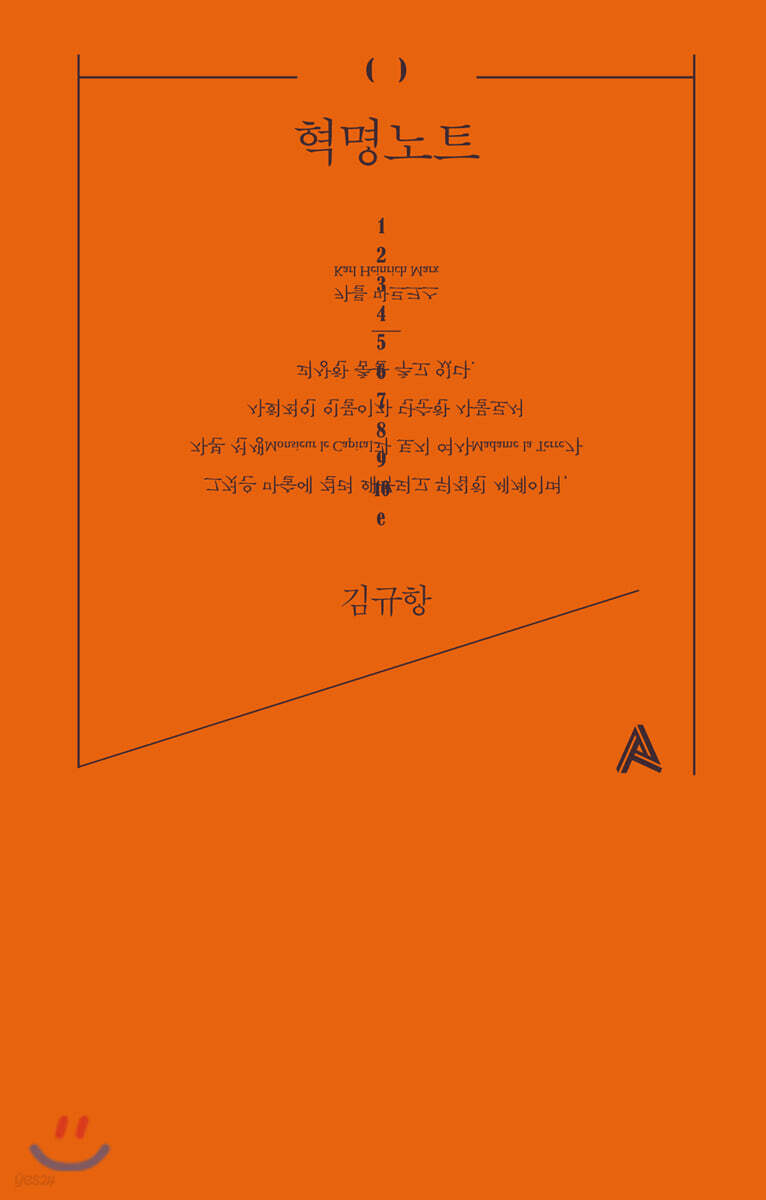
Revolutionary Notes
 |
Description
Book Introduction
Kim Gyu-hang, who reads the world with concise writing style and insightful sentences.
His revolutionary notes, written 11 years after the Life of Jesus
The Revolutionary Note begins with the following question:
'Is capitalism really a class society?'
A blueprint for a revolution that permeates the social system
Kim Gyu-hang is a rare socio-cultural critic whose writing style and content are consistent.
Although he has been listed as an author in the so-called Red Book several times, 『Revolutionary Notes』 is his second work, published 11 years after 『The Life of Jesus』.
With his uniquely sharp insight, he analyzes all structures of the world, including politics, economy, society, culture, art, education, people, and current affairs, and writes revolutionary notes.
Beyond the spiritual revolution at the personal level, 『Revolutionary Notes』 penetrates the fundamental social system that supports the sum total of individuals.
Kim Gyu-hang states that “the ‘world without prospects’ we live in now, with no end in sight, is not a temporary symptom of capitalism, but rather a revelation of its true nature,” and that “it is urgent to go beyond local or temporal perspectives, face the essence and structure of capitalism, and develop our own views on overcoming capitalism.”
『Revolutionary Notes』 begins by showing us the stark truth that we have been ignoring or denying.
“Human history is the history of classes.
As long as conditions were created for classes to be created, humanity has inevitably lived in a class society, as if it were an expression of instinct.
“The 20th century real socialist societies that were claimed to have abolished class were no exception.”
Then, one by one, we bring out the first questions, the fundamental questions that we have completely forgotten and live with.
For example, when everyone says, "We are entering the age of artificial intelligence and robots...", I tell them to ask, "Why do humans need artificial intelligence and robots?"
Should homes and real estate be private property? Wouldn't it be better for everyone if large monopolies (chaebols, conglomerates) were shared? Can the climate crisis be prevented under capitalism?… While reading "Revolutionary Notes," readers will experience lost questions being reopened and new ones emerging.
So, “change begins with ‘reopening the question.’”
His revolutionary notes, written 11 years after the Life of Jesus
The Revolutionary Note begins with the following question:
'Is capitalism really a class society?'
A blueprint for a revolution that permeates the social system
Kim Gyu-hang is a rare socio-cultural critic whose writing style and content are consistent.
Although he has been listed as an author in the so-called Red Book several times, 『Revolutionary Notes』 is his second work, published 11 years after 『The Life of Jesus』.
With his uniquely sharp insight, he analyzes all structures of the world, including politics, economy, society, culture, art, education, people, and current affairs, and writes revolutionary notes.
Beyond the spiritual revolution at the personal level, 『Revolutionary Notes』 penetrates the fundamental social system that supports the sum total of individuals.
Kim Gyu-hang states that “the ‘world without prospects’ we live in now, with no end in sight, is not a temporary symptom of capitalism, but rather a revelation of its true nature,” and that “it is urgent to go beyond local or temporal perspectives, face the essence and structure of capitalism, and develop our own views on overcoming capitalism.”
『Revolutionary Notes』 begins by showing us the stark truth that we have been ignoring or denying.
“Human history is the history of classes.
As long as conditions were created for classes to be created, humanity has inevitably lived in a class society, as if it were an expression of instinct.
“The 20th century real socialist societies that were claimed to have abolished class were no exception.”
Then, one by one, we bring out the first questions, the fundamental questions that we have completely forgotten and live with.
For example, when everyone says, "We are entering the age of artificial intelligence and robots...", I tell them to ask, "Why do humans need artificial intelligence and robots?"
Should homes and real estate be private property? Wouldn't it be better for everyone if large monopolies (chaebols, conglomerates) were shared? Can the climate crisis be prevented under capitalism?… While reading "Revolutionary Notes," readers will experience lost questions being reopened and new ones emerging.
So, “change begins with ‘reopening the question.’”
- You can preview some of the book's contents.
Preview
index
1
2
3
4
5
6
7
8
9
10
2
3
4
5
6
7
8
9
10
Into the book
We are convinced that living in a capitalist society is quite difficult, but at least it is better than previous societies.
Not necessarily.
In 13th-century England, serfs worked 31 hours a week.
In today's terms, a serf would work about five hours a day, half of which he would work autonomously on his own means of production, and would be provided with free housing and guaranteed lifetime employment, passing on the housing and employment to his children.
--- p.13
Exploitation is legal and normal under capitalism.
The phrase 'I wish for a world without exploitation' actually means 'I wish for the abolition of capitalism.'
--- p.38
The reason why capitalists endlessly repeat the pursuit of profit and accumulation activities is because they are ‘personified capital’ before they are human beings.
The soul of the capitalist is the soul of capital.
--- p.44
Jeff Bezos, the richest person in human history, has a net worth of 170 trillion won as of 2019.
This is the amount of money that a person earning 100 million won a year would have to save for 1.7 million years without spending a single penny of their wages.
Whether Bezos can spend all that money or actually needs it is irrelevant to his activities as a capitalist.
--- p.45
A wage slave is anyone who does not belong to the left side of the capitalist social relationship of 'capital versus wage labor.'
Small business owners who cannot secure stable wages and become self-exploiting business owners who exploit themselves and their families are also wage slaves.
--- p.79
In traditional slave societies, the proportion of slaves among the total population is approximately 30 percent.
Capitalist society is an extreme form of slavery, where most people, called citizens, or the people, are wage slaves.
--- p.80
We often refer to the situation in which poor people have the legal right to freedom but have difficulty enjoying any of it as a 'state in which freedom is violated by economic inequality.'
But that is true capitalist freedom.
--- p.83
Capital has no interest in 'civilizational' changes or distinctions such as whether labor is industrial or service labor, material or immaterial labor.
The essence of the working class is ‘social relations.’
--- p.84
Identity is not separate from class, but rather an extension of it.
Class exploitation and oppression exist not only between capital and wage labor, but also between men and women, and between majorities and minorities.
Also, minorities do not exist only as identities.
The lower class people are also a major minority.
--- p.93
Current capitalist productivity is such that a 15-hour workweek is sufficient for most people to maintain a decent standard of living.
However, the '15-hour workweek' is still a dream.
Why don't working hours decrease?
--- p.106
Just as primitive man did with natural phenomena, humans have a habit of dismissing things that are completely inexplicable as 'just the way they are'.
For modern people who do not understand materialism, life under capitalism is no different from that of primitive people facing inexplicable natural phenomena.
--- p.131
Although he is very critical of capitalism, his life as an individual conforms to capitalism. The 'separation of knowledge and life' is not an ethical problem, but rather a natural phenomenon that occurs because his life is captured by fetishism.
--- p.134
What makes capitalism special as a class society is that the ruling class is not the master.
The only master is capital, that is, materialism.
The ruling class is nothing more than a 'slave who has assumed the role of the ruling class', performing its role according to the orders and will of the material god.
Super capitalists in the Internet age are not just successful rich people, but are revered as revolutionaries and visionaries who change the world.
--- p.135
The more desperately we need freedom, the more difficult it is to discern its meaning.
Freedom is misunderstood as liberal freedom, and democracy as bourgeois democracy.
After a long struggle, freedom and democracy were achieved, and while everyone was celebrating, that is, while the sense of caution and restraint against capitalism was lifted, we very quickly rushed into a full-scale materialistic society.
--- p.154
It is not because Korea has become poorer than before that it has recorded the world's highest suicide rate and the world's lowest birth rate in just 20 years since democratization and that the younger generation has come to call their country "hell (Hell Joseon)."
The problem is that we suddenly found ourselves living in an extremely materialistic society.
--- p.156
Intellectuals are completely absorbed in grand narratives, but when errors or limitations are discovered, they return to micro-discourses.
It is difficult to find any proper criticism or reflection between these transitions.
There is only the 'age of grand discourse' and the 'age of micro discourse'.
In the age of grand narratives, if you pay attention to micro-discourses, you are labeled a “reactionary liberal,” and in the age of micro-discourses, if you pay attention to grand narratives, you are labeled a “dogmatic Marxist.”
--- p.193
As history shows, no ruling class is ever the first to give up its vested interests for the good of society.
They are reluctantly compromising so as not to lose everything.
The Nordic welfare society was created by a powerful revolutionary labor movement that aimed to overcome capitalism, or more precisely, by a compromise between the many workers who participated in that labor movement and the ruling class who felt threatened by it.
That is why that society is called a 'class compromise' system.
--- p.214
Change begins with ‘reopening the question.’
For example, when everyone says, "We are entering the age of artificial intelligence and robots," the question is, "Why do humans need artificial intelligence and robots? Do humans exist for them, or do they exist for humans?"
When everyone says, "We're entering a world where human labor is no longer necessary," the question is, "Shouldn't all people have the right to work? Shouldn't it be working hours, not jobs, that should be reduced?"
Should homes and real estate be private property? Wouldn't it be better for everyone if large monopolies (chaebols, large corporations) were shared? Can the climate crisis be prevented under capitalism? Forgotten questions are being reopened, and new ones are emerging.
--- p.234
The 'commons' movement, which has been attracting attention recently, is a movement that aims for a sharing society.
The key question will be whether this movement is targeting the most important targets of sharing.
If we talk about sharing in everyday life while avoiding the sharing of large monopoly capital, it is difficult to go beyond the play of some middle-class people trying to create a better world.
--- p.223
Revolution is the self-liberation of the people.
‘Self-liberation’ does not mean that an individual liberates himself through his own power.
No one can do that.
No one else can free me.
Self-liberation means that I am the subject of my own liberation.
Other people can help me get out of this oppressed state.
It is 'rescue', not liberation.
Liberation begins with standing before the system that oppresses me, standing before the fact that I live within it in a way that does not love myself.
And at some point, you come to the decision that 'I won't live like this anymore.'
It is a moment of lightning-like 'metanoia'.
The journey to self-liberation begins with metanoia.
Not necessarily.
In 13th-century England, serfs worked 31 hours a week.
In today's terms, a serf would work about five hours a day, half of which he would work autonomously on his own means of production, and would be provided with free housing and guaranteed lifetime employment, passing on the housing and employment to his children.
--- p.13
Exploitation is legal and normal under capitalism.
The phrase 'I wish for a world without exploitation' actually means 'I wish for the abolition of capitalism.'
--- p.38
The reason why capitalists endlessly repeat the pursuit of profit and accumulation activities is because they are ‘personified capital’ before they are human beings.
The soul of the capitalist is the soul of capital.
--- p.44
Jeff Bezos, the richest person in human history, has a net worth of 170 trillion won as of 2019.
This is the amount of money that a person earning 100 million won a year would have to save for 1.7 million years without spending a single penny of their wages.
Whether Bezos can spend all that money or actually needs it is irrelevant to his activities as a capitalist.
--- p.45
A wage slave is anyone who does not belong to the left side of the capitalist social relationship of 'capital versus wage labor.'
Small business owners who cannot secure stable wages and become self-exploiting business owners who exploit themselves and their families are also wage slaves.
--- p.79
In traditional slave societies, the proportion of slaves among the total population is approximately 30 percent.
Capitalist society is an extreme form of slavery, where most people, called citizens, or the people, are wage slaves.
--- p.80
We often refer to the situation in which poor people have the legal right to freedom but have difficulty enjoying any of it as a 'state in which freedom is violated by economic inequality.'
But that is true capitalist freedom.
--- p.83
Capital has no interest in 'civilizational' changes or distinctions such as whether labor is industrial or service labor, material or immaterial labor.
The essence of the working class is ‘social relations.’
--- p.84
Identity is not separate from class, but rather an extension of it.
Class exploitation and oppression exist not only between capital and wage labor, but also between men and women, and between majorities and minorities.
Also, minorities do not exist only as identities.
The lower class people are also a major minority.
--- p.93
Current capitalist productivity is such that a 15-hour workweek is sufficient for most people to maintain a decent standard of living.
However, the '15-hour workweek' is still a dream.
Why don't working hours decrease?
--- p.106
Just as primitive man did with natural phenomena, humans have a habit of dismissing things that are completely inexplicable as 'just the way they are'.
For modern people who do not understand materialism, life under capitalism is no different from that of primitive people facing inexplicable natural phenomena.
--- p.131
Although he is very critical of capitalism, his life as an individual conforms to capitalism. The 'separation of knowledge and life' is not an ethical problem, but rather a natural phenomenon that occurs because his life is captured by fetishism.
--- p.134
What makes capitalism special as a class society is that the ruling class is not the master.
The only master is capital, that is, materialism.
The ruling class is nothing more than a 'slave who has assumed the role of the ruling class', performing its role according to the orders and will of the material god.
Super capitalists in the Internet age are not just successful rich people, but are revered as revolutionaries and visionaries who change the world.
--- p.135
The more desperately we need freedom, the more difficult it is to discern its meaning.
Freedom is misunderstood as liberal freedom, and democracy as bourgeois democracy.
After a long struggle, freedom and democracy were achieved, and while everyone was celebrating, that is, while the sense of caution and restraint against capitalism was lifted, we very quickly rushed into a full-scale materialistic society.
--- p.154
It is not because Korea has become poorer than before that it has recorded the world's highest suicide rate and the world's lowest birth rate in just 20 years since democratization and that the younger generation has come to call their country "hell (Hell Joseon)."
The problem is that we suddenly found ourselves living in an extremely materialistic society.
--- p.156
Intellectuals are completely absorbed in grand narratives, but when errors or limitations are discovered, they return to micro-discourses.
It is difficult to find any proper criticism or reflection between these transitions.
There is only the 'age of grand discourse' and the 'age of micro discourse'.
In the age of grand narratives, if you pay attention to micro-discourses, you are labeled a “reactionary liberal,” and in the age of micro-discourses, if you pay attention to grand narratives, you are labeled a “dogmatic Marxist.”
--- p.193
As history shows, no ruling class is ever the first to give up its vested interests for the good of society.
They are reluctantly compromising so as not to lose everything.
The Nordic welfare society was created by a powerful revolutionary labor movement that aimed to overcome capitalism, or more precisely, by a compromise between the many workers who participated in that labor movement and the ruling class who felt threatened by it.
That is why that society is called a 'class compromise' system.
--- p.214
Change begins with ‘reopening the question.’
For example, when everyone says, "We are entering the age of artificial intelligence and robots," the question is, "Why do humans need artificial intelligence and robots? Do humans exist for them, or do they exist for humans?"
When everyone says, "We're entering a world where human labor is no longer necessary," the question is, "Shouldn't all people have the right to work? Shouldn't it be working hours, not jobs, that should be reduced?"
Should homes and real estate be private property? Wouldn't it be better for everyone if large monopolies (chaebols, large corporations) were shared? Can the climate crisis be prevented under capitalism? Forgotten questions are being reopened, and new ones are emerging.
--- p.234
The 'commons' movement, which has been attracting attention recently, is a movement that aims for a sharing society.
The key question will be whether this movement is targeting the most important targets of sharing.
If we talk about sharing in everyday life while avoiding the sharing of large monopoly capital, it is difficult to go beyond the play of some middle-class people trying to create a better world.
--- p.223
Revolution is the self-liberation of the people.
‘Self-liberation’ does not mean that an individual liberates himself through his own power.
No one can do that.
No one else can free me.
Self-liberation means that I am the subject of my own liberation.
Other people can help me get out of this oppressed state.
It is 'rescue', not liberation.
Liberation begins with standing before the system that oppresses me, standing before the fact that I live within it in a way that does not love myself.
And at some point, you come to the decision that 'I won't live like this anymore.'
It is a moment of lightning-like 'metanoia'.
The journey to self-liberation begins with metanoia.
--- p.238
We are convinced that living in a capitalist society is quite difficult, but at least it is better than previous societies.
Not necessarily.
In 13th-century England, serfs worked 31 hours a week.
In today's terms, a serf would work about five hours a day, half of which he would work autonomously on his own means of production, and would be provided with free housing and guaranteed lifetime employment, passing on the housing and employment to his children.
--- p.13
Exploitation is legal and normal under capitalism.
The phrase 'I wish for a world without exploitation' actually means 'I wish for the abolition of capitalism.'
--- p.38
The reason why capitalists endlessly repeat the pursuit of profit and accumulation activities is because they are ‘personified capital’ before they are human beings.
The soul of the capitalist is the soul of capital.
--- p.44
Jeff Bezos, the richest man in human history, has a net worth of 170 trillion won as of 2019.
This is the amount of money that a person earning 100 million won a year would have to save for 1.7 million years without spending a single penny of their wages.
Whether Bezos can spend all that money or actually needs it is irrelevant to his activities as a capitalist.
--- p.45
A wage slave is anyone who does not belong to the left side of the capitalist social relationship of 'capital versus wage labor.'
Small business owners who cannot secure stable wages and become self-exploiting business owners who exploit themselves and their families are also wage slaves.
--- p.79
In traditional slave societies, the proportion of slaves among the total population is approximately 30 percent.
Capitalist society is an extreme form of slavery, where most people, called citizens, or the people, are wage slaves.
--- p.80
We often refer to the situation in which poor people have the legal right to freedom but have difficulty enjoying any of it as a 'state in which freedom is violated by economic inequality.'
But that is true capitalist freedom.
--- p.83
Capital has no interest in 'civilizational' changes or distinctions such as whether labor is industrial or service labor, material or immaterial labor.
The essence of the working class is ‘social relations.’
--- p.84
Identity is not separate from class, but rather an extension of it.
Class exploitation and oppression exist not only between capital and wage labor, but also between men and women, and between majorities and minorities.
Also, minorities do not exist only as identities.
The lower class people are also a major minority.
--- p.93
Current capitalist productivity is such that a 15-hour workweek is sufficient for most people to maintain a decent standard of living.
However, the '15-hour workweek' is still a dream.
Why don't working hours decrease?
--- p.106
Just as primitive man did with natural phenomena, humans have a habit of dismissing things that are completely inexplicable as 'just the way they are'.
For modern people who do not understand materialism, life under capitalism is no different from that of primitive people facing inexplicable natural phenomena.
--- p.131
Although he is very critical of capitalism, his life as an individual conforms to capitalism. The 'separation of knowledge and life' is not an ethical issue, but rather a natural phenomenon that occurs because his life is captured by fetishism.
--- p.134
What makes capitalism special as a class society is that the ruling class is not the master.
The only master is capital, that is, materialism.
The ruling class is nothing more than a 'slave who has assumed the role of the ruling class', performing its role according to the orders and will of the material god.
Super capitalists in the Internet age are not just successful rich people, but are revered as revolutionaries and visionaries who change the world.
--- p.135
The more desperately we need freedom, the more difficult it is to discern its meaning.
Freedom is misunderstood as liberal freedom, and democracy as bourgeois democracy.
After a long struggle, freedom and democracy were achieved, and while everyone was celebrating, that is, while the sense of caution and restraint against capitalism was lifted, we very quickly rushed into a full-scale materialistic society.
--- p.154
It is not because Korea has become poorer than before that it has recorded the world's highest suicide rate and the world's lowest birth rate in just 20 years since democratization and that the younger generation has come to call their country "hell (Hell Joseon)."
The problem is that we suddenly found ourselves living in an extremely materialistic society.
--- p.156
Intellectuals are completely absorbed in grand narratives, but when errors or limitations are discovered, they return to micro-discourses.
It is difficult to find any proper criticism or reflection between these transitions.
There is only the 'age of grand discourse' and the 'age of micro discourse'.
In the age of grand narratives, if you pay attention to micro-discourses, you are labeled a “reactionary liberal,” and in the age of micro-discourses, if you pay attention to grand narratives, you are labeled a “dogmatic Marxist.”
--- p.193
As history shows, no ruling class is ever the first to give up its vested interests for the good of society.
They are reluctantly compromising so as not to lose everything.
The Nordic welfare society was created by a powerful revolutionary labor movement that aimed to overcome capitalism, or more precisely, by a compromise between the many workers who participated in that labor movement and the ruling class who felt threatened by it.
That is why that society is called a 'class compromise' system.
--- p.214
Change begins with ‘reopening the question.’
For example, when everyone says, "We are entering the age of artificial intelligence and robots," the question is, "Why do humans need artificial intelligence and robots? Do humans exist for them, or do they exist for humans?"
When everyone says, "We're entering a world where human labor is no longer necessary," the question is, "Shouldn't all people have the right to work? Shouldn't it be working hours, not jobs, that should be reduced?"
Should homes and real estate be private property? Wouldn't it be better for everyone if large monopolies (chaebols, large corporations) were shared? Can the climate crisis be prevented under capitalism? Forgotten questions are being reopened, and new ones are emerging.
--- p.234
The 'commons' movement, which has been attracting attention recently, is a movement that aims for a sharing society.
The key question is whether this movement is targeting the most important targets of sharing.
If we talk about sharing in everyday life while avoiding the sharing of large monopoly capital, it is difficult to go beyond the play of some middle-class people trying to create a better world.
--- p.223
Revolution is the self-liberation of the people.
‘Self-liberation’ does not mean that an individual liberates himself through his own power.
No one can do that.
No one else can free me.
Self-liberation means that I am the subject of my own liberation.
Other people can help me get out of this oppressed state.
It is 'rescue', not liberation.
Liberation begins with standing before the system that oppresses me, standing before the fact that I live within it in a way that does not love myself.
And at some point, you come to the decision that 'I won't live like this anymore.'
It is a moment of lightning-like 'metanoia'.
The journey to self-liberation begins with metanoia.
We are convinced that living in a capitalist society is quite difficult, but at least it is better than previous societies.
Not necessarily.
In 13th-century England, serfs worked 31 hours a week.
In today's terms, a serf would work about five hours a day, half of which he would work autonomously on his own means of production, and would be provided with free housing and guaranteed lifetime employment, passing on the housing and employment to his children.
--- p.13
Exploitation is legal and normal under capitalism.
The phrase 'I wish for a world without exploitation' actually means 'I wish for the abolition of capitalism.'
--- p.38
The reason why capitalists endlessly repeat the pursuit of profit and accumulation activities is because they are ‘personified capital’ before they are human beings.
The soul of the capitalist is the soul of capital.
--- p.44
Jeff Bezos, the richest person in human history, has a net worth of 170 trillion won as of 2019.
This is the amount of money that a person earning 100 million won a year would have to save for 1.7 million years without spending a single penny of their wages.
Whether Bezos can spend all that money or actually needs it is irrelevant to his activities as a capitalist.
--- p.45
A wage slave is anyone who does not belong to the left side of the capitalist social relationship of 'capital versus wage labor.'
Small business owners who cannot secure stable wages and become self-exploiting business owners who exploit themselves and their families are also wage slaves.
--- p.79
In traditional slave societies, the proportion of slaves among the total population is approximately 30 percent.
Capitalist society is an extreme form of slavery, where most people, called citizens, or the people, are wage slaves.
--- p.80
We often refer to the situation in which poor people have the legal right to freedom but have difficulty enjoying any of it as a 'state in which freedom is violated by economic inequality.'
But that is true capitalist freedom.
--- p.83
Capital has no interest in 'civilizational' changes or distinctions such as whether labor is industrial or service labor, material or immaterial labor.
The essence of the working class is ‘social relations.’
--- p.84
Identity is not separate from class, but rather an extension of it.
Class exploitation and oppression exist not only between capital and wage labor, but also between men and women, and between majorities and minorities.
Also, minorities do not exist only as identities.
The lower class people are also a major minority.
--- p.93
Current capitalist productivity is such that a 15-hour workweek is sufficient for most people to maintain a decent standard of living.
However, the '15-hour workweek' is still a dream.
Why don't working hours decrease?
--- p.106
Just as primitive man did with natural phenomena, humans have a habit of dismissing things that are completely inexplicable as 'just the way they are'.
For modern people who do not understand materialism, life under capitalism is no different from that of primitive people facing inexplicable natural phenomena.
--- p.131
Although he is very critical of capitalism, his life as an individual conforms to capitalism. The 'separation of knowledge and life' is not an ethical problem, but rather a natural phenomenon that occurs because his life is captured by fetishism.
--- p.134
What makes capitalism special as a class society is that the ruling class is not the master.
The only master is capital, that is, materialism.
The ruling class is nothing more than a 'slave who has assumed the role of the ruling class', performing its role according to the orders and will of the material god.
Super capitalists in the Internet age are not just successful rich people, but are revered as revolutionaries and visionaries who change the world.
--- p.135
The more desperately we need freedom, the more difficult it is to discern its meaning.
Freedom is misunderstood as liberal freedom, and democracy as bourgeois democracy.
After a long struggle, freedom and democracy were achieved, and while everyone was celebrating, that is, while the sense of caution and restraint against capitalism was lifted, we very quickly rushed into a full-scale materialistic society.
--- p.154
It is not because Korea has become poorer than before that it has recorded the world's highest suicide rate and the world's lowest birth rate in just 20 years since democratization and that the younger generation has come to call their country "hell (Hell Joseon)."
The problem is that we suddenly found ourselves living in an extremely materialistic society.
--- p.156
Intellectuals are completely absorbed in grand narratives, but when errors or limitations are discovered, they return to micro-discourses.
It is difficult to find any proper criticism or reflection between these transitions.
There is only the 'age of grand discourse' and the 'age of micro discourse'.
In the age of grand narratives, if you pay attention to micro-discourses, you are labeled a “reactionary liberal,” and in the age of micro-discourses, if you pay attention to grand narratives, you are labeled a “dogmatic Marxist.”
--- p.193
As history shows, no ruling class is ever the first to give up its vested interests for the good of society.
They are reluctantly compromising so as not to lose everything.
The Nordic welfare society was created by a powerful revolutionary labor movement that aimed to overcome capitalism, or more precisely, by a compromise between the many workers who participated in that labor movement and the ruling class who felt threatened by it.
That is why that society is called a 'class compromise' system.
--- p.214
Change begins with ‘reopening the question.’
For example, when everyone says, "We are entering the age of artificial intelligence and robots," the question is, "Why do humans need artificial intelligence and robots? Do humans exist for them, or do they exist for humans?"
When everyone says, "We're entering a world where human labor is no longer necessary," the question is, "Shouldn't all people have the right to work? Shouldn't it be working hours, not jobs, that should be reduced?"
Should homes and real estate be private property? Wouldn't it be better for everyone if large monopolies (chaebols, large corporations) were shared? Can the climate crisis be prevented under capitalism? Forgotten questions are being reopened, and new ones are emerging.
--- p.234
The 'commons' movement, which has been attracting attention recently, is a movement that aims for a sharing society.
The key question is whether this movement is targeting the most important targets of sharing.
If we talk about sharing in everyday life while avoiding the sharing of large monopoly capital, it is difficult to go beyond the play of some middle-class people trying to create a better world.
--- p.223
Revolution is the self-liberation of the people.
‘Self-liberation’ does not mean that an individual liberates himself through his own power.
No one can do that.
No one else can free me.
Self-liberation means that I am the subject of my own liberation.
Other people can help me get out of this oppressed state.
It is 'rescue', not liberation.
Liberation begins with standing before the system that oppresses me, standing before the fact that I live within it in a way that does not love myself.
And at some point, you come to the decision that 'I won't live like this anymore.'
It is a moment of lightning-like 'metanoia'.
The journey to self-liberation begins with metanoia.
Not necessarily.
In 13th-century England, serfs worked 31 hours a week.
In today's terms, a serf would work about five hours a day, half of which he would work autonomously on his own means of production, and would be provided with free housing and guaranteed lifetime employment, passing on the housing and employment to his children.
--- p.13
Exploitation is legal and normal under capitalism.
The phrase 'I wish for a world without exploitation' actually means 'I wish for the abolition of capitalism.'
--- p.38
The reason why capitalists endlessly repeat the pursuit of profit and accumulation activities is because they are ‘personified capital’ before they are human beings.
The soul of the capitalist is the soul of capital.
--- p.44
Jeff Bezos, the richest man in human history, has a net worth of 170 trillion won as of 2019.
This is the amount of money that a person earning 100 million won a year would have to save for 1.7 million years without spending a single penny of their wages.
Whether Bezos can spend all that money or actually needs it is irrelevant to his activities as a capitalist.
--- p.45
A wage slave is anyone who does not belong to the left side of the capitalist social relationship of 'capital versus wage labor.'
Small business owners who cannot secure stable wages and become self-exploiting business owners who exploit themselves and their families are also wage slaves.
--- p.79
In traditional slave societies, the proportion of slaves among the total population is approximately 30 percent.
Capitalist society is an extreme form of slavery, where most people, called citizens, or the people, are wage slaves.
--- p.80
We often refer to the situation in which poor people have the legal right to freedom but have difficulty enjoying any of it as a 'state in which freedom is violated by economic inequality.'
But that is true capitalist freedom.
--- p.83
Capital has no interest in 'civilizational' changes or distinctions such as whether labor is industrial or service labor, material or immaterial labor.
The essence of the working class is ‘social relations.’
--- p.84
Identity is not separate from class, but rather an extension of it.
Class exploitation and oppression exist not only between capital and wage labor, but also between men and women, and between majorities and minorities.
Also, minorities do not exist only as identities.
The lower class people are also a major minority.
--- p.93
Current capitalist productivity is such that a 15-hour workweek is sufficient for most people to maintain a decent standard of living.
However, the '15-hour workweek' is still a dream.
Why don't working hours decrease?
--- p.106
Just as primitive man did with natural phenomena, humans have a habit of dismissing things that are completely inexplicable as 'just the way they are'.
For modern people who do not understand materialism, life under capitalism is no different from that of primitive people facing inexplicable natural phenomena.
--- p.131
Although he is very critical of capitalism, his life as an individual conforms to capitalism. The 'separation of knowledge and life' is not an ethical issue, but rather a natural phenomenon that occurs because his life is captured by fetishism.
--- p.134
What makes capitalism special as a class society is that the ruling class is not the master.
The only master is capital, that is, materialism.
The ruling class is nothing more than a 'slave who has assumed the role of the ruling class', performing its role according to the orders and will of the material god.
Super capitalists in the Internet age are not just successful rich people, but are revered as revolutionaries and visionaries who change the world.
--- p.135
The more desperately we need freedom, the more difficult it is to discern its meaning.
Freedom is misunderstood as liberal freedom, and democracy as bourgeois democracy.
After a long struggle, freedom and democracy were achieved, and while everyone was celebrating, that is, while the sense of caution and restraint against capitalism was lifted, we very quickly rushed into a full-scale materialistic society.
--- p.154
It is not because Korea has become poorer than before that it has recorded the world's highest suicide rate and the world's lowest birth rate in just 20 years since democratization and that the younger generation has come to call their country "hell (Hell Joseon)."
The problem is that we suddenly found ourselves living in an extremely materialistic society.
--- p.156
Intellectuals are completely absorbed in grand narratives, but when errors or limitations are discovered, they return to micro-discourses.
It is difficult to find any proper criticism or reflection between these transitions.
There is only the 'age of grand discourse' and the 'age of micro discourse'.
In the age of grand narratives, if you pay attention to micro-discourses, you are labeled a “reactionary liberal,” and in the age of micro-discourses, if you pay attention to grand narratives, you are labeled a “dogmatic Marxist.”
--- p.193
As history shows, no ruling class is ever the first to give up its vested interests for the good of society.
They are reluctantly compromising so as not to lose everything.
The Nordic welfare society was created by a powerful revolutionary labor movement that aimed to overcome capitalism, or more precisely, by a compromise between the many workers who participated in that labor movement and the ruling class who felt threatened by it.
That is why that society is called a 'class compromise' system.
--- p.214
Change begins with ‘reopening the question.’
For example, when everyone says, "We are entering the age of artificial intelligence and robots," the question is, "Why do humans need artificial intelligence and robots? Do humans exist for them, or do they exist for humans?"
When everyone says, "We're entering a world where human labor is no longer necessary," the question is, "Shouldn't all people have the right to work? Shouldn't it be working hours, not jobs, that should be reduced?"
Should homes and real estate be private property? Wouldn't it be better for everyone if large monopolies (chaebols, large corporations) were shared? Can the climate crisis be prevented under capitalism? Forgotten questions are being reopened, and new ones are emerging.
--- p.234
The 'commons' movement, which has been attracting attention recently, is a movement that aims for a sharing society.
The key question is whether this movement is targeting the most important targets of sharing.
If we talk about sharing in everyday life while avoiding the sharing of large monopoly capital, it is difficult to go beyond the play of some middle-class people trying to create a better world.
--- p.223
Revolution is the self-liberation of the people.
‘Self-liberation’ does not mean that an individual liberates himself through his own power.
No one can do that.
No one else can free me.
Self-liberation means that I am the subject of my own liberation.
Other people can help me get out of this oppressed state.
It is 'rescue', not liberation.
Liberation begins with standing before the system that oppresses me, standing before the fact that I live within it in a way that does not love myself.
And at some point, you come to the decision that 'I won't live like this anymore.'
It is a moment of lightning-like 'metanoia'.
The journey to self-liberation begins with metanoia.
We are convinced that living in a capitalist society is quite difficult, but at least it is better than previous societies.
Not necessarily.
In 13th-century England, serfs worked 31 hours a week.
In today's terms, a serf would work about five hours a day, half of which he would work autonomously on his own means of production, and would be provided with free housing and guaranteed lifetime employment, passing on the housing and employment to his children.
--- p.13
Exploitation is legal and normal under capitalism.
The phrase 'I wish for a world without exploitation' actually means 'I wish for the abolition of capitalism.'
--- p.38
The reason why capitalists endlessly repeat the pursuit of profit and accumulation activities is because they are ‘personified capital’ before they are human beings.
The soul of the capitalist is the soul of capital.
--- p.44
Jeff Bezos, the richest person in human history, has a net worth of 170 trillion won as of 2019.
This is the amount of money that a person earning 100 million won a year would have to save for 1.7 million years without spending a single penny of their wages.
Whether Bezos can spend all that money or actually needs it is irrelevant to his activities as a capitalist.
--- p.45
A wage slave is anyone who does not belong to the left side of the capitalist social relationship of 'capital versus wage labor.'
Small business owners who cannot secure stable wages and become self-exploiting business owners who exploit themselves and their families are also wage slaves.
--- p.79
In traditional slave societies, the proportion of slaves among the total population is approximately 30 percent.
Capitalist society is an extreme form of slavery, where most people, called citizens, or the people, are wage slaves.
--- p.80
We often refer to the situation in which poor people have the legal right to freedom but have difficulty enjoying any of it as a 'state in which freedom is violated by economic inequality.'
But that is true capitalist freedom.
--- p.83
Capital has no interest in 'civilizational' changes or distinctions such as whether labor is industrial or service labor, material or immaterial labor.
The essence of the working class is ‘social relations.’
--- p.84
Identity is not separate from class, but rather an extension of it.
Class exploitation and oppression exist not only between capital and wage labor, but also between men and women, and between majorities and minorities.
Also, minorities do not exist only as identities.
The lower class people are also a major minority.
--- p.93
Current capitalist productivity is such that a 15-hour workweek is sufficient for most people to maintain a decent standard of living.
However, the '15-hour workweek' is still a dream.
Why don't working hours decrease?
--- p.106
Just as primitive man did with natural phenomena, humans have a habit of dismissing things that are completely inexplicable as 'just the way they are'.
For modern people who do not understand materialism, life under capitalism is no different from that of primitive people facing inexplicable natural phenomena.
--- p.131
Although he is very critical of capitalism, his life as an individual conforms to capitalism. The 'separation of knowledge and life' is not an ethical problem, but rather a natural phenomenon that occurs because his life is captured by fetishism.
--- p.134
What makes capitalism special as a class society is that the ruling class is not the master.
The only master is capital, that is, materialism.
The ruling class is nothing more than a 'slave who has assumed the role of the ruling class', performing its role according to the orders and will of the material god.
Super capitalists in the Internet age are not just successful rich people, but are revered as revolutionaries and visionaries who change the world.
--- p.135
The more desperately we need freedom, the more difficult it is to discern its meaning.
Freedom is misunderstood as liberal freedom, and democracy as bourgeois democracy.
After a long struggle, freedom and democracy were achieved, and while everyone was celebrating, that is, while the sense of caution and restraint against capitalism was lifted, we very quickly rushed into a full-scale materialistic society.
--- p.154
It is not because Korea has become poorer than before that it has recorded the world's highest suicide rate and the world's lowest birth rate in just 20 years since democratization and that the younger generation has come to call their country "hell (Hell Joseon)."
The problem is that we suddenly found ourselves living in an extremely materialistic society.
--- p.156
Intellectuals are completely absorbed in grand narratives, but when errors or limitations are discovered, they return to micro-discourses.
It is difficult to find any proper criticism or reflection between these transitions.
There is only the 'age of grand discourse' and the 'age of micro discourse'.
In the age of grand narratives, if you pay attention to micro-discourses, you are labeled a “reactionary liberal,” and in the age of micro-discourses, if you pay attention to grand narratives, you are labeled a “dogmatic Marxist.”
--- p.193
As history shows, no ruling class is ever the first to give up its vested interests for the good of society.
They are reluctantly compromising so as not to lose everything.
The Nordic welfare society was created by a powerful revolutionary labor movement that aimed to overcome capitalism, or more precisely, by a compromise between the many workers who participated in that labor movement and the ruling class who felt threatened by it.
That is why that society is called a 'class compromise' system.
--- p.214
Change begins with ‘reopening the question.’
For example, when everyone says, "We are entering the age of artificial intelligence and robots," the question is, "Why do humans need artificial intelligence and robots? Do humans exist for them, or do they exist for humans?"
When everyone says, "We're entering a world where human labor is no longer necessary," the question is, "Shouldn't all people have the right to work? Shouldn't it be working hours, not jobs, that should be reduced?"
Should homes and real estate be private property? Wouldn't it be better for everyone if large monopolies (chaebols, large corporations) were shared? Can the climate crisis be prevented under capitalism? Forgotten questions are being reopened, and new ones are emerging.
--- p.234
The 'commons' movement, which has been attracting attention recently, is a movement that aims for a sharing society.
The key question is whether this movement is targeting the most important targets of sharing.
If we talk about sharing in everyday life while avoiding the sharing of large monopoly capital, it is difficult to go beyond the play of some middle-class people trying to create a better world.
--- p.223
Revolution is the self-liberation of the people.
‘Self-liberation’ does not mean that an individual liberates himself through his own power.
No one can do that.
No one else can free me.
Self-liberation means that I am the subject of my own liberation.
Other people can help me get out of this oppressed state.
It is 'rescue', not liberation.
Liberation begins with standing before the system that oppresses me, standing before the fact that I live within it in a way that does not love myself.
And at some point, you come to the decision that 'I won't live like this anymore.'
It is a moment of lightning-like 'metanoia'.
The journey to self-liberation begins with metanoia.
--- p.238
Publisher's Review
Revolution is the construction and implementation of a new society.
『Revolutionary Notes』 uses Marx's insights, especially the concept of 'fetishism', which has been widely disparaged, to penetrate the structure of today's capitalist society.
The terminal signs of capitalism revealed today clearly show that this is an inherent part of our nature.
As liberalism reaches its extreme, 'fetishism' also grows and grows by parasitizing on liberalism, and so revolution is impossible with only individual ethical awareness.
Because no one, not even the so-called "radical left," can escape fetishism in a capitalist society, readers are forced to confront the uncomfortable but clear truth that revolution from within is the only path to self-liberation and freedom.
However, 『Revolutionary Notes』 is not a book that is only uncomfortable.
That's because there's still a glimmer of hope within the sentences.
Now, 『Revolutionary Notes』 explores how to overcome the capitalist social system and moves toward a "new society" where everyone can live as free individuals.
Because revolution is the construction and transition of a new society.
The new society is based on private ownership and sharing, a world where all current values are turned upside down.
There is no such thing as a 'class' where no one has to work for others.
『Revolutionary Notes』 is convinced that “the people are the masters of the history that liberates them and the masters of the history that forces them into a life of slavery.”
So, let's support the people, who are "the only ones who can make a revolution without starving or being beaten, if they are not free."
Referring to the spiritual term 'Metanoia', it reminds us to fight and show solidarity for a new society, just as Jesus declared that we must be reborn as new people to enter the Kingdom of God.
Moments of Insight from "Revolutionary Notes"
"Revolutionary Notes" offers moments of insight as it transcends several of the complex and tangled problems that capitalist society struggles to resolve.
This is the case when he explains the distorted perception of 'how Northern Europe became Northern Europe' and defines the view that revolution is an anachronism as an obsession based on stereotypes.
“The revolution of today must be different from the revolution of the era when blue-collar labor and absolute poverty represented the working class.
However, the point is that under capitalism, there is always no reform in a society where there is no sign of revolution.”
The same goes for the part that criticizes the existing revolutionary theory that recent left-wing populism is also repeating.
It is a mistake to view the people as objects of agitation, mobilization, and collectivization, and the key is the people's self-liberation.
The criticism of postmodernism, Korean intellectual society, and '21st century communism' as a pastime for some intellectuals is also notable.
While examining the Western left-wing intellectuals who were disintegrated and subsumed by the shock of advanced capitalism and the material world that began in the mid-20th century in a historical context, he writes that “their intellectual bankruptcy has not yet been recovered from, and ultimately, as seen in the recent ‘86 problem,’ discussions remain at the level of ‘ethics’ or ‘generation.’”
In addition, he points out that in a situation where the cultural industry has replaced art, it is essential to be discerning about the Korean Wave; that in the issue of regular and irregular workers in large corporations, the labor aristocracy is not a corruption of ethics but merely “another class attribute of workers”; that when we cling to the classic image of the working class, we call the precariat the “true working class” but that this is likely to degenerate into a “left-wing, left-leaning movement”; and that basic income is also a right-wing idea that strengthens materialism.
The endless echo, the sound of revolution
『Revolutionary Notes』 is a book composed of 119 short essays divided into 10 chapters.
The 119 concise articles are followed by further commentary or citations.
Although it is recommended to read the main narrative and supporting narrative (in the form of commentary or main text) together, the 119 fragments have an open structure that allows one to grasp their own argument even if read out of order.
It unfolds in an integrated and grand way, encompassing humanity from its beginning to its future, from one end of the Earth to the other, while its sharpened pen tip does not miss the details that make up the macroscopic picture.
It digs into each and every one of our small daily lives and brings up the first question we had forgotten in those scenes.
Through these questions, the reader begins to see cracks in various parts of his life, which he thought was going smoothly.
I look at the points that I have glossed over or confused and tolerated, as if I were looking at the lines of my hand.
The book says that the revolution is already being preoccupied with the pieces of a 'new society' that has arrived.
Now, when someone asks, 'Is a new society really possible?', 'the free man who struggles' can ask first:
"Is there a new society within me?" The sound of revolution, which transcends you and me, announces the arrival of a new society.
“As the content and form of the text gradually disappear, only the unique resonant frequency of the space remains.
The original role of space is to resonate sound.
But now you hear the sound of space.
The hierarchy of sound and space disappears, and the boundaries between performers and audience disappear.
“Eventually, the sound becomes everyone’s, yet no one’s.”
『Revolutionary Notes』 uses Marx's insights, especially the concept of 'fetishism', which has been widely disparaged, to penetrate the structure of today's capitalist society.
The terminal signs of capitalism revealed today clearly show that this is an inherent part of our nature.
As liberalism reaches its extreme, 'fetishism' also grows and grows by parasitizing on liberalism, and so revolution is impossible with only individual ethical awareness.
Because no one, not even the so-called "radical left," can escape fetishism in a capitalist society, readers are forced to confront the uncomfortable but clear truth that revolution from within is the only path to self-liberation and freedom.
However, 『Revolutionary Notes』 is not a book that is only uncomfortable.
That's because there's still a glimmer of hope within the sentences.
Now, 『Revolutionary Notes』 explores how to overcome the capitalist social system and moves toward a "new society" where everyone can live as free individuals.
Because revolution is the construction and transition of a new society.
The new society is based on private ownership and sharing, a world where all current values are turned upside down.
There is no such thing as a 'class' where no one has to work for others.
『Revolutionary Notes』 is convinced that “the people are the masters of the history that liberates them and the masters of the history that forces them into a life of slavery.”
So, let's support the people, who are "the only ones who can make a revolution without starving or being beaten, if they are not free."
Referring to the spiritual term 'Metanoia', it reminds us to fight and show solidarity for a new society, just as Jesus declared that we must be reborn as new people to enter the Kingdom of God.
Moments of Insight from "Revolutionary Notes"
"Revolutionary Notes" offers moments of insight as it transcends several of the complex and tangled problems that capitalist society struggles to resolve.
This is the case when he explains the distorted perception of 'how Northern Europe became Northern Europe' and defines the view that revolution is an anachronism as an obsession based on stereotypes.
“The revolution of today must be different from the revolution of the era when blue-collar labor and absolute poverty represented the working class.
However, the point is that under capitalism, there is always no reform in a society where there is no sign of revolution.”
The same goes for the part that criticizes the existing revolutionary theory that recent left-wing populism is also repeating.
It is a mistake to view the people as objects of agitation, mobilization, and collectivization, and the key is the people's self-liberation.
The criticism of postmodernism, Korean intellectual society, and '21st century communism' as a pastime for some intellectuals is also notable.
While examining the Western left-wing intellectuals who were disintegrated and subsumed by the shock of advanced capitalism and the material world that began in the mid-20th century in a historical context, he writes that “their intellectual bankruptcy has not yet been recovered from, and ultimately, as seen in the recent ‘86 problem,’ discussions remain at the level of ‘ethics’ or ‘generation.’”
In addition, he points out that in a situation where the cultural industry has replaced art, it is essential to be discerning about the Korean Wave; that in the issue of regular and irregular workers in large corporations, the labor aristocracy is not a corruption of ethics but merely “another class attribute of workers”; that when we cling to the classic image of the working class, we call the precariat the “true working class” but that this is likely to degenerate into a “left-wing, left-leaning movement”; and that basic income is also a right-wing idea that strengthens materialism.
The endless echo, the sound of revolution
『Revolutionary Notes』 is a book composed of 119 short essays divided into 10 chapters.
The 119 concise articles are followed by further commentary or citations.
Although it is recommended to read the main narrative and supporting narrative (in the form of commentary or main text) together, the 119 fragments have an open structure that allows one to grasp their own argument even if read out of order.
It unfolds in an integrated and grand way, encompassing humanity from its beginning to its future, from one end of the Earth to the other, while its sharpened pen tip does not miss the details that make up the macroscopic picture.
It digs into each and every one of our small daily lives and brings up the first question we had forgotten in those scenes.
Through these questions, the reader begins to see cracks in various parts of his life, which he thought was going smoothly.
I look at the points that I have glossed over or confused and tolerated, as if I were looking at the lines of my hand.
The book says that the revolution is already being preoccupied with the pieces of a 'new society' that has arrived.
Now, when someone asks, 'Is a new society really possible?', 'the free man who struggles' can ask first:
"Is there a new society within me?" The sound of revolution, which transcends you and me, announces the arrival of a new society.
“As the content and form of the text gradually disappear, only the unique resonant frequency of the space remains.
The original role of space is to resonate sound.
But now you hear the sound of space.
The hierarchy of sound and space disappears, and the boundaries between performers and audience disappear.
“Eventually, the sound becomes everyone’s, yet no one’s.”
GOODS SPECIFICS
- Date of issue: February 7, 2020
- Page count, weight, size: 256 pages | 250g | 120*188*20mm
- ISBN13: 9791159922862
- ISBN10: 1159922861
You may also like
카테고리
korean


korean

![GQ KOREA Mark (Monthly): December [2025]](http://librairie.coreenne.fr/cdn/shop/files/8ef265dbbfbf186523ed75ba7319009d.jpg?v=1765340328&width=3840)


