

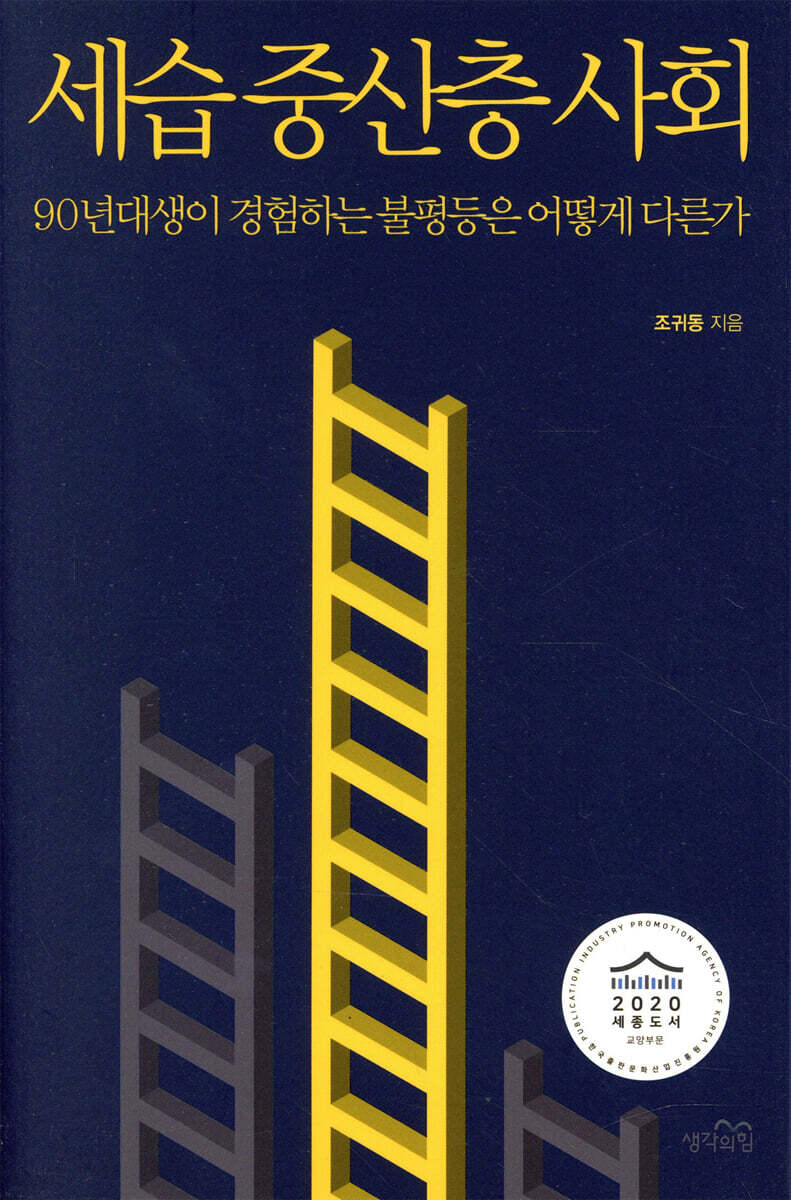
hereditary middle-class society
 |
Description
Book Introduction
A sharp and weighty question raised in an unequal society “The problem is not generation, it’s heredity!” Lee Cheol-hee, a member of the Democratic Party of Korea's National Assembly, strongly recommends reporter Cheon Gwan-yul of "Sisa IN"! 2019 was a year of continuous social interest and exploration regarding the 90s generation. This book, which prepares for Korean society after 2020, after the 'Great Patriotic War,' properly analyzes and diagnoses the 'inequality problem of those born in the 1990s.' How does inequality among those in their 20s differ from that of those in their 30s? How are those in their 20s in 2019 different from those in 1999 and 2009? This book explores the 20-something demographic through specific yet extensive data, along with the clear and poignant analysis gleaned from it, to explore the 20-something demographic from a fresh perspective, free from conventional frameworks. The essence of the inequality experienced by today's 20-somethings lies in the fact that the generation of parents in their 50s, who accumulated wealth based on their educational background and labor market status, not only invested in education but also used intangible assets such as cultural competencies and social networks to pass on the same educational background and labor market status to their children. This gap fixation determines the entire subsequent life cycle. Let's delve into the multiple inequalities plaguing our hereditary middle-class society: college entrance exams, employment, marriage, real estate... |
- You can preview some of the book's contents.
Preview
index
Prologue: Welcome to the world of the hereditary middle class.
Society of the 10s and 90s | Multiple Inequalities Experienced by People in Their 20s | Changes in the Labor Market Since 2010 | Structure of the Article
Chapter 1: The Problem with the Labor Market
Once an outsider, always an outsider | Your first job determines your status | The first gateway is to a prestigious university | Only 10 percent have decent jobs | A generation experiencing fiercer competition than ever before
Chapter 2: The Narrowing Gates to the Middle Class
The Changing Job Market | Fewer Jobs at Large Companies | Fierce Competition to Become an Insider | Women's Advancement | Mid-Skilled Jobs Disappear
Chapter 3: The Hidden Twenties: The Provinces and High School Graduates
"If you study well, you're a cheetah, if you don't, you're a returning student."|The marginalized: 'local university students and high school graduates'|The reality of local areas: a lack of quality jobs|Local areas have become the 'rural areas' of the job market|The deindustrialization tsunami has begun|High school graduates are invisible to our society|High school graduates with no future|Young people in working poverty
Chapter 4: The Emergence of the Hereditary Middle Class
How is inequality in your 20s different from that of your 30s? | The 'prestigious high school' system is back in operation. | "We design the 'life' of middle-class children." | The gap becomes apparent from middle school. | Even the power of the elderly follows class. | Choi Soon-sil's children, born in 1956 vs.
Children of the fatherland born in 1965
Chapter 5: The Privilege of a "Normal Family"
The Class Gap in Marriage and Real Estate | One in Five Men Enters Their 40s as a 'Bachelor' | Lower-Class Men Forced to Be Single | Women: The 'Perfect Marriage' vs.
"It's OK to Be Single" | Real Estate = Generation + Class | "Seoul Residents, Two-Home Owners": A Hereditary Middle Class
Chapter 6: The Origins of the Hereditary Middle Class
What Makes the 1960s Generation Different? | A Tale of Two Generations | The Growth of Large Corporations and the Emergence of Technocrats | The Working Life of Generations: A History of Victory | Another Fruit of Growth: Finance, IT, and Large-Scale Factory Production | The Combination of Education, Occupation, and Economic Status
Chapter 7: The Formation of Class Consciousness
"It was like a movie where I couldn't be the main character." | The Coexistence of Generation G and Generation N | Political Polarization Among Men and Women in Their 20s? That's the Inside Story of the "Hereditary Middle Class" | Perceptions of Injustice and Inequality Are a Class Issue
Chapter 8: The Myth of "Conservatism in Men in Their 20s"
The Truth Behind the '20s Male' Discourse | Analysis of the 'Conservative Defection' Among 20-Somethings in 2016-2017 | The Emergence of 'No Party Support' | Gender Conflict and the 'Class' Behind SNS | The Political Party of 60-Something Building Owners vs.
The political party of a manager in his 50s
Epilogue∥The Evolution of the Hereditary Middle Class
The global competition for prestigious university diplomas | The end of high growth, the beginning of hereditary capitalism | The 'educational arms race' intensifies during low growth | An impossible project: intergenerational concessions | The problem is not the '60s generation,' but the 'hereditary middle class.'
main
References
Society of the 10s and 90s | Multiple Inequalities Experienced by People in Their 20s | Changes in the Labor Market Since 2010 | Structure of the Article
Chapter 1: The Problem with the Labor Market
Once an outsider, always an outsider | Your first job determines your status | The first gateway is to a prestigious university | Only 10 percent have decent jobs | A generation experiencing fiercer competition than ever before
Chapter 2: The Narrowing Gates to the Middle Class
The Changing Job Market | Fewer Jobs at Large Companies | Fierce Competition to Become an Insider | Women's Advancement | Mid-Skilled Jobs Disappear
Chapter 3: The Hidden Twenties: The Provinces and High School Graduates
"If you study well, you're a cheetah, if you don't, you're a returning student."|The marginalized: 'local university students and high school graduates'|The reality of local areas: a lack of quality jobs|Local areas have become the 'rural areas' of the job market|The deindustrialization tsunami has begun|High school graduates are invisible to our society|High school graduates with no future|Young people in working poverty
Chapter 4: The Emergence of the Hereditary Middle Class
How is inequality in your 20s different from that of your 30s? | The 'prestigious high school' system is back in operation. | "We design the 'life' of middle-class children." | The gap becomes apparent from middle school. | Even the power of the elderly follows class. | Choi Soon-sil's children, born in 1956 vs.
Children of the fatherland born in 1965
Chapter 5: The Privilege of a "Normal Family"
The Class Gap in Marriage and Real Estate | One in Five Men Enters Their 40s as a 'Bachelor' | Lower-Class Men Forced to Be Single | Women: The 'Perfect Marriage' vs.
"It's OK to Be Single" | Real Estate = Generation + Class | "Seoul Residents, Two-Home Owners": A Hereditary Middle Class
Chapter 6: The Origins of the Hereditary Middle Class
What Makes the 1960s Generation Different? | A Tale of Two Generations | The Growth of Large Corporations and the Emergence of Technocrats | The Working Life of Generations: A History of Victory | Another Fruit of Growth: Finance, IT, and Large-Scale Factory Production | The Combination of Education, Occupation, and Economic Status
Chapter 7: The Formation of Class Consciousness
"It was like a movie where I couldn't be the main character." | The Coexistence of Generation G and Generation N | Political Polarization Among Men and Women in Their 20s? That's the Inside Story of the "Hereditary Middle Class" | Perceptions of Injustice and Inequality Are a Class Issue
Chapter 8: The Myth of "Conservatism in Men in Their 20s"
The Truth Behind the '20s Male' Discourse | Analysis of the 'Conservative Defection' Among 20-Somethings in 2016-2017 | The Emergence of 'No Party Support' | Gender Conflict and the 'Class' Behind SNS | The Political Party of 60-Something Building Owners vs.
The political party of a manager in his 50s
Epilogue∥The Evolution of the Hereditary Middle Class
The global competition for prestigious university diplomas | The end of high growth, the beginning of hereditary capitalism | The 'educational arms race' intensifies during low growth | An impossible project: intergenerational concessions | The problem is not the '60s generation,' but the 'hereditary middle class.'
main
References
Into the book
The inequality experienced by people in their 20s today is closer to the gap between the "hereditary middle class" and the rest of the population.
Thomas Piketty's observation that "a society structured almost entirely around a hierarchy of wealth has shifted to one structured almost entirely around a hierarchy of labor and human capital" applies not only to the West but also to Korea.
If those born in the 1960s formed the first generation of the hereditary middle class, thanks to the expansion of university enrollment (especially at prestigious universities), entry into the labor market during the economic boom, the rapid growth of large export companies, and the resulting increase in labor income and soaring asset prices, those born in the 1990s are the second generation of the hereditary middle class, created through their investment in education.
The essence of the inequality experienced by people in their 20s today lies in the fact that the middle-class people in their 50s, the parental generation, pass on the same educational background (or, more precisely, academic credentials) and labor market status to their children.
The fact that children of the hereditary middle class are monopolizing the "good jobs" is what makes the 20-somethings of 2019 different from those of 1999 or 2009.
This deepening 'gap fixation' has a powerful impact on life cycle opportunities such as marriage and housing.
Marriage and housing issues are both a consequence of the widening gap between the hereditary middle class and the rest of the population, and at the same time, factors that widen that gap.
--- p.12
How many people in their 20s successfully enter the labor market as "insiders"? If we define "decent" or "good" jobs as those paying a starting salary of 3 million won or more per month, then as of 2017, only 72,000 people could be considered "insiders."
This is estimated to be about 11.4 percent of people of the same age who have a high school diploma or higher.
This figure is significantly lower than the 16.5 percent estimated to be workers in the primary labor market among all employed people (including the self-employed).
It is much more difficult for today's 20-somethings to become middle class than it was before.
--- p.33
Ultimately, the most significant characteristic of the job market for college graduates since 2010 is that the job market conditions for graduates of four-year universities in Seoul have deteriorated significantly as “good jobs” or “decent jobs” have disappeared.
As the number of decent jobs decreases, competition before and after employment is bound to become fiercer.
The number of positions available to "insiders" in the labor market is decreasing, and if you are pushed out as an "outsider" in your first job, there are few opportunities to advance to an insider position.
For graduates of science and engineering colleges or graduate schools, the employment situation appears to have worsened less.
In the end, the biggest influence is 'Send a message'.
This suggests that the phenomenon of the number of college graduates employed decreasing by more than 50,000 per year since 2010, as mentioned above, was mainly observed in occupations such as human resources, finance, marketing, and sales.
On the other hand, in the case of secondary labor market jobs, it is difficult to see that the ‘quality’, such as wages, has deteriorated even if the ‘quantity’ of jobs is considered separately.
--- p.64
Those who graduated from local universities and those who graduated from high school or lower are not mentioned in today's youth discourse.
The reason why these are not mentioned is clearly revealed in the previous reaction to “The Return of the King.”
They say that they were unable to go to good universities because they were 'bad at studying', and therefore their inferior status in the labor market is natural.
Their inability to find a job is a result of their 'bad character' and lack of 'effort'.
The discourse that counters this type of thinking is limited to the following: 'Talented local university students are being discriminated against because of the social climate that only selects students based on their appearance.'
People within local universities say that the reason local university students are dropping out of the fierce academic competition among young people in their 20s is because they are facing a 'predestined defeat.'
Professor Yang Seung-hoon of Gyeongnam National University said about them, “They try to take the civil service exam, but it is difficult to overcome it with focus.
Even if I'm advised to take the TOEIC, I don't think I should try, so I can't focus enough to get a high score.
“Eventually, through acquaintances, they find low-paying jobs available in the local community,” he explains.
Their actions are both a cause and a result of habits learned from the experience of defeat.
--- p.93
Extracurricular activities are considered important in building so-called 'specs', and since the mid-2000s, there have been criticisms that there is a large gap in opportunities according to social class in college entrance exams.
Ultimately, it shows that the gap in non-cognitive abilities, such as conscientiousness, achievement motivation, and self-esteem, which are referred to as 'character', occurs depending on the parent's class.
The common saying that 'children from good families study well and have good personalities' is truly true.
Children who grow up in families with good parenting environments, that is, families where parents have economic power and social status supported by education and occupation, are superior to children from other classes not only in cognitive ability but also in non-cognitive ability.
And because non-cognitive abilities are supported, investments in education through places like Daechi-dong Academy are bearing fruit.
Effort is not skill.
It's a hierarchy.
--- p.144
Why does a book discussing the class gap between people in their 20s bring up the story of people in their 30s? The gap experienced by people in their 20s today isn't simply a matter of college degrees, job types, or income. It's a crucial issue that has a decisive impact on family formation and asset accumulation—life after employment—which determines their future.
The gap that people in their mid-to-late 30s face is likely to widen even further when today's 20-somethings reach their 30s.
The two biggest challenges for people in their 20s and early 30s are employment and forming a family.
Also, after getting a job, you need to save up assets to prepare for old age.
In the process, securing a home has a significant impact not only on asset accumulation but also on subsequent economic decisions.
However, in order for the life cycle of employment, marriage, childbirth, and asset accumulation to function in line with the 'middle-class nuclear family' model of the past, a 'decent job' and 'parental support' are essential.
--- p.152
The reason why people born in the 60s are different from those born in the 40s and 50s is, roughly speaking, because their experiences in the labor market were different.
There are four major aspects in which the 60s generation differs from previous generations.
First, the number of college graduates increased rapidly following the introduction of the university graduation quota system in 1982.
Second, due to the three lows boom in the late 1980s and early to mid 1990s, demand for these college graduates in export-oriented large corporations skyrocketed, and as export-oriented large corporations that survived the IMF foreign exchange crisis grew rapidly in the 2000s, their share of income increased.
Third, in the industrial advancement phase of the 2000s, those born in the 1980s and 1960s, who had a college degree and had worked for a large company for about 10 years, had the opportunity to occupy key positions in newly growing industries such as IT and finance.
Finally, this increased income flowed directly into the asset market, especially the real estate market, widening the gap between the 'middle class', who own one or two houses in prime locations in Seoul, and the rest of the population.
--- p.180
The political, social, and economic awareness of people in their 20s shows significant differences depending on their parents' socioeconomic status and gender.
The gender difference here does not simply mean that men are conservative and women are progressive.
This means that the political, social, and economic consciousness of men and women change in different ways depending on social class.
There is a greater 'gap in perception based on social class' in the 'worldview' of those in their 20s than in those in their 30s.
Even among those in their 30s, there was a gap in perception based on social class.
But in the 20s, the gap widens further, and the way in which the difference occurs also changes.
This division of consciousness by gender and class cannot be captured simply by stating that people in their 20s are less progressive or more conservative than in the past.
--- p.226
The more fundamental flaw in the theory of 'conservatism among men in their 20s' lies, as I have described several times, in the fact that people in their 20s cannot be lumped together as a single 'generation' and live within a much wider class gap than previous generations.
There are classes that can be called the 'hereditary middle class' and classes that cannot, and even within the two groups, there are large gaps in details such as socioeconomic status.
Therefore, the political consciousness of those in their 20s, who live by breathing it in as if it were air, cannot be homogeneous.
--- p.244
If the current problem is "How can we stop the monopoly of the hereditary middle class?", nothing better demonstrates their influence and dominance than the arguments for intergenerational concessions and securing fairness in education.
The slogans of the 86-style political struggle, which hides the real problem of 'hereditary succession' by raising voices about the problem of generations and fairness, while pretending to make appropriate concessions and suffering no real losses, are covering Korean society.
The problem is the very system of Korean society in 2019, in which their class interests are enforced and maintained.
Isn't what Korea needs now not concessions and fairness, but duty and equity?
Fairness from the very beginning and the economic and social burden of the hereditary middle class for that purpose.
Thomas Piketty's observation that "a society structured almost entirely around a hierarchy of wealth has shifted to one structured almost entirely around a hierarchy of labor and human capital" applies not only to the West but also to Korea.
If those born in the 1960s formed the first generation of the hereditary middle class, thanks to the expansion of university enrollment (especially at prestigious universities), entry into the labor market during the economic boom, the rapid growth of large export companies, and the resulting increase in labor income and soaring asset prices, those born in the 1990s are the second generation of the hereditary middle class, created through their investment in education.
The essence of the inequality experienced by people in their 20s today lies in the fact that the middle-class people in their 50s, the parental generation, pass on the same educational background (or, more precisely, academic credentials) and labor market status to their children.
The fact that children of the hereditary middle class are monopolizing the "good jobs" is what makes the 20-somethings of 2019 different from those of 1999 or 2009.
This deepening 'gap fixation' has a powerful impact on life cycle opportunities such as marriage and housing.
Marriage and housing issues are both a consequence of the widening gap between the hereditary middle class and the rest of the population, and at the same time, factors that widen that gap.
--- p.12
How many people in their 20s successfully enter the labor market as "insiders"? If we define "decent" or "good" jobs as those paying a starting salary of 3 million won or more per month, then as of 2017, only 72,000 people could be considered "insiders."
This is estimated to be about 11.4 percent of people of the same age who have a high school diploma or higher.
This figure is significantly lower than the 16.5 percent estimated to be workers in the primary labor market among all employed people (including the self-employed).
It is much more difficult for today's 20-somethings to become middle class than it was before.
--- p.33
Ultimately, the most significant characteristic of the job market for college graduates since 2010 is that the job market conditions for graduates of four-year universities in Seoul have deteriorated significantly as “good jobs” or “decent jobs” have disappeared.
As the number of decent jobs decreases, competition before and after employment is bound to become fiercer.
The number of positions available to "insiders" in the labor market is decreasing, and if you are pushed out as an "outsider" in your first job, there are few opportunities to advance to an insider position.
For graduates of science and engineering colleges or graduate schools, the employment situation appears to have worsened less.
In the end, the biggest influence is 'Send a message'.
This suggests that the phenomenon of the number of college graduates employed decreasing by more than 50,000 per year since 2010, as mentioned above, was mainly observed in occupations such as human resources, finance, marketing, and sales.
On the other hand, in the case of secondary labor market jobs, it is difficult to see that the ‘quality’, such as wages, has deteriorated even if the ‘quantity’ of jobs is considered separately.
--- p.64
Those who graduated from local universities and those who graduated from high school or lower are not mentioned in today's youth discourse.
The reason why these are not mentioned is clearly revealed in the previous reaction to “The Return of the King.”
They say that they were unable to go to good universities because they were 'bad at studying', and therefore their inferior status in the labor market is natural.
Their inability to find a job is a result of their 'bad character' and lack of 'effort'.
The discourse that counters this type of thinking is limited to the following: 'Talented local university students are being discriminated against because of the social climate that only selects students based on their appearance.'
People within local universities say that the reason local university students are dropping out of the fierce academic competition among young people in their 20s is because they are facing a 'predestined defeat.'
Professor Yang Seung-hoon of Gyeongnam National University said about them, “They try to take the civil service exam, but it is difficult to overcome it with focus.
Even if I'm advised to take the TOEIC, I don't think I should try, so I can't focus enough to get a high score.
“Eventually, through acquaintances, they find low-paying jobs available in the local community,” he explains.
Their actions are both a cause and a result of habits learned from the experience of defeat.
--- p.93
Extracurricular activities are considered important in building so-called 'specs', and since the mid-2000s, there have been criticisms that there is a large gap in opportunities according to social class in college entrance exams.
Ultimately, it shows that the gap in non-cognitive abilities, such as conscientiousness, achievement motivation, and self-esteem, which are referred to as 'character', occurs depending on the parent's class.
The common saying that 'children from good families study well and have good personalities' is truly true.
Children who grow up in families with good parenting environments, that is, families where parents have economic power and social status supported by education and occupation, are superior to children from other classes not only in cognitive ability but also in non-cognitive ability.
And because non-cognitive abilities are supported, investments in education through places like Daechi-dong Academy are bearing fruit.
Effort is not skill.
It's a hierarchy.
--- p.144
Why does a book discussing the class gap between people in their 20s bring up the story of people in their 30s? The gap experienced by people in their 20s today isn't simply a matter of college degrees, job types, or income. It's a crucial issue that has a decisive impact on family formation and asset accumulation—life after employment—which determines their future.
The gap that people in their mid-to-late 30s face is likely to widen even further when today's 20-somethings reach their 30s.
The two biggest challenges for people in their 20s and early 30s are employment and forming a family.
Also, after getting a job, you need to save up assets to prepare for old age.
In the process, securing a home has a significant impact not only on asset accumulation but also on subsequent economic decisions.
However, in order for the life cycle of employment, marriage, childbirth, and asset accumulation to function in line with the 'middle-class nuclear family' model of the past, a 'decent job' and 'parental support' are essential.
--- p.152
The reason why people born in the 60s are different from those born in the 40s and 50s is, roughly speaking, because their experiences in the labor market were different.
There are four major aspects in which the 60s generation differs from previous generations.
First, the number of college graduates increased rapidly following the introduction of the university graduation quota system in 1982.
Second, due to the three lows boom in the late 1980s and early to mid 1990s, demand for these college graduates in export-oriented large corporations skyrocketed, and as export-oriented large corporations that survived the IMF foreign exchange crisis grew rapidly in the 2000s, their share of income increased.
Third, in the industrial advancement phase of the 2000s, those born in the 1980s and 1960s, who had a college degree and had worked for a large company for about 10 years, had the opportunity to occupy key positions in newly growing industries such as IT and finance.
Finally, this increased income flowed directly into the asset market, especially the real estate market, widening the gap between the 'middle class', who own one or two houses in prime locations in Seoul, and the rest of the population.
--- p.180
The political, social, and economic awareness of people in their 20s shows significant differences depending on their parents' socioeconomic status and gender.
The gender difference here does not simply mean that men are conservative and women are progressive.
This means that the political, social, and economic consciousness of men and women change in different ways depending on social class.
There is a greater 'gap in perception based on social class' in the 'worldview' of those in their 20s than in those in their 30s.
Even among those in their 30s, there was a gap in perception based on social class.
But in the 20s, the gap widens further, and the way in which the difference occurs also changes.
This division of consciousness by gender and class cannot be captured simply by stating that people in their 20s are less progressive or more conservative than in the past.
--- p.226
The more fundamental flaw in the theory of 'conservatism among men in their 20s' lies, as I have described several times, in the fact that people in their 20s cannot be lumped together as a single 'generation' and live within a much wider class gap than previous generations.
There are classes that can be called the 'hereditary middle class' and classes that cannot, and even within the two groups, there are large gaps in details such as socioeconomic status.
Therefore, the political consciousness of those in their 20s, who live by breathing it in as if it were air, cannot be homogeneous.
--- p.244
If the current problem is "How can we stop the monopoly of the hereditary middle class?", nothing better demonstrates their influence and dominance than the arguments for intergenerational concessions and securing fairness in education.
The slogans of the 86-style political struggle, which hides the real problem of 'hereditary succession' by raising voices about the problem of generations and fairness, while pretending to make appropriate concessions and suffering no real losses, are covering Korean society.
The problem is the very system of Korean society in 2019, in which their class interests are enforced and maintained.
Isn't what Korea needs now not concessions and fairness, but duty and equity?
Fairness from the very beginning and the economic and social burden of the hereditary middle class for that purpose.
--- p.291
Publisher's Review
“Today’s 20-somethings are not a single generation,
10 percent of the hereditary middle class
The remaining 90 percent are the super-gap generation.”
2019 was hot as always.
There has been steady social interest and exploration regarding the 'mysterious 90s generation (20s)'.
As time passed, the topic shifted to backlash against '90s marketing' and generational debates, but the trend with '90s generation' as the subject has already become a mainstream in many parts of society.
As if to prove this, the '90s generation' was once again summoned in the controversy surrounding former Minister of Justice Cho Kuk, who resigned after only 35 days in office.
In this case, the issue of 'inequality' was the subject of intense firepower, no less than the keyword 'prosecutorial reform', and among them, the generation that received the most attention was them.
This clearly shows that there is a growing need to properly analyze and diagnose the 'inequality problem of those born in the 1990s' in our society.
Here, in response to this urgent call, a book has been published that delves deeper into the inequality issues facing people in their 20s with a sharp and refreshing perspective.
While previous analyses have highlighted their unique values and lifestyles, different from those of previous generations, this book takes a bold step forward in understanding the nature of inequality, focusing on the job market.
Furthermore, rather than staying at the large, uniform level of explanation that has been done by grouping by generation, the term 'hereditary middle class' is used to closely examine the inequality structure of Korean society divided into '10' and '90'.
These attempts offer readers a different perspective and approach than the generational discourse that has persisted to date, providing an opportunity to truly explore the problems we face and the alternatives we can offer.
The author, who has actively researched the structure of the Korean economy and its transformation processes, has written "Hereditary Middle Class Society: How Does the Inequality Experienced by Those Born in the 1990s Differ?" armed with meticulous collection and solid analysis.
Parents born in the 80s and 60s and their children born in the 90s,
Digging into the hereditary middle class!
To understand the hereditary middle class, it is necessary to revisit the controversy surrounding former Minister Cho Kuk.
The group that expressed the most anger regarding the suspicions surrounding their children's college admissions and scholarships were those in their 20s from middle-class families attending so-called prestigious universities.
Candlelight vigils demanding resignation continued at Seoul National University, Korea University, and other universities, and they expressed their anger, saying, “I feel a relative sense of deprivation.”
On the other hand, the majority of people in their 20s outside of prestigious universities remained silent throughout and showed a helpless response, saying, "It's someone else's business."
The book argues that the phenomenon of 20-somethings being divided between the anger of the middle class and the cynicism of the majority in the "Great Patriotic War" is due to the quantitative and qualitative characteristics of the inequality they experience.
In short, today's 20-somethings live in a fundamentally unequal world and experience complex inequalities that are different from those of previous generations.
And their position in the hierarchy of unequal structures depends on which class or caste their parents belonged to.
Thomas Piketty points out in “Capital in the Twenty-First Century” that “a society structured around a hierarchy of wealth has shifted to one structured almost entirely around a hierarchy of labor and human capital.”
This is an observation that applies not only to the West but also to Korea, and is in line with the reason why, in order to approach the problem of inequality among those born in the 1990s, we must first look at the '60s generation', the generation of their parents.
People born in the 60s are a special generation.
This is because they are the first generation to create multiple gaps in Korean society, including educational background, income, occupation, assets, and social networks.
The 586 generation formed the first generation of a solid and splendid hereditary middle class, thanks to the expansion of university enrollment (especially at prestigious universities), entry into the labor market during an economic boom, the rapid growth of large export companies, and the resulting increase in labor income and soaring asset prices.
The book describes the difference between these '80s class-60s generation' and '60s generation without class number' as different from before.
If the previous '50s generation without a college degree' had the capacity to occupy a relatively high position in the labor market, it was an unimaginable dream for the '60s generation without a college degree', but (except for some production workers at large corporations) most of the 'good jobs' were taken by college graduates.
In this way, the '80s generation - 60s generation' has been widening the gap between them and the rest of the '60s generation without a university degree' based on their academic background and labor market status through the IMF and the 2000s.
And as these people use their intangible assets, such as cultural capabilities and social networks, as well as their investments in education, to pass on the same status to their children born in the 1990s, a second generation of hereditary middle class is created.
Based on the hereditary middle class, the book carefully yet systematically explores the gaps within them, pointing out that the core of the problem faced by people in their 20s in Korean society is the reproduction of class or hierarchy.
When we look at recent issues facing people in their 20s, there are many issues centered around 'gender conflict' and 'conservatism among men in their 20s.'
Following the numbers presented in the book and the author's arguments, we can see that many of these factors were strongly influenced by socioeconomic factors, such as access to the labor market and the growing inequality.
Furthermore, based on the fact that political and social awareness differs depending on gender and class, we see that today's 20-somethings are not a single entity that can be grouped into a single generation, but rather a 'super-gap generation.'
This is because the heterogeneity of experiences in a situation of widening inequality and fixed gaps influences political and social consciousness, creating differences in worldviews that can be called 'class consciousness.'
This analysis doesn't explain everything about the problems facing people in their 20s, but it provides a clear and sufficient basis for understanding the driving forces that have brought major issues to the forefront.
At the same time, it contributes greatly to taking a close look at the true face of the '10 and 90 society' that is firmly established in Korean society.
Multiple inequalities experienced by people in their 20s:
Only 10 percent of 'pretty jobs' are available
To examine how a hereditary middle-class society operates, the author focuses on the experiences of people in their 20s as they enter the job market and later in their lives.
Entry into the labor market is a process that determines occupational and class status, and is the result of previous investment in human capital.
The book broadly divides the labor market into the 'primary labor market (high wages and high employment stability centered on regular workers in large corporations)' and the 'secondary labor market (low wages and low employment stability in small and medium-sized enterprises and non-regular workers)', and notes that the proportion of those entering the primary labor market has decreased to around 10 percent since 2010.
In the primary labor market, or in other words, assuming a decent job with a starting salary of 3 million won or more per month, only 72,000 people, or about 10 percent of the same age group, entered that market in 2017.
In the midst of such fierce competition, the first generation of the hereditary middle class, based not only on economic power but also on social networks and cultural capital, passed down to the second generation of the hereditary middle class a decent job worth 10 percent of the total, packaging it as a "difference in ability." The book's core argument is that this hardened gap determines the entire life cycle, including marriage and asset accumulation.
When the primary and secondary labor markets are replaced with the terms 'insider' and 'outsider,' the meaning of those words becomes even more vivid.
Just as it is difficult to become an 'insider' once you become an 'outsider' in any organization, it is also not easy to become an 'insider' once you become an outsider in the labor market.
Data supports this, showing that from 2004 to 2006, 3.5 percent of workers at small and medium-sized enterprises moved to large corporations after one year, but that percentage dropped to 2.2 percent between 2013 and 2015.
That is why, when entering the labor market, one's 'school of origin' has a huge impact, as it is an important crossroads that separates insiders from outsiders.
The extreme difference between insiders and outsiders is reminiscent of the term "bourgeoisie" that came to refer to the class of people in medieval European cities, the "people inside the castle walls."
In discussions of the labor market, a particularly noteworthy aspect is the change that has occurred since 2010. With the introduction and spread of IT, the number of attractive jobs at large corporations, particularly general-purpose office jobs requiring no special skills, has begun to decline.
Accordingly, the employment conditions for graduates of four-year universities in Seoul, especially those in the humanities, have deteriorated significantly, and among them, the gender ratio of men securing decent jobs has decreased sharply.
This phenomenon is a result of the increasing proportion of women entering four-year universities in Seoul and the disappearance of male dominance in the labor market.
The fact that men, especially those from middle-class backgrounds, are forced into extremely competitive situations sets the stage for conflicts over jobs within this group to manifest as gender conflicts.
The book emphasizes that today's 20-somethings are facing a more intense competition to enter the "sex" than previous generations.
In the competitive process, their fates are divided depending on who loses more 'opportunities' and who 'prevents' more, based on gender, class, education level, and region of residence.
The 'real' problem hidden in the unequal reality of those in their 20s was not that there were few jobs, but that there were few decent jobs created.
If we follow the data presented in the book, we can confirm that the number of jobs and conditions in the secondary labor market have not deteriorated that much.
Multiple inequalities experienced by people in their 20s:
The privilege of a "normal family" as demonstrated by marriage and real estate
The author argues that the fact that children of the hereditary middle class are monopolizing the good jobs is what makes 20-somethings in 2019 different from 20-somethings in 1999 or 2009.
The deepening gap has a powerful impact on life-cycle opportunities such as marriage and housing. Marriage and real estate issues are both a consequence of the widening gap between the hereditary middle class and the rest of the population, and at the same time, factors that further widen the gap.
In short, the gap experienced by people in their 20s goes beyond issues of college diplomas, job types, and income, but also becomes a major criterion for determining 'life after employment', such as family formation and asset accumulation.
One of the characteristics of today's 20-somethings is that their perception of the so-called 'normal family' is different from that of previous generations.
This is because they recognized that whether a man and a woman can form a normal family by meeting, getting married, having and raising one or two children, and becoming homeowners depends not on their own abilities but on their 'class of origin.'
The fact that parental support is absolutely essential in this process suggests that the concept of an “independent 20-something” is no longer solid.
The book says that, especially for the middle class, familism is essential for the reproduction of normal families.
This means that, unlike the main approach of the existing discourse on people in their 20s, which presupposes 'free and independent individuals,' the existence of family has become important to them as a supply base for reproduction or a provider of a basic social safety net.
The act of forming a nuclear family of four has become a privileged act of the middle class within the 'fence'.
The results of a public opinion poll conducted in 2018 by the Hankyoreh Economic and Social Research Institute, the Hankyoreh 21, and Global Research show that the so-called 'Generation G (Global Generation)' and the 'N-po Generation' coexist among people in their 20s.
Generation G is a concept proposed by the Chosun Ilbo in 2010 to define people in their 20s, and is characterized by a confident and hopeful attitude.
Meanwhile, the N-po generation is derived from the new word 'Sampo Generation' created by the Kyunghyang Shinmun in 2011, which refers to young people who have given up on dating, marriage, and childbirth, and later expanded to mean 'the generation that has given up on N things'.
The gap between wealthy and affluent 20-somethings in the marriage and housing markets is wide.
As the book's central argument suggests, this is because the experiences and outcomes of those in their 20s entering the labor market fundamentally differ across social classes.
Therefore, the author points out that the N-po generation is not a term that refers to all 20-somethings, but rather the 'remaining' 20-somethings who do not belong to the 20-somethings with wealthy and capable parents.
"The End of High Growth, the Beginning of Hereditary Capitalism"
Preparing for Korean Society Beyond 2020
The book does not stop at delving into the issue of inequality among those born in the 1990s, but also does not forget to examine the 586 generation, their parents' generation and the origin of the hereditary middle class.
What on earth was different about the people born in the 1960s, and how their small efforts led to such great inequality, we delve into.
Those born in the 1980s and 1960s are a group that grew up riding the wave of growth and development of large corporations around 1980 and the resulting explosion in demand for 'technocrats'.
As soon as they entered the labor market, they formed a thick middle layer as the size of large corporations and various professional groups expanded.
Afterwards, when the generation immediately above him was restructured due to the IMF foreign exchange crisis, he advanced to the management position and has been in the position for a long time to this day.
In the 2000s, amidst the qualitative development of Korean capitalism and the explosive growth of large export companies, they took on the status of a "first generation" or "core group" in new industries such as finance and IT.
The problem arose after the 2008 global financial crisis, when the qualitative development of the Korean economy began to stall.
With the end of high growth, hereditary capitalism, in which the return on capital, as Piketty said, overwhelms the income growth rate, began.
However, the author does not agree with the '586 concession theory' that can be easily seen in generational discourse.
In the second half of 2019, criticism of the 586 generation poured in like a flood from all sides.
The crux of the criticism was that they were vested interests, and therefore, as a generational group, they should make concessions.
However, the author points out that 'class inheritance' is not taken seriously in these discussions.
The real problem is not the unfairness of the process, but the inequality of opportunity or inequality in developing capabilities.
"Hereditary Middle-Class Society" reminds us that the real problem is not "generation" or "fairness," but "hereditary."
What Korean society needs is not compromise and fairness, but duty and equity.
Fairness from the very beginning and the economic and social burden of the hereditary middle class for this purpose.
The book consists of a total of eight chapters.
Chapter 1 provides an overview of the characteristics of the labor market that people in their 20s are entering.
Chapter 2 examines the changes in the "experiences" of those in their 20s entering the labor market since 2010, and Chapter 3 examines how education serves as a generator of inequality that maintains the hereditary middle class.
Chapter 4 discusses local university students and high school graduates, who account for the '90 percent'.
Chapter 5 analyzes the class differentiation patterns that appear in life cycle tasks after employment, such as marriage and home purchase.
Chapter 6 discusses how the current multiple gap among those born in the 1990s stems from the historical specificity of their parents' generation, those born in the 1960s.
Chapter 7 focuses on how the worldview of today's 20-somethings differs by gender and class.
Chapter 8 addresses how such differences in worldview influence the most superficial party support.
After the chaotic year of 2019, the outlook for the general elections to be held this April is shrouded in fog.
As expected, the generation that receives the most attention is those in their 20s.
Since 2018, the theory of "conservatism among men in their 20s" has been spreading, particularly among progressive groups, but the book argues that this trend has many flaws.
Looking at trends in political approval ratings, there is no basis to believe that men in their 20s have become particularly conservative recently.
At the same time, he adds, we need to examine whether the political leanings of women in their 20s, the comparison group, have been progressive in the past.
This is because we cannot objectively look at the issue of political consciousness among people in their 20s by examining only one side of the phenomenon.
Furthermore, those in their 20s, who live in a much wider class gap than previous generations, have different mechanisms depending on their class, even if they are all men, such as those in the upper-middle class and those who are not.
In short, the author emphasizes that today's 20-somethings live in an extremely stratified society, and therefore, we must acknowledge that experiences in the everyday world differ depending on the class.
This book, which delves into the inequality issues facing those in their 20s, also does not neglect to examine the periphery of our society, represented by 'local university students and high school graduates.'
Specific yet extensive data, along with clear and penetrating analysis gleaned from it, allows us to look at the 20s from a new perspective, breaking free from existing frameworks.
If you want to truly understand the 20-something generation, who experience more complex inequalities than any other generation, this book will be an invaluable guide.
The key to solving the problem lies in accurately recognizing its cause.
In 2020, the problem isn't the '60s generation.'
It is the 'hereditary middle class'.
10 percent of the hereditary middle class
The remaining 90 percent are the super-gap generation.”
2019 was hot as always.
There has been steady social interest and exploration regarding the 'mysterious 90s generation (20s)'.
As time passed, the topic shifted to backlash against '90s marketing' and generational debates, but the trend with '90s generation' as the subject has already become a mainstream in many parts of society.
As if to prove this, the '90s generation' was once again summoned in the controversy surrounding former Minister of Justice Cho Kuk, who resigned after only 35 days in office.
In this case, the issue of 'inequality' was the subject of intense firepower, no less than the keyword 'prosecutorial reform', and among them, the generation that received the most attention was them.
This clearly shows that there is a growing need to properly analyze and diagnose the 'inequality problem of those born in the 1990s' in our society.
Here, in response to this urgent call, a book has been published that delves deeper into the inequality issues facing people in their 20s with a sharp and refreshing perspective.
While previous analyses have highlighted their unique values and lifestyles, different from those of previous generations, this book takes a bold step forward in understanding the nature of inequality, focusing on the job market.
Furthermore, rather than staying at the large, uniform level of explanation that has been done by grouping by generation, the term 'hereditary middle class' is used to closely examine the inequality structure of Korean society divided into '10' and '90'.
These attempts offer readers a different perspective and approach than the generational discourse that has persisted to date, providing an opportunity to truly explore the problems we face and the alternatives we can offer.
The author, who has actively researched the structure of the Korean economy and its transformation processes, has written "Hereditary Middle Class Society: How Does the Inequality Experienced by Those Born in the 1990s Differ?" armed with meticulous collection and solid analysis.
Parents born in the 80s and 60s and their children born in the 90s,
Digging into the hereditary middle class!
To understand the hereditary middle class, it is necessary to revisit the controversy surrounding former Minister Cho Kuk.
The group that expressed the most anger regarding the suspicions surrounding their children's college admissions and scholarships were those in their 20s from middle-class families attending so-called prestigious universities.
Candlelight vigils demanding resignation continued at Seoul National University, Korea University, and other universities, and they expressed their anger, saying, “I feel a relative sense of deprivation.”
On the other hand, the majority of people in their 20s outside of prestigious universities remained silent throughout and showed a helpless response, saying, "It's someone else's business."
The book argues that the phenomenon of 20-somethings being divided between the anger of the middle class and the cynicism of the majority in the "Great Patriotic War" is due to the quantitative and qualitative characteristics of the inequality they experience.
In short, today's 20-somethings live in a fundamentally unequal world and experience complex inequalities that are different from those of previous generations.
And their position in the hierarchy of unequal structures depends on which class or caste their parents belonged to.
Thomas Piketty points out in “Capital in the Twenty-First Century” that “a society structured around a hierarchy of wealth has shifted to one structured almost entirely around a hierarchy of labor and human capital.”
This is an observation that applies not only to the West but also to Korea, and is in line with the reason why, in order to approach the problem of inequality among those born in the 1990s, we must first look at the '60s generation', the generation of their parents.
People born in the 60s are a special generation.
This is because they are the first generation to create multiple gaps in Korean society, including educational background, income, occupation, assets, and social networks.
The 586 generation formed the first generation of a solid and splendid hereditary middle class, thanks to the expansion of university enrollment (especially at prestigious universities), entry into the labor market during an economic boom, the rapid growth of large export companies, and the resulting increase in labor income and soaring asset prices.
The book describes the difference between these '80s class-60s generation' and '60s generation without class number' as different from before.
If the previous '50s generation without a college degree' had the capacity to occupy a relatively high position in the labor market, it was an unimaginable dream for the '60s generation without a college degree', but (except for some production workers at large corporations) most of the 'good jobs' were taken by college graduates.
In this way, the '80s generation - 60s generation' has been widening the gap between them and the rest of the '60s generation without a university degree' based on their academic background and labor market status through the IMF and the 2000s.
And as these people use their intangible assets, such as cultural capabilities and social networks, as well as their investments in education, to pass on the same status to their children born in the 1990s, a second generation of hereditary middle class is created.
Based on the hereditary middle class, the book carefully yet systematically explores the gaps within them, pointing out that the core of the problem faced by people in their 20s in Korean society is the reproduction of class or hierarchy.
When we look at recent issues facing people in their 20s, there are many issues centered around 'gender conflict' and 'conservatism among men in their 20s.'
Following the numbers presented in the book and the author's arguments, we can see that many of these factors were strongly influenced by socioeconomic factors, such as access to the labor market and the growing inequality.
Furthermore, based on the fact that political and social awareness differs depending on gender and class, we see that today's 20-somethings are not a single entity that can be grouped into a single generation, but rather a 'super-gap generation.'
This is because the heterogeneity of experiences in a situation of widening inequality and fixed gaps influences political and social consciousness, creating differences in worldviews that can be called 'class consciousness.'
This analysis doesn't explain everything about the problems facing people in their 20s, but it provides a clear and sufficient basis for understanding the driving forces that have brought major issues to the forefront.
At the same time, it contributes greatly to taking a close look at the true face of the '10 and 90 society' that is firmly established in Korean society.
Multiple inequalities experienced by people in their 20s:
Only 10 percent of 'pretty jobs' are available
To examine how a hereditary middle-class society operates, the author focuses on the experiences of people in their 20s as they enter the job market and later in their lives.
Entry into the labor market is a process that determines occupational and class status, and is the result of previous investment in human capital.
The book broadly divides the labor market into the 'primary labor market (high wages and high employment stability centered on regular workers in large corporations)' and the 'secondary labor market (low wages and low employment stability in small and medium-sized enterprises and non-regular workers)', and notes that the proportion of those entering the primary labor market has decreased to around 10 percent since 2010.
In the primary labor market, or in other words, assuming a decent job with a starting salary of 3 million won or more per month, only 72,000 people, or about 10 percent of the same age group, entered that market in 2017.
In the midst of such fierce competition, the first generation of the hereditary middle class, based not only on economic power but also on social networks and cultural capital, passed down to the second generation of the hereditary middle class a decent job worth 10 percent of the total, packaging it as a "difference in ability." The book's core argument is that this hardened gap determines the entire life cycle, including marriage and asset accumulation.
When the primary and secondary labor markets are replaced with the terms 'insider' and 'outsider,' the meaning of those words becomes even more vivid.
Just as it is difficult to become an 'insider' once you become an 'outsider' in any organization, it is also not easy to become an 'insider' once you become an outsider in the labor market.
Data supports this, showing that from 2004 to 2006, 3.5 percent of workers at small and medium-sized enterprises moved to large corporations after one year, but that percentage dropped to 2.2 percent between 2013 and 2015.
That is why, when entering the labor market, one's 'school of origin' has a huge impact, as it is an important crossroads that separates insiders from outsiders.
The extreme difference between insiders and outsiders is reminiscent of the term "bourgeoisie" that came to refer to the class of people in medieval European cities, the "people inside the castle walls."
In discussions of the labor market, a particularly noteworthy aspect is the change that has occurred since 2010. With the introduction and spread of IT, the number of attractive jobs at large corporations, particularly general-purpose office jobs requiring no special skills, has begun to decline.
Accordingly, the employment conditions for graduates of four-year universities in Seoul, especially those in the humanities, have deteriorated significantly, and among them, the gender ratio of men securing decent jobs has decreased sharply.
This phenomenon is a result of the increasing proportion of women entering four-year universities in Seoul and the disappearance of male dominance in the labor market.
The fact that men, especially those from middle-class backgrounds, are forced into extremely competitive situations sets the stage for conflicts over jobs within this group to manifest as gender conflicts.
The book emphasizes that today's 20-somethings are facing a more intense competition to enter the "sex" than previous generations.
In the competitive process, their fates are divided depending on who loses more 'opportunities' and who 'prevents' more, based on gender, class, education level, and region of residence.
The 'real' problem hidden in the unequal reality of those in their 20s was not that there were few jobs, but that there were few decent jobs created.
If we follow the data presented in the book, we can confirm that the number of jobs and conditions in the secondary labor market have not deteriorated that much.
Multiple inequalities experienced by people in their 20s:
The privilege of a "normal family" as demonstrated by marriage and real estate
The author argues that the fact that children of the hereditary middle class are monopolizing the good jobs is what makes 20-somethings in 2019 different from 20-somethings in 1999 or 2009.
The deepening gap has a powerful impact on life-cycle opportunities such as marriage and housing. Marriage and real estate issues are both a consequence of the widening gap between the hereditary middle class and the rest of the population, and at the same time, factors that further widen the gap.
In short, the gap experienced by people in their 20s goes beyond issues of college diplomas, job types, and income, but also becomes a major criterion for determining 'life after employment', such as family formation and asset accumulation.
One of the characteristics of today's 20-somethings is that their perception of the so-called 'normal family' is different from that of previous generations.
This is because they recognized that whether a man and a woman can form a normal family by meeting, getting married, having and raising one or two children, and becoming homeowners depends not on their own abilities but on their 'class of origin.'
The fact that parental support is absolutely essential in this process suggests that the concept of an “independent 20-something” is no longer solid.
The book says that, especially for the middle class, familism is essential for the reproduction of normal families.
This means that, unlike the main approach of the existing discourse on people in their 20s, which presupposes 'free and independent individuals,' the existence of family has become important to them as a supply base for reproduction or a provider of a basic social safety net.
The act of forming a nuclear family of four has become a privileged act of the middle class within the 'fence'.
The results of a public opinion poll conducted in 2018 by the Hankyoreh Economic and Social Research Institute, the Hankyoreh 21, and Global Research show that the so-called 'Generation G (Global Generation)' and the 'N-po Generation' coexist among people in their 20s.
Generation G is a concept proposed by the Chosun Ilbo in 2010 to define people in their 20s, and is characterized by a confident and hopeful attitude.
Meanwhile, the N-po generation is derived from the new word 'Sampo Generation' created by the Kyunghyang Shinmun in 2011, which refers to young people who have given up on dating, marriage, and childbirth, and later expanded to mean 'the generation that has given up on N things'.
The gap between wealthy and affluent 20-somethings in the marriage and housing markets is wide.
As the book's central argument suggests, this is because the experiences and outcomes of those in their 20s entering the labor market fundamentally differ across social classes.
Therefore, the author points out that the N-po generation is not a term that refers to all 20-somethings, but rather the 'remaining' 20-somethings who do not belong to the 20-somethings with wealthy and capable parents.
"The End of High Growth, the Beginning of Hereditary Capitalism"
Preparing for Korean Society Beyond 2020
The book does not stop at delving into the issue of inequality among those born in the 1990s, but also does not forget to examine the 586 generation, their parents' generation and the origin of the hereditary middle class.
What on earth was different about the people born in the 1960s, and how their small efforts led to such great inequality, we delve into.
Those born in the 1980s and 1960s are a group that grew up riding the wave of growth and development of large corporations around 1980 and the resulting explosion in demand for 'technocrats'.
As soon as they entered the labor market, they formed a thick middle layer as the size of large corporations and various professional groups expanded.
Afterwards, when the generation immediately above him was restructured due to the IMF foreign exchange crisis, he advanced to the management position and has been in the position for a long time to this day.
In the 2000s, amidst the qualitative development of Korean capitalism and the explosive growth of large export companies, they took on the status of a "first generation" or "core group" in new industries such as finance and IT.
The problem arose after the 2008 global financial crisis, when the qualitative development of the Korean economy began to stall.
With the end of high growth, hereditary capitalism, in which the return on capital, as Piketty said, overwhelms the income growth rate, began.
However, the author does not agree with the '586 concession theory' that can be easily seen in generational discourse.
In the second half of 2019, criticism of the 586 generation poured in like a flood from all sides.
The crux of the criticism was that they were vested interests, and therefore, as a generational group, they should make concessions.
However, the author points out that 'class inheritance' is not taken seriously in these discussions.
The real problem is not the unfairness of the process, but the inequality of opportunity or inequality in developing capabilities.
"Hereditary Middle-Class Society" reminds us that the real problem is not "generation" or "fairness," but "hereditary."
What Korean society needs is not compromise and fairness, but duty and equity.
Fairness from the very beginning and the economic and social burden of the hereditary middle class for this purpose.
The book consists of a total of eight chapters.
Chapter 1 provides an overview of the characteristics of the labor market that people in their 20s are entering.
Chapter 2 examines the changes in the "experiences" of those in their 20s entering the labor market since 2010, and Chapter 3 examines how education serves as a generator of inequality that maintains the hereditary middle class.
Chapter 4 discusses local university students and high school graduates, who account for the '90 percent'.
Chapter 5 analyzes the class differentiation patterns that appear in life cycle tasks after employment, such as marriage and home purchase.
Chapter 6 discusses how the current multiple gap among those born in the 1990s stems from the historical specificity of their parents' generation, those born in the 1960s.
Chapter 7 focuses on how the worldview of today's 20-somethings differs by gender and class.
Chapter 8 addresses how such differences in worldview influence the most superficial party support.
After the chaotic year of 2019, the outlook for the general elections to be held this April is shrouded in fog.
As expected, the generation that receives the most attention is those in their 20s.
Since 2018, the theory of "conservatism among men in their 20s" has been spreading, particularly among progressive groups, but the book argues that this trend has many flaws.
Looking at trends in political approval ratings, there is no basis to believe that men in their 20s have become particularly conservative recently.
At the same time, he adds, we need to examine whether the political leanings of women in their 20s, the comparison group, have been progressive in the past.
This is because we cannot objectively look at the issue of political consciousness among people in their 20s by examining only one side of the phenomenon.
Furthermore, those in their 20s, who live in a much wider class gap than previous generations, have different mechanisms depending on their class, even if they are all men, such as those in the upper-middle class and those who are not.
In short, the author emphasizes that today's 20-somethings live in an extremely stratified society, and therefore, we must acknowledge that experiences in the everyday world differ depending on the class.
This book, which delves into the inequality issues facing those in their 20s, also does not neglect to examine the periphery of our society, represented by 'local university students and high school graduates.'
Specific yet extensive data, along with clear and penetrating analysis gleaned from it, allows us to look at the 20s from a new perspective, breaking free from existing frameworks.
If you want to truly understand the 20-something generation, who experience more complex inequalities than any other generation, this book will be an invaluable guide.
The key to solving the problem lies in accurately recognizing its cause.
In 2020, the problem isn't the '60s generation.'
It is the 'hereditary middle class'.
GOODS SPECIFICS
- Date of issue: January 20, 2020
- Page count, weight, size: 312 pages | 465g | 140*210*18mm
- ISBN13: 9791185585826
- ISBN10: 1185585826
You may also like
카테고리
korean


korean

![GQ KOREA Mark (Monthly): December [2025]](http://librairie.coreenne.fr/cdn/shop/files/8ef265dbbfbf186523ed75ba7319009d.jpg?v=1765340328&width=3840)


