

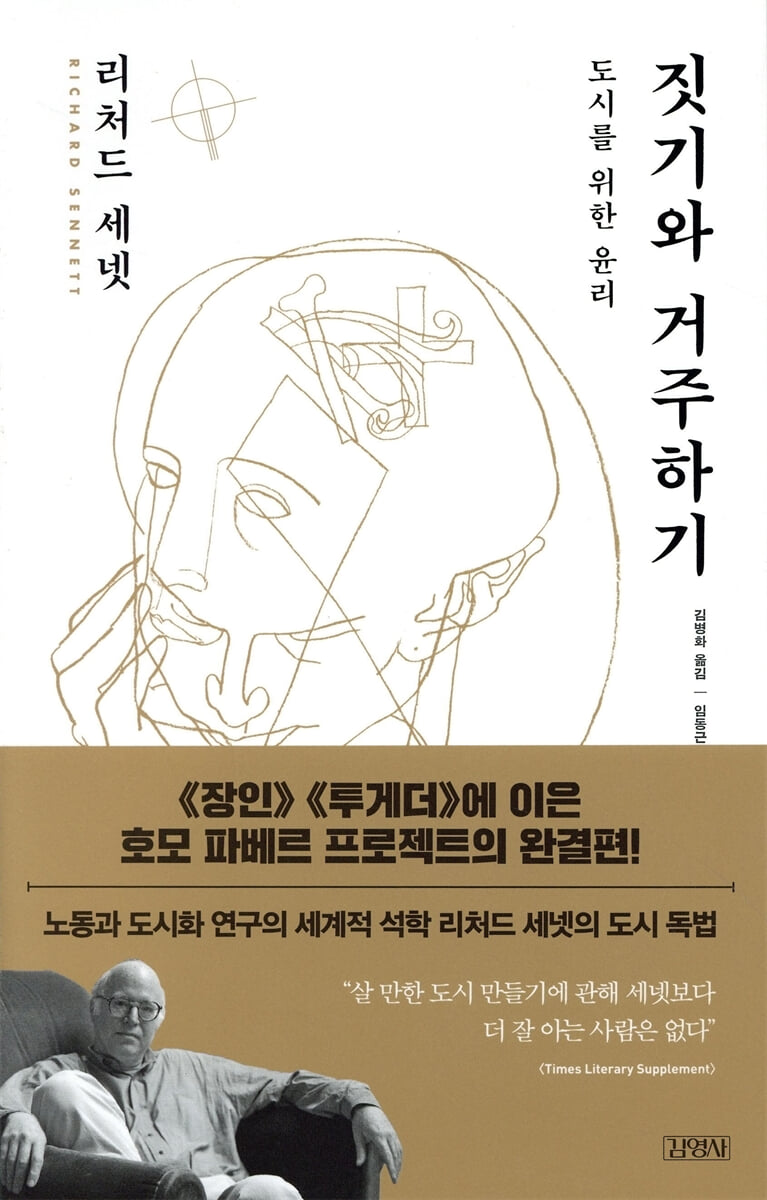
Building and living
 |
Description
Book Introduction
- A word from MD
-
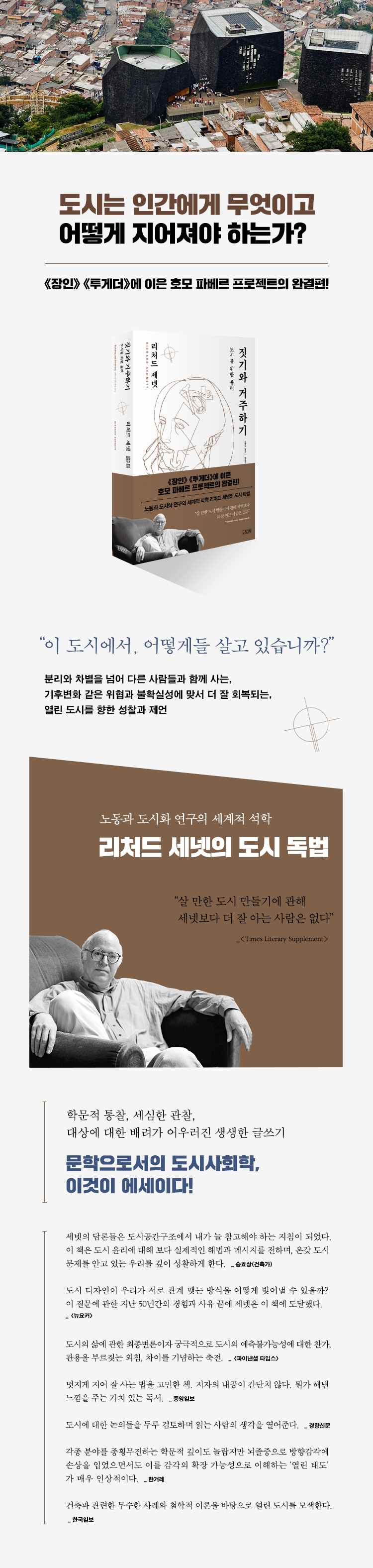
Thinking about an open cityRichard Sennett, an authority on urbanization research, asks about the present and future of cities.
Many cities are struggling to find adequate solutions to their problems of jobs, housing, safety, and inequality.
Class and multicultural issues are also serious.
This book examines various cases and considers what a city is and how it should be built.
January 10, 2020. Social and Political PD Son Min-gyu
What is a city to humans and how should it be built?
Moving through space and inhabiting places,
Urban sociology for humans struggling to build lives and build the world.
The final installment in the Homo Faber trilogy, following "The Craftsman" and "Together."
A reading of the city by Richard Sennett, a world-renowned scholar of labor and urbanization studies.
In this book, he reflects on and proposes ideas about cities, transcending time and space, from ancient Athens to 21st-century Shanghai.
Reflecting on how Paris, Barcelona, and New York became what they are today, the book explores the ideas of major thinkers such as Jane Jacobs, Lewis Mumford, Heidegger, Walter Benjamin, and Hannah Arendt, while traveling to iconic locations ranging from the back alleys of Medellín, Colombia, to Google's headquarters in New York, and Songdo, South Korea, to show how physical cities can enrich people's everyday experiences and strengthen social bonds—or vice versa.
In this book, where the relationship between the physical city being built, 'ville', and the mental city 'cite' that citizens experience in their daily lives is constantly changing, Sennett uses his broad and deep knowledge and delicate insight to examine how and to what extent closed cities—cities where architectural segregation and social inequality reinforce each other—have increased, and proposes an alternative, the open city.
In open cities, people can reveal and accept their differences, learn to deal with complexity, and become more resilient in the face of both short-term and long-term threats and uncertainties, such as the climate crisis.
Moving through space and inhabiting places,
Urban sociology for humans struggling to build lives and build the world.
The final installment in the Homo Faber trilogy, following "The Craftsman" and "Together."
A reading of the city by Richard Sennett, a world-renowned scholar of labor and urbanization studies.
In this book, he reflects on and proposes ideas about cities, transcending time and space, from ancient Athens to 21st-century Shanghai.
Reflecting on how Paris, Barcelona, and New York became what they are today, the book explores the ideas of major thinkers such as Jane Jacobs, Lewis Mumford, Heidegger, Walter Benjamin, and Hannah Arendt, while traveling to iconic locations ranging from the back alleys of Medellín, Colombia, to Google's headquarters in New York, and Songdo, South Korea, to show how physical cities can enrich people's everyday experiences and strengthen social bonds—or vice versa.
In this book, where the relationship between the physical city being built, 'ville', and the mental city 'cite' that citizens experience in their daily lives is constantly changing, Sennett uses his broad and deep knowledge and delicate insight to examine how and to what extent closed cities—cities where architectural segregation and social inequality reinforce each other—have increased, and proposes an alternative, the open city.
In open cities, people can reveal and accept their differences, learn to deal with complexity, and become more resilient in the face of both short-term and long-term threats and uncertainties, such as the climate crisis.
- You can preview some of the book's contents.
Preview
index
1.
Introductory words: twisted, open, and rustic
Twisted│Open│Simple
Part 1 Two Cities
2.
unstable foundation
The Birth of Urban Planning - The Story of an Engineer│Cité - Difficult to Read│Bill│Crowd│Modern but Not Free - Max Weber is Unhappy
3.
Cité and Bill's Divorce
The Separation of People and Places│The Widening Crack│How to Open the City
The difficulties of living in the second part
4.
Klee's Angel Leaves Europe
Informal Residences - Mr. Sudhir in Delhi │ "They occupy but do not live." - Madame Q in Shanghai │ Klee's Angel Leaves Europe - Walter Benjamin in Moscow
5.
The weight of the typist
Residence - Stranger, Brother, Neighbor│Avoid - Two Rejections│Compare - Nearby Classes│Mixing - The Mask of Politeness
6.
Tocqueville of Technopolis
A New Kind of Individual - A Detached Tocqueville | A New Kind of Ghetto - Googleplex | Frictionless Technology - What Psychological Cost Does Being 'User-Friendly' Cost Users | Two Smart Cities - Prescription or Adjustment
Opening of the Third City
7.
A competent city person
Street Smart - Touching, Listening, and Smelling Places│Knowledge of Walking - Settling in Unfamiliar Places│Conversational Practice - Talking to Strangers│Disruption Management - Immigrants, Model City Residents
8.
Five open forms
The center is simultaneous - two central spaces and a failed design│Punctuation - monumental and secular signs│Porosity - cell membrane│Unfinished - shell and generic form│Multiplicity - seed plan
9.
The era of creation
Co-creation - Working in an Open Form│Collaborative but not Close - Sociality
Part 4: Ethics for the City
10.
Shadow of Time
Nature Attacks Cities: Long-Term and Short-Term Threats | Ruptures and Consolidations: 'Normal' City Time | Repairs: Quality Testing
Conclusion: One of many
Acknowledgements
clear
Translator's Note
main
List of illustrations
Search
Introductory words: twisted, open, and rustic
Twisted│Open│Simple
Part 1 Two Cities
2.
unstable foundation
The Birth of Urban Planning - The Story of an Engineer│Cité - Difficult to Read│Bill│Crowd│Modern but Not Free - Max Weber is Unhappy
3.
Cité and Bill's Divorce
The Separation of People and Places│The Widening Crack│How to Open the City
The difficulties of living in the second part
4.
Klee's Angel Leaves Europe
Informal Residences - Mr. Sudhir in Delhi │ "They occupy but do not live." - Madame Q in Shanghai │ Klee's Angel Leaves Europe - Walter Benjamin in Moscow
5.
The weight of the typist
Residence - Stranger, Brother, Neighbor│Avoid - Two Rejections│Compare - Nearby Classes│Mixing - The Mask of Politeness
6.
Tocqueville of Technopolis
A New Kind of Individual - A Detached Tocqueville | A New Kind of Ghetto - Googleplex | Frictionless Technology - What Psychological Cost Does Being 'User-Friendly' Cost Users | Two Smart Cities - Prescription or Adjustment
Opening of the Third City
7.
A competent city person
Street Smart - Touching, Listening, and Smelling Places│Knowledge of Walking - Settling in Unfamiliar Places│Conversational Practice - Talking to Strangers│Disruption Management - Immigrants, Model City Residents
8.
Five open forms
The center is simultaneous - two central spaces and a failed design│Punctuation - monumental and secular signs│Porosity - cell membrane│Unfinished - shell and generic form│Multiplicity - seed plan
9.
The era of creation
Co-creation - Working in an Open Form│Collaborative but not Close - Sociality
Part 4: Ethics for the City
10.
Shadow of Time
Nature Attacks Cities: Long-Term and Short-Term Threats | Ruptures and Consolidations: 'Normal' City Time | Repairs: Quality Testing
Conclusion: One of many
Acknowledgements
clear
Translator's Note
main
List of illustrations
Search
Detailed image
Into the book
In his 1784 essay on life in the Cosmopolis, Immanuel Kant argued that “nothing straight can ever be made from the crooked timber of man.”
The city is a melting pot, teeming with immigrants of diverse backgrounds speaking dozens of languages.
It is also distorted because the inequality within it is so obvious.
Just blocks away from where the slim, stylish women eat lunch are the tired janitors, and there are too many young graduates and too few jobs.
Could physical buildings solve these problems? Could plans to pedestrianize streets alleviate the housing crisis? Would using reinforced insulated glass in buildings make people more tolerant of immigrants? Cities seem to be torn apart by the asymmetry between the city and the ville.
--- p.10~11
The experience of road speed defines a particular version of modernity: 'fast is free, slow is unfree.'
The formula of always having to move as fast as possible to wherever you want diminishes our instinctive sense of place.
You are just passing by.
--- p.58~59
The Boisin Plan illustrates one aspect of fluid modernity: the erasure of the past.
Le Corbusier imagined new districts built of unpainted or white-painted concrete.
Using such colors is meant to challenge the way the passage of time leaves traces on physical materials.
Old buildings and worn paving stones indicate that the physical environment has been used.
Residence leaves traces.
Unpainted or white-painted concrete was attractive to Le Corbusier because it symbolized that a building could be restored at any time, as if no one had ever lived there.
There is a tempting logic to using materials in this way:
To live your own life, you need to break with the past.
To live in the present, eliminate the marks left by time that bring back memories, habits, and beliefs of the past.
Paint the bill white.
White signifies newness and now.
--- p.109~110
Naked power needs clothes to survive.
That is, you have to legitimize yourself.
The promise of growth is one way.
Growth encompasses economic, political, and technological progress all at once.
--- p.146
Mrs. Q was questioning the discernment of Western thinking about Chinese cities.
One time I gave her Jane Jacobs's The Death and Life of Great American Cities and told her to read it.
I thought you might like that book.
But she didn't like it.
Because that great American who championed small towns, slow growth, and bottom-up politics was so "American."
Slow growth is something only rich countries can afford.
Moreover, Mrs. Q naively regarded Jane Jacobs's ideas about spontaneity.
For her, spontaneity meant the Red Guard units she had been stationed in during the Cultural Revolution.
--- p.163~164
Adult refugees didn't learn enough Swedish, as is common when adults learn a foreign language. The only work they could do was manual labor.
In contrast, adolescent children acquired language at a faster rate.
Adults have seen children easily learn foreign languages and quickly embrace foreign cultures.
As children become more integrated, they may forget the hardships and trauma that brought their parents there in the first place.
After some time had passed since settling in, many parents began to worry that their children might actually turn out that way.
Integration was both a practical salvation and an experiential loss.
How would you live in a place where you don't belong? Conversely, how would others treat you in such a place?
--- p.183
I was fortunate enough to attend a few of Levinas' weekly lectures on Torah interpretation, and I found them confusing.
Why did he devote so much time to the arduous task of translating Hebrew into French? Over time, I realized that translation was precisely the issue his ethical vision addressed.
Languages reach out to each other, but they encounter insurmountable limitations.
Each language contains irreducible and untranslatable meanings.
In life, such situations exist more widely.
From Levinas's perspective, neighbors are ethical beings who turn to each other, but ultimately do not understand each other.
However, we cannot turn away indifferently just because we do not understand our neighbors.
Because our relationship with our neighbors is precisely the relationship between humans and God, a relationship with a divine being that transcends our capacity to understand.
--- p.186
The idea that the oppressed will unite in solidarity is a naive notion, and in reality, it rarely happens.
Oppression does not produce unity.
Rather, solidarity is a necessary fiction to convey to the ruling class, 'We are strong because we are united.'
The oppressed need to learn to believe and act on this fiction as fact.
Otherwise, the oppressors will use their divisions to divide and rule.
--- p.200
The trend toward frictionlessness reserves attention for the specific details of complex places, even at a trivial level.
For example, instead of going to a local cafe that is hard to get to, you just go to Starbucks.
To take a more serious example, frictionlessness only recognizes the typicality of others, such as blacks or Muslims.
Because identifying the specificity of a black man or a Muslim woman who doesn't fit that stereotype requires mental as well as emotional labor.
--- p.236
You're talking about your father's cruelty, and I 'out of the blue' say that my father is bald.
This unexpected reaction actually frees you from the painful and entrenched stream of monologue the confession of your father's evil deeds that you have kept in your heart for a long time.
The story about my father's baldness lightens the weight of the exchange between you and me, but more importantly, it keeps the exchange going.
I haven't forgotten that your father was cruel.
In fact, I'm going to try to find hints and traces of that in you as I order another glass of alcohol.
We will talk more.
--- p.289
Le Corbusier hoped that a series of identical high-rise buildings could extend indefinitely throughout the Marais district and, by extension, throughout all of Paris.
The design represents a closed system composed of homogeneous, addable parts.
That indiscriminateness was realized in Madame Q's Shanghai and the new towns of Korea.
Identical buildings in such places are distinguished by large numbers written on their exterior walls.
Without seeing the numbers, people have a hard time discerning which building they live in.
--- p.312
A radical element in Van Eyck's park was the concept of how children should play.
The children's playground in his park was not isolated from the road for safety reasons.
There was a chin, but no iron fence.
Van Eyck's position was that children should learn the difference between traffic and grass, and they did.
There have been very few accidents due to this porosity.
In the same way, benches provided for adults were not spatially separated from the areas where children played.
The children learned how to behave so as not to disturb the elderly who were talking or sleeping there.
--- p.332
No planner since Jane Jacobs has said, "Surrender," like Robert Moses.
I don't boldly declare to the public, 'I know what's best.'
Because there are ways to wield the whip more delicately than just making such declarations.
Community building-related 'consultation' typically involves the planning department.
When the department puts forward a proposal, for example, regarding the location and construction method of a new road, and people living near the location or cycling champions raise a loud objection, the planning department “reflects” on the objections after a “beneficial exchange of views” and then proceeds with the project in a manner not significantly different from what was originally intended.
During this process, planners create the illusion that negotiations are actually taking place by embedding details into the proposal that they are willing to discard, much like diplomatic negotiations.
--- p.363
At this time, an expert was absent.
A UN planner had to leave Beirut because of his mother's illness.
When I returned a week later and said, “I’m sorry I left you behind,” the South Beirut man replied,
“We managed to do it ourselves.” They did it by focusing on how much power line the neighborhood needed rather than on their mutual grudges.
The expert's departure did not bring about a warm reconciliation.
Because the burden caused by the difference was too great.
But the plan didn't fall apart even though the expert was gone.
--- p.376
Alexis de Tocqueville used the word democracy in two senses.
The first is the majority rule, which he feared.
Because the majority can oppress the minority, and the 51 percent can oppress the 49 percent.
The second is individualism.
Individualism here means that people separate themselves and focus on their own work.
He feared this kind of individualism.
Because it “silently releases the vitality of action.”
A society where people share almost the same tastes and beliefs, a society where life is simplified and user-friendly, is a society that is losing energy.
It is a society where cooperation between different people is withering away.
--- p.387
Social critic Ash Amin describes the Kantian cosmopolitan as someone who is “indifferent to difference” and thus capable of practicing tolerance.
Tolerance was a core virtue in Karl Popper's definition of an open society.
Isaiah Berlin also said that tolerance is necessary because there is not one truth, but rather a number of conflicting yet equally valid truths.
Tolerance, so to speak, depends on indifference to the truth, or at least on an indifference that does not regard truth as a matter of life and death.
The city is a melting pot, teeming with immigrants of diverse backgrounds speaking dozens of languages.
It is also distorted because the inequality within it is so obvious.
Just blocks away from where the slim, stylish women eat lunch are the tired janitors, and there are too many young graduates and too few jobs.
Could physical buildings solve these problems? Could plans to pedestrianize streets alleviate the housing crisis? Would using reinforced insulated glass in buildings make people more tolerant of immigrants? Cities seem to be torn apart by the asymmetry between the city and the ville.
--- p.10~11
The experience of road speed defines a particular version of modernity: 'fast is free, slow is unfree.'
The formula of always having to move as fast as possible to wherever you want diminishes our instinctive sense of place.
You are just passing by.
--- p.58~59
The Boisin Plan illustrates one aspect of fluid modernity: the erasure of the past.
Le Corbusier imagined new districts built of unpainted or white-painted concrete.
Using such colors is meant to challenge the way the passage of time leaves traces on physical materials.
Old buildings and worn paving stones indicate that the physical environment has been used.
Residence leaves traces.
Unpainted or white-painted concrete was attractive to Le Corbusier because it symbolized that a building could be restored at any time, as if no one had ever lived there.
There is a tempting logic to using materials in this way:
To live your own life, you need to break with the past.
To live in the present, eliminate the marks left by time that bring back memories, habits, and beliefs of the past.
Paint the bill white.
White signifies newness and now.
--- p.109~110
Naked power needs clothes to survive.
That is, you have to legitimize yourself.
The promise of growth is one way.
Growth encompasses economic, political, and technological progress all at once.
--- p.146
Mrs. Q was questioning the discernment of Western thinking about Chinese cities.
One time I gave her Jane Jacobs's The Death and Life of Great American Cities and told her to read it.
I thought you might like that book.
But she didn't like it.
Because that great American who championed small towns, slow growth, and bottom-up politics was so "American."
Slow growth is something only rich countries can afford.
Moreover, Mrs. Q naively regarded Jane Jacobs's ideas about spontaneity.
For her, spontaneity meant the Red Guard units she had been stationed in during the Cultural Revolution.
--- p.163~164
Adult refugees didn't learn enough Swedish, as is common when adults learn a foreign language. The only work they could do was manual labor.
In contrast, adolescent children acquired language at a faster rate.
Adults have seen children easily learn foreign languages and quickly embrace foreign cultures.
As children become more integrated, they may forget the hardships and trauma that brought their parents there in the first place.
After some time had passed since settling in, many parents began to worry that their children might actually turn out that way.
Integration was both a practical salvation and an experiential loss.
How would you live in a place where you don't belong? Conversely, how would others treat you in such a place?
--- p.183
I was fortunate enough to attend a few of Levinas' weekly lectures on Torah interpretation, and I found them confusing.
Why did he devote so much time to the arduous task of translating Hebrew into French? Over time, I realized that translation was precisely the issue his ethical vision addressed.
Languages reach out to each other, but they encounter insurmountable limitations.
Each language contains irreducible and untranslatable meanings.
In life, such situations exist more widely.
From Levinas's perspective, neighbors are ethical beings who turn to each other, but ultimately do not understand each other.
However, we cannot turn away indifferently just because we do not understand our neighbors.
Because our relationship with our neighbors is precisely the relationship between humans and God, a relationship with a divine being that transcends our capacity to understand.
--- p.186
The idea that the oppressed will unite in solidarity is a naive notion, and in reality, it rarely happens.
Oppression does not produce unity.
Rather, solidarity is a necessary fiction to convey to the ruling class, 'We are strong because we are united.'
The oppressed need to learn to believe and act on this fiction as fact.
Otherwise, the oppressors will use their divisions to divide and rule.
--- p.200
The trend toward frictionlessness reserves attention for the specific details of complex places, even at a trivial level.
For example, instead of going to a local cafe that is hard to get to, you just go to Starbucks.
To take a more serious example, frictionlessness only recognizes the typicality of others, such as blacks or Muslims.
Because identifying the specificity of a black man or a Muslim woman who doesn't fit that stereotype requires mental as well as emotional labor.
--- p.236
You're talking about your father's cruelty, and I 'out of the blue' say that my father is bald.
This unexpected reaction actually frees you from the painful and entrenched stream of monologue the confession of your father's evil deeds that you have kept in your heart for a long time.
The story about my father's baldness lightens the weight of the exchange between you and me, but more importantly, it keeps the exchange going.
I haven't forgotten that your father was cruel.
In fact, I'm going to try to find hints and traces of that in you as I order another glass of alcohol.
We will talk more.
--- p.289
Le Corbusier hoped that a series of identical high-rise buildings could extend indefinitely throughout the Marais district and, by extension, throughout all of Paris.
The design represents a closed system composed of homogeneous, addable parts.
That indiscriminateness was realized in Madame Q's Shanghai and the new towns of Korea.
Identical buildings in such places are distinguished by large numbers written on their exterior walls.
Without seeing the numbers, people have a hard time discerning which building they live in.
--- p.312
A radical element in Van Eyck's park was the concept of how children should play.
The children's playground in his park was not isolated from the road for safety reasons.
There was a chin, but no iron fence.
Van Eyck's position was that children should learn the difference between traffic and grass, and they did.
There have been very few accidents due to this porosity.
In the same way, benches provided for adults were not spatially separated from the areas where children played.
The children learned how to behave so as not to disturb the elderly who were talking or sleeping there.
--- p.332
No planner since Jane Jacobs has said, "Surrender," like Robert Moses.
I don't boldly declare to the public, 'I know what's best.'
Because there are ways to wield the whip more delicately than just making such declarations.
Community building-related 'consultation' typically involves the planning department.
When the department puts forward a proposal, for example, regarding the location and construction method of a new road, and people living near the location or cycling champions raise a loud objection, the planning department “reflects” on the objections after a “beneficial exchange of views” and then proceeds with the project in a manner not significantly different from what was originally intended.
During this process, planners create the illusion that negotiations are actually taking place by embedding details into the proposal that they are willing to discard, much like diplomatic negotiations.
--- p.363
At this time, an expert was absent.
A UN planner had to leave Beirut because of his mother's illness.
When I returned a week later and said, “I’m sorry I left you behind,” the South Beirut man replied,
“We managed to do it ourselves.” They did it by focusing on how much power line the neighborhood needed rather than on their mutual grudges.
The expert's departure did not bring about a warm reconciliation.
Because the burden caused by the difference was too great.
But the plan didn't fall apart even though the expert was gone.
--- p.376
Alexis de Tocqueville used the word democracy in two senses.
The first is the majority rule, which he feared.
Because the majority can oppress the minority, and the 51 percent can oppress the 49 percent.
The second is individualism.
Individualism here means that people separate themselves and focus on their own work.
He feared this kind of individualism.
Because it “silently releases the vitality of action.”
A society where people share almost the same tastes and beliefs, a society where life is simplified and user-friendly, is a society that is losing energy.
It is a society where cooperation between different people is withering away.
--- p.387
Social critic Ash Amin describes the Kantian cosmopolitan as someone who is “indifferent to difference” and thus capable of practicing tolerance.
Tolerance was a core virtue in Karl Popper's definition of an open society.
Isaiah Berlin also said that tolerance is necessary because there is not one truth, but rather a number of conflicting yet equally valid truths.
Tolerance, so to speak, depends on indifference to the truth, or at least on an indifference that does not regard truth as a matter of life and death.
--- p.434~435
Publisher's Review
“No one knows better than Sennett about making cities worth living in.” _[Times Literary Supplement]
The final installment of the Homo Faber project, following 『Craftsman』 and 『Together』!
A reading of the city by Richard Sennett, a world-renowned scholar of labor and urbanization studies.
What is a city to humans, and how should it be built?
"Building and Dwelling" is the final installment of the "Homo Faber Project," a long-running project by Richard Sennett, a world-renowned scholar of labor and urbanization studies.
In this project, Sennett explains how humans (Homo Faber), beings who create their own lives through concrete practices, shape their personal efforts, social relationships, and physical environments.
Following 『Craftsman』, which preached that 'technology' that improves life is not receiving due recognition in modern society, 『Together』 focused on 'cooperation', a skill necessary for actually doing work, and proposed ways to strengthen social cooperation.
The final part of the trilogy, Building and Dwelling, explores the relationship between the city, the physical environment of civilization, and Homo Faber.
This is the final book in a project that has been in the works for ten years, and the theme of the 'city' dates back to Sennett's first book, 'The Uses of Disorder', published about 50 years ago.
In this book, which can be said to be a reflection of a lifetime of experience and reflection as a sociologist, traveler, and urban planner, Sennett unfolds with a scholarly yet elegant and delicate tone what cities are to humans and how they should be built.
Living together with others beyond separation and discrimination,
Better resilient to threats and uncertainties such as climate change,
Reflections and Suggestions for an Open City
In this book, Sennett reflects on and proposes ideas about cities, transcending time and space, from ancient Athens to 21st-century Shanghai.
Reflecting on how Paris, Barcelona, and New York became what they are today, the book explores the ideas of major thinkers such as Jane Jacobs, Lewis Mumford, Heidegger, Walter Benjamin, and Hannah Arendt, while traveling to iconic locations ranging from the back alleys of Medellín, Colombia, to Google's headquarters in New York, and Songdo, South Korea, to show how physical cities can enrich people's everyday experiences and strengthen social bonds—or vice versa.
In this book, where the relationship between the physical city being built, 'ville', and the mental city 'cite' that citizens experience in their daily lives is constantly changing, Sennett uses his broad and deep knowledge and delicate insight to examine how and to what extent closed cities - cities where architectural separation and social inequality reinforce each other - have increased, and proposes the 'open city' as an alternative.
In open cities, people can reveal and accept their differences, learn to deal with complexity, and become more resilient in the face of both short-term and long-term threats and uncertainties, such as the climate crisis.
“So what are you going to do?”
An intellectual journey to find answers to the questions posed by Jane Jacobs, the "mother of urban planning."
Vivid writing that combines scholarly insight, meticulous observation, and consideration for the subject matter.
Urban sociology as literature, this is an essay!
Sennett's writing is distinctive.
One media outlet's assessment that "a snapshot of reality brings great ideas to life" is by no means an exaggeration.
He talks about his specific experiences, then immediately connects them to discussions of sociological theory and social reality, and while he seems to be flustered by constantly changing the subject, he soon gets to the point.
Concrete cases and sociological theories are linked extremely flexibly.
Sennett described his first book, The Uses of Disorder, as "sociology in literary form," and urged that it be read as "an essay reflecting on urban culture" rather than as an introduction to urban planning or a sociological treatise.
This order also applies to 『Building and Dwelling』.
Mr. Sudhir, a street vendor whom the author met in person at Nehru Place, a market in Delhi, India, can be said to be the main character of this 'sociology as literature', appearing in various places from the first appearance in Chapter 4 until the final conclusion, and in Chapter 8, he even designs a city in Sennett's imagination.
In addition, his experiences with Madame Q in Shanghai, China, and with the boys who guided the way in Medellin, Colombia, South America, are impressive examples of Sennett's ability to extract sociological meaning from the trivial acts and events of everyday life.
Readers will feel as if they have met them along with Sennet.
Deep scholarly insight, meticulous observation, and consideration for the subject matter underlie such lively and vivid writing.
This book is also an intellectual journey to find answers to the questions posed to Sennett by Jane Jacobs, also known as the 'mother of urban planning.'
After introducing the debate between Jane Jacobs, who advocated an informal, free, and loose approach, and Lewis Mumford, who emphasized the need for large-scale, holistic urban planning to solve urban problems, Sennett recalls his meeting with Jacobs.
“When I was first trying to figure out the relationship between Cité and Bill, I told Jane Jacobs that she was better than Mumford when it came to Cité, and Mumford was better when it came to Bill.
(Omitted) After hearing what I said, she turned around curtly and asked, “So what are you going to do?” (p. 136) “So what are you going to do?” This question, which is not easily answered, appears at the end of Part 1, and the reader cannot help but turn the page, wondering if Sennett has found the answer and what it is.
These devices, which appear throughout the book, are the work of an excellent and skilled storyteller.
“How do you all live in this city?”
Moving through space and inhabiting places,
Struggling to build life and build the world
Urban Sociology for Humans
Sennett explores how the rift between the built and the lived—the bill and the city—affects three issues.
The first is urban expansion and rapid growth.
As of 2018, the urban population ratio in Korea reached 92%.
Globally, 55%, or more than half of the world's population, lives in cities, and this proportion continues to increase, with seven out of ten people projected to live in cities by 2050.
According to a UN report, the regions expected to see the greatest population growth are those in Asia and Africa, including India, China, and Nigeria, which were relatively underdeveloped regions. The explosive growth and subsequent suffering seen in cities like Delhi and Shanghai in these regions are familiar to us, who have achieved rapid growth, often referred to as the "Miracle on the Han River." (Chapter 4)
The second is the exclusion of the typist.
In January 2015, the anti-Islam group PEGIDA staged a protest in Dresden, Germany.
They said they wanted 'the expulsion of Islam from Germany to preserve our culture'.
But in most places outside Dresden, anti-Pegida protests outnumbered the protests, and less than a year later, Germany welcomed refugees from the Syrian civil war as brothers.
Now, all that remains is 'integration'.
According to Sennett, for refugees, integration is "practically salvation, but experiential loss." Can they truly integrate into their new society and become "neighbors"? Today's cities spatially separate refugees and other groups based on religious, racial, ethnic, and class affiliations.
A prime example is the phenomenon we call "gentrification." (Chapter 5)
The third is a technology issue.
Technology makes life smoother and sleeker, lightening the load on the typist.
Google is not just a dream job, but is also called a “god’s workplace.”
Sennett tours Google's headquarters and asks whether self-contained spaces with laundromats, doctors, and gyms are truly desirable.
This type of architecture encourages gentrification by driving up housing prices and rents in surrounding areas, and the company is built to stimulate the free exchange of ideas internally, even as it destroys the free market outside.
But does this frictionless, introverted environment truly foster creativity? Sennett compares two smart cities—Songdo, South Korea, and Curitiba, Brazil—to demonstrate the psychological toll frictionless "user-friendliness" takes on users (Chapter 6).
This is the image of today's city as read by Sennett and of humans as "beings struggling to settle down while wandering in a place where they do not belong" (p. 184).
But Sennett, who said in an interview, "It's a very strange thing to be an optimist at the end of your life, but I really believe it's possible," has a warm view of the city and its people.
And he proposes that we share our own experiments and challenges and think together about how we can create an 'open city' where no one is excluded and everyone is welcome.
“The author’s time is over, and it is now the reader’s time.”
An introduction to reading 『Building and Dwelling』 in depth
This book includes an introduction by Dr. Dong-Geun Lim, who translated Sennet's Flesh and Stone.
This commentary, which is also the inner story of Dr. Dong-Geun Lim, who conducts an imaginary interview with Sennet, contains things that should not be forgotten when reading Sennet, as well as questions and topics raised in "Building and Dwelling," stimulating readers to read the book deeply, actively, and from various perspectives.
The last part of the release is moved here.
“Now the author’s time is over and it is the reader’s time.
The traces left by readers will continue in the future books of Sennett and his colleagues, providing new insights to people living in different times and cities.
“Senet’s ideas about ‘cities and people’, which he developed over nearly 50 years starting in his 20s, are contained in this book as ‘Ethics for Cities,’ and we underline and question them.”
The final installment of the Homo Faber project, following 『Craftsman』 and 『Together』!
A reading of the city by Richard Sennett, a world-renowned scholar of labor and urbanization studies.
What is a city to humans, and how should it be built?
"Building and Dwelling" is the final installment of the "Homo Faber Project," a long-running project by Richard Sennett, a world-renowned scholar of labor and urbanization studies.
In this project, Sennett explains how humans (Homo Faber), beings who create their own lives through concrete practices, shape their personal efforts, social relationships, and physical environments.
Following 『Craftsman』, which preached that 'technology' that improves life is not receiving due recognition in modern society, 『Together』 focused on 'cooperation', a skill necessary for actually doing work, and proposed ways to strengthen social cooperation.
The final part of the trilogy, Building and Dwelling, explores the relationship between the city, the physical environment of civilization, and Homo Faber.
This is the final book in a project that has been in the works for ten years, and the theme of the 'city' dates back to Sennett's first book, 'The Uses of Disorder', published about 50 years ago.
In this book, which can be said to be a reflection of a lifetime of experience and reflection as a sociologist, traveler, and urban planner, Sennett unfolds with a scholarly yet elegant and delicate tone what cities are to humans and how they should be built.
Living together with others beyond separation and discrimination,
Better resilient to threats and uncertainties such as climate change,
Reflections and Suggestions for an Open City
In this book, Sennett reflects on and proposes ideas about cities, transcending time and space, from ancient Athens to 21st-century Shanghai.
Reflecting on how Paris, Barcelona, and New York became what they are today, the book explores the ideas of major thinkers such as Jane Jacobs, Lewis Mumford, Heidegger, Walter Benjamin, and Hannah Arendt, while traveling to iconic locations ranging from the back alleys of Medellín, Colombia, to Google's headquarters in New York, and Songdo, South Korea, to show how physical cities can enrich people's everyday experiences and strengthen social bonds—or vice versa.
In this book, where the relationship between the physical city being built, 'ville', and the mental city 'cite' that citizens experience in their daily lives is constantly changing, Sennett uses his broad and deep knowledge and delicate insight to examine how and to what extent closed cities - cities where architectural separation and social inequality reinforce each other - have increased, and proposes the 'open city' as an alternative.
In open cities, people can reveal and accept their differences, learn to deal with complexity, and become more resilient in the face of both short-term and long-term threats and uncertainties, such as the climate crisis.
“So what are you going to do?”
An intellectual journey to find answers to the questions posed by Jane Jacobs, the "mother of urban planning."
Vivid writing that combines scholarly insight, meticulous observation, and consideration for the subject matter.
Urban sociology as literature, this is an essay!
Sennett's writing is distinctive.
One media outlet's assessment that "a snapshot of reality brings great ideas to life" is by no means an exaggeration.
He talks about his specific experiences, then immediately connects them to discussions of sociological theory and social reality, and while he seems to be flustered by constantly changing the subject, he soon gets to the point.
Concrete cases and sociological theories are linked extremely flexibly.
Sennett described his first book, The Uses of Disorder, as "sociology in literary form," and urged that it be read as "an essay reflecting on urban culture" rather than as an introduction to urban planning or a sociological treatise.
This order also applies to 『Building and Dwelling』.
Mr. Sudhir, a street vendor whom the author met in person at Nehru Place, a market in Delhi, India, can be said to be the main character of this 'sociology as literature', appearing in various places from the first appearance in Chapter 4 until the final conclusion, and in Chapter 8, he even designs a city in Sennett's imagination.
In addition, his experiences with Madame Q in Shanghai, China, and with the boys who guided the way in Medellin, Colombia, South America, are impressive examples of Sennett's ability to extract sociological meaning from the trivial acts and events of everyday life.
Readers will feel as if they have met them along with Sennet.
Deep scholarly insight, meticulous observation, and consideration for the subject matter underlie such lively and vivid writing.
This book is also an intellectual journey to find answers to the questions posed to Sennett by Jane Jacobs, also known as the 'mother of urban planning.'
After introducing the debate between Jane Jacobs, who advocated an informal, free, and loose approach, and Lewis Mumford, who emphasized the need for large-scale, holistic urban planning to solve urban problems, Sennett recalls his meeting with Jacobs.
“When I was first trying to figure out the relationship between Cité and Bill, I told Jane Jacobs that she was better than Mumford when it came to Cité, and Mumford was better when it came to Bill.
(Omitted) After hearing what I said, she turned around curtly and asked, “So what are you going to do?” (p. 136) “So what are you going to do?” This question, which is not easily answered, appears at the end of Part 1, and the reader cannot help but turn the page, wondering if Sennett has found the answer and what it is.
These devices, which appear throughout the book, are the work of an excellent and skilled storyteller.
“How do you all live in this city?”
Moving through space and inhabiting places,
Struggling to build life and build the world
Urban Sociology for Humans
Sennett explores how the rift between the built and the lived—the bill and the city—affects three issues.
The first is urban expansion and rapid growth.
As of 2018, the urban population ratio in Korea reached 92%.
Globally, 55%, or more than half of the world's population, lives in cities, and this proportion continues to increase, with seven out of ten people projected to live in cities by 2050.
According to a UN report, the regions expected to see the greatest population growth are those in Asia and Africa, including India, China, and Nigeria, which were relatively underdeveloped regions. The explosive growth and subsequent suffering seen in cities like Delhi and Shanghai in these regions are familiar to us, who have achieved rapid growth, often referred to as the "Miracle on the Han River." (Chapter 4)
The second is the exclusion of the typist.
In January 2015, the anti-Islam group PEGIDA staged a protest in Dresden, Germany.
They said they wanted 'the expulsion of Islam from Germany to preserve our culture'.
But in most places outside Dresden, anti-Pegida protests outnumbered the protests, and less than a year later, Germany welcomed refugees from the Syrian civil war as brothers.
Now, all that remains is 'integration'.
According to Sennett, for refugees, integration is "practically salvation, but experiential loss." Can they truly integrate into their new society and become "neighbors"? Today's cities spatially separate refugees and other groups based on religious, racial, ethnic, and class affiliations.
A prime example is the phenomenon we call "gentrification." (Chapter 5)
The third is a technology issue.
Technology makes life smoother and sleeker, lightening the load on the typist.
Google is not just a dream job, but is also called a “god’s workplace.”
Sennett tours Google's headquarters and asks whether self-contained spaces with laundromats, doctors, and gyms are truly desirable.
This type of architecture encourages gentrification by driving up housing prices and rents in surrounding areas, and the company is built to stimulate the free exchange of ideas internally, even as it destroys the free market outside.
But does this frictionless, introverted environment truly foster creativity? Sennett compares two smart cities—Songdo, South Korea, and Curitiba, Brazil—to demonstrate the psychological toll frictionless "user-friendliness" takes on users (Chapter 6).
This is the image of today's city as read by Sennett and of humans as "beings struggling to settle down while wandering in a place where they do not belong" (p. 184).
But Sennett, who said in an interview, "It's a very strange thing to be an optimist at the end of your life, but I really believe it's possible," has a warm view of the city and its people.
And he proposes that we share our own experiments and challenges and think together about how we can create an 'open city' where no one is excluded and everyone is welcome.
“The author’s time is over, and it is now the reader’s time.”
An introduction to reading 『Building and Dwelling』 in depth
This book includes an introduction by Dr. Dong-Geun Lim, who translated Sennet's Flesh and Stone.
This commentary, which is also the inner story of Dr. Dong-Geun Lim, who conducts an imaginary interview with Sennet, contains things that should not be forgotten when reading Sennet, as well as questions and topics raised in "Building and Dwelling," stimulating readers to read the book deeply, actively, and from various perspectives.
The last part of the release is moved here.
“Now the author’s time is over and it is the reader’s time.
The traces left by readers will continue in the future books of Sennett and his colleagues, providing new insights to people living in different times and cities.
“Senet’s ideas about ‘cities and people’, which he developed over nearly 50 years starting in his 20s, are contained in this book as ‘Ethics for Cities,’ and we underline and question them.”
GOODS SPECIFICS
- Date of issue: January 3, 2020
- Page count, weight, size: 512 pages | 788g | 145*225*35mm
- ISBN13: 9788934999669
- ISBN10: 8934999667
You may also like
카테고리
korean


korean

![GQ KOREA Mark (Monthly): December [2025]](http://librairie.coreenne.fr/cdn/shop/files/8ef265dbbfbf186523ed75ba7319009d.jpg?v=1765340328&width=3840)


