

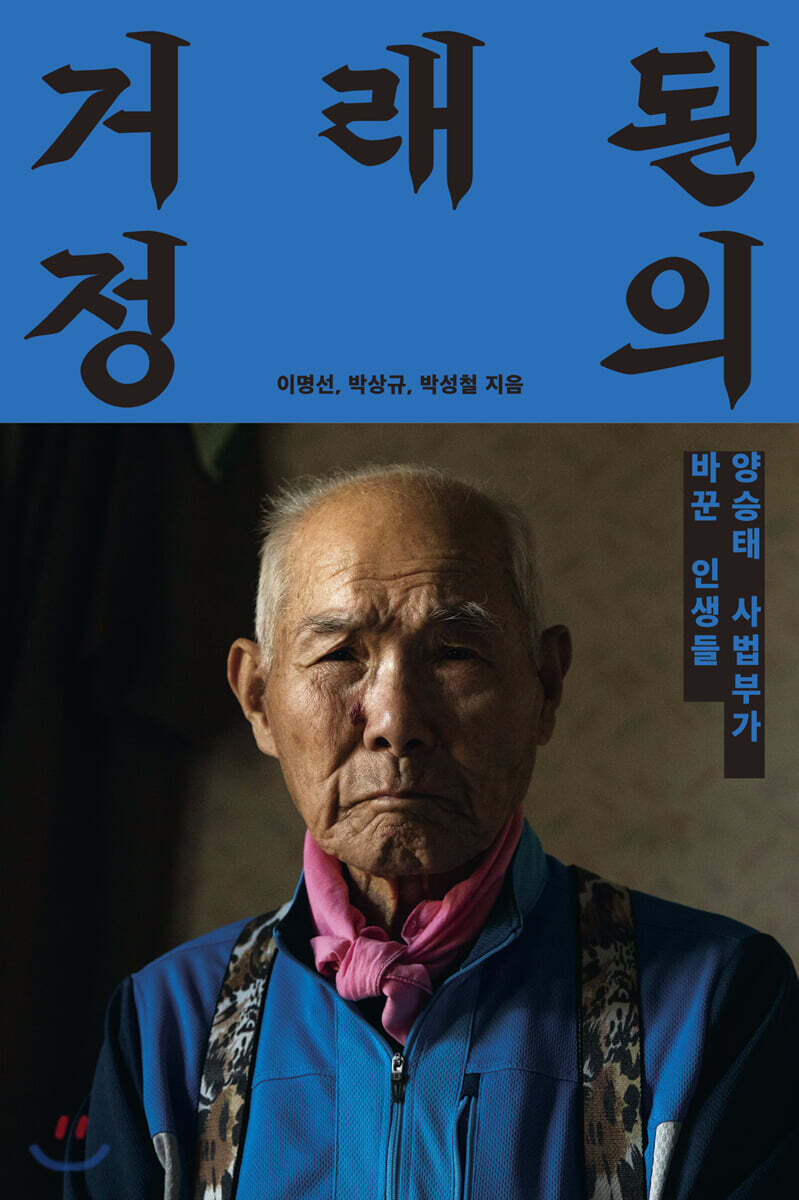
Traded definition
 |
Description
Book Introduction
- A word from MD
-
Lives Destroyed by the JudiciaryA just society requires a properly functioning judiciary.
Unfortunately, this book records the opposite.
The main characters are victims whose daily lives were destroyed by a ruling involving Judge Yang Seung-tae.
Victims of forced labor at war-criminal companies, KTX crew members, and Ssangyong Motors workers now question whether our judiciary is just.
December 13, 2019. Social and Political PD Son Min-gyu
A book containing the three years of reporting by Sherlock, a truth-seeking group comprised of journalists and lawyers.
In February 2017, the true face of judicial corruption was revealed through the suspicions surrounding the Supreme Court's "judge blacklist," and we trace the trajectory of "trial trading" through direct contact with victims and their voices.
Their voices encounter the dark modern and contemporary political history of Korea, from the Jeju spy fabrication case, the Korean-Japanese spy fabrication case, the People's Revolutionary Party Reconstruction Committee case, the Daegu October Incident, the Chuncheon rape and murder fabrication case, the emergency measure violation case, compensation for damages from forced labor by war criminals, to the Ssangyong Motor layoffs, the Korean Teachers and Education Workers Union (KTU) teacher guerrilla memorial service case, the KTU's illegalization as a union, the Unified Progressive Party's dissolution trial, and the dismissal of KTX crew members, and vividly testify to how the state and the judiciary have changed the lives of ordinary people.
And let's contrast the life of one person involved in all of these incidents: former Chief Justice Yang Seung-tae.
In February 2017, the true face of judicial corruption was revealed through the suspicions surrounding the Supreme Court's "judge blacklist," and we trace the trajectory of "trial trading" through direct contact with victims and their voices.
Their voices encounter the dark modern and contemporary political history of Korea, from the Jeju spy fabrication case, the Korean-Japanese spy fabrication case, the People's Revolutionary Party Reconstruction Committee case, the Daegu October Incident, the Chuncheon rape and murder fabrication case, the emergency measure violation case, compensation for damages from forced labor by war criminals, to the Ssangyong Motor layoffs, the Korean Teachers and Education Workers Union (KTU) teacher guerrilla memorial service case, the KTU's illegalization as a union, the Unified Progressive Party's dissolution trial, and the dismissal of KTX crew members, and vividly testify to how the state and the judiciary have changed the lives of ordinary people.
And let's contrast the life of one person involved in all of these incidents: former Chief Justice Yang Seung-tae.
- You can preview some of the book's contents.
Preview
index
Recommendation
prolog
Part 1: Yang Seung-tae's Years as a Judge 1975–2004
Forced false confessions and intentional mistrials
Yang Seung-tae's life, the life he destroyed
When a judge sides with someone
Yang Seung-tae and Kim Ki-chun were one.
-- 'State crimes' and the responsibility of the law
Part 2: Yang Seung-tae's tenure as Supreme Court Justice and Chief Justice, 2005–2017
An elderly man owes 1.3 billion won to the National Intelligence Service
Paying off the NIS debt with bank debt
The irony of the perpetrator becoming the creditor
Mom's 60 Years are Traded
There is no miracle in room 7.
Never slept on rights
A Closer Look at the '6-Month Verdict'
Usage of the word 'Gwangjeong'
one person
Kim Joo-joong's last interview
Neither innocence nor guilt means anything
Killing the Korean Teachers and Education Workers Union
A riot created
The fight is not over
talk
Park Sung-chul ↔ Lee Myeong-seon / Meeting the victims of trial deals
Park Sang-gyu ↔ Lee Myeong-seon / Why are they always socially disadvantaged?
Epilogue
prolog
Part 1: Yang Seung-tae's Years as a Judge 1975–2004
Forced false confessions and intentional mistrials
Yang Seung-tae's life, the life he destroyed
When a judge sides with someone
Yang Seung-tae and Kim Ki-chun were one.
-- 'State crimes' and the responsibility of the law
Part 2: Yang Seung-tae's tenure as Supreme Court Justice and Chief Justice, 2005–2017
An elderly man owes 1.3 billion won to the National Intelligence Service
Paying off the NIS debt with bank debt
The irony of the perpetrator becoming the creditor
Mom's 60 Years are Traded
There is no miracle in room 7.
Never slept on rights
A Closer Look at the '6-Month Verdict'
Usage of the word 'Gwangjeong'
one person
Kim Joo-joong's last interview
Neither innocence nor guilt means anything
Killing the Korean Teachers and Education Workers Union
A riot created
The fight is not over
talk
Park Sung-chul ↔ Lee Myeong-seon / Meeting the victims of trial deals
Park Sang-gyu ↔ Lee Myeong-seon / Why are they always socially disadvantaged?
Epilogue
Detailed image

Into the book
Looking at the People's Revolutionary Party family, I was reminded of a large family gathered around the holidays.
Looking at the banquet table of Mr. Lee Chang-bok's wife, Ms. Park In-sun, I felt even more like a holiday.
A day before, I went to a traditional market in Seoul to buy ingredients and prepare a sumptuous feast.
There were so many side dishes that the guests sat around a long wooden table and were busy protecting the plates that were about to be pushed off the table.
Then someone told a joke that was both funny and sad.
“We are a family brought together by Park Chung-hee.”
--- p.
19, from "Prologue"
Oh Jae-seon listened to his younger brother's words without even putting down the noodles he was holding on his chopsticks.
“I’m fine, so take care of your health first.
I'll tell the lawyer not to call you as a witness.
“Don’t worry and rest easy.”
While he was talking on the phone, the noodles in his chopsticks swelled.
Oh Jae-seon said, choking up, “My younger brother, who was tortured because of me, is still suffering from trauma.”
He slowly chewed the burst white noodles, wiping his reddened eyes.
Even that wasn't easy to get through, so he left a lot of food behind.
--- p.35, from “Forced False Confessions and Intentional Misjudgments”
Our society is deeply angered by low-level investigators who act as the "club of the regime," but is lenient toward high-ranking judges who cooperate with the regime by passing judgments that punish innocent people.
They have never been held legally responsible.
I asked Kang Hee-chul, who said he still often loses sleep over this.
“Judge Yang Seung-tae, who sentenced you to life imprisonment in the first trial, can you forgive me?”
“You have to say that the perpetrator was wrong before you can forgive or not.
“Don’t even say that to me!”
--- p.58, from “When a Judge Sides with Someone”
If time could be turned back, the victims would seek restoration.
Since time cannot be turned back, compensation for the victims' losses can only be monetary.
On one side of the scale, national crimes are placed, and on the other side, money is placed, and the weight of the damage is measured.
Then, at some point, national crime disappears from view and becomes a mere matter of determining the amount of money involved.
The organized crime of the state that violates human rights is abstracted into a hazy cloud, and only the money that is in hand is counted.
In a world where money is becoming increasingly important, they say that even if you just put a little bit on the scale, it will quickly become balanced.
--- p.79, from “‘State Crimes’ and the Responsibility of the Law”
Lee Chang-bok appealed and filed a second appeal, but the court sided with the National Intelligence Service all three times.
The amount to be repaid, which was around 490 million won with an annual interest rate of 20%, was increased to over 1 billion won.
Even the house in Yangpyeong where he would spend his later years was at risk of being taken away by the National Intelligence Service.
In November 2019, Lee Chang-bok filed a lawsuit challenging the forced auction of his real estate, but the court dismissed it.
Mediation with the creditor, South Korea, also fell through.
Lee Chang-bok plans to appeal.
The fight is ongoing.
"Do the legal standards change with each administration? Why does your stance on us have to change every five years?"
--- p.113, from “The Elderly Man Who Owes 1.3 Billion Won to the National Intelligence Service”
The bank's interest rate was lower than the National Intelligence Service's interest rate.
No bank offers an interest rate of 20 percent per annum.
Jeon Jae-yeon, who was burdened by the 20 percent annual interest rate, took out a mortgage loan to pay off the money.
The same was true for Jeon Jae-yeon's older sisters Jeon Gyeong-ae and Jeon Gyeong-ran.
The interest on the loan owed to pay off the National Intelligence Service's refund is deducted from the three people's bank accounts.
It was a decision made with tears in my eyes because I couldn't afford the interest rates that the National Intelligence Service was charging at the level of a loan shark.
--- p.118, from “The Elderly Man Who Owes 1.3 Billion Won to the National Intelligence Service”
The house was the first home the family had ever owned.
It was a house that was bought with the money that the brothers saved while attending night school while their father was imprisoned, and it was also a house that was bought with money that was raised by relatives and priests who worked hard to uncover the truth about the People's Revolutionary Party Reconstruction Committee incident.
As of November 2019, each brother's debt amounts to approximately 740 million won.
The amount of debt has been reduced since the house was sold at auction, but the situation of sitting on a mountain of debt remains.
It was heartbreaking for Naeun Joo to hand over a space filled with over a decade of sorrow and effort to the person who framed her father as a spy.
--- p.127, from “The Irony of the Perpetrator Becoming a Creditor”
On February 20, 2019, the National Human Rights Commission of Korea ruled that the state must provide relief to the victims of the People's Revolutionary Party incident.
The National Human Rights Commission of Korea submitted its opinion to President Moon Jae-in, stating, “It is desirable to establish and implement a complete and effective relief plan so that victims of the People’s Revolutionary Party can quickly resolve the difficult situation they are facing due to the issue of returning their ill-gotten gains and fully fulfill their responsibility to protect the people.”
But as of now, there has been no response from the Blue House.
--- p.128, from “The Irony of the Perpetrator Becoming a Creditor”
Until the first trial, a claim for damages had to be made within three years from the date of the criminal compensation decision, but while the second trial was in progress, a precedent was created that changed the three-year period to six months, and the payment of 2.6 billion won in damages was canceled.
In other words, they took away 2.6 billion won on the difficult-to-convince basis of not filing a lawsuit early to prepare for 'future precedent changes.'
--- p.163, from “The Miracle in Room 7… does not exist”
Since the Constitutional Court ruled that the Democratization Compensation Act is unconstitutional, Oh Jong-sang can now resume his lawsuit for damages in court.
Filing a constitutional appeal was the last and only way for Oh Jong-sang to receive compensation from the state.
The Constitutional Court's decision opened the way for a retrial for Oh Jong-sang, but the case is currently at a standstill.
A retrial request has been filed, but the Supreme Court continues to postpone it.
The Constitutional Court's decision of unconstitutionality is significant.
This is because several cases with similar circumstances to Oh Jong-sang are currently on trial or awaiting trial.
There are a total of 18 cases that lost in court for similar reasons to Oh Jong-sang.
However, it is regrettable that even if compensation is received under the Democratization Compensation Act, relief cannot be provided if the loss was finalized before the Constitutional Court's decision in August 2018.
--- p.209, from “Usage of the word ‘Gwangjeong’”
Lee Chun-sik is a victim of forced labor fighting against Nippon Steel (now Nippon Steel & Sumitomo Metal Corporation). He is the only surviving plaintiff in the Nippon Steel forced labor lawsuit that began in 2005.
There were four victims who initially filed the lawsuit, but with the passing of Yeo Woon-taek, Shin Cheon-su, and Kim Gyu-su, only Lee Chun-sik remained until the Supreme Court sentencing.
He stood alone until the Supreme Court finally ruled in favor of Lee Chun-sik on October 30, 2018.
At that time, the sentencing time was only about 10 minutes.
The lawsuit for compensation for damages caused by forced labor during the Japanese colonial period, which had dragged on for 13 years and 8 months, or as long as 18 years, finally came to an end that day.
“There are four of us, including me, and being tried alone is very painful, I’m crying, and I feel bad.”
--- p.214, from “One Person”
Nippon Steel filed a lawsuit with the Supreme Court, again dissatisfied with the remand decision.
After that, the courts started to not budge.
Even as the manuscripts nearing their 100th birthday passed away one by one, the Supreme Court did not set a hearing date.
Five years after the appeal, the Supreme Court only asked for patience, saying, “We are reviewing the case to ensure a unified and consistent handling of the forced labor compensation claim.”
The timing was strange.
After the Park Geun-hye administration came to power, the Supreme Court reserved its position only on the forced labor case.
Although he appeared to be asking for patience because he was being cautious externally, he was actually deliberately delaying the incident.
Usually, a verdict is reached within a year at the latest, but it is difficult to accept that it took five years.
The truth was revealed in May 2018 through documents released by the Special Investigation Team (SIT) into allegations of abuse of judicial power.
--- p.224, from “One Person”
Out of curiosity, I asked permission to look at Mr. Kim's cell phone.
The text message window was covered in complex, incomprehensible symbols.
It was a schedule sent by the cosmetics delivery company where Mr. Kim worked.
Work instructions shared through the group window continued to arrive on Kim's cell phone.
Ms. Shin also showed me her husband's last text message.
The words that appeared most commonly were 'thank you' and 'sorry'.
To my mother and older sister, I said, "I'm sorry and thankful for meeting such a bad child/bad younger sibling," and to my close friends, I said, "Thank you for always caring for me. I owe you everything."
What brought tears to my eyes for a moment was Kim's recent phone conversation.
My call log was filled with loan solicitation calls starting with 070.
It was the large corporations that continued to search for the deceased Kim Joo-joong.
--- p.245, from “Kim Joo-jung’s Last Interview”
Young Kim Hyung-geun loved books so much that he briefly opened a bookstore while he was incarcerated for violating the National Security Act.
After graduating from college, he brought humanities and social science books from Iksan, North Jeolla Province, and opened a bookstore called 'Hwangto Bookstore', but the Roh Tae-woo administration confiscated and refused to return over 3,000 books, claiming they were banned.
In the end, the bookstore went bankrupt, and Kim Hyung-geun was left to live on the streets.
Kim Hyung-geun's books seemed to be guarding his time and space.
Most of the books were out of print.
There were only books about democracy, unification, and education.
Time passed and the paper turned yellow, but his passion remained intact in the book.
His past, lived fiercely, was conveyed through the roughly drawn underlines.
--- p.273, from “Neither Guilty nor Innocent Has Any Meaning”
During the Park Geun-hye administration, the legal status of the Korean Teachers and Education Workers Union changed seven times.
It was the result of the ongoing battle between the Ministry of Employment and Labor and the Korean Teachers and Education Workers Union over the legal status of the Korean Teachers and Education Workers Union.
When the court sided with the Korean Teachers and Education Workers Union, the Ministry of Employment and Labor filed an appeal, and when the court sided with the Ministry of Employment and Labor, the Korean Teachers and Education Workers Union responded in the same way.
This situation continued until February 1, 2016, when the Korean Teachers and Education Workers Union appealed the main case to the Supreme Court and filed a fourth application for suspension of the effect.
Meanwhile, the fight continued with people throwing themselves into the fight, such as shaving their heads, bowing three times, and fasting.
Director Kim Ki-chun's illegal unionization operation continued behind the scenes.
He described the first trial verdict as “a result achieved after a long process,” and instructed that the law be “enforced with strong determination.”
They claimed that the illegalization of the Korean Teachers and Education Workers Union was the result of the Park Geun-hye administration's long-term planning and efforts, but they secretly planned to empty the Korean Teachers and Education Workers Union's offices and steal 600 million won in subsidies.
--- p.285, from “Killing the Korean Teachers and Education Workers Union”
The decision to disband came on the second anniversary of President Park's election.
On December 19, 2014, the Constitutional Court ruled to dissolve the Unified Progressive Party and forfeit all of its members' seats in the National Assembly.
The decision was made on the second anniversary of President Park's election, and people started jokingly asking if it was a gift.
There were criticisms that the Constitutional Court deliberately rushed the ruling.
This is because, for the first time in constitutional history, a government-filed request for a ruling on the dissolution of a political party was decided in less than 13 and a half months.
Everything then proceeded according to the instructions from the Blue House as recorded in the work log of former Senior Secretary Kim Young-han.
Legal experts have raised questions about the Constitutional Court's decision.
There were many critical voices in academic circles.
--- p.309, from "The Manufactured Riot"
At first glance, it seems like everything is resolved, but in fact, one big task remains for Kim Seung-ha.
Even for the sake of a friend who has turned his back on the world, he will try to prove to the end that 'we were not wrong'.
My friend died of despair after the Supreme Court overturned the lower court's ruling and ruled in favor of Korail.
He took his own life, leaving behind his three-year-old daughter.
The grief of losing a comrade is a wound that rarely heals.
“I want to win this fight completely and tell that friend’s daughter, ‘Mom died fighting against injustice.’
“Nothing can compensate for this, but I believe that working together to uncover the truth and restore justice is the last thing we can do for our friend.”
--- p.325, from “The Fight Is Not Over”
“Your Honor…….”
The reason I always use this adjective when speaking to judges, even though I don't know them well, is because they, sitting on the bench, are real beings who can impose terrible and horrific punishments before the gods in heaven, or bestow the most gentle grace.
The last hill that people who have been pushed to the edge of this world lean on is the judiciary, and the person they trust until the end is the judge.
During the military regime, many people who were tortured told the truth to the judge, even if they made false confessions to the police and prosecutors.
The textbook saying that "the judiciary is the last bastion of human rights" is, for some, a very real thing.
--- p.391, from "Epilogue"
Even though the judge would never have conducted a trial while conducting a household survey, all the victims of the trial deals I met lived far from the fruit shop.
Without a solid background, let alone well-off parents, the only people they could trust in this land were the judges at the highest level of the law school. People who offered their pure faith and offered it again.
The Yang Seung-tae judiciary dealt with these people as if they were singled out with tongs.
The same goes for the Korean judiciary throughout all eras, even before Yang Seung-tae.
Would it have been less sad if, like in the investigative agency, I had been asked an honest question like, “What does your father do?” in court?
When will our poor faith, our naive belief that all are equal before the law, be betrayed?
Looking at the banquet table of Mr. Lee Chang-bok's wife, Ms. Park In-sun, I felt even more like a holiday.
A day before, I went to a traditional market in Seoul to buy ingredients and prepare a sumptuous feast.
There were so many side dishes that the guests sat around a long wooden table and were busy protecting the plates that were about to be pushed off the table.
Then someone told a joke that was both funny and sad.
“We are a family brought together by Park Chung-hee.”
--- p.
19, from "Prologue"
Oh Jae-seon listened to his younger brother's words without even putting down the noodles he was holding on his chopsticks.
“I’m fine, so take care of your health first.
I'll tell the lawyer not to call you as a witness.
“Don’t worry and rest easy.”
While he was talking on the phone, the noodles in his chopsticks swelled.
Oh Jae-seon said, choking up, “My younger brother, who was tortured because of me, is still suffering from trauma.”
He slowly chewed the burst white noodles, wiping his reddened eyes.
Even that wasn't easy to get through, so he left a lot of food behind.
--- p.35, from “Forced False Confessions and Intentional Misjudgments”
Our society is deeply angered by low-level investigators who act as the "club of the regime," but is lenient toward high-ranking judges who cooperate with the regime by passing judgments that punish innocent people.
They have never been held legally responsible.
I asked Kang Hee-chul, who said he still often loses sleep over this.
“Judge Yang Seung-tae, who sentenced you to life imprisonment in the first trial, can you forgive me?”
“You have to say that the perpetrator was wrong before you can forgive or not.
“Don’t even say that to me!”
--- p.58, from “When a Judge Sides with Someone”
If time could be turned back, the victims would seek restoration.
Since time cannot be turned back, compensation for the victims' losses can only be monetary.
On one side of the scale, national crimes are placed, and on the other side, money is placed, and the weight of the damage is measured.
Then, at some point, national crime disappears from view and becomes a mere matter of determining the amount of money involved.
The organized crime of the state that violates human rights is abstracted into a hazy cloud, and only the money that is in hand is counted.
In a world where money is becoming increasingly important, they say that even if you just put a little bit on the scale, it will quickly become balanced.
--- p.79, from “‘State Crimes’ and the Responsibility of the Law”
Lee Chang-bok appealed and filed a second appeal, but the court sided with the National Intelligence Service all three times.
The amount to be repaid, which was around 490 million won with an annual interest rate of 20%, was increased to over 1 billion won.
Even the house in Yangpyeong where he would spend his later years was at risk of being taken away by the National Intelligence Service.
In November 2019, Lee Chang-bok filed a lawsuit challenging the forced auction of his real estate, but the court dismissed it.
Mediation with the creditor, South Korea, also fell through.
Lee Chang-bok plans to appeal.
The fight is ongoing.
"Do the legal standards change with each administration? Why does your stance on us have to change every five years?"
--- p.113, from “The Elderly Man Who Owes 1.3 Billion Won to the National Intelligence Service”
The bank's interest rate was lower than the National Intelligence Service's interest rate.
No bank offers an interest rate of 20 percent per annum.
Jeon Jae-yeon, who was burdened by the 20 percent annual interest rate, took out a mortgage loan to pay off the money.
The same was true for Jeon Jae-yeon's older sisters Jeon Gyeong-ae and Jeon Gyeong-ran.
The interest on the loan owed to pay off the National Intelligence Service's refund is deducted from the three people's bank accounts.
It was a decision made with tears in my eyes because I couldn't afford the interest rates that the National Intelligence Service was charging at the level of a loan shark.
--- p.118, from “The Elderly Man Who Owes 1.3 Billion Won to the National Intelligence Service”
The house was the first home the family had ever owned.
It was a house that was bought with the money that the brothers saved while attending night school while their father was imprisoned, and it was also a house that was bought with money that was raised by relatives and priests who worked hard to uncover the truth about the People's Revolutionary Party Reconstruction Committee incident.
As of November 2019, each brother's debt amounts to approximately 740 million won.
The amount of debt has been reduced since the house was sold at auction, but the situation of sitting on a mountain of debt remains.
It was heartbreaking for Naeun Joo to hand over a space filled with over a decade of sorrow and effort to the person who framed her father as a spy.
--- p.127, from “The Irony of the Perpetrator Becoming a Creditor”
On February 20, 2019, the National Human Rights Commission of Korea ruled that the state must provide relief to the victims of the People's Revolutionary Party incident.
The National Human Rights Commission of Korea submitted its opinion to President Moon Jae-in, stating, “It is desirable to establish and implement a complete and effective relief plan so that victims of the People’s Revolutionary Party can quickly resolve the difficult situation they are facing due to the issue of returning their ill-gotten gains and fully fulfill their responsibility to protect the people.”
But as of now, there has been no response from the Blue House.
--- p.128, from “The Irony of the Perpetrator Becoming a Creditor”
Until the first trial, a claim for damages had to be made within three years from the date of the criminal compensation decision, but while the second trial was in progress, a precedent was created that changed the three-year period to six months, and the payment of 2.6 billion won in damages was canceled.
In other words, they took away 2.6 billion won on the difficult-to-convince basis of not filing a lawsuit early to prepare for 'future precedent changes.'
--- p.163, from “The Miracle in Room 7… does not exist”
Since the Constitutional Court ruled that the Democratization Compensation Act is unconstitutional, Oh Jong-sang can now resume his lawsuit for damages in court.
Filing a constitutional appeal was the last and only way for Oh Jong-sang to receive compensation from the state.
The Constitutional Court's decision opened the way for a retrial for Oh Jong-sang, but the case is currently at a standstill.
A retrial request has been filed, but the Supreme Court continues to postpone it.
The Constitutional Court's decision of unconstitutionality is significant.
This is because several cases with similar circumstances to Oh Jong-sang are currently on trial or awaiting trial.
There are a total of 18 cases that lost in court for similar reasons to Oh Jong-sang.
However, it is regrettable that even if compensation is received under the Democratization Compensation Act, relief cannot be provided if the loss was finalized before the Constitutional Court's decision in August 2018.
--- p.209, from “Usage of the word ‘Gwangjeong’”
Lee Chun-sik is a victim of forced labor fighting against Nippon Steel (now Nippon Steel & Sumitomo Metal Corporation). He is the only surviving plaintiff in the Nippon Steel forced labor lawsuit that began in 2005.
There were four victims who initially filed the lawsuit, but with the passing of Yeo Woon-taek, Shin Cheon-su, and Kim Gyu-su, only Lee Chun-sik remained until the Supreme Court sentencing.
He stood alone until the Supreme Court finally ruled in favor of Lee Chun-sik on October 30, 2018.
At that time, the sentencing time was only about 10 minutes.
The lawsuit for compensation for damages caused by forced labor during the Japanese colonial period, which had dragged on for 13 years and 8 months, or as long as 18 years, finally came to an end that day.
“There are four of us, including me, and being tried alone is very painful, I’m crying, and I feel bad.”
--- p.214, from “One Person”
Nippon Steel filed a lawsuit with the Supreme Court, again dissatisfied with the remand decision.
After that, the courts started to not budge.
Even as the manuscripts nearing their 100th birthday passed away one by one, the Supreme Court did not set a hearing date.
Five years after the appeal, the Supreme Court only asked for patience, saying, “We are reviewing the case to ensure a unified and consistent handling of the forced labor compensation claim.”
The timing was strange.
After the Park Geun-hye administration came to power, the Supreme Court reserved its position only on the forced labor case.
Although he appeared to be asking for patience because he was being cautious externally, he was actually deliberately delaying the incident.
Usually, a verdict is reached within a year at the latest, but it is difficult to accept that it took five years.
The truth was revealed in May 2018 through documents released by the Special Investigation Team (SIT) into allegations of abuse of judicial power.
--- p.224, from “One Person”
Out of curiosity, I asked permission to look at Mr. Kim's cell phone.
The text message window was covered in complex, incomprehensible symbols.
It was a schedule sent by the cosmetics delivery company where Mr. Kim worked.
Work instructions shared through the group window continued to arrive on Kim's cell phone.
Ms. Shin also showed me her husband's last text message.
The words that appeared most commonly were 'thank you' and 'sorry'.
To my mother and older sister, I said, "I'm sorry and thankful for meeting such a bad child/bad younger sibling," and to my close friends, I said, "Thank you for always caring for me. I owe you everything."
What brought tears to my eyes for a moment was Kim's recent phone conversation.
My call log was filled with loan solicitation calls starting with 070.
It was the large corporations that continued to search for the deceased Kim Joo-joong.
--- p.245, from “Kim Joo-jung’s Last Interview”
Young Kim Hyung-geun loved books so much that he briefly opened a bookstore while he was incarcerated for violating the National Security Act.
After graduating from college, he brought humanities and social science books from Iksan, North Jeolla Province, and opened a bookstore called 'Hwangto Bookstore', but the Roh Tae-woo administration confiscated and refused to return over 3,000 books, claiming they were banned.
In the end, the bookstore went bankrupt, and Kim Hyung-geun was left to live on the streets.
Kim Hyung-geun's books seemed to be guarding his time and space.
Most of the books were out of print.
There were only books about democracy, unification, and education.
Time passed and the paper turned yellow, but his passion remained intact in the book.
His past, lived fiercely, was conveyed through the roughly drawn underlines.
--- p.273, from “Neither Guilty nor Innocent Has Any Meaning”
During the Park Geun-hye administration, the legal status of the Korean Teachers and Education Workers Union changed seven times.
It was the result of the ongoing battle between the Ministry of Employment and Labor and the Korean Teachers and Education Workers Union over the legal status of the Korean Teachers and Education Workers Union.
When the court sided with the Korean Teachers and Education Workers Union, the Ministry of Employment and Labor filed an appeal, and when the court sided with the Ministry of Employment and Labor, the Korean Teachers and Education Workers Union responded in the same way.
This situation continued until February 1, 2016, when the Korean Teachers and Education Workers Union appealed the main case to the Supreme Court and filed a fourth application for suspension of the effect.
Meanwhile, the fight continued with people throwing themselves into the fight, such as shaving their heads, bowing three times, and fasting.
Director Kim Ki-chun's illegal unionization operation continued behind the scenes.
He described the first trial verdict as “a result achieved after a long process,” and instructed that the law be “enforced with strong determination.”
They claimed that the illegalization of the Korean Teachers and Education Workers Union was the result of the Park Geun-hye administration's long-term planning and efforts, but they secretly planned to empty the Korean Teachers and Education Workers Union's offices and steal 600 million won in subsidies.
--- p.285, from “Killing the Korean Teachers and Education Workers Union”
The decision to disband came on the second anniversary of President Park's election.
On December 19, 2014, the Constitutional Court ruled to dissolve the Unified Progressive Party and forfeit all of its members' seats in the National Assembly.
The decision was made on the second anniversary of President Park's election, and people started jokingly asking if it was a gift.
There were criticisms that the Constitutional Court deliberately rushed the ruling.
This is because, for the first time in constitutional history, a government-filed request for a ruling on the dissolution of a political party was decided in less than 13 and a half months.
Everything then proceeded according to the instructions from the Blue House as recorded in the work log of former Senior Secretary Kim Young-han.
Legal experts have raised questions about the Constitutional Court's decision.
There were many critical voices in academic circles.
--- p.309, from "The Manufactured Riot"
At first glance, it seems like everything is resolved, but in fact, one big task remains for Kim Seung-ha.
Even for the sake of a friend who has turned his back on the world, he will try to prove to the end that 'we were not wrong'.
My friend died of despair after the Supreme Court overturned the lower court's ruling and ruled in favor of Korail.
He took his own life, leaving behind his three-year-old daughter.
The grief of losing a comrade is a wound that rarely heals.
“I want to win this fight completely and tell that friend’s daughter, ‘Mom died fighting against injustice.’
“Nothing can compensate for this, but I believe that working together to uncover the truth and restore justice is the last thing we can do for our friend.”
--- p.325, from “The Fight Is Not Over”
“Your Honor…….”
The reason I always use this adjective when speaking to judges, even though I don't know them well, is because they, sitting on the bench, are real beings who can impose terrible and horrific punishments before the gods in heaven, or bestow the most gentle grace.
The last hill that people who have been pushed to the edge of this world lean on is the judiciary, and the person they trust until the end is the judge.
During the military regime, many people who were tortured told the truth to the judge, even if they made false confessions to the police and prosecutors.
The textbook saying that "the judiciary is the last bastion of human rights" is, for some, a very real thing.
--- p.391, from "Epilogue"
Even though the judge would never have conducted a trial while conducting a household survey, all the victims of the trial deals I met lived far from the fruit shop.
Without a solid background, let alone well-off parents, the only people they could trust in this land were the judges at the highest level of the law school. People who offered their pure faith and offered it again.
The Yang Seung-tae judiciary dealt with these people as if they were singled out with tongs.
The same goes for the Korean judiciary throughout all eras, even before Yang Seung-tae.
Would it have been less sad if, like in the investigative agency, I had been asked an honest question like, “What does your father do?” in court?
When will our poor faith, our naive belief that all are equal before the law, be betrayed?
--- p.392, from "Epilogue"
Publisher's Review
From December 2016 to the present… 3 years,
Meeting 57 living and 14 dead people
This is a record of the investigation conducted by the truth-finding group 'Sherlock', comprised of reporters and lawyers, over the past three years.
In February 2017, the true face of judicial corruption was revealed through the suspicions surrounding the Supreme Court's "judge blacklist," and we trace the trajectory of judicial corruption through direct meetings with victims of "trial trading" and their voices.
Their voices encounter the dark modern and contemporary political history of Korea, from the Jeju spy fabrication case, the Korean resident in Japan spy fabrication case, the People's Revolutionary Party Reconstruction Committee case, the Daegu October Incident, the Chuncheon rape and murder fabrication case, the emergency measure violation case, compensation for damages from forced labor by war criminal companies, to the Ssangyong Motor layoffs, the Korean Teachers and Education Workers Union (KTU) teacher guerrilla memorial service case, the KTU's illegalization as a union, the Unified Progressive Party's dissolution trial, and the dismissal of KTX crew members, and testify to how the state and the judiciary 'changed' the lives of ordinary people.
And let's contrast the life of one person involved in all of these incidents: former Chief Justice Yang Seung-tae.
An unchecked power structure
Reportage on the social tragedy that has wrought upon Korean society
Book structure
The book is divided into two parts.
Part 1, “Yang Seung-tae’s Judicial Years 1975-2004,” contains the story of how the young judge Yang Seung-tae rose through the ranks of judges by making rulings in support of the government, along with the voices of the victims of the fabricated spy case.
Part 2, “Yang Seung-tae’s Time as Justice and Chief Justice 2005-2017,” contains the voices of victims of “trial deals” widely revealed through public documents from the special investigation team of the judiciary, ranging from the People’s Revolutionary Party Reconstruction Committee incident to the dismissal of KTX crew members.
By adding 'reporting notes' to the introduction and 'diary' of the incident at the end of the article, we made it easier for readers to understand the flow of the investigation and the flow of the incident.
In the middle, the article by attorney Park Seong-cheol was placed to add legal interpretation, especially on ‘state crimes’ and ‘statute of limitations’, and at the end, there is a conversation between the author, attorney Park Seong-cheol, and reporter Lee Myeong-seon, and reporter Park Sang-gyu and reporter Lee Myeong-seon, containing their respective concerns and future prospects on how journalism and the law can work together to establish damaged judicial justice.
To convey the vividness, photos of victims of judicial abuse taken by photographers Yongseong Joo and Yubin Park and the authors were placed throughout the book.
On the other hand, we made it a rule not to show the faces of former Chief Justice Yang Seung-tae and those in power who were involved in the judicial corruption.
The irony of the perpetrator becoming the creditor
The National Intelligence Service, a "loan shark," is stealing state compensation funds.
The victims and their families of the People's Revolutionary Party Reconstruction Committee incident, who were found not guilty after a retrial in 2008, were paid 65 percent of the damages awarded in the first trial in 2009.
Most of them, who had shed the "communist" label that had followed them for over 30 years, used part of the compensation to repay those who had helped them or to support pro-democracy groups, and used the remainder to buy a house to live in for the rest of their lives.
However, in 2011, the Supreme Court ruled that the interest calculation for compensation paid to victims of the People's Revolutionary Party's life imprisonment and detention was incorrect, and deleted 34 years' worth of interest.
The reason was that “since it happened a long time ago, if we calculate the interest from then on, the interest would be too high to pay.”
In July 2013, the National Intelligence Service filed a lawsuit demanding the money be returned.
They demanded not only the 34 years of interest that had been deleted, but also the overdue interest on the amount that had not been returned to date, and applied an annual interest rate of 20%.
The court ruled in favor of the National Intelligence Service, the successor to the Central Intelligence Agency, which had fabricated the case through illegal detention, harsh treatment, and torture, and the perpetrators themselves have now become the victims' creditors.
Lee Chang-bok, who appealed the case, lost all three times.
The repayment amount, which was about 490 million won with an annual interest rate of 20%, was increased to over 1 billion won.
The suffering of parents was passed down to their children.
Jeon Chang-il's children are paying off the NIS's debt by taking out mortgage loans from banks with lower interest rates than the NIS.
The refund for each of Na Kyung-il's four children, which was about 200 million won, increased to 740 million won, and the first house the family had purchased together was auctioned off.
On February 20, 2019, the National Human Rights Commission of Korea submitted its opinion to President Moon Jae-in, stating, “It is desirable to establish and implement a complete and effective relief plan so that victims of the People’s Revolutionary Party can promptly resolve the difficulties they are experiencing due to the issue of returning their ill-gotten gains and fully fulfill their responsibility to protect the people.” However, the Blue House has not responded to this request.
--- In November 2019, Lee Chang-bok filed a lawsuit challenging the forced auction of his real estate, but the court dismissed it.
Mediation with the creditor, South Korea, also fell through.
Lee Chang-bok plans to appeal.
… “Do the legal standards change with each administration? Why does your stance on us have to change every five years?” (p. 113)
--- The bank's interest rate was lower than the National Intelligence Service's interest rate.
No bank offers an interest rate of 20 percent per annum.
Jeon Jae-yeon, who was burdened by the 20 percent annual interest rate, took out a mortgage loan to pay off the money.
The same was true for Jeon Jae-yeon's older sisters Jeon Gyeong-ae and Jeon Gyeong-ran.
The interest on the loan owed to pay off the National Intelligence Service's refund is deducted from the three people's bank accounts.
It was a decision made with tears in my eyes because I couldn't afford the interest rates that the National Intelligence Service was charging at the level of a loan shark.
(Page 118)
--- As of November 2019, each brother's debt amounts to approximately 740 million won.
The amount of debt was reduced when the house was sold at auction, but the situation of sitting on a mountain of debt remains.
It was heartbreaking for Naeun Joo to hand over a space filled with over a decade of sorrow and effort to the person who framed her father as a spy.
(Page 127)
How long will the statute of limitations on suffering expire?
Arbitrarily changing the statute of limitations for compensation claims from three years to six months
Jeong Won-seop, known as the main character in the movie [Miracle in Cell No. 7], is the victim of the Chuncheon rape and murder case.
When a police officer's daughter was murdered, the police manipulated evidence and testimony to frame him as the culprit.
Jeong Won-seop was acquitted in October 2011 through a retrial and received criminal compensation on four occasions.
In November 2012, he filed a lawsuit against the state for damages to his family, and won the first trial, ordering the state to pay 2.6 billion won to his family.
However, the verdict was overturned on appeal.
In January 2014, the Seoul High Court ruled that “all lawsuits for damages were dismissed because they were filed more than six months after the date of the final decision on criminal compensation.”
The court explained that the date the criminal compensation decision was confirmed was May 18, 2012, and the date the lawsuit for damages was filed was November 28, 2012, so the court lost the right to receive compensation by exactly 'ten days'.
In addition, until the first trial, a claim for damages had to be made within three years from the date of the criminal compensation decision, but as the second trial was underway, a precedent was created where the three-year period was changed to six months.
--- [The normal process for determining state compensation]
1.
The Truth and Reconciliation Commission has decided to uncover the truth.
2.
Not guilty verdict confirmed through retrial
3.
Criminal compensation claim
4.
Criminal compensation decision
5.
State damages claim
6.
State damages decision ruling
- Sometimes, instead of claiming criminal compensation, they claim compensation from the state.
- In cases like the 'October Daegu Incident' where victims were not indicted and died in a mass civilian massacre, the court has long held that a claim for state compensation can be made within three years from the date of the Truth and Reconciliation Commission's decision to investigate the truth.
- Normally, there was a three-year statute of limitations between 1 and 2, and between 4 and 5, but after the ruling on the 'Kim Sang-soon spy fabrication case' on December 12, 2013, the Supreme Court changed the statute of limitations from three years to six months without any particular reason.
(Page 165)
In fact, if you calculate from the day when the criminal compensation was fully received, Jeong Won-seop filed a claim for damages after 40 days.
Even if a decision is made on criminal compensation, you don't know 'when you can receive the money' or 'how many times you can receive it', so in the worst case scenario, you may have to go into debt to pay the cost of filing a lawsuit for damages.
However, regardless of these circumstances, the court arbitrarily changed the precedent to state that a claim for damages must be filed unconditionally within six months from the date of the criminal compensation decision.
--- Nowhere in the verdict is there an explanation as to why 3 years was reduced to 6 months.
It wasn't like the law was changed in the National Assembly.
The statute of limitations for claims for damages was suddenly reduced from 3 years to 6 months.
If you received criminal compensation before filing a claim for damages, the case law was changed so that you can only receive compensation if you file a claim for damages within 6 months from the date of the final decision on criminal compensation.
In other words, in order to receive both criminal compensation and damages, you must file a claim for criminal compensation within 6 months from the date of the final not guilty verdict in the retrial, and you must file a claim for state compensation within 6 months from the date of the final criminal compensation decision to receive state compensation.
(Page 166)
There are other cases where the court's application of the statute of limitations is strange.
Jeong Do-gon, a bereaved family member of the 'Daegu October Incident', filed a lawsuit for damages 1 year and 4 months earlier than his mother, Lee Oe-sik, but the court awarded compensation to Lee Oe-sik and did not award compensation to Jeong Do-gon.
The same case was decided differently based on the absurd logic that ‘the period for claiming damages has passed’ (page 140).
In the case of the 'Japanese-related spy fabrication case' and the 'mother-son spy fabrication case', even though they were conducted around the same time, the trial of the former progressed quickly and the verdict was handed down before the precedent was established, resulting in the former winning and the latter losing (page 180).
In the case of the 'Chongryon spy fabrication case', the results were different even during the same trial process. This was due to a coincidence in which the date of finalization of the criminal compensation decision was delayed as the decision was delivered by public notice due to the relocation of one of the four people, Mr. Kim.
Attorney Park Seong-cheol, the author, says that the Civil Act Partial Amendment Bill (Bill No. 17202) proposed by 12 people including Representative Kim Cheol-min in December 2018 and the Civil Act Partial Amendment Bill (Bill No. 17823) proposed by Representative No Woong-rae in the same month contain a statute of limitations exclusion clause, and that if the bills are passed, victims who have been sacrificed by the Supreme Court's unfair ruling will also be able to receive relief according to the included supplementary provisions (page 196).
However, although the bill has been proposed, discussions in the National Assembly are sluggish.
The author emphasizes that “social attention, discussion, and consensus are desperately needed to provide some solace to those who have been twice abandoned by the state due to the Supreme Court’s unconstitutional ruling.”
While justice is delayed, only 'one' remains.
Suspicious Meetings Between the Blue House, the Judiciary, and the Ministry of Foreign Affairs
On October 30, 2018, Lee Chun-sik (95 years old), who had been fighting against Nippon Steel (now Nippon Steel & Sumitomo Metal Corporation), won his lawsuit for compensation for damages from forced labor during the Japanese colonial period after 13 years and 8 months.
Of the four people who initially filed the lawsuit, only Yeo Woon-taek, Shin Cheon-su, and Kim Gyu-su passed away, leaving him as the only one left.
The three people entered the Supreme Court with their portraits.
But why on earth did it take so long?
After Nippon Steel lost the second trial in 2013 and filed a lawsuit with the Supreme Court, the court remained silent for five years.
In the meantime, the manuscripts that were looking forward to living to 100 years old passed away one by one.
--- The timing was strange.
After the Park Geun-hye administration took office, the Supreme Court reserved its position only on the forced labor case.
Although he appeared to be asking for patience because he was being cautious externally, he was actually deliberately delaying the incident.
Usually, a verdict is reached within a year at the latest, but it is difficult to accept that it took five years.
(Page 224)
The truth was revealed in May 2018 through documents released by the Special Investigation Team (SIT) into allegations of abuse of judicial power.
The circumstances surrounding the secret three-way meeting between the Blue House, the judiciary, and the Ministry of Foreign Affairs that took place at the Blue House from 2013 to 2015 have been revealed.
In 2013, when Shinil Steel, which had not accepted the second trial's decision, appealed to the Supreme Court, then-Chief of Staff Kim Ki-choon, then-Director of the Court Administration Cha Han-sung, and Minister of Foreign Affairs Yoon Byung-se gathered together, and during the second meeting in 2014, then-Senior Secretary to the President for Political Affairs Cho Yoon-sun, then-Minister of Foreign Affairs Yoon Byung-se, Minister of Justice Hwang Kyo-ahn, and Minister of the Interior and Safety Chung Jong-seop were also present.
And a year later, in December 2015, the Park Geun-hye government announced the conclusion of an agreement with the Japanese government, receiving 1 billion yen without the consent of the victims.
--- The biggest concern of the Blue House (Chief of Staff Lee Byung-ki) is the restoration of friendly relations between Korea and Japan, and it is expected that the court will remand the case to dismiss the claim for compensation for victims of forced labor during the Japanese colonial period (“[79] BH Response Strategy Related to the Supreme Court” (2018/06/05))
The monopoly of unelected power
What on earth is the 'Supreme Court'?
Author Lee Myeong-seon says that only by knowing about the Supreme Court can one understand why the National Court Administration took risks to conduct judicial activities that would please the Blue House and the National Assembly.
According to him, former Chief Justice Yang Seung-tae appointed people with similar views to himself to the Judicial Policy Advisory Committee in July 2013 to promote the establishment of the Supreme Court.
In June 2014, the Judicial Policy Advisory Committee recommended the establishment of an appellate court to former Chief Justice Yang, and in October 2014, during the Supreme Court's state audit, then-Chief of the Court Administration Park Byeong-dae emphasized the importance of an appellate court while announcing the Supreme Court's work plan.
The Supreme Court argued that with each justice receiving 4,000 appeals annually and 70 percent of civil cases being dismissed, unnecessary appeals should be reduced so that the Supreme Court can focus on important cases.
The problem is that the Chief Justice of the Supreme Court is elected by the Chief Justice.
The Chief Justice of the Supreme Court is appointed by the President with the consent of the National Assembly.
The Chief Justice of the Supreme Court is the highest ranking non-elected official.
If an appellate court is established under the Supreme Court, the final decision for ordinary citizens will be effectively made at the appellate court.
There have been concerns that the head of the Supreme Court, which determines the final judgment of the people, may harm judicial independence because he is unelected and appointed by the Chief Justice of the Supreme Court without the consent of the National Assembly, which is the representative body of the people.
High-ranking judges, including the Chief Justice of the High Court, could not help but be favorable to the promotion of the Supreme Court, as it opened the way for them to become Supreme Court judges even if they could not become Supreme Court Justices.
For Chief Justice Yang Seung-tae, this was an opportunity to capitalize on the promotion aspirations of these senior judges.
If the Chief Justice were to gain the power to appoint judges of the Supreme Court, his control over senior judges would increase.
--- As it became known later, the Court Administration Office was diligently meeting with members of the National Assembly to establish an appellate court.
I did something that could be seen as lobbying.
It was also revealed that former Court Administration Office Deputy Director Lim Jong-heon provided legal advisory services to Liberty Korea Party lawmaker Hong Il-pyo, who proposed the Supreme Court bill.
When Rep. Hong was under investigation by the prosecution for violating the Political Funds Act, former Vice Minister Lim instructed a judge on the Supreme Court's sentencing committee to devise a response strategy.
This information was made known through former Vice Minister Lim's indictment.
The prosecution submitted this situation to the court in an indictment.
(Page 229)
Despite the efforts of the Court Administration Office, the Supreme Court Bill was not even properly discussed in the National Assembly's Legislation and Judiciary Committee.
It was naturally abolished as the 19th National Assembly term came to an end.
A death no one remembers
Courtesy to the dead is to restore justice
--- Out of curiosity, I asked permission to look at Kim Joo-joong's cell phone.
The text message window was covered in complex, incomprehensible symbols.
It was a schedule sent by the cosmetics delivery company where Mr. Kim worked.
Work instructions shared through the group window continued to arrive on Kim's cell phone.
… What brought tears to my eyes for a moment was the record of Kim’s missed calls.
My call log was filled with loan solicitation calls starting with 070.
It was the large corporations that continued to search for the deceased Kim Joo-joong.
(Page 245)
--- The bookshelves were filled with files filled with records that Kim Hyung-geun had written while teaching students during his lifetime.
The children's names were written one by one in cursive.
…
“There is only one thing I wish for.
“I only wish for the restoration of my dead son’s honor.” (p. 273)
--- Yang Seung-tae was released on bail on July 22, 2019, after six months in custody.
Oh Jae-seon died of a chronic illness on August 25, 2019, seven months after leaving the nursing home.
If he had not received criminal compensation, and had stayed in a nursing home and received good treatment, he might have lived longer.
As a child, Jae-seon Oh risked his life crossing the sea to Japan to make a living.
Returning to his hometown of Jeju Island, he was falsely accused of being a spy and spent his youth in prison.
It was only in his old age, when he was ill, that he managed to clear his name and make a lot of money for the first time in his life, but he died just a year after being cleared of the charges.
(Page 45)
Oh Jae-seon, the victim of the Jeju spy fabrication case, passed away last August.
The news of his death was not made known to the world until several months later.
In his youth, he met former Chief Justice Yang Seung-tae in court at a critical moment, but died a meaningless death just one year after being cleared of the charges.
There are also those who died without ever being able to clear their names or return to their original places.
Kim Joo-jung, a laid-off worker at Ssangyong Motors who worked hard to overcome poverty but was criticized by the public; Park, a KTX crew member who was pessimistic about the possibility of having to pass on debt to his daughter after the Supreme Court overturned the verdict; Kim Hyung-geun, a teacher in the commemoration ceremony for partisans who died of liver cancer two years later after the Supreme Court also overturned his not-guilty verdict and sent him to a retrial…
In the book, their voices are conveyed through their remaining family members and colleagues.
Who can compensate for their deaths, and what can they do? Former KTX branch manager Kim Seung-ha says the last thing he can do for his deceased friend is to seek justice.
It's been a long time since the full extent of the judicial corruption was revealed, but somehow, change remains minimal and the victims' suffering continues.
--- At first glance, it seems like everything is resolved, but in fact, one big homework remains for Seungha Kim.
Even for the sake of a friend who has turned his back on the world, he will try to prove to the end that 'we were not wrong'.
My friend died of despair after the Supreme Court overturned the lower court's ruling and ruled in favor of Korail.
He took his own life, leaving behind his three-year-old daughter.
The grief of losing a comrade is a wound that rarely heals.
“…I want to tell that friend’s daughter, ‘Mom died first while fighting against injustice.’
“Nothing can compensate for this, but I believe that working together to uncover the truth and restore justice is the last thing we can do for our friend.” (p. 325)
Why don't they pay the price or apologize?
The suffering of ordinary people who considered the trial 'pure and sacred'
--- If time could be turned back, the victims would seek restoration.
Since time cannot be turned back, compensation for the victims' losses can only be monetary.
On one side of the scale, national crimes are placed, and on the other side, money is placed, and the weight of the damage is measured.
Then, at some point, national crime disappears from view and becomes a mere matter of how much money is involved.
The organized crime of the state that violates human rights is abstracted into a hazy cloud, and only the money that is in hand is counted.
In a world where money is becoming increasingly important, they say that even if you just put a little bit on the scale, it will quickly become balanced.
(Page 79)
--- Our society is deeply angry at low-ranking investigators who act as the 'club of the regime', but is lenient toward high-ranking judges who cooperate with the regime by passing judgments that beat up innocent people.
They have never been held legally responsible.
I asked Kang Hee-chul, who said that he still often loses sleep over this.
“Judge Yang Seung-tae, who sentenced you to life imprisonment in the first trial, can you forgive me?”
“You have to say that the perpetrator was wrong before you can forgive or not.
“Don’t even say that to me!” (page 58)
"If time could be turned back, the victims would seek restoration." Their stolen time and dignity, their altered lives, and the misery of their families cannot be resolved with money.
Why have so many people who were acquitted through retrials after the Truth and Reconciliation Commission (for the sake of truth) decided to ascertain the truth, yet not received a proper apology?
Does this mean that the judges who tried them simply made a mistake by chance and therefore cannot be held responsible?
Former Chief Justice Yang Seung-tae said this at a press conference in June 2018.
“The Supreme Court’s decisions are truly pure and sacred.
I can't stand people disparaging it so carelessly.
If trust in the Supreme Court's judgment collapses, the country will collapse.
There has never been a time when the Supreme Court's judgment has been questioned.
If any of you citizens have any doubts about the Supreme Court's decision in this case, I hope you will put those doubts aside."
Who really considered the trial to be 'pure and sacred'?
In his ‘Epilogue,’ author Park Sang-gyu quotes the final statement of Kwon In-sook, a victim of the Bucheon sexual torture incident.
--- “I don’t know the law very well.
But when I see the women, grandmothers, and young ladies in prison, I realize that the judges and prosecutors are in control of their lives.
Judges and prosecutors make them laugh and cry, and they are the ones who determine the fate of their families.
But they all know that those with connections can commit murder without being convicted.
It is not the logic that is spoon-fed to them by so-called student activists, but rather the logic that they have experienced and learned for themselves.
A human being prays every day in his prison cell for the fate of those who cannot be called human.
“When I see them praying to the judges and prosecutors rather than to God, and when I see the dirty power of the judges and prosecutors who control fate, I feel much more relieved and honored than when I sit in a low position and wear a shabby prison uniform.” (Kwon In-sook, Beyond One Wall, Georeum, 1989)
Park Sang-gyu notes that the victims of judicial cases such as 'trial deals' and 'retrial cases' are invariably socially vulnerable.
Before talking about institutional limitations or their supplementation, we must revisit this essence.
Above all, the belief that “all are equal before the law” must be restored.
--- The only people we can trust in this land are the judges on the high pedestal of the law, the people who have offered their pure faith and continued to offer it.
The Yang Seung-tae judiciary dealt with these people as if they were singled out with tongs.
The same goes for the Korean judiciary throughout all eras, even before Yang Seung-tae.
Would it have been less sad if, like in the investigative agency, I had been asked an honest question like, “What does your father do?” in court?
When will our poor faith, our naive belief that all are equal before the law, be betrayed?
(Page 392)
'Correction' rather than 'punishment',
We want the judiciary restored.
In his book, "Dialogue," author Park Seong-cheol laments that the essence of the judicial corruption case is being narrowed down to whether the then Chief Justice of the Supreme Court or the administrative judges should be punished.
As the issue narrowed down to whether or not to impose criminal punishment, the judiciary failed to demonstrate any self-correcting ability and moved on to the prosecution's investigation.
--- Park Seong-cheol: If impeachment is brought in the National Assembly, a constitutional trial will be held.
This incident should have established constitutional standards and precedents for the performance of judges' duties, but it did not move in that direction.
The moment when the shocking documents were revealed as a result of the second investigation was a very critical moment, but the Supreme Court's response at the time was complacent.
It is very unfortunate that the judges only responded by saying that they did not believe there was any abuse of power and that there was no criminal guilt.
The issue has been narrowed down to whether or not criminal punishment will be imposed.
There are concerns and criticisms that too many problems in our society are left in the hands of prosecutors.
What is most regrettable in this judicial corruption scandal is that we ended up relying on the prosecution.
(Page 348)
We also express regret over the two statements made by all Supreme Court justices.
It clearly revealed the judiciary's inability to self-correct in all aspects, including timing, method, and content.
--- Park Seong-cheol: The first announcement was on January 23, 2018, the day after the additional investigation committee released its second investigation report.
It was after the second investigation, right after the administrative documents were made public.
The Won Se-hoon document was the first to become controversial.
Dozens of documents covering the case of former National Intelligence Service Director Won Se-hoon, from the first trial to the appeal trial and the Supreme Court trial, have been released.
There was considerable media coverage that raised suspicions of a trial deal.
Would judges really have drafted such a document?
It was something difficult to imagine.
…The very next day after this shocking document was released, 13 Supreme Court justices issued this statement:
“I want to make it clear that I have not received any contact from anyone inside or outside the judiciary regarding the trial.
“We express deep concern and regret that some media reports, such as the above, are different from the facts and are causing unnecessary doubts and misunderstandings among the public and members of the judiciary about the independence of the judiciary and the fairness of trials.” (p. 352)
--- Park Seong-cheol: The second time the Supreme Court justices collectively announced their position was on the same day that Chief Justice Kim Myeong-su issued his address to the nation.
Chief Justice Kim released a statement at around 1:30 p.m., and it is said that he released this statement at around 4 p.m. the same day.
“Regarding the allegations of judicial bargaining that undermine the very nature of the trial, the Supreme Court Justices clearly state that these are groundless and express deep concern that this confusion among the public should no longer continue.” Isn’t this too hollow to be called a rebuttal to the Third Report?
It is said that the Supreme Court justices' opinions were unanimous.
“Regarding the fact that some in society have raised issues as if there were any doubts about the Supreme Court’s rulings, all Supreme Court justices, including those involved in the cases in question, agreed that there can be no doubts about the independence of the Supreme Court’s judicial decisions.”
Just because someone said, “There can be no doubts,” it was not a situation where doubts would cease.
Yet, he publicly announced this to reporters simply under the name of “all Supreme Court Justices.”
(Pages 358-362)
Attorney Lee Tan-hee (then a judge), who played a major role in revealing the judicial corruption of the Yang Seung-tae judiciary by making the Supreme Court Administration's "judge blacklist" document public, wrote the following in the book's recommendation.
"If we don't rectify the judicial system here and now, what will we rely on, who will we trust, and how will we be able to live without losing our human dignity?" (Attorney Lee Tan-hee, "Recommendation")
I recommend this book to those who hope that the courts and the judiciary will fulfill their role as the "last bastion of human rights," to those who hope that their wounded faith in judicial "justice" will be restored, and to those who sympathize with the idea that this is the only last action we can take for the victims of judicial abuse who have endured decades of pain that cannot be restored by any means, without a "statute of limitations."
Meeting 57 living and 14 dead people
This is a record of the investigation conducted by the truth-finding group 'Sherlock', comprised of reporters and lawyers, over the past three years.
In February 2017, the true face of judicial corruption was revealed through the suspicions surrounding the Supreme Court's "judge blacklist," and we trace the trajectory of judicial corruption through direct meetings with victims of "trial trading" and their voices.
Their voices encounter the dark modern and contemporary political history of Korea, from the Jeju spy fabrication case, the Korean resident in Japan spy fabrication case, the People's Revolutionary Party Reconstruction Committee case, the Daegu October Incident, the Chuncheon rape and murder fabrication case, the emergency measure violation case, compensation for damages from forced labor by war criminal companies, to the Ssangyong Motor layoffs, the Korean Teachers and Education Workers Union (KTU) teacher guerrilla memorial service case, the KTU's illegalization as a union, the Unified Progressive Party's dissolution trial, and the dismissal of KTX crew members, and testify to how the state and the judiciary 'changed' the lives of ordinary people.
And let's contrast the life of one person involved in all of these incidents: former Chief Justice Yang Seung-tae.
An unchecked power structure
Reportage on the social tragedy that has wrought upon Korean society
Book structure
The book is divided into two parts.
Part 1, “Yang Seung-tae’s Judicial Years 1975-2004,” contains the story of how the young judge Yang Seung-tae rose through the ranks of judges by making rulings in support of the government, along with the voices of the victims of the fabricated spy case.
Part 2, “Yang Seung-tae’s Time as Justice and Chief Justice 2005-2017,” contains the voices of victims of “trial deals” widely revealed through public documents from the special investigation team of the judiciary, ranging from the People’s Revolutionary Party Reconstruction Committee incident to the dismissal of KTX crew members.
By adding 'reporting notes' to the introduction and 'diary' of the incident at the end of the article, we made it easier for readers to understand the flow of the investigation and the flow of the incident.
In the middle, the article by attorney Park Seong-cheol was placed to add legal interpretation, especially on ‘state crimes’ and ‘statute of limitations’, and at the end, there is a conversation between the author, attorney Park Seong-cheol, and reporter Lee Myeong-seon, and reporter Park Sang-gyu and reporter Lee Myeong-seon, containing their respective concerns and future prospects on how journalism and the law can work together to establish damaged judicial justice.
To convey the vividness, photos of victims of judicial abuse taken by photographers Yongseong Joo and Yubin Park and the authors were placed throughout the book.
On the other hand, we made it a rule not to show the faces of former Chief Justice Yang Seung-tae and those in power who were involved in the judicial corruption.
The irony of the perpetrator becoming the creditor
The National Intelligence Service, a "loan shark," is stealing state compensation funds.
The victims and their families of the People's Revolutionary Party Reconstruction Committee incident, who were found not guilty after a retrial in 2008, were paid 65 percent of the damages awarded in the first trial in 2009.
Most of them, who had shed the "communist" label that had followed them for over 30 years, used part of the compensation to repay those who had helped them or to support pro-democracy groups, and used the remainder to buy a house to live in for the rest of their lives.
However, in 2011, the Supreme Court ruled that the interest calculation for compensation paid to victims of the People's Revolutionary Party's life imprisonment and detention was incorrect, and deleted 34 years' worth of interest.
The reason was that “since it happened a long time ago, if we calculate the interest from then on, the interest would be too high to pay.”
In July 2013, the National Intelligence Service filed a lawsuit demanding the money be returned.
They demanded not only the 34 years of interest that had been deleted, but also the overdue interest on the amount that had not been returned to date, and applied an annual interest rate of 20%.
The court ruled in favor of the National Intelligence Service, the successor to the Central Intelligence Agency, which had fabricated the case through illegal detention, harsh treatment, and torture, and the perpetrators themselves have now become the victims' creditors.
Lee Chang-bok, who appealed the case, lost all three times.
The repayment amount, which was about 490 million won with an annual interest rate of 20%, was increased to over 1 billion won.
The suffering of parents was passed down to their children.
Jeon Chang-il's children are paying off the NIS's debt by taking out mortgage loans from banks with lower interest rates than the NIS.
The refund for each of Na Kyung-il's four children, which was about 200 million won, increased to 740 million won, and the first house the family had purchased together was auctioned off.
On February 20, 2019, the National Human Rights Commission of Korea submitted its opinion to President Moon Jae-in, stating, “It is desirable to establish and implement a complete and effective relief plan so that victims of the People’s Revolutionary Party can promptly resolve the difficulties they are experiencing due to the issue of returning their ill-gotten gains and fully fulfill their responsibility to protect the people.” However, the Blue House has not responded to this request.
--- In November 2019, Lee Chang-bok filed a lawsuit challenging the forced auction of his real estate, but the court dismissed it.
Mediation with the creditor, South Korea, also fell through.
Lee Chang-bok plans to appeal.
… “Do the legal standards change with each administration? Why does your stance on us have to change every five years?” (p. 113)
--- The bank's interest rate was lower than the National Intelligence Service's interest rate.
No bank offers an interest rate of 20 percent per annum.
Jeon Jae-yeon, who was burdened by the 20 percent annual interest rate, took out a mortgage loan to pay off the money.
The same was true for Jeon Jae-yeon's older sisters Jeon Gyeong-ae and Jeon Gyeong-ran.
The interest on the loan owed to pay off the National Intelligence Service's refund is deducted from the three people's bank accounts.
It was a decision made with tears in my eyes because I couldn't afford the interest rates that the National Intelligence Service was charging at the level of a loan shark.
(Page 118)
--- As of November 2019, each brother's debt amounts to approximately 740 million won.
The amount of debt was reduced when the house was sold at auction, but the situation of sitting on a mountain of debt remains.
It was heartbreaking for Naeun Joo to hand over a space filled with over a decade of sorrow and effort to the person who framed her father as a spy.
(Page 127)
How long will the statute of limitations on suffering expire?
Arbitrarily changing the statute of limitations for compensation claims from three years to six months
Jeong Won-seop, known as the main character in the movie [Miracle in Cell No. 7], is the victim of the Chuncheon rape and murder case.
When a police officer's daughter was murdered, the police manipulated evidence and testimony to frame him as the culprit.
Jeong Won-seop was acquitted in October 2011 through a retrial and received criminal compensation on four occasions.
In November 2012, he filed a lawsuit against the state for damages to his family, and won the first trial, ordering the state to pay 2.6 billion won to his family.
However, the verdict was overturned on appeal.
In January 2014, the Seoul High Court ruled that “all lawsuits for damages were dismissed because they were filed more than six months after the date of the final decision on criminal compensation.”
The court explained that the date the criminal compensation decision was confirmed was May 18, 2012, and the date the lawsuit for damages was filed was November 28, 2012, so the court lost the right to receive compensation by exactly 'ten days'.
In addition, until the first trial, a claim for damages had to be made within three years from the date of the criminal compensation decision, but as the second trial was underway, a precedent was created where the three-year period was changed to six months.
--- [The normal process for determining state compensation]
1.
The Truth and Reconciliation Commission has decided to uncover the truth.
2.
Not guilty verdict confirmed through retrial
3.
Criminal compensation claim
4.
Criminal compensation decision
5.
State damages claim
6.
State damages decision ruling
- Sometimes, instead of claiming criminal compensation, they claim compensation from the state.
- In cases like the 'October Daegu Incident' where victims were not indicted and died in a mass civilian massacre, the court has long held that a claim for state compensation can be made within three years from the date of the Truth and Reconciliation Commission's decision to investigate the truth.
- Normally, there was a three-year statute of limitations between 1 and 2, and between 4 and 5, but after the ruling on the 'Kim Sang-soon spy fabrication case' on December 12, 2013, the Supreme Court changed the statute of limitations from three years to six months without any particular reason.
(Page 165)
In fact, if you calculate from the day when the criminal compensation was fully received, Jeong Won-seop filed a claim for damages after 40 days.
Even if a decision is made on criminal compensation, you don't know 'when you can receive the money' or 'how many times you can receive it', so in the worst case scenario, you may have to go into debt to pay the cost of filing a lawsuit for damages.
However, regardless of these circumstances, the court arbitrarily changed the precedent to state that a claim for damages must be filed unconditionally within six months from the date of the criminal compensation decision.
--- Nowhere in the verdict is there an explanation as to why 3 years was reduced to 6 months.
It wasn't like the law was changed in the National Assembly.
The statute of limitations for claims for damages was suddenly reduced from 3 years to 6 months.
If you received criminal compensation before filing a claim for damages, the case law was changed so that you can only receive compensation if you file a claim for damages within 6 months from the date of the final decision on criminal compensation.
In other words, in order to receive both criminal compensation and damages, you must file a claim for criminal compensation within 6 months from the date of the final not guilty verdict in the retrial, and you must file a claim for state compensation within 6 months from the date of the final criminal compensation decision to receive state compensation.
(Page 166)
There are other cases where the court's application of the statute of limitations is strange.
Jeong Do-gon, a bereaved family member of the 'Daegu October Incident', filed a lawsuit for damages 1 year and 4 months earlier than his mother, Lee Oe-sik, but the court awarded compensation to Lee Oe-sik and did not award compensation to Jeong Do-gon.
The same case was decided differently based on the absurd logic that ‘the period for claiming damages has passed’ (page 140).
In the case of the 'Japanese-related spy fabrication case' and the 'mother-son spy fabrication case', even though they were conducted around the same time, the trial of the former progressed quickly and the verdict was handed down before the precedent was established, resulting in the former winning and the latter losing (page 180).
In the case of the 'Chongryon spy fabrication case', the results were different even during the same trial process. This was due to a coincidence in which the date of finalization of the criminal compensation decision was delayed as the decision was delivered by public notice due to the relocation of one of the four people, Mr. Kim.
Attorney Park Seong-cheol, the author, says that the Civil Act Partial Amendment Bill (Bill No. 17202) proposed by 12 people including Representative Kim Cheol-min in December 2018 and the Civil Act Partial Amendment Bill (Bill No. 17823) proposed by Representative No Woong-rae in the same month contain a statute of limitations exclusion clause, and that if the bills are passed, victims who have been sacrificed by the Supreme Court's unfair ruling will also be able to receive relief according to the included supplementary provisions (page 196).
However, although the bill has been proposed, discussions in the National Assembly are sluggish.
The author emphasizes that “social attention, discussion, and consensus are desperately needed to provide some solace to those who have been twice abandoned by the state due to the Supreme Court’s unconstitutional ruling.”
While justice is delayed, only 'one' remains.
Suspicious Meetings Between the Blue House, the Judiciary, and the Ministry of Foreign Affairs
On October 30, 2018, Lee Chun-sik (95 years old), who had been fighting against Nippon Steel (now Nippon Steel & Sumitomo Metal Corporation), won his lawsuit for compensation for damages from forced labor during the Japanese colonial period after 13 years and 8 months.
Of the four people who initially filed the lawsuit, only Yeo Woon-taek, Shin Cheon-su, and Kim Gyu-su passed away, leaving him as the only one left.
The three people entered the Supreme Court with their portraits.
But why on earth did it take so long?
After Nippon Steel lost the second trial in 2013 and filed a lawsuit with the Supreme Court, the court remained silent for five years.
In the meantime, the manuscripts that were looking forward to living to 100 years old passed away one by one.
--- The timing was strange.
After the Park Geun-hye administration took office, the Supreme Court reserved its position only on the forced labor case.
Although he appeared to be asking for patience because he was being cautious externally, he was actually deliberately delaying the incident.
Usually, a verdict is reached within a year at the latest, but it is difficult to accept that it took five years.
(Page 224)
The truth was revealed in May 2018 through documents released by the Special Investigation Team (SIT) into allegations of abuse of judicial power.
The circumstances surrounding the secret three-way meeting between the Blue House, the judiciary, and the Ministry of Foreign Affairs that took place at the Blue House from 2013 to 2015 have been revealed.
In 2013, when Shinil Steel, which had not accepted the second trial's decision, appealed to the Supreme Court, then-Chief of Staff Kim Ki-choon, then-Director of the Court Administration Cha Han-sung, and Minister of Foreign Affairs Yoon Byung-se gathered together, and during the second meeting in 2014, then-Senior Secretary to the President for Political Affairs Cho Yoon-sun, then-Minister of Foreign Affairs Yoon Byung-se, Minister of Justice Hwang Kyo-ahn, and Minister of the Interior and Safety Chung Jong-seop were also present.
And a year later, in December 2015, the Park Geun-hye government announced the conclusion of an agreement with the Japanese government, receiving 1 billion yen without the consent of the victims.
--- The biggest concern of the Blue House (Chief of Staff Lee Byung-ki) is the restoration of friendly relations between Korea and Japan, and it is expected that the court will remand the case to dismiss the claim for compensation for victims of forced labor during the Japanese colonial period (“[79] BH Response Strategy Related to the Supreme Court” (2018/06/05))
The monopoly of unelected power
What on earth is the 'Supreme Court'?
Author Lee Myeong-seon says that only by knowing about the Supreme Court can one understand why the National Court Administration took risks to conduct judicial activities that would please the Blue House and the National Assembly.
According to him, former Chief Justice Yang Seung-tae appointed people with similar views to himself to the Judicial Policy Advisory Committee in July 2013 to promote the establishment of the Supreme Court.
In June 2014, the Judicial Policy Advisory Committee recommended the establishment of an appellate court to former Chief Justice Yang, and in October 2014, during the Supreme Court's state audit, then-Chief of the Court Administration Park Byeong-dae emphasized the importance of an appellate court while announcing the Supreme Court's work plan.
The Supreme Court argued that with each justice receiving 4,000 appeals annually and 70 percent of civil cases being dismissed, unnecessary appeals should be reduced so that the Supreme Court can focus on important cases.
The problem is that the Chief Justice of the Supreme Court is elected by the Chief Justice.
The Chief Justice of the Supreme Court is appointed by the President with the consent of the National Assembly.
The Chief Justice of the Supreme Court is the highest ranking non-elected official.
If an appellate court is established under the Supreme Court, the final decision for ordinary citizens will be effectively made at the appellate court.
There have been concerns that the head of the Supreme Court, which determines the final judgment of the people, may harm judicial independence because he is unelected and appointed by the Chief Justice of the Supreme Court without the consent of the National Assembly, which is the representative body of the people.
High-ranking judges, including the Chief Justice of the High Court, could not help but be favorable to the promotion of the Supreme Court, as it opened the way for them to become Supreme Court judges even if they could not become Supreme Court Justices.
For Chief Justice Yang Seung-tae, this was an opportunity to capitalize on the promotion aspirations of these senior judges.
If the Chief Justice were to gain the power to appoint judges of the Supreme Court, his control over senior judges would increase.
--- As it became known later, the Court Administration Office was diligently meeting with members of the National Assembly to establish an appellate court.
I did something that could be seen as lobbying.
It was also revealed that former Court Administration Office Deputy Director Lim Jong-heon provided legal advisory services to Liberty Korea Party lawmaker Hong Il-pyo, who proposed the Supreme Court bill.
When Rep. Hong was under investigation by the prosecution for violating the Political Funds Act, former Vice Minister Lim instructed a judge on the Supreme Court's sentencing committee to devise a response strategy.
This information was made known through former Vice Minister Lim's indictment.
The prosecution submitted this situation to the court in an indictment.
(Page 229)
Despite the efforts of the Court Administration Office, the Supreme Court Bill was not even properly discussed in the National Assembly's Legislation and Judiciary Committee.
It was naturally abolished as the 19th National Assembly term came to an end.
A death no one remembers
Courtesy to the dead is to restore justice
--- Out of curiosity, I asked permission to look at Kim Joo-joong's cell phone.
The text message window was covered in complex, incomprehensible symbols.
It was a schedule sent by the cosmetics delivery company where Mr. Kim worked.
Work instructions shared through the group window continued to arrive on Kim's cell phone.
… What brought tears to my eyes for a moment was the record of Kim’s missed calls.
My call log was filled with loan solicitation calls starting with 070.
It was the large corporations that continued to search for the deceased Kim Joo-joong.
(Page 245)
--- The bookshelves were filled with files filled with records that Kim Hyung-geun had written while teaching students during his lifetime.
The children's names were written one by one in cursive.
…
“There is only one thing I wish for.
“I only wish for the restoration of my dead son’s honor.” (p. 273)
--- Yang Seung-tae was released on bail on July 22, 2019, after six months in custody.
Oh Jae-seon died of a chronic illness on August 25, 2019, seven months after leaving the nursing home.
If he had not received criminal compensation, and had stayed in a nursing home and received good treatment, he might have lived longer.
As a child, Jae-seon Oh risked his life crossing the sea to Japan to make a living.
Returning to his hometown of Jeju Island, he was falsely accused of being a spy and spent his youth in prison.
It was only in his old age, when he was ill, that he managed to clear his name and make a lot of money for the first time in his life, but he died just a year after being cleared of the charges.
(Page 45)
Oh Jae-seon, the victim of the Jeju spy fabrication case, passed away last August.
The news of his death was not made known to the world until several months later.
In his youth, he met former Chief Justice Yang Seung-tae in court at a critical moment, but died a meaningless death just one year after being cleared of the charges.
There are also those who died without ever being able to clear their names or return to their original places.
Kim Joo-jung, a laid-off worker at Ssangyong Motors who worked hard to overcome poverty but was criticized by the public; Park, a KTX crew member who was pessimistic about the possibility of having to pass on debt to his daughter after the Supreme Court overturned the verdict; Kim Hyung-geun, a teacher in the commemoration ceremony for partisans who died of liver cancer two years later after the Supreme Court also overturned his not-guilty verdict and sent him to a retrial…
In the book, their voices are conveyed through their remaining family members and colleagues.
Who can compensate for their deaths, and what can they do? Former KTX branch manager Kim Seung-ha says the last thing he can do for his deceased friend is to seek justice.
It's been a long time since the full extent of the judicial corruption was revealed, but somehow, change remains minimal and the victims' suffering continues.
--- At first glance, it seems like everything is resolved, but in fact, one big homework remains for Seungha Kim.
Even for the sake of a friend who has turned his back on the world, he will try to prove to the end that 'we were not wrong'.
My friend died of despair after the Supreme Court overturned the lower court's ruling and ruled in favor of Korail.
He took his own life, leaving behind his three-year-old daughter.
The grief of losing a comrade is a wound that rarely heals.
“…I want to tell that friend’s daughter, ‘Mom died first while fighting against injustice.’
“Nothing can compensate for this, but I believe that working together to uncover the truth and restore justice is the last thing we can do for our friend.” (p. 325)
Why don't they pay the price or apologize?
The suffering of ordinary people who considered the trial 'pure and sacred'
--- If time could be turned back, the victims would seek restoration.
Since time cannot be turned back, compensation for the victims' losses can only be monetary.
On one side of the scale, national crimes are placed, and on the other side, money is placed, and the weight of the damage is measured.
Then, at some point, national crime disappears from view and becomes a mere matter of how much money is involved.
The organized crime of the state that violates human rights is abstracted into a hazy cloud, and only the money that is in hand is counted.
In a world where money is becoming increasingly important, they say that even if you just put a little bit on the scale, it will quickly become balanced.
(Page 79)
--- Our society is deeply angry at low-ranking investigators who act as the 'club of the regime', but is lenient toward high-ranking judges who cooperate with the regime by passing judgments that beat up innocent people.
They have never been held legally responsible.
I asked Kang Hee-chul, who said that he still often loses sleep over this.
“Judge Yang Seung-tae, who sentenced you to life imprisonment in the first trial, can you forgive me?”
“You have to say that the perpetrator was wrong before you can forgive or not.
“Don’t even say that to me!” (page 58)
"If time could be turned back, the victims would seek restoration." Their stolen time and dignity, their altered lives, and the misery of their families cannot be resolved with money.
Why have so many people who were acquitted through retrials after the Truth and Reconciliation Commission (for the sake of truth) decided to ascertain the truth, yet not received a proper apology?
Does this mean that the judges who tried them simply made a mistake by chance and therefore cannot be held responsible?
Former Chief Justice Yang Seung-tae said this at a press conference in June 2018.
“The Supreme Court’s decisions are truly pure and sacred.
I can't stand people disparaging it so carelessly.
If trust in the Supreme Court's judgment collapses, the country will collapse.
There has never been a time when the Supreme Court's judgment has been questioned.
If any of you citizens have any doubts about the Supreme Court's decision in this case, I hope you will put those doubts aside."
Who really considered the trial to be 'pure and sacred'?
In his ‘Epilogue,’ author Park Sang-gyu quotes the final statement of Kwon In-sook, a victim of the Bucheon sexual torture incident.
--- “I don’t know the law very well.
But when I see the women, grandmothers, and young ladies in prison, I realize that the judges and prosecutors are in control of their lives.
Judges and prosecutors make them laugh and cry, and they are the ones who determine the fate of their families.
But they all know that those with connections can commit murder without being convicted.
It is not the logic that is spoon-fed to them by so-called student activists, but rather the logic that they have experienced and learned for themselves.
A human being prays every day in his prison cell for the fate of those who cannot be called human.
“When I see them praying to the judges and prosecutors rather than to God, and when I see the dirty power of the judges and prosecutors who control fate, I feel much more relieved and honored than when I sit in a low position and wear a shabby prison uniform.” (Kwon In-sook, Beyond One Wall, Georeum, 1989)
Park Sang-gyu notes that the victims of judicial cases such as 'trial deals' and 'retrial cases' are invariably socially vulnerable.
Before talking about institutional limitations or their supplementation, we must revisit this essence.
Above all, the belief that “all are equal before the law” must be restored.
--- The only people we can trust in this land are the judges on the high pedestal of the law, the people who have offered their pure faith and continued to offer it.
The Yang Seung-tae judiciary dealt with these people as if they were singled out with tongs.
The same goes for the Korean judiciary throughout all eras, even before Yang Seung-tae.
Would it have been less sad if, like in the investigative agency, I had been asked an honest question like, “What does your father do?” in court?
When will our poor faith, our naive belief that all are equal before the law, be betrayed?
(Page 392)
'Correction' rather than 'punishment',
We want the judiciary restored.
In his book, "Dialogue," author Park Seong-cheol laments that the essence of the judicial corruption case is being narrowed down to whether the then Chief Justice of the Supreme Court or the administrative judges should be punished.
As the issue narrowed down to whether or not to impose criminal punishment, the judiciary failed to demonstrate any self-correcting ability and moved on to the prosecution's investigation.
--- Park Seong-cheol: If impeachment is brought in the National Assembly, a constitutional trial will be held.
This incident should have established constitutional standards and precedents for the performance of judges' duties, but it did not move in that direction.
The moment when the shocking documents were revealed as a result of the second investigation was a very critical moment, but the Supreme Court's response at the time was complacent.
It is very unfortunate that the judges only responded by saying that they did not believe there was any abuse of power and that there was no criminal guilt.
The issue has been narrowed down to whether or not criminal punishment will be imposed.
There are concerns and criticisms that too many problems in our society are left in the hands of prosecutors.
What is most regrettable in this judicial corruption scandal is that we ended up relying on the prosecution.
(Page 348)
We also express regret over the two statements made by all Supreme Court justices.
It clearly revealed the judiciary's inability to self-correct in all aspects, including timing, method, and content.
--- Park Seong-cheol: The first announcement was on January 23, 2018, the day after the additional investigation committee released its second investigation report.
It was after the second investigation, right after the administrative documents were made public.
The Won Se-hoon document was the first to become controversial.
Dozens of documents covering the case of former National Intelligence Service Director Won Se-hoon, from the first trial to the appeal trial and the Supreme Court trial, have been released.
There was considerable media coverage that raised suspicions of a trial deal.
Would judges really have drafted such a document?
It was something difficult to imagine.
…The very next day after this shocking document was released, 13 Supreme Court justices issued this statement:
“I want to make it clear that I have not received any contact from anyone inside or outside the judiciary regarding the trial.
“We express deep concern and regret that some media reports, such as the above, are different from the facts and are causing unnecessary doubts and misunderstandings among the public and members of the judiciary about the independence of the judiciary and the fairness of trials.” (p. 352)
--- Park Seong-cheol: The second time the Supreme Court justices collectively announced their position was on the same day that Chief Justice Kim Myeong-su issued his address to the nation.
Chief Justice Kim released a statement at around 1:30 p.m., and it is said that he released this statement at around 4 p.m. the same day.
“Regarding the allegations of judicial bargaining that undermine the very nature of the trial, the Supreme Court Justices clearly state that these are groundless and express deep concern that this confusion among the public should no longer continue.” Isn’t this too hollow to be called a rebuttal to the Third Report?
It is said that the Supreme Court justices' opinions were unanimous.
“Regarding the fact that some in society have raised issues as if there were any doubts about the Supreme Court’s rulings, all Supreme Court justices, including those involved in the cases in question, agreed that there can be no doubts about the independence of the Supreme Court’s judicial decisions.”
Just because someone said, “There can be no doubts,” it was not a situation where doubts would cease.
Yet, he publicly announced this to reporters simply under the name of “all Supreme Court Justices.”
(Pages 358-362)
Attorney Lee Tan-hee (then a judge), who played a major role in revealing the judicial corruption of the Yang Seung-tae judiciary by making the Supreme Court Administration's "judge blacklist" document public, wrote the following in the book's recommendation.
"If we don't rectify the judicial system here and now, what will we rely on, who will we trust, and how will we be able to live without losing our human dignity?" (Attorney Lee Tan-hee, "Recommendation")
I recommend this book to those who hope that the courts and the judiciary will fulfill their role as the "last bastion of human rights," to those who hope that their wounded faith in judicial "justice" will be restored, and to those who sympathize with the idea that this is the only last action we can take for the victims of judicial abuse who have endured decades of pain that cannot be restored by any means, without a "statute of limitations."
GOODS SPECIFICS
- Date of publication: December 9, 2019
- Page count, weight, size: 392 pages | 496g | 140*210*30mm
- ISBN13: 9788964373392
- ISBN10: 8964373391
You may also like
카테고리
korean


korean

![GQ KOREA Mark (Monthly): December [2025]](http://librairie.coreenne.fr/cdn/shop/files/8ef265dbbfbf186523ed75ba7319009d.jpg?v=1765340328&width=3840)


