

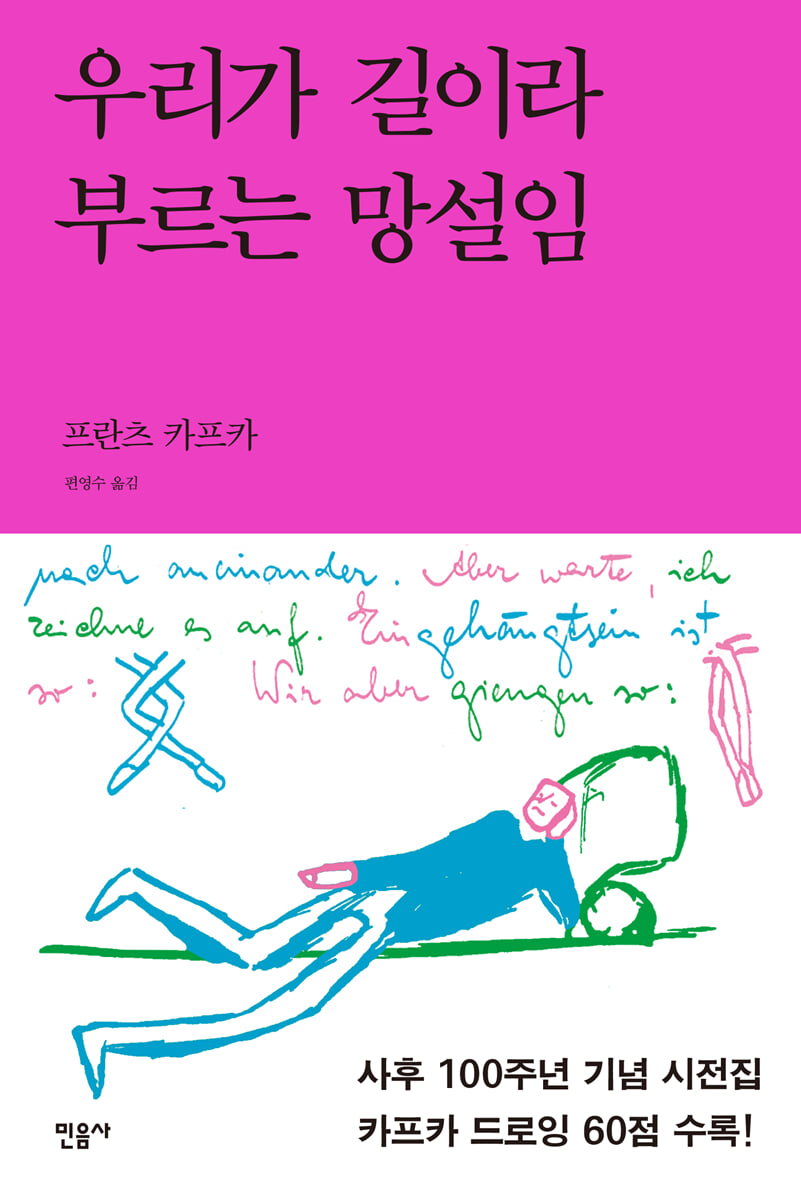
The hesitation we call the path
 |
Description
Book Introduction
The first poetry collection in Korea commemorating the 100th anniversary of Franz Kafka's death!
“There is not a single line that does not concern me or does not surprise me.” —Rainer Maria Rilke
To commemorate the 100th anniversary of the death of Franz Kafka (1883-1924), a collection of Kafka drawings, titled “Hesitation We Call Road,” containing 116 poems and 60 drawings, was published as the 58th issue of Minumsa’s World Poets Series.
This is the first complete collection of Kafka's poetry in Korea, translated by Professor Emeritus Pyeon Yeong-su, winner of the 'Korean-German Literature Translation Award' and former president of the 'Korean Kafka Society'.
Part 1 is centered around the motifs of loneliness, Part 2 is centered around the motifs of anxiety, unhappiness, sadness, pain, and fear, Part 3 is centered around the motifs of transience, Part 4 is centered around the motifs of resistance, and Part 5 is centered around the motifs of freedom and happiness.
“There is not a single line that does not concern me or does not surprise me.” —Rainer Maria Rilke
To commemorate the 100th anniversary of the death of Franz Kafka (1883-1924), a collection of Kafka drawings, titled “Hesitation We Call Road,” containing 116 poems and 60 drawings, was published as the 58th issue of Minumsa’s World Poets Series.
This is the first complete collection of Kafka's poetry in Korea, translated by Professor Emeritus Pyeon Yeong-su, winner of the 'Korean-German Literature Translation Award' and former president of the 'Korean Kafka Society'.
Part 1 is centered around the motifs of loneliness, Part 2 is centered around the motifs of anxiety, unhappiness, sadness, pain, and fear, Part 3 is centered around the motifs of transience, Part 4 is centered around the motifs of resistance, and Part 5 is centered around the motifs of freedom and happiness.
- You can preview some of the book's contents.
Preview
index
Part 1: You must pass through the wilderness
1 There is a coming and going Es gibt ein Kommen
2 It's cool and gloomy today Kuhl und hart ist der heutige Tag
3 Standing in an old small town In dem alten Stadtchen stehn
4 people, Menschen crossing the dark bridge, die uber dunkle Brucken gehn
5 The Shape of My Existence Bild meiner Existenz
6 Wenn ich des Nachts
7 Desolate Fields Ode Felder
8 Again, again Wiederum, wiederum
9 Never, never Nimmermehr, nimmermehr
10 Walking along the tree-lined street Durch die Allee
11 What hinders you? Was stort dich?
12 In bed, kneel Im Bett, das Knie
13 As the forest breathes in the moonlight, Wie der Wald im Mondschein atmet
Part 2: Wearing the Mask of Hell
14 In der abendlichen Sonne in the sunset
15 The Trees Die Baume
16 In the Valley of Boredom Aus dem Grunde der Ermattung
17 This pulley in the heart Dieser Flaschenzug im Innern
18 Void, Void, Void Nichts, nichts, nichts
19 The Meaninglessness of Youth Sinnlosigkeit der Jugend
20 Forget everything Alles vergessen
21 Black people walked out Es fuhren die Neger
22 Dream and cry Traume und weine
23 Take off his clothes, and he will heal you. Entkleidet ihn, dann wird er heilen
24 Rejoice, you who are sick.
25 Ah, they were wearing the masks of hell Ach sie trugen, Larven der Holle
26 The number of old years of wounds Es ist das Alter der Wunde
27 Attack Die Angriffe
28 Like a squirrel stuck in a hamster wheel Wie ein Einhornchen im Kafig
29 A Birdcage
30 Good people walk Die Guten gehn
31 Still the hounds play in the yard Noch spielen die Jagdhunde
32 The development of humanity is Die Menschheitsentwicklung
Verse 33 Help me! Hilf mir!
34 You crow, I said Du Rabe, sagte ich
35 Evil Das Bose
36 There are cases where evil surprises Es gibt Uberraschungen des Bosen
37 The important thing is Darauf kommt es an
38 You are out Du bleibst außerhalb
39 It was a dazzling moonlit night Es blendete uns die Mondnacht
40 It was the first shovel Es war der erste Spatenstich
41 In hartem Schlag with a sharp price
42 Under all intentions Unter jeder Absicht
43 There is a goal, but Es gibt nur ein Ziel
44 A Tricky Challenge
45 One Transition Ein Umschwung
46 Dreams have arrived Traume sind angekommen
47 Please try Erreiche es nur
48 You will never draw water up Niemals ziehst du das Wasser
49 He shook his head Den Kopf hat er
50 Death took him Der Tod mußte ihn
51 Love is Liebe ist
52 This is weird Wie wunderbar
Part 3 Your heart is really cold
53 It's not stupid. Nicht-Narrheit ist
54 He went out from their company Er entwand sich ihren Kreisen
55 Like an Autumn Path Wie ein Weg im Herbst
56 The period of remembrance is over Das Trauerjahr war voruber
57 Run, Little Pony Trabe, kleines Pferdchen
58 The Deep Well Der tiefe Brunnen
59 Many souls of the dead are Manche Schatten der Abgeschiedenen
60 Shabby abandoned house! Armes verlassenes Haus!
61 Variety Die Mannigfaltigkeiten
62 Wrap Your Dreams Around Schlinge den Traum
63 What is Irgendein Ding
64 You always talk about death, but Immerfort sprichst du vom Tod
65 Only three zigzag lines left Nut drei Zickzackstriche blieben
Part 4: Already at the very bottom
66 Heavy Showers Starker Regenguβ
67 too late zu spat
68 The thornbush is Der Dornbusch
69 He who has faith Wer glaubt
70 I don't know the content Ich kenne den Inhalt nicht
71 The sound of the flute tempted Es lockte die Flote
72 Before I didn't understand Fruher begriff ich nicht
73 Keep Calm Ruhe zu bewahren
74 The merry fellows were going down Es fuhren die munten Genossen
75 Creative Schopferisch
76 You say Du sagst
77 Mit starkstem Licht with very strong light
78 I can swim Ich kann schwimmen
79 My longing is Meine Sehnsucht
80 My Life Mein Leben
81 Didn't he fight enough? Kampfte er nicht genug?
82 A rag? Ein Strohhalm?
Jump and Dance Part 5 149
83 I ran down the alley Ich sprang durch die Gassen
84 The wish to become an Indian Wunsch, Indianer zu werden
85 I ran as fast as I could towards the southern city. Ich strebte zu der Stadt im Suden hin
86 rang loudly Tonend erklang
87 Hold on high your lamp, go before us!
88 O beautiful time O schone Stunde
89 Town Square Der Dorfplatz
90 There's nothing bad! Nichts Boses!
91 It is not necessary Es ist nicht notwendig
92 The Way of Truth Der wahre Weg
93 The more tightly the words are tightened, the more Je mehr Pferde du anspannst
94 Three Things Dreierlei
95 We saw and were amazed Staunend sahen wir
96 Faith Der Glaube
97 The wind is still for a few days
98 Ah, what is in store for us here! Ach was wird uns hier bereitet!
99 Little Soul Kleine Seele
100 It was summer Sommer war es
101 Nothing holds me back Nichts halt mich
102 What are you grieving for, lonely soul? Um was klagst du, verlassene Seele?
103 Understand Happiness Das Gluck begreifen
104 There are countless places to hide Verstecke sind unzahlige
105 There is no possession Es gibt kein Haben
106 Put on your coat Schlage deinen Mantel
107 The flowers were hanging like a dream Traumend hing die Blume
108 The God of Dreams Der Traume Herr
109 The trained body Der gestahlte Korper
110 Find him with a pointed pen Suche ihn mit spitzer Feder
111 Refreshing Fullness Frische Fulle
112 Preserve the Wreckage Aufgehoben die Reste
113 As if we sometimes So wie man manchmal
114 You came too late Du bist zu spat gekommen
115 Only One Word Nur ein Wort
116 Where are you going, Master Nari? Wohin reitest du, Herr?
Author's Chronology 197
Note 209
About the work: The Angel's Song from Hell
1 There is a coming and going Es gibt ein Kommen
2 It's cool and gloomy today Kuhl und hart ist der heutige Tag
3 Standing in an old small town In dem alten Stadtchen stehn
4 people, Menschen crossing the dark bridge, die uber dunkle Brucken gehn
5 The Shape of My Existence Bild meiner Existenz
6 Wenn ich des Nachts
7 Desolate Fields Ode Felder
8 Again, again Wiederum, wiederum
9 Never, never Nimmermehr, nimmermehr
10 Walking along the tree-lined street Durch die Allee
11 What hinders you? Was stort dich?
12 In bed, kneel Im Bett, das Knie
13 As the forest breathes in the moonlight, Wie der Wald im Mondschein atmet
Part 2: Wearing the Mask of Hell
14 In der abendlichen Sonne in the sunset
15 The Trees Die Baume
16 In the Valley of Boredom Aus dem Grunde der Ermattung
17 This pulley in the heart Dieser Flaschenzug im Innern
18 Void, Void, Void Nichts, nichts, nichts
19 The Meaninglessness of Youth Sinnlosigkeit der Jugend
20 Forget everything Alles vergessen
21 Black people walked out Es fuhren die Neger
22 Dream and cry Traume und weine
23 Take off his clothes, and he will heal you. Entkleidet ihn, dann wird er heilen
24 Rejoice, you who are sick.
25 Ah, they were wearing the masks of hell Ach sie trugen, Larven der Holle
26 The number of old years of wounds Es ist das Alter der Wunde
27 Attack Die Angriffe
28 Like a squirrel stuck in a hamster wheel Wie ein Einhornchen im Kafig
29 A Birdcage
30 Good people walk Die Guten gehn
31 Still the hounds play in the yard Noch spielen die Jagdhunde
32 The development of humanity is Die Menschheitsentwicklung
Verse 33 Help me! Hilf mir!
34 You crow, I said Du Rabe, sagte ich
35 Evil Das Bose
36 There are cases where evil surprises Es gibt Uberraschungen des Bosen
37 The important thing is Darauf kommt es an
38 You are out Du bleibst außerhalb
39 It was a dazzling moonlit night Es blendete uns die Mondnacht
40 It was the first shovel Es war der erste Spatenstich
41 In hartem Schlag with a sharp price
42 Under all intentions Unter jeder Absicht
43 There is a goal, but Es gibt nur ein Ziel
44 A Tricky Challenge
45 One Transition Ein Umschwung
46 Dreams have arrived Traume sind angekommen
47 Please try Erreiche es nur
48 You will never draw water up Niemals ziehst du das Wasser
49 He shook his head Den Kopf hat er
50 Death took him Der Tod mußte ihn
51 Love is Liebe ist
52 This is weird Wie wunderbar
Part 3 Your heart is really cold
53 It's not stupid. Nicht-Narrheit ist
54 He went out from their company Er entwand sich ihren Kreisen
55 Like an Autumn Path Wie ein Weg im Herbst
56 The period of remembrance is over Das Trauerjahr war voruber
57 Run, Little Pony Trabe, kleines Pferdchen
58 The Deep Well Der tiefe Brunnen
59 Many souls of the dead are Manche Schatten der Abgeschiedenen
60 Shabby abandoned house! Armes verlassenes Haus!
61 Variety Die Mannigfaltigkeiten
62 Wrap Your Dreams Around Schlinge den Traum
63 What is Irgendein Ding
64 You always talk about death, but Immerfort sprichst du vom Tod
65 Only three zigzag lines left Nut drei Zickzackstriche blieben
Part 4: Already at the very bottom
66 Heavy Showers Starker Regenguβ
67 too late zu spat
68 The thornbush is Der Dornbusch
69 He who has faith Wer glaubt
70 I don't know the content Ich kenne den Inhalt nicht
71 The sound of the flute tempted Es lockte die Flote
72 Before I didn't understand Fruher begriff ich nicht
73 Keep Calm Ruhe zu bewahren
74 The merry fellows were going down Es fuhren die munten Genossen
75 Creative Schopferisch
76 You say Du sagst
77 Mit starkstem Licht with very strong light
78 I can swim Ich kann schwimmen
79 My longing is Meine Sehnsucht
80 My Life Mein Leben
81 Didn't he fight enough? Kampfte er nicht genug?
82 A rag? Ein Strohhalm?
Jump and Dance Part 5 149
83 I ran down the alley Ich sprang durch die Gassen
84 The wish to become an Indian Wunsch, Indianer zu werden
85 I ran as fast as I could towards the southern city. Ich strebte zu der Stadt im Suden hin
86 rang loudly Tonend erklang
87 Hold on high your lamp, go before us!
88 O beautiful time O schone Stunde
89 Town Square Der Dorfplatz
90 There's nothing bad! Nichts Boses!
91 It is not necessary Es ist nicht notwendig
92 The Way of Truth Der wahre Weg
93 The more tightly the words are tightened, the more Je mehr Pferde du anspannst
94 Three Things Dreierlei
95 We saw and were amazed Staunend sahen wir
96 Faith Der Glaube
97 The wind is still for a few days
98 Ah, what is in store for us here! Ach was wird uns hier bereitet!
99 Little Soul Kleine Seele
100 It was summer Sommer war es
101 Nothing holds me back Nichts halt mich
102 What are you grieving for, lonely soul? Um was klagst du, verlassene Seele?
103 Understand Happiness Das Gluck begreifen
104 There are countless places to hide Verstecke sind unzahlige
105 There is no possession Es gibt kein Haben
106 Put on your coat Schlage deinen Mantel
107 The flowers were hanging like a dream Traumend hing die Blume
108 The God of Dreams Der Traume Herr
109 The trained body Der gestahlte Korper
110 Find him with a pointed pen Suche ihn mit spitzer Feder
111 Refreshing Fullness Frische Fulle
112 Preserve the Wreckage Aufgehoben die Reste
113 As if we sometimes So wie man manchmal
114 You came too late Du bist zu spat gekommen
115 Only One Word Nur ein Wort
116 Where are you going, Master Nari? Wohin reitest du, Herr?
Author's Chronology 197
Note 209
About the work: The Angel's Song from Hell
Detailed image

Publisher's Review
The path of truth
Not a rope hanging high in the air,
just above the ground
low hanging
It's on a rope.
Rather than making it walk,
Rather, it seems like it would cause me to stumble
─Franz Kafka, 『The Hesitation We Call the Road』, No. 92
Kafka liked Goethe, Friedrich Hölderlin, and Walt Whitman.
Professor Pyeon Yeong-su says that Kafka “intentionally connected and interpenetrated prose and poetry.”
Kafka once said, “The Sentence is a poem rather than a novel, and therefore needs some space around it to be effective.”
Kafka did not want to distinguish between poetry and prose.
He would write the same text in prose and also in poetry, dividing it into lines and stanzas.
For example, the sentence “I have spent my life, refraining from destroying life” was written as a poem:
So Kafka's poetry can also be read as prose poetry.
My life
I sent,
Destroying life
By exercising self-restraint.
─Franz Kafka, 『The Hesitation We Call the Road』, No. 79
Nevertheless, Kafka used the poetic form because “poetry is an art that can emotionally grasp a world with very few words.”
Max Brod could not help but admire the poetic elements in Kafka's works.
Through this collection of poems, readers will be able to confirm Kafka's poetic talent and Kafka the poet.
There is a goal, but
There is no way.
What we call a path is,
It's hesitation.
─Franz Kafka, 『The Hesitation We Call the Road』, No. 43
● An 'amazing journey' from the 'world of lies'!
“It is the fate, and perhaps the greatness, of Kafka’s work to offer all possibilities but not to prove them.” —Albert Camus
Kafka's goal is to leave 'here'.
'Here' includes everything that can be named (a specific place, all places, a group of apparently normal humans).
“The creepy thing about this trip is that the owner leaves ‘here’ without caring if he starves to death.”
Kafka's poetic self ultimately renounces all kinds of possessions for the sake of a 'great journey'.
“Just leaving here, just leaving here.
I'm constantly leaving here,
“That way I can reach my goal.”
─Franz Kafka, 『The Hesitation We Call the Road』, No. 116
Professor Pyeon Yeong-su explains, “The ‘here’ that this poem addresses refers to a ‘false world’ that deals only with the relationships between ownership and possession.”
What Kafka ultimately wants to leave behind is the ‘world of lies.’
This is the point where Kafka's poetic world may resonate more with today's readers.
The path of truth
Not a rope hanging high in the air,
just above the ground
low hanging
It's on a rope.
Rather than making it walk,
Rather, it seems like it would cause me to stumble
─Franz Kafka, 『The Hesitation We Call the Road』, No. 92
Professor Pyeon Yeong-su describes Kafka's poetry as 'poetry of fragments.'
“Kafka was one of the most important forerunners of the poetry of fragments, who foresaw the coming destruction of the world and the world order.” Nevertheless, the strength of Kafka’s poetry lies in its vibrant vitality.
Little soul,
You are dancing
Jump up,
In the warm air
Bow your head,
Swaying roughly in the wind
In the sparkling grass,
You're raising both feet.
─Franz Kafka, 『The Hesitation We Call the Road』, No. 99
● Includes 60 drawings, including recently released ones!
In a letter to Felice Bauer from 1913, Kafka recalled a time when they were taking walks together.
Kafka did not intend to describe the scene of them walking arm in arm, but rather to convey the psychological closeness he had become to her at that moment.
The author, feeling sorry that he could not express the mystery in words, drew a drawing in the letter.
In this way, Kafka often expressed the frustration that could not be expressed in words through drawings.
Kafka once said, “Everything but the depiction of a dreamlike inner life has become secondary.”
Kafka found a solution to the dilemma of not being able to fully convey dreams in words in images.
Kafka once (1901-1906) wanted to become a painter.
Kafka recalled that at that time, “Drawing gave me more satisfaction than anything else.”
Max Brod, who first met Kafka in 1902, also initially took notice of Kafka's drawings and began reading Kafka's writings a few years later.
Kafka mainly left drawings in the margins of his letters and notebooks, so Max Brod later cut out those parts and created a Kafka collection.
Currently, about 150 sketches survive.
Kafka's doodle-style drawings mainly depict the facial expressions and postures of characters very dynamically with simple touches.
Kafka's emphasis on drawing demonstrates his pioneering qualities in modern graffiti art and graphic art.
Kafka's characters are not bound by traditional proportions, they flow freely rather than delicately, and although the background is omitted, he effectively conveys situations and emotional states such as festivals, fencing, and horseback riding.
The National Library of Israel also recovered Kafka drawings that had been illegally auctioned and presented them as public property through an online exhibition in 2021.
"The Hesitation We Call Road" contains 60 Kafka drawings, including new ones from the Max Brod Foundation archive.
● The oldest literary series in Korea, started in 1973!
From Horace, the poet of 'Carpe Diem', to William Carlos Williams, the poet of the movie 'Paterson', 'Shakespeare's Sonnets', the representative works of modernism 'The Waste Land' and 'Flowers of Evil', Fernando Pessoa, the heretic of American poetry Charles Bukowski, and the representative poet of the 19th century Emily Dickinson, the 'World Poets' series, which has maintained the longest lifespan with carefully selected poetry collections for half a century, will continue in the future.
Franz Kafka (1883-1924)
He was born in Prague, present-day Czech Republic, as a writer in the Austro-Hungarian Empire at the time.
After graduating from the Faculty of Law at Prague University, he worked in a court for a year and then worked for an insurance company for the rest of his life.
He met Max Brod, who would later edit Kafka's complete works, and developed a friendship with him, growing as a writer and writing The Metamorphosis (Die Verwandlung) (published in 1916) and The Trial (Der Prozess) (published in 1925).
He lived his entire life as an ordinary office worker during the day and a hidden genius writer at night, and he wrote novels with deep insight into the absurdity of life.
His lonely life, struggling against the hostile environment he faced as a Jewish German and the conflict of not being recognized as a writer by his father, made him a pioneer of existentialist literature.
He was diagnosed with tuberculosis in September 1917 and spent time in a sanatorium, where he died in Vienna in 1924.
Not a rope hanging high in the air,
just above the ground
low hanging
It's on a rope.
Rather than making it walk,
Rather, it seems like it would cause me to stumble
─Franz Kafka, 『The Hesitation We Call the Road』, No. 92
Kafka liked Goethe, Friedrich Hölderlin, and Walt Whitman.
Professor Pyeon Yeong-su says that Kafka “intentionally connected and interpenetrated prose and poetry.”
Kafka once said, “The Sentence is a poem rather than a novel, and therefore needs some space around it to be effective.”
Kafka did not want to distinguish between poetry and prose.
He would write the same text in prose and also in poetry, dividing it into lines and stanzas.
For example, the sentence “I have spent my life, refraining from destroying life” was written as a poem:
So Kafka's poetry can also be read as prose poetry.
My life
I sent,
Destroying life
By exercising self-restraint.
─Franz Kafka, 『The Hesitation We Call the Road』, No. 79
Nevertheless, Kafka used the poetic form because “poetry is an art that can emotionally grasp a world with very few words.”
Max Brod could not help but admire the poetic elements in Kafka's works.
Through this collection of poems, readers will be able to confirm Kafka's poetic talent and Kafka the poet.
There is a goal, but
There is no way.
What we call a path is,
It's hesitation.
─Franz Kafka, 『The Hesitation We Call the Road』, No. 43
● An 'amazing journey' from the 'world of lies'!
“It is the fate, and perhaps the greatness, of Kafka’s work to offer all possibilities but not to prove them.” —Albert Camus
Kafka's goal is to leave 'here'.
'Here' includes everything that can be named (a specific place, all places, a group of apparently normal humans).
“The creepy thing about this trip is that the owner leaves ‘here’ without caring if he starves to death.”
Kafka's poetic self ultimately renounces all kinds of possessions for the sake of a 'great journey'.
“Just leaving here, just leaving here.
I'm constantly leaving here,
“That way I can reach my goal.”
─Franz Kafka, 『The Hesitation We Call the Road』, No. 116
Professor Pyeon Yeong-su explains, “The ‘here’ that this poem addresses refers to a ‘false world’ that deals only with the relationships between ownership and possession.”
What Kafka ultimately wants to leave behind is the ‘world of lies.’
This is the point where Kafka's poetic world may resonate more with today's readers.
The path of truth
Not a rope hanging high in the air,
just above the ground
low hanging
It's on a rope.
Rather than making it walk,
Rather, it seems like it would cause me to stumble
─Franz Kafka, 『The Hesitation We Call the Road』, No. 92
Professor Pyeon Yeong-su describes Kafka's poetry as 'poetry of fragments.'
“Kafka was one of the most important forerunners of the poetry of fragments, who foresaw the coming destruction of the world and the world order.” Nevertheless, the strength of Kafka’s poetry lies in its vibrant vitality.
Little soul,
You are dancing
Jump up,
In the warm air
Bow your head,
Swaying roughly in the wind
In the sparkling grass,
You're raising both feet.
─Franz Kafka, 『The Hesitation We Call the Road』, No. 99
● Includes 60 drawings, including recently released ones!
In a letter to Felice Bauer from 1913, Kafka recalled a time when they were taking walks together.
Kafka did not intend to describe the scene of them walking arm in arm, but rather to convey the psychological closeness he had become to her at that moment.
The author, feeling sorry that he could not express the mystery in words, drew a drawing in the letter.
In this way, Kafka often expressed the frustration that could not be expressed in words through drawings.
Kafka once said, “Everything but the depiction of a dreamlike inner life has become secondary.”
Kafka found a solution to the dilemma of not being able to fully convey dreams in words in images.
Kafka once (1901-1906) wanted to become a painter.
Kafka recalled that at that time, “Drawing gave me more satisfaction than anything else.”
Max Brod, who first met Kafka in 1902, also initially took notice of Kafka's drawings and began reading Kafka's writings a few years later.
Kafka mainly left drawings in the margins of his letters and notebooks, so Max Brod later cut out those parts and created a Kafka collection.
Currently, about 150 sketches survive.
Kafka's doodle-style drawings mainly depict the facial expressions and postures of characters very dynamically with simple touches.
Kafka's emphasis on drawing demonstrates his pioneering qualities in modern graffiti art and graphic art.
Kafka's characters are not bound by traditional proportions, they flow freely rather than delicately, and although the background is omitted, he effectively conveys situations and emotional states such as festivals, fencing, and horseback riding.
The National Library of Israel also recovered Kafka drawings that had been illegally auctioned and presented them as public property through an online exhibition in 2021.
"The Hesitation We Call Road" contains 60 Kafka drawings, including new ones from the Max Brod Foundation archive.
● The oldest literary series in Korea, started in 1973!
From Horace, the poet of 'Carpe Diem', to William Carlos Williams, the poet of the movie 'Paterson', 'Shakespeare's Sonnets', the representative works of modernism 'The Waste Land' and 'Flowers of Evil', Fernando Pessoa, the heretic of American poetry Charles Bukowski, and the representative poet of the 19th century Emily Dickinson, the 'World Poets' series, which has maintained the longest lifespan with carefully selected poetry collections for half a century, will continue in the future.
Franz Kafka (1883-1924)
He was born in Prague, present-day Czech Republic, as a writer in the Austro-Hungarian Empire at the time.
After graduating from the Faculty of Law at Prague University, he worked in a court for a year and then worked for an insurance company for the rest of his life.
He met Max Brod, who would later edit Kafka's complete works, and developed a friendship with him, growing as a writer and writing The Metamorphosis (Die Verwandlung) (published in 1916) and The Trial (Der Prozess) (published in 1925).
He lived his entire life as an ordinary office worker during the day and a hidden genius writer at night, and he wrote novels with deep insight into the absurdity of life.
His lonely life, struggling against the hostile environment he faced as a Jewish German and the conflict of not being recognized as a writer by his father, made him a pioneer of existentialist literature.
He was diagnosed with tuberculosis in September 1917 and spent time in a sanatorium, where he died in Vienna in 1924.
GOODS SPECIFICS
- Date of issue: February 10, 2024
- Page count, weight, size: 248 pages | 140*210*20mm
- ISBN13: 9788937475580
- ISBN10: 8937475588
You may also like
카테고리
korean


korean

![GQ KOREA Mark (Monthly): December [2025]](http://librairie.coreenne.fr/cdn/shop/files/8ef265dbbfbf186523ed75ba7319009d.jpg?v=1765340328&width=3840)


