

bad education
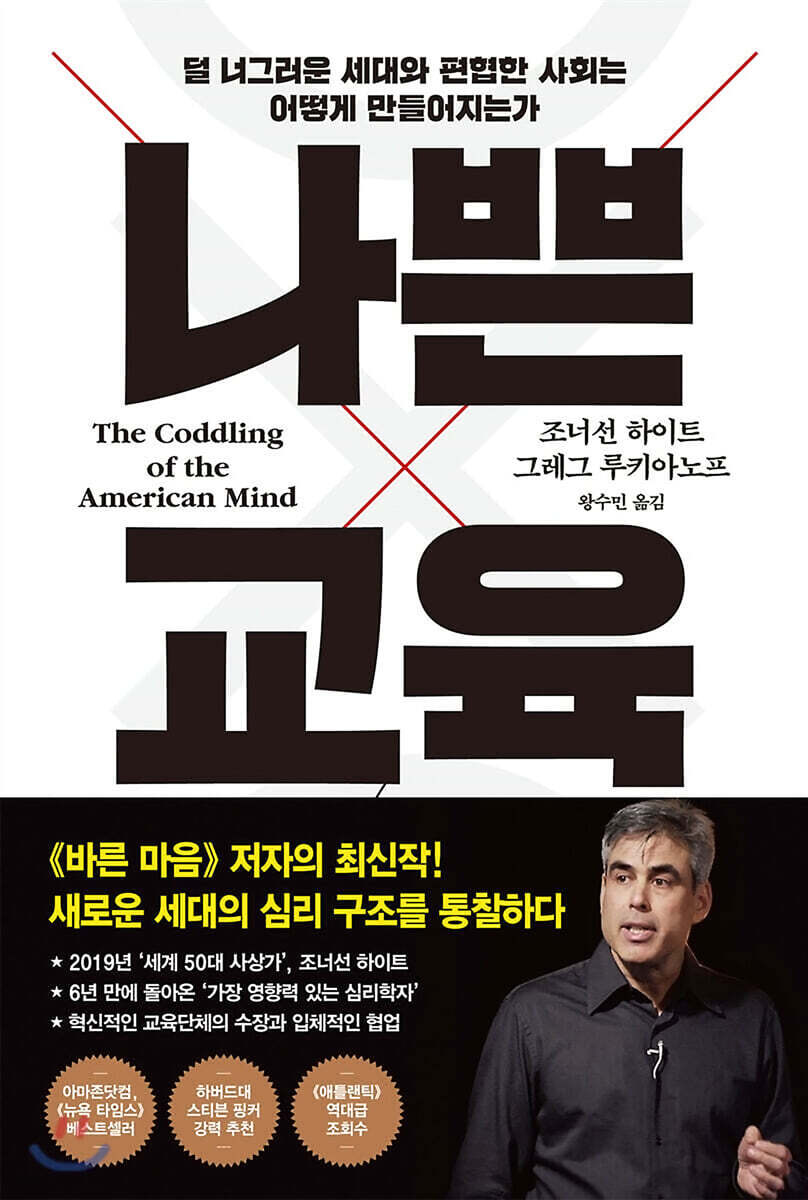 |
Description
Book Introduction
- A word from MD
-
What Hurts YouthJonathan White and Greg Lukianoff, authors of "The Righteous Mind," diagnose the psychology of today's young generation and offer solutions.
They noted a tendency to suffer from depression, anxiety, panic attacks, and increased hatred toward others.
This is not unrelated to the spread of smartphones, the commercialization of universities, and class issues.
November 29, 2019. Humanities PD Son Min-gyu
Author of the bestseller “Right Mind”
The world's most influential psychologist
Jonathan Haidt's latest co-authored book!
Insights into the psychology of the new generation
Odd things are happening and things are getting worse.
Rates of depression, anxiety, and suicide among young people are on the rise.
Extremists are on the rise both on and off campus, fueling ever-deeper animosity toward one another.
In the so-called "point-at-the-perpetrator culture" of social media, it's possible for someone's well-intentioned words to be mercilessly interpreted by someone else and publicly shamed.
How on earth did this happen?
Social psychologist Jonathan Haidt and educational leader Greg Lukianoff delve into how so-called "great untruths" have become widespread among a new generation of Americans.
The authors persuasively argue that three misconceptions, or gross untruths, underlie the deterioration of university public discourse today.
Because safety is so emphasized, thoughts and expressions are blocked, and various cognitive distortions are rampant, making it common for others' good intentions to be interpreted maliciously.
Additionally, for political purposes or due to the nature of social media, a culture of antagonism between 'us and them' is spreading.
The authors point out that this is not just an American phenomenon, but a global one, and analyze in detail the causes, dividing them into six categories.
Jonathan Haidt rose to global prominence with his previous work, The Righteous Mind (2013), and was named one of the “50 Greatest Thinkers in the World” (Prospect) in 2019 and one of the “100 Greatest Thinkers in the World” (Foreign Policy) in 2012.
He is also one of the most cited researchers in the fields of moral psychology and political psychology.
In his new book, Bad Education, his first in six years, he collaborates with Greg Lukianoff, a lawyer and head of the innovative education organization FIRE, to thoroughly expose the "great untruths" of the so-called iGeneration.
The authors lay the foundation for a hopeful future, offering concrete solutions that can help children, universities, and society become wiser.
The world's most influential psychologist
Jonathan Haidt's latest co-authored book!
Insights into the psychology of the new generation
Odd things are happening and things are getting worse.
Rates of depression, anxiety, and suicide among young people are on the rise.
Extremists are on the rise both on and off campus, fueling ever-deeper animosity toward one another.
In the so-called "point-at-the-perpetrator culture" of social media, it's possible for someone's well-intentioned words to be mercilessly interpreted by someone else and publicly shamed.
How on earth did this happen?
Social psychologist Jonathan Haidt and educational leader Greg Lukianoff delve into how so-called "great untruths" have become widespread among a new generation of Americans.
The authors persuasively argue that three misconceptions, or gross untruths, underlie the deterioration of university public discourse today.
Because safety is so emphasized, thoughts and expressions are blocked, and various cognitive distortions are rampant, making it common for others' good intentions to be interpreted maliciously.
Additionally, for political purposes or due to the nature of social media, a culture of antagonism between 'us and them' is spreading.
The authors point out that this is not just an American phenomenon, but a global one, and analyze in detail the causes, dividing them into six categories.
Jonathan Haidt rose to global prominence with his previous work, The Righteous Mind (2013), and was named one of the “50 Greatest Thinkers in the World” (Prospect) in 2019 and one of the “100 Greatest Thinkers in the World” (Foreign Policy) in 2012.
He is also one of the most cited researchers in the fields of moral psychology and political psychology.
In his new book, Bad Education, his first in six years, he collaborates with Greg Lukianoff, a lawyer and head of the innovative education organization FIRE, to thoroughly expose the "great untruths" of the so-called iGeneration.
The authors lay the foundation for a hopeful future, offering concrete solutions that can help children, universities, and society become wiser.
- You can preview some of the book's contents.
Preview
index
Introduction_ A Journey to Find Wisdom
The real reason I wrote this book
Turbulent Period: 2015–2017
"Jijeongseong" means "overprotection."
What we are trying to do in this book
Part 1: The Great Untruth
Chapter 1: The Untruth of Evil
Unbreakable strength
The rise of safety awareness
safe space
iGeneration and safety awareness
# Chapter 1 Galmuri
Chapter 2: The Untruth of Emotional Reasoning
What is Cognitive Behavioral Therapy
Microaggressions: Impact Matters More Than Intention
Cancellation of invitation
# Chapter 2 Galmuri
Chapter 3: The Untruth of 'Us vs. Them'
Groups and Tribes
Two Types of Identity Politics
Identity politics of 'universal humanity'
'Public Enemy' Identity Politics
Modern Marcuseism
Culture of pointing fingers
The power of universal humanity
# Chapter 3 Galmuri
Part 2: When Bad Thoughts Work in Reality
Chapter 4: Intimidation and Violence
Can words be violent?
Violence and intimidation following the Berkeley incident
Charlottesville violence
Fall 2017
The difference between speech and violence
# Chapter 4 Galmuri
Chapter 5: Witch Hunt
provocative thoughts
Retraction is a new form of refutation.
Solidarity or Diversity?
Welcome to Evergreen University
Universities in Crisis
# Chapter 5 Galmuri
Part 3: How Did I Get Here?
Chapter 6: Polarization Cycle
boiling point
Off-campus right-wing anger
Threats facing universities
# Chapter 6 Galmuri
Chapter 7: Anxiety and Depression
iGeneration
Anti-social media?
Why do girls generally suffer?
iGeneration Goes to College
Screen Time: Warning About Warnings
# Chapter 7 Galmuri
Chapter 8: Paranoid Parenting
A parent's worst fear
Real vs. Hypothetical Risk
The dangers of safety precautions
The pressure of overprotection on parents
Hierarchy matters
Safe but not wise
# Chapter 8 Galmuri
Chapter 9: The Decline of Play
The decline of free play
Childhood as a period of test preparation
The Resume Arms Race
Childhood as a preparation for democracy
# Chapter 9 Galmuri
Chapter 10: A Bureaucracy that Pursues Safety
corporatization of universities
The customer is always right
What fuels distorted thinking?
Case of overreaction
Cases of overregulation
If something catches your eye, say something.
Expanding the concept of bullying and covert harassment
How is moral dependence developed?
# Chapter 10 Galmuri
Chapter 11: People Who Are Too Righteous
Intuitive definition
Justice of distribution
Definition of process
Based on the principle of proportionality
Aim for equal results
Correlation does not imply causation
# Chapter 11 Galmuri
Part 4: Becoming Wise
Chapter 12: How to Make Children Wiser
First, prepare yourself to do it on your own.
Second, it teaches us how to deal with emotional reasoning.
Third, it teaches us to think beyond "us versus them."
Fourth, it helps schools change.
Fifth, limit the use of electronic devices.
Sixth, establish new national standards.
Chapter 13: How Universities Can Become Wiser
First, it connects my identity with my freedom of exploration.
Second, create the best combination of diverse people.
Third, we aim for productive conflict of opinions.
Fourth, draw a circle of a larger community.
Outgoing article_ For society to become wiser
Appendix 1: How to Use Cognitive Behavioral Therapy
Appendix 2: University of Chicago Statement on Principles of Freedom of Expression
Acknowledgements
main
References
Search
The real reason I wrote this book
Turbulent Period: 2015–2017
"Jijeongseong" means "overprotection."
What we are trying to do in this book
Part 1: The Great Untruth
Chapter 1: The Untruth of Evil
Unbreakable strength
The rise of safety awareness
safe space
iGeneration and safety awareness
# Chapter 1 Galmuri
Chapter 2: The Untruth of Emotional Reasoning
What is Cognitive Behavioral Therapy
Microaggressions: Impact Matters More Than Intention
Cancellation of invitation
# Chapter 2 Galmuri
Chapter 3: The Untruth of 'Us vs. Them'
Groups and Tribes
Two Types of Identity Politics
Identity politics of 'universal humanity'
'Public Enemy' Identity Politics
Modern Marcuseism
Culture of pointing fingers
The power of universal humanity
# Chapter 3 Galmuri
Part 2: When Bad Thoughts Work in Reality
Chapter 4: Intimidation and Violence
Can words be violent?
Violence and intimidation following the Berkeley incident
Charlottesville violence
Fall 2017
The difference between speech and violence
# Chapter 4 Galmuri
Chapter 5: Witch Hunt
provocative thoughts
Retraction is a new form of refutation.
Solidarity or Diversity?
Welcome to Evergreen University
Universities in Crisis
# Chapter 5 Galmuri
Part 3: How Did I Get Here?
Chapter 6: Polarization Cycle
boiling point
Off-campus right-wing anger
Threats facing universities
# Chapter 6 Galmuri
Chapter 7: Anxiety and Depression
iGeneration
Anti-social media?
Why do girls generally suffer?
iGeneration Goes to College
Screen Time: Warning About Warnings
# Chapter 7 Galmuri
Chapter 8: Paranoid Parenting
A parent's worst fear
Real vs. Hypothetical Risk
The dangers of safety precautions
The pressure of overprotection on parents
Hierarchy matters
Safe but not wise
# Chapter 8 Galmuri
Chapter 9: The Decline of Play
The decline of free play
Childhood as a period of test preparation
The Resume Arms Race
Childhood as a preparation for democracy
# Chapter 9 Galmuri
Chapter 10: A Bureaucracy that Pursues Safety
corporatization of universities
The customer is always right
What fuels distorted thinking?
Case of overreaction
Cases of overregulation
If something catches your eye, say something.
Expanding the concept of bullying and covert harassment
How is moral dependence developed?
# Chapter 10 Galmuri
Chapter 11: People Who Are Too Righteous
Intuitive definition
Justice of distribution
Definition of process
Based on the principle of proportionality
Aim for equal results
Correlation does not imply causation
# Chapter 11 Galmuri
Part 4: Becoming Wise
Chapter 12: How to Make Children Wiser
First, prepare yourself to do it on your own.
Second, it teaches us how to deal with emotional reasoning.
Third, it teaches us to think beyond "us versus them."
Fourth, it helps schools change.
Fifth, limit the use of electronic devices.
Sixth, establish new national standards.
Chapter 13: How Universities Can Become Wiser
First, it connects my identity with my freedom of exploration.
Second, create the best combination of diverse people.
Third, we aim for productive conflict of opinions.
Fourth, draw a circle of a larger community.
Outgoing article_ For society to become wiser
Appendix 1: How to Use Cognitive Behavioral Therapy
Appendix 2: University of Chicago Statement on Principles of Freedom of Expression
Acknowledgements
main
References
Search
Detailed image

Into the book
In this security mindset, young people are deprived of the experiences necessary to develop a strong mind, and as a result, they become more fragile and insecure.
We tend to see ourselves as victims all the time.
--- p.63
The logic typically used is this:
If a speaker is causing discomfort, embarrassment, or anger to some students, it is perfectly justifiable to ban that speaker from campus altogether based on the “danger” he poses to students.
--- p.85
We worry that we might say the wrong thing, that we might like the wrong post, or that we might rush to the defense of someone we believe to be innocent.
It's because they're afraid that if they make a mistake, they might be accused of being a perpetrator by the crowd on social media.
--- p.131
The original motivation of most of these people was to help and protect children and those who were vulnerable to injury or sacrifice.
But you know, the road to hell is paved with good intentions.
--- p.221
The mental health crisis spreading across America was clearly not caused by universities.
Universities were simply busy responding to the crisis.
Perhaps that is why the custom and values of safety awareness have spread so quickly on campus since 2013.
But safety precautions don't help students who struggle with anxiety and depression.
--- p.271
The plan to completely eliminate peanuts has resulted in countless children's immune systems never learning that peanut protein is harmless.
So, in the end, the number of children who develop allergic reactions to peanuts or even die from exposure to peanuts has increased.
--- p.282
There is no way to directly teach children what hardness is, but instead, we can give them the gift of experience.
(…) The gift begins with recognizing that we absolutely need time for children, free from adult supervision and any set framework.
We tend to see ourselves as victims all the time.
--- p.63
The logic typically used is this:
If a speaker is causing discomfort, embarrassment, or anger to some students, it is perfectly justifiable to ban that speaker from campus altogether based on the “danger” he poses to students.
--- p.85
We worry that we might say the wrong thing, that we might like the wrong post, or that we might rush to the defense of someone we believe to be innocent.
It's because they're afraid that if they make a mistake, they might be accused of being a perpetrator by the crowd on social media.
--- p.131
The original motivation of most of these people was to help and protect children and those who were vulnerable to injury or sacrifice.
But you know, the road to hell is paved with good intentions.
--- p.221
The mental health crisis spreading across America was clearly not caused by universities.
Universities were simply busy responding to the crisis.
Perhaps that is why the custom and values of safety awareness have spread so quickly on campus since 2013.
But safety precautions don't help students who struggle with anxiety and depression.
--- p.271
The plan to completely eliminate peanuts has resulted in countless children's immune systems never learning that peanut protein is harmless.
So, in the end, the number of children who develop allergic reactions to peanuts or even die from exposure to peanuts has increased.
--- p.282
There is no way to directly teach children what hardness is, but instead, we can give them the gift of experience.
(…) The gift begins with recognizing that we absolutely need time for children, free from adult supervision and any set framework.
--- p.405
Publisher's Review
Their extreme anger
How is it born?
In society, we often witness situations where “arguments lead to disaster.”
When someone makes a statement, someone else demands an immediate apology, calling the statement “unjust,” discriminatory against a minority, or a “microaggression.”
Then, the person who made that statement feels wronged and refutes that that was not his intention.
But things only get worse.
The person who raised the issue again strongly criticized it, saying that what was important was the “impact” rather than the “intention.”
They also add that such attempts at rebuttal only fuel further hurt and trauma, so they advise against it. The situation becomes even more dire on social media.
In an instant, a crowd gathers and begins to exchange emotional words with each other.
Now the original content of the argument has been put on the back burner, the “tribalism” switch has been turned on between the two sides, and the only thing that matters is winning the fierce “us versus them” fight.
All statements are interpreted under the assumption that the other person is malicious, and this creates a synergistic effect, resulting in all sorts of irrational “cognitive distortions.”
In such a situation, the ability of anyone on the opposing side to speak out on their own behalf is limited as much as possible, and only extreme voices that confirm that they are on the same side survive.
The authors of this book noticed that this phenomenon was occurring frequently in their own workplaces, universities.
And in Part 1, it is diagnosed that there are three false beliefs, the so-called 'great untruths', behind this.
- The Untruth of Weakness: Work that is too hard to kill makes us weaker.
- The Untruth of Emotional Reasoning: Always trust your feelings.
- The untruth of 'us versus them': Life is a struggle between good people and bad people.
According to Jonathan Haidt, each of these three untruths contradicts ancient wisdom (Haidt has conducted extensive psychological research on ancient wisdom in his book The Happiness Hypothesis).
According to ancient wisdom, we must become stronger through suffering, mastering our raging emotions with rational reason and recognizing that we are one and share a common humanity.
But as is often observed, our society has three widely accepted 'great untruths' that contradict this.
In particular, this book analyzes in detail the ways in which this 'great untruth' appears among the iGeneration, that is, those born after 1995, who make up the majority of college students.
In our view, this is because the iGeneration has been most directly affected by the surge in 'great untruths'.
Promoting great untruth
Six causes
In Part II, the authors explore in detail how the "great untruth" manifests itself specifically on college campuses.
The authors are highly critical of the situation in which words have become violence due to “secret concept expansion” and the atmosphere of witch hunts.
How could it not be so?
Part 3 then presents six causes of the 'great untruth', focusing on the iGeneration.
- Political polarization and deepening animosity between political parties
- Increased levels of anxiety and depression in teenagers
- Changes in parenting styles
- Decrease in free play
- The growth of campus bureaucracy
- A heightened passion for justice
The authors trace the roots of the phenomenon back to childhood.
These three 'great untruths' are ideas that are engendered in a culture of safety, and the reason for this culture of safety can be found in the way children are raised.
In the United States, there has been a gradual shift from autonomous parenting to protective parenting due to various social factors.
So, today's American students are under a lot of stress from a young age about academic achievement and college entrance exam specifications under the guidance and supervision of their parents.
“In South Korea, parents are more concerned about college entrance exams than anywhere else in the world, reducing their children’s free time and sending them to expensive and demanding private academy classes instead” (Chapter 12), and the United States is becoming similar.
This hinders free play, experiences, and risk-taking behaviors essential for child development, and fuels the "great untruth."
Among the six explanatory clues presented in this book, there is one more noteworthy one.
Depression, anxiety, and suicide rates are on the rise among teenagers.
In the United States, since 2013, there has been a surge in depression and anxiety, to the point where university counseling centers are overwhelmed by the demand.
The teenage suicide rate is also “disturbingly high.”
For girls, the suicide rate has nearly doubled since the early 2000s (according to various surveys, Korea also has a serious rate of adolescent depression and suicide).
What is noteworthy is that the authors cite the use of electronic devices such as smartphones and social media as one of the causes.
Although the authors are cautious about making definitive statements, they provide a detailed account of how electronic device use is linked to mental illness and self-harm, citing various statistical data and psychological studies.
The authors' message is that we cannot simply dismiss the vague concerns of the older generation when faced with unfamiliar technology.
Many readers will also find helpful insights in Chapter 6, which addresses "Political Polarization and the Deepening Antagonism Between Parties," and Chapter 11, which addresses "Heightened Passion for Justice," both relevant to current events in Korean society.
Beyond safety precautions and overprotection,
There is hope for the new generation
Part 4 contains solutions to address the problem of the "great untruth."
It presents several methods that schools, teachers, and parents can implement immediately, as well as guidelines that may be useful to politicians and administrators.
If the contents up to Part 3 mainly deal with academic analysis and intellectual insight, Part 4 provides practical suggestions.
This is also a deliberate optimism on the part of the authors, who seek to find “signs of hope” even in seemingly hopeless situations.
This book deals specifically with American society, particularly the younger generation.
However, it very precisely identifies and analyzes global phenomena that cannot be limited to American society.
The beliefs and resulting social phenomena that the authors call “great untruths” are also applicable to Korean society.
It is also noteworthy that the younger generation, referred to in Korea as the “90s generation,” is approached not simply from a market marketing perspective, but as social beings.
According to the authors' classification, the "90s generation" consists of millennials and the iGeneration, and today's new social phenomena are precisely coming from the iGeneration.
And just as smartphones, Facebook, Twitter, and Instagram have no borders, there is no such thing as a separate iGeneration in the US and the iGeneration in Korea.
Perhaps this book's analysis is even more relevant to Korea's iGeneration, which experiences more protective parenting and tends to define itself through relationships with others.
How is it born?
In society, we often witness situations where “arguments lead to disaster.”
When someone makes a statement, someone else demands an immediate apology, calling the statement “unjust,” discriminatory against a minority, or a “microaggression.”
Then, the person who made that statement feels wronged and refutes that that was not his intention.
But things only get worse.
The person who raised the issue again strongly criticized it, saying that what was important was the “impact” rather than the “intention.”
They also add that such attempts at rebuttal only fuel further hurt and trauma, so they advise against it. The situation becomes even more dire on social media.
In an instant, a crowd gathers and begins to exchange emotional words with each other.
Now the original content of the argument has been put on the back burner, the “tribalism” switch has been turned on between the two sides, and the only thing that matters is winning the fierce “us versus them” fight.
All statements are interpreted under the assumption that the other person is malicious, and this creates a synergistic effect, resulting in all sorts of irrational “cognitive distortions.”
In such a situation, the ability of anyone on the opposing side to speak out on their own behalf is limited as much as possible, and only extreme voices that confirm that they are on the same side survive.
The authors of this book noticed that this phenomenon was occurring frequently in their own workplaces, universities.
And in Part 1, it is diagnosed that there are three false beliefs, the so-called 'great untruths', behind this.
- The Untruth of Weakness: Work that is too hard to kill makes us weaker.
- The Untruth of Emotional Reasoning: Always trust your feelings.
- The untruth of 'us versus them': Life is a struggle between good people and bad people.
According to Jonathan Haidt, each of these three untruths contradicts ancient wisdom (Haidt has conducted extensive psychological research on ancient wisdom in his book The Happiness Hypothesis).
According to ancient wisdom, we must become stronger through suffering, mastering our raging emotions with rational reason and recognizing that we are one and share a common humanity.
But as is often observed, our society has three widely accepted 'great untruths' that contradict this.
In particular, this book analyzes in detail the ways in which this 'great untruth' appears among the iGeneration, that is, those born after 1995, who make up the majority of college students.
In our view, this is because the iGeneration has been most directly affected by the surge in 'great untruths'.
Promoting great untruth
Six causes
In Part II, the authors explore in detail how the "great untruth" manifests itself specifically on college campuses.
The authors are highly critical of the situation in which words have become violence due to “secret concept expansion” and the atmosphere of witch hunts.
How could it not be so?
Part 3 then presents six causes of the 'great untruth', focusing on the iGeneration.
- Political polarization and deepening animosity between political parties
- Increased levels of anxiety and depression in teenagers
- Changes in parenting styles
- Decrease in free play
- The growth of campus bureaucracy
- A heightened passion for justice
The authors trace the roots of the phenomenon back to childhood.
These three 'great untruths' are ideas that are engendered in a culture of safety, and the reason for this culture of safety can be found in the way children are raised.
In the United States, there has been a gradual shift from autonomous parenting to protective parenting due to various social factors.
So, today's American students are under a lot of stress from a young age about academic achievement and college entrance exam specifications under the guidance and supervision of their parents.
“In South Korea, parents are more concerned about college entrance exams than anywhere else in the world, reducing their children’s free time and sending them to expensive and demanding private academy classes instead” (Chapter 12), and the United States is becoming similar.
This hinders free play, experiences, and risk-taking behaviors essential for child development, and fuels the "great untruth."
Among the six explanatory clues presented in this book, there is one more noteworthy one.
Depression, anxiety, and suicide rates are on the rise among teenagers.
In the United States, since 2013, there has been a surge in depression and anxiety, to the point where university counseling centers are overwhelmed by the demand.
The teenage suicide rate is also “disturbingly high.”
For girls, the suicide rate has nearly doubled since the early 2000s (according to various surveys, Korea also has a serious rate of adolescent depression and suicide).
What is noteworthy is that the authors cite the use of electronic devices such as smartphones and social media as one of the causes.
Although the authors are cautious about making definitive statements, they provide a detailed account of how electronic device use is linked to mental illness and self-harm, citing various statistical data and psychological studies.
The authors' message is that we cannot simply dismiss the vague concerns of the older generation when faced with unfamiliar technology.
Many readers will also find helpful insights in Chapter 6, which addresses "Political Polarization and the Deepening Antagonism Between Parties," and Chapter 11, which addresses "Heightened Passion for Justice," both relevant to current events in Korean society.
Beyond safety precautions and overprotection,
There is hope for the new generation
Part 4 contains solutions to address the problem of the "great untruth."
It presents several methods that schools, teachers, and parents can implement immediately, as well as guidelines that may be useful to politicians and administrators.
If the contents up to Part 3 mainly deal with academic analysis and intellectual insight, Part 4 provides practical suggestions.
This is also a deliberate optimism on the part of the authors, who seek to find “signs of hope” even in seemingly hopeless situations.
This book deals specifically with American society, particularly the younger generation.
However, it very precisely identifies and analyzes global phenomena that cannot be limited to American society.
The beliefs and resulting social phenomena that the authors call “great untruths” are also applicable to Korean society.
It is also noteworthy that the younger generation, referred to in Korea as the “90s generation,” is approached not simply from a market marketing perspective, but as social beings.
According to the authors' classification, the "90s generation" consists of millennials and the iGeneration, and today's new social phenomena are precisely coming from the iGeneration.
And just as smartphones, Facebook, Twitter, and Instagram have no borders, there is no such thing as a separate iGeneration in the US and the iGeneration in Korea.
Perhaps this book's analysis is even more relevant to Korea's iGeneration, which experiences more protective parenting and tends to define itself through relationships with others.
GOODS SPECIFICS
- Date of issue: December 2, 2019
- Page count, weight, size: 572 pages | 814g | 152*225*35mm
- ISBN13: 9791189336189
- ISBN10: 1189336189
You may also like
카테고리
korean


korean

![GQ KOREA Mark (Monthly): December [2025]](http://librairie.coreenne.fr/cdn/shop/files/8ef265dbbfbf186523ed75ba7319009d.jpg?v=1765340328&width=3840)


