

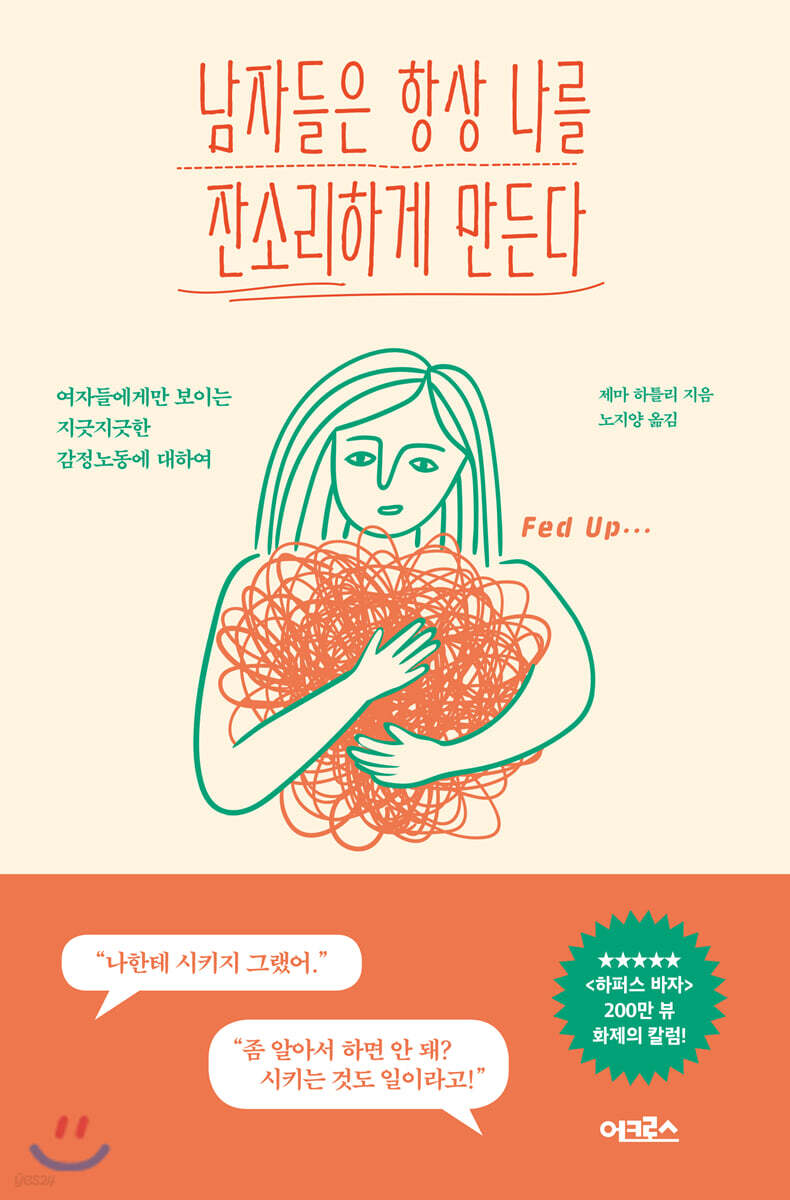
Men always nag me
 |
Description
Book Introduction
- A word from MD
-
Emotional labor is burdensome to handle on just one sideAlthough the number of dual-income couples has increased, gender inequality in housework remains.
Even in the workplace, emotional labor is more demanded from women.
This book, which documents women's emotional labor through various examples, sharply criticizes social climate while maintaining humor.
Let's not forget.
Equality is the key to safety and happiness.
October 25, 2019. Social and Political PD Son Min-gyu
Absolute empathy and support from women around the world!
A hotly debated essay from [Harper's Bazaar] that delves into women's emotional labor!
How to keep our sons from pushing their burdens onto others
How our daughters should not carry other people's burdens
The column that was published in [Harper's Bazaar] in 2017 and immediately received an explosive response, garnering 2 million views, has now been published as a book.
Acclaimed journalist Gemma Hartley brings emotional labor—“the invisible, laborious, time-consuming, and exhausting ‘heartbreaking work’ that is overwhelmingly unfairly carried out by women”—to the forefront for everyone to see.
In this book, Gemma Hartley goes beyond giving a name to the nameless emotional labor, offering practical advice on how to properly utilize the caregiving skill of emotional labor without being forced into it.
The author's writing style is captivating, with its sincerity and richness, including vivid experiences, diverse case studies and interviews, and discussions with credible scholars, while maintaining a sense of humor.
If we want our sons to take better care of their own lives and our daughters to avoid carrying the burdens of others, this is a must-read.
A hotly debated essay from [Harper's Bazaar] that delves into women's emotional labor!
How to keep our sons from pushing their burdens onto others
How our daughters should not carry other people's burdens
The column that was published in [Harper's Bazaar] in 2017 and immediately received an explosive response, garnering 2 million views, has now been published as a book.
Acclaimed journalist Gemma Hartley brings emotional labor—“the invisible, laborious, time-consuming, and exhausting ‘heartbreaking work’ that is overwhelmingly unfairly carried out by women”—to the forefront for everyone to see.
In this book, Gemma Hartley goes beyond giving a name to the nameless emotional labor, offering practical advice on how to properly utilize the caregiving skill of emotional labor without being forced into it.
The author's writing style is captivating, with its sincerity and richness, including vivid experiences, diverse case studies and interviews, and discussions with credible scholars, while maintaining a sense of humor.
If we want our sons to take better care of their own lives and our daughters to avoid carrying the burdens of others, this is a must-read.
- You can preview some of the book's contents.
Preview
index
Prologue: The moment I saw the storage box lying on the floor, I burst into tears.
To those who ask what's difficult about being at home
1.
The fifth time I asked my husband the same question
2.
What pregnancy and parenting left me with
3.
Put it down? Then who will do it?
4.
Should I be grateful if someone helps me with a lot of housework?
5.
Why do I only see this?
Part 2: Nothing will change even if you go outside the house
6.
Something neither working moms nor stay-at-home moms can escape
7.
I also decline to take on the role of a kind person at work.
8.
Too emotional to be a leader?
9.
The price we have paid
10.
Ending the long-running fight
Part 3: It's time to stop nagging
11.
Do women have a housework gene?
12.
Talking about emotional labor
13.
Let's admit what needs to be admitted
14.
When you draw a line, it becomes more valuable.
15.
What to throw away and what to keep
Acknowledgements
main
To those who ask what's difficult about being at home
1.
The fifth time I asked my husband the same question
2.
What pregnancy and parenting left me with
3.
Put it down? Then who will do it?
4.
Should I be grateful if someone helps me with a lot of housework?
5.
Why do I only see this?
Part 2: Nothing will change even if you go outside the house
6.
Something neither working moms nor stay-at-home moms can escape
7.
I also decline to take on the role of a kind person at work.
8.
Too emotional to be a leader?
9.
The price we have paid
10.
Ending the long-running fight
Part 3: It's time to stop nagging
11.
Do women have a housework gene?
12.
Talking about emotional labor
13.
Let's admit what needs to be admitted
14.
When you draw a line, it becomes more valuable.
15.
What to throw away and what to keep
Acknowledgements
main
Into the book
I'm the one who knows where my husband put his keys, the one who knows what time the wedding starts, and the one who has to decide on the right outfit for the occasion.
Are there any oranges left? Where's the green sweater? When is whose birthday? What are we having for dinner? I live with all sorts of complicated lists in my head.
Is it because I want to? Because there's no one else who can do it.
Who else reads the kids' school notices if not me?
Who else, if not me, is planning what to bring to a friend's potluck?
No one lifts a finger until I ask them to.
There is only one reason: it has always been that way.
--- p.17
Every time I wanted to go to the bathroom, I had to press a button to find someone to help me.
I couldn't sleep, was in a daze from the drugs, couldn't sit properly because of the perineal pain, and yet a mountain of information was being poured in front of me.
I just had a baby.
Do I have to do this right now? My husband, healthy and sane, is sitting blankly next to me.
Why not have my husband log the time, read the paperwork, and check it every time I breastfeed or change a diaper? Given my current situation, that seemed like the only reasonable solution.
But when I was in the hospital, the nurses only gave instructions to me.
--- p.87
Until then, I thought that I was the one taking on all this emotional labor because I was a stay-at-home mom.
I didn't know.
Even if you become a working mom, the problem of emotional labor imbalance will not be solved.
Working moms are in the same boat as stay-at-home moms, just dealing with different details and perhaps even more intensely.
After my husband lost his job, I learned that there was a deep disconnect between us that the hours we each worked and the money we earned couldn't resolve.
It didn't matter whether I worked full-time, stayed home, or earned money.
As it turns out, I was the one doing most of the emotional labor.
It was a problem my husband never faced.
--- p.176
In her paper, Hochschild points out a stark difference between female and male flight attendants.
In the service industry, both men and women perform emotional labor, but emotional labor also operates differently depending on people's expectations of gender.
“Women are trained to suppress their anger and aggression, so they appear ‘gentle’ to their clients.
Men train themselves to overcome fear and vulnerability within the implicit promise that they can be tough on rule breakers.” Unlike women, men practice maintaining authority, and women practice being polite.
--- p.202
Ever since Hillary Clinton announced her candidacy for president, countless people have frowned and argued.
Not feminine enough (“You always wear neat, stiff pantsuits, so you don’t even give us a chance to nitpick!”).
Cold, calculating, and too loud.
Not “friendly”.
Meanwhile, in the 2008 New Hampshire primary, he was criticized for shedding a few tears.
Some political commentators, with limited knowledge of the 69-year-old woman's body, have commented that her unique hormonal changes make her less capable of being a leader with the composure and strength to lead.
In short, she was too masculine to be comfortable, and too feminine to be President of the United States.
This no-win game was saying that her political skills were just about at their limit, that that was the best she could go.
--- p.222
Wanting a full partnership, not just “help,” means both parties need to think and act.
This doesn't mean that we should divide the work that needs to be done in our house exactly in half.
It's about acknowledging that my way may not be the best way.
It's about confronting the prejudices and half-truths we've believed in.
The idea that my partner can't do housework properly without my meticulous direction, that women are born with a neatness gene and desperately need a shiny sink (this is a prejudice that's hard to shake off, but I'm trying).
We need to find blind spots that we have not been able to see and bring light into them.
I too must try to change myself.
If you want your partner to change, you should do so.
Are there any oranges left? Where's the green sweater? When is whose birthday? What are we having for dinner? I live with all sorts of complicated lists in my head.
Is it because I want to? Because there's no one else who can do it.
Who else reads the kids' school notices if not me?
Who else, if not me, is planning what to bring to a friend's potluck?
No one lifts a finger until I ask them to.
There is only one reason: it has always been that way.
--- p.17
Every time I wanted to go to the bathroom, I had to press a button to find someone to help me.
I couldn't sleep, was in a daze from the drugs, couldn't sit properly because of the perineal pain, and yet a mountain of information was being poured in front of me.
I just had a baby.
Do I have to do this right now? My husband, healthy and sane, is sitting blankly next to me.
Why not have my husband log the time, read the paperwork, and check it every time I breastfeed or change a diaper? Given my current situation, that seemed like the only reasonable solution.
But when I was in the hospital, the nurses only gave instructions to me.
--- p.87
Until then, I thought that I was the one taking on all this emotional labor because I was a stay-at-home mom.
I didn't know.
Even if you become a working mom, the problem of emotional labor imbalance will not be solved.
Working moms are in the same boat as stay-at-home moms, just dealing with different details and perhaps even more intensely.
After my husband lost his job, I learned that there was a deep disconnect between us that the hours we each worked and the money we earned couldn't resolve.
It didn't matter whether I worked full-time, stayed home, or earned money.
As it turns out, I was the one doing most of the emotional labor.
It was a problem my husband never faced.
--- p.176
In her paper, Hochschild points out a stark difference between female and male flight attendants.
In the service industry, both men and women perform emotional labor, but emotional labor also operates differently depending on people's expectations of gender.
“Women are trained to suppress their anger and aggression, so they appear ‘gentle’ to their clients.
Men train themselves to overcome fear and vulnerability within the implicit promise that they can be tough on rule breakers.” Unlike women, men practice maintaining authority, and women practice being polite.
--- p.202
Ever since Hillary Clinton announced her candidacy for president, countless people have frowned and argued.
Not feminine enough (“You always wear neat, stiff pantsuits, so you don’t even give us a chance to nitpick!”).
Cold, calculating, and too loud.
Not “friendly”.
Meanwhile, in the 2008 New Hampshire primary, he was criticized for shedding a few tears.
Some political commentators, with limited knowledge of the 69-year-old woman's body, have commented that her unique hormonal changes make her less capable of being a leader with the composure and strength to lead.
In short, she was too masculine to be comfortable, and too feminine to be President of the United States.
This no-win game was saying that her political skills were just about at their limit, that that was the best she could go.
--- p.222
Wanting a full partnership, not just “help,” means both parties need to think and act.
This doesn't mean that we should divide the work that needs to be done in our house exactly in half.
It's about acknowledging that my way may not be the best way.
It's about confronting the prejudices and half-truths we've believed in.
The idea that my partner can't do housework properly without my meticulous direction, that women are born with a neatness gene and desperately need a shiny sink (this is a prejudice that's hard to shake off, but I'm trying).
We need to find blind spots that we have not been able to see and bring light into them.
I too must try to change myself.
If you want your partner to change, you should do so.
--- p.307
Publisher's Review
“No one lifts a finger until I ask them to.”
: Why are things that bother you (emotional labor) only visible to women?
As a Mother's Day gift, Gemma asks her husband to call a cleaning service.
However, Jema's husband, who had been putting it off day after day, finally decided to clean the bathroom himself.
Leaving her with three children and a living room that was becoming increasingly chaotic.
Gemma's desire to escape the role of housekeeper, even for a moment, was frustrated, and her husband did not understand her, saying that he did not understand what was wrong with her cleaning.
Even as Gemma was trying to put away the boxes of packing supplies her husband had put down the day before, her husband gave her a decisive word.
“You should have told me to put it up for you.”
At that moment, Gemma felt to her bones that she was the only one who took care of all the household chores and people, and that it had become so natural.
Why do men have to ask for things they can easily solve if they just put their mind to it? Why are the countless tasks that need to be solved so invisible to men?
Gemma Hartley says the reason is that 'women shoulder all the emotional labor.'
Emotional labor, as defined by Gemma, is the invisible labor we do without compensation to make the people around us comfortable and happy.
This includes emotional work, psychological overload, mental strain, household management, office work, and shadow work.
In the book, the author uses her own life as a vivid example to show that emotional labor is not just a source of annoying household chores and dissatisfaction, but can be the root cause of problems that touch every area of our lives and a harmful consequence of the sexism that permeates our culture.
“Women are good at this kind of thing, aren’t they?”
: Do women have a housework gene?
Gemma Hartley recounts her experience shopping for a bottle drying rack with her husband when she was pregnant with her first child.
When I asked my husband to help me decide which product to buy, he said this:
“I don’t know.
You studied a lot.
“You know better than I do.”
This episode starkly exposes the stereotypes our society holds about women.
Women are considered to be born with an innate ability to care for others.
Women are trained in emotional labor from a young age.
I grew up watching my mother, grandmother, and other female relatives prepare meals every day, skillfully manage all the family's schedules, and make sure all the miscellaneous tasks were done properly.
From the moment they first start dating someone, women are expected to grow into good girlfriends, wise wives, and caring mothers.
I have to calculate whether my reaction will hurt the other person's feelings, maintain a cheerful and casual tone when asking for a favor, and show restraint and patience in uncomfortable situations while pretending to be happy.
This inequality in emotional labor causes women to set strict, almost perfectionistic standards for themselves.
This is what sociologists call 'maternal gatekeeping.'
Women suffer from guilt if they are not faithful to their children, if they are not supportive, if they do not do their household chores perfectly.
Because they have to meet their own standards, they end up thinking, "I'd rather do it myself" than clumsily delegate work to men, making it difficult for them to escape the inequality of emotional labor.
Women are not originally good at emotional labor; they were created that way, and they are being trained to not be able to escape from it.
“Even if I’m feeling down, I have to check in with other people to see if they’re feeling okay.”
Why a society that demands emotional labor only from women is dangerous
At home and outside the home, women are always at the forefront of emotional labor.
A woman's polite behavior, easy smile, listening, and warm words are not innate tendencies, but rather personality traits developed in a lower-status person's relationships with superiors.
This can be seen as an indication of the implicit agreement that women should be socially lower in status than men, and therefore should be obedient and submissive to men.
Women who achieve great things are labeled as “too strong,” “dogmatic,” or “political.”
It is the price paid for refusing the emotional labor that society demands.
The social climate that constantly demands emotional labor from women has now reached a point where women cannot even guarantee their survival without performing emotional labor.
The expectation of emotional labor is what enables rape culture.
When women are sexually harassed at work, they think:
'You might get fired from your job.
You might get caught.
You might get bullied.
You might get pushed out.
'I don't have the confidence to handle something like that.' So women keep their mouths shut to survive safely.
The reasons why women who suffer abuse at home cannot leave their homes are similar.
Because they have been taught from a young age to prioritize the well-being of others over their own, they worry that their revelations will harm other family members.
The sentence by Margaret Atwood, winner of the 2019 Man Booker Prize, quoted in the book, “Men are afraid that women will laugh at them, and women are afraid that men will kill them,” clearly shows the harm caused by the imbalance in emotional labor.
“Can’t you do it on your own? Being told what to do is work!”
: Women want a partner who has equal initiative.
What angered Gemma Hartley most about her husband's attitude was that while he shared the physical housework, he ignored and avoided responsibility for the emotional labor.
Why must I always be the one who figures out what needs to be done? Why must I be the one deciding who gets to do it? Why must I have the same conversation over and over again?
Asking someone to do something without asking doesn't mean you need help; it means you need partnership.
Helping means, 'This is not my job,' 'I'm doing you a favor,' 'This is your responsibility.'
On the other hand, a full partnership means moving beyond the concept of help and sharing responsibility with an equal attitude, and it means dismantling the patriarchal system within the family.
Emotional labor can be frustrating and stressful, but it's also a crucial skill that allows us all to live more fully and authentically.
Emotional labor strengthens social bonds, brings order to life, and maintains interest and love for one another.
Emotional labor is certainly valuable, but it is also difficult.
Therefore, it is unfair to transfer emotional labor to one side.
Gemma Hartley emphasizes that while improving emotional labor imbalances is important for couples' happiness, the bigger goal is to improve the future of children.
The goal of this book is to help us recognize the value of our emotional labor, share responsibility for all aspects of our lives with our partners, and build independent lives without them.
As the [Time] review says, "Men Always Nagging Me" will be a small revolution, a powerful tool for change in the home.
: Why are things that bother you (emotional labor) only visible to women?
As a Mother's Day gift, Gemma asks her husband to call a cleaning service.
However, Jema's husband, who had been putting it off day after day, finally decided to clean the bathroom himself.
Leaving her with three children and a living room that was becoming increasingly chaotic.
Gemma's desire to escape the role of housekeeper, even for a moment, was frustrated, and her husband did not understand her, saying that he did not understand what was wrong with her cleaning.
Even as Gemma was trying to put away the boxes of packing supplies her husband had put down the day before, her husband gave her a decisive word.
“You should have told me to put it up for you.”
At that moment, Gemma felt to her bones that she was the only one who took care of all the household chores and people, and that it had become so natural.
Why do men have to ask for things they can easily solve if they just put their mind to it? Why are the countless tasks that need to be solved so invisible to men?
Gemma Hartley says the reason is that 'women shoulder all the emotional labor.'
Emotional labor, as defined by Gemma, is the invisible labor we do without compensation to make the people around us comfortable and happy.
This includes emotional work, psychological overload, mental strain, household management, office work, and shadow work.
In the book, the author uses her own life as a vivid example to show that emotional labor is not just a source of annoying household chores and dissatisfaction, but can be the root cause of problems that touch every area of our lives and a harmful consequence of the sexism that permeates our culture.
“Women are good at this kind of thing, aren’t they?”
: Do women have a housework gene?
Gemma Hartley recounts her experience shopping for a bottle drying rack with her husband when she was pregnant with her first child.
When I asked my husband to help me decide which product to buy, he said this:
“I don’t know.
You studied a lot.
“You know better than I do.”
This episode starkly exposes the stereotypes our society holds about women.
Women are considered to be born with an innate ability to care for others.
Women are trained in emotional labor from a young age.
I grew up watching my mother, grandmother, and other female relatives prepare meals every day, skillfully manage all the family's schedules, and make sure all the miscellaneous tasks were done properly.
From the moment they first start dating someone, women are expected to grow into good girlfriends, wise wives, and caring mothers.
I have to calculate whether my reaction will hurt the other person's feelings, maintain a cheerful and casual tone when asking for a favor, and show restraint and patience in uncomfortable situations while pretending to be happy.
This inequality in emotional labor causes women to set strict, almost perfectionistic standards for themselves.
This is what sociologists call 'maternal gatekeeping.'
Women suffer from guilt if they are not faithful to their children, if they are not supportive, if they do not do their household chores perfectly.
Because they have to meet their own standards, they end up thinking, "I'd rather do it myself" than clumsily delegate work to men, making it difficult for them to escape the inequality of emotional labor.
Women are not originally good at emotional labor; they were created that way, and they are being trained to not be able to escape from it.
“Even if I’m feeling down, I have to check in with other people to see if they’re feeling okay.”
Why a society that demands emotional labor only from women is dangerous
At home and outside the home, women are always at the forefront of emotional labor.
A woman's polite behavior, easy smile, listening, and warm words are not innate tendencies, but rather personality traits developed in a lower-status person's relationships with superiors.
This can be seen as an indication of the implicit agreement that women should be socially lower in status than men, and therefore should be obedient and submissive to men.
Women who achieve great things are labeled as “too strong,” “dogmatic,” or “political.”
It is the price paid for refusing the emotional labor that society demands.
The social climate that constantly demands emotional labor from women has now reached a point where women cannot even guarantee their survival without performing emotional labor.
The expectation of emotional labor is what enables rape culture.
When women are sexually harassed at work, they think:
'You might get fired from your job.
You might get caught.
You might get bullied.
You might get pushed out.
'I don't have the confidence to handle something like that.' So women keep their mouths shut to survive safely.
The reasons why women who suffer abuse at home cannot leave their homes are similar.
Because they have been taught from a young age to prioritize the well-being of others over their own, they worry that their revelations will harm other family members.
The sentence by Margaret Atwood, winner of the 2019 Man Booker Prize, quoted in the book, “Men are afraid that women will laugh at them, and women are afraid that men will kill them,” clearly shows the harm caused by the imbalance in emotional labor.
“Can’t you do it on your own? Being told what to do is work!”
: Women want a partner who has equal initiative.
What angered Gemma Hartley most about her husband's attitude was that while he shared the physical housework, he ignored and avoided responsibility for the emotional labor.
Why must I always be the one who figures out what needs to be done? Why must I be the one deciding who gets to do it? Why must I have the same conversation over and over again?
Asking someone to do something without asking doesn't mean you need help; it means you need partnership.
Helping means, 'This is not my job,' 'I'm doing you a favor,' 'This is your responsibility.'
On the other hand, a full partnership means moving beyond the concept of help and sharing responsibility with an equal attitude, and it means dismantling the patriarchal system within the family.
Emotional labor can be frustrating and stressful, but it's also a crucial skill that allows us all to live more fully and authentically.
Emotional labor strengthens social bonds, brings order to life, and maintains interest and love for one another.
Emotional labor is certainly valuable, but it is also difficult.
Therefore, it is unfair to transfer emotional labor to one side.
Gemma Hartley emphasizes that while improving emotional labor imbalances is important for couples' happiness, the bigger goal is to improve the future of children.
The goal of this book is to help us recognize the value of our emotional labor, share responsibility for all aspects of our lives with our partners, and build independent lives without them.
As the [Time] review says, "Men Always Nagging Me" will be a small revolution, a powerful tool for change in the home.
GOODS SPECIFICS
- Date of publication: October 21, 2019
- Page count, weight, size: 394 pages | 456g | 135*205*19mm
- ISBN13: 9791190030229
- ISBN10: 1190030225
You may also like
카테고리
korean


korean

![GQ KOREA Mark (Monthly): December [2025]](http://librairie.coreenne.fr/cdn/shop/files/8ef265dbbfbf186523ed75ba7319009d.jpg?v=1765340328&width=3840)


