

The truth doesn't matter
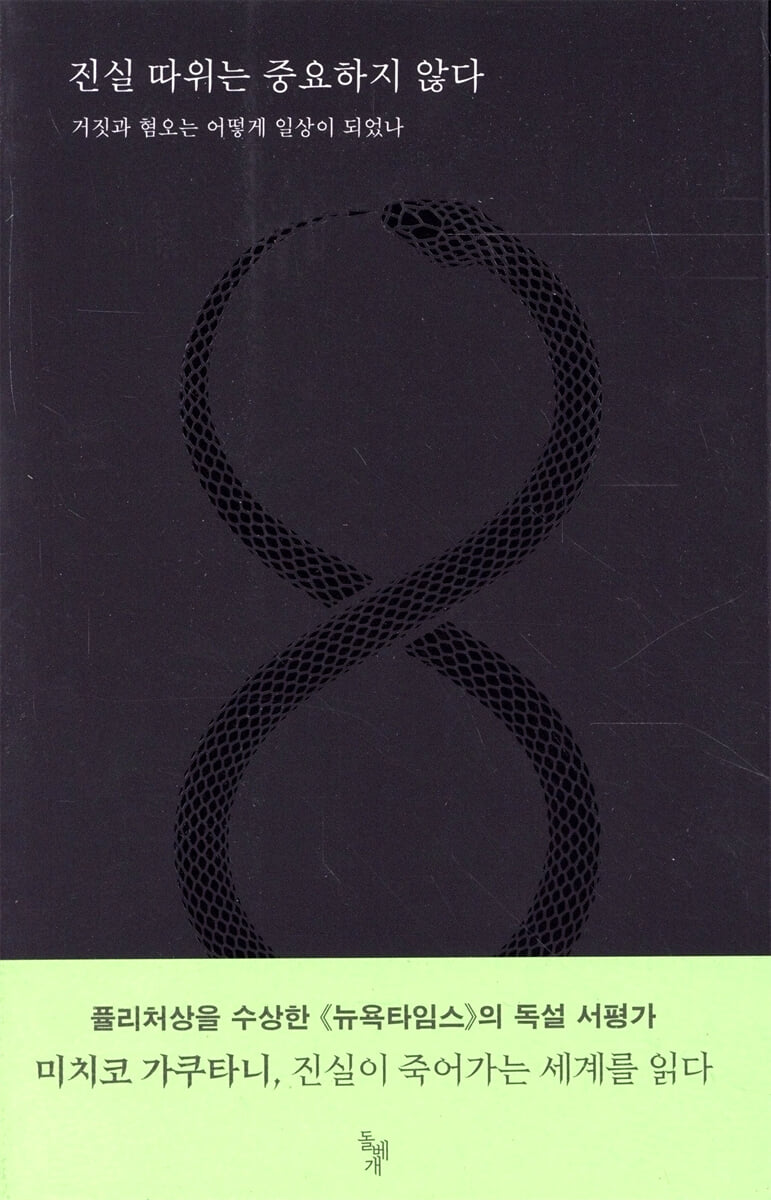 |
Description
Book Introduction
Hatred and loathing, fake news, lies, 'indulgence', anti-intellectualism…
A harsh critic's warning to the world Trump has created.
A book by Pulitzer Prize-winning New York Times critic Michiko Kakutani is being introduced in Korea for the first time.
『Truth Doesn't Matter』 reads this world, where truth is dying, with coolness and clarity through the eyes of an excellent book critic.
If you need to read just one book about a world saturated with anti-intellectualism, bigotry, and hate speech, in an age where Trump tells an average of 5.9 lies a day, where fake news and conspiracy theories threaten democracy, this is it.
Blessed with profound knowledge and insight, this book weaves together politics, history, and literature to paint a concise and lucid map of how post-truth has become so widespread and pervasive in our environment today, and how we arrived at this language.
The commentary by Jeong Hee-jin, a feminist scholar who offers some of the sharpest critiques of Korean society, will also spark in-depth discussion about our society.
A harsh critic's warning to the world Trump has created.
A book by Pulitzer Prize-winning New York Times critic Michiko Kakutani is being introduced in Korea for the first time.
『Truth Doesn't Matter』 reads this world, where truth is dying, with coolness and clarity through the eyes of an excellent book critic.
If you need to read just one book about a world saturated with anti-intellectualism, bigotry, and hate speech, in an age where Trump tells an average of 5.9 lies a day, where fake news and conspiracy theories threaten democracy, this is it.
Blessed with profound knowledge and insight, this book weaves together politics, history, and literature to paint a concise and lucid map of how post-truth has become so widespread and pervasive in our environment today, and how we arrived at this language.
The commentary by Jeong Hee-jin, a feminist scholar who offers some of the sharpest critiques of Korean society, will also spark in-depth discussion about our society.
- You can preview some of the book's contents.
Preview
index
Entering
1 The Decline and Fall of Reason
2 New Culture War
3 The Rise of the 'Ego' and Subjectivity
4 The extinction of reality
5 Language Inclusion
6 Filters, storage towers, shortages
7 Attention Deficit
8 'The Fire Hose of Lies': Propaganda and Fake News
9 People who take pleasure in other people's misfortune
Going out
main
Additional sources
The Human Condition in the Post-Truth Era - Jeong Hee-jin
Translator's Note: A full-fledged cultural and political critique by a sharp-tongued book reviewer.
1 The Decline and Fall of Reason
2 New Culture War
3 The Rise of the 'Ego' and Subjectivity
4 The extinction of reality
5 Language Inclusion
6 Filters, storage towers, shortages
7 Attention Deficit
8 'The Fire Hose of Lies': Propaganda and Fake News
9 People who take pleasure in other people's misfortune
Going out
main
Additional sources
The Human Condition in the Post-Truth Era - Jeong Hee-jin
Translator's Note: A full-fledged cultural and political critique by a sharp-tongued book reviewer.
Into the book
The term "truth decay" has joined the now-familiar vocabulary of the post-truth era, alongside phrases like "fake news" and "alternative facts."
The Rand Corporation used this term to refer to the “diminishing role of facts and analysis” in American public life.
It's not just fake news.
There's the fake science created by climate change deniers and anti-vaccinationists, the fake history promoted by Holocaust revisionists and white supremacists, the fake Americans on Facebook created by Russian internet trolls, and the fake followers and likes on social media created by bots.
--- p.11
In other words, Trump uses Orwellian magic to confuse people by using language to mean the opposite of what it actually means.
“War is peace,” “Freedom is slavery,” “Ignorance is strength.”
Not only did he try to discredit media outlets he perceived as threatening or unfriendly by using the term “fake news,” he also called the investigation into Russian interference in the U.S. presidential election “the biggest witch hunt in American political history.”
This is despite the fact that Trump himself has repeatedly attacked any institution he perceives as hostile to him, including the media, the judiciary, the FBI, and intelligence agencies.
--- p.88
“As traditional institutions lost trust, the tenuous ties of the workplace became inadequate to meet people’s need for belonging.” In response, people regained a sense of community by seeking out other groups like like-minded neighbors, churches, and social groups.
These dynamics would be amplified at lightning speed by the Internet—by news sites catering to particular ideological perspectives, by message boards for people with particular interests, by social media that further segmented people into partisan silos sharing their interests.
At the turn of the millennium, these divisions were more about tastes and values than ideology, but “as political parties came to represent ways of life, and ways of life came to define communities, it seemed like everyone could be divided into Republicans or Democrats,” Bishop writes.
By everything, I mean not just health care, voting rights, or views on global warming, but also where you shop, what you eat, and what movies you watch.
--- p.99
Lenin once said that his own inflammatory language was “intended to arouse hatred, disgust and contempt.”
This kind of language was intended not to convince the opposing class, but to break it; not to correct the enemy's mistakes, but to destroy him; and to annihilate the enemy's organization from the face of the earth.
This kind of rhetoric is really the kind that evokes the worst thoughts, the worst suspicions about the enemy.” All of this sounds like the language that Trump and his supporters used to attack Hillary Clinton during the 2016 US presidential campaign (“Lock up Hillary Clinton”), the language of the most rabid supporters of the Brexit movement in the UK, and the language increasingly used by right-wing populist movements on both sides of the Atlantic.
--- p.128
The sheer volume of disinformation unleashed by Russia's firehose system bears a striking resemblance to the more spontaneous but equally massive cascade of lies, scandals, and shocking rhetoric churned out by Trump, his Republican allies, and their media apparatchiks.
They tend to overwhelm and desensitize people, while lowering the bar for abnormality and normalizing the unacceptable.
Insults are driven by a weariness with being insulted, and this weariness is driven by cynicism and ennui, which empowers those who spread lies.
Garry Kasparov, a former world chess champion and pro-democracy Russian leader, tweeted in December 2016:
“The point of modern propaganda is not just to spread misinformation or push an agenda.
“It also exhausts our critical thinking and invalidates the truth.” --- p.134
The most horrific racist, sexist, and downright cruel remarks are often posted on social media, often accompanied by a wink or a sneer.
And when people who say such things are criticized publicly, they often respond by saying they were just joking.
It's very similar to when Trump makes an aggressive remark and White House aides say he's just joking or that someone misunderstood what he said.
--- p.147
I don't agree with the book's point of view.
However, I sincerely hope that many people will read this book and share the issues raised by the author.
I believe that even if a book can't save the world, it can stop people in their tracks for a moment.
This book is a necessary stop for thought in our contemporary society.
Michiko Kakutani believes in truth and faithfully reports on the "fake news" and its harmful effects created by the Trump era.
There is no one who would disagree.
This may be the best Trump report of our time.
(…) Now people know that even self-development like ‘effort’ is an impossible self-realization.
Instead, they try to realize themselves by pushing away others, hating them, and becoming 'servants'.
Trump's significance lies in his role as a model for these times.
One practical thing we can do is to fight the 'Trumps' around us.
Just as we need to overcome the 'fascism within us,' we also need to overcome the 'Trump within me,' but for now, it seems there are more people who avoid Trumps than Trumps themselves.
I see this situation as hopeful.
We must not miss this period, which includes depression, urban exodus, the "live with your eyes closed" pledge, and the emergence of the "YOLO" tribe, including myself.
Before everyone became Trump.
This is why this book is a must-read.
The Rand Corporation used this term to refer to the “diminishing role of facts and analysis” in American public life.
It's not just fake news.
There's the fake science created by climate change deniers and anti-vaccinationists, the fake history promoted by Holocaust revisionists and white supremacists, the fake Americans on Facebook created by Russian internet trolls, and the fake followers and likes on social media created by bots.
--- p.11
In other words, Trump uses Orwellian magic to confuse people by using language to mean the opposite of what it actually means.
“War is peace,” “Freedom is slavery,” “Ignorance is strength.”
Not only did he try to discredit media outlets he perceived as threatening or unfriendly by using the term “fake news,” he also called the investigation into Russian interference in the U.S. presidential election “the biggest witch hunt in American political history.”
This is despite the fact that Trump himself has repeatedly attacked any institution he perceives as hostile to him, including the media, the judiciary, the FBI, and intelligence agencies.
--- p.88
“As traditional institutions lost trust, the tenuous ties of the workplace became inadequate to meet people’s need for belonging.” In response, people regained a sense of community by seeking out other groups like like-minded neighbors, churches, and social groups.
These dynamics would be amplified at lightning speed by the Internet—by news sites catering to particular ideological perspectives, by message boards for people with particular interests, by social media that further segmented people into partisan silos sharing their interests.
At the turn of the millennium, these divisions were more about tastes and values than ideology, but “as political parties came to represent ways of life, and ways of life came to define communities, it seemed like everyone could be divided into Republicans or Democrats,” Bishop writes.
By everything, I mean not just health care, voting rights, or views on global warming, but also where you shop, what you eat, and what movies you watch.
--- p.99
Lenin once said that his own inflammatory language was “intended to arouse hatred, disgust and contempt.”
This kind of language was intended not to convince the opposing class, but to break it; not to correct the enemy's mistakes, but to destroy him; and to annihilate the enemy's organization from the face of the earth.
This kind of rhetoric is really the kind that evokes the worst thoughts, the worst suspicions about the enemy.” All of this sounds like the language that Trump and his supporters used to attack Hillary Clinton during the 2016 US presidential campaign (“Lock up Hillary Clinton”), the language of the most rabid supporters of the Brexit movement in the UK, and the language increasingly used by right-wing populist movements on both sides of the Atlantic.
--- p.128
The sheer volume of disinformation unleashed by Russia's firehose system bears a striking resemblance to the more spontaneous but equally massive cascade of lies, scandals, and shocking rhetoric churned out by Trump, his Republican allies, and their media apparatchiks.
They tend to overwhelm and desensitize people, while lowering the bar for abnormality and normalizing the unacceptable.
Insults are driven by a weariness with being insulted, and this weariness is driven by cynicism and ennui, which empowers those who spread lies.
Garry Kasparov, a former world chess champion and pro-democracy Russian leader, tweeted in December 2016:
“The point of modern propaganda is not just to spread misinformation or push an agenda.
“It also exhausts our critical thinking and invalidates the truth.” --- p.134
The most horrific racist, sexist, and downright cruel remarks are often posted on social media, often accompanied by a wink or a sneer.
And when people who say such things are criticized publicly, they often respond by saying they were just joking.
It's very similar to when Trump makes an aggressive remark and White House aides say he's just joking or that someone misunderstood what he said.
--- p.147
I don't agree with the book's point of view.
However, I sincerely hope that many people will read this book and share the issues raised by the author.
I believe that even if a book can't save the world, it can stop people in their tracks for a moment.
This book is a necessary stop for thought in our contemporary society.
Michiko Kakutani believes in truth and faithfully reports on the "fake news" and its harmful effects created by the Trump era.
There is no one who would disagree.
This may be the best Trump report of our time.
(…) Now people know that even self-development like ‘effort’ is an impossible self-realization.
Instead, they try to realize themselves by pushing away others, hating them, and becoming 'servants'.
Trump's significance lies in his role as a model for these times.
One practical thing we can do is to fight the 'Trumps' around us.
Just as we need to overcome the 'fascism within us,' we also need to overcome the 'Trump within me,' but for now, it seems there are more people who avoid Trumps than Trumps themselves.
I see this situation as hopeful.
We must not miss this period, which includes depression, urban exodus, the "live with your eyes closed" pledge, and the emergence of the "YOLO" tribe, including myself.
Before everyone became Trump.
This is why this book is a must-read.
--- From "Jeong Hee-jin (Women's Studies Researcher), Commentary"
Publisher's Review
The first domestically published work by legendary, sharp-tongued critic Michiko Kakutani
It was he who conducted the final interview with President Obama about the book in January 2017, just before he left office.
The name of this book reviewer, Michiko Kakutani, who has become a cultural icon through her work in J.K. Rowling's detective novel "The Silkworm" and through references in various dramas such as "Sex and the City," "Girls," and "The Affair," is Jonathan Franzen, who attacked Salman Rushdie for writing "the dumbest person in New York," "the strange woman," "Norman Mailer for writing "a one-man kamikaze," and "Susan Sontag for writing "stupid bad reviews contrasted with brilliant bad reviews."
Michiko Kakutani is a Japanese-American literary critic and book reviewer. She worked for The Washington Post and Time before joining The New York Times in 1979, where she was in charge of book reviews from 1983 to 2017.
He did not hesitate to make harsh comments about specific works by famous authors such as Haruki Murakami, Susan Sontag, Margaret Atwood, Jonathan Franzen, and Norman Mailer, and the authors responded to his harsh criticism in various ways.
But this controversy did not make him famous.
He was a critical assistant to Ian McEwan, David Foster Wallace, and George Saunders, and, following his own critical principles, he employed cool and merciless criticism of the works themselves, creating his own distinct style with a sharp and caustic tone.
Kakutani won the Pulitzer Prize for criticism in 1998 and is known as "the most influential book critic in the English-speaking world."
And readers who had encountered his name through lists of Michiko Kakutani's best books of the year or excerpts from reviews were finally able to read his writing directly in Korean in the fall of 2019.
"The Death of Truth: Notes on Falsehood in the Age of Trump" is Kakutani's second book, published 30 years after "The Poet at the Piano," a collection of interviews with various writers and artists.
Documenting Trump and the Post-Truth Era through a Critic's Eye
"The Truth Doesn't Matter" is the first book published by Michiko Kakutani, a renowned literary critic and book reviewer, after leaving the New York Times. It is a political and cultural critique.
Why was the first book he wrote, embarking on a full-fledged career as a writer, not a literary critique, but a political and cultural critique? Perhaps readers can discern in it Kakutani's urgent critical intervention into the urgent circumstances of the times (and isn't such intervention one of the essential roles of criticism?).
Kakutani wrote the book to “examine how indifference to facts, emotion replacing reason, and corroded language are eroding the value of truth in a post-truth era where the term ‘decline of truth’ now includes familiar phrases like ‘fake news’ and ‘alternative facts,’ and what this means for America and the world.”
In this book, Kakutani uses the keyword “death of truth” to salvage a world shrouded in anti-intellectualism, prejudice disguised as jokes, and hate speech, in which truth is under attack, objectivity is losing popularity, and US President Trump tells 5.9 lies a day, reason and science are in retreat, and democracy is threatened by fake news and conspiracy theories. He reads this world with the cool and clear eyes of an uncompromising book critic.
He traverses not only Trump's personal lies, narcissism, and politics of hate, but also the broader culture of our time, symbolized by "Trump," weaving together political reality, history, and literature to find answers to the following questions:
"How did this happen? How did truth and reason come to be in such peril? What does the imminent death of truth and reason portend for the future of our public discourse, politics, and governance?"
According to him, this phenomenon has been gradually appearing for several decades.
Kakutani documents what has transpired around the "death of truth" across diverse fields, encompassing everyday life, politics, academia, literature, popular culture, and internet social media, regardless of political affiliation.
Since the culture wars began in the 1960s, postmodernism, once discussed in academia, has permeated popular culture and mainstream politics, spreading relativism and giving rise to what Christopher Lassey calls “a culture of narcissism” and Tom Wolfe calls “the age of the ‘I,’” leading to the rise of subjectivity.
Also, starting around 1980, America began to fragment in response to the social changes of the 1960s, reorganizing life around “values, tastes, and beliefs.”
And it was the Internet that lit the fire here.
He delves deeply and sharply into the dark core of what is ailing democracy, encompassing the landscape surrounding American democracy, discussions on postmodernism and the culture wars since the 1960s, the rise of subjectivity, the collapse of 'reality', filter bubbles, storage towers, and shortages, the problems of the Internet as a medium, Russia's interference in the US presidential election, the language of not only Trump but also Hitler, Lenin, and Putin, the nihilism that permeates society, propaganda, and Internet trolls.
Drawing on the stories of George Orwell, Hannah Arendt, Stefan Zweig, Tom Wolfe, and David Foster Wallace, he paints a concise and lucid map of how post-truth has become so widespread and pervasive in our environment today, and how we have arrived at the language of irony, prejudice, and hate.
And in this situation, we ask ourselves how we can revive the truth, the cornerstone of democracy.
How Lies and Hatred Became Everyday in Korean Society
The title, "Truth Doesn't Matter," encapsulates the attitude that has created a world where truth is dying, and is a paradoxical expression that contradicts the book's argument. "Truth Doesn't Matter" laments the crisis of democracy symbolized by Trump, diagnoses an era in which truth has lost its power, and hopes for the restoration of language that embodies truthfulness and transparency.
And Kakutani's analysis and suggestions are even more useful in a Korean society still noisy with excessive and biased rhetoric, as seen in the fake news controversy surrounding the appointment of Cho Kuk as the Minister of Justice.
This book will provide meaningful insights and critical points on the manipulation of public opinion through comment groups and fake news, lies and political agitation, the Taegeukgi group, social media and tribalism, conspiracy theories, anti-intellectualism, malicious comments, and hate speech.
At the end, the book includes an introduction by Jeong Hee-jin, a feminist scholar who offers some of the sharpest critiques on Korean society, sparking in-depth discussion about our society, where lies and hatred have become commonplace.
Jeong Hee-jin wrote that while she “does not agree with the book’s perspective,” she “deeply hopes that many people will read this book and share the issues the author raises.”
Unlike Kakutani, who criticizes postmodernism and believes in the existence of truth, Jeong Hee-jin is wary of a single voice that claims to be the truth.
However, he wrote that he hopes the book will be read as “required reading” as “the best Trump report of our time.”
In an era where even “self-development like ‘effort’” has become “impossible self-realization” and people try to “realize themselves by pushing away others, hating them, and becoming ‘servants,’” “Trump’s significance lies in being a model for this era,” and “the only practical thing we can do is to fight the ‘Trumps’ around us.”
Through this book, written honestly by a sharp critic, readers will gain not only three-dimensional insights into our society but also crucial resources for the grand battle.
It was he who conducted the final interview with President Obama about the book in January 2017, just before he left office.
The name of this book reviewer, Michiko Kakutani, who has become a cultural icon through her work in J.K. Rowling's detective novel "The Silkworm" and through references in various dramas such as "Sex and the City," "Girls," and "The Affair," is Jonathan Franzen, who attacked Salman Rushdie for writing "the dumbest person in New York," "the strange woman," "Norman Mailer for writing "a one-man kamikaze," and "Susan Sontag for writing "stupid bad reviews contrasted with brilliant bad reviews."
Michiko Kakutani is a Japanese-American literary critic and book reviewer. She worked for The Washington Post and Time before joining The New York Times in 1979, where she was in charge of book reviews from 1983 to 2017.
He did not hesitate to make harsh comments about specific works by famous authors such as Haruki Murakami, Susan Sontag, Margaret Atwood, Jonathan Franzen, and Norman Mailer, and the authors responded to his harsh criticism in various ways.
But this controversy did not make him famous.
He was a critical assistant to Ian McEwan, David Foster Wallace, and George Saunders, and, following his own critical principles, he employed cool and merciless criticism of the works themselves, creating his own distinct style with a sharp and caustic tone.
Kakutani won the Pulitzer Prize for criticism in 1998 and is known as "the most influential book critic in the English-speaking world."
And readers who had encountered his name through lists of Michiko Kakutani's best books of the year or excerpts from reviews were finally able to read his writing directly in Korean in the fall of 2019.
"The Death of Truth: Notes on Falsehood in the Age of Trump" is Kakutani's second book, published 30 years after "The Poet at the Piano," a collection of interviews with various writers and artists.
Documenting Trump and the Post-Truth Era through a Critic's Eye
"The Truth Doesn't Matter" is the first book published by Michiko Kakutani, a renowned literary critic and book reviewer, after leaving the New York Times. It is a political and cultural critique.
Why was the first book he wrote, embarking on a full-fledged career as a writer, not a literary critique, but a political and cultural critique? Perhaps readers can discern in it Kakutani's urgent critical intervention into the urgent circumstances of the times (and isn't such intervention one of the essential roles of criticism?).
Kakutani wrote the book to “examine how indifference to facts, emotion replacing reason, and corroded language are eroding the value of truth in a post-truth era where the term ‘decline of truth’ now includes familiar phrases like ‘fake news’ and ‘alternative facts,’ and what this means for America and the world.”
In this book, Kakutani uses the keyword “death of truth” to salvage a world shrouded in anti-intellectualism, prejudice disguised as jokes, and hate speech, in which truth is under attack, objectivity is losing popularity, and US President Trump tells 5.9 lies a day, reason and science are in retreat, and democracy is threatened by fake news and conspiracy theories. He reads this world with the cool and clear eyes of an uncompromising book critic.
He traverses not only Trump's personal lies, narcissism, and politics of hate, but also the broader culture of our time, symbolized by "Trump," weaving together political reality, history, and literature to find answers to the following questions:
"How did this happen? How did truth and reason come to be in such peril? What does the imminent death of truth and reason portend for the future of our public discourse, politics, and governance?"
According to him, this phenomenon has been gradually appearing for several decades.
Kakutani documents what has transpired around the "death of truth" across diverse fields, encompassing everyday life, politics, academia, literature, popular culture, and internet social media, regardless of political affiliation.
Since the culture wars began in the 1960s, postmodernism, once discussed in academia, has permeated popular culture and mainstream politics, spreading relativism and giving rise to what Christopher Lassey calls “a culture of narcissism” and Tom Wolfe calls “the age of the ‘I,’” leading to the rise of subjectivity.
Also, starting around 1980, America began to fragment in response to the social changes of the 1960s, reorganizing life around “values, tastes, and beliefs.”
And it was the Internet that lit the fire here.
He delves deeply and sharply into the dark core of what is ailing democracy, encompassing the landscape surrounding American democracy, discussions on postmodernism and the culture wars since the 1960s, the rise of subjectivity, the collapse of 'reality', filter bubbles, storage towers, and shortages, the problems of the Internet as a medium, Russia's interference in the US presidential election, the language of not only Trump but also Hitler, Lenin, and Putin, the nihilism that permeates society, propaganda, and Internet trolls.
Drawing on the stories of George Orwell, Hannah Arendt, Stefan Zweig, Tom Wolfe, and David Foster Wallace, he paints a concise and lucid map of how post-truth has become so widespread and pervasive in our environment today, and how we have arrived at the language of irony, prejudice, and hate.
And in this situation, we ask ourselves how we can revive the truth, the cornerstone of democracy.
How Lies and Hatred Became Everyday in Korean Society
The title, "Truth Doesn't Matter," encapsulates the attitude that has created a world where truth is dying, and is a paradoxical expression that contradicts the book's argument. "Truth Doesn't Matter" laments the crisis of democracy symbolized by Trump, diagnoses an era in which truth has lost its power, and hopes for the restoration of language that embodies truthfulness and transparency.
And Kakutani's analysis and suggestions are even more useful in a Korean society still noisy with excessive and biased rhetoric, as seen in the fake news controversy surrounding the appointment of Cho Kuk as the Minister of Justice.
This book will provide meaningful insights and critical points on the manipulation of public opinion through comment groups and fake news, lies and political agitation, the Taegeukgi group, social media and tribalism, conspiracy theories, anti-intellectualism, malicious comments, and hate speech.
At the end, the book includes an introduction by Jeong Hee-jin, a feminist scholar who offers some of the sharpest critiques on Korean society, sparking in-depth discussion about our society, where lies and hatred have become commonplace.
Jeong Hee-jin wrote that while she “does not agree with the book’s perspective,” she “deeply hopes that many people will read this book and share the issues the author raises.”
Unlike Kakutani, who criticizes postmodernism and believes in the existence of truth, Jeong Hee-jin is wary of a single voice that claims to be the truth.
However, he wrote that he hopes the book will be read as “required reading” as “the best Trump report of our time.”
In an era where even “self-development like ‘effort’” has become “impossible self-realization” and people try to “realize themselves by pushing away others, hating them, and becoming ‘servants,’” “Trump’s significance lies in being a model for this era,” and “the only practical thing we can do is to fight the ‘Trumps’ around us.”
Through this book, written honestly by a sharp critic, readers will gain not only three-dimensional insights into our society but also crucial resources for the grand battle.
GOODS SPECIFICS
- Date of issue: October 4, 2019
- Page count, weight, size: 208 pages | 220g | 120*188*14mm
- ISBN13: 9788971999790
- ISBN10: 8971999799
You may also like
카테고리
korean


korean

![GQ KOREA Mark (Monthly): December [2025]](http://librairie.coreenne.fr/cdn/shop/files/8ef265dbbfbf186523ed75ba7319009d.jpg?v=1765340328&width=3840)


