

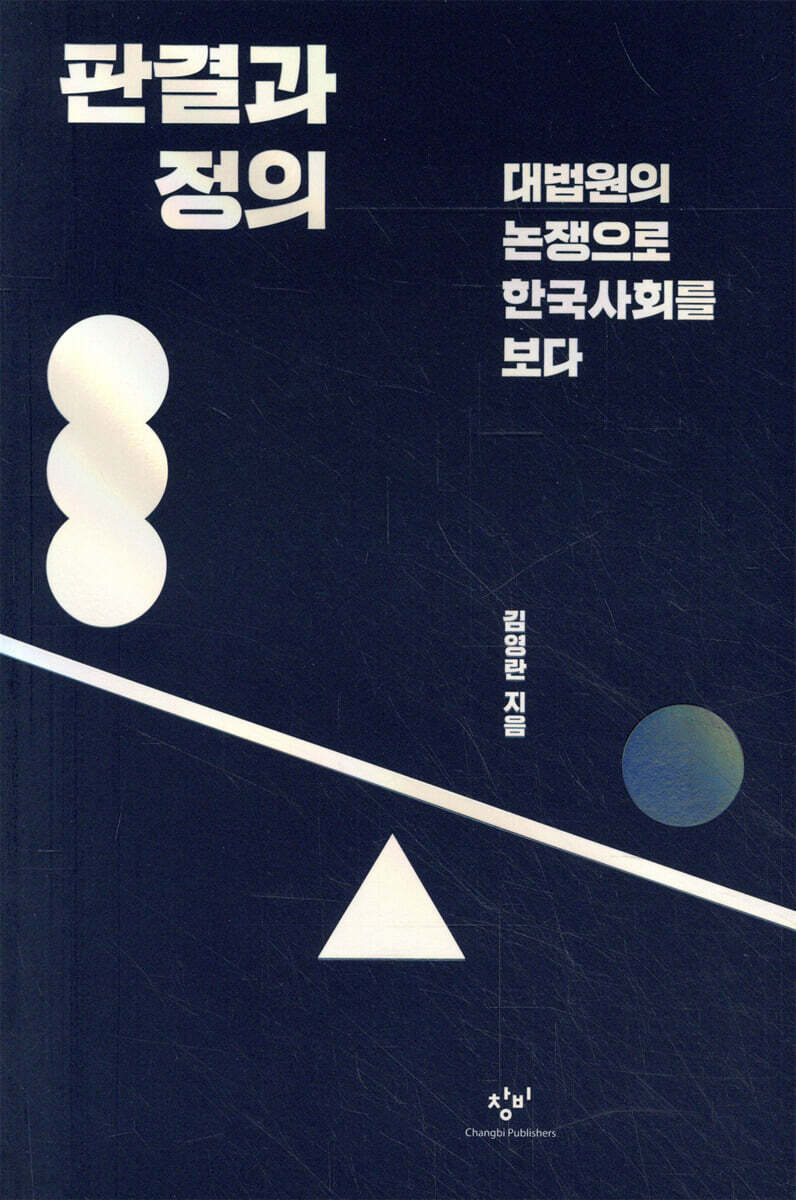
Judgment and Justice
 |
Description
Book Introduction
- A word from MD
-
Korean society as seen through the Supreme Court's rulingFormer Supreme Court Justice Kim Young-ran reflects on Supreme Court rulings to assess the current state of justice in Korean society.
By analyzing the decisions of the full bench of the Supreme Court that were handed down after the retirement of the Justice, we addressed issues from a macroscopic perspective regarding patriarchy in Korean society, gender sensitivity, democracy in the private sphere, and coming to terms with the past.
September 20, 2019. Social and Political PD Son Min-gyu
Has the Supreme Court's decision made our society more just?
Kim Young-ran's Questions for the Future of Democracy
In today's world, where distrust in the judiciary and a political landscape spiraling into endless political strife, "judgments" and "justice" are more questionable than ever, a new book, "Judgments and Justice," has been published that examines the current state of justice in Korean society by looking back on Supreme Court rulings.
Author Kim Young-ran has been at the forefront of protecting the values of democracy, having served as the first female Supreme Court Justice in the Republic of Korea and as Chairperson of the Anti-Corruption and Civil Rights Commission, who worked hard to enact the “Kim Young-ran Act” (Act on the Prohibition of Improper Solicitation and Bribery, etc.), which overturned long-standing practices of solicitation in our society.
In his previous work, “Rethinking Judgments,” the author looked back on the decisions of the full bench of the Supreme Court in which he participated while serving as a Supreme Court Justice. In this book, “Judgments and Justice,” the author looks back on the decisions of the full bench of the Supreme Court that were handed down after his retirement as a Supreme Court Justice, and analyzes the ongoing issues from a macroscopic perspective.
The book is filled with the author's long-standing concerns as a judge and his sharp perspective on the "justice pursued by judgment."
In particular, through this book, the author breaks the conventional wisdom that judges interpret and judge based solely on legal principles, and coolly criticizes 'how Supreme Court justices use the freedom granted to them.'
Kim Young-ran's Questions for the Future of Democracy
In today's world, where distrust in the judiciary and a political landscape spiraling into endless political strife, "judgments" and "justice" are more questionable than ever, a new book, "Judgments and Justice," has been published that examines the current state of justice in Korean society by looking back on Supreme Court rulings.
Author Kim Young-ran has been at the forefront of protecting the values of democracy, having served as the first female Supreme Court Justice in the Republic of Korea and as Chairperson of the Anti-Corruption and Civil Rights Commission, who worked hard to enact the “Kim Young-ran Act” (Act on the Prohibition of Improper Solicitation and Bribery, etc.), which overturned long-standing practices of solicitation in our society.
In his previous work, “Rethinking Judgments,” the author looked back on the decisions of the full bench of the Supreme Court in which he participated while serving as a Supreme Court Justice. In this book, “Judgments and Justice,” the author looks back on the decisions of the full bench of the Supreme Court that were handed down after his retirement as a Supreme Court Justice, and analyzes the ongoing issues from a macroscopic perspective.
The book is filled with the author's long-standing concerns as a judge and his sharp perspective on the "justice pursued by judgment."
In particular, through this book, the author breaks the conventional wisdom that judges interpret and judge based solely on legal principles, and coolly criticizes 'how Supreme Court justices use the freedom granted to them.'
- You can preview some of the book's contents.
Preview
index
Prologue Life on Court
01 The Current State of Patriarchal Change
A new standard for family hierarchy
02 Adult Sensitivity, or Just the Victim's Emotions?
Lawsuit to overturn dismissal of sexually harassing professor
03 Scope of the Constitution Applicable to Private Organizations
Teachers' union? Civil servants' union? Political party
04 Can a contract take precedence over the law?
Humidifier disinfectant case, regular wage case, railway union strike case
05 Is there no responsibility for 'Gap's' laissez-faire?
Kangwon Land incident, KIKO incident
06 Minimum steps to settle the past
Retrial of the Cho Bong-am case and the People's Revolutionary Party damages case
07 What is the extent of the judiciary's authority over past events?
Jindo civilian massacre? Retrial of Jeong Won-seop's case
08 Political Verdicts: What's the Problem?
Samsung X-Files incident
09 Political judgments that judges cannot avoid
PD Notebook mad cow disease reporting incident
Epilogue: To avoid falling into the error of Nirvana
01 The Current State of Patriarchal Change
A new standard for family hierarchy
02 Adult Sensitivity, or Just the Victim's Emotions?
Lawsuit to overturn dismissal of sexually harassing professor
03 Scope of the Constitution Applicable to Private Organizations
Teachers' union? Civil servants' union? Political party
04 Can a contract take precedence over the law?
Humidifier disinfectant case, regular wage case, railway union strike case
05 Is there no responsibility for 'Gap's' laissez-faire?
Kangwon Land incident, KIKO incident
06 Minimum steps to settle the past
Retrial of the Cho Bong-am case and the People's Revolutionary Party damages case
07 What is the extent of the judiciary's authority over past events?
Jindo civilian massacre? Retrial of Jeong Won-seop's case
08 Political Verdicts: What's the Problem?
Samsung X-Files incident
09 Political judgments that judges cannot avoid
PD Notebook mad cow disease reporting incident
Epilogue: To avoid falling into the error of Nirvana
Publisher's Review
Has the Supreme Court's decision made our society more just?
Kim Young-ran's Questions for the Future of Democracy
In today's world, where distrust in the judiciary and a political landscape spiraling into endless political strife, "judgments" and "justice" are more questionable than ever, a new book, "Judgments and Justice," has been published that examines the current state of justice in Korean society by looking back on Supreme Court rulings.
Author Kim Young-ran has been at the forefront of protecting the values of democracy, having served as the first female Supreme Court Justice in the Republic of Korea and as Chairperson of the Anti-Corruption and Civil Rights Commission, who worked hard to enact the “Kim Young-ran Act” (Act on the Prohibition of Improper Solicitation and Bribery, etc.), which overturned long-standing practices of solicitation in our society.
In his previous work, “Rethinking Judgments,” the author looked back on the decisions of the full bench of the Supreme Court in which he participated while serving as a Supreme Court Justice. In this book, “Judgments and Justice,” the author looks back on the decisions of the full bench of the Supreme Court that were handed down after his retirement as a Supreme Court Justice, and analyzes the ongoing issues from a macroscopic perspective.
The book is filled with the author's long-standing concerns as a judge and his sharp perspective on the "justice pursued by judgment."
In particular, through this book, the author breaks the conventional wisdom that judges interpret and judge based solely on legal principles, and coolly criticizes 'how Supreme Court justices use the freedom granted to them.'
In this book, you can encounter again the incidents that shook our society, such as the ‘lawsuit to overturn the dismissal decision of a sexually harassing professor,’ the ‘humidifier disinfectant incident,’ the ‘Kangwon Land incident,’ the ‘KIKO incident,’ and the ‘Samsung X-file incident.’
The topics the author brings up in these cases are those that have been constant subjects of debate in Korean society, such as patriarchy, laissez-faire, coming to terms with the past, and the judicialization of politics.
The judiciary, in principle, makes decisions based on the given law, but even for the same law, different interpretations may appear depending on changes in common sense shared by society and the maturity of democracy, and the judgments may also vary accordingly.
Where is the direction of this 'changing' judgment headed, and who should be the entity determining that direction?
This is the question the author poses in this book.
A verdict is not a period.
The judgment brings an end to the controversy surrounding the case, but the concerns about the values that were at issue in the judgment remain.
We must look back on the accumulated judgments and examine whether they have made our society more just. We must also change the common sense and consensus of society as a whole in a better direction so that the judiciary's decisions can be more just.
"Judgment and Justice" will serve as a "guide to justice," showing us, as democratic citizens, where to begin and in what direction we should proceed.
How is the Supreme Court responding to a changing society?
Judgments tend to lag rather than lead changes in our society.
Therefore, it is absolutely necessary and important to reflect on whether the judiciary is upholding social justice in keeping with the changing society.
From the very first chapter, the author addresses the issue of gender discrimination, one of the hottest topics in our society today.
As social norms changed, institutional gender discrimination such as the household headship system disappeared, but gender stratification such as patriarchy still remains.
The author argues that the essence of patriarchy, which has long established a male-dominated order based on dichotomous logic, is not simply a phenomenon arising from gender differences, but rather a problem of hierarchical order constructed through stratification.
As awareness of these problems spreads, society changes, and patriarchy gradually disintegrates, the Supreme Court is accepting these changes in a somewhat conservative manner.
The author says that, despite this, the Supreme Court is showing signs of change through its various rulings and that it is worth keeping an eye on this.
The following chapter examines the first instance in which the term "adult sensitivity" appeared in a Supreme Court ruling.
As the lawsuit to overturn the dismissal of a sexually harassing professor progressed, the high court ruled that the victim's claim of sexual harassment could not be accepted, but the Supreme Court overturned this ruling.
The Supreme Court explains the intent of its ruling by saying, “When a court hears a sexual harassment lawsuit, it must understand the issue of gender discrimination in the context in which the incident occurred and maintain ‘gender sensitivity’ so as to achieve gender equality.”
The author introduces this judgment and emphasizes what ‘adult sensitivity’ is and why it is necessary in the judgment process.
Chapter 3 examines constitutional principles at work within various private organizations.
By examining the debate over clan membership, the struggle for voting rights in the teachers' and civil servants' unions, and the controversy over proxy voting that arose during the Unified Progressive Party's primary, this book prompts reflection on the question: "To what extent and in what manner does the Constitution apply to private organizations?"
This provides an opportunity to reflect on whether democracy, which is founded on the Constitution, is not being protected more and more in areas that are closer to our lives.
The impact of neoliberalism and globalization on the ruling
It is a widely recognized fact that the impact of neoliberalism, which has become a global trend, on Korea extends across all areas of society.
The author expresses concern about the logic of power hidden in the fundamental principles of neoliberalism, which prioritize the values of “formal equality” and “the free pursuit of individual interests” above all else.
The book examines representative cases such as the 'Humidifier Disinfectant Case,' the 'Regular Wage Case,' and the 'Railroad Union Strike Case,' and points out the crisis faced by legal principles in the neoliberal system by retracing the process in which judgments were handed down based on the 'principle of contractual supremacy,' giving priority to contracts over law and consequently protecting the parties in a superior position.
Again, looking back at the 'Kangwon Land Incident' and the 'KIKO Incident', we point out the power that can be gained when the position of 'A' and laissez-faire are combined, and the dangers of Supreme Court rulings that affirm the logic of such power, and once again remind us of the mission of the law and the judiciary.
In particular, it is noteworthy that chapters 4 and 5 introduce the discussion of Alain Supiot, a world-renowned scholar of law and economics, and present a concise and detailed critique of the neoliberal trend.
This will enable ordinary readers to clearly understand the risks inherent in rulings that raise concerns about the supremacy of contract.
Moreover, for those in the legal profession, this content will be a chillingly sharp criticism of the current situation where neoliberal judgments are rampant.
The increasingly inseparable relationship between politics and the judiciary
The terms ‘judicialization of politics’ and ‘politicization of the judiciary’ are no longer new.
Even before the recent 'judicial corruption' incident, most citizens are aware that there have been countless attempts and actual mergers of the judiciary and politics.
This is why it is important to understand the reasons for the growing prevalence of political judgments and the factors considered in the process of making political judgments.
In chapters 6 to 9, the author examines the relationship between the judiciary and politics, dividing it into two major cases.
First, chapters 6 and 7 examine how the judiciary responds to the issue of settling past wrongdoings.
The judiciary, during the past military regime, played a role that could hardly be called the "judicialization of politics," providing only a formal legal application process for the government's unilateral decisions, and this resulted in numerous judicial victims.
Looking back at the retrial decisions of the Supreme Court (Lee Yong-hoon Court), which attempted to liquidate past history using the retrial method, the author points out the clear limitations of the process.
It also points out the problems with the logic applied in the ruling process of cases related to past history during the Yang Seung-tae court era, which followed the process of ‘organization’ rather than ‘liquidation’ of past history.
The author's point is all the more regrettable and painful when we consider the greater harm this flawed logic of the ruling has caused to those who have been harmed by state power.
Lastly, we look back at the 'Samsung X-Files case' and the 'PD Notebook mad cow disease reporting case', which can be considered representative examples of political judgment.
In this section, the author considers what a political judgment is and points out the reasons why a political judgment is made.
At the same time, we urge the Supreme Court to find a wise way to address the increasing trend of political issues not being resolved within the political sphere but instead seeking judicial judgment.
Weighing Justice in Verdicts
The author recalls his time as a judicial researcher and mentions the shock he felt when he learned that "judgments can also be choices."
That shock became a source of fear during my time as a Supreme Court Justice, and it became the trigger for me to keep asking myself, "What exactly are the criteria for that selection?"
Since retiring as a Supreme Court Justice, the author has worked to find an answer to this question by holding positions that allowed him to contemplate more deeply about judgment and justice, including as the Chairman of the National Human Rights Commission and as a distinguished professor at a law school.
"Judgment and Justice" is another provisional conclusion reached after much deliberation.
In this book, the author talks about the values reflected, or not reflected, in Supreme Court decisions.
A ruling that simply interprets the given law literally will produce results no different from those left to artificial intelligence.
That is why it is necessary to ‘think about and imagine the future of the world and the law when interpreting and applying the law.’
The author identifies the values that must be considered during this process, allowing readers to determine whether the Supreme Court's decision is the result of a successful execution of this process.
Despite the burden of criticizing a Supreme Court ruling in which she had no part, Kim Young-ran brought the topic of “justice” to the forefront.
This is because I have accepted this as a responsibility as a citizen of a democratic society, beyond the sense of duty as someone who has been in the legal profession for a long time.
The author's heart, weighing the weight of justice in the Supreme Court's ruling, and the readers' yearning for our society to become a more just and democratic society meet here.
The insights and perspectives contained in "Judgment and Justice" will serve as a foundation for thought for all those contemplating justice in our society.
Kim Young-ran's Questions for the Future of Democracy
In today's world, where distrust in the judiciary and a political landscape spiraling into endless political strife, "judgments" and "justice" are more questionable than ever, a new book, "Judgments and Justice," has been published that examines the current state of justice in Korean society by looking back on Supreme Court rulings.
Author Kim Young-ran has been at the forefront of protecting the values of democracy, having served as the first female Supreme Court Justice in the Republic of Korea and as Chairperson of the Anti-Corruption and Civil Rights Commission, who worked hard to enact the “Kim Young-ran Act” (Act on the Prohibition of Improper Solicitation and Bribery, etc.), which overturned long-standing practices of solicitation in our society.
In his previous work, “Rethinking Judgments,” the author looked back on the decisions of the full bench of the Supreme Court in which he participated while serving as a Supreme Court Justice. In this book, “Judgments and Justice,” the author looks back on the decisions of the full bench of the Supreme Court that were handed down after his retirement as a Supreme Court Justice, and analyzes the ongoing issues from a macroscopic perspective.
The book is filled with the author's long-standing concerns as a judge and his sharp perspective on the "justice pursued by judgment."
In particular, through this book, the author breaks the conventional wisdom that judges interpret and judge based solely on legal principles, and coolly criticizes 'how Supreme Court justices use the freedom granted to them.'
In this book, you can encounter again the incidents that shook our society, such as the ‘lawsuit to overturn the dismissal decision of a sexually harassing professor,’ the ‘humidifier disinfectant incident,’ the ‘Kangwon Land incident,’ the ‘KIKO incident,’ and the ‘Samsung X-file incident.’
The topics the author brings up in these cases are those that have been constant subjects of debate in Korean society, such as patriarchy, laissez-faire, coming to terms with the past, and the judicialization of politics.
The judiciary, in principle, makes decisions based on the given law, but even for the same law, different interpretations may appear depending on changes in common sense shared by society and the maturity of democracy, and the judgments may also vary accordingly.
Where is the direction of this 'changing' judgment headed, and who should be the entity determining that direction?
This is the question the author poses in this book.
A verdict is not a period.
The judgment brings an end to the controversy surrounding the case, but the concerns about the values that were at issue in the judgment remain.
We must look back on the accumulated judgments and examine whether they have made our society more just. We must also change the common sense and consensus of society as a whole in a better direction so that the judiciary's decisions can be more just.
"Judgment and Justice" will serve as a "guide to justice," showing us, as democratic citizens, where to begin and in what direction we should proceed.
How is the Supreme Court responding to a changing society?
Judgments tend to lag rather than lead changes in our society.
Therefore, it is absolutely necessary and important to reflect on whether the judiciary is upholding social justice in keeping with the changing society.
From the very first chapter, the author addresses the issue of gender discrimination, one of the hottest topics in our society today.
As social norms changed, institutional gender discrimination such as the household headship system disappeared, but gender stratification such as patriarchy still remains.
The author argues that the essence of patriarchy, which has long established a male-dominated order based on dichotomous logic, is not simply a phenomenon arising from gender differences, but rather a problem of hierarchical order constructed through stratification.
As awareness of these problems spreads, society changes, and patriarchy gradually disintegrates, the Supreme Court is accepting these changes in a somewhat conservative manner.
The author says that, despite this, the Supreme Court is showing signs of change through its various rulings and that it is worth keeping an eye on this.
The following chapter examines the first instance in which the term "adult sensitivity" appeared in a Supreme Court ruling.
As the lawsuit to overturn the dismissal of a sexually harassing professor progressed, the high court ruled that the victim's claim of sexual harassment could not be accepted, but the Supreme Court overturned this ruling.
The Supreme Court explains the intent of its ruling by saying, “When a court hears a sexual harassment lawsuit, it must understand the issue of gender discrimination in the context in which the incident occurred and maintain ‘gender sensitivity’ so as to achieve gender equality.”
The author introduces this judgment and emphasizes what ‘adult sensitivity’ is and why it is necessary in the judgment process.
Chapter 3 examines constitutional principles at work within various private organizations.
By examining the debate over clan membership, the struggle for voting rights in the teachers' and civil servants' unions, and the controversy over proxy voting that arose during the Unified Progressive Party's primary, this book prompts reflection on the question: "To what extent and in what manner does the Constitution apply to private organizations?"
This provides an opportunity to reflect on whether democracy, which is founded on the Constitution, is not being protected more and more in areas that are closer to our lives.
The impact of neoliberalism and globalization on the ruling
It is a widely recognized fact that the impact of neoliberalism, which has become a global trend, on Korea extends across all areas of society.
The author expresses concern about the logic of power hidden in the fundamental principles of neoliberalism, which prioritize the values of “formal equality” and “the free pursuit of individual interests” above all else.
The book examines representative cases such as the 'Humidifier Disinfectant Case,' the 'Regular Wage Case,' and the 'Railroad Union Strike Case,' and points out the crisis faced by legal principles in the neoliberal system by retracing the process in which judgments were handed down based on the 'principle of contractual supremacy,' giving priority to contracts over law and consequently protecting the parties in a superior position.
Again, looking back at the 'Kangwon Land Incident' and the 'KIKO Incident', we point out the power that can be gained when the position of 'A' and laissez-faire are combined, and the dangers of Supreme Court rulings that affirm the logic of such power, and once again remind us of the mission of the law and the judiciary.
In particular, it is noteworthy that chapters 4 and 5 introduce the discussion of Alain Supiot, a world-renowned scholar of law and economics, and present a concise and detailed critique of the neoliberal trend.
This will enable ordinary readers to clearly understand the risks inherent in rulings that raise concerns about the supremacy of contract.
Moreover, for those in the legal profession, this content will be a chillingly sharp criticism of the current situation where neoliberal judgments are rampant.
The increasingly inseparable relationship between politics and the judiciary
The terms ‘judicialization of politics’ and ‘politicization of the judiciary’ are no longer new.
Even before the recent 'judicial corruption' incident, most citizens are aware that there have been countless attempts and actual mergers of the judiciary and politics.
This is why it is important to understand the reasons for the growing prevalence of political judgments and the factors considered in the process of making political judgments.
In chapters 6 to 9, the author examines the relationship between the judiciary and politics, dividing it into two major cases.
First, chapters 6 and 7 examine how the judiciary responds to the issue of settling past wrongdoings.
The judiciary, during the past military regime, played a role that could hardly be called the "judicialization of politics," providing only a formal legal application process for the government's unilateral decisions, and this resulted in numerous judicial victims.
Looking back at the retrial decisions of the Supreme Court (Lee Yong-hoon Court), which attempted to liquidate past history using the retrial method, the author points out the clear limitations of the process.
It also points out the problems with the logic applied in the ruling process of cases related to past history during the Yang Seung-tae court era, which followed the process of ‘organization’ rather than ‘liquidation’ of past history.
The author's point is all the more regrettable and painful when we consider the greater harm this flawed logic of the ruling has caused to those who have been harmed by state power.
Lastly, we look back at the 'Samsung X-Files case' and the 'PD Notebook mad cow disease reporting case', which can be considered representative examples of political judgment.
In this section, the author considers what a political judgment is and points out the reasons why a political judgment is made.
At the same time, we urge the Supreme Court to find a wise way to address the increasing trend of political issues not being resolved within the political sphere but instead seeking judicial judgment.
Weighing Justice in Verdicts
The author recalls his time as a judicial researcher and mentions the shock he felt when he learned that "judgments can also be choices."
That shock became a source of fear during my time as a Supreme Court Justice, and it became the trigger for me to keep asking myself, "What exactly are the criteria for that selection?"
Since retiring as a Supreme Court Justice, the author has worked to find an answer to this question by holding positions that allowed him to contemplate more deeply about judgment and justice, including as the Chairman of the National Human Rights Commission and as a distinguished professor at a law school.
"Judgment and Justice" is another provisional conclusion reached after much deliberation.
In this book, the author talks about the values reflected, or not reflected, in Supreme Court decisions.
A ruling that simply interprets the given law literally will produce results no different from those left to artificial intelligence.
That is why it is necessary to ‘think about and imagine the future of the world and the law when interpreting and applying the law.’
The author identifies the values that must be considered during this process, allowing readers to determine whether the Supreme Court's decision is the result of a successful execution of this process.
Despite the burden of criticizing a Supreme Court ruling in which she had no part, Kim Young-ran brought the topic of “justice” to the forefront.
This is because I have accepted this as a responsibility as a citizen of a democratic society, beyond the sense of duty as someone who has been in the legal profession for a long time.
The author's heart, weighing the weight of justice in the Supreme Court's ruling, and the readers' yearning for our society to become a more just and democratic society meet here.
The insights and perspectives contained in "Judgment and Justice" will serve as a foundation for thought for all those contemplating justice in our society.
GOODS SPECIFICS
- Date of issue: September 20, 2019
- Page count, weight, size: 236 pages | 324g | 140*210*15mm
- ISBN13: 9788936486433
- ISBN10: 8936486438
You may also like
카테고리
korean


korean

![GQ KOREA Mark (Monthly): December [2025]](http://librairie.coreenne.fr/cdn/shop/files/8ef265dbbfbf186523ed75ba7319009d.jpg?v=1765340328&width=3840)


