

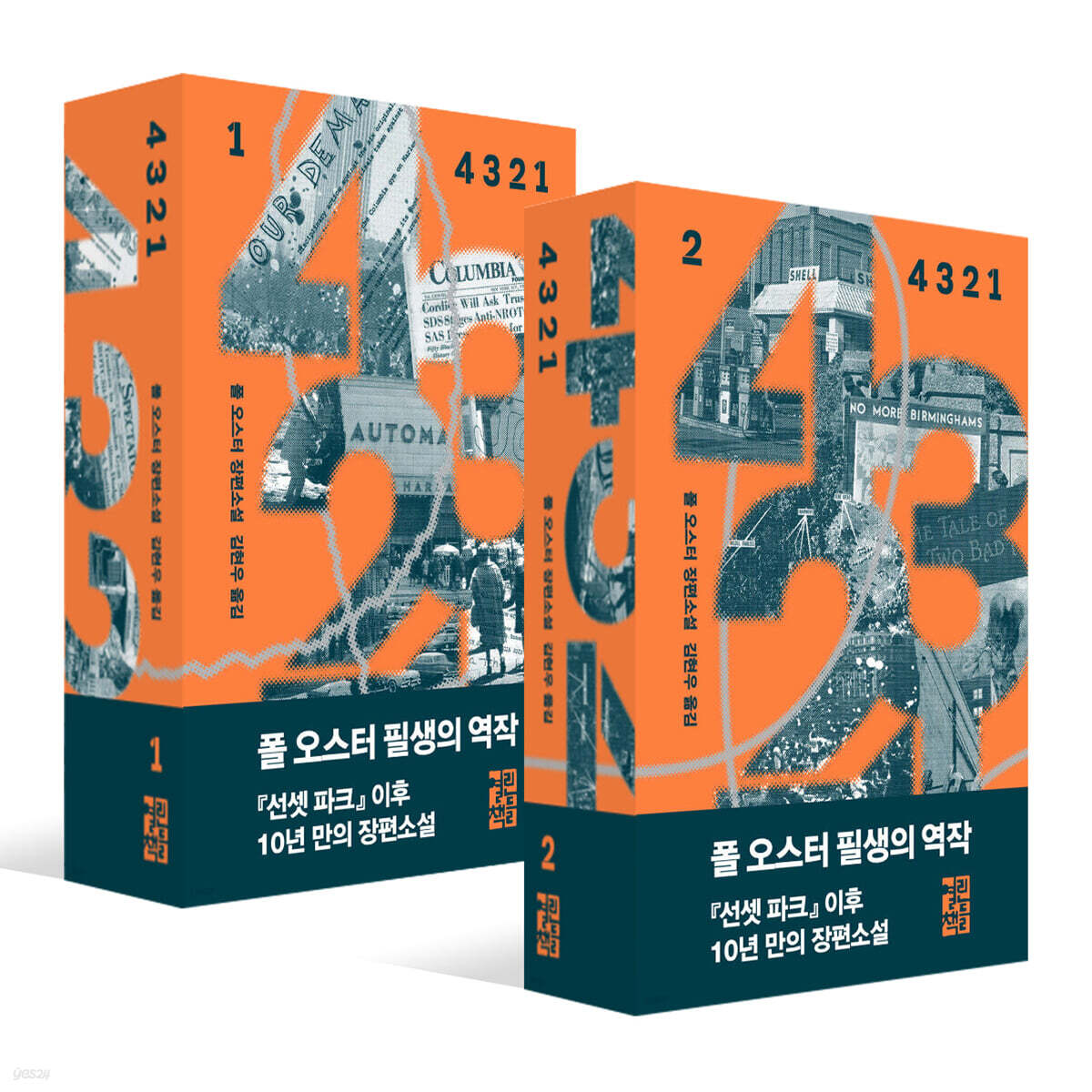
4 3 2 1 set
 |
Description
Book Introduction
This product is a product made by YES24. (Individual returns are not possible.) [Book] 4 3 2 1 (1) (2 volumes) 〈I feel like I've been waiting my whole life to write this book〉 Paul Auster's first full-length novel in 10 years since his masterpiece, Sunset Park. Paul Auster has demonstrated his outstanding skills across novels, essays, and screenplays for over half a century. He, who has risen to the ranks of today's leading American literary writers, is presenting a new full-length novel in Korea for the first time in 10 years. 『4 3 2 1』 is a masterpiece born from great ambition as well as the largest volume of all of Auster's works, and has been highly praised as "Paul Auster's greatest masterpiece," and in an interview with 『The Guardian』, he confessed, "It seems like I've been waiting my whole life to write this book." This epic coming-of-age novel meticulously depicts the life of the protagonist, Archie Ferguson, from birth to adolescence in four versions, and the author's own life is reflected throughout. [Book] 4 3 2 1 (2) (2 volumes) 〈I feel like I've been waiting my whole life to write this book〉 Paul Auster's first full-length novel in 10 years since his masterpiece, Sunset Park. Paul Auster has demonstrated his outstanding skills across novels, essays, and screenplays for over half a century. He, who has risen to the ranks of today's leading American literary writers, is presenting a new full-length novel in Korea for the first time in 10 years. 『4 3 2 1』 is a masterpiece born from great ambition as well as the largest volume of all of Auster's works, and has been highly praised as "Paul Auster's greatest masterpiece," and in an interview with 『The Guardian』, he confessed, "It seems like I've been waiting my whole life to write this book." This epic coming-of-age novel meticulously depicts the life of the protagonist, Archie Ferguson, from birth to adolescence in four versions, and the author's own life is reflected throughout. |
- You can preview some of the book's contents.
Preview
index
Volume 1
1.0 | 1.1 | 1.2 | 1.3 | 1.4 | 2.1 | 2.2 | 2.3 | 2.4 | 3.1 | 3.2 | 3.3 | 3.4 | 4.1 | 4.2 | 4.3
Volume 2
4.4 | 5.1 | 5.2 | 5.3 | 5.4 | 6.1 | 6.2 | 6.3 | 6.4 | 7.1 | 7.2 | 7.3 | 7.4
1.0 | 1.1 | 1.2 | 1.3 | 1.4 | 2.1 | 2.2 | 2.3 | 2.4 | 3.1 | 3.2 | 3.3 | 3.4 | 4.1 | 4.2 | 4.3
Volume 2
4.4 | 5.1 | 5.2 | 5.3 | 5.4 | 6.1 | 6.2 | 6.3 | 6.4 | 7.1 | 7.2 | 7.3 | 7.4
Detailed image

Into the book
Volume 1
Although Ferguson was not yet five years old, he already understood that there were two realms in the world: the visible and the invisible, and that sometimes the invisible could be even more vivid than the visible.
--- p.70
Yes, anything could have happened, and just because something happened one way doesn't mean it couldn't have happened another way.
Everything could have been different.
--- p.102
Someone was being kissed, someone was being punched, or someone was attending their mother's funeral at 11 a.m. on June 10, 1857, while someone else, on the same block in the same city, was holding a newborn baby in their arms.
The sadness of one moment coincides with the joy of another, and unless you are God, that is, unless you can see everything that happens at any given moment, you cannot possibly know these two things happening simultaneously, much less the case of the grieving son or the smiling mother.
--- p.432~433
So you can never know if you made the wrong choice or not.
You should have known all those facts, but the only way to know them all is to be in two places at once - and that's impossible.
--- p.436
Time moved in both directions, for every step taken into the future carried with it memories of the past.
Ferguson is not yet fifteen, but he has accumulated enough memories to know that the world around him is constantly being shaped by the world inside him.
The shape of the world experienced by each individual was also determined by their own memories, and although people were together in a common space they shared, each person's journey through time was different, which meant that each and every one of them lived in a world that was slightly different from everyone else's.
--- p.621
What was confusing about the caterpillar-to-butterfly transformation was that the caterpillar was probably quite content with being a caterpillar.
The caterpillars crawling on the soil would never have thought of becoming something else, and it must have been sad for them to know that they could no longer remain caterpillars.
But starting over as a butterfly was definitely better, and completely amazing.
Even though life as a butterfly was more precarious and sometimes only lasted for a day.
--- p.714
Volume 2
There was none of the resentment, anger, or hostility in his voice that one might expect from a man in exile, and that was precisely what drew Ferguson to Mr. Rosenbloom, and why he was so enjoyable to be with—not because he had suffered, but because he was a man who could still joke despite his suffering.
--- p.34
That summer seemed like it would never end.
The sun stood still in the sky, a page in a book disappeared, and it seemed like it would always be summer, as long as you didn't breathe too deeply or ask for too much.
They were nineteen, and it was finally, almost finally, perhaps finally time to say goodbye to a time when it seemed like anything lay ahead of them.
--- p.147
The gods, looking down from their mountains, simply shrugged their shoulders.
--- p.460
He sensed the parallelism of the same person walking the chosen path and the unchosen path at the same time.
It felt like the world as it is now was only a part of the real world, that reality was also made up of things that could have happened but didn't.
One path is neither better nor worse than any other path, but the pain of being alive in just one body is that at any given moment you have to be on just one path, you could have chosen another path and gone somewhere completely different, but you have to.
--- p.729~730
God is nowhere, he told himself.
But life is everywhere, death is everywhere, and the living and the dead are thus joined together.
Although Ferguson was not yet five years old, he already understood that there were two realms in the world: the visible and the invisible, and that sometimes the invisible could be even more vivid than the visible.
--- p.70
Yes, anything could have happened, and just because something happened one way doesn't mean it couldn't have happened another way.
Everything could have been different.
--- p.102
Someone was being kissed, someone was being punched, or someone was attending their mother's funeral at 11 a.m. on June 10, 1857, while someone else, on the same block in the same city, was holding a newborn baby in their arms.
The sadness of one moment coincides with the joy of another, and unless you are God, that is, unless you can see everything that happens at any given moment, you cannot possibly know these two things happening simultaneously, much less the case of the grieving son or the smiling mother.
--- p.432~433
So you can never know if you made the wrong choice or not.
You should have known all those facts, but the only way to know them all is to be in two places at once - and that's impossible.
--- p.436
Time moved in both directions, for every step taken into the future carried with it memories of the past.
Ferguson is not yet fifteen, but he has accumulated enough memories to know that the world around him is constantly being shaped by the world inside him.
The shape of the world experienced by each individual was also determined by their own memories, and although people were together in a common space they shared, each person's journey through time was different, which meant that each and every one of them lived in a world that was slightly different from everyone else's.
--- p.621
What was confusing about the caterpillar-to-butterfly transformation was that the caterpillar was probably quite content with being a caterpillar.
The caterpillars crawling on the soil would never have thought of becoming something else, and it must have been sad for them to know that they could no longer remain caterpillars.
But starting over as a butterfly was definitely better, and completely amazing.
Even though life as a butterfly was more precarious and sometimes only lasted for a day.
--- p.714
Volume 2
There was none of the resentment, anger, or hostility in his voice that one might expect from a man in exile, and that was precisely what drew Ferguson to Mr. Rosenbloom, and why he was so enjoyable to be with—not because he had suffered, but because he was a man who could still joke despite his suffering.
--- p.34
That summer seemed like it would never end.
The sun stood still in the sky, a page in a book disappeared, and it seemed like it would always be summer, as long as you didn't breathe too deeply or ask for too much.
They were nineteen, and it was finally, almost finally, perhaps finally time to say goodbye to a time when it seemed like anything lay ahead of them.
--- p.147
The gods, looking down from their mountains, simply shrugged their shoulders.
--- p.460
He sensed the parallelism of the same person walking the chosen path and the unchosen path at the same time.
It felt like the world as it is now was only a part of the real world, that reality was also made up of things that could have happened but didn't.
One path is neither better nor worse than any other path, but the pain of being alive in just one body is that at any given moment you have to be on just one path, you could have chosen another path and gone somewhere completely different, but you have to.
--- p.729~730
God is nowhere, he told himself.
But life is everywhere, death is everywhere, and the living and the dead are thus joined together.
--- p.731
Publisher's Review
"I feel like I've been waiting my whole life to write this book."
Paul Auster's masterpiece
A full-length novel published ten years after Sunset Park
Paul Auster has demonstrated his outstanding skills across novels, essays, and screenplays for over half a century.
He, who has risen to the ranks of today's leading American literary writers, is presenting a new full-length novel in Korea for the first time in 10 years.
『4 3 2 1』 is a masterpiece born from great ambition as well as the largest volume of all of Auster's works, and has been highly praised as "Paul Auster's greatest masterpiece," and he confessed in an interview, "It feels like I've been waiting my whole life to write this book." (『The Guardian』, 2017.
1. 20.) This epic coming-of-age novel depicts the life of the protagonist Archie Ferguson in detail in four versions, from before and after birth to his youth, and the author's own life is reflected throughout.
Ferguson grows up in four parallel lives, passing through a whirlpool of different relationships, events, and coincidences, depending on what he chose, did not choose, and could not choose.
The joy, fear, desire, anger, and confusion he experiences along the way are interwoven with the turbulent political and cultural currents of the 1950s and 1960s in America, and thus Ferguson's story becomes a comprehensive work that encompasses both the era and the individual.
Although it is over 1,500 pages long, the fast-paced plot, sweeping drama, and sentences that vividly portray the characters' thoughts and emotions draw readers in and keep them turning the pages without a second thought.
Anything could have happened, everything could have been different.
Four versions of life woven from different possibilities
Ferguson's story of growing and growing through a turbulent world.
Archie Ferguson, born March 3, 1947.
Her mother's name is Rose and she studied photography in New York.
His father's name is Stanley, and he runs a furniture and appliance retail store called Sam Brothers Home World with his brothers.
Ferguson grew up in suburban New Jersey, developing an interest in reading, writing, and sports, and as a teenager, developed a crush on Amy, a girl his age.
He witnesses in real time the historical events of post-war America, including the Cold War, the Kennedy assassination, racial conflict, the civil rights movement, the Vietnam War, and the anti-war movement.
Here are some backgrounds shared by “All Fergusons” in “4 3 2 1”:
Same name, same era, same beginning. But what if the details of life were different? Given different circumstances, if a different path were chosen at a crossroads, if something happened or didn't happen, what would change? From these questions, Ferguson is divided into Ferguson-1, Ferguson-2, Ferguson-3, and Ferguson-4, placed on parallel lines. The novel alternates between four versions of the story, spanning from childhood to adolescence.
Anything could have happened, and just because something happened one way doesn't mean it couldn't have happened another way.
Everything Could Have Been Different (Volume 1, Page 102)
When Ferguson was six, he fell from an oak tree and broke his leg. While lying in bed in a cast, he began to consider the possible outcomes of the accident.
He might not have climbed the tree that day, the tree itself might not have been in his backyard, he might have fallen from the tree and broken all his limbs, or he might have died.
He concludes that “anything could have happened, (…) everything could have been different.”
The power of 『4 3 2 1』 is concentrated in this sentence.
Starting from the hypothesis of “what if,” Auster sought to capture the many possible lives that run parallel to the one life we live.
Ferguson's father either dies trying to chase down an arsonist or goes on to become successful by opening more stores, while his mother becomes a famous photographer and holds exhibitions or quits photography altogether.
Some Fergusons lose two fingers, some Fergusons decide not to go to college, some Fergusons get beaten up by their friends every day, and some Fergusons write short stories starring shoes.
In this Borgesian labyrinth woven with different possibilities, several pasts and several times created by Auster coexist.
The possibility of life and death hovering around us
Reality is made up of things that could have happened but didn't.
Ever since he became conscious, he had been sensing the parallelism of the same person walking along those forks in the road, the chosen path and the unchosen path, at the same time.
The people I see and the people who are their shadows, the feeling that the world as it is now is only a part of the real world, that reality is also made up of things that could have happened but didn't. (Volume 2, pp. 729-730)
If you follow the subtle threads of Fergusson's tastes and interests, the decisions related to interpersonal relationships and career paths, the small episodes and the big drama, you might find yourself lost in a maze.
Ferguson severing ties with his father, Ferguson skipping school to see "Children of Heaven," Ferguson falling in love with Amy, and Ferguson writing sports articles for the local newspaper are all jumbled together in my head.
This is because the circular structure, which alternates between four versions of one chapter, and the dense content with details of details leads to this.
The translator shares his translation-reading experience in this regard, at one point realizing that “we are not looking at the life of one of the four Fergusons, but rather the life of a person in whom all the Fergusons are interwoven.”
〈And then I realized that that was more similar to our real lives.
So, the mixture of reality and possibility... This discovery resonates with Ferguson's perception of reality, who lives with the feeling that "the world as it is now is only a part of the real world, that reality is also made up of things that could have happened but did not."
One Ferguson is made up of other Fergusons that could have been.
All of those Fergusons grow up side by side, each going through the same chapter in their own way.
God is nowhere, he told himself.
But life is everywhere, and death is everywhere, and the living and the dead are thus joined together. (Volume 2, p. 731)
Along with the possibility of life that arises from “If,” another axis that supports this novel is the possibility of death.
The author has revealed the incident that was a key factor in writing “4 3 2 1,” “The Incident Among Incidents,” through NPR radio broadcasts and other media.
It happened when I was fourteen and attending a youth camp during summer vacation.
While hiking in the woods with friends, a storm hits, and at one point, a friend right next to Oster is struck by lightning and falls.
He is stuck in the middle of a storm and takes care of his friend, but his friend's face gradually turns pale as he passes away.
From then on, Oster's perspective on the world changes irreversibly.
I come to accept with my whole body that things I had no inkling of, things I never expected could happen to me, could happen to me, anytime, anywhere.
He has confessed in many interviews, as well as in his previous works including “Winter Diary,” that the incident has been haunting him his entire life, and that he cannot shake off the thought of death that could come at any time.
It was only after he lived another 50 years that he began to write 『4 3 2 1』.
Writing about a possible life and a possible death at the same time.
This novel, written by Auster over three years, almost daily until exhaustion, after years of waiting, is filled with moments of possible death as much as possible life: witnessing death, political death, incredible obituaries, premature deaths—in short, the possibility of death.
Thus, it awakens in the reader a sense of the uncertainty and fragility of life.
Joking in an uncertain life
Writing and Speaking in a Burning World
That's precisely why Ferguson was drawn to Mr. Rosenbloom, and why he was so enjoyable to be with—not because he had suffered, but because he was someone who could still joke around despite his suffering. (Volume 2, p. 34)
If life is so uncertain, how can we cope with it? There's no single, clear-cut answer for anyone, not even Ferguson. But as we follow his journey through life, a couple of behavioral patterns stand out.
First of all, it's about joking and loving jokes.
Things like the jokes he exchanged with his mother as a child (calling his butt "a daily duty"), the comedy duo Laurel and Hardy, who always fail and get into trouble but somehow survive, and the list of stupid jokes he wrote with his roommate Howard, make his life a little less scary.
His closest friends are those who can laugh at the same jokes as him.
Even in moments he is unaware of, even at funerals, the joke-like situations he finds himself in bring out various kinds of laughter in the reader.
The jokes in this novel come from discovering and observing moments when something goes wrong or goes wrong, slippery conversations, situations where sadness, bitterness, and relief coexist, connections between everyday life and cultural references, and ridiculously small movements that defy order. They represent the culmination of Auster's taste for jokes that he has revealed throughout his work.
Above all, 『4 3 2 1』 is a novel that begins with a joke about a Jewish immigrant who gets the wrong English name due to an immigration officer's mistake shortly after arriving in the United States, and ends by bringing up the same joke again.
The joke, Ferguson believes, is “a fable about the constant crossroads a man encounters as he navigates life,” a story “strange, funny, and tragic,” a description that can be read as both about the novel itself and perhaps about life itself.
If the world is burning—and you are burning with it—isn't that the most important time of year to write a book? (Volume 2, p. 660)
Another activity that all Fergusons have in common is writing.
A certain Ferguson, in elementary school, wrote an article about President Nixon being attacked by angry people in Caracas and published it in the children's newspaper (he was called in by the principal and scolded for writing a "red" article).
Some Ferguson writes a memoir (some parts are somewhat exaggerated) looking back on a childhood turbulent with loss.
A certain Ferguson completes a short story featuring a shoe as the protagonist and alluding to the Holocaust (after being harshly criticized by his literature teacher, he curses the world).
Ever since he was learning to read from his grandmother and wrote letters about the Rosenbergs' executions, his attempts to understand his life and the world have always been through writing.
Writing is something Ferguson wants to do, something he can do, and something he has to do for some reason.
The same goes for Oster.
This novel fully reflects Auster's obsessive exploration of writing, telling the story of how much he loved books and writing since childhood, who influenced him, what anxieties and fears he had while writing, and the process he went through while writing.
"The Drunken", inserted as a novel within a novel, is actually a work that Auster wrote when he was nineteen.
In an interview, Oster said this about writing:
Only those who feel they really have to write can stay locked in their rooms all day.
“When I think about the possible alternatives—how beautiful and interesting life could be—writing seems like a crazy way to spend life.” (The Guardian, 2017.
1. 20.) Ferguson and Oster are both people who chose that path.
Words to repeat while looking at the past and future
Even though I was staggering, I did what I could.
So you can never know if you made the wrong choice or not.
I should have known all these facts, but the only way to know them all is to be in two places at once—and that's impossible. (Volume 1, p. 436)
Again, let's go back to the question that starts with "if."
What if I had made different choices? What if something had happened, or not happened? What could have been possible differently? These are the questions the writer, now in his later years, asks himself.
Hadn't he been waiting his whole life to accumulate enough time to create enough distance to calmly look back on the past?
There is no right answer to what choice would have been good or how to live well in 『4 3 2 1』, which was written after a long wait.
However, Auster makes us more sensitive to life by telling us that we are always surrounded by the possibility of life and death.
Possibilities come from things we can't do anything about, but they also come from things we can see, even if they end in failure.
As for the latter, as Ferguson puts it, we “never know whether we have made the wrong choice,” and there is as much freedom in that fact as anxiety.
So, faced with countless crossroads, we have no choice but to trust our choices, do what we can, and keep going, even if we stumble, with the losses that have come or will come. 『4 3 2 1』, made up of sentences that seem to break and then disconnect, yet create their own unique flow, tells us that.
It also sounds like the words of Oster, who still has a mountain of stories he wants to tell, repeating them while looking at both the past and the future.
A word from the translator
Everyone lives with the thought, “What would have happened if I had done that back then?”
Isn't the me as a possibility, the me that could have been me, different from who I am now, always with the me of reality?
Such possibilities will probably come to mind sometimes with relief, more often with regret.
While I was translating the book, I often found myself reflecting on my past and feeling both relief and regret. Now, as I write this review, I'm beginning to think that perhaps it's not necessary to search only in the past for such possibilities, for a certain existence called "another self."
If at some point in the past, another self could branch out, then countless other selves could branch out from the current me in the future.
I hope that readers will finally recognize this natural flow.
Paul Auster's masterpiece
A full-length novel published ten years after Sunset Park
Paul Auster has demonstrated his outstanding skills across novels, essays, and screenplays for over half a century.
He, who has risen to the ranks of today's leading American literary writers, is presenting a new full-length novel in Korea for the first time in 10 years.
『4 3 2 1』 is a masterpiece born from great ambition as well as the largest volume of all of Auster's works, and has been highly praised as "Paul Auster's greatest masterpiece," and he confessed in an interview, "It feels like I've been waiting my whole life to write this book." (『The Guardian』, 2017.
1. 20.) This epic coming-of-age novel depicts the life of the protagonist Archie Ferguson in detail in four versions, from before and after birth to his youth, and the author's own life is reflected throughout.
Ferguson grows up in four parallel lives, passing through a whirlpool of different relationships, events, and coincidences, depending on what he chose, did not choose, and could not choose.
The joy, fear, desire, anger, and confusion he experiences along the way are interwoven with the turbulent political and cultural currents of the 1950s and 1960s in America, and thus Ferguson's story becomes a comprehensive work that encompasses both the era and the individual.
Although it is over 1,500 pages long, the fast-paced plot, sweeping drama, and sentences that vividly portray the characters' thoughts and emotions draw readers in and keep them turning the pages without a second thought.
Anything could have happened, everything could have been different.
Four versions of life woven from different possibilities
Ferguson's story of growing and growing through a turbulent world.
Archie Ferguson, born March 3, 1947.
Her mother's name is Rose and she studied photography in New York.
His father's name is Stanley, and he runs a furniture and appliance retail store called Sam Brothers Home World with his brothers.
Ferguson grew up in suburban New Jersey, developing an interest in reading, writing, and sports, and as a teenager, developed a crush on Amy, a girl his age.
He witnesses in real time the historical events of post-war America, including the Cold War, the Kennedy assassination, racial conflict, the civil rights movement, the Vietnam War, and the anti-war movement.
Here are some backgrounds shared by “All Fergusons” in “4 3 2 1”:
Same name, same era, same beginning. But what if the details of life were different? Given different circumstances, if a different path were chosen at a crossroads, if something happened or didn't happen, what would change? From these questions, Ferguson is divided into Ferguson-1, Ferguson-2, Ferguson-3, and Ferguson-4, placed on parallel lines. The novel alternates between four versions of the story, spanning from childhood to adolescence.
Anything could have happened, and just because something happened one way doesn't mean it couldn't have happened another way.
Everything Could Have Been Different (Volume 1, Page 102)
When Ferguson was six, he fell from an oak tree and broke his leg. While lying in bed in a cast, he began to consider the possible outcomes of the accident.
He might not have climbed the tree that day, the tree itself might not have been in his backyard, he might have fallen from the tree and broken all his limbs, or he might have died.
He concludes that “anything could have happened, (…) everything could have been different.”
The power of 『4 3 2 1』 is concentrated in this sentence.
Starting from the hypothesis of “what if,” Auster sought to capture the many possible lives that run parallel to the one life we live.
Ferguson's father either dies trying to chase down an arsonist or goes on to become successful by opening more stores, while his mother becomes a famous photographer and holds exhibitions or quits photography altogether.
Some Fergusons lose two fingers, some Fergusons decide not to go to college, some Fergusons get beaten up by their friends every day, and some Fergusons write short stories starring shoes.
In this Borgesian labyrinth woven with different possibilities, several pasts and several times created by Auster coexist.
The possibility of life and death hovering around us
Reality is made up of things that could have happened but didn't.
Ever since he became conscious, he had been sensing the parallelism of the same person walking along those forks in the road, the chosen path and the unchosen path, at the same time.
The people I see and the people who are their shadows, the feeling that the world as it is now is only a part of the real world, that reality is also made up of things that could have happened but didn't. (Volume 2, pp. 729-730)
If you follow the subtle threads of Fergusson's tastes and interests, the decisions related to interpersonal relationships and career paths, the small episodes and the big drama, you might find yourself lost in a maze.
Ferguson severing ties with his father, Ferguson skipping school to see "Children of Heaven," Ferguson falling in love with Amy, and Ferguson writing sports articles for the local newspaper are all jumbled together in my head.
This is because the circular structure, which alternates between four versions of one chapter, and the dense content with details of details leads to this.
The translator shares his translation-reading experience in this regard, at one point realizing that “we are not looking at the life of one of the four Fergusons, but rather the life of a person in whom all the Fergusons are interwoven.”
〈And then I realized that that was more similar to our real lives.
So, the mixture of reality and possibility... This discovery resonates with Ferguson's perception of reality, who lives with the feeling that "the world as it is now is only a part of the real world, that reality is also made up of things that could have happened but did not."
One Ferguson is made up of other Fergusons that could have been.
All of those Fergusons grow up side by side, each going through the same chapter in their own way.
God is nowhere, he told himself.
But life is everywhere, and death is everywhere, and the living and the dead are thus joined together. (Volume 2, p. 731)
Along with the possibility of life that arises from “If,” another axis that supports this novel is the possibility of death.
The author has revealed the incident that was a key factor in writing “4 3 2 1,” “The Incident Among Incidents,” through NPR radio broadcasts and other media.
It happened when I was fourteen and attending a youth camp during summer vacation.
While hiking in the woods with friends, a storm hits, and at one point, a friend right next to Oster is struck by lightning and falls.
He is stuck in the middle of a storm and takes care of his friend, but his friend's face gradually turns pale as he passes away.
From then on, Oster's perspective on the world changes irreversibly.
I come to accept with my whole body that things I had no inkling of, things I never expected could happen to me, could happen to me, anytime, anywhere.
He has confessed in many interviews, as well as in his previous works including “Winter Diary,” that the incident has been haunting him his entire life, and that he cannot shake off the thought of death that could come at any time.
It was only after he lived another 50 years that he began to write 『4 3 2 1』.
Writing about a possible life and a possible death at the same time.
This novel, written by Auster over three years, almost daily until exhaustion, after years of waiting, is filled with moments of possible death as much as possible life: witnessing death, political death, incredible obituaries, premature deaths—in short, the possibility of death.
Thus, it awakens in the reader a sense of the uncertainty and fragility of life.
Joking in an uncertain life
Writing and Speaking in a Burning World
That's precisely why Ferguson was drawn to Mr. Rosenbloom, and why he was so enjoyable to be with—not because he had suffered, but because he was someone who could still joke around despite his suffering. (Volume 2, p. 34)
If life is so uncertain, how can we cope with it? There's no single, clear-cut answer for anyone, not even Ferguson. But as we follow his journey through life, a couple of behavioral patterns stand out.
First of all, it's about joking and loving jokes.
Things like the jokes he exchanged with his mother as a child (calling his butt "a daily duty"), the comedy duo Laurel and Hardy, who always fail and get into trouble but somehow survive, and the list of stupid jokes he wrote with his roommate Howard, make his life a little less scary.
His closest friends are those who can laugh at the same jokes as him.
Even in moments he is unaware of, even at funerals, the joke-like situations he finds himself in bring out various kinds of laughter in the reader.
The jokes in this novel come from discovering and observing moments when something goes wrong or goes wrong, slippery conversations, situations where sadness, bitterness, and relief coexist, connections between everyday life and cultural references, and ridiculously small movements that defy order. They represent the culmination of Auster's taste for jokes that he has revealed throughout his work.
Above all, 『4 3 2 1』 is a novel that begins with a joke about a Jewish immigrant who gets the wrong English name due to an immigration officer's mistake shortly after arriving in the United States, and ends by bringing up the same joke again.
The joke, Ferguson believes, is “a fable about the constant crossroads a man encounters as he navigates life,” a story “strange, funny, and tragic,” a description that can be read as both about the novel itself and perhaps about life itself.
If the world is burning—and you are burning with it—isn't that the most important time of year to write a book? (Volume 2, p. 660)
Another activity that all Fergusons have in common is writing.
A certain Ferguson, in elementary school, wrote an article about President Nixon being attacked by angry people in Caracas and published it in the children's newspaper (he was called in by the principal and scolded for writing a "red" article).
Some Ferguson writes a memoir (some parts are somewhat exaggerated) looking back on a childhood turbulent with loss.
A certain Ferguson completes a short story featuring a shoe as the protagonist and alluding to the Holocaust (after being harshly criticized by his literature teacher, he curses the world).
Ever since he was learning to read from his grandmother and wrote letters about the Rosenbergs' executions, his attempts to understand his life and the world have always been through writing.
Writing is something Ferguson wants to do, something he can do, and something he has to do for some reason.
The same goes for Oster.
This novel fully reflects Auster's obsessive exploration of writing, telling the story of how much he loved books and writing since childhood, who influenced him, what anxieties and fears he had while writing, and the process he went through while writing.
"The Drunken", inserted as a novel within a novel, is actually a work that Auster wrote when he was nineteen.
In an interview, Oster said this about writing:
Only those who feel they really have to write can stay locked in their rooms all day.
“When I think about the possible alternatives—how beautiful and interesting life could be—writing seems like a crazy way to spend life.” (The Guardian, 2017.
1. 20.) Ferguson and Oster are both people who chose that path.
Words to repeat while looking at the past and future
Even though I was staggering, I did what I could.
So you can never know if you made the wrong choice or not.
I should have known all these facts, but the only way to know them all is to be in two places at once—and that's impossible. (Volume 1, p. 436)
Again, let's go back to the question that starts with "if."
What if I had made different choices? What if something had happened, or not happened? What could have been possible differently? These are the questions the writer, now in his later years, asks himself.
Hadn't he been waiting his whole life to accumulate enough time to create enough distance to calmly look back on the past?
There is no right answer to what choice would have been good or how to live well in 『4 3 2 1』, which was written after a long wait.
However, Auster makes us more sensitive to life by telling us that we are always surrounded by the possibility of life and death.
Possibilities come from things we can't do anything about, but they also come from things we can see, even if they end in failure.
As for the latter, as Ferguson puts it, we “never know whether we have made the wrong choice,” and there is as much freedom in that fact as anxiety.
So, faced with countless crossroads, we have no choice but to trust our choices, do what we can, and keep going, even if we stumble, with the losses that have come or will come. 『4 3 2 1』, made up of sentences that seem to break and then disconnect, yet create their own unique flow, tells us that.
It also sounds like the words of Oster, who still has a mountain of stories he wants to tell, repeating them while looking at both the past and the future.
A word from the translator
Everyone lives with the thought, “What would have happened if I had done that back then?”
Isn't the me as a possibility, the me that could have been me, different from who I am now, always with the me of reality?
Such possibilities will probably come to mind sometimes with relief, more often with regret.
While I was translating the book, I often found myself reflecting on my past and feeling both relief and regret. Now, as I write this review, I'm beginning to think that perhaps it's not necessary to search only in the past for such possibilities, for a certain existence called "another self."
If at some point in the past, another self could branch out, then countless other selves could branch out from the current me in the future.
I hope that readers will finally recognize this natural flow.
GOODS SPECIFICS
- Date of issue: November 20, 2023
- Format: Hardcover book binding method guide
- Page count, weight, size: 1,592 pages | 128*188*80mm
You may also like
카테고리
korean


korean

![GQ KOREA Mark (Monthly): December [2025]](http://librairie.coreenne.fr/cdn/shop/files/8ef265dbbfbf186523ed75ba7319009d.jpg?v=1765340328&width=3840)


