

huge acceleration
 |
Description
Book Introduction
- A word from MD
-
When the longed-for future is right in front of usThis is a follow-up work by Scott Galloway, who predicted the future of business through “The Future of Platform Empires.”
He outlines how to cope with the future “coming 10 years early” due to the pandemic.
It covers the changes in the market that are coming before our eyes, such as the platform business that has become larger as individual lifestyles change.
October 1, 2021. Economics and Management PD Kang Min-ji
★ Amazon's Top Trending Releases Amid the 2020 Pandemic Crisis ★
★ Highly recommended by The New York Times, The Financial Times, and The Economist ★
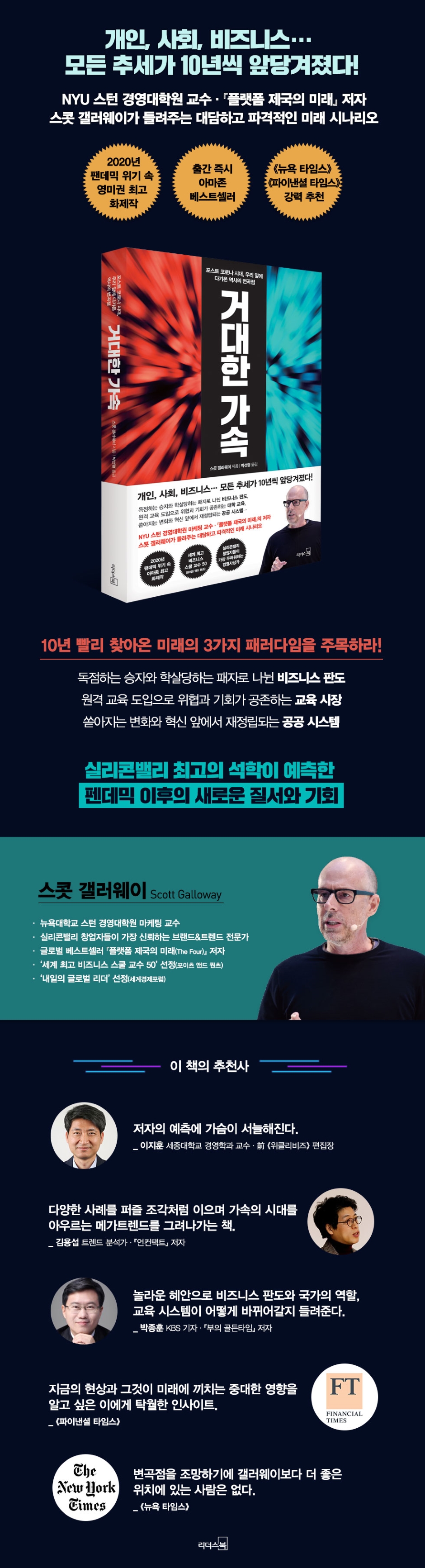
Personal, social, business… every trend has been brought forward by 10 years!
A business landscape divided into monopolized winners and slaughtered losers.
The higher education market, where risks and opportunities coexist with the introduction of distance learning,
Public systems are being redefined in the face of a torrent of change and innovation…
Professor of Marketing at NYU Stern School of Business and author of "The Future of Platform Empires"
Scott Galloway presents a bold and groundbreaking future scenario.
In less than two years, we have witnessed changes that were previously unimaginable.
The coronavirus, which suddenly appeared one day, is advancing trends in all areas, including individuals, businesses, markets, and society, by 10 years. Moreover, the pace of this change is expected to accelerate even further in the future.
How will the world unfold after the pandemic, hit by a "great acceleration" that cannot be avoided or escaped?
Professor Scott Galloway of New York University, considered one of the world's top business school professors, persuasively analyzes the new paradigm that will dominate the future using three keywords: "business landscape, education market, and government role."
What will be the next move for the "Big Four," the platform empires that have grown even stronger in a capital market polarized by the pandemic? Who are the market disruptors challenging them? What risks and opportunities will large-scale remote education, triggered by social distancing, bring to the education market? What new values will society recognize amidst the daily accumulation of capital and innovation? The great transformation has already begun, and the future we once vaguely imagined is already upon us.
In an era where the pace of survival, extinction, and change is accelerating, this book offers chilling insights that will help you stay ahead of the world at a turning point and anticipate new opportunities.
★ Highly recommended by The New York Times, The Financial Times, and The Economist ★
Personal, social, business… every trend has been brought forward by 10 years!
A business landscape divided into monopolized winners and slaughtered losers.
The higher education market, where risks and opportunities coexist with the introduction of distance learning,
Public systems are being redefined in the face of a torrent of change and innovation…
Professor of Marketing at NYU Stern School of Business and author of "The Future of Platform Empires"
Scott Galloway presents a bold and groundbreaking future scenario.
In less than two years, we have witnessed changes that were previously unimaginable.
The coronavirus, which suddenly appeared one day, is advancing trends in all areas, including individuals, businesses, markets, and society, by 10 years. Moreover, the pace of this change is expected to accelerate even further in the future.
How will the world unfold after the pandemic, hit by a "great acceleration" that cannot be avoided or escaped?
Professor Scott Galloway of New York University, considered one of the world's top business school professors, persuasively analyzes the new paradigm that will dominate the future using three keywords: "business landscape, education market, and government role."
What will be the next move for the "Big Four," the platform empires that have grown even stronger in a capital market polarized by the pandemic? Who are the market disruptors challenging them? What risks and opportunities will large-scale remote education, triggered by social distancing, bring to the education market? What new values will society recognize amidst the daily accumulation of capital and innovation? The great transformation has already begun, and the future we once vaguely imagined is already upon us.
In an era where the pace of survival, extinction, and change is accelerating, this book offers chilling insights that will help you stay ahead of the world at a turning point and anticipate new opportunities.
- You can preview some of the book's contents.
Preview
index
Introduction
Chapter 1 | The Rapidly Reshaping Business Landscape
Mass Wealth: A World Where the Strong Get Even Stronger
The era when cash reigns supreme
What companies that survive crises have
A completely different 'new normal' unfolding before us
From the 'Brand Era' to the 'Product Era'
Digital marketing companies stuck in the swamp
A world where value and privacy are traded is coming.
Social media divided into red and blue camps
The era of search favoring the blue camp
Chapter 2 | The Future of an Even More Powerful Platform Empire
Polarized capital markets
Innovation, Monopoly, and Obscurity
The Big 4 and platform companies are expanding in all directions.
A larger size, bigger problems
Taking on the Big 4
How Amazon Predicts the Future
Apple's ambitions to become the most profitable company in history
Google and Facebook Enter Second Heydays
Chapter 3 | Other Market Disruptors
Signs of a disturbance appearing quickly
An era where founders hold power
The belief that 'this time is different'
SoftBank's $100 billion buffet
The emergence of a yoga bable with only a flashy design
What Failed Challengers Missed
The DNA of a Successful Market Disruptor
Unicorns worth noting for various reasons
Chapter 4 | Higher Education: Risk and Innovation Await
The most profitable business in history
The scarcity cartel that has dominated society
The caste system called the Ivy League
25% of universities will disappear within 15 years.
The pandemic has rapidly transformed the higher education market.
The financial crisis that hit the pyramid
A decisive factor influencing the quality of education
Technology drives scale, and scale drives profits.
What will the 'micro generation' choose?
Chapter 5 | What the Great Acceleration Left Us
Changing Capitalism, Conflicting Values
America's "exceptionalism" that led to the pandemic
What Has the Unprecedented Capital Market Rise Brought?
A society that lacks development despite immense prosperity
The road is getting narrower and narrower.
From an innovation economy to an exploitative economy
Sometimes government can be surprisingly effective.
What can we do
Acknowledgements
annotation
Chapter 1 | The Rapidly Reshaping Business Landscape
Mass Wealth: A World Where the Strong Get Even Stronger
The era when cash reigns supreme
What companies that survive crises have
A completely different 'new normal' unfolding before us
From the 'Brand Era' to the 'Product Era'
Digital marketing companies stuck in the swamp
A world where value and privacy are traded is coming.
Social media divided into red and blue camps
The era of search favoring the blue camp
Chapter 2 | The Future of an Even More Powerful Platform Empire
Polarized capital markets
Innovation, Monopoly, and Obscurity
The Big 4 and platform companies are expanding in all directions.
A larger size, bigger problems
Taking on the Big 4
How Amazon Predicts the Future
Apple's ambitions to become the most profitable company in history
Google and Facebook Enter Second Heydays
Chapter 3 | Other Market Disruptors
Signs of a disturbance appearing quickly
An era where founders hold power
The belief that 'this time is different'
SoftBank's $100 billion buffet
The emergence of a yoga bable with only a flashy design
What Failed Challengers Missed
The DNA of a Successful Market Disruptor
Unicorns worth noting for various reasons
Chapter 4 | Higher Education: Risk and Innovation Await
The most profitable business in history
The scarcity cartel that has dominated society
The caste system called the Ivy League
25% of universities will disappear within 15 years.
The pandemic has rapidly transformed the higher education market.
The financial crisis that hit the pyramid
A decisive factor influencing the quality of education
Technology drives scale, and scale drives profits.
What will the 'micro generation' choose?
Chapter 5 | What the Great Acceleration Left Us
Changing Capitalism, Conflicting Values
America's "exceptionalism" that led to the pandemic
What Has the Unprecedented Capital Market Rise Brought?
A society that lacks development despite immense prosperity
The road is getting narrower and narrower.
From an innovation economy to an exploitative economy
Sometimes government can be surprisingly effective.
What can we do
Acknowledgements
annotation
Detailed image
Into the book
“For decades nothing can happen, and then in a few weeks something that would take decades to happen can happen.” This quote is attributed to Lenin, but it was actually said by Scottish MP George Galloway.
This is becoming a reality in every aspect of our lives today.
E-commerce began to take root in 2000, and its share of retail sales has grown by about 1 percent each year since then.
At the beginning of 2020, approximately 16 percent of retail transactions were conducted through digital channels.
However, within eight weeks of the coronavirus arriving in the United States (March to mid-April 2020), it surged to 27 percent and has remained there ever since.
That's 10 years' worth of growth in just 8 weeks.
All trends related to society, business, and individuals have been brought forward by ten years.
Even if your company hasn't reached that point yet, consumer behavior and markets have already reached the 2030 point on the trend line.
---From "Introductory Remarks"
But as the world moved toward a technology-based economy, this second business model became more profitable but also more problematic.
In the past, all you had to do was give a little bit of your time and attention to get free stuff from advertisers.
But when these relationships moved online, companies giving away free stuff suddenly had access to all the data related to consumers.
All the data we have: the books we read, where we shop, who we talk to, what we eat, where we live, etc.
And they use that data to squeeze more money out of us.
In the past, we traded value for time, but now we have to trade value for privacy.
---From "A World That Trades Value and Privacy Is Coming"
On the earnings call, Bezos announced that he would reinvest the $4 billion in profits that investors had expected.
The new investment theme was the coronavirus.
Bezos detailed his vision, including at-home COVID-19 testing, plasma donations, personal protective equipment, social distancing, additional compensation, and protocols for adapting to the new world.
Amazon is developing the first 'vaccinated' supply chain.
A great strategy closes the gap between market conditions and company assets.
Simply put, this strategy is Amazon's answer to the following question:
---From "How Amazon Predicts the Future"
This billion-dollar company is the T algorithm itself.
At first, I thought the company was overvalued, but then one day, the coronavirus outbreak suddenly hit.
Then, it grew by 69 percent compared to the previous year.
Recurring revenue is at the heart of the company's business model.
After buying a $2,000 bike, wouldn't a $39 monthly membership fee seem like a very reasonable price?
---From "Unicorns Worth Noting for Various Reasons"
The explosion of interest in open online courses in the early 2000s proved premature, but there are plenty of other sharks vying for their prey.
Top brands in higher education—Harvard, Yale, Stanford, and MIT—are steadily expanding their online courses.
Harvard University professor David Malan has gained worldwide popularity by making his famous introductory computer science course available for free online.
In 2018, 1,200 students enrolled in Yale University Professor Laurie Santos's course, "Psychology and the Good Life," making it the most popular course in the school's 300-year history.
And when Santos and Yale University made the course available for free online, more than a million people signed up.
---From "25% of universities will disappear within 15 years"
Even when the virus disappears and people can be close to each other again, the experience of temporarily losing college life will raise questions parents and students have been afraid to raise.
Is campus life really worth it? After a month of classes at home, most students probably long to return to campus.
But spending a year without experiencing the "traditional" college experience inevitably leads many to reflect on how much they miss that experience and whether it's truly worth it.
---From "What Will the 'Micro Generation' Choose?"
The less inequality there is, the more generous people are; the more inequality there is, the less generous people are.
Michael Lewis says, “The problem arises from inequality itself.
Inequality creates a chemical reaction in a privileged few, tilting their brains in one direction.
Then they become unconcerned with anyone but themselves and lose the moral sensibilities necessary to be decent citizens,” he said.
The privileged see their noble image in the mirror.
People who are financially successful take it for granted that someone who delivers groceries or cleans subways for $14 an hour will suffer the same financial fate.
They are not smart, they are not good, and they are not worthy like you.
This is becoming a reality in every aspect of our lives today.
E-commerce began to take root in 2000, and its share of retail sales has grown by about 1 percent each year since then.
At the beginning of 2020, approximately 16 percent of retail transactions were conducted through digital channels.
However, within eight weeks of the coronavirus arriving in the United States (March to mid-April 2020), it surged to 27 percent and has remained there ever since.
That's 10 years' worth of growth in just 8 weeks.
All trends related to society, business, and individuals have been brought forward by ten years.
Even if your company hasn't reached that point yet, consumer behavior and markets have already reached the 2030 point on the trend line.
---From "Introductory Remarks"
But as the world moved toward a technology-based economy, this second business model became more profitable but also more problematic.
In the past, all you had to do was give a little bit of your time and attention to get free stuff from advertisers.
But when these relationships moved online, companies giving away free stuff suddenly had access to all the data related to consumers.
All the data we have: the books we read, where we shop, who we talk to, what we eat, where we live, etc.
And they use that data to squeeze more money out of us.
In the past, we traded value for time, but now we have to trade value for privacy.
---From "A World That Trades Value and Privacy Is Coming"
On the earnings call, Bezos announced that he would reinvest the $4 billion in profits that investors had expected.
The new investment theme was the coronavirus.
Bezos detailed his vision, including at-home COVID-19 testing, plasma donations, personal protective equipment, social distancing, additional compensation, and protocols for adapting to the new world.
Amazon is developing the first 'vaccinated' supply chain.
A great strategy closes the gap between market conditions and company assets.
Simply put, this strategy is Amazon's answer to the following question:
---From "How Amazon Predicts the Future"
This billion-dollar company is the T algorithm itself.
At first, I thought the company was overvalued, but then one day, the coronavirus outbreak suddenly hit.
Then, it grew by 69 percent compared to the previous year.
Recurring revenue is at the heart of the company's business model.
After buying a $2,000 bike, wouldn't a $39 monthly membership fee seem like a very reasonable price?
---From "Unicorns Worth Noting for Various Reasons"
The explosion of interest in open online courses in the early 2000s proved premature, but there are plenty of other sharks vying for their prey.
Top brands in higher education—Harvard, Yale, Stanford, and MIT—are steadily expanding their online courses.
Harvard University professor David Malan has gained worldwide popularity by making his famous introductory computer science course available for free online.
In 2018, 1,200 students enrolled in Yale University Professor Laurie Santos's course, "Psychology and the Good Life," making it the most popular course in the school's 300-year history.
And when Santos and Yale University made the course available for free online, more than a million people signed up.
---From "25% of universities will disappear within 15 years"
Even when the virus disappears and people can be close to each other again, the experience of temporarily losing college life will raise questions parents and students have been afraid to raise.
Is campus life really worth it? After a month of classes at home, most students probably long to return to campus.
But spending a year without experiencing the "traditional" college experience inevitably leads many to reflect on how much they miss that experience and whether it's truly worth it.
---From "What Will the 'Micro Generation' Choose?"
The less inequality there is, the more generous people are; the more inequality there is, the less generous people are.
Michael Lewis says, “The problem arises from inequality itself.
Inequality creates a chemical reaction in a privileged few, tilting their brains in one direction.
Then they become unconcerned with anyone but themselves and lose the moral sensibilities necessary to be decent citizens,” he said.
The privileged see their noble image in the mirror.
People who are financially successful take it for granted that someone who delivers groceries or cleans subways for $14 an hour will suffer the same financial fate.
They are not smart, they are not good, and they are not worthy like you.
---From "The Road is Getting Narrower"
Publisher's Review
“There has never been a cooler post-corona scenario!”
Three Years After the Future of Platform Empires, Scott Galloway's Predictions Are Even More Powerful
Pay attention to the three paradigms that will dominate the post-pandemic world!
Scott Galloway, a professor at New York University and considered one of the most influential intellectuals in the English-speaking world and the most feared scholar by Silicon Valley entrepreneurs, has returned with his new book, The Great Acceleration (Post Corona).
It has been three years since his first book, "The Future of Platform Empires (The Four)", which analyzed in detail the business models and hidden expansion strategies of the IT giants "Big 4" - Google, Amazon, Facebook, and Apple - became an international bestseller.
This new work has received rave reviews from leading media outlets such as the New York Times, the Financial Times, and the Economist, and has also garnered attention as the most talked-about book on Amazon, with the most reader reviews among books published during the pandemic.
In this book, Galloway highlights ‘speed’ as the most decisive impact of the pandemic.
While the coronavirus has shifted some trends, it is also dramatically changing existing dynamics in society at an alarming rate, potentially accelerating all personal, social, and business trends by a decade.
He emphasizes that this rapid current is already rushing in at a tremendous speed, and he paints a concrete picture of the future that has arrived 10 years early in three areas: the 'business landscape,' the 'higher education market,' and the 'public system.'
The business market is being reorganized into monopolized winners and slaughtered losers.
What sets companies apart from others that have survived the pandemic?
The pace of change has accelerated by 10 years. Seize the opportunity amidst the crisis!
In August 2020, Apple became the first company in U.S. stock market history to reach a market capitalization of $2 trillion.
This was achieved just five months after the shocking global stock market crash in March of that year, a remarkable achievement considering that it took Apple 42 years to reach a market capitalization of $1 trillion.
Not only Apple, but also five companies including Google, Amazon, Facebook, and Microsoft increased their market capitalization by more than $1.1 trillion in mid-2020 alone, and the US e-commerce industry achieved 10 years' worth of growth in just eight weeks starting in March of the same year.
While one side was celebrating, a merciless massacre was taking place on the other side.
The stock prices of 'BEACH' stocks, which stand for booking, entertainment, airlines, cruises and casinos, and hotels and resorts, fell by an average of 50 to 70 percent during the same period.
Symbols of American capitalism, such as ExxonMobil, the Coca-Cola Company, and 3M, have seen their market capitalization evaporate by more than $500 billion, and prominent brands such as retail giant Neiman Marcus, health food company GNC, and the US subsidiary of MUJI have declared bankruptcy.
If we simply analyze this polarization phenomenon as "non-face-to-face industries that benefited from the pandemic survived while face-to-face industries declined," this is a very fragmentary insight.
Galloway emphasizes that companies capable of "overcorrecting"—shifting their strategic spectrum too quickly and harshly—"premiumizing personal information" in a world where value and privacy are traded off, and "lightening capital"—easily changing their cost structure—can survive sudden crises in any industry.
The reason Airbnb and Uber, which were hit hard by the coronavirus but are holding on to their competitors, and the reason Walmart, a retail giant, continues to grow despite the dominance of Amazon, a retail giant, are all because they possess these elements.
The coronavirus is rapidly changing many economic sectors, and the winners will likely take all and the losers will be eliminated more ruthlessly as time goes on.
It is clear that survival is an important goal in times like these.
For everyone, now is the time to unlearn what we've learned in the past and transform ourselves to navigate the post-pandemic world.
What's next for the increasingly powerful platform empires known as the "Big 4"?
Who are the emerging market disruptors in these turbulent times?
A Bold Prediction of the Post-Pandemic Business Landscape
In Galloway's previous work, "The Future of Platform Empires," the "Big 4"—Google, Amazon, Apple, and Facebook—formed powerful platform empires by cleverly combining monopolies with "flywheels," which automatically increase profits without increasing costs or investments.
And the coronavirus pandemic that emerged in 2020 brought the "Big Four" record profits and a second heyday, and they are expanding inexorably beyond the IT industry.
But to raise capital like they do now, Big Tech companies need to convince investors that their stock prices can double in the next five years.
To do so, they would need to increase their revenue by nearly $1 trillion and enter new markets to compete with each other.
So, what new prey will the "Big Four" seek in the future? The author predicts their next moves, citing industries where Amazon, with its vast customer data, stands to gain the most; Apple, which reaps significant profits through recurring sales "rundles," will likely choose a second wearable; and Google and Facebook, which boast a more robust customer base than any other advertising company, are making new attempts.
Meanwhile, paradoxically, the pandemic is solidifying the positions of market leaders like the "Big Four" while sharpening the punch of startups.
This is because innovation and capital are flooding in through the gaping hole of opportunity, and signs of disruption are appearing.
This book sharply points out the difference between successful market disruptors and flashy startups, dissecting notable challengers like Lululemon, Peloton, One Medical, Lemonade, Warby Parker, and Brooklinen.
It also provides a sobering assessment of the future of various companies that teeter on the edge between challenger and dominant, such as Tesla, Shopify, Spotify, Twitter, Uber, and WeWork, and tells us who will ascend to the throne of the business world in the post-COVID-19 era.
25% of universities will disappear within 15 years!
The era of large-scale remote education triggered by COVID-19,
A groundbreaking vision for the higher education paradigm
If there's one sector that has experienced as much seismic shift as the business world due to the pandemic, it's definitely higher education.
While technological advancements and innovations have driven progress in all other sectors, this $700 billion "market" has remained stagnant.
But then, one day, a pandemic suddenly appeared, emptying campuses, and geographical and physical constraints disappeared in an instant thanks to the forced introduction of online classes and distance learning despite stubborn professors' resistance.
The problem is that students and parents who pay expensive tuition but are unable to experience the benefits of campus life are beginning to question the necessity of college.
In August 2020, one-third of all college students in the United States responded that they had no plans to return to school, and Harvard University reported that 20 percent of its incoming freshmen had requested a deferral.
The author predicts that this trend will accelerate in the future, completely changing the current higher education system.
The 10-30% of universities that don't offer value for money will disappear, and the surviving schools will partner with venture capitalists and big tech companies to provide the curriculum companies need at a lower price.
A semester will shift from a four-month period to a four- to six-week module, and online education, which has become routine thanks to the introduction of technology, will lead to an 'expansion in scale.'
Such changes mean that the privileged value of prestigious universities, which have been granted only to a small number of students by charging high tuition fees, could completely disappear.
While this may be a somewhat radical outlook, it's a compelling one considering the financial difficulties faced by Ivy League schools and the crisis facing universities due to COVID-19. It also holds significant implications for those of us who spend enormous amounts of money to send our children to prestigious universities.
As rapid change approaches,
Effective solidarity between individuals and nations is needed!
A New Future for Public Systems: A Focus on the Crisis
The COVID-19 virus has raised fundamental doubts about public systems that were previously considered "well-functioning."
Many countries considered advanced have been shocked by their failure to protect their citizens from the virus, and people have been looking to Bill Gates or Elon Musk to provide guidance on appropriate behavior.
During the pandemic, the top three Americans have gained more wealth than the bottom 50 percent combined, and the extreme wealth gap is now beginning to solidify not just at the starting line but also at the finish line.
Technology advances day by day, but individuals and society are actually regressing.
Galloway examines the various social disruptions highlighted by the pandemic and proposes that individuals and governments work together effectively to maximize the benefits of capitalism—innovation and progress.
Individuals must break free from their blind faith in performance-based pay, recognize that innovation and the public sphere are entirely different, and keep those in power in check.
The government also emphasizes that it should protect the truly vulnerable rather than the privileged class, and that public support should be a useful ladder for climbing to the upper class.
This is advice worth heeding even in Korea, where national support and relief, the decline of the middle class, and growing inequality are becoming hot topics.
The coronavirus, which is just 1/400th the width of a human hair, is changing everything we've become accustomed to on this 130 trillion-ton planet.
The rapidly changing world offers many opportunities, but it is also harsh.
This book will provide the most reliable response strategy to those who fear an accelerating future and massive acceleration.
Three Years After the Future of Platform Empires, Scott Galloway's Predictions Are Even More Powerful
Pay attention to the three paradigms that will dominate the post-pandemic world!
Scott Galloway, a professor at New York University and considered one of the most influential intellectuals in the English-speaking world and the most feared scholar by Silicon Valley entrepreneurs, has returned with his new book, The Great Acceleration (Post Corona).
It has been three years since his first book, "The Future of Platform Empires (The Four)", which analyzed in detail the business models and hidden expansion strategies of the IT giants "Big 4" - Google, Amazon, Facebook, and Apple - became an international bestseller.
This new work has received rave reviews from leading media outlets such as the New York Times, the Financial Times, and the Economist, and has also garnered attention as the most talked-about book on Amazon, with the most reader reviews among books published during the pandemic.
In this book, Galloway highlights ‘speed’ as the most decisive impact of the pandemic.
While the coronavirus has shifted some trends, it is also dramatically changing existing dynamics in society at an alarming rate, potentially accelerating all personal, social, and business trends by a decade.
He emphasizes that this rapid current is already rushing in at a tremendous speed, and he paints a concrete picture of the future that has arrived 10 years early in three areas: the 'business landscape,' the 'higher education market,' and the 'public system.'
The business market is being reorganized into monopolized winners and slaughtered losers.
What sets companies apart from others that have survived the pandemic?
The pace of change has accelerated by 10 years. Seize the opportunity amidst the crisis!
In August 2020, Apple became the first company in U.S. stock market history to reach a market capitalization of $2 trillion.
This was achieved just five months after the shocking global stock market crash in March of that year, a remarkable achievement considering that it took Apple 42 years to reach a market capitalization of $1 trillion.
Not only Apple, but also five companies including Google, Amazon, Facebook, and Microsoft increased their market capitalization by more than $1.1 trillion in mid-2020 alone, and the US e-commerce industry achieved 10 years' worth of growth in just eight weeks starting in March of the same year.
While one side was celebrating, a merciless massacre was taking place on the other side.
The stock prices of 'BEACH' stocks, which stand for booking, entertainment, airlines, cruises and casinos, and hotels and resorts, fell by an average of 50 to 70 percent during the same period.
Symbols of American capitalism, such as ExxonMobil, the Coca-Cola Company, and 3M, have seen their market capitalization evaporate by more than $500 billion, and prominent brands such as retail giant Neiman Marcus, health food company GNC, and the US subsidiary of MUJI have declared bankruptcy.
If we simply analyze this polarization phenomenon as "non-face-to-face industries that benefited from the pandemic survived while face-to-face industries declined," this is a very fragmentary insight.
Galloway emphasizes that companies capable of "overcorrecting"—shifting their strategic spectrum too quickly and harshly—"premiumizing personal information" in a world where value and privacy are traded off, and "lightening capital"—easily changing their cost structure—can survive sudden crises in any industry.
The reason Airbnb and Uber, which were hit hard by the coronavirus but are holding on to their competitors, and the reason Walmart, a retail giant, continues to grow despite the dominance of Amazon, a retail giant, are all because they possess these elements.
The coronavirus is rapidly changing many economic sectors, and the winners will likely take all and the losers will be eliminated more ruthlessly as time goes on.
It is clear that survival is an important goal in times like these.
For everyone, now is the time to unlearn what we've learned in the past and transform ourselves to navigate the post-pandemic world.
What's next for the increasingly powerful platform empires known as the "Big 4"?
Who are the emerging market disruptors in these turbulent times?
A Bold Prediction of the Post-Pandemic Business Landscape
In Galloway's previous work, "The Future of Platform Empires," the "Big 4"—Google, Amazon, Apple, and Facebook—formed powerful platform empires by cleverly combining monopolies with "flywheels," which automatically increase profits without increasing costs or investments.
And the coronavirus pandemic that emerged in 2020 brought the "Big Four" record profits and a second heyday, and they are expanding inexorably beyond the IT industry.
But to raise capital like they do now, Big Tech companies need to convince investors that their stock prices can double in the next five years.
To do so, they would need to increase their revenue by nearly $1 trillion and enter new markets to compete with each other.
So, what new prey will the "Big Four" seek in the future? The author predicts their next moves, citing industries where Amazon, with its vast customer data, stands to gain the most; Apple, which reaps significant profits through recurring sales "rundles," will likely choose a second wearable; and Google and Facebook, which boast a more robust customer base than any other advertising company, are making new attempts.
Meanwhile, paradoxically, the pandemic is solidifying the positions of market leaders like the "Big Four" while sharpening the punch of startups.
This is because innovation and capital are flooding in through the gaping hole of opportunity, and signs of disruption are appearing.
This book sharply points out the difference between successful market disruptors and flashy startups, dissecting notable challengers like Lululemon, Peloton, One Medical, Lemonade, Warby Parker, and Brooklinen.
It also provides a sobering assessment of the future of various companies that teeter on the edge between challenger and dominant, such as Tesla, Shopify, Spotify, Twitter, Uber, and WeWork, and tells us who will ascend to the throne of the business world in the post-COVID-19 era.
25% of universities will disappear within 15 years!
The era of large-scale remote education triggered by COVID-19,
A groundbreaking vision for the higher education paradigm
If there's one sector that has experienced as much seismic shift as the business world due to the pandemic, it's definitely higher education.
While technological advancements and innovations have driven progress in all other sectors, this $700 billion "market" has remained stagnant.
But then, one day, a pandemic suddenly appeared, emptying campuses, and geographical and physical constraints disappeared in an instant thanks to the forced introduction of online classes and distance learning despite stubborn professors' resistance.
The problem is that students and parents who pay expensive tuition but are unable to experience the benefits of campus life are beginning to question the necessity of college.
In August 2020, one-third of all college students in the United States responded that they had no plans to return to school, and Harvard University reported that 20 percent of its incoming freshmen had requested a deferral.
The author predicts that this trend will accelerate in the future, completely changing the current higher education system.
The 10-30% of universities that don't offer value for money will disappear, and the surviving schools will partner with venture capitalists and big tech companies to provide the curriculum companies need at a lower price.
A semester will shift from a four-month period to a four- to six-week module, and online education, which has become routine thanks to the introduction of technology, will lead to an 'expansion in scale.'
Such changes mean that the privileged value of prestigious universities, which have been granted only to a small number of students by charging high tuition fees, could completely disappear.
While this may be a somewhat radical outlook, it's a compelling one considering the financial difficulties faced by Ivy League schools and the crisis facing universities due to COVID-19. It also holds significant implications for those of us who spend enormous amounts of money to send our children to prestigious universities.
As rapid change approaches,
Effective solidarity between individuals and nations is needed!
A New Future for Public Systems: A Focus on the Crisis
The COVID-19 virus has raised fundamental doubts about public systems that were previously considered "well-functioning."
Many countries considered advanced have been shocked by their failure to protect their citizens from the virus, and people have been looking to Bill Gates or Elon Musk to provide guidance on appropriate behavior.
During the pandemic, the top three Americans have gained more wealth than the bottom 50 percent combined, and the extreme wealth gap is now beginning to solidify not just at the starting line but also at the finish line.
Technology advances day by day, but individuals and society are actually regressing.
Galloway examines the various social disruptions highlighted by the pandemic and proposes that individuals and governments work together effectively to maximize the benefits of capitalism—innovation and progress.
Individuals must break free from their blind faith in performance-based pay, recognize that innovation and the public sphere are entirely different, and keep those in power in check.
The government also emphasizes that it should protect the truly vulnerable rather than the privileged class, and that public support should be a useful ladder for climbing to the upper class.
This is advice worth heeding even in Korea, where national support and relief, the decline of the middle class, and growing inequality are becoming hot topics.
The coronavirus, which is just 1/400th the width of a human hair, is changing everything we've become accustomed to on this 130 trillion-ton planet.
The rapidly changing world offers many opportunities, but it is also harsh.
This book will provide the most reliable response strategy to those who fear an accelerating future and massive acceleration.
GOODS SPECIFICS
- Publication date: October 5, 2021
- Page count, weight, size: 280 pages | 518g | 150*225*20mm
- ISBN13: 9788901252537
- ISBN10: 8901252538
You may also like
카테고리
korean


korean

![ELLE 엘르 스페셜 에디션 A형 : 12월 [2025]](http://librairie.coreenne.fr/cdn/shop/files/b8e27a3de6c9538896439686c6b0e8fb.jpg?v=1766436872&width=3840)


