

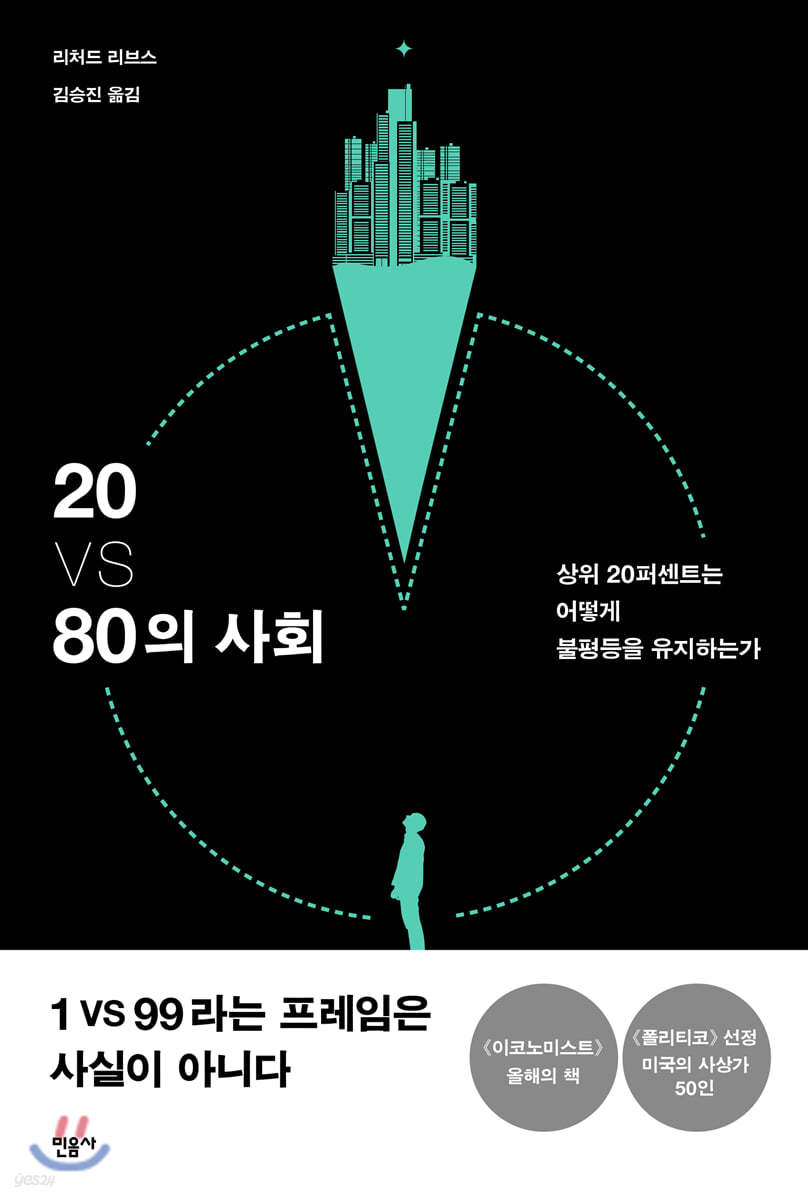
20 vs 80 society
 |
Description
Book Introduction
The Economist's Book of the Year Politico's 50 Most Influential American Thinkers From college admissions to housing and high-paying jobs monopolizing all the privileges of society Dissecting the Strategies and Hypocrisy of the Top 20 Percent "20 vs. 80 Society," which was selected as the Economist's Book of the Year and had a huge impact on American society, has been published by Minumsa. This book critiques point by point how the top 20 percent, who are actually responsible for inequality, are ruining society. Author Richard Reeves breaks away from the conventional framework of confrontation between the top 1 percent and the remaining 99 percent and analyzes the structure of inequality centered on the top 20 percent, or the upper middle class. This is a hotly debated book that sharply criticizes the hypocrisy and unfair practices of the middle and upper classes, and has changed the course of discussions on inequality. |
- You can preview some of the book's contents.
Preview
index
Praise poured in for this book
1.
The problem is the top 20 percent.
How the Top 20 Percent Perpetuates Inequality | Children Born into Privilege | Stifled Mobility | Tilt-Off Job Market | Unfair Opportunity Hoarding Strategies | Change Depends on the Top 20 Percent
2.
The gap between 20 and 80 is widening.
The top 20 percent are getting richer | High education is a status symbol | People choose spouses of the same level | Neighbors are like-minded | Health is an asset | Life is worth living for the top 20 percent
3.
Parenting gap creates privilege
Planned Births Are the First Step to Success | Which Parents Are More Devoted? | Not All Schools Are Created the Same | Prestigious Universities Offer More Opportunities for Middle- and Upper-Class Children | Children Raised in Quite Different Environments
4.
People on the Glass Floor
Focus on relative social mobility | We need to increase downward social mobility.
5.
How High-Paying Jobs Are Passed Down
The Dystopia of a Merit-Based Society | The Limits of Merit-Based Society | An Unequal Higher Education System | We Need a True Opportunity to Compete
6.
A strategy called opportunity hoarding
What Parents Shouldn't Do | What is Opportunity Hoarding? | Exclusive Land Use Regulations | The Unfair College Admissions System | Internships Where Networks and Connections Matter More | The Cultural Obstacle of Classism | Small Concessions Can Change Society
7.
Proposals for Change
Reduce unplanned pregnancies and births | Improve the quality of childcare by increasing home visiting programs | Put more quality teachers in the workforce | Make college financing fair | Eliminate exclusionary land use regulations | Eliminate preferential treatment for children of alumni | Open up internship opportunities | Fund by eliminating regressive tax subsidies
8.
Shout out to 20 percent of people
main
Acknowledgements
1.
The problem is the top 20 percent.
How the Top 20 Percent Perpetuates Inequality | Children Born into Privilege | Stifled Mobility | Tilt-Off Job Market | Unfair Opportunity Hoarding Strategies | Change Depends on the Top 20 Percent
2.
The gap between 20 and 80 is widening.
The top 20 percent are getting richer | High education is a status symbol | People choose spouses of the same level | Neighbors are like-minded | Health is an asset | Life is worth living for the top 20 percent
3.
Parenting gap creates privilege
Planned Births Are the First Step to Success | Which Parents Are More Devoted? | Not All Schools Are Created the Same | Prestigious Universities Offer More Opportunities for Middle- and Upper-Class Children | Children Raised in Quite Different Environments
4.
People on the Glass Floor
Focus on relative social mobility | We need to increase downward social mobility.
5.
How High-Paying Jobs Are Passed Down
The Dystopia of a Merit-Based Society | The Limits of Merit-Based Society | An Unequal Higher Education System | We Need a True Opportunity to Compete
6.
A strategy called opportunity hoarding
What Parents Shouldn't Do | What is Opportunity Hoarding? | Exclusive Land Use Regulations | The Unfair College Admissions System | Internships Where Networks and Connections Matter More | The Cultural Obstacle of Classism | Small Concessions Can Change Society
7.
Proposals for Change
Reduce unplanned pregnancies and births | Improve the quality of childcare by increasing home visiting programs | Put more quality teachers in the workforce | Make college financing fair | Eliminate exclusionary land use regulations | Eliminate preferential treatment for children of alumni | Open up internship opportunities | Fund by eliminating regressive tax subsidies
8.
Shout out to 20 percent of people
main
Acknowledgements
Detailed image

Into the book
The discourse on inequality focuses only on the problems of the top 1 percent.
As if the remaining 99 percent were all in a similarly unfortunate situation.
If we focus only on the top 1 percent, it's easy to believe that we, the upper-middle class, are in the same boat as the majority.
But that is not true.
--- p.16~17
The size of the upper middle class and the power it collectively wields can reshape cities, control education systems, and transform labor markets.
The middle and upper classes also have a huge influence on public discourse.
Because most journalists, think tank researchers, TV producers, professors, and commentators are middle- and upper-class.
--- p.23
It is no surprise that wealth inequality is growing faster than income inequality.
The average wealth held by the top 20 percent of households increased by 83 percent between 1983 and 2013.
Meanwhile, the rest of the population saw their wealth increase much more slowly, or even decline.
--- p.47
A gap that is much more difficult to bridge is the gap in spending on "enriching children's experiences," such as travel, books, and tutors.
According to Greg Duncan and Richard Murnane, the top 20 percent of households spend ten times more than the bottom 20 percent.
--- p.71
Both high education and high income of parents increase the likelihood that their children will grow up to be highly educated and have high incomes.
This process continues into the next generation.
The same goes for wealth.
Wealthy families will continue to be wealthy for generations to come, but this inheritance will be through education rather than direct inheritance—that is, through degrees rather than inheritance.
--- p.101
Rising inequality means that those who fall out of the upper and middle classes face a deeper fall.
Then, upper-middle-class parents have a greater incentive to create a glass floor to keep their children from falling, and they have the resources to do so.
So, we try to do everything we can, including opportunity hoarding, to reduce the risk of downward mobility for our children.
If their efforts are successful, a more rigid hierarchy will emerge at the top.
--- p.112
Our upper-middle class, with their high incomes, can convert that income into wealth through the housing market, and the tax system can greatly help with this.
Then, he tries to protect the wealth he has gained.
In particular, it uses exclusive land use regulations to prevent low-income people from moving into our neighborhoods and driving down our home values, or rather, from damaging even a little of what makes our neighborhoods great.
This process of exclusion does not even face public criticism.
--- p.158
It's no surprise that 60 percent of pregnancies in women under 30 are unplanned.
The high rate of unplanned pregnancies and childbirths among young women, especially those in their 20s, has serious implications for poverty, inequality, public spending, housing, and health care.
But what concerns me most is the gap in opportunity, particularly the class inequality that arises in human capital formation.
As if the remaining 99 percent were all in a similarly unfortunate situation.
If we focus only on the top 1 percent, it's easy to believe that we, the upper-middle class, are in the same boat as the majority.
But that is not true.
--- p.16~17
The size of the upper middle class and the power it collectively wields can reshape cities, control education systems, and transform labor markets.
The middle and upper classes also have a huge influence on public discourse.
Because most journalists, think tank researchers, TV producers, professors, and commentators are middle- and upper-class.
--- p.23
It is no surprise that wealth inequality is growing faster than income inequality.
The average wealth held by the top 20 percent of households increased by 83 percent between 1983 and 2013.
Meanwhile, the rest of the population saw their wealth increase much more slowly, or even decline.
--- p.47
A gap that is much more difficult to bridge is the gap in spending on "enriching children's experiences," such as travel, books, and tutors.
According to Greg Duncan and Richard Murnane, the top 20 percent of households spend ten times more than the bottom 20 percent.
--- p.71
Both high education and high income of parents increase the likelihood that their children will grow up to be highly educated and have high incomes.
This process continues into the next generation.
The same goes for wealth.
Wealthy families will continue to be wealthy for generations to come, but this inheritance will be through education rather than direct inheritance—that is, through degrees rather than inheritance.
--- p.101
Rising inequality means that those who fall out of the upper and middle classes face a deeper fall.
Then, upper-middle-class parents have a greater incentive to create a glass floor to keep their children from falling, and they have the resources to do so.
So, we try to do everything we can, including opportunity hoarding, to reduce the risk of downward mobility for our children.
If their efforts are successful, a more rigid hierarchy will emerge at the top.
--- p.112
Our upper-middle class, with their high incomes, can convert that income into wealth through the housing market, and the tax system can greatly help with this.
Then, he tries to protect the wealth he has gained.
In particular, it uses exclusive land use regulations to prevent low-income people from moving into our neighborhoods and driving down our home values, or rather, from damaging even a little of what makes our neighborhoods great.
This process of exclusion does not even face public criticism.
--- p.158
It's no surprise that 60 percent of pregnancies in women under 30 are unplanned.
The high rate of unplanned pregnancies and childbirths among young women, especially those in their 20s, has serious implications for poverty, inequality, public spending, housing, and health care.
But what concerns me most is the gap in opportunity, particularly the class inequality that arises in human capital formation.
--- p.186
Publisher's Review
★★★ The Economist's Book of the Year
★★★ Politico's 50 Most Influential American Thinkers
From college admissions to housing and high-paying jobs
monopolizing all the privileges of society
Dissecting the Strategies and Hypocrisy of the Top 20 Percent
"20 vs. 80 Society," which was selected as the Economist's Book of the Year and had a huge impact on American society, has been published by Minumsa.
This book critiques point by point how the top 20 percent, who are actually responsible for inequality, are ruining society.
Author Richard Reeves breaks away from the conventional framework of confrontation between the top 1 percent and the remaining 99 percent and analyzes the structure of inequality centered on the top 20 percent, or the upper middle class.
This is a hotly debated book that sharply criticizes the hypocrisy and unfair practices of the middle and upper classes, and has changed the course of discussions on inequality.
Clear evidence, real data, and provocative claims
A controversial work that changed the course of the inequality debate
“The size and collective power of the upper middle class, the top 20 percent, can reshape cities, dominate education systems, and transform labor markets.
The middle and upper classes also have a huge influence on public discourse.
“Because most journalists, think tank researchers, TV producers, professors, and commentators are middle- and upper-class.”
In "20 vs. 80 Society," the author argues that the concept of the middle class is nothing more than a "convenient fiction."
To meaningfully analyze the current inequality structure, we must look at the problem through the frame of the 'upper-middle class.'
Current indicators of inequality reveal a huge gap between the top 20 percent and the remaining 80 percent, and this gap between the top 20 percent and the rest is widening.
Therefore, in order to identify the causes of inequality and devise solutions, we must recognize the structure of inequality called '20 VS 80' and focus the discussion on the upper-middle class, the top 20 percent.
The unequal structure of American society, which is mainly explained in this book, does not feel out of place when viewed in light of the reality of Korean society.
If the middle class is gradually disintegrating amid the global economic downturn, the behavior of the upper-middle class captured in this book is similar to the reality experienced by many in Korean society today.
The image of the upper-middle class trying to develop human capital through the upbringing and education of their children and thereby pass on high-paying professional jobs to their descendants is very familiar.
In this way, the gap widens and social status is inherited.
The phenomenon in Korean society, expressed as the so-called spoon theory, can be said to be an example of this context.
Therefore, as this book argues, the problem of inequality in Korean society also requires attention to the top 20 percent.
Through the clear figures and arguments presented in this book, realistic solutions can be found to many problems in Korean society.
Opportunity Hoarding Strategies for Your Children
There is no country for the 80 percent.
One of the important concepts presented by the author in ‘20 vs. 80 Society’ is ‘opportunity hoarding.’
Contrary to the hope that success can be achieved simply by having ability and skills, the opportunities for success are not equal, but rather, the top 20 percent are hoarding it.
The upper-middle class, regardless of means, monopolizes opportunities for success, including education, college admissions, internships, and high-paying jobs, and seeks to pass on social status to their children.
Their attempts become reality through laws and systems that are designed to their advantage.
Income, wealth, and social status that are unfairly inherited in this way gradually widen the gap in inequality.
The upper middle class hoards opportunities and creates a 'glass floor'.
The glass floor is a term coined by the author to refer to the safeguards that prevent the next generation from falling into the lower classes, and the author points out that we must pay attention to rigid downward mobility.
It highlights that the unfair practices of upper-middle-class parents who create a glass floor for their children are a key cause of maintaining inequality.
Opportunity hoarding and the glass floor it creates perpetuate class divisions and exacerbate inequality across generations.
“On weekdays, I criticize the problem of inequality,
“On weekends and evenings, we help reinforce inequality!”
A scathing dissection of the upper-middle class's dual attitude toward class.
The upper-middle class, highly educated and holding high-paying professional jobs, ostensibly criticizes inequality fiercely.
It was also the upper-middle-class intellectuals who created the confrontation between the 1 percent and the 99 percent and led the criticism of the super-rich at the top.
However, from the perspective of ‘consistency between words and actions’, their attitude is duplicitous and even hypocritical.
They support exclusive real estate policies to maintain their wealth and do everything possible to ensure their children receive good educations and high-paying jobs.
They use their connections and networks to provide internship opportunities for their children, and they can afford to support their tuition and even take advantage of scholarships.
In Korean society, it is not uncommon to see intellectuals and social leaders who call themselves opinion leaders competing to criticize the conglomerates and the top 1 percent of the wealthy.
Contrary to what they say, we often see hypocrisy in the way they look after their own interests and pass on privileges to their children.
It is sometimes accepted that politicians and scholars have a history of real estate speculation and false residence registration.
This is why the examples in 『20 VS 80 Society』 create a sense of uneasiness.
Meanwhile, the author's honest attitude in revealing that he immigrated from England to the United States to escape class society stands out in this book.
The author confesses that he belongs to the top 20 percent, the upper middle class, and urges 'us (the top 20 percent)' to reflect.
It is quite different from the so-called 'out-of-body speech', which maintains a critical attitude toward society while omitting responsibility for oneself as a party concerned.
The author emphasizes the conscience and moral responsibility of the upper-middle class, and says that the policies and measures proposed in the book must begin with self-reflection by the upper-middle class if they are to be implemented.
What makes this book unique is that it goes beyond abstract and moral arguments and vividly exposes the reality of the inequality inflicted on the bottom 80 percent.
This distinction is why the book received significant media attention when it was published in the United States (The Economist's Book of the Year), and why the author was recognized as an important American intellectual (Politico's 50 Most Influential American Thinkers) after its publication.
This book consists of a total of eight chapters.
Chapter 1 summarizes the key arguments presented in the book.
Chapters 2 through 6 deal with the reality of inequality and the mechanisms by which it is maintained, including the gap in education, childcare, social mobility, job opportunities, college admissions, and internship systems.
Chapters 7 and 8 propose realistic policies to address these issues and call for a shift in awareness and effort for change.
★★★ Politico's 50 Most Influential American Thinkers
From college admissions to housing and high-paying jobs
monopolizing all the privileges of society
Dissecting the Strategies and Hypocrisy of the Top 20 Percent
"20 vs. 80 Society," which was selected as the Economist's Book of the Year and had a huge impact on American society, has been published by Minumsa.
This book critiques point by point how the top 20 percent, who are actually responsible for inequality, are ruining society.
Author Richard Reeves breaks away from the conventional framework of confrontation between the top 1 percent and the remaining 99 percent and analyzes the structure of inequality centered on the top 20 percent, or the upper middle class.
This is a hotly debated book that sharply criticizes the hypocrisy and unfair practices of the middle and upper classes, and has changed the course of discussions on inequality.
Clear evidence, real data, and provocative claims
A controversial work that changed the course of the inequality debate
“The size and collective power of the upper middle class, the top 20 percent, can reshape cities, dominate education systems, and transform labor markets.
The middle and upper classes also have a huge influence on public discourse.
“Because most journalists, think tank researchers, TV producers, professors, and commentators are middle- and upper-class.”
In "20 vs. 80 Society," the author argues that the concept of the middle class is nothing more than a "convenient fiction."
To meaningfully analyze the current inequality structure, we must look at the problem through the frame of the 'upper-middle class.'
Current indicators of inequality reveal a huge gap between the top 20 percent and the remaining 80 percent, and this gap between the top 20 percent and the rest is widening.
Therefore, in order to identify the causes of inequality and devise solutions, we must recognize the structure of inequality called '20 VS 80' and focus the discussion on the upper-middle class, the top 20 percent.
The unequal structure of American society, which is mainly explained in this book, does not feel out of place when viewed in light of the reality of Korean society.
If the middle class is gradually disintegrating amid the global economic downturn, the behavior of the upper-middle class captured in this book is similar to the reality experienced by many in Korean society today.
The image of the upper-middle class trying to develop human capital through the upbringing and education of their children and thereby pass on high-paying professional jobs to their descendants is very familiar.
In this way, the gap widens and social status is inherited.
The phenomenon in Korean society, expressed as the so-called spoon theory, can be said to be an example of this context.
Therefore, as this book argues, the problem of inequality in Korean society also requires attention to the top 20 percent.
Through the clear figures and arguments presented in this book, realistic solutions can be found to many problems in Korean society.
Opportunity Hoarding Strategies for Your Children
There is no country for the 80 percent.
One of the important concepts presented by the author in ‘20 vs. 80 Society’ is ‘opportunity hoarding.’
Contrary to the hope that success can be achieved simply by having ability and skills, the opportunities for success are not equal, but rather, the top 20 percent are hoarding it.
The upper-middle class, regardless of means, monopolizes opportunities for success, including education, college admissions, internships, and high-paying jobs, and seeks to pass on social status to their children.
Their attempts become reality through laws and systems that are designed to their advantage.
Income, wealth, and social status that are unfairly inherited in this way gradually widen the gap in inequality.
The upper middle class hoards opportunities and creates a 'glass floor'.
The glass floor is a term coined by the author to refer to the safeguards that prevent the next generation from falling into the lower classes, and the author points out that we must pay attention to rigid downward mobility.
It highlights that the unfair practices of upper-middle-class parents who create a glass floor for their children are a key cause of maintaining inequality.
Opportunity hoarding and the glass floor it creates perpetuate class divisions and exacerbate inequality across generations.
“On weekdays, I criticize the problem of inequality,
“On weekends and evenings, we help reinforce inequality!”
A scathing dissection of the upper-middle class's dual attitude toward class.
The upper-middle class, highly educated and holding high-paying professional jobs, ostensibly criticizes inequality fiercely.
It was also the upper-middle-class intellectuals who created the confrontation between the 1 percent and the 99 percent and led the criticism of the super-rich at the top.
However, from the perspective of ‘consistency between words and actions’, their attitude is duplicitous and even hypocritical.
They support exclusive real estate policies to maintain their wealth and do everything possible to ensure their children receive good educations and high-paying jobs.
They use their connections and networks to provide internship opportunities for their children, and they can afford to support their tuition and even take advantage of scholarships.
In Korean society, it is not uncommon to see intellectuals and social leaders who call themselves opinion leaders competing to criticize the conglomerates and the top 1 percent of the wealthy.
Contrary to what they say, we often see hypocrisy in the way they look after their own interests and pass on privileges to their children.
It is sometimes accepted that politicians and scholars have a history of real estate speculation and false residence registration.
This is why the examples in 『20 VS 80 Society』 create a sense of uneasiness.
Meanwhile, the author's honest attitude in revealing that he immigrated from England to the United States to escape class society stands out in this book.
The author confesses that he belongs to the top 20 percent, the upper middle class, and urges 'us (the top 20 percent)' to reflect.
It is quite different from the so-called 'out-of-body speech', which maintains a critical attitude toward society while omitting responsibility for oneself as a party concerned.
The author emphasizes the conscience and moral responsibility of the upper-middle class, and says that the policies and measures proposed in the book must begin with self-reflection by the upper-middle class if they are to be implemented.
What makes this book unique is that it goes beyond abstract and moral arguments and vividly exposes the reality of the inequality inflicted on the bottom 80 percent.
This distinction is why the book received significant media attention when it was published in the United States (The Economist's Book of the Year), and why the author was recognized as an important American intellectual (Politico's 50 Most Influential American Thinkers) after its publication.
This book consists of a total of eight chapters.
Chapter 1 summarizes the key arguments presented in the book.
Chapters 2 through 6 deal with the reality of inequality and the mechanisms by which it is maintained, including the gap in education, childcare, social mobility, job opportunities, college admissions, and internship systems.
Chapters 7 and 8 propose realistic policies to address these issues and call for a shift in awareness and effort for change.
GOODS SPECIFICS
- Date of publication: August 23, 2019
- Page count, weight, size: 272 pages | 386g | 145*215*19mm
- ISBN13: 9788937443589
- ISBN10: 8937443589
You may also like
카테고리
korean


korean

![GQ KOREA Mark (Monthly): December [2025]](http://librairie.coreenne.fr/cdn/shop/files/8ef265dbbfbf186523ed75ba7319009d.jpg?v=1765340328&width=3840)


