

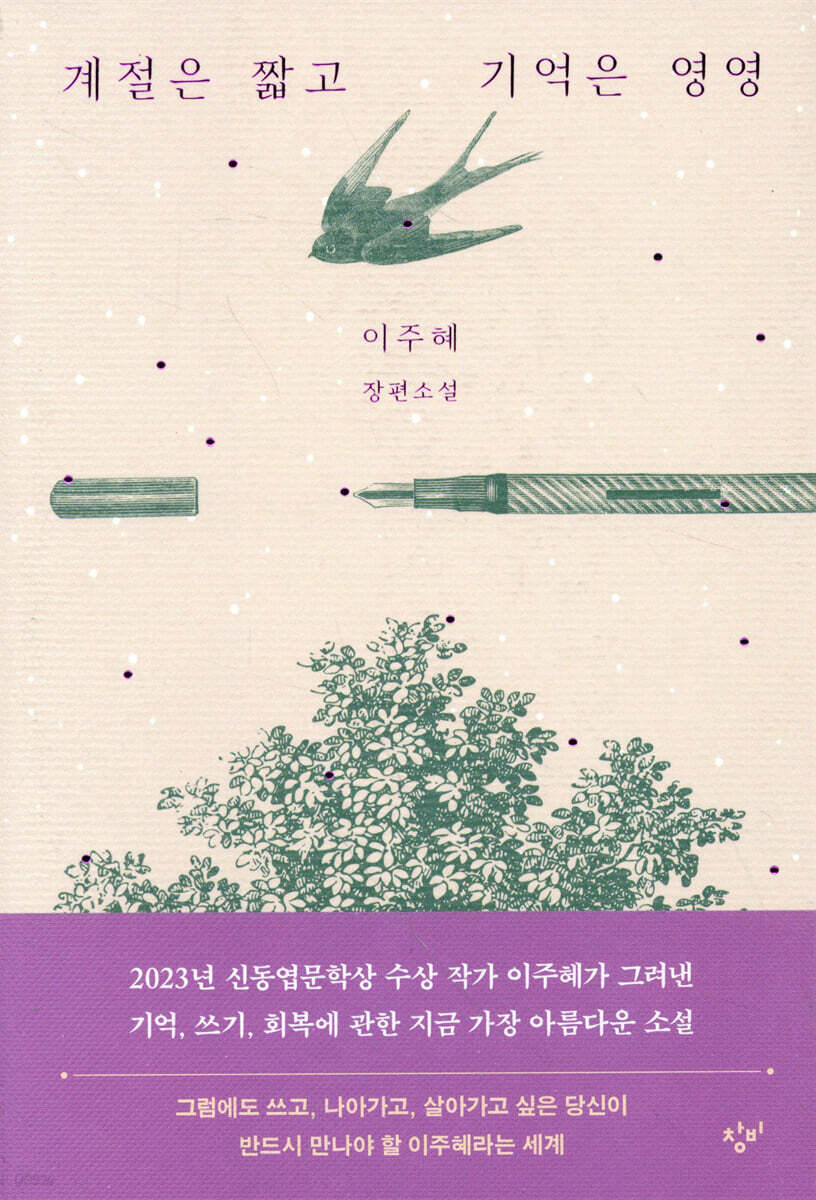
Seasons are short and memories are eternal
 |
Description
Book Introduction
- A word from MD
-
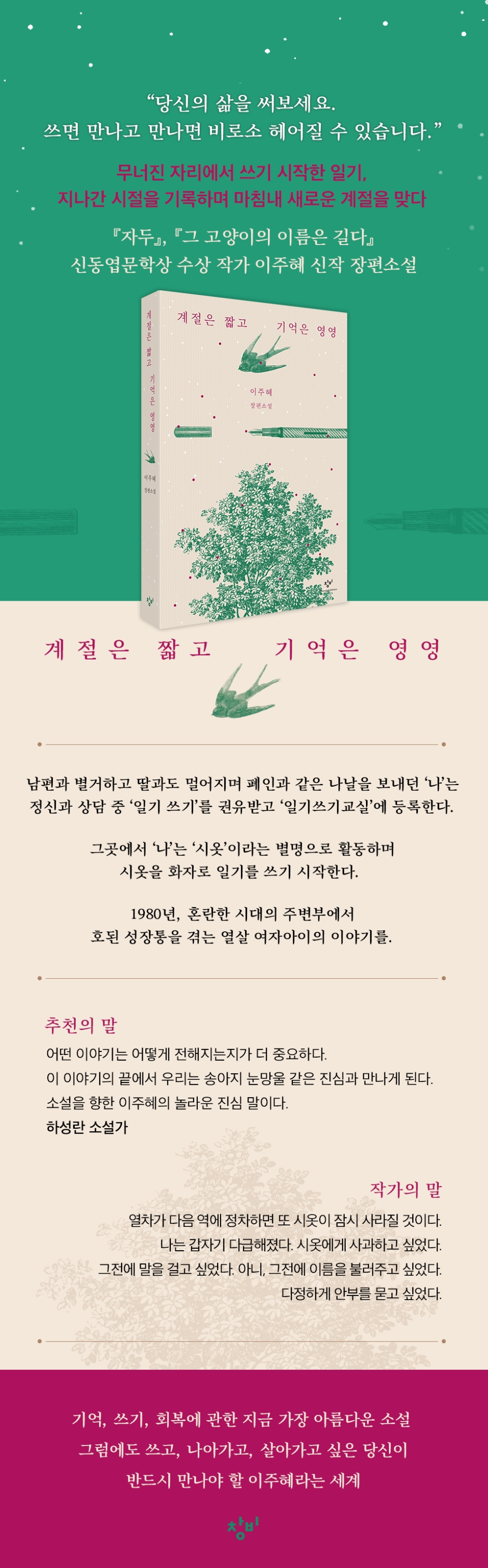
Writing about the past, the season has finally arrivedA full-length novel by Lee Ju-hye, winner of the 2023 Shin Dong-yup Literary Award.
The protagonist becomes alone due to an incident.
After psychiatric counseling, I ended up writing down things I had never been able to tell anyone else in a diary writing class.
By reflecting on the painful reality through writing, he delicately portrays the process of truly saying goodbye and moving forward.
December 1, 2023. Novel/Poetry PD Kim Yu-ri
For you today who wants to write about yesterday
The most beautiful novel right now
Lee Ju-hye, winner of the Shin Dong-yup Literary Award
A brilliant story about memory, writing, and recovery
Author Lee Ju-hye, who has consistently published works that “deeply penetrate the walls of our society’s extraordinary gender inequality and insensitivity to it” (Shin Dong-yup Literary Award judges’ comments) with “delicately crafted language,” has published her second full-length novel, “Season is Short and Memories are Forever.”
This is the first new novel to be published since winning the 2023 Shin Dong-yup Literary Award.
With meticulous composition and fluid prose, the author, who has earned the trust of critics and readers alike for delving into the complexities of women's realities without compromise or compromise, demonstrates her narrative prowess, which has become even more solid and outstanding, without reservation in this novel.
The novel begins with a woman choosing 'writing' as a way to overcome the painful reality before her eyes.
The process of looking back on and rewriting memories that can be called original experiences, revealing the wounds deeply rooted within, and moving forward with them is depicted in elegant language.
When painful memories of a time that do not fade even after a long time are vividly unfolded in high-resolution sentences, you can experience a moment when the power of memory that takes control of existence and holds it in place and the power of existence that tries to live without being crushed by memory clash and mix in a fierce and fascinating way.
One person's desperate and dazzling attempt to embrace both the pain and joy that fills his life by confronting memories he longed to part with forever leaves a deep impression on those who wish to fully accept the past and move on to the next.
The most beautiful novel right now
Lee Ju-hye, winner of the Shin Dong-yup Literary Award
A brilliant story about memory, writing, and recovery
Author Lee Ju-hye, who has consistently published works that “deeply penetrate the walls of our society’s extraordinary gender inequality and insensitivity to it” (Shin Dong-yup Literary Award judges’ comments) with “delicately crafted language,” has published her second full-length novel, “Season is Short and Memories are Forever.”
This is the first new novel to be published since winning the 2023 Shin Dong-yup Literary Award.
With meticulous composition and fluid prose, the author, who has earned the trust of critics and readers alike for delving into the complexities of women's realities without compromise or compromise, demonstrates her narrative prowess, which has become even more solid and outstanding, without reservation in this novel.
The novel begins with a woman choosing 'writing' as a way to overcome the painful reality before her eyes.
The process of looking back on and rewriting memories that can be called original experiences, revealing the wounds deeply rooted within, and moving forward with them is depicted in elegant language.
When painful memories of a time that do not fade even after a long time are vividly unfolded in high-resolution sentences, you can experience a moment when the power of memory that takes control of existence and holds it in place and the power of existence that tries to live without being crushed by memory clash and mix in a fierce and fascinating way.
One person's desperate and dazzling attempt to embrace both the pain and joy that fills his life by confronting memories he longed to part with forever leaves a deep impression on those who wish to fully accept the past and move on to the next.
- You can preview some of the book's contents.
Preview
index
Part 1 Spring Meets Spring
Part 2 Spring sought spring
Part 3 The injured spring cried for a long time
Part 4 Spring has brought spring
Epilogue: Spring is Revenge
Author's Note
Part 2 Spring sought spring
Part 3 The injured spring cried for a long time
Part 4 Spring has brought spring
Epilogue: Spring is Revenge
Author's Note
Detailed image
Into the book
The emotions that should have been as colorful as a rainbow were drowned out by anxiety and fear.
(…) I walked with my head down so as not to see anything.
Everything was a stimulus.
When I bent down to wash my hair, the shower hose tangled in the faucet looked like a noose.
When I closed my eyes, there was darkness, and darkness meant death.
I couldn't close my eyes, so I couldn't sleep.
I couldn't even open my mouth.
The food reminded me of choking.
Anxiety locked every passage in my body from the inside out.
--- p.14~15
As for my diary, I stopped writing it when I turned forty.
As if to celebrate turning forty, I shredded all the dozens of diaries I had written in my twenties and thirties with an office shredder.
It took three days.
Writing a diary is an act of looking at your life from a bit of distance.
I guess it's a way to look at yourself from an objective perspective.
When the distance from ourselves is 0, we call it problematic.
To borrow the doctor's words, the distance between me and myself was passing zero and converging into a negative number.
He was a loser who was so consumed by anxiety and fear that he blocked out all external stimuli and retreated into his inner cave.
--- p.15
Write your life.
Only when we write can we meet, and only when we meet can we finally part ways.
This was the lecture introduction I saw on the website.
What do you mean you can break up with?
Dochi asked.
Me as I wrote.
The me that I locked up in the records.
Me, still wandering in the memories of the past.
Shadow poured out his answers as if possessed, then closed his mouth for a moment.
For some reason, goosebumps appeared on both my arms.
If there is a memory you want to break up with, write it down.
Any shame becomes bearable when put into words.
--- p.22~23
The mother-in-law was the center of the household.
I was sure that when spring came and the new school year began, a completely different world would unfold.
However, that year, the house of the eldest daughter, who had thought it would be a happy and special one, faced a noisy change.
A man disappears from the house, a man breaks in, a man gets pregnant, and a girl turns into a boy.
--- p.34~35
The adults who thought Si-ot was a boy looked at Si-ot's face for a long time.
Hey, look at that bastard's pale face.
They praised the poet's white face, her dazzling features, her clear, ringing voice, and her beautiful voice that sang with precise pitch.
As a boy, Shiot was always praised and was the object of fascination, so she came to think that becoming a boy was not such a bad thing.
All I had to do was bear the weight of the silent lies.
--- p.71
Unlike Annie, who was born in a hospital, Siot was born in the living room of a house.
(…) After the first cry of the poem, the coughs of the men waiting outside the door became more frequent.
The grandmother, across the iron dam, only opened the sliding door a little after she had finished cleaning up the delivery room.
"What?" asked the grandfather in the sash impatiently, and the grandmother on the other side of the iron fence said, "It's nothing."
I once overheard adults chatting, answering softly and closing the door again.
Although Si-ot was deeply hurt by the adults' carelessness, she never confided in anyone about it.
Born as nothing, Shiot suffered heartache from similar problems many times after that.
The wounds were gentle and routine.
--- p.101
Nothing had changed for Siot.
The poem could still sing with a clear voice.
Could wearing a pleated skirt, putting on a hairpin, and painting your lips red be considered a transformation? Isn't that more of a minor change, like changing your clothes every day?
Shiot could not understand how such trivial things could become such a huge wave that swept away everything in Shiot.
He was the one who misunderstood Si-ot's gender from the beginning, so why is the conductor so angry and betrayed as if Si-ot had lied and cheated him?
It was a huge puzzle that the young boy's mind could never solve.
(…) The song was taken away from Si-ot because he was not a boy.
Si-ot walked, crying loudly, with her throat completely sore from losing her song.
No one spoke to Si-ot as she walked crying in the middle of May.
--- p.210~212
Don't fall.
Did Shiot understand what I said? The Shiot in my dream turns its head and looks at me.
At that moment I realize.
The siot knows everything that lies beyond the threshold.
Even though you know it, you insist on crossing that line.
Don't fall.
I apologize.
The girl looks at me and smiles.
That smile speaks volumes.
I can't wait any longer.
Now it's time to move on to another story.
Even if some sinister world yawns beyond, we must willingly cross the border.
The world always passes by like that.
The young girl speaks quite maturely.
I stretch out my hand, but I can't catch the shiot.
The girl greets me from afar and crosses the threshold.
At that moment, the story moves on to the next chapter.
--- p.224~225
Shiot came across a picture of a girl in a school uniform.
(…) Shiot knew that the girl was his mother, but at the same time he couldn’t believe that she was his mother.
In the photos, the girl smiled innocently, her face completely oblivious to any misfortune.
The girl was very much loved.
The girl's future seemed to be filled with happiness.
(…) Si-ot was afraid because he knew that the future of the girl who grew up being blessed with only happiness was only his own.
Si-ot trembled as he seemed to understand why his mother hated him.
--- p.234~235
If I plant this ginkgo seed in the ground, will it sprout? Will this troublesome fruit successfully fulfill its role as a seed? Even if it sprouts, will I be able to wait until then? I, who cannot foresee any future and always runs away to the past? It won't be easy, but if I wait and finally witness the ginkgo sprout, it will undoubtedly be a beautiful thing.
Should I pretend to be fooled and plant it in a sunny spot? And wait patiently? For some reason, my heart felt a little fluttering.
--- p.298
Mom, tell me.
Is it right for someone my age to be this indecisive? This clumsy, this unpredictable, this temperamental, this many mistakes, this many mean things, this occasional harsh remark—is that right? Yesterday, for the first time, I began to wonder what my mother was like when she was my age.
What kind of twenties did my mother go through to meet my father, give birth to me, and become the mother she is today? Where did she fall, and how did she get up? Did she even get up? She must have had her own moments, just like I do now. It's so obvious, so natural, so why haven't I ever wondered about those times?
--- p.320
Now that I'm older than my mom was back then, I understand.
No one is perfect from the beginning.
Grandma, mom, and dad were all hesitant and confused, but at that moment, they just made the choices they could.
Contrary to its appearance, it must have been very noisy on the inside.
It must have collapsed and collapsed again many times.
But I think I would have walked forward step by step, making constant choices at every moment.
Life is like that.
I finally understand now.
(…) I walked with my head down so as not to see anything.
Everything was a stimulus.
When I bent down to wash my hair, the shower hose tangled in the faucet looked like a noose.
When I closed my eyes, there was darkness, and darkness meant death.
I couldn't close my eyes, so I couldn't sleep.
I couldn't even open my mouth.
The food reminded me of choking.
Anxiety locked every passage in my body from the inside out.
--- p.14~15
As for my diary, I stopped writing it when I turned forty.
As if to celebrate turning forty, I shredded all the dozens of diaries I had written in my twenties and thirties with an office shredder.
It took three days.
Writing a diary is an act of looking at your life from a bit of distance.
I guess it's a way to look at yourself from an objective perspective.
When the distance from ourselves is 0, we call it problematic.
To borrow the doctor's words, the distance between me and myself was passing zero and converging into a negative number.
He was a loser who was so consumed by anxiety and fear that he blocked out all external stimuli and retreated into his inner cave.
--- p.15
Write your life.
Only when we write can we meet, and only when we meet can we finally part ways.
This was the lecture introduction I saw on the website.
What do you mean you can break up with?
Dochi asked.
Me as I wrote.
The me that I locked up in the records.
Me, still wandering in the memories of the past.
Shadow poured out his answers as if possessed, then closed his mouth for a moment.
For some reason, goosebumps appeared on both my arms.
If there is a memory you want to break up with, write it down.
Any shame becomes bearable when put into words.
--- p.22~23
The mother-in-law was the center of the household.
I was sure that when spring came and the new school year began, a completely different world would unfold.
However, that year, the house of the eldest daughter, who had thought it would be a happy and special one, faced a noisy change.
A man disappears from the house, a man breaks in, a man gets pregnant, and a girl turns into a boy.
--- p.34~35
The adults who thought Si-ot was a boy looked at Si-ot's face for a long time.
Hey, look at that bastard's pale face.
They praised the poet's white face, her dazzling features, her clear, ringing voice, and her beautiful voice that sang with precise pitch.
As a boy, Shiot was always praised and was the object of fascination, so she came to think that becoming a boy was not such a bad thing.
All I had to do was bear the weight of the silent lies.
--- p.71
Unlike Annie, who was born in a hospital, Siot was born in the living room of a house.
(…) After the first cry of the poem, the coughs of the men waiting outside the door became more frequent.
The grandmother, across the iron dam, only opened the sliding door a little after she had finished cleaning up the delivery room.
"What?" asked the grandfather in the sash impatiently, and the grandmother on the other side of the iron fence said, "It's nothing."
I once overheard adults chatting, answering softly and closing the door again.
Although Si-ot was deeply hurt by the adults' carelessness, she never confided in anyone about it.
Born as nothing, Shiot suffered heartache from similar problems many times after that.
The wounds were gentle and routine.
--- p.101
Nothing had changed for Siot.
The poem could still sing with a clear voice.
Could wearing a pleated skirt, putting on a hairpin, and painting your lips red be considered a transformation? Isn't that more of a minor change, like changing your clothes every day?
Shiot could not understand how such trivial things could become such a huge wave that swept away everything in Shiot.
He was the one who misunderstood Si-ot's gender from the beginning, so why is the conductor so angry and betrayed as if Si-ot had lied and cheated him?
It was a huge puzzle that the young boy's mind could never solve.
(…) The song was taken away from Si-ot because he was not a boy.
Si-ot walked, crying loudly, with her throat completely sore from losing her song.
No one spoke to Si-ot as she walked crying in the middle of May.
--- p.210~212
Don't fall.
Did Shiot understand what I said? The Shiot in my dream turns its head and looks at me.
At that moment I realize.
The siot knows everything that lies beyond the threshold.
Even though you know it, you insist on crossing that line.
Don't fall.
I apologize.
The girl looks at me and smiles.
That smile speaks volumes.
I can't wait any longer.
Now it's time to move on to another story.
Even if some sinister world yawns beyond, we must willingly cross the border.
The world always passes by like that.
The young girl speaks quite maturely.
I stretch out my hand, but I can't catch the shiot.
The girl greets me from afar and crosses the threshold.
At that moment, the story moves on to the next chapter.
--- p.224~225
Shiot came across a picture of a girl in a school uniform.
(…) Shiot knew that the girl was his mother, but at the same time he couldn’t believe that she was his mother.
In the photos, the girl smiled innocently, her face completely oblivious to any misfortune.
The girl was very much loved.
The girl's future seemed to be filled with happiness.
(…) Si-ot was afraid because he knew that the future of the girl who grew up being blessed with only happiness was only his own.
Si-ot trembled as he seemed to understand why his mother hated him.
--- p.234~235
If I plant this ginkgo seed in the ground, will it sprout? Will this troublesome fruit successfully fulfill its role as a seed? Even if it sprouts, will I be able to wait until then? I, who cannot foresee any future and always runs away to the past? It won't be easy, but if I wait and finally witness the ginkgo sprout, it will undoubtedly be a beautiful thing.
Should I pretend to be fooled and plant it in a sunny spot? And wait patiently? For some reason, my heart felt a little fluttering.
--- p.298
Mom, tell me.
Is it right for someone my age to be this indecisive? This clumsy, this unpredictable, this temperamental, this many mistakes, this many mean things, this occasional harsh remark—is that right? Yesterday, for the first time, I began to wonder what my mother was like when she was my age.
What kind of twenties did my mother go through to meet my father, give birth to me, and become the mother she is today? Where did she fall, and how did she get up? Did she even get up? She must have had her own moments, just like I do now. It's so obvious, so natural, so why haven't I ever wondered about those times?
--- p.320
Now that I'm older than my mom was back then, I understand.
No one is perfect from the beginning.
Grandma, mom, and dad were all hesitant and confused, but at that moment, they just made the choices they could.
Contrary to its appearance, it must have been very noisy on the inside.
It must have collapsed and collapsed again many times.
But I think I would have walked forward step by step, making constant choices at every moment.
Life is like that.
I finally understand now.
--- p.324
Publisher's Review
A diary I started writing in a collapsed place,
Recording the past and finally welcoming the new season
One day, 'I', who is in my fifties, finds out that her husband 'Seok-gu' has been stalking a female colleague with whom she was active in political parties. She is irreparably hurt when Seok-gu tells her that he is not ashamed because his actions were sincere.
After that, he started to settle down and live apart, and he became estranged from his daughter, Haejun, who had been especially close to Seokgu, and he lived like a wreck until he finally received psychiatric counseling, where the doctor told him that 'writing a diary' would be helpful.
While half-believing the doctor's words that "writing a diary is an act of looking at one's life from a distance" (page 15), 'I' was searching for 'diary writing' on the Internet and discovered a 'diary writing class' run by a writing room.
And I'm instantly captivated by the phrase promoting that classroom.
“Write your life.
“Only when we write can we meet, and only when we meet can we finally part ways.” (Page 16)
As if I had been holding onto memories I wanted to break up with, I was suddenly drawn to this sentence and enrolled in the ‘Diary Writing Class.’
However, since “I couldn’t write a single line if I started with ‘I’” (page 32), he tells a story he had never told anyone before in his diary for the first time, using a speaker named ‘Si-ot’.
The story of Si-ot, a ten-year-old girl going through severe growing pains on the periphery of a dark and chaotic era in 1980.
The diary, which spans parts 1 through 4 of the novel, describes the pain sharply engraved in Si-ot's young body and mind in powerful and dense sentences.
The humiliation and shame she had to endure as a girl, the days when she insisted on wearing only short hair, a T-shirt, and pants so she wouldn't be "seen as someone with a vagina" (p. 70), that spring when she pretended to be a "clear-skinned boy" (p. 61) to get what she desperately wanted and bore the weight of the secret alone, and when everything was revealed and she "felt like she was being driven to the edge of the world" (p. 211).
This wasn't all that Siot had to endure.
At that time, Si-ot was “getting used to the feeling of the word ‘poor.’” (page 79) Her father disappeared after incurring a large debt, and the empty space left by her father was filled by her grandmother’s increasingly desperate chanting and her mother’s sighs.
There were humiliations I had to endure because I was poor and dreams I had to give up.
The ten-year-old Si-ot was anxious, not knowing whether she wanted to be a 'girl' or a 'boy' and what she should become, and was even trying to act calm in the face of the sudden poverty that had befallen her. She was tired, sad, and lonely.
I go through the emotions of that time, which I have never properly faced before, one by one, and although I go back and forth between anxiety and frustration every day, I do not stop writing in my diary.
I cling to writing as if I can only meet a different tomorrow by fully reliving that time.
As I follow the sentences that delicately reflect on the heart that I had not been able to cherish, I find myself wanting to quietly bring out the long-standing wounds that I had ignored and now look at them under the bright light.
Meanwhile, 'I' also writes in my diary the stories of people I had completely forgotten about.
My friend next door, Annie, always dressed up like a princess, making Si-ot toss and turn with admiration and jealousy.
After her father disappeared, the 'Swallow Tea House Man' who broke into her house demanding the return of "the heartbreaking money my mother had saved by selling tea leaves" (page 81) was suspicious and rude, but he was an adult who knew how to gently comfort his young daughter-in-law.
'Yunsoo' was a precious friend who taught me how to share sadness and fear, and Yunsoo's older sister 'Yunsim', who was always suffering from poverty and fatigue, would smile brightly when she saw Si-ot, her eyes turning into rainbows.
'I' meets them again in the diary, and vaguely realizes that the diary he is writing is "not his own story" (page 340), but a story he is writing together with those who once left a deep mark on Si-ot and passed by.
And we come to understand that they too were barely getting through that time, a time of savagery, hatred, and discrimination that made the city terribly miserable and chaotic.
But despite such understanding and continued writing, it seems that 'I', rather than breaking away from memories, am clinging to them more and more, and rebuilding the shattered reality feels increasingly distant.
Moreover, he is now shocked to hear news of one of them who has now grown distant.
The novel tenaciously follows the arduous process of writing and recovery, keeping you captivated until the very last page.
Even so, you want to keep writing, moving forward, and living.
The world of Lee Joo-hye, whom you must meet right now
My efforts to record with meticulous detail the memories that have not faded even after forty years are probably an expression of my will to overcome the difficult present and move forward.
One of the driving forces that allows that will to continue, however precariously, is the other students who attend the diary writing class with me.
They come together with their own stories and become the first readers of each other's diaries.
“A diary to be read by others” (page 41) is bound to be different from a diary written and read alone, and thanks to those who read my writing together and add stories, ‘I’ can look into my memories more intently and write until the moment when Si-ot welcomes a new spring.
The rough and honest conversations and the kind of friendship shared among the fellow writers will be another attraction of this novel.
Lee Ju-hye is a writer who “never forgets that even in hardship, there is a time for self-respect and wisdom” (Shin Dong-yup Literary Award judges’ comment), and “The Season is Short and Memories Are Forever” is a story that saves the difficult present by retrieving the moments when she tried to “walk forward step by step, making constant choices at every moment” (p. 324) in the midst of yesterday’s despair and pain.
In the novel, 'I' suffers as I write about the pain of my childhood that has not yet been resolved, but writing a diary is not just about throwing myself into pain again.
Like the question, “Am I alive now? Have I survived?” (page 76), it is rather a process of gradually strengthening one’s inner strength by renewing one’s sense of oneself as vividly alive here and now despite the trials of the past.
In the diary, I recall the countless choices I made as a child to navigate the reality before me, and I contemplate which direction I should take from where I stand now.
Is it a steep cliff, or is it a threshold that “leaves us with another story” (p. 224)?
Let's watch this recovery narrative, told with a careful and truthful voice, until the very end.
Before you know it, you will witness “Lee Joo-hye’s amazing sincerity” (Ha Seong-ran, recommendation) that will warm the reader’s life.
Author's Note
The night did not reveal its true nature, but showed me a face that was both infinitely unfamiliar and yet familiar.
That face was Lee Joo-hye, then Min Ae-ni, then Jeong Yun-sim, then Choi Su-ho, and then Jeong Yun-su.
And it was always a poem.
Since I serialized this novel in a quarterly magazine last year, it has been Si-ot who has silently endured my cruelty and harshness.
The train door opened and a young couple got off.
The sissy also disappeared from my sight.
As the doors closed and the train departed, the shiot reappeared on the window glass.
Suddenly, I realized that I hadn't even given Siot a name.
When the train stops at the next station, the siot will disappear for a moment again.
I suddenly became anxious.
I wanted to apologize to Shiot.
I wanted to talk to you before.
No, I wanted to call your name before that.
I wanted to ask you how you were doing.
Fall 2023
Lee Joo-hye
Recording the past and finally welcoming the new season
One day, 'I', who is in my fifties, finds out that her husband 'Seok-gu' has been stalking a female colleague with whom she was active in political parties. She is irreparably hurt when Seok-gu tells her that he is not ashamed because his actions were sincere.
After that, he started to settle down and live apart, and he became estranged from his daughter, Haejun, who had been especially close to Seokgu, and he lived like a wreck until he finally received psychiatric counseling, where the doctor told him that 'writing a diary' would be helpful.
While half-believing the doctor's words that "writing a diary is an act of looking at one's life from a distance" (page 15), 'I' was searching for 'diary writing' on the Internet and discovered a 'diary writing class' run by a writing room.
And I'm instantly captivated by the phrase promoting that classroom.
“Write your life.
“Only when we write can we meet, and only when we meet can we finally part ways.” (Page 16)
As if I had been holding onto memories I wanted to break up with, I was suddenly drawn to this sentence and enrolled in the ‘Diary Writing Class.’
However, since “I couldn’t write a single line if I started with ‘I’” (page 32), he tells a story he had never told anyone before in his diary for the first time, using a speaker named ‘Si-ot’.
The story of Si-ot, a ten-year-old girl going through severe growing pains on the periphery of a dark and chaotic era in 1980.
The diary, which spans parts 1 through 4 of the novel, describes the pain sharply engraved in Si-ot's young body and mind in powerful and dense sentences.
The humiliation and shame she had to endure as a girl, the days when she insisted on wearing only short hair, a T-shirt, and pants so she wouldn't be "seen as someone with a vagina" (p. 70), that spring when she pretended to be a "clear-skinned boy" (p. 61) to get what she desperately wanted and bore the weight of the secret alone, and when everything was revealed and she "felt like she was being driven to the edge of the world" (p. 211).
This wasn't all that Siot had to endure.
At that time, Si-ot was “getting used to the feeling of the word ‘poor.’” (page 79) Her father disappeared after incurring a large debt, and the empty space left by her father was filled by her grandmother’s increasingly desperate chanting and her mother’s sighs.
There were humiliations I had to endure because I was poor and dreams I had to give up.
The ten-year-old Si-ot was anxious, not knowing whether she wanted to be a 'girl' or a 'boy' and what she should become, and was even trying to act calm in the face of the sudden poverty that had befallen her. She was tired, sad, and lonely.
I go through the emotions of that time, which I have never properly faced before, one by one, and although I go back and forth between anxiety and frustration every day, I do not stop writing in my diary.
I cling to writing as if I can only meet a different tomorrow by fully reliving that time.
As I follow the sentences that delicately reflect on the heart that I had not been able to cherish, I find myself wanting to quietly bring out the long-standing wounds that I had ignored and now look at them under the bright light.
Meanwhile, 'I' also writes in my diary the stories of people I had completely forgotten about.
My friend next door, Annie, always dressed up like a princess, making Si-ot toss and turn with admiration and jealousy.
After her father disappeared, the 'Swallow Tea House Man' who broke into her house demanding the return of "the heartbreaking money my mother had saved by selling tea leaves" (page 81) was suspicious and rude, but he was an adult who knew how to gently comfort his young daughter-in-law.
'Yunsoo' was a precious friend who taught me how to share sadness and fear, and Yunsoo's older sister 'Yunsim', who was always suffering from poverty and fatigue, would smile brightly when she saw Si-ot, her eyes turning into rainbows.
'I' meets them again in the diary, and vaguely realizes that the diary he is writing is "not his own story" (page 340), but a story he is writing together with those who once left a deep mark on Si-ot and passed by.
And we come to understand that they too were barely getting through that time, a time of savagery, hatred, and discrimination that made the city terribly miserable and chaotic.
But despite such understanding and continued writing, it seems that 'I', rather than breaking away from memories, am clinging to them more and more, and rebuilding the shattered reality feels increasingly distant.
Moreover, he is now shocked to hear news of one of them who has now grown distant.
The novel tenaciously follows the arduous process of writing and recovery, keeping you captivated until the very last page.
Even so, you want to keep writing, moving forward, and living.
The world of Lee Joo-hye, whom you must meet right now
My efforts to record with meticulous detail the memories that have not faded even after forty years are probably an expression of my will to overcome the difficult present and move forward.
One of the driving forces that allows that will to continue, however precariously, is the other students who attend the diary writing class with me.
They come together with their own stories and become the first readers of each other's diaries.
“A diary to be read by others” (page 41) is bound to be different from a diary written and read alone, and thanks to those who read my writing together and add stories, ‘I’ can look into my memories more intently and write until the moment when Si-ot welcomes a new spring.
The rough and honest conversations and the kind of friendship shared among the fellow writers will be another attraction of this novel.
Lee Ju-hye is a writer who “never forgets that even in hardship, there is a time for self-respect and wisdom” (Shin Dong-yup Literary Award judges’ comment), and “The Season is Short and Memories Are Forever” is a story that saves the difficult present by retrieving the moments when she tried to “walk forward step by step, making constant choices at every moment” (p. 324) in the midst of yesterday’s despair and pain.
In the novel, 'I' suffers as I write about the pain of my childhood that has not yet been resolved, but writing a diary is not just about throwing myself into pain again.
Like the question, “Am I alive now? Have I survived?” (page 76), it is rather a process of gradually strengthening one’s inner strength by renewing one’s sense of oneself as vividly alive here and now despite the trials of the past.
In the diary, I recall the countless choices I made as a child to navigate the reality before me, and I contemplate which direction I should take from where I stand now.
Is it a steep cliff, or is it a threshold that “leaves us with another story” (p. 224)?
Let's watch this recovery narrative, told with a careful and truthful voice, until the very end.
Before you know it, you will witness “Lee Joo-hye’s amazing sincerity” (Ha Seong-ran, recommendation) that will warm the reader’s life.
Author's Note
The night did not reveal its true nature, but showed me a face that was both infinitely unfamiliar and yet familiar.
That face was Lee Joo-hye, then Min Ae-ni, then Jeong Yun-sim, then Choi Su-ho, and then Jeong Yun-su.
And it was always a poem.
Since I serialized this novel in a quarterly magazine last year, it has been Si-ot who has silently endured my cruelty and harshness.
The train door opened and a young couple got off.
The sissy also disappeared from my sight.
As the doors closed and the train departed, the shiot reappeared on the window glass.
Suddenly, I realized that I hadn't even given Siot a name.
When the train stops at the next station, the siot will disappear for a moment again.
I suddenly became anxious.
I wanted to apologize to Shiot.
I wanted to talk to you before.
No, I wanted to call your name before that.
I wanted to ask you how you were doing.
Fall 2023
Lee Joo-hye
GOODS SPECIFICS
- Date of issue: November 10, 2023
- Page count, weight, size: 348 pages | 376g | 128*188*30mm
- ISBN13: 9788936439446
- ISBN10: 8936439448
You may also like
카테고리
korean


korean

![GQ KOREA Mark (Monthly): December [2025]](http://librairie.coreenne.fr/cdn/shop/files/8ef265dbbfbf186523ed75ba7319009d.jpg?v=1765340328&width=3840)


