

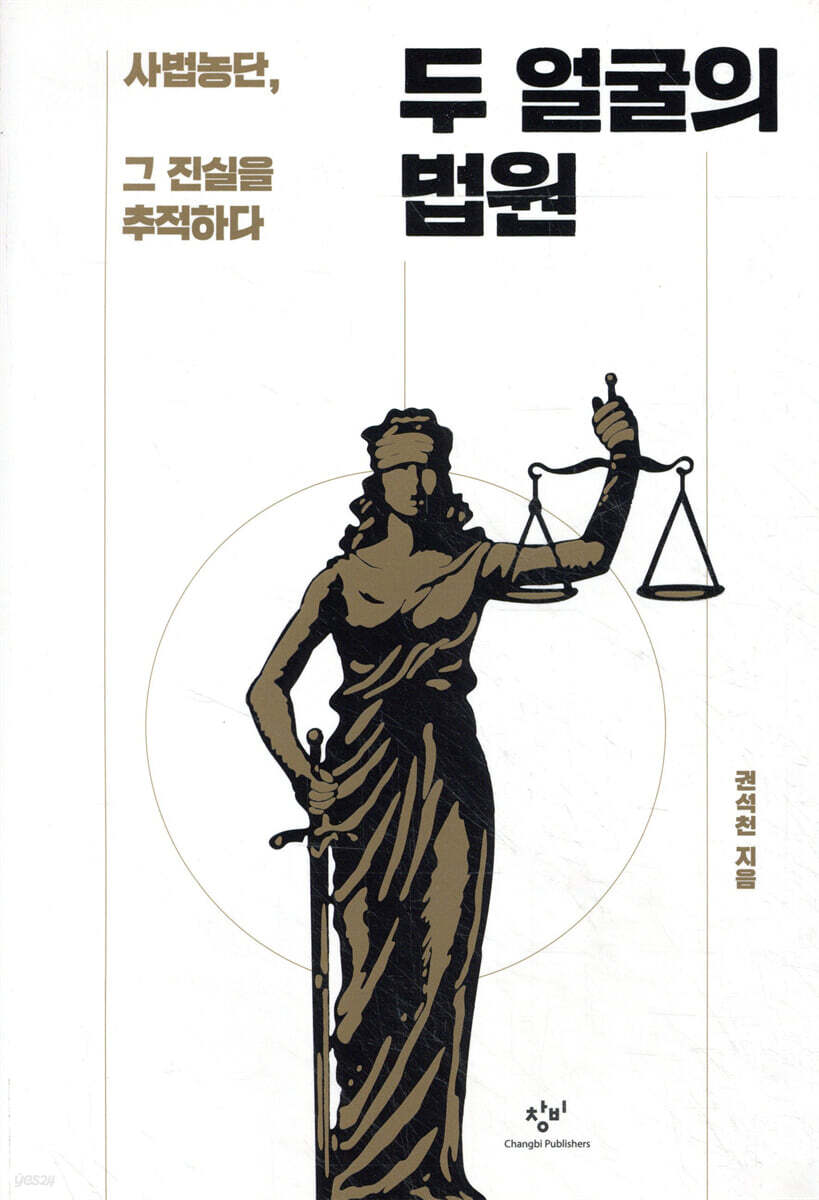
Two-faced court
 |
Description
Book Introduction
- A word from MD
-
The South Korean judiciary at a crossroadsReporter Kwon Seok-cheon investigated the truth behind the judicial corruption that shook Korean society, including the forced labor trial, background checks on judges, and allegations of collusion with the Blue House.
We gathered relevant data by hearing testimonies from various sources, including former Judge Lee Tan-hee.
Through this, we reveal the evils caused by the Supreme Court Chief Justice-centered judicial system.
August 16, 2019. Social and Political PD Son Min-gyu
Forced labor trial, background checks on judges, collusion with the Blue House…
The Truth Behind the Yang Seung-tae Court Judicial Scandal That Rocked Korean Society
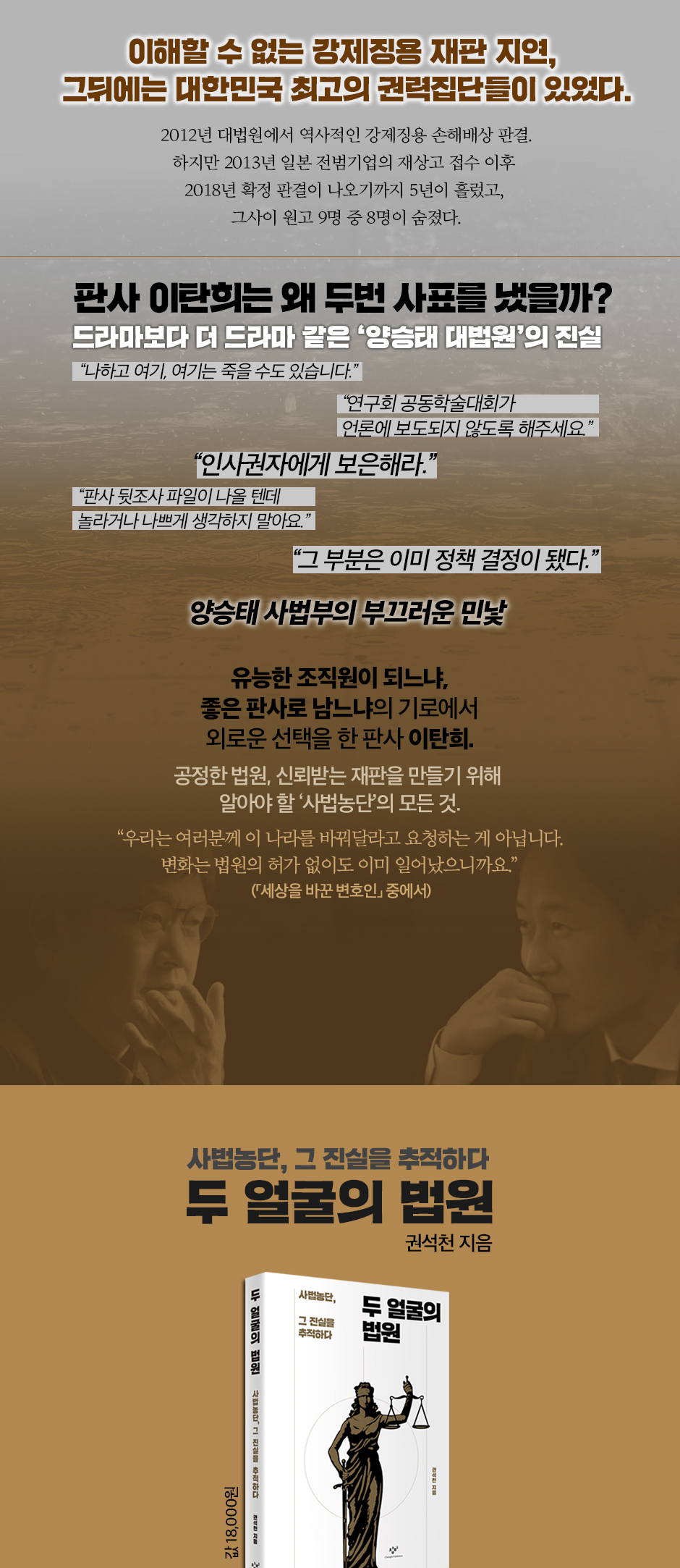
The incomprehensible delay in the trial of the forced labor case during the Japanese colonial period was just the tip of the huge iceberg called the "Yang Seung-tae Court judicial corruption."
In 2012, the Supreme Court issued a historic ruling on compensation for damages caused by forced labor.
However, between the Japanese war criminal company's appeal in 2013 and the final ruling in 2018, the case was tied up in the Supreme Court for five years, during which time eight of the nine plaintiffs died.
The moment the veil was lifted, the true story was revealed.
While judges at the Court Administration Office were creating documents that could influence trials, betraying their conscience as judges, secret meetings and phone calls continued between the Office's executives, the Blue House, and the government.
As a result, an unprecedented event occurred in which a former Chief Justice of the Supreme Court was arrested and put on trial.
What on earth was going on in the court?
Veteran journalist Kwon Seok-cheon's book, "The Two Faces of the Court: Judicial Corruption, Tracing the Truth," is the first in-depth account of "judicial corruption."
Beginning with an in-depth interview with former Judge Lee Tan-hee, who played a crucial role in revealing the abuse of judicial power by resigning in defiance of an unjust order, I listened to the testimonies of various sources I encountered during my long career as a legal reporter, covered trials in court, and reviewed a vast amount of related materials.
Through these works, we were able to faithfully and three-dimensionally capture the situation when the incident first broke out, the three stages of the Supreme Court's internal investigation, the prosecution's investigation, and the process leading up to the trial.
Reading through the process will reveal why Judge Lee Tan-hee had to resign twice, while also providing a vivid glimpse into the problems facing the Korean judiciary.
In particular, the forced labor trial cases in Chapter 7 concisely illustrate the nature of judicial corruption, which goes beyond the level of friction between Korea and Japan and can impact the lives of citizens.
The author persuasively proves that the 'judicial corruption' was not simply the misconduct of a few people in the Supreme Court, but rather stemmed from the organizational logic that inevitably emerged from the court system centered around the Chief Justice.
Furthermore, we point out and warn that the organizational logic of betraying the public values that are the reason for the organization's existence and serving the private interests of its members—specifically, high-ranking members—is deeply rooted throughout Korean society, from the Sewol Ferry disaster to various corruption scandals and the Park Geun-hye administration's state affairs scandal.
The current situation, facing the so-called 'judicial corruption' incident, is an important crossroads for Korean society.
How can we restore trust in the courts, which have fallen to rock bottom, and ensure that they serve the sovereign citizens? What must Korean society do to move beyond organizational logic and advance further? You will discover these valuable keywords in this book.
The Truth Behind the Yang Seung-tae Court Judicial Scandal That Rocked Korean Society
The incomprehensible delay in the trial of the forced labor case during the Japanese colonial period was just the tip of the huge iceberg called the "Yang Seung-tae Court judicial corruption."
In 2012, the Supreme Court issued a historic ruling on compensation for damages caused by forced labor.
However, between the Japanese war criminal company's appeal in 2013 and the final ruling in 2018, the case was tied up in the Supreme Court for five years, during which time eight of the nine plaintiffs died.
The moment the veil was lifted, the true story was revealed.
While judges at the Court Administration Office were creating documents that could influence trials, betraying their conscience as judges, secret meetings and phone calls continued between the Office's executives, the Blue House, and the government.
As a result, an unprecedented event occurred in which a former Chief Justice of the Supreme Court was arrested and put on trial.
What on earth was going on in the court?
Veteran journalist Kwon Seok-cheon's book, "The Two Faces of the Court: Judicial Corruption, Tracing the Truth," is the first in-depth account of "judicial corruption."
Beginning with an in-depth interview with former Judge Lee Tan-hee, who played a crucial role in revealing the abuse of judicial power by resigning in defiance of an unjust order, I listened to the testimonies of various sources I encountered during my long career as a legal reporter, covered trials in court, and reviewed a vast amount of related materials.
Through these works, we were able to faithfully and three-dimensionally capture the situation when the incident first broke out, the three stages of the Supreme Court's internal investigation, the prosecution's investigation, and the process leading up to the trial.
Reading through the process will reveal why Judge Lee Tan-hee had to resign twice, while also providing a vivid glimpse into the problems facing the Korean judiciary.
In particular, the forced labor trial cases in Chapter 7 concisely illustrate the nature of judicial corruption, which goes beyond the level of friction between Korea and Japan and can impact the lives of citizens.
The author persuasively proves that the 'judicial corruption' was not simply the misconduct of a few people in the Supreme Court, but rather stemmed from the organizational logic that inevitably emerged from the court system centered around the Chief Justice.
Furthermore, we point out and warn that the organizational logic of betraying the public values that are the reason for the organization's existence and serving the private interests of its members—specifically, high-ranking members—is deeply rooted throughout Korean society, from the Sewol Ferry disaster to various corruption scandals and the Park Geun-hye administration's state affairs scandal.
The current situation, facing the so-called 'judicial corruption' incident, is an important crossroads for Korean society.
How can we restore trust in the courts, which have fallen to rock bottom, and ensure that they serve the sovereign citizens? What must Korean society do to move beyond organizational logic and advance further? You will discover these valuable keywords in this book.
- You can preview some of the book's contents.
Preview
index
Prologue Why Should the Judges Be Frustrated?
Chapter 1: Why Did Judge Lee Tan-hee Resign?
The judiciary that has become power itself · The joint academic conference that emerged as a detonator · Judge Lee Tan-hee, who took charge of planning and general affairs on the eve of the storm · “Me and here, we could die” · “Please don’t let it be reported in the media” · “Introduce the Supreme Court” The judiciary’s advance · “Repay the person with the power to appoint” · “You have to change your words to become a Supreme Court Justice” · The beginning of the turmoil, the notice of ‘duplicate membership withdrawal’ · “Don’t be surprised about the background check file on the judge…” · “Please tell this logic to the research group” · The decisive word “It has become a policy decision” · “I will not be competent” · What is organizational logic?
Chapter 2: Withdraw the resignation
"Yes! Killing two birds with one stone" · The Holy Family, making excuses for things they want to hide · The other side of the respected senior judge · Who is the master, and what is a professional? · "How can you dismantle the administrative office?" · "If it's a crime, I'll gladly accept the punishment." · The crossroads of public values and organizational logic · Weak court ideology
Chapter 3: Yang Seung-tae's Last Chance Blown - First Investigation
The report on 'refusal of illegal instructions' that shook the Supreme Court · How did the National Court Administration respond to the 'false report'? · Lee Tan-hee stands before the judges · 'Cutting the tail', the Korean way of handling cases · Judges cry, "Find out the truth" · Im Jong-heon leaves the court amidst a series of judges' meetings · "I won't hurt anyone" · "If you want to do anything in the Republic of Korea" · Blacklist suspicions resolved as 'Lee Kyu-jin's one-man show' · "Investigated and investigated as if in a civil trial" · The judicial community is divided into two · The renewed dilemma of 'should I resign and fight?' · The 'last chance' of the aborted Yang Seung-tae court
Chapter 4: Pandora's Box Opened - Second Investigation
Conspiracy theories surrounding anonymous bulletin boards · How was Yang Seung-tae's 'two-track' strategy created? · What is 'Kyo-gak-sal-woo'? · "I will show you the level of someone who has only been a judge for 31 years." · Chief Justice Kim Myeong-su decides on additional investigation. · The additional investigation committee opens the computer under suspicion after many twists and turns. · The mystery of the 'computer of the first planning review officer' · Judges involved in covering up the truth as 'members of the administrative office' · Surveillance activities conducted from the perspectives of 'royalists' and 'mainstream' · The Won Se-hoon document that became the 'eye of the storm' · The constant metamorphosis of the 'judicial blacklist'
Chapter 5: Investigating the Administrative Office - Third Investigation
The Special Investigation Team's Strange Investigative Methods · Who Does the 'Judiciary' Refer to? · The 'Banality of Evil' Seen in Brainstorming · "The Chosun Ilbo is Sniffing Around the Bulletin Board" · Judges Who Withstood the Relentless Pressure of the Administrative Office · Kim Myeong-su's Administrative Office Investigates Yang Seung-tae's Administrative Office · The Controversial Story of Judge Management That Forced 'Silence of the Lambs' · The Chief Justice's 'Special Conviction' · The Path to Liquidating the Past Limited to the Prosecution's Investigation · Statements by Supreme Court Justices Announced under the Name of 'Ildong'
Chapter 6: No One Said It Was Shameful
The organizational logic of the prosecution vs. the organizational logic of the court · Judge Lee Tan-hee's second resignation · Yang Seung-tae, "Such a cruel investigation of the court..." · What was the law to Im Jong-heon? · The conviction that "if you hide it, it can be hidden" · The 'stepping stone precedents of judges' that are difficult to trust · The National Assembly members hiding behind the 'separation of powers' · What is the "level of someone who has only been in the trial" · If the judge's spirit is distorted, the trial will also be distorted.
Chapter 7: Into the Truth - The Inside Story of the Forced Labor Reconscription Retrial Case
How documents work in the case of the forced labor retrial · From the administrative office to the Supreme Court: Documents sent after deleting problematic parts · The administrative office that even considered ways to reduce the amount of compensation · What is a country? · What was happening in reality outside the document? · Who was the high-ranking judge who told the Minister of Foreign Affairs about the “judgment problem”? · The shock of a Ministry of Foreign Affairs official: “This is how the world works” · The third hidden picture behind the documents and meetings · Who is controlling the trial outside the courtroom? · A long day of a certain chief judge · The convictions of judges who protected judicial independence · Trials are not mathematics
Chapter 8: Beyond 'Judicial Abuse', Beyond 'Organizational Logic'
We can't leave everything to criminal trials. Administrative offices exist everywhere in Korean society. A piece of truth: my own autobiography. A new era has already begun.
Epilogue We are cruising through the rough seas.
supplement
'Judicial Corruption' Case Log / Yang Seung-tae, Court Administration Office
Chapter 1: Why Did Judge Lee Tan-hee Resign?
The judiciary that has become power itself · The joint academic conference that emerged as a detonator · Judge Lee Tan-hee, who took charge of planning and general affairs on the eve of the storm · “Me and here, we could die” · “Please don’t let it be reported in the media” · “Introduce the Supreme Court” The judiciary’s advance · “Repay the person with the power to appoint” · “You have to change your words to become a Supreme Court Justice” · The beginning of the turmoil, the notice of ‘duplicate membership withdrawal’ · “Don’t be surprised about the background check file on the judge…” · “Please tell this logic to the research group” · The decisive word “It has become a policy decision” · “I will not be competent” · What is organizational logic?
Chapter 2: Withdraw the resignation
"Yes! Killing two birds with one stone" · The Holy Family, making excuses for things they want to hide · The other side of the respected senior judge · Who is the master, and what is a professional? · "How can you dismantle the administrative office?" · "If it's a crime, I'll gladly accept the punishment." · The crossroads of public values and organizational logic · Weak court ideology
Chapter 3: Yang Seung-tae's Last Chance Blown - First Investigation
The report on 'refusal of illegal instructions' that shook the Supreme Court · How did the National Court Administration respond to the 'false report'? · Lee Tan-hee stands before the judges · 'Cutting the tail', the Korean way of handling cases · Judges cry, "Find out the truth" · Im Jong-heon leaves the court amidst a series of judges' meetings · "I won't hurt anyone" · "If you want to do anything in the Republic of Korea" · Blacklist suspicions resolved as 'Lee Kyu-jin's one-man show' · "Investigated and investigated as if in a civil trial" · The judicial community is divided into two · The renewed dilemma of 'should I resign and fight?' · The 'last chance' of the aborted Yang Seung-tae court
Chapter 4: Pandora's Box Opened - Second Investigation
Conspiracy theories surrounding anonymous bulletin boards · How was Yang Seung-tae's 'two-track' strategy created? · What is 'Kyo-gak-sal-woo'? · "I will show you the level of someone who has only been a judge for 31 years." · Chief Justice Kim Myeong-su decides on additional investigation. · The additional investigation committee opens the computer under suspicion after many twists and turns. · The mystery of the 'computer of the first planning review officer' · Judges involved in covering up the truth as 'members of the administrative office' · Surveillance activities conducted from the perspectives of 'royalists' and 'mainstream' · The Won Se-hoon document that became the 'eye of the storm' · The constant metamorphosis of the 'judicial blacklist'
Chapter 5: Investigating the Administrative Office - Third Investigation
The Special Investigation Team's Strange Investigative Methods · Who Does the 'Judiciary' Refer to? · The 'Banality of Evil' Seen in Brainstorming · "The Chosun Ilbo is Sniffing Around the Bulletin Board" · Judges Who Withstood the Relentless Pressure of the Administrative Office · Kim Myeong-su's Administrative Office Investigates Yang Seung-tae's Administrative Office · The Controversial Story of Judge Management That Forced 'Silence of the Lambs' · The Chief Justice's 'Special Conviction' · The Path to Liquidating the Past Limited to the Prosecution's Investigation · Statements by Supreme Court Justices Announced under the Name of 'Ildong'
Chapter 6: No One Said It Was Shameful
The organizational logic of the prosecution vs. the organizational logic of the court · Judge Lee Tan-hee's second resignation · Yang Seung-tae, "Such a cruel investigation of the court..." · What was the law to Im Jong-heon? · The conviction that "if you hide it, it can be hidden" · The 'stepping stone precedents of judges' that are difficult to trust · The National Assembly members hiding behind the 'separation of powers' · What is the "level of someone who has only been in the trial" · If the judge's spirit is distorted, the trial will also be distorted.
Chapter 7: Into the Truth - The Inside Story of the Forced Labor Reconscription Retrial Case
How documents work in the case of the forced labor retrial · From the administrative office to the Supreme Court: Documents sent after deleting problematic parts · The administrative office that even considered ways to reduce the amount of compensation · What is a country? · What was happening in reality outside the document? · Who was the high-ranking judge who told the Minister of Foreign Affairs about the “judgment problem”? · The shock of a Ministry of Foreign Affairs official: “This is how the world works” · The third hidden picture behind the documents and meetings · Who is controlling the trial outside the courtroom? · A long day of a certain chief judge · The convictions of judges who protected judicial independence · Trials are not mathematics
Chapter 8: Beyond 'Judicial Abuse', Beyond 'Organizational Logic'
We can't leave everything to criminal trials. Administrative offices exist everywhere in Korean society. A piece of truth: my own autobiography. A new era has already begun.
Epilogue We are cruising through the rough seas.
supplement
'Judicial Corruption' Case Log / Yang Seung-tae, Court Administration Office
Detailed image
Publisher's Review
The reality inside the courthouse was more dramatic than the drama itself.
An in-depth interview with Lee Tan-hee, who exposed the "judicial corruption" to us.
A series of unbelievable events occurred at Yang Seung-tae's court.
We investigated judges, centered around the Court Administration Office, monitored judges' internet cafes, and studied ways to disband academic research groups.
Documents that could interfere with and influence the trial were being created, and systematic brainstorming was being conducted on how to move the Blue House and the National Assembly.
What is more shocking is that the ones who did such things were judges.
It was a true story that was more dramatic than a drama, but it was only known in fragments until now.
In order to vividly grasp the inside story of the incident, an in-depth interview was necessary with former Judge Lee Tan-hee (currently a lawyer affiliated with the Public Interest Human Rights Law Foundation ‘Gonggam’), who, immediately after being appointed to the Supreme Court Administration in February 2017, submitted a letter of resignation in protest of his superior’s unfair instructions and brought the ‘judicial corruption’ to our attention.
Kwon Seok-cheon traced the situation at the time and the unfolding of events through ten in-depth interviews with Lee Tan-hee.
Chapters 1 and 2 unfold like a fast-paced movie about the experiences of Judge Lee Tan-hee, who had been nurturing his dream of becoming a “good judge,” as he becomes caught up in the whirlwind of events and finds himself in the middle of conflict.
During the process of submitting his resignation and later withdrawing it, he was shocked to discover that all the persuasion, unfair instructions, pressure, and political remarks he had received from the Court Administration and senior judges were not fiction but reality.
The explicit statements below are just part of another face the court has been hiding.
"Here and here, we could die." "Please make sure the research group's joint academic conference isn't reported in the press." "Repay the person with the power to appoint." "The judge's background check file will come out, so don't be surprised or think badly of it." "That part has already been decided as a policy."
There was no place beyond the influence of the Court Administration Office.
The three phone conversations with Deputy Chief Justice Lim Jong-heon after he resigned in order to remain a good judge symbolically show why the abuse of judicial power occurred (pages 88-91).
The pressure and persuasion from the Supreme Court and senior judges to withdraw the resignation continues without end.
“No one can be the master of the court forever.
Sometimes you meet the wrong owner.
But the owner keeps changing.” (Page 101) Even after deciding to return to the bench, there is continued last-minute persuasion to “go to the Judicial Policy Research Institute or the Judicial Research and Training Institute and then work under the new Chief Justice.”
How did Lee Tan-hee overcome that difficult situation?
Through how Lee Tan-hee made a lonely decision at the crossroads of becoming a competent member of an organization or remaining a good judge, and between public values and organizational logic, we will come to realize the importance of setting standards for life.
Three Supreme Court fact-finding investigations
Self-correction efforts reveal their limitations in the face of organizational logic.
Chapters 3-5 focus on the three fact-finding investigations conducted at the Kim Myeong-su court following the Yang Seung-tae court.
Live testimonies continue to be released about the resistance and limitations the truth-finding investigation, which was marked by numerous twists and turns, encountered.
It also included the stories of people from various positions, including Lee Tan-hee, officials from the fact-finding organization, executives of the Court Administration Office at the time, and frontline court judges.
The fact that the investigation process was reconstructed using the documents and testimonies that were revealed at the time alone has material value.
The abuse of judicial power that was revealed when Judge Lee Tan-hee submitted her resignation letter was made known is gradually being confirmed through the third Supreme Court investigation.
At the center of it all was the Court Administration Office, which was known as the gathering place for the so-called 'elite judges'.
The Court Administration Office sought to solidify the judicial administration as superior to the judiciary by supporting the Chief Justice of the Supreme Court.
To do this, they actively exploited the characteristics of judges who instinctively seek to be selected to attempt to 'tame judges' and inject influence into the trials.
Chapter 3 examines the investigation process (first investigation) conducted by the Truth and Reconciliation Commission under the Yang Seung-tae Court and its limitations.
The fact-finding committee's investigation, which began amidst the judges' seething demands for truth-finding, showed clear limitations, such as deciding not to investigate the administrative office's computers, which were crucial in uncovering the truth, despite conducting a large-scale investigation of those involved.
During the investigation, Lee Tan-hee does his best to cooperate in uncovering the truth, but he runs into a wall of internal court logic, represented by the saying, “I will make sure neither side gets hurt.”
In the end, the 'judge blacklist' was concluded to be a non-existent issue and an incident caused by the misconduct of some judges.
However, these investigation results only amplified the suspicions, and the judiciary's demand for an investigation into the truth became even stronger.
Newly appointed Chief Justice Kim Myeong-su, who had shown a strong will to investigate allegations of judicial corruption even before taking office, will begin investigating the truth after taking office.
A supplementary investigation committee (second investigation) was formed to conduct a physical investigation (administrative office computer investigation) that was limited by the first investigation.
During the process described in Chapter 4, various documents prepared by the Court Administration Office were discovered.
Pandora's box has been opened.
Not only has it been proven with clear evidence that the judiciary was investigated, but shocking documents related to trials that have become social issues, such as the ruling that former National Intelligence Service Director Won Se-hoon violated election law, have been revealed.
It was also revealed that during the first investigation, administrative officials and investigators colluded to conceal the truth.
Amidst a sharp clash between demands for further investigation and internal opposition within the court, the Chief Justice decides to conduct further investigation.
Chapter 5 depicts the third investigation conducted by Kim Myeong-su's special investigation team.
The computers of key figures, including former Court Administration Office Deputy Director Lim Jong-heon, were additionally investigated.
As a result, the desired results were achieved, such as discovering documents that planned some kind of 'deal' with the Blue House and controlled internal public opinion during the process of advancing the Supreme Court.
The contents of the documents and the appearance of the administrative judges revealed in the process specifically reveal who the court has been working for and how it has been operating.
It reveals who the "judiciary" referred to in the document refers to, what the "brainstorming" that led to the document's creation resulted in, why judges should not work in a bureaucratic organization like the administrative office, and how the "controversial judge" management enforced the "silence of the lambs."
However, the third investigation could not go beyond the limitation of the Court Administration Office of Kim Myeong-su's Court investigating the Court Administration Office of Yang Seung-tae's Court.
Although shocking documents were revealed, the conclusion was that there was no 'blacklist' and criminal punishment would be difficult.
Thus, through the 1st to 3rd investigations, the concept of the 'judicial blacklist' went through a continuous process of transformation from 'judge background check' → 'investigation of trends of all judges' → 'review of personnel disadvantages' → 'implementation of personnel disadvantages', and ultimately ended up as nothing.
As the administrative office becomes an immovable constant, the structure of the issue is reduced from 'the entire court vs. the Supreme Court Administration' to 'the Supreme Court Administration vs. the personal style of Lim Jong-heon.'
The final version was a statement released by the Supreme Court Justices after the third investigation.
From the Court Administration Office to the 13 Supreme Court Justices and high-ranking judges, no matter what the situation was, self-purification within the courts was impossible as they were caught up in the organizational logic that “trials must be sacred” and “the judiciary must be protected.”
Allegations of abuse of judicial power are limited to the prosecution's investigation, as follow-up measures, such as disciplinary action against judges and impeachment, are not being faithfully implemented.
The prosecution investigation led to a trial, but no one sincerely apologized or reflected in concrete terms (Chapter 6).
Former Chief Justice Yang Seung-tae, former Vice Chief Justice Lim Jong-heon, and the judges point out problems with the prosecution's investigation, but do not reflect on how they conducted their own trials.
Through this appearance, we can see who we are being judged by.
Along with this, we are asking why Kim Myung-soo Court is unable to properly reform the judicial system, why he is rushing to complete the disciplinary action against judges, and whether he truly has the will to reform the organizational logic of the court.
The fight to uncover the truth and re-establish principles is not over.
Forced conscription retrial case
The shameful truth of the Supreme Court trial
Chapter 7 dissects the workings of Korean court trials through the symbolic and representative case of the forced labor retrial case.
The Supreme Court (National Court Administration), the Blue House (Ministry of Foreign Affairs), and Kim & Chang, which represented the Japanese company in its appeal, formed a “triangular formation” and were deeply involved in the trial of this case.
The court sought the cooperation of the Blue House to implement the policies promoted by the Supreme Court and other courts, and explored various methods, centered around the National Court Administration, to find a way to achieve the conclusion desired by the Blue House.
They changed the system to allow the administration to comment on the trial, explored scenarios that could delay the trial, and even considered ways to reduce the compensation for forced labor victims.
① How the suspicious documents were produced by the National Court Administration, ② How the National Court Administration, the Blue House, and the government interacted in the real world outside the documents, and ③ How Kim & Chang operated behind the scenes will be examined and analyzed in detail in three sequential stages.
The most powerful groups in South Korea, truly the most powerful, gathered together to discuss countermeasures for a civil trial that assessed the rights of socially vulnerable victims of forced labor, and put the results into action.
The author examines the context and problems revealed in the trial of former Vice Minister Lim Jong-heon and others so that they can be seen at a glance.
By examining the forced labor retrial case, which typifies the process by which trials are distorted and refracted by forces outside the courtroom, we can understand where citizens' distrust of the courts originates.
No one wants to entrust their life and destiny to the hands of "legal technicians" who are only good at legal regulations without seriously considering the spirit of the law and the invisible truth.
If the trial is distorted by power and personal networks, the verdict will be poisonous to oneself.
Moreover, if the Supreme Court trial, which is the final judgment process, is like that, then the entire court trial cannot be trusted.
Is 'judicial corruption' a fabricated myth or a reality that needs to be changed?
What should we do?
The controversy surrounding judicial corruption continues through three Supreme Court investigations, prosecutorial investigations, and trials.
On the one hand, there is resistance to the term “judicial corruption” itself, saying, “With the change of government, even the judiciary has become a target for clearing out corruption.”
On the other hand, some say that this is an “old reality” that needs to be reformed, saying that “this was an inevitable situation that occurred as the judicial administration centered on the Chief Justice became more powerful.”
What is the truth?
The author does not force a conclusion on the reader.
I hope that readers will read the book and make their own judgment.
The important thing is that we cannot leave all of the 'judicial corruption' within the narrow framework of criminal trials.
The court in charge of the case must determine guilt or innocence without losing sight of the public value of this unprecedented case in which judges are accused of abuse of power.
However, it is difficult to fully discuss and organize the principles of judicial independence and fair trials in criminal trials.
It is urgent and important to provide judges with standards of conduct separate from criminal trials.
I also hope that we realize that the organizational logic that led to this incident is not just a problem for the courts, but a problem that all of us living in Korean society must overcome together.
This is because the ‘judicial corruption’ is something that the Blue House power, the government power, the National Assembly power, and the media power ‘jointly’ carried out.
This is because wherever organizations exist, whether in the government, the prosecution, or in corporations, there exist ‘administrative offices’ that reproduce organizational logic.
To do so, we must first make the experience gained in the court an asset for all members of our society.
We must remain vigilant until the courts regain the public's trust and become the true "balance" of our society.
Rebuilding the courts is now a task for all of us, and as the author says, “a new era has already begun.”
The dawn of a new era is supported by the determination of Judge Lee Tan-hee, who sought to uphold public values through his resignation, the courage of judges who defended judicial independence to the end in frontline courts, and the aspirations of the judicial community, who demanded truth-finding to ensure trustworthy trials.
The author suggests that the younger generation living in this era no longer wants to kneel before the grandiose name of an organization, but rather wants to pursue their own values in a more fundamental sense. This is our hope.
“Let us not be disillusioned, nor be afraid.
The transition period is just a little longer.
“We are cruising through the waves,” says Lee Tan-hee, now a public defender, in closing.
“I survived the two-year long fight and grew more.
So, my behavior and way of thinking have become more solid.
The same goes for young lawyers and citizens.
We have all grown and are growing through our experiences.
Life is hard and there are so many things to worry about that you might put it on hold for a while, but experiences never go away.
Just wait and see.
“That experience will be recalled when needed.”
An in-depth interview with Lee Tan-hee, who exposed the "judicial corruption" to us.
A series of unbelievable events occurred at Yang Seung-tae's court.
We investigated judges, centered around the Court Administration Office, monitored judges' internet cafes, and studied ways to disband academic research groups.
Documents that could interfere with and influence the trial were being created, and systematic brainstorming was being conducted on how to move the Blue House and the National Assembly.
What is more shocking is that the ones who did such things were judges.
It was a true story that was more dramatic than a drama, but it was only known in fragments until now.
In order to vividly grasp the inside story of the incident, an in-depth interview was necessary with former Judge Lee Tan-hee (currently a lawyer affiliated with the Public Interest Human Rights Law Foundation ‘Gonggam’), who, immediately after being appointed to the Supreme Court Administration in February 2017, submitted a letter of resignation in protest of his superior’s unfair instructions and brought the ‘judicial corruption’ to our attention.
Kwon Seok-cheon traced the situation at the time and the unfolding of events through ten in-depth interviews with Lee Tan-hee.
Chapters 1 and 2 unfold like a fast-paced movie about the experiences of Judge Lee Tan-hee, who had been nurturing his dream of becoming a “good judge,” as he becomes caught up in the whirlwind of events and finds himself in the middle of conflict.
During the process of submitting his resignation and later withdrawing it, he was shocked to discover that all the persuasion, unfair instructions, pressure, and political remarks he had received from the Court Administration and senior judges were not fiction but reality.
The explicit statements below are just part of another face the court has been hiding.
"Here and here, we could die." "Please make sure the research group's joint academic conference isn't reported in the press." "Repay the person with the power to appoint." "The judge's background check file will come out, so don't be surprised or think badly of it." "That part has already been decided as a policy."
There was no place beyond the influence of the Court Administration Office.
The three phone conversations with Deputy Chief Justice Lim Jong-heon after he resigned in order to remain a good judge symbolically show why the abuse of judicial power occurred (pages 88-91).
The pressure and persuasion from the Supreme Court and senior judges to withdraw the resignation continues without end.
“No one can be the master of the court forever.
Sometimes you meet the wrong owner.
But the owner keeps changing.” (Page 101) Even after deciding to return to the bench, there is continued last-minute persuasion to “go to the Judicial Policy Research Institute or the Judicial Research and Training Institute and then work under the new Chief Justice.”
How did Lee Tan-hee overcome that difficult situation?
Through how Lee Tan-hee made a lonely decision at the crossroads of becoming a competent member of an organization or remaining a good judge, and between public values and organizational logic, we will come to realize the importance of setting standards for life.
Three Supreme Court fact-finding investigations
Self-correction efforts reveal their limitations in the face of organizational logic.
Chapters 3-5 focus on the three fact-finding investigations conducted at the Kim Myeong-su court following the Yang Seung-tae court.
Live testimonies continue to be released about the resistance and limitations the truth-finding investigation, which was marked by numerous twists and turns, encountered.
It also included the stories of people from various positions, including Lee Tan-hee, officials from the fact-finding organization, executives of the Court Administration Office at the time, and frontline court judges.
The fact that the investigation process was reconstructed using the documents and testimonies that were revealed at the time alone has material value.
The abuse of judicial power that was revealed when Judge Lee Tan-hee submitted her resignation letter was made known is gradually being confirmed through the third Supreme Court investigation.
At the center of it all was the Court Administration Office, which was known as the gathering place for the so-called 'elite judges'.
The Court Administration Office sought to solidify the judicial administration as superior to the judiciary by supporting the Chief Justice of the Supreme Court.
To do this, they actively exploited the characteristics of judges who instinctively seek to be selected to attempt to 'tame judges' and inject influence into the trials.
Chapter 3 examines the investigation process (first investigation) conducted by the Truth and Reconciliation Commission under the Yang Seung-tae Court and its limitations.
The fact-finding committee's investigation, which began amidst the judges' seething demands for truth-finding, showed clear limitations, such as deciding not to investigate the administrative office's computers, which were crucial in uncovering the truth, despite conducting a large-scale investigation of those involved.
During the investigation, Lee Tan-hee does his best to cooperate in uncovering the truth, but he runs into a wall of internal court logic, represented by the saying, “I will make sure neither side gets hurt.”
In the end, the 'judge blacklist' was concluded to be a non-existent issue and an incident caused by the misconduct of some judges.
However, these investigation results only amplified the suspicions, and the judiciary's demand for an investigation into the truth became even stronger.
Newly appointed Chief Justice Kim Myeong-su, who had shown a strong will to investigate allegations of judicial corruption even before taking office, will begin investigating the truth after taking office.
A supplementary investigation committee (second investigation) was formed to conduct a physical investigation (administrative office computer investigation) that was limited by the first investigation.
During the process described in Chapter 4, various documents prepared by the Court Administration Office were discovered.
Pandora's box has been opened.
Not only has it been proven with clear evidence that the judiciary was investigated, but shocking documents related to trials that have become social issues, such as the ruling that former National Intelligence Service Director Won Se-hoon violated election law, have been revealed.
It was also revealed that during the first investigation, administrative officials and investigators colluded to conceal the truth.
Amidst a sharp clash between demands for further investigation and internal opposition within the court, the Chief Justice decides to conduct further investigation.
Chapter 5 depicts the third investigation conducted by Kim Myeong-su's special investigation team.
The computers of key figures, including former Court Administration Office Deputy Director Lim Jong-heon, were additionally investigated.
As a result, the desired results were achieved, such as discovering documents that planned some kind of 'deal' with the Blue House and controlled internal public opinion during the process of advancing the Supreme Court.
The contents of the documents and the appearance of the administrative judges revealed in the process specifically reveal who the court has been working for and how it has been operating.
It reveals who the "judiciary" referred to in the document refers to, what the "brainstorming" that led to the document's creation resulted in, why judges should not work in a bureaucratic organization like the administrative office, and how the "controversial judge" management enforced the "silence of the lambs."
However, the third investigation could not go beyond the limitation of the Court Administration Office of Kim Myeong-su's Court investigating the Court Administration Office of Yang Seung-tae's Court.
Although shocking documents were revealed, the conclusion was that there was no 'blacklist' and criminal punishment would be difficult.
Thus, through the 1st to 3rd investigations, the concept of the 'judicial blacklist' went through a continuous process of transformation from 'judge background check' → 'investigation of trends of all judges' → 'review of personnel disadvantages' → 'implementation of personnel disadvantages', and ultimately ended up as nothing.
As the administrative office becomes an immovable constant, the structure of the issue is reduced from 'the entire court vs. the Supreme Court Administration' to 'the Supreme Court Administration vs. the personal style of Lim Jong-heon.'
The final version was a statement released by the Supreme Court Justices after the third investigation.
From the Court Administration Office to the 13 Supreme Court Justices and high-ranking judges, no matter what the situation was, self-purification within the courts was impossible as they were caught up in the organizational logic that “trials must be sacred” and “the judiciary must be protected.”
Allegations of abuse of judicial power are limited to the prosecution's investigation, as follow-up measures, such as disciplinary action against judges and impeachment, are not being faithfully implemented.
The prosecution investigation led to a trial, but no one sincerely apologized or reflected in concrete terms (Chapter 6).
Former Chief Justice Yang Seung-tae, former Vice Chief Justice Lim Jong-heon, and the judges point out problems with the prosecution's investigation, but do not reflect on how they conducted their own trials.
Through this appearance, we can see who we are being judged by.
Along with this, we are asking why Kim Myung-soo Court is unable to properly reform the judicial system, why he is rushing to complete the disciplinary action against judges, and whether he truly has the will to reform the organizational logic of the court.
The fight to uncover the truth and re-establish principles is not over.
Forced conscription retrial case
The shameful truth of the Supreme Court trial
Chapter 7 dissects the workings of Korean court trials through the symbolic and representative case of the forced labor retrial case.
The Supreme Court (National Court Administration), the Blue House (Ministry of Foreign Affairs), and Kim & Chang, which represented the Japanese company in its appeal, formed a “triangular formation” and were deeply involved in the trial of this case.
The court sought the cooperation of the Blue House to implement the policies promoted by the Supreme Court and other courts, and explored various methods, centered around the National Court Administration, to find a way to achieve the conclusion desired by the Blue House.
They changed the system to allow the administration to comment on the trial, explored scenarios that could delay the trial, and even considered ways to reduce the compensation for forced labor victims.
① How the suspicious documents were produced by the National Court Administration, ② How the National Court Administration, the Blue House, and the government interacted in the real world outside the documents, and ③ How Kim & Chang operated behind the scenes will be examined and analyzed in detail in three sequential stages.
The most powerful groups in South Korea, truly the most powerful, gathered together to discuss countermeasures for a civil trial that assessed the rights of socially vulnerable victims of forced labor, and put the results into action.
The author examines the context and problems revealed in the trial of former Vice Minister Lim Jong-heon and others so that they can be seen at a glance.
By examining the forced labor retrial case, which typifies the process by which trials are distorted and refracted by forces outside the courtroom, we can understand where citizens' distrust of the courts originates.
No one wants to entrust their life and destiny to the hands of "legal technicians" who are only good at legal regulations without seriously considering the spirit of the law and the invisible truth.
If the trial is distorted by power and personal networks, the verdict will be poisonous to oneself.
Moreover, if the Supreme Court trial, which is the final judgment process, is like that, then the entire court trial cannot be trusted.
Is 'judicial corruption' a fabricated myth or a reality that needs to be changed?
What should we do?
The controversy surrounding judicial corruption continues through three Supreme Court investigations, prosecutorial investigations, and trials.
On the one hand, there is resistance to the term “judicial corruption” itself, saying, “With the change of government, even the judiciary has become a target for clearing out corruption.”
On the other hand, some say that this is an “old reality” that needs to be reformed, saying that “this was an inevitable situation that occurred as the judicial administration centered on the Chief Justice became more powerful.”
What is the truth?
The author does not force a conclusion on the reader.
I hope that readers will read the book and make their own judgment.
The important thing is that we cannot leave all of the 'judicial corruption' within the narrow framework of criminal trials.
The court in charge of the case must determine guilt or innocence without losing sight of the public value of this unprecedented case in which judges are accused of abuse of power.
However, it is difficult to fully discuss and organize the principles of judicial independence and fair trials in criminal trials.
It is urgent and important to provide judges with standards of conduct separate from criminal trials.
I also hope that we realize that the organizational logic that led to this incident is not just a problem for the courts, but a problem that all of us living in Korean society must overcome together.
This is because the ‘judicial corruption’ is something that the Blue House power, the government power, the National Assembly power, and the media power ‘jointly’ carried out.
This is because wherever organizations exist, whether in the government, the prosecution, or in corporations, there exist ‘administrative offices’ that reproduce organizational logic.
To do so, we must first make the experience gained in the court an asset for all members of our society.
We must remain vigilant until the courts regain the public's trust and become the true "balance" of our society.
Rebuilding the courts is now a task for all of us, and as the author says, “a new era has already begun.”
The dawn of a new era is supported by the determination of Judge Lee Tan-hee, who sought to uphold public values through his resignation, the courage of judges who defended judicial independence to the end in frontline courts, and the aspirations of the judicial community, who demanded truth-finding to ensure trustworthy trials.
The author suggests that the younger generation living in this era no longer wants to kneel before the grandiose name of an organization, but rather wants to pursue their own values in a more fundamental sense. This is our hope.
“Let us not be disillusioned, nor be afraid.
The transition period is just a little longer.
“We are cruising through the waves,” says Lee Tan-hee, now a public defender, in closing.
“I survived the two-year long fight and grew more.
So, my behavior and way of thinking have become more solid.
The same goes for young lawyers and citizens.
We have all grown and are growing through our experiences.
Life is hard and there are so many things to worry about that you might put it on hold for a while, but experiences never go away.
Just wait and see.
“That experience will be recalled when needed.”
GOODS SPECIFICS
- Date of publication: August 15, 2019
- Page count, weight, size: 420 pages | 616g | 153*224*22mm
- ISBN13: 9788936486426
- ISBN10: 893648642X
You may also like
카테고리
korean


korean

![GQ KOREA Mark (Monthly): December [2025]](http://librairie.coreenne.fr/cdn/shop/files/8ef265dbbfbf186523ed75ba7319009d.jpg?v=1765340328&width=3840)


