

Little things like this
 |
Description
Book Introduction
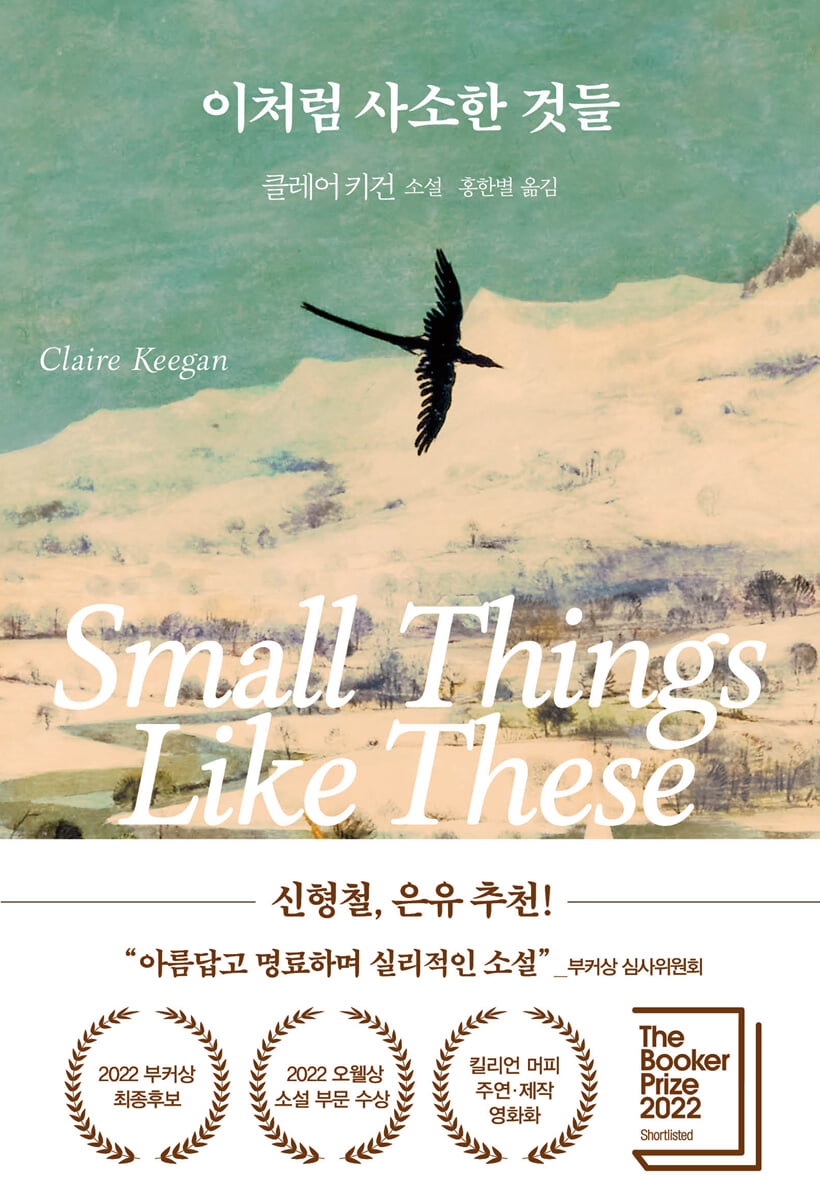
A masterpiece by Claire Keegan, an author whose works only appear once per generation! * Recommended by literary critic Shin Hyeong-cheol and reporter Eun-yu * 2022 Booker Prize finalist * Winner of the 2022 Orwell Prize for Fiction * Film adaptation starring and produced by Cillian Murphy Claire Keegan's masterpiece, "Such Little Things," which was first introduced in Korea in April 2023 and received enthusiastic acclaim from Korean writers and literature readers with "The Girl Entrusted," has been translated and published by Dasan Books. This is the first novel the author has published in 11 years since his previous work, "The Girl Left Behind," and it is a work that has brought international fame to Keegan, who has long been considered a master in his home country. It was shortlisted for the 2022 Booker Prize, and in the same year swept major literary awards such as the Orwell Prize (novel category) and the Kerry Group Prize. In particular, the Booker Prize judging committee praised the novel as “a beautiful, clear, and practical novel,” noting that it was a work that captured the essence of Keegan. This book, which received rave reviews from readers around the world and became a bestseller, depicts the inner workings of a man who discovers a secret conspiracy within his own social community and struggles with a choice that could potentially lose everything. Keegan's characteristically delicate observations and sophisticated writing style meticulously capture a person's moral turmoil, inner conflict, and existential anguish. Irish actor Cillian Murphy, known as a huge fan of the author, is producing and starring in a film based on the novel, which has now completed filming. |
- You can preview some of the book's contents.
Preview
Detailed image
.jpg)
Into the book
It was a tough time, but Furlong was determined to persevere, to stay quiet, not to be a jerk to people, and to see that her daughters grew up well and graduated from St. Margaret's School, the only decent girls' school in the city.
--- p.24
It's always like this, thought Furlong.
It always moved on automatically and without rest to the next step, to the next thing to do.
What would life be like if we had time to stop, think, and reflect, Furlong thought.
Will life change, or will it remain the same? Or will it just become a chaotic mess?
--- p.29
Even though the next day was a school day, I let the kids stay up quite late that night.
Sheila mixed the Ribena concentrate and made a pitcher of juice, while Furlong sat down at the Rayburn stove and toasted slices of soda bread on a long fork.
After baking, the kids spread butter on them and topped them with Marmite or lemon curd.
Furlong burned his bread and ate it, blaming himself for not watching it closely and holding it too close to the fire, when suddenly something rose in his throat.
It felt like a night like this would never come again.
--- p.35
These days, Furlong often wonders what's important to him, what else is there besides Eileen and her daughters?
I was approaching my forties, but I felt like I wasn't going anywhere or making any progress, and sometimes I couldn't help but wonder what the point of these days was.
--- p.44
It felt both plausible and profoundly unfair that so much in life was determined by luck.
--- p.64~65
“If I’m wrong, say so, Bill.
“But I heard there was a conflict with that gentleman at the convent over there?”
Furlong's hand tightened as he took the change, and his gaze fell to the mop holder, following it to the corner of the room.
“I wouldn’t call it a collision, but yes, I was there for a bit this morning.”
"It's none of my business, but you know you better be careful when talking about things there. They say keep your enemies close.
They say that if you keep a vicious dog by your side, a gentle dog won't bite.
“I know, but.”
--- p.105
Suddenly, it occurred to me, what is the meaning of life if we don't help each other?
Can you call yourself a Christian and look at yourself in the mirror without ever having the courage to face the world for days, decades, or even a lifetime?
--- p.24
It's always like this, thought Furlong.
It always moved on automatically and without rest to the next step, to the next thing to do.
What would life be like if we had time to stop, think, and reflect, Furlong thought.
Will life change, or will it remain the same? Or will it just become a chaotic mess?
--- p.29
Even though the next day was a school day, I let the kids stay up quite late that night.
Sheila mixed the Ribena concentrate and made a pitcher of juice, while Furlong sat down at the Rayburn stove and toasted slices of soda bread on a long fork.
After baking, the kids spread butter on them and topped them with Marmite or lemon curd.
Furlong burned his bread and ate it, blaming himself for not watching it closely and holding it too close to the fire, when suddenly something rose in his throat.
It felt like a night like this would never come again.
--- p.35
These days, Furlong often wonders what's important to him, what else is there besides Eileen and her daughters?
I was approaching my forties, but I felt like I wasn't going anywhere or making any progress, and sometimes I couldn't help but wonder what the point of these days was.
--- p.44
It felt both plausible and profoundly unfair that so much in life was determined by luck.
--- p.64~65
“If I’m wrong, say so, Bill.
“But I heard there was a conflict with that gentleman at the convent over there?”
Furlong's hand tightened as he took the change, and his gaze fell to the mop holder, following it to the corner of the room.
“I wouldn’t call it a collision, but yes, I was there for a bit this morning.”
"It's none of my business, but you know you better be careful when talking about things there. They say keep your enemies close.
They say that if you keep a vicious dog by your side, a gentle dog won't bite.
“I know, but.”
--- p.105
Suddenly, it occurred to me, what is the meaning of life if we don't help each other?
Can you call yourself a Christian and look at yourself in the mirror without ever having the courage to face the world for days, decades, or even a lifetime?
--- p.119
Publisher's Review
The shortest novel ever nominated for the Booker Prize
The birth of a new classic to read over and over again every Christmas!
Some may be disappointed that Claire Keegan's new book, finally released after more than a decade, is only about 100 pages long.
But don't worry.
“Keegan is a writer who doesn’t waste a single word.” These are the words of British cultural critic Barry Pearce while introducing 『Such Little Things』, published 11 years after 『The Girl Left Behind』 (p. 104).
Keegan was already a master writer in his native Ireland and Europe, but his fame had not yet spread to other continents.
But the publication of "Such Little Things" in 2021 sparked a frenzied excitement among readers in the United States and around the world, as if trying to make up for lost time.
An event that further fueled this phenomenon was the book's shortlisting for the 2022 Booker Prize.
At just 116 pages in the original, the book earned the nickname of 'the shortest work ever nominated for the Booker Prize.'
If there is a dominant tenet in Keegan's novels, it is a willingness to conceal and an obsession with efficiency.
He calls his work 'the work of subtraction' and confesses that he finds joy in simplicity above all else.
This characteristic, which has continued from the early works, is also revealed in 『Such Small Things』, which is developed from the perspective of the protagonist Bill Furlong. The avoidance of such long dialogues or messy explanations is also the author's consideration for the characters in the novel.
Keegan adds that it feels inappropriate for a writer to expose emotions that characters are reluctant to acknowledge.
“I believe that good writing depends on good manners.”
As translator Hong Han-byeol explains, Claire Keegan is a writer who compresses countless meanings, hiding them within the surface of language, and speaks cautiously, almost as if she were about to say something.
There are things that are not explicitly stated but are subtly implied, so the reader has to read them twice, three times, or even more to notice them.
Shin Hyeong-cheol and Eun-yu, who recommended this book, also shared the anecdote, “As soon as I read it, I read it again right there on the spot.”
Anyone who has passed through the doorway of misfortune knows,
The line between comfort and ruin is a very fragile one.
In 1985, Newros, a small town in Ireland, is going through a harsh winter, with the entire country struggling with unemployment and poverty.
The story unfolds from the perspective of Bill Furlong, a coal merchant who, although not wealthy, has a stable married life with five daughters and is able to make ends meet.
Neuros is slowly declining.
The lines for unemployment benefits are getting longer, and people are unable to pay their electricity bills, leaving their homes cold and some people sleeping in their coats.
Furlong looks at this bleak landscape and thinks.
Maybe the easiest thing in the world is losing everything.
Furlong was born poor and orphaned at an early age, but received financial support from a kind adult, and is keenly aware that he was simply 'lucky'.
I know I have the privilege of having a job that supports my family, of being able to send my daughters to a good school, and of ending my day lying in a warm bed, thinking about what I need to tackle the next day.
And we live without forgetting the fact that we can easily lose this comfortable daily life at any time.
One morning before Christmas, Furlong goes out to deliver coal to a convent and discovers a girl in the warehouse, leading him to suspect something illegal is going on there.
He even asks himself, "What's the point of life if we don't help each other?", but the world around him, including his wife, advises him to ignore what needs to be ignored in order to keep his family peaceful, and silences him.
Furlong, who had been living a comfortable life in a village where the convent wielded absolute power, is deeply troubled by whether to show courage in the face of imminent danger or to remain silent for the sake of her daughters and family.
And at that dangerous crossroads, I feel a sense of anxiety and a thrill at the same time.
Furlong, cowering before a choice that could cost him everything, gazes down at the river flowing through the village for a long time.
I envy the fact that the river knows its own path, that it flows so easily and freely according to its own stubborn will into the vast sea.
“What will survive among us is love.”
Claire Keegan's affirmation of human decency
This book, which won the Orwell Prize for elevating political writing to art, features the Magdalene Laundry incident.
From the moment the word 'convent' appears early in the novel, Irish readers will have sensed a hidden ominous note.
The Magdalene Laundries were a facility operated by Catholic nuns with the cooperation of the Irish government from the 18th century to the late 20th century, established under the pretext of rehabilitating and protecting women who had 'committed acts contrary to sexual morality'.
But in reality, innocent girls and women were imprisoned there, subjected to forced labor, assault, sexual violence, and emotional abuse, and their babies were neglected or killed.
The Irish government did not apologize for the brutal human rights violations that had been committed for over 70 years, and it was not until 2013 that it issued a belated apology.
Against this backdrop, 『Such Trivial Things』 has often been seen as a historical novel, but the author does not completely agree that the novel is based on the Magdalene Laundry incident.
“The book begins with the story of a boy who goes out with his father to deliver coal and discovers another boy his age locked in the coal shed of a boarding school.
The boy's father simply locked the door and continued on with his next delivery without saying a word.
At some point, I became obsessed with the coalman's perspective and focused on him.
I felt the need to explore how he, as a father, could complete his deliveries, get through his days, and live his life with this knowledge, and still consider himself a good father.
I'm not sure if Furlong will still consider himself a good father after this novel ends.
Because I might not be able to provide my daughters with a proper education, or I might lose my business and not be able to support my family.
I'm interested in how we cope and live with what's trapped in our hearts.
I wasn't intentionally trying to write about misogyny, Catholic Ireland, economic hardship, fatherhood, or anything universal.
But I wanted to answer the question: why did so many people, girls and women, know that they were being imprisoned and forced to work, yet did little or nothing?”
_Claire Keegan, from an interview for the 2022 Booker Prize
In this way, the novel is not simply an accusation of an event itself.
Instead of focusing on religion or the convent, the story unfolds by focusing on the misery or moments of emotion felt by the protagonist in his life.
The incident merely serves as a device to capture how the culture and environment of society influence the morality of a common citizen, and by following the inner self of an individual, it speaks to the existential concerns of human beings and the essence of life.
But there are also things that are revealed that were not intended to be revealed, but are not without meaning.
The tragedy of the story is enhanced by the fact that it is set in Ireland, considered the most staunchly Catholic country in Europe, and during Christmas, the time of year when the birth of baby Jesus is celebrated.
But in the midst of that tragedy, we find a glimmer of hope for human possibility in one person who, instead of giving in to despair, pays attention to what's happening outside while everyone else is having a merry Christmas.
Critic Shin Hyeong-cheol said at the end of the novel, “We gain one reason why we cannot give up this world,” and Keegan also expressed his hope that this work would become a book that responds to the words of British poet Philip Larkin, “What will survive among us is love.”
When you consider where Furlong's love flows from and where it flows to, you will realize that the statement that "this small book condenses a great deal of humanism" (Financial Times) is no exaggeration.
This novel, which begins with the story of one individual, ultimately becomes an affirmation of human dignity.
Translator's Note
(...) I received a long email from the author containing several requests and explanations through the publisher when I started translating this book.
I was very grateful that the author took the time to translate and provided detailed assistance.
Meanwhile, I realized how much the author wanted to say but didn't say in this short story, how much he wanted to imply rather than reveal, and I was at a loss as to how to translate this piece, which was like the tip of an iceberg.
This short story was more like poetry, the structure of its language as delicate as snowflakes.
It felt like it would collapse and melt if I touched it wrong.
Claire Keegan compresses countless meanings into the surface of language, speaking cautiously, almost as if she were saying nothing.
Subtly hinting without explicitly saying it.
There were things that I had to read twice to understand, or even three or four times to notice.
However, while reading this book countless times in preparation for the translation, I tried not to include in the translation what I learned as an explanation.
If that were the case, it would not have been a piece of writing that left a deep vibration and a subtle aftertaste, as Claire Keegan intended, through restraint and suppression.
So, I hope readers will read this book slowly, twice if possible.
Then you will be able to see things that are not visible at first glance.
I wish that were the case.
_Translator Hong Han-byeol (from the Translator's Note)
The birth of a new classic to read over and over again every Christmas!
Some may be disappointed that Claire Keegan's new book, finally released after more than a decade, is only about 100 pages long.
But don't worry.
“Keegan is a writer who doesn’t waste a single word.” These are the words of British cultural critic Barry Pearce while introducing 『Such Little Things』, published 11 years after 『The Girl Left Behind』 (p. 104).
Keegan was already a master writer in his native Ireland and Europe, but his fame had not yet spread to other continents.
But the publication of "Such Little Things" in 2021 sparked a frenzied excitement among readers in the United States and around the world, as if trying to make up for lost time.
An event that further fueled this phenomenon was the book's shortlisting for the 2022 Booker Prize.
At just 116 pages in the original, the book earned the nickname of 'the shortest work ever nominated for the Booker Prize.'
If there is a dominant tenet in Keegan's novels, it is a willingness to conceal and an obsession with efficiency.
He calls his work 'the work of subtraction' and confesses that he finds joy in simplicity above all else.
This characteristic, which has continued from the early works, is also revealed in 『Such Small Things』, which is developed from the perspective of the protagonist Bill Furlong. The avoidance of such long dialogues or messy explanations is also the author's consideration for the characters in the novel.
Keegan adds that it feels inappropriate for a writer to expose emotions that characters are reluctant to acknowledge.
“I believe that good writing depends on good manners.”
As translator Hong Han-byeol explains, Claire Keegan is a writer who compresses countless meanings, hiding them within the surface of language, and speaks cautiously, almost as if she were about to say something.
There are things that are not explicitly stated but are subtly implied, so the reader has to read them twice, three times, or even more to notice them.
Shin Hyeong-cheol and Eun-yu, who recommended this book, also shared the anecdote, “As soon as I read it, I read it again right there on the spot.”
Anyone who has passed through the doorway of misfortune knows,
The line between comfort and ruin is a very fragile one.
In 1985, Newros, a small town in Ireland, is going through a harsh winter, with the entire country struggling with unemployment and poverty.
The story unfolds from the perspective of Bill Furlong, a coal merchant who, although not wealthy, has a stable married life with five daughters and is able to make ends meet.
Neuros is slowly declining.
The lines for unemployment benefits are getting longer, and people are unable to pay their electricity bills, leaving their homes cold and some people sleeping in their coats.
Furlong looks at this bleak landscape and thinks.
Maybe the easiest thing in the world is losing everything.
Furlong was born poor and orphaned at an early age, but received financial support from a kind adult, and is keenly aware that he was simply 'lucky'.
I know I have the privilege of having a job that supports my family, of being able to send my daughters to a good school, and of ending my day lying in a warm bed, thinking about what I need to tackle the next day.
And we live without forgetting the fact that we can easily lose this comfortable daily life at any time.
One morning before Christmas, Furlong goes out to deliver coal to a convent and discovers a girl in the warehouse, leading him to suspect something illegal is going on there.
He even asks himself, "What's the point of life if we don't help each other?", but the world around him, including his wife, advises him to ignore what needs to be ignored in order to keep his family peaceful, and silences him.
Furlong, who had been living a comfortable life in a village where the convent wielded absolute power, is deeply troubled by whether to show courage in the face of imminent danger or to remain silent for the sake of her daughters and family.
And at that dangerous crossroads, I feel a sense of anxiety and a thrill at the same time.
Furlong, cowering before a choice that could cost him everything, gazes down at the river flowing through the village for a long time.
I envy the fact that the river knows its own path, that it flows so easily and freely according to its own stubborn will into the vast sea.
“What will survive among us is love.”
Claire Keegan's affirmation of human decency
This book, which won the Orwell Prize for elevating political writing to art, features the Magdalene Laundry incident.
From the moment the word 'convent' appears early in the novel, Irish readers will have sensed a hidden ominous note.
The Magdalene Laundries were a facility operated by Catholic nuns with the cooperation of the Irish government from the 18th century to the late 20th century, established under the pretext of rehabilitating and protecting women who had 'committed acts contrary to sexual morality'.
But in reality, innocent girls and women were imprisoned there, subjected to forced labor, assault, sexual violence, and emotional abuse, and their babies were neglected or killed.
The Irish government did not apologize for the brutal human rights violations that had been committed for over 70 years, and it was not until 2013 that it issued a belated apology.
Against this backdrop, 『Such Trivial Things』 has often been seen as a historical novel, but the author does not completely agree that the novel is based on the Magdalene Laundry incident.
“The book begins with the story of a boy who goes out with his father to deliver coal and discovers another boy his age locked in the coal shed of a boarding school.
The boy's father simply locked the door and continued on with his next delivery without saying a word.
At some point, I became obsessed with the coalman's perspective and focused on him.
I felt the need to explore how he, as a father, could complete his deliveries, get through his days, and live his life with this knowledge, and still consider himself a good father.
I'm not sure if Furlong will still consider himself a good father after this novel ends.
Because I might not be able to provide my daughters with a proper education, or I might lose my business and not be able to support my family.
I'm interested in how we cope and live with what's trapped in our hearts.
I wasn't intentionally trying to write about misogyny, Catholic Ireland, economic hardship, fatherhood, or anything universal.
But I wanted to answer the question: why did so many people, girls and women, know that they were being imprisoned and forced to work, yet did little or nothing?”
_Claire Keegan, from an interview for the 2022 Booker Prize
In this way, the novel is not simply an accusation of an event itself.
Instead of focusing on religion or the convent, the story unfolds by focusing on the misery or moments of emotion felt by the protagonist in his life.
The incident merely serves as a device to capture how the culture and environment of society influence the morality of a common citizen, and by following the inner self of an individual, it speaks to the existential concerns of human beings and the essence of life.
But there are also things that are revealed that were not intended to be revealed, but are not without meaning.
The tragedy of the story is enhanced by the fact that it is set in Ireland, considered the most staunchly Catholic country in Europe, and during Christmas, the time of year when the birth of baby Jesus is celebrated.
But in the midst of that tragedy, we find a glimmer of hope for human possibility in one person who, instead of giving in to despair, pays attention to what's happening outside while everyone else is having a merry Christmas.
Critic Shin Hyeong-cheol said at the end of the novel, “We gain one reason why we cannot give up this world,” and Keegan also expressed his hope that this work would become a book that responds to the words of British poet Philip Larkin, “What will survive among us is love.”
When you consider where Furlong's love flows from and where it flows to, you will realize that the statement that "this small book condenses a great deal of humanism" (Financial Times) is no exaggeration.
This novel, which begins with the story of one individual, ultimately becomes an affirmation of human dignity.
Translator's Note
(...) I received a long email from the author containing several requests and explanations through the publisher when I started translating this book.
I was very grateful that the author took the time to translate and provided detailed assistance.
Meanwhile, I realized how much the author wanted to say but didn't say in this short story, how much he wanted to imply rather than reveal, and I was at a loss as to how to translate this piece, which was like the tip of an iceberg.
This short story was more like poetry, the structure of its language as delicate as snowflakes.
It felt like it would collapse and melt if I touched it wrong.
Claire Keegan compresses countless meanings into the surface of language, speaking cautiously, almost as if she were saying nothing.
Subtly hinting without explicitly saying it.
There were things that I had to read twice to understand, or even three or four times to notice.
However, while reading this book countless times in preparation for the translation, I tried not to include in the translation what I learned as an explanation.
If that were the case, it would not have been a piece of writing that left a deep vibration and a subtle aftertaste, as Claire Keegan intended, through restraint and suppression.
So, I hope readers will read this book slowly, twice if possible.
Then you will be able to see things that are not visible at first glance.
I wish that were the case.
_Translator Hong Han-byeol (from the Translator's Note)
GOODS SPECIFICS
- Publication date: November 27, 2023
- Page count, weight, size: 132 pages | 172g | 132*192*20mm
- ISBN13: 9791130646381
- ISBN10: 1130646386
You may also like
카테고리
korean


korean

![GQ KOREA Mark (Monthly): December [2025]](http://librairie.coreenne.fr/cdn/shop/files/8ef265dbbfbf186523ed75ba7319009d.jpg?v=1765340328&width=3840)


