

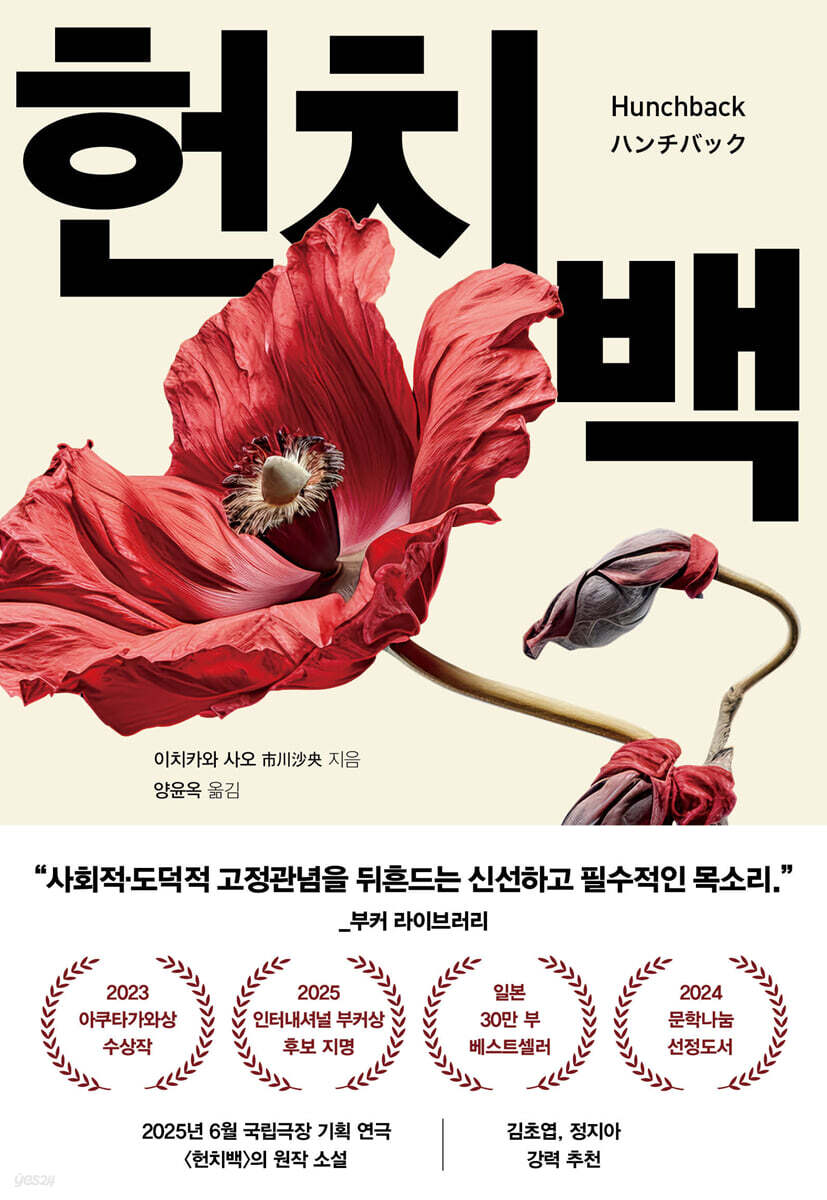
Hunchback
 |
Description
Book Introduction
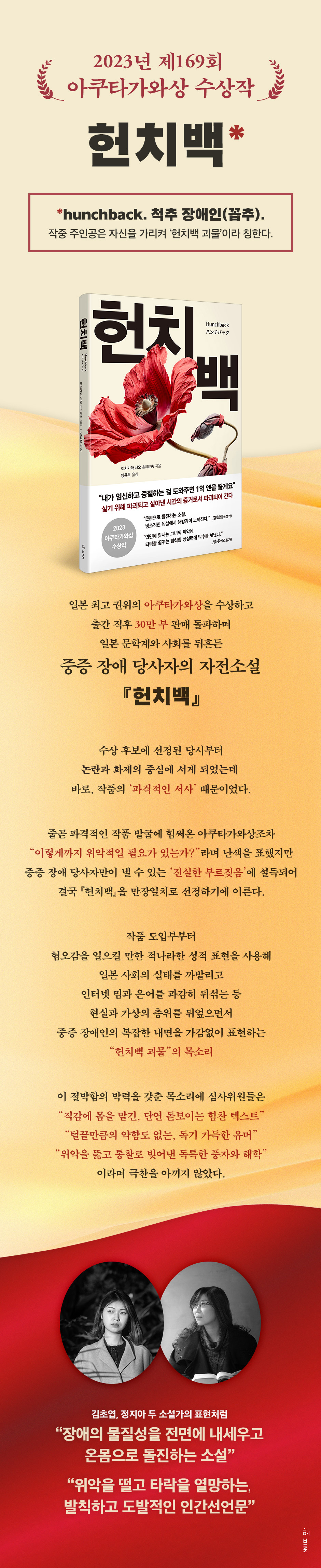
The first recipient of the Akutakawa Prize, a severely disabled person, was unanimously selected. A hit that shook Japan, selling over 300,000 copies upon its publication. The 169th Akutagawa Prize Awards Ceremony held on July 19th. As befitting Japan's most prestigious literary award, local media outlets flocked to the awards ceremony hall, and when the winners took the stage, reporters were entranced by the unusual scene and flashed their cameras. The winner appeared before reporters in an electric wheelchair. That was the moment when Ichikawa Sao appeared. He humorously answered reporters' questions while pressing the tracheostomy tube in his neck, and when it was his turn to give his acceptance speech, he said: “I hope everyone will consider why it took until 2023 for the first person with a severe disability to receive the award.” His criticism of the Japanese publishing industry, which focuses on paper books that exclude people with disabilities, and his appeal for "barrier-free reading," including the additional distribution of e-books and audiobooks, were reported in real time and became a hot topic not only in Japan but also in domestic media and social media communities. This buzz did not stop online, but continued into sales, and 『Hunchback』, which was a hot topic from the time of its publication, became a mega bestseller, selling 200,000 copies in just one month. As Ichikawa Sao revealed in her acceptance speech, this is the first time a writer with a severe disability has won the Akutagawa Prize, and it is clear that this historic event has made "Hunchback" a hot potato. However, there was another factor that really increased the scope of the topic: the award-winning work's groundbreaking plot and artistic quality. "Hunchback" is a story about Shaka, a woman with a severe spinal disability, who proposes to her male caregiver, "I'll give you 100 million yen if you help me get pregnant and have an abortion." It is a work that so openly displays a hypocritical imagination that some of the judges expressed their disapproval. Although it is a work that clearly has divided opinions, all nine judges did not spare their praise and unanimously selected 『Hunchi Baek』 as the winner. “Even though the author, a weak person, wrote a story about the weak, there is not even the slightest hint of weakness here.” _ Shuichi Yoshida (novelist) “The development of language that challenges common sense thinking is not a product of the protagonist’s circumstances, but rather a product of the novel itself.” _ Horie Toshiyuki (novelist) Looking at the judging process, including the two reviews above, we can see that the reason the Japanese literary world is paying attention to "Hunchiback" is not because of the author's disability, but because of the work's unconventionality and literary quality. A similar case can be seen in the live broadcast of the book review panel held when the Akutagawa Prize was announced. While the book reviewers emphasized the importance of Ichikawa Sao's disability, they also unanimously agreed that the literary value of "Hunchiback" was overwhelming, regardless of that. The fact that a severely disabled person has portrayed a severely disabled protagonist so truthfully and vividly makes "Hunchibaek" a valuable work of literature written by people with disabilities, but the literary experimentation it presents further enhances its literary value. As befitting a winner of the Akutagawa Prize, which is renowned for bringing a breath of fresh air to the literary world by discovering writers who boldly challenge the unconventional, "Hunchiback" displays outstanding literary experimentation by boldly borrowing internet memes and slang while putting satirical expressions brimming with topical themes at the forefront. The main character Shaka's frame novel that appears in the first half develops into an experiment in metafiction by overturning the layers of reality in the second half. Regarding this, translator Yang Yun-ok, who translated "Hunchback" into Korean, said, "It is especially amazing that a short passage in the last part can transform the entire novel into a three-dimensional world that overturns it and unfolds a completely different hypothesis. (…) I think it is a miraculous masterpiece.” |
- You can preview some of the book's contents.
Preview
index
5 for the Korean version
Hunchback 11
Interview with the 169th Akutagawa Prize Winner 108
Translator's Note 132
Hunchback 11
Interview with the 169th Akutagawa Prize Winner 108
Translator's Note 132
Detailed image
Into the book
I want to try pregnancy and abortion.
The fetus won't be able to grow properly inside my curved body.
I won't even be able to endure childbirth.
Of course, raising children is also difficult.
But perhaps, as far as pregnancy and abortion are concerned, it would be possible for them to do so like any other person.
Because there is no problem with reproductive function.
So I want to try pregnancy and abortion.
My dream is to get pregnant and have an abortion like any normal woman.
--- p.27~28
I hate paper books.
I hate the machismo of a reading culture that demands five healthful qualities: "You must be able to see, hold a book, turn the pages, maintain a reading posture, and freely go to a bookstore to buy things."
I hate the ignorant arrogance of so-called 'book lovers' who do not realize their privilege.
--- p.37~38
In 1996, a law was finally passed officially recognizing that disabled people can give birth, but with the advancement of reproductive technology and its necessities, the killing of disabled people has become a casual affair for many couples.
The cost will soon become cheaper.
So, isn't it okay for a disabled person to conceive with the intention of killing someone? That's barely enough to balance things out.
--- p.60
Every time I read a book, my spine would bend and crush my lungs, a hole would form in my neck, and when I walked, I would bang my head here and there, my body was being destroyed just to survive.
What difference is there between killing a life that is sprouting and killing a life that is trying to survive?
--- p.61
My brain is always like this, whether I'm hypoxic or not, but in real life, I'm a young, honest, and taciturn disabled woman named Izawa Shaka, and that's why "Buddha" and "Shaka Shaka" have been able to reveal their crude and childish nonsense without hesitation up until now.
Words born in the swamp, drawing muddy threads like the mud around a lotus flower.
But without mud, the lotus cannot survive.
--- p.67
To those who see me only through money, I also see myself only through money.
That's just how society is.
So after waiting politely for six days, I said to Mr. Tanaka.
“How much do you want?” Communication was established precisely without an introduction.
Because we were both weak.
--- p.74
“How about 155 million yen?” I said, pressing against his neck.
“It’s as tall as Mr. Tanaka.
1 million yen per centimeter.
“You’re putting a price on your able-bodied body.”
--- p.75
I wish you hadn't just pretended that nothing had happened in the first place.
I wish Tanaka had been a little more evil.
It's okay if you hate me. It's more like BL than TL.
I didn't think I could convince a real, living man with such novel-like words.
--- p.90
Yes, that's right.
That compassion is the right distance.
I can't be the Mona Lisa.
Because I'm a hunchback monster.
The fetus won't be able to grow properly inside my curved body.
I won't even be able to endure childbirth.
Of course, raising children is also difficult.
But perhaps, as far as pregnancy and abortion are concerned, it would be possible for them to do so like any other person.
Because there is no problem with reproductive function.
So I want to try pregnancy and abortion.
My dream is to get pregnant and have an abortion like any normal woman.
--- p.27~28
I hate paper books.
I hate the machismo of a reading culture that demands five healthful qualities: "You must be able to see, hold a book, turn the pages, maintain a reading posture, and freely go to a bookstore to buy things."
I hate the ignorant arrogance of so-called 'book lovers' who do not realize their privilege.
--- p.37~38
In 1996, a law was finally passed officially recognizing that disabled people can give birth, but with the advancement of reproductive technology and its necessities, the killing of disabled people has become a casual affair for many couples.
The cost will soon become cheaper.
So, isn't it okay for a disabled person to conceive with the intention of killing someone? That's barely enough to balance things out.
--- p.60
Every time I read a book, my spine would bend and crush my lungs, a hole would form in my neck, and when I walked, I would bang my head here and there, my body was being destroyed just to survive.
What difference is there between killing a life that is sprouting and killing a life that is trying to survive?
--- p.61
My brain is always like this, whether I'm hypoxic or not, but in real life, I'm a young, honest, and taciturn disabled woman named Izawa Shaka, and that's why "Buddha" and "Shaka Shaka" have been able to reveal their crude and childish nonsense without hesitation up until now.
Words born in the swamp, drawing muddy threads like the mud around a lotus flower.
But without mud, the lotus cannot survive.
--- p.67
To those who see me only through money, I also see myself only through money.
That's just how society is.
So after waiting politely for six days, I said to Mr. Tanaka.
“How much do you want?” Communication was established precisely without an introduction.
Because we were both weak.
--- p.74
“How about 155 million yen?” I said, pressing against his neck.
“It’s as tall as Mr. Tanaka.
1 million yen per centimeter.
“You’re putting a price on your able-bodied body.”
--- p.75
I wish you hadn't just pretended that nothing had happened in the first place.
I wish Tanaka had been a little more evil.
It's okay if you hate me. It's more like BL than TL.
I didn't think I could convince a real, living man with such novel-like words.
--- p.90
Yes, that's right.
That compassion is the right distance.
I can't be the Mona Lisa.
Because I'm a hunchback monster.
--- p.95
Publisher's Review
* 2023 Akutagawa Prize Winner
* Bestseller in Japan with 300,000 copies sold
* Strongly recommended by novelists Kim Cho-yeop and Jeong Ji-ah
"I'll give you 100 million yen if you help me get pregnant and have an abortion."
A groundbreaking autobiographical novel by a person with a severe disability that took Japan by storm in 2023.
A voice of flesh and desire, bent and twisted like the spine of a person with a spinal disorder.
The Monster's Declaration of Humanity, a highly recommended book by novelists Kim Cho-yeop and Jeong Ji-ah.
*Hunchback.
Spinal disability (hunchback).
In the novel, the protagonist, Shaka Izawa, refers to himself as a 'hunchback monster'.
“A novel that rushes in with your whole body.
“I am here, a body that is being destroyed to survive, a desirer.” I could hear the protagonist Shaka’s voice saying this throughout the reading.”
_ Kim Cho-yeop (novelist)
“I couldn’t bring myself to cry in front of the confession of the main character, Shaka, who resembles Ichikawa Sao, that she really wants to get pregnant and have an abortion like non-disabled women.
(…) I applaud her hypocrisy in the face of compassion and her impudent imagination in dreaming of corruption.”
_Jung Ji-ah (novelist)
As previously explained, 『Hunchibaek』 is a work of countless charms, a “treasure trove of literature,” to borrow the expression of translator Yang Yun-ok.
Among those countless jewels, the jewel of greatest value is undoubtedly the literature of the parties.
Therefore, the most complete way to read this work would be to project 'Ichikawa Sao' onto the novel's main character, 'Izawa Shaka'.
The main character, Shaka Izawa, is a character who inherited almost everything from the author, Sao Ichikawa.
The basis for this is in the author's "Award-winning Interview," where the author explained that about 30 percent of his personal experiences went into "Hunchback," and revealed how closely connected he and his work are, saying, ""Hunchback" is a work that was written almost in one sitting, so it feels like it was just a direct output of my senses and the images in my head without any noticeable trial and error."
The author, a person with a severe disability, began writing novels at the age of 20, and has been submitting his works to various literary awards, including light novels, every year for the past 20 years.
In other words, to borrow the expression of translator Yang Yun-ok, “Hunchibaek” is a work that “comes out in one breath, like a bursting dam, when the writer’s innate talent, combined with the painful language of the body through many years of training in reading and writing.”
The author and the protagonist, who is the author's projection, have in common a severe spinal disorder and an incurable disease called myotubular myopathy, which is the cause of the disorder. As a result, they spend all day lying on a bed in a small room of about 5 pyeong.
All I can do with my body not even being able to hold a pen properly is write by pressing the tablet with my thumb.
So the author began writing a novel, and the protagonist in the novel also began writing, and the nature of the writing of the two people was very similar yet different.
This is because the writings of the protagonist Shaka are full of immoral nonsense that cannot be revealed to anyone else, such as “If I were to be reborn, I would like to become a high-class prostitute” and “I would like to get pregnant and have an abortion like non-disabled women.”
(It is extremely ironic that the author, Sao Ichikawa, used that unfilial remark as a sentence in a novel and presented it to over 300,000 readers.) The reason Shaka wants to become a prostitute and get pregnant and have an abortion is not because she is senseless or antisocial.
She, like the author Ichikawa Sao, not only attends Waseda University, a prestigious private university, but unlike the author, she inherited a huge fortune and belongs to the upper class.
Moreover, she is a woman who lives a decent life, earning money by writing adult novels and mass-produced articles even though she doesn't need to work, and donating all of the money to the underprivileged.
Why does this woman, with such integrity, secretly make outrageous remarks, and ultimately use her vast wealth to purchase the body of a male caregiver, attempting to "pregnant and abort" her? She replies that it's to remain "a solid woman, Izawa Shaka," to become "human," not a "hunchbag monster."
A body that cannot survive without a respirator and a suction machine to remove phlegm due to its twisted and distorted spine.
A life where not only is it impossible to eat or bathe without the help of others, but even normal love and sex are impossible.
A previous history of forced abortions of children with disabilities or of not giving disabled people the right to become pregnant.
And the current reality is that even up until now, we are not given the right to read books.
In the face of all this, she monologues as follows:
“(…) In real life, I lived as a young, honest, and taciturn disabled woman named Izawa Shaka, and that is why I was able to reveal my crude and childish remarks in “Buddha” and “Shaka” without hesitation.
Words born in the swamp, drawing muddy threads like the mud around a lotus flower.
But without mud, the lotus cannot survive.”
- Main text p.
67
Of course, the fact that the character Izawa Shaka in the novel purchases the body of a male caregiver and attempts to "pregnant and have an abortion" is fictional, but the twisted and distorted body that is the basis for the desire and eventual act is actually the body of Ichikawa Sao, so this true and vivid story of "Hunchback" never reads like fiction.
To borrow Shaka's expression, the life of a severely disabled person, "whose body and mind are destroyed in order to survive each day."
As novelist Jeong Ji-ah said in her recommendation, Ichikawa Sao “endures fiercely, while trembling with hypocrisy and yearning for corruption,” “a life that is being destroyed in order to live and is being destroyed as evidence of the time lived,” and therefore, his “Hunchback” cannot be read as anything other than “a fierce survival story of a severely disabled person who cannot even move his body as he wishes, but rather a bold and provocative declaration of humanity.”
This human declaration of the Hunchback Monster, as author Kim Cho-yeop wrote in the recommendation, makes the reader “feel a sense of liberation,” but at the same time, “I don’t know if I can say it’s fun, and I imagine that even such confusion will be laughed at by Shaka as ‘their arrogance,’” making it difficult to read with peace of mind until the end.
"Hunchback" criticizes, dismantles, and reconstructs the deceptions of our society from the perspective of people with disabilities.
And we can never be comfortable with these calls and questions for social change.
The reason is, to borrow the words of judge Keichiro Hirano, “because the spirit of the questions this book poses to us does not allow readers to give easy answers.”
A confession of hypocrisy and corruption to break down social barriers and protect human dignity.
Writing by a Severely Disabled Person Following the History of the Human Rights Movement for Disability and Women
“Until ‘Hunchiback’ won a literary award, the Japanese people didn’t realize the barrier.
“Hunchback is a small voice of someone whose existence is not properly visible in our society.”
_ From 〈Dedicated to the Korean Edition〉
"I would like to commemorate Tomoko Yonezu, a first-generation activist who dedicated her life to protecting the rights of people with disabilities and the women's movement, and Yuho Asaka and her daughter Umi, who championed reproductive rights (the right of individuals, especially women, to make their own decisions about pregnancy, childbirth, and contraception). Their names are included here."
_ From the Translator's Note
In her “Award-winning Interview,” Ichikawa Sao said, “While writing my graduation thesis (which included a formal analysis of the past and present history of representations of people with disabilities and a discussion of the possibilities of representations of people with disabilities), I realized that I could hardly find any pure literature with writers with disabilities or severely disabled people as main characters, which led me to write ‘Hunchback,’” revealing that her creative motivation lay in the discrimination against the socially disadvantaged that remains in the literary and publishing world.
Existing literature rarely depicts people with disabilities and therefore always relegates them to the role of stereotypes; the literary world, which calls itself intellectual but shows less consideration for people with disabilities than the sports world; and the publishing world, which insists on only producing paper books that are difficult for people with severe disabilities to read.
Criticism and satire of the above three aspects are revealed throughout the work, and this soon becomes the foundation for the confession of hypocrisy and corruption of the main characters, Izawa and Shaka.
However, this does not mean that Ichikawa Sao's efforts to break down social barriers and protect human dignity consist solely of confessions of hypocrisy and corruption.
He also puts in a tremendous effort to revive the voices of female disabled activists who had been dormant in the history of the disability and women's rights movements, such as Tomoko Yonezu, Goro Iwama, and Yuho Asaka, and to give strength to the voice of Shaka Izawa, a person whose existence has been largely invisible in our society.
Another point to note here is that, as he stated in his “Dedication to the Korean Edition” that “I was able to write ‘Hunchibaek’ thanks to the empowering power of Korean literature in speaking about the real world,” the voice of Izawa Shaka also includes the voice of Korean literature that fought for the human rights of women with disabilities.
And thanks to the voices of many different countries sharing their strength, 『Hunchi Baek』 has now been delivered to Korean readers and has become a source of creative work for them.
This virtuous cycle of progress created by the writing of women with severe disabilities offers a wonder far surpassing the emotion a single book can convey.
* Bestseller in Japan with 300,000 copies sold
* Strongly recommended by novelists Kim Cho-yeop and Jeong Ji-ah
"I'll give you 100 million yen if you help me get pregnant and have an abortion."
A groundbreaking autobiographical novel by a person with a severe disability that took Japan by storm in 2023.
A voice of flesh and desire, bent and twisted like the spine of a person with a spinal disorder.
The Monster's Declaration of Humanity, a highly recommended book by novelists Kim Cho-yeop and Jeong Ji-ah.
*Hunchback.
Spinal disability (hunchback).
In the novel, the protagonist, Shaka Izawa, refers to himself as a 'hunchback monster'.
“A novel that rushes in with your whole body.
“I am here, a body that is being destroyed to survive, a desirer.” I could hear the protagonist Shaka’s voice saying this throughout the reading.”
_ Kim Cho-yeop (novelist)
“I couldn’t bring myself to cry in front of the confession of the main character, Shaka, who resembles Ichikawa Sao, that she really wants to get pregnant and have an abortion like non-disabled women.
(…) I applaud her hypocrisy in the face of compassion and her impudent imagination in dreaming of corruption.”
_Jung Ji-ah (novelist)
As previously explained, 『Hunchibaek』 is a work of countless charms, a “treasure trove of literature,” to borrow the expression of translator Yang Yun-ok.
Among those countless jewels, the jewel of greatest value is undoubtedly the literature of the parties.
Therefore, the most complete way to read this work would be to project 'Ichikawa Sao' onto the novel's main character, 'Izawa Shaka'.
The main character, Shaka Izawa, is a character who inherited almost everything from the author, Sao Ichikawa.
The basis for this is in the author's "Award-winning Interview," where the author explained that about 30 percent of his personal experiences went into "Hunchback," and revealed how closely connected he and his work are, saying, ""Hunchback" is a work that was written almost in one sitting, so it feels like it was just a direct output of my senses and the images in my head without any noticeable trial and error."
The author, a person with a severe disability, began writing novels at the age of 20, and has been submitting his works to various literary awards, including light novels, every year for the past 20 years.
In other words, to borrow the expression of translator Yang Yun-ok, “Hunchibaek” is a work that “comes out in one breath, like a bursting dam, when the writer’s innate talent, combined with the painful language of the body through many years of training in reading and writing.”
The author and the protagonist, who is the author's projection, have in common a severe spinal disorder and an incurable disease called myotubular myopathy, which is the cause of the disorder. As a result, they spend all day lying on a bed in a small room of about 5 pyeong.
All I can do with my body not even being able to hold a pen properly is write by pressing the tablet with my thumb.
So the author began writing a novel, and the protagonist in the novel also began writing, and the nature of the writing of the two people was very similar yet different.
This is because the writings of the protagonist Shaka are full of immoral nonsense that cannot be revealed to anyone else, such as “If I were to be reborn, I would like to become a high-class prostitute” and “I would like to get pregnant and have an abortion like non-disabled women.”
(It is extremely ironic that the author, Sao Ichikawa, used that unfilial remark as a sentence in a novel and presented it to over 300,000 readers.) The reason Shaka wants to become a prostitute and get pregnant and have an abortion is not because she is senseless or antisocial.
She, like the author Ichikawa Sao, not only attends Waseda University, a prestigious private university, but unlike the author, she inherited a huge fortune and belongs to the upper class.
Moreover, she is a woman who lives a decent life, earning money by writing adult novels and mass-produced articles even though she doesn't need to work, and donating all of the money to the underprivileged.
Why does this woman, with such integrity, secretly make outrageous remarks, and ultimately use her vast wealth to purchase the body of a male caregiver, attempting to "pregnant and abort" her? She replies that it's to remain "a solid woman, Izawa Shaka," to become "human," not a "hunchbag monster."
A body that cannot survive without a respirator and a suction machine to remove phlegm due to its twisted and distorted spine.
A life where not only is it impossible to eat or bathe without the help of others, but even normal love and sex are impossible.
A previous history of forced abortions of children with disabilities or of not giving disabled people the right to become pregnant.
And the current reality is that even up until now, we are not given the right to read books.
In the face of all this, she monologues as follows:
“(…) In real life, I lived as a young, honest, and taciturn disabled woman named Izawa Shaka, and that is why I was able to reveal my crude and childish remarks in “Buddha” and “Shaka” without hesitation.
Words born in the swamp, drawing muddy threads like the mud around a lotus flower.
But without mud, the lotus cannot survive.”
- Main text p.
67
Of course, the fact that the character Izawa Shaka in the novel purchases the body of a male caregiver and attempts to "pregnant and have an abortion" is fictional, but the twisted and distorted body that is the basis for the desire and eventual act is actually the body of Ichikawa Sao, so this true and vivid story of "Hunchback" never reads like fiction.
To borrow Shaka's expression, the life of a severely disabled person, "whose body and mind are destroyed in order to survive each day."
As novelist Jeong Ji-ah said in her recommendation, Ichikawa Sao “endures fiercely, while trembling with hypocrisy and yearning for corruption,” “a life that is being destroyed in order to live and is being destroyed as evidence of the time lived,” and therefore, his “Hunchback” cannot be read as anything other than “a fierce survival story of a severely disabled person who cannot even move his body as he wishes, but rather a bold and provocative declaration of humanity.”
This human declaration of the Hunchback Monster, as author Kim Cho-yeop wrote in the recommendation, makes the reader “feel a sense of liberation,” but at the same time, “I don’t know if I can say it’s fun, and I imagine that even such confusion will be laughed at by Shaka as ‘their arrogance,’” making it difficult to read with peace of mind until the end.
"Hunchback" criticizes, dismantles, and reconstructs the deceptions of our society from the perspective of people with disabilities.
And we can never be comfortable with these calls and questions for social change.
The reason is, to borrow the words of judge Keichiro Hirano, “because the spirit of the questions this book poses to us does not allow readers to give easy answers.”
A confession of hypocrisy and corruption to break down social barriers and protect human dignity.
Writing by a Severely Disabled Person Following the History of the Human Rights Movement for Disability and Women
“Until ‘Hunchiback’ won a literary award, the Japanese people didn’t realize the barrier.
“Hunchback is a small voice of someone whose existence is not properly visible in our society.”
_ From 〈Dedicated to the Korean Edition〉
"I would like to commemorate Tomoko Yonezu, a first-generation activist who dedicated her life to protecting the rights of people with disabilities and the women's movement, and Yuho Asaka and her daughter Umi, who championed reproductive rights (the right of individuals, especially women, to make their own decisions about pregnancy, childbirth, and contraception). Their names are included here."
_ From the Translator's Note
In her “Award-winning Interview,” Ichikawa Sao said, “While writing my graduation thesis (which included a formal analysis of the past and present history of representations of people with disabilities and a discussion of the possibilities of representations of people with disabilities), I realized that I could hardly find any pure literature with writers with disabilities or severely disabled people as main characters, which led me to write ‘Hunchback,’” revealing that her creative motivation lay in the discrimination against the socially disadvantaged that remains in the literary and publishing world.
Existing literature rarely depicts people with disabilities and therefore always relegates them to the role of stereotypes; the literary world, which calls itself intellectual but shows less consideration for people with disabilities than the sports world; and the publishing world, which insists on only producing paper books that are difficult for people with severe disabilities to read.
Criticism and satire of the above three aspects are revealed throughout the work, and this soon becomes the foundation for the confession of hypocrisy and corruption of the main characters, Izawa and Shaka.
However, this does not mean that Ichikawa Sao's efforts to break down social barriers and protect human dignity consist solely of confessions of hypocrisy and corruption.
He also puts in a tremendous effort to revive the voices of female disabled activists who had been dormant in the history of the disability and women's rights movements, such as Tomoko Yonezu, Goro Iwama, and Yuho Asaka, and to give strength to the voice of Shaka Izawa, a person whose existence has been largely invisible in our society.
Another point to note here is that, as he stated in his “Dedication to the Korean Edition” that “I was able to write ‘Hunchibaek’ thanks to the empowering power of Korean literature in speaking about the real world,” the voice of Izawa Shaka also includes the voice of Korean literature that fought for the human rights of women with disabilities.
And thanks to the voices of many different countries sharing their strength, 『Hunchi Baek』 has now been delivered to Korean readers and has become a source of creative work for them.
This virtuous cycle of progress created by the writing of women with severe disabilities offers a wonder far surpassing the emotion a single book can convey.
GOODS SPECIFICS
- Date of issue: October 31, 2023
- Format: Hardcover book binding method guide
- Page count, weight, size: 140 pages | 268g | 127*188*15mm
- ISBN13: 9791193078174
- ISBN10: 1193078172
You may also like
카테고리
korean


korean

![GQ KOREA Mark (Monthly): December [2025]](http://librairie.coreenne.fr/cdn/shop/files/8ef265dbbfbf186523ed75ba7319009d.jpg?v=1765340328&width=3840)


