

A new world of investing
 |
Description
Book Introduction
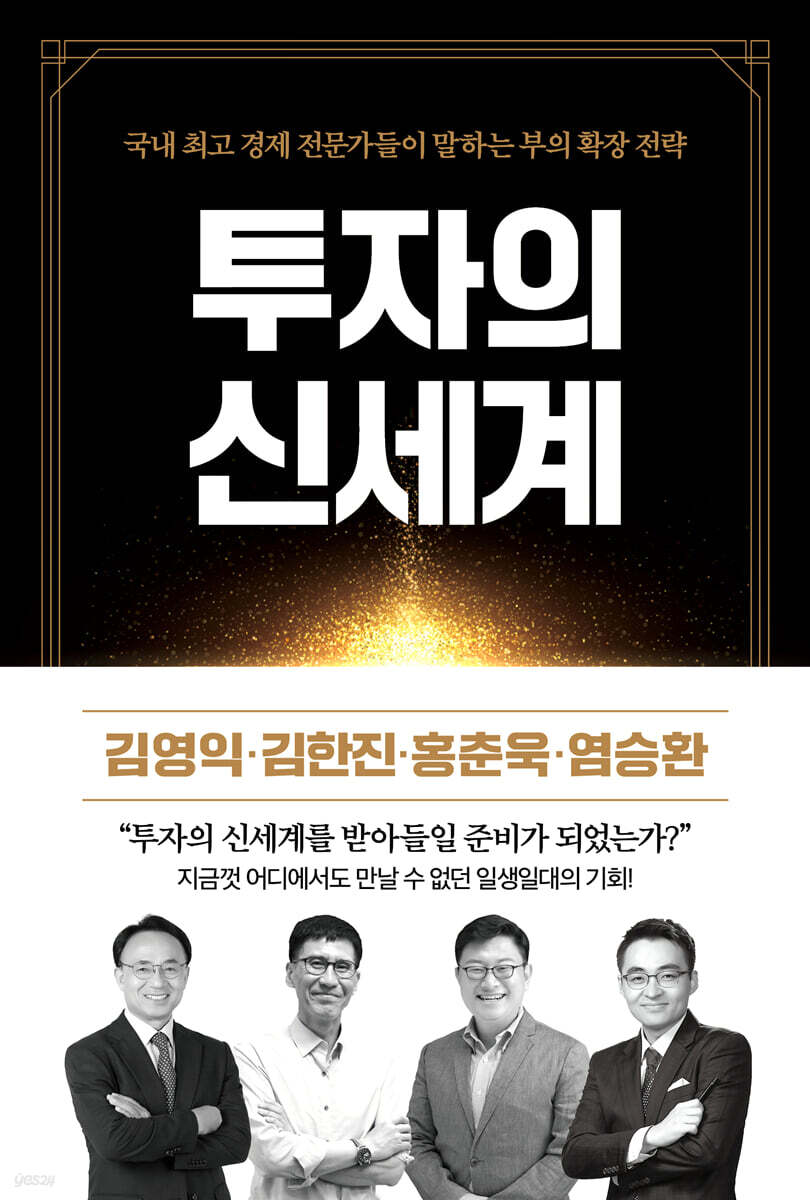
They are back. The Complete Guide to Successful Investment from Four of Korea's Most Trusted Economic Experts When, where, and how should we invest? A once-in-a-lifetime lesson in becoming rich from an investment specialist Four of South Korea's top economic experts and bestselling authors return to the pages of their books to help navigate these uncertain times. Hong Chun-wook, Korea's most trusted analyst; Kim Young-ik, who has been selected as the Best Analyst for five consecutive years; Kim Han-jin, who holds the record for most Best Analyst awards; and Yeom Seung-hwan, a leading analyst with the absolute support of individual investors, have returned with their co-authored book, "The New World of Investment." Author Hong Chun-wook looks back on the stock market over the past 100 years and offers guidance on foolproof investment (History of the Stock Market). Author Kim Young-ik analyzes the process of how the axis of global economic growth is shifting from the United States to Asia and proposes countermeasures (Global Economy and the Great Transition of Wealth). Dr. Kim Han-jin introduces investment methods that individual stock investors can sustain and even improve their skills (Investment Principles), and author Yeom Seung-hwan predicts the future after the pandemic and explains in detail where and how to invest (Invest in the Future). "The New World of Investment" guides you into the new world of investing by explaining in detail why you need to know the history of the stock market, when and how economic crises will occur, which industries will be advantageous in the future stock market, and the mindset and lifestyle necessary for wise investment. |
- You can preview some of the book's contents.
Preview
index
introduction
Chapter 1: History of the Stock Market
1 The Age of the Gold Standard and Bonds
2 The establishment and collapse of the Bretton Woods system
3 The Age of Bubbles and Panics
*Q&A for investors who want to enter a new world of investment.
Chapter 2: The Global Economy and the Great Wealth Transformation
1. Changes in the axis of global economic growth
2 Conditions for continued growth in the world economy
3. The expansion of imbalances in the U.S. economy and the direction of their resolution.
4. The Korean economy is entering a period of structural low growth and low interest rates.
5 Implications of the Economic Outlook for Investment
*Q&A for investors who want to enter a new world of investment.
Chapter 3: Principles of Investment
1 What kind of investment mindset should I have?
2 Investment Strategies and Response Strategies in a Bull Market
3. Investment Strategies and Response Strategies in a Bear Market
4 The Difference Between Investment Failure and Success: Case Studies
*Q&A for investors who want to enter a new world of investment.
Chapter 4: Post-COVID-19: Invest in the Future (5N)
1. Eco-friendly (New Energy)
2 The Resurgence of Europe (New EU)
3 New Space
4 New Universe
5 New Consumer
*Q&A for investors who want to enter a new world of investment.
Chapter 1: History of the Stock Market
1 The Age of the Gold Standard and Bonds
2 The establishment and collapse of the Bretton Woods system
3 The Age of Bubbles and Panics
*Q&A for investors who want to enter a new world of investment.
Chapter 2: The Global Economy and the Great Wealth Transformation
1. Changes in the axis of global economic growth
2 Conditions for continued growth in the world economy
3. The expansion of imbalances in the U.S. economy and the direction of their resolution.
4. The Korean economy is entering a period of structural low growth and low interest rates.
5 Implications of the Economic Outlook for Investment
*Q&A for investors who want to enter a new world of investment.
Chapter 3: Principles of Investment
1 What kind of investment mindset should I have?
2 Investment Strategies and Response Strategies in a Bull Market
3. Investment Strategies and Response Strategies in a Bear Market
4 The Difference Between Investment Failure and Success: Case Studies
*Q&A for investors who want to enter a new world of investment.
Chapter 4: Post-COVID-19: Invest in the Future (5N)
1. Eco-friendly (New Energy)
2 The Resurgence of Europe (New EU)
3 New Space
4 New Universe
5 New Consumer
*Q&A for investors who want to enter a new world of investment.
Detailed image

Into the book
As the low-interest-rate environment became prolonged and inflation was suppressed by the information and communication revolution and the advancement of globalization, stock markets around the world, including the U.S., showed a strong upward trend.
But even as inflationary pressures have eased, financial crises have not disappeared, and they feel larger and more frequent than ever before, from the Japanese asset market collapse of 1990 to the Lehman Brothers crisis of 2008.
Why does this happen?
---From "In a world of low prices, why are financial crises so frequent?"
Inflation and rising interest rates in the United States will cause asset price bubbles to burst and expose the limits of debt-fueled growth.
Then, the global economy is likely to fall into another severe recession, just like in 2020.
Because household and corporate debt is so high, lowering interest rates (and there is little room for further cuts) and loosening monetary policy will not significantly increase consumption and investment.
The story is that monetary policy will not have much effect.
---From "Expanding Green New Deal Investment"
What attitude should we have toward the market to succeed in investing?
Some of the smart investors I know have a good understanding of the patterns and physiology of bull and bear markets, and they approach the market with humility and flexibility.
He has a natural intuition, but his attitude toward stocks seems very sincere.
They have in common that they are very persistent in finding stocks, are calm, and refrain from excessive greed.
I think a lot, but once I make a decision, I am the type to confidently push through to the end.
---From "The Difference Between Investment Failure and Success"
I've spent a lot of time thinking about which industries will change the world and lead the stock market in the post-COVID-19 era.
What is the certain future? One of the best ways to succeed in stock investing is to invest in the future.
After much thought, I have come up with a prediction of the five futures (5N).
The 5Ns are New Energy, New EU, New Space, New Universe, and New Consumption.
---From "Invest in the Future (5N)!"
I worked as an economist for over 20 years at a securities firm's research center and a private economic research institute, and I met people who had amassed great wealth.
They have in common a keen insight into the trends of the times.
In this book, I wanted to examine with you, the readers, where we stand in the flow of time.
Policymakers around the world overcame the 2008 global financial crisis with bold fiscal and monetary policies, and are now overcoming the 2020 COVID-19 economic crisis.
As the world moves toward a zero-carbon era, eco-friendly industries such as electric vehicles are likely to grow at a very rapid pace.
The healthcare industry is also expected to continue growing.
But even as inflationary pressures have eased, financial crises have not disappeared, and they feel larger and more frequent than ever before, from the Japanese asset market collapse of 1990 to the Lehman Brothers crisis of 2008.
Why does this happen?
---From "In a world of low prices, why are financial crises so frequent?"
Inflation and rising interest rates in the United States will cause asset price bubbles to burst and expose the limits of debt-fueled growth.
Then, the global economy is likely to fall into another severe recession, just like in 2020.
Because household and corporate debt is so high, lowering interest rates (and there is little room for further cuts) and loosening monetary policy will not significantly increase consumption and investment.
The story is that monetary policy will not have much effect.
---From "Expanding Green New Deal Investment"
What attitude should we have toward the market to succeed in investing?
Some of the smart investors I know have a good understanding of the patterns and physiology of bull and bear markets, and they approach the market with humility and flexibility.
He has a natural intuition, but his attitude toward stocks seems very sincere.
They have in common that they are very persistent in finding stocks, are calm, and refrain from excessive greed.
I think a lot, but once I make a decision, I am the type to confidently push through to the end.
---From "The Difference Between Investment Failure and Success"
I've spent a lot of time thinking about which industries will change the world and lead the stock market in the post-COVID-19 era.
What is the certain future? One of the best ways to succeed in stock investing is to invest in the future.
After much thought, I have come up with a prediction of the five futures (5N).
The 5Ns are New Energy, New EU, New Space, New Universe, and New Consumption.
---From "Invest in the Future (5N)!"
I worked as an economist for over 20 years at a securities firm's research center and a private economic research institute, and I met people who had amassed great wealth.
They have in common a keen insight into the trends of the times.
In this book, I wanted to examine with you, the readers, where we stand in the flow of time.
Policymakers around the world overcame the 2008 global financial crisis with bold fiscal and monetary policies, and are now overcoming the 2020 COVID-19 economic crisis.
As the world moves toward a zero-carbon era, eco-friendly industries such as electric vehicles are likely to grow at a very rapid pace.
The healthcare industry is also expected to continue growing.
---From "Preface (Kim Young-ik)"
Publisher's Review
The first question to go to the new world,
Why should we study the history of the stock market?
"You must follow the path of investment that never fails!"_Hong Chun-wook
Looking back at the history of the stock market over the past 100 years can help us reduce mistakes in the future.
Author Hong Chun-wook explains the flow of modern capitalist society, including the gold standard, the relationship between bonds and stocks, the Great Depression, and the Bretton Woods system.
The reasons why stock returns have risen above those of other bonds since World War II include the abolition of the gold standard, the information and communications revolution, and the advancement of globalization.
The stock market showed strength as inflation was suppressed and the low interest rate environment became prolonged due to the information and communication revolution and the advancement of globalization.
However, even in this environment, economic crises continued, such as the collapse of the Japanese asset market in the 1990s and the global financial crisis of 2008. In particular, the 2008 global financial crisis clearly demonstrated that policy authorities still lacked the ability to control the economic cycle.
This led to a collapse in trust in central banks, but the 2020 coronavirus shock and subsequent responses have significantly restored their influence.
While we cannot know what the future holds for the stock market, we should take the path to "investment without fail" by examining the history of the global stock market and the evolution of the financial system since 1871.
The second question is, how should we invest now that the US-China hegemony war is in full swing?
"Turn the coming crisis into an opportunity to expand your wealth!" - Kim Young-ik
Chapter 2 analyzes the process by which the axis of global economic growth is shifting from the United States and other Western advanced countries to Asia.
Looking back at the past 500 years of history, China, Spain, the Netherlands, and the United Kingdom have been the world's leading powers, in that order, and since World War II, the United States has maintained that position.
However, the United States' share of the global economy is relatively shrinking, and China's GDP is expected to surpass that of the United States around 2030.
Author Kim Young-ik advises that while crises will arise as the global economic hegemony shifts, we should use them as opportunities to increase our wealth, offering some tips for doing so.
In particular, while the bubble will burst within one or two years, revealing the limits of growth, he emphasizes that this crisis can also be an opportunity to increase wealth in other aspects.
And those opportunities will likely come from Asia, including China, where industries like the eco-friendly and healthcare sectors are expected to grow rapidly.
Third question: What is an investment method that can be consistently practiced and even improve your skills?
"Be humble before the market! Treating stocks with integrity is paramount!" - Kim Han-jin
Author Kim Han-jin explains an investment method that individual stock investors can consistently follow and, if followed, improve their investment skills.
He urges readers not to get too tense or lax, quoting legendary New York Yankees catcher Yogi Berra, who said, “Baseball is 90 percent mental and half physical.”
He also advises that we all enjoy investing wisely, according to our own circumstances and situations, as impatience, greed, a sense of loss, and intoxication can lead us to failure.
While writing this book, the author confesses that he first asked himself, "What are my investment principles?" and then tried to generalize them as much as possible.
As I organized the principles from the perspective of an investment mindset, I came to the conclusion that I would focus on finding good companies rather than judging the market.
In addition, the book offers practical methods for selecting stocks and investment tips for promising growth stocks, and it is hoped that this book will serve as a good manual and nutrient for readers' wealth projects.
The final question: where should we invest?
"To succeed in stock investing, you must invest in the future!" - Yeom Seung-hwan
The author, nicknamed "Yeombli," is absolutely beloved by many investors. In Chapter 4, he explains in detail how to invest after the pandemic.
Due to COVID-19, most countries around the world were forced to implement economic lockdown policies.
As economic activity slowed and unemployment soared, the stock market naturally plummeted.
The global economy is in its worst state in 10 years since the 2008 financial crisis.
But now, about a year and a half later, global stock markets are at record highs, and South Korea's exports have continued to rise since November 2020.
The global economy is effectively adapting to COVID-19 and preparing for the post-COVID-19 era.
The author predicts that the coming future will be characterized by an environment-friendly environment (New Energy), the revival of Europe (New EU), a new space (New Space), a new world (New Universe), and a new consumption (New Consumption). He recommends promising domestic and foreign stocks for each future and urges preparation for the new era to come.
Why should we study the history of the stock market?
"You must follow the path of investment that never fails!"_Hong Chun-wook
Looking back at the history of the stock market over the past 100 years can help us reduce mistakes in the future.
Author Hong Chun-wook explains the flow of modern capitalist society, including the gold standard, the relationship between bonds and stocks, the Great Depression, and the Bretton Woods system.
The reasons why stock returns have risen above those of other bonds since World War II include the abolition of the gold standard, the information and communications revolution, and the advancement of globalization.
The stock market showed strength as inflation was suppressed and the low interest rate environment became prolonged due to the information and communication revolution and the advancement of globalization.
However, even in this environment, economic crises continued, such as the collapse of the Japanese asset market in the 1990s and the global financial crisis of 2008. In particular, the 2008 global financial crisis clearly demonstrated that policy authorities still lacked the ability to control the economic cycle.
This led to a collapse in trust in central banks, but the 2020 coronavirus shock and subsequent responses have significantly restored their influence.
While we cannot know what the future holds for the stock market, we should take the path to "investment without fail" by examining the history of the global stock market and the evolution of the financial system since 1871.
The second question is, how should we invest now that the US-China hegemony war is in full swing?
"Turn the coming crisis into an opportunity to expand your wealth!" - Kim Young-ik
Chapter 2 analyzes the process by which the axis of global economic growth is shifting from the United States and other Western advanced countries to Asia.
Looking back at the past 500 years of history, China, Spain, the Netherlands, and the United Kingdom have been the world's leading powers, in that order, and since World War II, the United States has maintained that position.
However, the United States' share of the global economy is relatively shrinking, and China's GDP is expected to surpass that of the United States around 2030.
Author Kim Young-ik advises that while crises will arise as the global economic hegemony shifts, we should use them as opportunities to increase our wealth, offering some tips for doing so.
In particular, while the bubble will burst within one or two years, revealing the limits of growth, he emphasizes that this crisis can also be an opportunity to increase wealth in other aspects.
And those opportunities will likely come from Asia, including China, where industries like the eco-friendly and healthcare sectors are expected to grow rapidly.
Third question: What is an investment method that can be consistently practiced and even improve your skills?
"Be humble before the market! Treating stocks with integrity is paramount!" - Kim Han-jin
Author Kim Han-jin explains an investment method that individual stock investors can consistently follow and, if followed, improve their investment skills.
He urges readers not to get too tense or lax, quoting legendary New York Yankees catcher Yogi Berra, who said, “Baseball is 90 percent mental and half physical.”
He also advises that we all enjoy investing wisely, according to our own circumstances and situations, as impatience, greed, a sense of loss, and intoxication can lead us to failure.
While writing this book, the author confesses that he first asked himself, "What are my investment principles?" and then tried to generalize them as much as possible.
As I organized the principles from the perspective of an investment mindset, I came to the conclusion that I would focus on finding good companies rather than judging the market.
In addition, the book offers practical methods for selecting stocks and investment tips for promising growth stocks, and it is hoped that this book will serve as a good manual and nutrient for readers' wealth projects.
The final question: where should we invest?
"To succeed in stock investing, you must invest in the future!" - Yeom Seung-hwan
The author, nicknamed "Yeombli," is absolutely beloved by many investors. In Chapter 4, he explains in detail how to invest after the pandemic.
Due to COVID-19, most countries around the world were forced to implement economic lockdown policies.
As economic activity slowed and unemployment soared, the stock market naturally plummeted.
The global economy is in its worst state in 10 years since the 2008 financial crisis.
But now, about a year and a half later, global stock markets are at record highs, and South Korea's exports have continued to rise since November 2020.
The global economy is effectively adapting to COVID-19 and preparing for the post-COVID-19 era.
The author predicts that the coming future will be characterized by an environment-friendly environment (New Energy), the revival of Europe (New EU), a new space (New Space), a new world (New Universe), and a new consumption (New Consumption). He recommends promising domestic and foreign stocks for each future and urges preparation for the new era to come.
GOODS SPECIFICS
- Publication date: July 30, 2021
- Page count, weight, size: 320 pages | 582g | 152*225*30mm
- ISBN13: 9791197516511
- ISBN10: 1197516514
You may also like
카테고리
korean


korean

![ELLE 엘르 스페셜 에디션 A형 : 12월 [2025]](http://librairie.coreenne.fr/cdn/shop/files/b8e27a3de6c9538896439686c6b0e8fb.jpg?v=1766436872&width=3840)


