

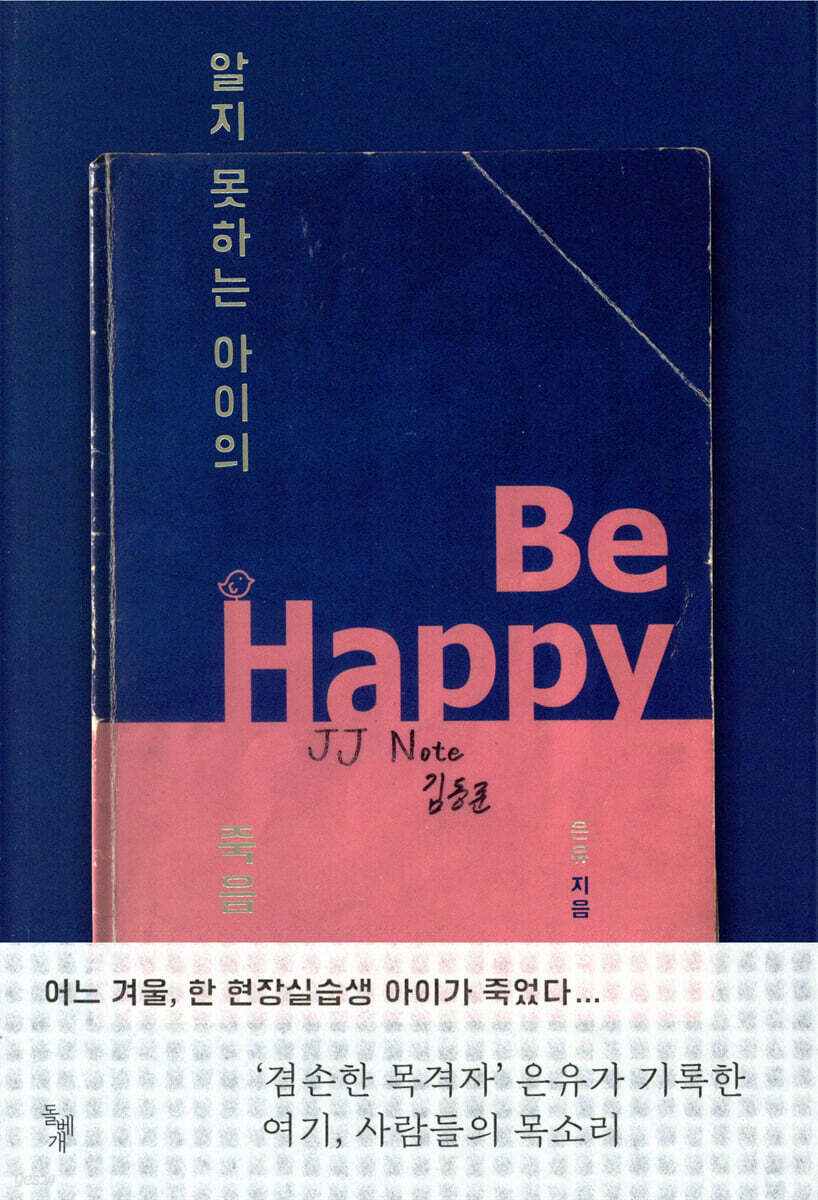
Death of an unknown child
 |
Description
Book Introduction
- A word from MD
-
Children who died because of workA high school senior who could not endure long working hours and workplace violence took his own life.
I was a field trainee who was working on packaging sausages.
Similar deaths continued among field trainees afterward.
A humble witness, the metaphorical author, documents the life and death of a young worker.
June 14, 2019. Social and Political PD Son Min-gyu
One winter, a child who was a field training student died…
Here, the voices of the people are recorded by the metaphor of the "humble witness."
Why do some people only become visible through death? Beginning with the death of Kim Dong-jun, a field training student who took his own life due to long working hours and workplace violence, the film compiles interviews with Kim Dong-jun's mother, the labor attorney handling the case, the father of the field training son who lost his life in an accident, and current and former students and graduates of vocational high schools (such as specialized and Meister high schools) who are often excluded from discourse on education and labor.
This book goes beyond simply investigating and mourning the death of one person, but vividly captures the lives and work of those directly and indirectly involved, the sadness and anger, memories and hopes they hold onto.
The metaphor of the "humble witness" delicately testifies to a society that is insensitive to everyday violence, a society where dangerous labor and death are concentrated on young workers, and Im Jin-sil's photographs that capture these intense and deeply emotional scenes amplify their resonance.
Writer Eun-yu has received widespread acclaim from readers for her collections of essays, 『The Front Line of Writing』 and 『Words of Writing』, and 『Becoming Transparent Every Time We Fight』 and 『Approaching Words』, which showcase “warm yet sharp, everyday-focused writing.” However, she is also an excellent interviewer and reportage writer who has written 『Between Violence and Dignity』, a collection of interviews with victims of fabricated espionage cases, and 『The Heart of Publishing』, a collection of interviews with people who create and promote books.
"The Death of an Unknown Child" is not a book about "the language of those who have no reason to change the world," but rather a book that honestly captures the lives of "those who cannot speak for themselves" and "those who have no language," and a book that fully explores the concerns about writing that moves people's hearts. In this book, metaphor shows its aspect as a "humble witness."
Regarding the two years of interviewing and writing, Eunyu wrote, “It was difficult work, listening to the stories of people who were suffering greatly,” but “it wasn’t all that hard” (p. 31).
“It is the writer’s choice what to keep and what to erase from the original interview, which is two or three times as long,” and although he “often hesitated” and “wanted to run away, afraid and confused, wondering if I lacked knowledge” (p. 32), Eunyu willingly stayed by the interviewees’ side, transcribing their voices, and succeeded in delicately revealing the emotions that captivated them.
And that's because the metaphor was in the position of a 'humble witness'.
“I approached this with the mindset of a fluid, vulnerable, and imperfect being whose thoughts and feelings change every moment, watching, listening, and recording the life story of another weak being.
I tried my best to make the result the best.
“It was possible because it was a task that could be done with humility to put aside one’s own judgment and sincerity to listen again, rather than with any literary talent or sociological knowledge.” (p. 33) Thanks to these multilayered stories left behind by Eunyu, we will be able to hear the voices of small but great people and meet children we did not know or see, even now.
Here, the voices of the people are recorded by the metaphor of the "humble witness."
Why do some people only become visible through death? Beginning with the death of Kim Dong-jun, a field training student who took his own life due to long working hours and workplace violence, the film compiles interviews with Kim Dong-jun's mother, the labor attorney handling the case, the father of the field training son who lost his life in an accident, and current and former students and graduates of vocational high schools (such as specialized and Meister high schools) who are often excluded from discourse on education and labor.
This book goes beyond simply investigating and mourning the death of one person, but vividly captures the lives and work of those directly and indirectly involved, the sadness and anger, memories and hopes they hold onto.
The metaphor of the "humble witness" delicately testifies to a society that is insensitive to everyday violence, a society where dangerous labor and death are concentrated on young workers, and Im Jin-sil's photographs that capture these intense and deeply emotional scenes amplify their resonance.
Writer Eun-yu has received widespread acclaim from readers for her collections of essays, 『The Front Line of Writing』 and 『Words of Writing』, and 『Becoming Transparent Every Time We Fight』 and 『Approaching Words』, which showcase “warm yet sharp, everyday-focused writing.” However, she is also an excellent interviewer and reportage writer who has written 『Between Violence and Dignity』, a collection of interviews with victims of fabricated espionage cases, and 『The Heart of Publishing』, a collection of interviews with people who create and promote books.
"The Death of an Unknown Child" is not a book about "the language of those who have no reason to change the world," but rather a book that honestly captures the lives of "those who cannot speak for themselves" and "those who have no language," and a book that fully explores the concerns about writing that moves people's hearts. In this book, metaphor shows its aspect as a "humble witness."
Regarding the two years of interviewing and writing, Eunyu wrote, “It was difficult work, listening to the stories of people who were suffering greatly,” but “it wasn’t all that hard” (p. 31).
“It is the writer’s choice what to keep and what to erase from the original interview, which is two or three times as long,” and although he “often hesitated” and “wanted to run away, afraid and confused, wondering if I lacked knowledge” (p. 32), Eunyu willingly stayed by the interviewees’ side, transcribing their voices, and succeeded in delicately revealing the emotions that captivated them.
And that's because the metaphor was in the position of a 'humble witness'.
“I approached this with the mindset of a fluid, vulnerable, and imperfect being whose thoughts and feelings change every moment, watching, listening, and recording the life story of another weak being.
I tried my best to make the result the best.
“It was possible because it was a task that could be done with humility to put aside one’s own judgment and sincerity to listen again, rather than with any literary talent or sociological knowledge.” (p. 33) Thanks to these multilayered stories left behind by Eunyu, we will be able to hear the voices of small but great people and meet children we did not know or see, even now.
- You can preview some of the book's contents.
Preview
index
Entering and having the courage to live each day
Part 1: Kim Dong-jun
Will I be able to go to work tomorrow in my right mind? _Kim Dong-jun
It's a sin not to do good deeds - Kang Seok-kyung (Kim Dong-jun's mother)
I was usually sensitive to violence, but I missed Dongjun. _Kang Su-jeong (Kim Dong-jun's aunt)
We must expose the violence we don't recognize as violence. _Kim Ki-bae (labor attorney handling the Kim Dong-jun case)
Part 2 Kim Dong-jun and others
Policymakers are all powerful people - Lee Sang-young (Lee Min-ho's father)
These children are on the front lines, meeting the most disadvantaged sections of our society. _Jang Yoon-ho (Teacher at Icheon Jeil High School)
I want to become a capable mechanical maintenance specialist. _Lim Hyeon-ji (3rd year, Yuhan High School)
I think I'll have a hard time later on, just like my senior who works overtime. _Seo Dong-hyeon (pseudonym, graduate of ○○ Industrial High School)
Can our first labor be truly human? _Lee Eun-ah (Chairperson, National Specialized High School Graduates' Labor Union)
It's Okay to Be In Pain - A Roundtable Discussion with the Families of Field Intern Students on the First Anniversary of Lee Min-ho's Death
Recommendation
Part 1: Kim Dong-jun
Will I be able to go to work tomorrow in my right mind? _Kim Dong-jun
It's a sin not to do good deeds - Kang Seok-kyung (Kim Dong-jun's mother)
I was usually sensitive to violence, but I missed Dongjun. _Kang Su-jeong (Kim Dong-jun's aunt)
We must expose the violence we don't recognize as violence. _Kim Ki-bae (labor attorney handling the Kim Dong-jun case)
Part 2 Kim Dong-jun and others
Policymakers are all powerful people - Lee Sang-young (Lee Min-ho's father)
These children are on the front lines, meeting the most disadvantaged sections of our society. _Jang Yoon-ho (Teacher at Icheon Jeil High School)
I want to become a capable mechanical maintenance specialist. _Lim Hyeon-ji (3rd year, Yuhan High School)
I think I'll have a hard time later on, just like my senior who works overtime. _Seo Dong-hyeon (pseudonym, graduate of ○○ Industrial High School)
Can our first labor be truly human? _Lee Eun-ah (Chairperson, National Specialized High School Graduates' Labor Union)
It's Okay to Be In Pain - A Roundtable Discussion with the Families of Field Intern Students on the First Anniversary of Lee Min-ho's Death
Recommendation
Into the book
Prejudice against specialized high school students, like most prejudices, arises from 'not knowing much' and is reinforced by 'lack of contact'.
A man in his thirties was talking to me and said that he had never met a single graduate of a specialized high school in his life.
I, who was facing him, graduated from high school.
The specialized high school graduate he was talking about was me.
(…) Specialized high school students are portrayed as disadvantaged only through articles like ‘Death of an Intern’.
When they are repeatedly called out by the media, the unfair situations they face become perceived as the default in their lives.
Since they were originally poor, it is not surprising that they continue to be poor.
The ignorance and indifference of the older generation thus solidifies the structure of violence.
As individuals who are not members of the classification codes "specialized high school students" or "field training students," our community has not seriously attempted to listen to their voices.
These children's identities were not entirely that of field trainees, but the moment they died, they were stuffed as unfortunate field trainees.
Is that all?
Even after death, whenever a similar incident occurs, they are busy being called Mr. ○○ and Miss ○○.
This is why I felt it was necessary to remember them not as interns Kim or Lee, but as unique beings, complex and diverse individuals who each accumulated experiences and memories within their own unique relationships.
Why did these children have to die?
I think this question will be revealed little by little only as we ask them what kind of life they wanted to live.
--- pp.10~11
So how and when do we learn as we grow up?
That you should not tolerate unfair situations.
That you have the right to refuse work if it is dangerous, if you are anxious, or if it is difficult.
That I can quit my job.
That there is nothing like that in the world.
--- p.13
But who would benefit from a life of working so hard that your body breaks down without you knowing?
Only now does he ask the question.
Losing a son and asking for help.
I found out by asking and asking again.
It is more important to be a person who takes care of and protects oneself than to be a person who takes responsibility for one's own work.
If you're having a hard time, you don't have to go to work.
Protecting myself comes first.
--- p.21
I hope the voices of these small but powerful individuals will provide an opportunity to reflect on our lives, instill in children who are already workers or will one day become workers the values of dignified labor, gradually eradicate prejudice against those we don't know well, and send a message of possibility that a life different from the one we have lived so far is okay.
--- p.33
I remember something my father once told me.
Persimmon blossoms fall from persimmon trees and fruit grows, but the persimmons that don't grow well fall to the corn.
My father said that if you fall, you have to let it go, and that if you stick with it, it won't grow.
Do people fall like that too? Is that how it is?
Then how should we give birth to and raise children?
--- p.49
If our society is to become a little better, we need to be able to respect vulnerable people and treat vulnerable things with sensitivity.
Because there is no such culture, people say about the deceased's death, 'My friend was hit a few times and died a weak-hearted death.
Some people just walk around with their lips cracked, that's just life.
The interpretation is 'Everyone knows that'.
(…) We are immersed in everyday violence, even though we are not aware of it.
Everyday violence extends into countless forms, manifesting itself in all kinds of death and loneliness.
We don't even know how numb we are.
This is one of the essences of this case.
--- p.118
What I felt was this:
If you live in Korea and listen well, you will die.
There is no reason to listen to them because if you listen well, the company will take advantage of you and only give you the worst tasks.
In Korea, people without money have no value in life.
There are no policies for the poor and powerless.
Why? Policymakers are all powerful.
I can't get out.
I always told Minho to live a good life, not to harm others, and to work hard at his job.
Minho grew up like that.
The conclusion is that if you listen well, you will turn your back on the world.
--- p.137
When I visited the company as a recruiter, it was lunchtime.
If you tell me to eat before I go, I'll say I'll eat.
But I'll eat company food.
If you eat company food, you can get a rough estimate.
Companies that care about food are a little better.
There was an incident where a fellow teacher went to see the kids who had gone out for an internship and suggested they eat at the cafeteria, but it was underground.
He said to the kids in front of the restaurant, “I’ll go out and buy it for you.”
He said he really couldn't eat it.
So there are things that children can't endure.
I don't think I could survive even if they paid me twice the minimum wage.
The working environment is also important.
These children are on the front lines meeting the most disadvantaged sections of our society.
--- p.152
I told him to tell Sam if it happened again, but he said he didn't think we could do it either.
I feel like I have to endure it.
And we don't know.
I don't know if this is unfair or not, so I don't know if I could experience something like this, but if it's my original job at that company, I think it's the only job I have, even if it's dangerous, so if I think of it as the job given to me, I think I'll do it even if it's dangerous.
If I can't do that, I won't be able to do my job, so I guess I have no choice but to do it.
If I tell my teacher, my parents will find out too, and that’s a bit much…
I can't tell my parents because they'll be very worried if they find out.
--- p.181
When I heard about the Jeju Island Lee Min-ho incident, I was a senior in high school and busy preparing for employment, so it felt like a distant event.
I think most students at specialized high schools would think that way.
This accident is far from me.
Because we live in such a brainwashing atmosphere.
Also, because society thinks that a high school graduate is not enough, I think there is an underlying resignation that says, 'What can I do once I graduate from high school?'
After graduating from high school, you may end up doing dangerous work and have accidents.
There's nothing I can do.
I feel wronged, but even if I try not to think that way, I am brainwashed…
I think rebelling also requires social status and courage.
A man in his thirties was talking to me and said that he had never met a single graduate of a specialized high school in his life.
I, who was facing him, graduated from high school.
The specialized high school graduate he was talking about was me.
(…) Specialized high school students are portrayed as disadvantaged only through articles like ‘Death of an Intern’.
When they are repeatedly called out by the media, the unfair situations they face become perceived as the default in their lives.
Since they were originally poor, it is not surprising that they continue to be poor.
The ignorance and indifference of the older generation thus solidifies the structure of violence.
As individuals who are not members of the classification codes "specialized high school students" or "field training students," our community has not seriously attempted to listen to their voices.
These children's identities were not entirely that of field trainees, but the moment they died, they were stuffed as unfortunate field trainees.
Is that all?
Even after death, whenever a similar incident occurs, they are busy being called Mr. ○○ and Miss ○○.
This is why I felt it was necessary to remember them not as interns Kim or Lee, but as unique beings, complex and diverse individuals who each accumulated experiences and memories within their own unique relationships.
Why did these children have to die?
I think this question will be revealed little by little only as we ask them what kind of life they wanted to live.
--- pp.10~11
So how and when do we learn as we grow up?
That you should not tolerate unfair situations.
That you have the right to refuse work if it is dangerous, if you are anxious, or if it is difficult.
That I can quit my job.
That there is nothing like that in the world.
--- p.13
But who would benefit from a life of working so hard that your body breaks down without you knowing?
Only now does he ask the question.
Losing a son and asking for help.
I found out by asking and asking again.
It is more important to be a person who takes care of and protects oneself than to be a person who takes responsibility for one's own work.
If you're having a hard time, you don't have to go to work.
Protecting myself comes first.
--- p.21
I hope the voices of these small but powerful individuals will provide an opportunity to reflect on our lives, instill in children who are already workers or will one day become workers the values of dignified labor, gradually eradicate prejudice against those we don't know well, and send a message of possibility that a life different from the one we have lived so far is okay.
--- p.33
I remember something my father once told me.
Persimmon blossoms fall from persimmon trees and fruit grows, but the persimmons that don't grow well fall to the corn.
My father said that if you fall, you have to let it go, and that if you stick with it, it won't grow.
Do people fall like that too? Is that how it is?
Then how should we give birth to and raise children?
--- p.49
If our society is to become a little better, we need to be able to respect vulnerable people and treat vulnerable things with sensitivity.
Because there is no such culture, people say about the deceased's death, 'My friend was hit a few times and died a weak-hearted death.
Some people just walk around with their lips cracked, that's just life.
The interpretation is 'Everyone knows that'.
(…) We are immersed in everyday violence, even though we are not aware of it.
Everyday violence extends into countless forms, manifesting itself in all kinds of death and loneliness.
We don't even know how numb we are.
This is one of the essences of this case.
--- p.118
What I felt was this:
If you live in Korea and listen well, you will die.
There is no reason to listen to them because if you listen well, the company will take advantage of you and only give you the worst tasks.
In Korea, people without money have no value in life.
There are no policies for the poor and powerless.
Why? Policymakers are all powerful.
I can't get out.
I always told Minho to live a good life, not to harm others, and to work hard at his job.
Minho grew up like that.
The conclusion is that if you listen well, you will turn your back on the world.
--- p.137
When I visited the company as a recruiter, it was lunchtime.
If you tell me to eat before I go, I'll say I'll eat.
But I'll eat company food.
If you eat company food, you can get a rough estimate.
Companies that care about food are a little better.
There was an incident where a fellow teacher went to see the kids who had gone out for an internship and suggested they eat at the cafeteria, but it was underground.
He said to the kids in front of the restaurant, “I’ll go out and buy it for you.”
He said he really couldn't eat it.
So there are things that children can't endure.
I don't think I could survive even if they paid me twice the minimum wage.
The working environment is also important.
These children are on the front lines meeting the most disadvantaged sections of our society.
--- p.152
I told him to tell Sam if it happened again, but he said he didn't think we could do it either.
I feel like I have to endure it.
And we don't know.
I don't know if this is unfair or not, so I don't know if I could experience something like this, but if it's my original job at that company, I think it's the only job I have, even if it's dangerous, so if I think of it as the job given to me, I think I'll do it even if it's dangerous.
If I can't do that, I won't be able to do my job, so I guess I have no choice but to do it.
If I tell my teacher, my parents will find out too, and that’s a bit much…
I can't tell my parents because they'll be very worried if they find out.
--- p.181
When I heard about the Jeju Island Lee Min-ho incident, I was a senior in high school and busy preparing for employment, so it felt like a distant event.
I think most students at specialized high schools would think that way.
This accident is far from me.
Because we live in such a brainwashing atmosphere.
Also, because society thinks that a high school graduate is not enough, I think there is an underlying resignation that says, 'What can I do once I graduate from high school?'
After graduating from high school, you may end up doing dangerous work and have accidents.
There's nothing I can do.
I feel wronged, but even if I try not to think that way, I am brainwashed…
I think rebelling also requires social status and courage.
--- p.212
Publisher's Review
The life and death of a young worker
There was a kid who wanted to be a programmer.
I decided on my career path early and entered a Meister high school, which is said to be advantageous for employment, and before graduation, I began my career as an intern at a large company famous for its cultural industry.
And the job I ended up doing was packaging sausages at a food factory.
Unable to endure long working hours and workplace violence, the child took his own life in January 2014.
The night before, he wrote on Twitter:
“I’m so scared.
“Will I be able to go to work tomorrow in my right mind?” The boy’s name is Kim Dong-jun, a third-year student at Dong-A Meister High School and an intern.
Similar deaths have occurred among field trainees before and since then.
The on-the-job training system, which allows students at vocational high schools (specialized high schools and Meister high schools) to learn work as both students and workers, has become a graveyard for young workers.
In November 2017, Lee Min-ho, an on-the-job training student working at a bottled water factory in Jeju, died after being caught in a loading press. In January of the same year, Hong Su-yeon, an on-the-job training student working at a customer service center in Jeonju, committed suicide due to work-related stress. In Changwon, Kim, who had graduated from a technical high school, worked as an on-the-job training student, and then worked as an industrial technician, was found dead.
Kim, a young worker who died while repairing a screen door at Guui Station in May 2016, also started working as an on-the-job trainee.
Around the same time, Kim Dong-gyun, who was in charge of boiling soup at a restaurant in Seongnam, ended his life due to bullying at work.
Decades have passed since the publication of the biography of Jeon Tae-il, which recorded and testified to the life and death of a young worker, but accidents and deaths of children just starting to learn to work continue to occur even today.
“Fixing subways, building cars, making soup at a buffet restaurant, answering the phone at a call center, packaging and transporting bottled water, making ham, repairing elevators…
“So, the traces of the ‘unknown death of a child’ remain in every area of our daily lives, from what we eat and drink to what we use.” (p. 17)
『The Death of an Unknown Child』 seeks to illuminate and mourn the deaths of Kim Dong-jun and countless other Kim Dong-juns and young workers who were not properly known or mourned, and to remember their deaths as social deaths.
Furthermore, I would like to share in the grief of the bereaved families living after the loss (the meeting of bereaved families of field training students mentioned at the end of this book served as a small spark for the creation of the network of families affected by industrial accidents, "Never Again").
This book is a work that seeks to remember the children who “were only stuffed as unfortunate field trainees through death” and “were called Mr. ○○ or Miss ○○ every time a similar incident occurred even after death” “not as field trainees Mr. Kim or Mr. Lee, but as unique beings, complex and colorful individuals who each accumulated experiences and memories within their own unique relationships” (p. 11).
And it starts with the question of why these children had to die, and the question of what kind of people they were and what kind of lives they wanted to live.
Stories of people working, dreaming, despairing, and dreaming again
"The Death of an Unknown Child" listens to the voices of young workers who are only seen after they die in industrial accidents, and of specialized high school students who have become invisible in an education system focused on college entrance exams, while also asking about the well-being of all of us who work and live here now.
This book begins with the records left by Kim Dong-jun in his notebooks and social media, and traces and reconstructs the life of the departed, while also overlaying and overlaying the lives of those who live after their death.
The stories of various people continue, including Kim Dong-jun's mother, the aunt who reported this case to the press, the labor attorney in charge of the case, the father of Lee Min-ho, an intern who lost his life in an accident in Jeju in 2017, a vocational high school teacher, and young workers who are currently enrolled or graduated from vocational high schools.
Therefore, this book is not limited to a memorial to the death of Kim Dong-jun or an accusation of the reality that the unjust deaths of young workers are occurring everywhere.
Lim Hyeon-ji, a high school student with a deep desire to become a machine maintenance expert; Seo Dong-hyeon, a graduate who hates studying and wants to make money quickly; and Lee Eun-ah, a 21-year-old who unexpectedly became the president of the National Specialized High School Graduates' Union, talk about their dreams, but also express their anxiety about the future and the prejudice and discrimination against specialized high school students.
Furthermore, he asks how we can know what is unjust and dangerous, and how humane work is possible.
The future they will face, the time of adulthood, is intertwined with what we dream of or what we despair of.
In this book, when a mother who lost her son, an aunt who was involved in social movements, a labor attorney who handled Dongjun's case, a father who also lost his son, and a specialized high school teacher interested in labor rights education tell their stories about their lives, the connection between their stories and our own becomes clearer.
The homes, workplaces, and schools where they are are places we have passed through, places where we exist now, and places where our children may be.
The stories of those directly and indirectly involved with Kim Dong-jun powerfully remind us not only of a society where dangerous labor and death are concentrated on young workers, but also of a society insensitive to the chain violence of everyday life, a life where everyone works themselves to the point of breaking down and being unable to protect themselves, the universal experiences of working, dreaming, and despairing, and how we want to live and what kind of world we dream of.
The delicate writing of the metaphor vividly captures the sadness, anger, helplessness, and hope they are held captive by, and Im Jin-sil's photographs, which capture this intense and profound emotional landscape, amplify its resonance.
A delicate reportage essay on the metaphor of the "humble witness."
Writer Eun-yu has received widespread acclaim from readers for her collections of essays, 『The Front Line of Writing』 and 『Words of Writing』, and 『Becoming Transparent Every Time We Fight』 and 『Approaching Words』, which showcase “warm yet sharp, everyday-focused writing.” However, she is also an excellent interviewer and reportage writer who has written 『Between Violence and Dignity』, a collection of interviews with victims of fabricated espionage cases, and 『The Heart of Publishing』, a collection of interviews with people who create and promote books.
"The Death of an Unknown Child" is not a book about "the language of those who have no reason to change the world," but rather a book that honestly captures the lives of "those who cannot speak for themselves" and "those who have no language," and a book that fully explores the concerns about writing that moves people's hearts. In this book, metaphor shows its aspect as a "humble witness."
Regarding the two years of interviewing and writing, Eunyu wrote, “It was difficult work, listening to the stories of people who were suffering greatly,” but “it wasn’t all that hard” (p. 31).
“It is the writer’s choice what to keep and what to erase from the original interview, which is two or three times as long,” and although he “often hesitated” and “wanted to run away, afraid and confused, wondering if I lacked knowledge” (p. 32), Eunyu willingly stayed by the interviewees’ side, transcribing their voices, and succeeded in delicately revealing the emotions that captivated them.
And that's because the metaphor was in the position of a 'humble witness'.
“I approached this with the mindset of a fluid, vulnerable, and imperfect being whose thoughts and feelings change every moment, watching, listening, and recording the life story of another weak being.
I tried my best to make the result the best.
“It was possible because it was a task that could be done with humility to put aside one’s own judgment and sincerity to listen again, rather than with any literary talent or sociological knowledge.” (p. 33) Thanks to these multilayered stories left behind by Eunyu, we will be able to hear the voices of small but great people and meet children we did not know or see, even now.
There was a kid who wanted to be a programmer.
I decided on my career path early and entered a Meister high school, which is said to be advantageous for employment, and before graduation, I began my career as an intern at a large company famous for its cultural industry.
And the job I ended up doing was packaging sausages at a food factory.
Unable to endure long working hours and workplace violence, the child took his own life in January 2014.
The night before, he wrote on Twitter:
“I’m so scared.
“Will I be able to go to work tomorrow in my right mind?” The boy’s name is Kim Dong-jun, a third-year student at Dong-A Meister High School and an intern.
Similar deaths have occurred among field trainees before and since then.
The on-the-job training system, which allows students at vocational high schools (specialized high schools and Meister high schools) to learn work as both students and workers, has become a graveyard for young workers.
In November 2017, Lee Min-ho, an on-the-job training student working at a bottled water factory in Jeju, died after being caught in a loading press. In January of the same year, Hong Su-yeon, an on-the-job training student working at a customer service center in Jeonju, committed suicide due to work-related stress. In Changwon, Kim, who had graduated from a technical high school, worked as an on-the-job training student, and then worked as an industrial technician, was found dead.
Kim, a young worker who died while repairing a screen door at Guui Station in May 2016, also started working as an on-the-job trainee.
Around the same time, Kim Dong-gyun, who was in charge of boiling soup at a restaurant in Seongnam, ended his life due to bullying at work.
Decades have passed since the publication of the biography of Jeon Tae-il, which recorded and testified to the life and death of a young worker, but accidents and deaths of children just starting to learn to work continue to occur even today.
“Fixing subways, building cars, making soup at a buffet restaurant, answering the phone at a call center, packaging and transporting bottled water, making ham, repairing elevators…
“So, the traces of the ‘unknown death of a child’ remain in every area of our daily lives, from what we eat and drink to what we use.” (p. 17)
『The Death of an Unknown Child』 seeks to illuminate and mourn the deaths of Kim Dong-jun and countless other Kim Dong-juns and young workers who were not properly known or mourned, and to remember their deaths as social deaths.
Furthermore, I would like to share in the grief of the bereaved families living after the loss (the meeting of bereaved families of field training students mentioned at the end of this book served as a small spark for the creation of the network of families affected by industrial accidents, "Never Again").
This book is a work that seeks to remember the children who “were only stuffed as unfortunate field trainees through death” and “were called Mr. ○○ or Miss ○○ every time a similar incident occurred even after death” “not as field trainees Mr. Kim or Mr. Lee, but as unique beings, complex and colorful individuals who each accumulated experiences and memories within their own unique relationships” (p. 11).
And it starts with the question of why these children had to die, and the question of what kind of people they were and what kind of lives they wanted to live.
Stories of people working, dreaming, despairing, and dreaming again
"The Death of an Unknown Child" listens to the voices of young workers who are only seen after they die in industrial accidents, and of specialized high school students who have become invisible in an education system focused on college entrance exams, while also asking about the well-being of all of us who work and live here now.
This book begins with the records left by Kim Dong-jun in his notebooks and social media, and traces and reconstructs the life of the departed, while also overlaying and overlaying the lives of those who live after their death.
The stories of various people continue, including Kim Dong-jun's mother, the aunt who reported this case to the press, the labor attorney in charge of the case, the father of Lee Min-ho, an intern who lost his life in an accident in Jeju in 2017, a vocational high school teacher, and young workers who are currently enrolled or graduated from vocational high schools.
Therefore, this book is not limited to a memorial to the death of Kim Dong-jun or an accusation of the reality that the unjust deaths of young workers are occurring everywhere.
Lim Hyeon-ji, a high school student with a deep desire to become a machine maintenance expert; Seo Dong-hyeon, a graduate who hates studying and wants to make money quickly; and Lee Eun-ah, a 21-year-old who unexpectedly became the president of the National Specialized High School Graduates' Union, talk about their dreams, but also express their anxiety about the future and the prejudice and discrimination against specialized high school students.
Furthermore, he asks how we can know what is unjust and dangerous, and how humane work is possible.
The future they will face, the time of adulthood, is intertwined with what we dream of or what we despair of.
In this book, when a mother who lost her son, an aunt who was involved in social movements, a labor attorney who handled Dongjun's case, a father who also lost his son, and a specialized high school teacher interested in labor rights education tell their stories about their lives, the connection between their stories and our own becomes clearer.
The homes, workplaces, and schools where they are are places we have passed through, places where we exist now, and places where our children may be.
The stories of those directly and indirectly involved with Kim Dong-jun powerfully remind us not only of a society where dangerous labor and death are concentrated on young workers, but also of a society insensitive to the chain violence of everyday life, a life where everyone works themselves to the point of breaking down and being unable to protect themselves, the universal experiences of working, dreaming, and despairing, and how we want to live and what kind of world we dream of.
The delicate writing of the metaphor vividly captures the sadness, anger, helplessness, and hope they are held captive by, and Im Jin-sil's photographs, which capture this intense and profound emotional landscape, amplify its resonance.
A delicate reportage essay on the metaphor of the "humble witness."
Writer Eun-yu has received widespread acclaim from readers for her collections of essays, 『The Front Line of Writing』 and 『Words of Writing』, and 『Becoming Transparent Every Time We Fight』 and 『Approaching Words』, which showcase “warm yet sharp, everyday-focused writing.” However, she is also an excellent interviewer and reportage writer who has written 『Between Violence and Dignity』, a collection of interviews with victims of fabricated espionage cases, and 『The Heart of Publishing』, a collection of interviews with people who create and promote books.
"The Death of an Unknown Child" is not a book about "the language of those who have no reason to change the world," but rather a book that honestly captures the lives of "those who cannot speak for themselves" and "those who have no language," and a book that fully explores the concerns about writing that moves people's hearts. In this book, metaphor shows its aspect as a "humble witness."
Regarding the two years of interviewing and writing, Eunyu wrote, “It was difficult work, listening to the stories of people who were suffering greatly,” but “it wasn’t all that hard” (p. 31).
“It is the writer’s choice what to keep and what to erase from the original interview, which is two or three times as long,” and although he “often hesitated” and “wanted to run away, afraid and confused, wondering if I lacked knowledge” (p. 32), Eunyu willingly stayed by the interviewees’ side, transcribing their voices, and succeeded in delicately revealing the emotions that captivated them.
And that's because the metaphor was in the position of a 'humble witness'.
“I approached this with the mindset of a fluid, vulnerable, and imperfect being whose thoughts and feelings change every moment, watching, listening, and recording the life story of another weak being.
I tried my best to make the result the best.
“It was possible because it was a task that could be done with humility to put aside one’s own judgment and sincerity to listen again, rather than with any literary talent or sociological knowledge.” (p. 33) Thanks to these multilayered stories left behind by Eunyu, we will be able to hear the voices of small but great people and meet children we did not know or see, even now.
GOODS SPECIFICS
- Date of issue: June 14, 2019
- Page count, weight, size: 252 pages | 358g | 135*200*20mm
- ISBN13: 9788971999639
- ISBN10: 8971999632
You may also like
카테고리
korean


korean

![GQ KOREA Mark (Monthly): December [2025]](http://librairie.coreenne.fr/cdn/shop/files/8ef265dbbfbf186523ed75ba7319009d.jpg?v=1765340328&width=3840)


