

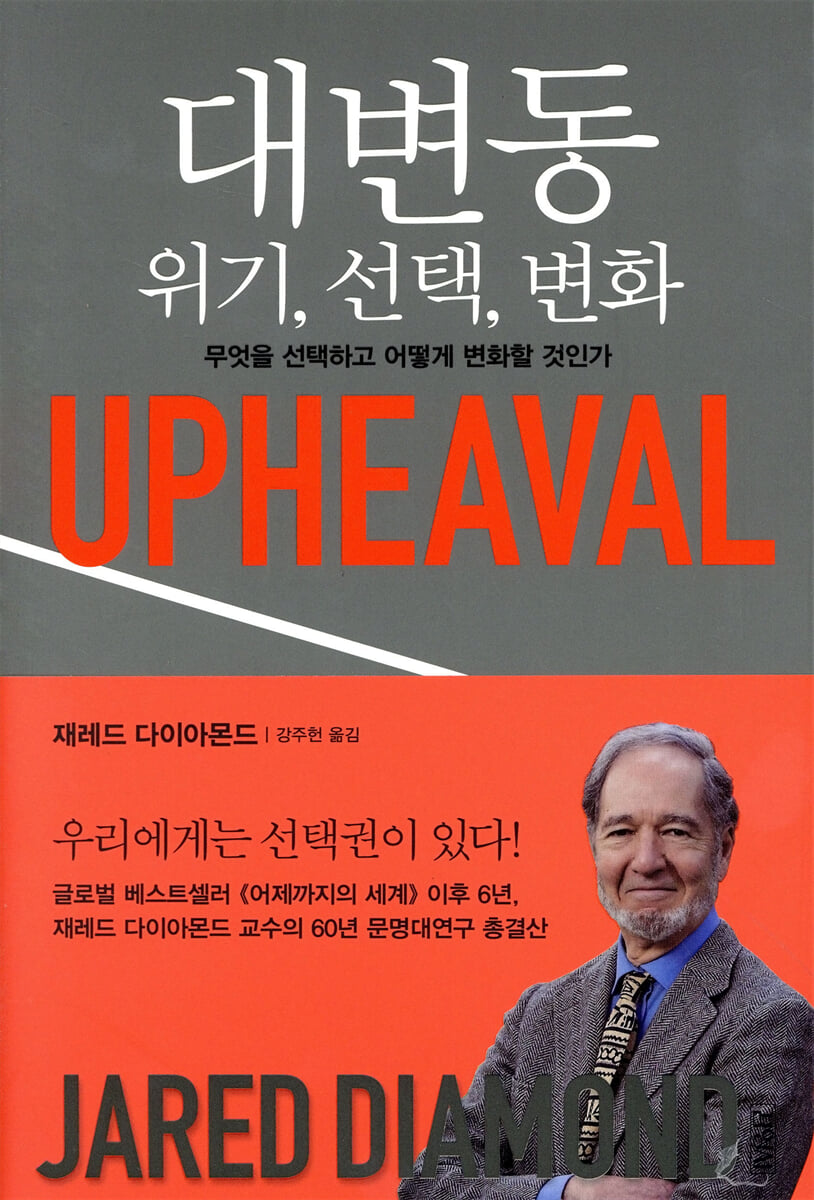
Cataclysmic crisis, choice, change
 |
Description
Book Introduction
A new work six years after the global bestseller "The World Until Yesterday" The definitive edition of Jared Diamond's 60-year exploration of civilization! The world's first Korean and English versions published simultaneously Professor Jared Diamond, a world-renowned scholar whose work transcends academic boundaries, encompassing cultural anthropology, history, science, and even future prospects, presents his culmination of his research on civilization, "Opportunities for the Future." Following his explorations of the rise and fall of civilizations in "Guns, Germs, and Steel," "Collapse," and "The World Until Yesterday," this masterpiece perfectly captures the future shaped by crisis, choice, and change. 12 factors influencing crisis resolution, a study of countries that have overcome upheaval and succeeded, the challenges facing Japan and the United States and the potential for change, and the outlook for the world going forward. A powerful solution to save my future and the world's! "We have a choice." With this new work, Professor Diamond has finally completed a grand picture that encompasses time and space. The long-awaited four-part series, the culmination of his 60 years of research into civilization, now moves into future history. How can we overcome the crisis and create opportunities for the future? What is the turning point that determines success or self-destruction? Professor Diamond's dazzling comparative research, his overwhelming knowledge encompassing history, geography, linguistics, anthropology, biology, and psychology, and his brilliant insights spanning civilizations past and present, transcend all previous works and offer wisdom and solutions for the future. Where does the path to the future begin? Professor Diamond first defines what constitutes a "crisis" and analyzes twelve factors that influence crisis resolution. And he emphasizes that 'selective change' is necessary to successfully cope with internal and external pressures demanding change. This multi-layered comparative study of two countries suddenly swept by external forces (Finland and Japan), two countries in crisis due to internal conflict (Chile and Indonesia), and two countries suffering from gradually escalating crises (Germany and Australia) provides real-world examples of how painful but honest self-evaluation and response helped overcome turbulent times in modern and contemporary times. Furthermore, it explains the great changes facing Japan, the United States, and the world today, and presents the possibilities for change in the present and future. It soberly examines the future prospects and challenges of the world, including how to overcome problems such as international inequality, environmental resource shortages, climate change, nuclear war, and demographic changes. Finally, it raises the question, 'Is a crisis really necessary for change?' As Yuval Harari recommends, "The Great Transformation: Crisis, Choice, Change" is a book desperately needed in this age of crisis. |
- You can preview some of the book's contents.
Preview
index
To Korean readers
Prologue: The Legacy of the Coconut Grove Fire
Two Stories | What is a Crisis? | Personal and National Crisis | What This Book Covers and Doesn't Cover | Structure of This Book
Part 1 Individual
Chapter 1: Personal Crisis
Personal Crisis | Trajectory | Crisis Handling | Factors Related to Outcome | National Crisis
Part 2: The Nation: The Evolution of the Crisis
Chapter 2: The War Between Finland and the Soviet Union
Visit Finland | Finnish | Finland until 1939 | Winter War | Consequences of the Winter War | Continuation War | After 1945 | Tightrope Walking | Finlandization | A Framework for Crisis
Chapter 3: The Origins of Modern Japan
My Relationship with Japan | Japan before 1853 | Commodore Perry | 1853–1868 | The Meiji Era | The Meiji Restoration | Westernization | Military Expansion Policy | A Framework for the Crisis | Remaining Issues
Chapter 4: Chile for All Chileans
Visit Chile | Chile before 1970 | Allende | Coups and Pinochet | The Economy to the End! | After Pinochet | The Shadow of Pinochet | The Frame of Crisis | Back to Chile
Chapter 5 Indonesia: The Birth of a New Nation
At the Hotel | Indonesia's Background | Colonial Era | Independence | Sukarno | Coup | Genocide | Suharto | Suharto's Legacy | A Frame of Crisis | Back to Indonesia
Chapter 6: Reconstruction of Germany
Germany in 1945 | 1945 to 1961 | Germany in Judgment | 1968 | The Aftermath of 1968 | Brandt and Reunification | Geographical Constraints | Self-Pity? | Leaders and Realism | The Crisis Frame
Chapter 7 Australia: Who Are We?
Visit Australia | The First Fleet and Aboriginal Australians | Early Settlers | Towards Self-Government | Federation | Stop Them! | World War I | World War II | Loosening Ties | Abandoning the White Australia Doctrine | A Frame of Crisis
Part 3: The Nation and the World: Ongoing Crises
Chapter 8: What challenges will Japan face in the future?
Japan Today | Economic Advantages | Other Advantages | Government Debt | Women | Falling Birth Rates | Aging and Population Decline | Immigration | China and South Korea | Natural Resource Management | A Framework for Crisis
Chapter 9: What Challenges Will the United States Face in the Future? Strengths and Critical Issues
The United States Today | National Wealth | Geography | The Benefits of Democracy | Other Benefits | Political Polarization | Why? | Other Sectors Polarizing
Chapter 10: What Challenges Will the United States Face in the Future? Three "Different" Problems
Other Issues | Elections | Inequality and Socioeconomic Mobility | So What's the Problem? | Investing for the Future | A Framework for the Crisis
Chapter 11: What challenges will the world face in the future?
The World Today | Nuclear Weapons | Climate Change | Fossil Fuels | Alternative Energy Sources | Other Natural Resources | Inequality | A Framework for Crisis
Epilogue: Lessons Learned, Questions Remaining, and a Look Ahead
Predictive Factors | Is a Crisis Necessary? | The Role of Leaders in History | The Role of Specific Leaders | What's Next? | Lessons for the Future
Acknowledgements
Translator's Note: Is Now a Crisis?
References
Search
Prologue: The Legacy of the Coconut Grove Fire
Two Stories | What is a Crisis? | Personal and National Crisis | What This Book Covers and Doesn't Cover | Structure of This Book
Part 1 Individual
Chapter 1: Personal Crisis
Personal Crisis | Trajectory | Crisis Handling | Factors Related to Outcome | National Crisis
Part 2: The Nation: The Evolution of the Crisis
Chapter 2: The War Between Finland and the Soviet Union
Visit Finland | Finnish | Finland until 1939 | Winter War | Consequences of the Winter War | Continuation War | After 1945 | Tightrope Walking | Finlandization | A Framework for Crisis
Chapter 3: The Origins of Modern Japan
My Relationship with Japan | Japan before 1853 | Commodore Perry | 1853–1868 | The Meiji Era | The Meiji Restoration | Westernization | Military Expansion Policy | A Framework for the Crisis | Remaining Issues
Chapter 4: Chile for All Chileans
Visit Chile | Chile before 1970 | Allende | Coups and Pinochet | The Economy to the End! | After Pinochet | The Shadow of Pinochet | The Frame of Crisis | Back to Chile
Chapter 5 Indonesia: The Birth of a New Nation
At the Hotel | Indonesia's Background | Colonial Era | Independence | Sukarno | Coup | Genocide | Suharto | Suharto's Legacy | A Frame of Crisis | Back to Indonesia
Chapter 6: Reconstruction of Germany
Germany in 1945 | 1945 to 1961 | Germany in Judgment | 1968 | The Aftermath of 1968 | Brandt and Reunification | Geographical Constraints | Self-Pity? | Leaders and Realism | The Crisis Frame
Chapter 7 Australia: Who Are We?
Visit Australia | The First Fleet and Aboriginal Australians | Early Settlers | Towards Self-Government | Federation | Stop Them! | World War I | World War II | Loosening Ties | Abandoning the White Australia Doctrine | A Frame of Crisis
Part 3: The Nation and the World: Ongoing Crises
Chapter 8: What challenges will Japan face in the future?
Japan Today | Economic Advantages | Other Advantages | Government Debt | Women | Falling Birth Rates | Aging and Population Decline | Immigration | China and South Korea | Natural Resource Management | A Framework for Crisis
Chapter 9: What Challenges Will the United States Face in the Future? Strengths and Critical Issues
The United States Today | National Wealth | Geography | The Benefits of Democracy | Other Benefits | Political Polarization | Why? | Other Sectors Polarizing
Chapter 10: What Challenges Will the United States Face in the Future? Three "Different" Problems
Other Issues | Elections | Inequality and Socioeconomic Mobility | So What's the Problem? | Investing for the Future | A Framework for the Crisis
Chapter 11: What challenges will the world face in the future?
The World Today | Nuclear Weapons | Climate Change | Fossil Fuels | Alternative Energy Sources | Other Natural Resources | Inequality | A Framework for Crisis
Epilogue: Lessons Learned, Questions Remaining, and a Look Ahead
Predictive Factors | Is a Crisis Necessary? | The Role of Leaders in History | The Role of Specific Leaders | What's Next? | Lessons for the Future
Acknowledgements
Translator's Note: Is Now a Crisis?
References
Search
Detailed image

Into the book
A crisis rarely strikes without warning.
For individuals and nations, most crises are the result of gradual changes that have accumulated over a long period of time.
Couples who have been in conflict for a long time are bound to divorce, and the Chilean coup was also the result of accumulated political and economic difficulties.
A 'crisis' occurs when pressure that has been building up for a long time suddenly explodes.
--- From the "Prologue"
This book is a narrative introduction, comparing the crises that have occurred in seven modern countries over the past several decades and the selective changes that have been made in response.
I personally experienced the crises of those seven countries and analyzed them from the perspective of selective change to overcome personal crises.
(…) I have visited seven countries frequently and have lived in six of them for significant periods of time, dating back to 70 years ago.
Of course, even now, I know how to speak six languages.
I love and admire all seven countries and always enjoy visiting them.
I've also visited seven countries in the past two years, and seriously considered moving permanently to two of them.
Therefore, I can write about those countries in depth and favorably, based on my own experience and the indirect experience I've heard from long-time friends who live there.
I, as well as my friends, have lived there long enough to witness and experience the main events.
(…) Of course, the seven countries are not a randomly selected sample, even though they were selected based on personal experience.
Five countries are wealthy industrialized countries, one is average, and only one is a poor developing country.
--- From the "Prologue"
How could a country that previously experienced democracy degenerate into such barbarism? While military interventions have occurred in Chilean history, how could a military junta persist, far surpassing past examples in duration, number of casualties, and sadistic torture? While this may not be a complete answer, the polarization of the political climate, the rise of violence, and the breakdown of political compromise were likely contributing factors, both large and small.
Another cause was the poster that read "Jakarta Biene," which seemed to foreshadow the intensification of the far-left militancy and the massacre by the far-right during the Allende era.
--- From "Chapter 4: Chile for All Chileans"
It takes a considerable amount of time for an individual to come up with a new answer to the question, “Who am I?”
Moreover, a nation with a population exceeding millions and composed of diverse groups with diverse ideas about national identity will take much longer to resolve the fundamental question of “Who are we?”
So it's no surprise that Australians still wrestle with the issue today.
Although the resolution of the crisis in Australia was slow, so slow that many Australians did not even suspect there was a crisis, Australia experienced the most extensive but consistent change in the shortest period of time of the six countries: 19 days in December 1972.
All of these changes are what I find most interesting about the story of modern Australia.
--- From "Chapter 7 Australia: Who Are We?"
What will become of America in the future? It will depend on the choices it makes.
The fact that America enjoys such enormous fundamental advantages means that if it wisely addresses its own problems, its future can be as bright as its past.
Unfortunately, however, the United States is currently squandering that advantage.
(…) So the question remains whether the United States will attempt to build a fence in the future.
But that fence should not be a wall along the border with Mexico, but a fence that divides the functioning sectors of American society from the non-functioning sectors.
--- From "Chapter 10: What Challenges Will the United States Need to Solve in the Future? Three 'Different' Problems"
The answer to the question, “Does a crisis have to come before a nation can make significant, selective changes?” is similar to the answer to the individual case.
As individuals, we constantly act to solve current or anticipated problems.
We also anticipate new problems we may face in the future and try to prevent them at the source.
Even in the case of a country, inertia and resistance must be overcome.
For individuals and nations, most crises are the result of gradual changes that have accumulated over a long period of time.
Couples who have been in conflict for a long time are bound to divorce, and the Chilean coup was also the result of accumulated political and economic difficulties.
A 'crisis' occurs when pressure that has been building up for a long time suddenly explodes.
--- From the "Prologue"
This book is a narrative introduction, comparing the crises that have occurred in seven modern countries over the past several decades and the selective changes that have been made in response.
I personally experienced the crises of those seven countries and analyzed them from the perspective of selective change to overcome personal crises.
(…) I have visited seven countries frequently and have lived in six of them for significant periods of time, dating back to 70 years ago.
Of course, even now, I know how to speak six languages.
I love and admire all seven countries and always enjoy visiting them.
I've also visited seven countries in the past two years, and seriously considered moving permanently to two of them.
Therefore, I can write about those countries in depth and favorably, based on my own experience and the indirect experience I've heard from long-time friends who live there.
I, as well as my friends, have lived there long enough to witness and experience the main events.
(…) Of course, the seven countries are not a randomly selected sample, even though they were selected based on personal experience.
Five countries are wealthy industrialized countries, one is average, and only one is a poor developing country.
--- From the "Prologue"
How could a country that previously experienced democracy degenerate into such barbarism? While military interventions have occurred in Chilean history, how could a military junta persist, far surpassing past examples in duration, number of casualties, and sadistic torture? While this may not be a complete answer, the polarization of the political climate, the rise of violence, and the breakdown of political compromise were likely contributing factors, both large and small.
Another cause was the poster that read "Jakarta Biene," which seemed to foreshadow the intensification of the far-left militancy and the massacre by the far-right during the Allende era.
--- From "Chapter 4: Chile for All Chileans"
It takes a considerable amount of time for an individual to come up with a new answer to the question, “Who am I?”
Moreover, a nation with a population exceeding millions and composed of diverse groups with diverse ideas about national identity will take much longer to resolve the fundamental question of “Who are we?”
So it's no surprise that Australians still wrestle with the issue today.
Although the resolution of the crisis in Australia was slow, so slow that many Australians did not even suspect there was a crisis, Australia experienced the most extensive but consistent change in the shortest period of time of the six countries: 19 days in December 1972.
All of these changes are what I find most interesting about the story of modern Australia.
--- From "Chapter 7 Australia: Who Are We?"
What will become of America in the future? It will depend on the choices it makes.
The fact that America enjoys such enormous fundamental advantages means that if it wisely addresses its own problems, its future can be as bright as its past.
Unfortunately, however, the United States is currently squandering that advantage.
(…) So the question remains whether the United States will attempt to build a fence in the future.
But that fence should not be a wall along the border with Mexico, but a fence that divides the functioning sectors of American society from the non-functioning sectors.
--- From "Chapter 10: What Challenges Will the United States Need to Solve in the Future? Three 'Different' Problems"
The answer to the question, “Does a crisis have to come before a nation can make significant, selective changes?” is similar to the answer to the individual case.
As individuals, we constantly act to solve current or anticipated problems.
We also anticipate new problems we may face in the future and try to prevent them at the source.
Even in the case of a country, inertia and resistance must be overcome.
--- From "Epilogue"
Publisher's Review
Six years after the global bestseller "The World Until Yesterday"!
Professor Jared Diamond's 60-year exploration of civilization is the definitive book.
Professor Jared Diamond, a world-renowned scholar, has sharply analyzed the dynamic changes in the world, crossing academic boundaries from cultural anthropology to history, science, and future prospects.
His global bestsellers Guns, Germs, and Steel, The Collapse of Civilization, and The World Until Yesterday overturned conventional wisdom and became masterpieces of the century.
Six years later, the world-awaited new book, Upheaval: Crisis, Choice, Change (original title: Upheaval), was published simultaneously in English and Korean for the first time in the world.
With this new work, Professor Diamond has finally completed a grand picture that encompasses time and space.
The long-awaited four-part series, the culmination of his 60 years of research into civilization, now moves into future history.
How can we overcome the crisis and create opportunities for the future?
What is the turning point that determines success or self-destruction?
Professor Diamond's dazzling comparative research, his overwhelming knowledge encompassing history, geography, linguistics, anthropology, biology, and psychology, and his brilliant insights spanning civilizations past and present, transcend all previous works and offer wisdom and solutions for the future.
Where does the path to the future begin? Professor Diamond first defines what constitutes a "crisis" and analyzes twelve factors that influence crisis resolution.
And he emphasizes that 'selective change' is necessary to successfully cope with internal and external pressures demanding change.
This multi-layered comparative study of two countries suddenly swept by external forces (Finland and Japan), two countries in crisis due to internal conflict (Chile and Indonesia), and two countries suffering from gradually escalating crises (Germany and Australia) provides real-world examples of how painful but honest self-evaluation and response helped overcome turbulent times in modern and contemporary times.
Furthermore, it explains the great changes facing Japan, the United States, and the world today, and presents the possibilities for change in the present and future.
It soberly examines the future prospects and challenges of the world, including how to overcome problems such as international inequality, environmental resource shortages, climate change, nuclear war, and demographic changes.
Finally, it raises the question, 'Is a crisis really necessary for change?'
As Yuval Harari recommends, "The Great Transformation: Crisis, Choice, Change" is a book desperately needed in this age of crisis.
“We have a choice!”
What to choose and how to change
Unlike previous works that discussed grand narratives in the history of humanity and civilization, Professor Jared Diamond focuses more specifically on the present and future world in this book.
In particular, it provides a detailed analysis of the crises facing Japan and the United States, which are geopolitically closest to Korean society.
With his uniquely sharp perspective, he accurately captures reality and suggests the best solutions for what we should choose and how we should change in the future.
This is why our society must listen to the global crisis.
The seven countries covered in this book resemble aspects of our modern history.
Finland, neighboring the superpower that was the Soviet Union; Chile and Indonesia, which experienced military dictatorships; Japan, which has been constantly influenced by geography and history; and even the United States, where polarization is widening—their crises, choices, and changes are not far from our own.
What future do we have to choose now?
Professor Diamond's sharp and sobering diagnosis allows us to clarify the crisis situation and find a path forward.
This book offers solutions and insights to the crisis facing global and Korean society, and conveys the possibility of change and recovery.
“This is why I do not listen to the grumblings of pessimists, why I do not give up hope, and why I continue to write about history.
We have a choice.
Crises have plagued nations in the past, and they do so again today.
But modern nations and the modern world need not wander in the dark.
Because the changes that worked in the past and the changes that didn't will show you the right direction." _From the text
“What is the turning point from crisis to prosperity?”
A masterpiece that perfectly captures the future that changes through choice and change.
Professor Jared Diamond outlines 12 key factors for resolving national crises.
This is an extension of the factors that influence an individual's ability to overcome a crisis to a national crisis.
The core of the 12 factors is to 'honestly evaluate' one's abilities and values, to determine what is working well in the new environment and what needs to be changed, and ultimately to achieve 'selective change.'
※ 12 factors for resolving national crises
1.
National consensus that the country is in crisis
2.
Accepting responsibility to do something
3.
Building fences to define the problems to be solved
4.
Material and economic support from other countries
5.
Examples from other countries that can serve as models for problem-solving methods
6.
national identity
7.
Honest self-evaluation
8.
Historical crises experienced in the past
9.
How to Deal with Failure
10.
The ability to respond flexibly to situations
11.
Core values of the country
12.
Freedom from geopolitical constraints
The research begins with the idea that although the causes and forms of crises vary, the process of overcoming them is mostly similar.
Professor Diamond analyzes seven countries based on the 12 factors above.
Finland, Japan, Chile, Indonesia, Germany, Australia, and the United States all faced major crises in different environments.
Sudden upheaval due to external military threats: Finland and Japan
Finland faced a major attack from the Soviet Union on its border in 1939, and Japan was forced to cope with a new environment when it was invaded by the American fleet demanding the opening of its ports.
After the war with the Soviet Union, Finland recognized the reality that it needed to gain the Soviet Union's trust to survive, through honest self-assessment, the seventh of the twelve key factors suggested by the author.
The policy of maintaining a pragmatic relationship with the Soviet Union, even at the cost of giving up some democratic principles, was the result of the tenth factor, flexible response.
Japan's selective Westernization, an attempt to withstand pressure from Western powers, was part of the third factor: building a fence.
By drawing a clear line between which traditional values to maintain and which to abandon, we were able to identify the fifth factor, the model most suited to the Japanese situation.
■ Domestic political compromise breaks down and puts Chile and Indonesia in danger
Chile and Indonesia are in crisis as they face severe economic turmoil.
Although the country acknowledged that it was in a state of crisis, it failed to reach a national consensus on what the problem was, which was the first factor.
Political divisions deepened, ultimately leading to a military coup.
The leaders' values had a significant impact on the selective changes in both countries.
Chilean dictator Pinochet adopted neoliberal policies through the third factor, massive fence-building.
Meanwhile, Indonesian dictator Suharto sought to strengthen national identity and resolve domestic problems by establishing a new ruling principle called the "New Order."
Both countries are currently taking a step forward toward democracy, achieving regime change through peaceful protests.
■ Suffering from a gradual, cumulative, non-explosive crisis: Germany and Australia
Germany and Australia faced crises in the reorganized world order after World War II.
At that time, several problems were simultaneously occurring in Germany, including the legacy of the Nazi era and the political division of East and West Germany.
Germany, which faced extreme geopolitical constraints, the 12th factor, saw reconciliation with its formerly hostile neighbors as key to resolving the crisis.
This judgment was possible because Germany did not wallow in self-pity as a defeated nation, but accepted responsibility for the crisis as a secondary factor.
Australia faced the problem of accepting new members of its society after the war.
We acknowledged that maintaining the core values of the 11th factor, the self-image of being a member of the Commonwealth, was not practical in a changing environment.
Australia is currently refining its sixth element, national identity, by acknowledging Asian influences rather than the geographically distant British.
■ Beyond the National Level, a Global Crisis: Japan and the United States
The crisis in modern Japan, as Professor Diamond points out, is the population problem caused by the rapidly declining birth rate.
Low birth rates, the role of women, and an aging population are closely related in that they reduce the size of the working-age population.
Historical issues related to Korea and China are also urgent crises that Japan must resolve for the future.
There is also discussion about excessive government debt and mismanagement of natural resources.
Despite being a resource-poor country, Japan is not proactive in utilizing its resources in a sustainable way, such as by being a leading opponent of regulations on deep-sea fishing and whaling.
In modern times, democracy is also facing a crisis.
Professor Diamond worries that American democracy is disintegrating as political polarization worsens.
Over the past two decades, there has been a marked increase in the number of instances where political compromises have failed, leading to government shutdowns or filibusters.
Polarization is expanding into various areas of daily life as socioeconomic inequality worsens.
The reason he's revisiting a topic that's been discussed for decades is to answer the question, "So what's the problem?"
As the Los Angeles riots sparked by economic inequality and racial discrimination, deepening despair could lead to major upheaval.
The same goes for the gap in living standards not only in the United States but also globally.
However, Professor Diamond describes himself as a “cautious optimist.”
His listing of crises in this book is not intended to spread pessimism.
To emphasize the attitude that is absolutely necessary to successfully solve the current problem.
Only by acknowledging the gravity of the crisis we face can we begin to make choices and change.
We are now at a turning point, moving from crisis to prosperity.
Which future will you choose?
Professor Jared Diamond's 60-year exploration of civilization is the definitive book.
Professor Jared Diamond, a world-renowned scholar, has sharply analyzed the dynamic changes in the world, crossing academic boundaries from cultural anthropology to history, science, and future prospects.
His global bestsellers Guns, Germs, and Steel, The Collapse of Civilization, and The World Until Yesterday overturned conventional wisdom and became masterpieces of the century.
Six years later, the world-awaited new book, Upheaval: Crisis, Choice, Change (original title: Upheaval), was published simultaneously in English and Korean for the first time in the world.
With this new work, Professor Diamond has finally completed a grand picture that encompasses time and space.
The long-awaited four-part series, the culmination of his 60 years of research into civilization, now moves into future history.
How can we overcome the crisis and create opportunities for the future?
What is the turning point that determines success or self-destruction?
Professor Diamond's dazzling comparative research, his overwhelming knowledge encompassing history, geography, linguistics, anthropology, biology, and psychology, and his brilliant insights spanning civilizations past and present, transcend all previous works and offer wisdom and solutions for the future.
Where does the path to the future begin? Professor Diamond first defines what constitutes a "crisis" and analyzes twelve factors that influence crisis resolution.
And he emphasizes that 'selective change' is necessary to successfully cope with internal and external pressures demanding change.
This multi-layered comparative study of two countries suddenly swept by external forces (Finland and Japan), two countries in crisis due to internal conflict (Chile and Indonesia), and two countries suffering from gradually escalating crises (Germany and Australia) provides real-world examples of how painful but honest self-evaluation and response helped overcome turbulent times in modern and contemporary times.
Furthermore, it explains the great changes facing Japan, the United States, and the world today, and presents the possibilities for change in the present and future.
It soberly examines the future prospects and challenges of the world, including how to overcome problems such as international inequality, environmental resource shortages, climate change, nuclear war, and demographic changes.
Finally, it raises the question, 'Is a crisis really necessary for change?'
As Yuval Harari recommends, "The Great Transformation: Crisis, Choice, Change" is a book desperately needed in this age of crisis.
“We have a choice!”
What to choose and how to change
Unlike previous works that discussed grand narratives in the history of humanity and civilization, Professor Jared Diamond focuses more specifically on the present and future world in this book.
In particular, it provides a detailed analysis of the crises facing Japan and the United States, which are geopolitically closest to Korean society.
With his uniquely sharp perspective, he accurately captures reality and suggests the best solutions for what we should choose and how we should change in the future.
This is why our society must listen to the global crisis.
The seven countries covered in this book resemble aspects of our modern history.
Finland, neighboring the superpower that was the Soviet Union; Chile and Indonesia, which experienced military dictatorships; Japan, which has been constantly influenced by geography and history; and even the United States, where polarization is widening—their crises, choices, and changes are not far from our own.
What future do we have to choose now?
Professor Diamond's sharp and sobering diagnosis allows us to clarify the crisis situation and find a path forward.
This book offers solutions and insights to the crisis facing global and Korean society, and conveys the possibility of change and recovery.
“This is why I do not listen to the grumblings of pessimists, why I do not give up hope, and why I continue to write about history.
We have a choice.
Crises have plagued nations in the past, and they do so again today.
But modern nations and the modern world need not wander in the dark.
Because the changes that worked in the past and the changes that didn't will show you the right direction." _From the text
“What is the turning point from crisis to prosperity?”
A masterpiece that perfectly captures the future that changes through choice and change.
Professor Jared Diamond outlines 12 key factors for resolving national crises.
This is an extension of the factors that influence an individual's ability to overcome a crisis to a national crisis.
The core of the 12 factors is to 'honestly evaluate' one's abilities and values, to determine what is working well in the new environment and what needs to be changed, and ultimately to achieve 'selective change.'
※ 12 factors for resolving national crises
1.
National consensus that the country is in crisis
2.
Accepting responsibility to do something
3.
Building fences to define the problems to be solved
4.
Material and economic support from other countries
5.
Examples from other countries that can serve as models for problem-solving methods
6.
national identity
7.
Honest self-evaluation
8.
Historical crises experienced in the past
9.
How to Deal with Failure
10.
The ability to respond flexibly to situations
11.
Core values of the country
12.
Freedom from geopolitical constraints
The research begins with the idea that although the causes and forms of crises vary, the process of overcoming them is mostly similar.
Professor Diamond analyzes seven countries based on the 12 factors above.
Finland, Japan, Chile, Indonesia, Germany, Australia, and the United States all faced major crises in different environments.
Sudden upheaval due to external military threats: Finland and Japan
Finland faced a major attack from the Soviet Union on its border in 1939, and Japan was forced to cope with a new environment when it was invaded by the American fleet demanding the opening of its ports.
After the war with the Soviet Union, Finland recognized the reality that it needed to gain the Soviet Union's trust to survive, through honest self-assessment, the seventh of the twelve key factors suggested by the author.
The policy of maintaining a pragmatic relationship with the Soviet Union, even at the cost of giving up some democratic principles, was the result of the tenth factor, flexible response.
Japan's selective Westernization, an attempt to withstand pressure from Western powers, was part of the third factor: building a fence.
By drawing a clear line between which traditional values to maintain and which to abandon, we were able to identify the fifth factor, the model most suited to the Japanese situation.
■ Domestic political compromise breaks down and puts Chile and Indonesia in danger
Chile and Indonesia are in crisis as they face severe economic turmoil.
Although the country acknowledged that it was in a state of crisis, it failed to reach a national consensus on what the problem was, which was the first factor.
Political divisions deepened, ultimately leading to a military coup.
The leaders' values had a significant impact on the selective changes in both countries.
Chilean dictator Pinochet adopted neoliberal policies through the third factor, massive fence-building.
Meanwhile, Indonesian dictator Suharto sought to strengthen national identity and resolve domestic problems by establishing a new ruling principle called the "New Order."
Both countries are currently taking a step forward toward democracy, achieving regime change through peaceful protests.
■ Suffering from a gradual, cumulative, non-explosive crisis: Germany and Australia
Germany and Australia faced crises in the reorganized world order after World War II.
At that time, several problems were simultaneously occurring in Germany, including the legacy of the Nazi era and the political division of East and West Germany.
Germany, which faced extreme geopolitical constraints, the 12th factor, saw reconciliation with its formerly hostile neighbors as key to resolving the crisis.
This judgment was possible because Germany did not wallow in self-pity as a defeated nation, but accepted responsibility for the crisis as a secondary factor.
Australia faced the problem of accepting new members of its society after the war.
We acknowledged that maintaining the core values of the 11th factor, the self-image of being a member of the Commonwealth, was not practical in a changing environment.
Australia is currently refining its sixth element, national identity, by acknowledging Asian influences rather than the geographically distant British.
■ Beyond the National Level, a Global Crisis: Japan and the United States
The crisis in modern Japan, as Professor Diamond points out, is the population problem caused by the rapidly declining birth rate.
Low birth rates, the role of women, and an aging population are closely related in that they reduce the size of the working-age population.
Historical issues related to Korea and China are also urgent crises that Japan must resolve for the future.
There is also discussion about excessive government debt and mismanagement of natural resources.
Despite being a resource-poor country, Japan is not proactive in utilizing its resources in a sustainable way, such as by being a leading opponent of regulations on deep-sea fishing and whaling.
In modern times, democracy is also facing a crisis.
Professor Diamond worries that American democracy is disintegrating as political polarization worsens.
Over the past two decades, there has been a marked increase in the number of instances where political compromises have failed, leading to government shutdowns or filibusters.
Polarization is expanding into various areas of daily life as socioeconomic inequality worsens.
The reason he's revisiting a topic that's been discussed for decades is to answer the question, "So what's the problem?"
As the Los Angeles riots sparked by economic inequality and racial discrimination, deepening despair could lead to major upheaval.
The same goes for the gap in living standards not only in the United States but also globally.
However, Professor Diamond describes himself as a “cautious optimist.”
His listing of crises in this book is not intended to spread pessimism.
To emphasize the attitude that is absolutely necessary to successfully solve the current problem.
Only by acknowledging the gravity of the crisis we face can we begin to make choices and change.
We are now at a turning point, moving from crisis to prosperity.
Which future will you choose?
GOODS SPECIFICS
- Date of issue: June 10, 2019
- Page count, weight, size: 600 pages | 884g | 145*215*32mm
- ISBN13: 9788934995791
- ISBN10: 8934995793
You may also like
카테고리
korean


korean

![GQ KOREA Mark (Monthly): December [2025]](http://librairie.coreenne.fr/cdn/shop/files/8ef265dbbfbf186523ed75ba7319009d.jpg?v=1765340328&width=3840)


