

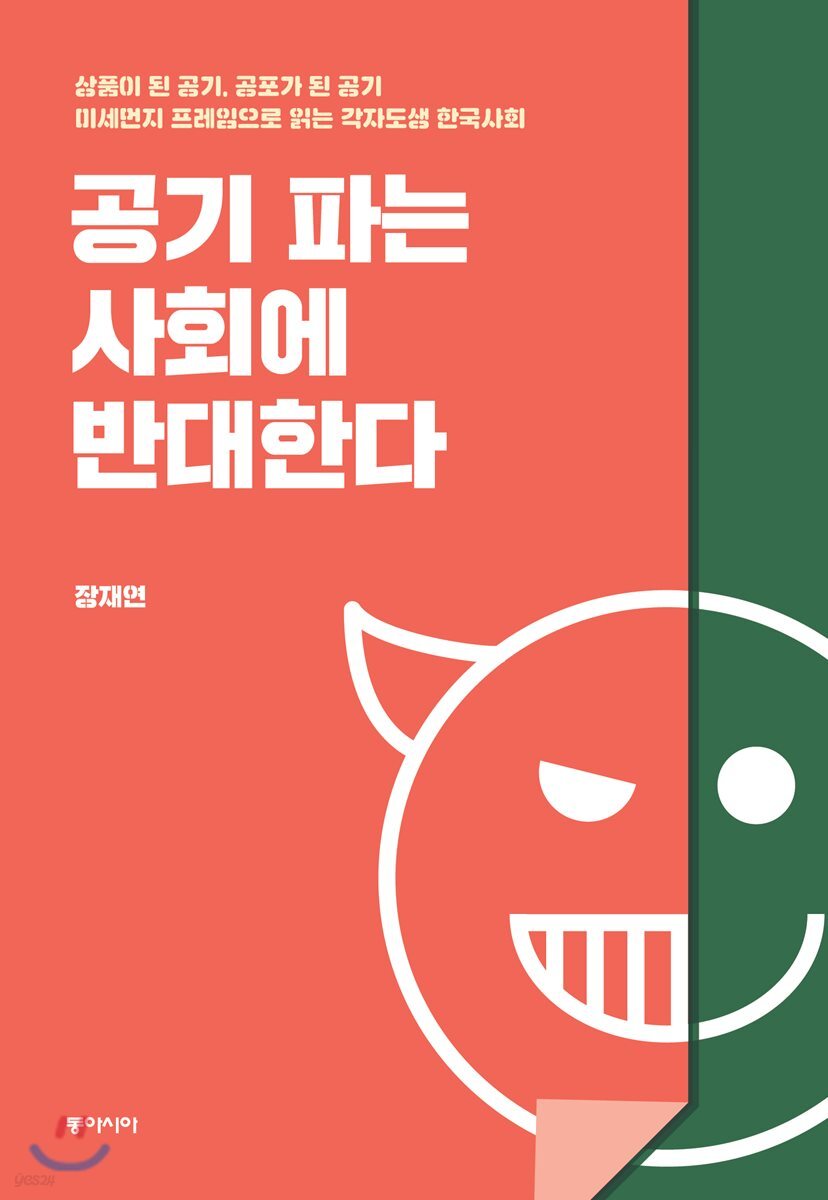
I oppose a society that sells air
 |
Description
Book Introduction
Who makes 'air' a commodity?
: The response to fine dust is the true face of Korean society!
Professor Jang Jae-yeon, a fine dust researcher with 30 years of experience in the environmental movement, discusses the geocentric theory of fine dust in Korean society in 2019.
: Reading the Korean society of each person living for themselves through the frame of fine dust!
“2019, The World is Confusion in the Dust”
The song [Misery] released by singer UV last month says that the world in 2019 is in a state of chaos due to dust.
The concept of Hite Jinro's beer brand 'Terra', launched this year, is clean lager.
They advertise that they are “concerned about cleanliness in the era of ultrafine dust,” and that even the malt, the raw material for beer, is imported from Australia’s Golden Triangle, which has the world’s best air quality.
Fine dust has entered deep into our lives, not to mention the lyrics of popular songs.
Products designed to avoid 'fine dust' are also appearing one after another.
Amorepacific's 'Fresh Pop' shampoo recommends a fine dust diet, and YouTube is overflowing with advertisements for various 'fine dust cleansing methods' and cosmetics such as cleansing products.
With the slogans, “Carry clean air with you” and “Give the gift of air,” even a portable mini air purifier (LG PuriCare) has appeared.
The 'air-selling society' has finally arrived.
These fine dust-related products and cultural phenomena demonstrate our stark fear of fine dust.
According to the 2018 report of the Korea Institute for Health and Social Affairs titled ‘Study on Social Integration Diagnosis and Response Measures (IV)’, ‘air pollution such as fine dust’ was selected as the item with the highest level of anxiety among various risks.
Professor Jang Jae-yeon (Ajou University School of Medicine, Co-representative of the Korean Federation for Environmental Movements), author of “Oppose a Society That Sells Air,” has been consistently researching air pollution issues, including fine dust, since publishing his doctoral thesis analyzing data on fine dust in Seoul in 1988, while also continuing his environmental activism for over 30 years.
The author points out that government ministries, the media, academia, and businesses have caused or contributed to this phenomenon, and likens the belief in and spread of misinformation to the 'geocentric theory' of fine dust.
Companies are using "fear marketing" to encourage people to protect themselves, and academia is focusing on developing high-performance masks and air purifiers and measuring pollution instead of researching ways to reduce sources of pollution.
This book scientifically approaches misconceptions about fine dust based on concrete data and verified materials, while also viewing the series of situations surrounding "fine dust" as a social phenomenon and examining how false information and fake news disguised as science are produced and spread.
At the same time, it specifically suggests what needs to be done now to solve the problem of fine dust together rather than leaving it to individuals.
: The response to fine dust is the true face of Korean society!
Professor Jang Jae-yeon, a fine dust researcher with 30 years of experience in the environmental movement, discusses the geocentric theory of fine dust in Korean society in 2019.
: Reading the Korean society of each person living for themselves through the frame of fine dust!
“2019, The World is Confusion in the Dust”
The song [Misery] released by singer UV last month says that the world in 2019 is in a state of chaos due to dust.
The concept of Hite Jinro's beer brand 'Terra', launched this year, is clean lager.
They advertise that they are “concerned about cleanliness in the era of ultrafine dust,” and that even the malt, the raw material for beer, is imported from Australia’s Golden Triangle, which has the world’s best air quality.
Fine dust has entered deep into our lives, not to mention the lyrics of popular songs.
Products designed to avoid 'fine dust' are also appearing one after another.
Amorepacific's 'Fresh Pop' shampoo recommends a fine dust diet, and YouTube is overflowing with advertisements for various 'fine dust cleansing methods' and cosmetics such as cleansing products.
With the slogans, “Carry clean air with you” and “Give the gift of air,” even a portable mini air purifier (LG PuriCare) has appeared.
The 'air-selling society' has finally arrived.
These fine dust-related products and cultural phenomena demonstrate our stark fear of fine dust.
According to the 2018 report of the Korea Institute for Health and Social Affairs titled ‘Study on Social Integration Diagnosis and Response Measures (IV)’, ‘air pollution such as fine dust’ was selected as the item with the highest level of anxiety among various risks.
Professor Jang Jae-yeon (Ajou University School of Medicine, Co-representative of the Korean Federation for Environmental Movements), author of “Oppose a Society That Sells Air,” has been consistently researching air pollution issues, including fine dust, since publishing his doctoral thesis analyzing data on fine dust in Seoul in 1988, while also continuing his environmental activism for over 30 years.
The author points out that government ministries, the media, academia, and businesses have caused or contributed to this phenomenon, and likens the belief in and spread of misinformation to the 'geocentric theory' of fine dust.
Companies are using "fear marketing" to encourage people to protect themselves, and academia is focusing on developing high-performance masks and air purifiers and measuring pollution instead of researching ways to reduce sources of pollution.
This book scientifically approaches misconceptions about fine dust based on concrete data and verified materials, while also viewing the series of situations surrounding "fine dust" as a social phenomenon and examining how false information and fake news disguised as science are produced and spread.
At the same time, it specifically suggests what needs to be done now to solve the problem of fine dust together rather than leaving it to individuals.
- You can preview some of the book's contents.
Preview
index
prolog
Part 1: The Science of Dust
: The Air That Became Fear: A Closer Look at Science
Dust Theory and Practice: Is Air Pollution Worst Ever?
The Fear of Dust: From the Birth of Korean "Ultrafine Dust" to the Designation of a "Class 1 Carcinogen"
Is Korea's air pollution among the worst in the world?
Ranking of countries with premature deaths and disease burden due to fine dust
What are the criteria for risk (1): The World Health Organization's fine dust standards are not criteria for disease outbreaks.
What is the standard for risk (2): Focusing on comparison with the US AQI
Part 2: How the Fine Dust Frame Works for Us
Fine dust, from 'geocentric theory' to 'made in China'
In search of the origin of the 'geocentric theory' of fine dust
A Scientific Approach to Fine Dust from China
How much influence does fine dust from China have? A case study of fine dust movement between European countries.
Is it okay if the fine dust in summer doesn't come from China?
How long are we going to keep blaming China?
Part 3: How Unscientific Became Belief
: Speaking about the production and spread of false news
South Korea, fooled by computer graphics fine dust
How Airborne Fear Is Created: Misreading the Paper That Created the "3 Hours and 40 Minutes of Smoke Inhalation" Theory and News Coverage
When Misinformation Calls It Science: Reports on "South Korea-China Joint Research" Miss Fact-Checking
When Misinterpretations Become News: Nature Reports 30,000 Premature Deaths Caused by Fine Dust from China
Is Dust Getting Smaller and More Toxic?: The Production and Expansion of False Fine Dust Reports
Part 4: Why Air Became a Personal Responsibility
: For the air to belong to everyone
Masks cannot be a solution to fine dust.
The second-order vehicle system cannot be a solution to fine dust.
It's not a problem with the fine dust measurement network.
I support shutting down aging coal-fired power plants.
How New York and London, the Worst Polluted Cities, Became Cleaner
What we can do now to reduce fine dust
What should we do to protect children?
Epilogue
Americas
Part 1: The Science of Dust
: The Air That Became Fear: A Closer Look at Science
Dust Theory and Practice: Is Air Pollution Worst Ever?
The Fear of Dust: From the Birth of Korean "Ultrafine Dust" to the Designation of a "Class 1 Carcinogen"
Is Korea's air pollution among the worst in the world?
Ranking of countries with premature deaths and disease burden due to fine dust
What are the criteria for risk (1): The World Health Organization's fine dust standards are not criteria for disease outbreaks.
What is the standard for risk (2): Focusing on comparison with the US AQI
Part 2: How the Fine Dust Frame Works for Us
Fine dust, from 'geocentric theory' to 'made in China'
In search of the origin of the 'geocentric theory' of fine dust
A Scientific Approach to Fine Dust from China
How much influence does fine dust from China have? A case study of fine dust movement between European countries.
Is it okay if the fine dust in summer doesn't come from China?
How long are we going to keep blaming China?
Part 3: How Unscientific Became Belief
: Speaking about the production and spread of false news
South Korea, fooled by computer graphics fine dust
How Airborne Fear Is Created: Misreading the Paper That Created the "3 Hours and 40 Minutes of Smoke Inhalation" Theory and News Coverage
When Misinformation Calls It Science: Reports on "South Korea-China Joint Research" Miss Fact-Checking
When Misinterpretations Become News: Nature Reports 30,000 Premature Deaths Caused by Fine Dust from China
Is Dust Getting Smaller and More Toxic?: The Production and Expansion of False Fine Dust Reports
Part 4: Why Air Became a Personal Responsibility
: For the air to belong to everyone
Masks cannot be a solution to fine dust.
The second-order vehicle system cannot be a solution to fine dust.
It's not a problem with the fine dust measurement network.
I support shutting down aging coal-fired power plants.
How New York and London, the Worst Polluted Cities, Became Cleaner
What we can do now to reduce fine dust
What should we do to protect children?
Epilogue
Americas
Into the book
The science that explains fine dust, which is believed in by the academic, political, media, and even citizens of South Korea today, is similar to the geocentric theory.
They do not believe that fine dust is caused by our daily lives and industries, such as fossil fuels and waste incineration, but rather that it comes from neighboring countries and that we are only suffering the consequences.
The geocentric theory of fine dust has not solved anything in the past five years.
It only served to fuel fear and anger towards neighboring countries.
While our neighboring country improved its fine dust pollution level by 40%, we wasted time by standing still.
--- p.8
Just because pollution levels have improved compared to the past, we must never stop or become lazy in our efforts to improve it.
This is because pollution is getting worse again.
Although fine dust pollution has improved, further improvement is needed.
Therefore, the public's great concern can be a very positive phenomenon in that it can act as a powerful driving force for environmental improvement.
Even so, it is difficult to significantly distort scientific or historical facts themselves.
They incite people to believe that the current situation is the worst possible one, and they indiscriminately push forward various policies, alternatives, or absurd and ineffective measures that have already been implemented in the past as if they were something completely new and ingenious. This only exacerbates policy confusion and hinders problem solving.
--- p.28~29
A frequently cited figure to emphasize the severity of the health damage caused by fine dust pollution is that the number of premature deaths due to fine dust exceeds 10,000 per year.
It is also added that “China has over a million people.”
‘Early death due to fine dust’ does not mean that fine dust was recorded as the cause of death on the death certificate or that it was individually diagnosed.
The number of premature deaths due to fine dust is a statistically estimated figure using several variables, such as fine dust pollution level and mortality rate by disease.
Therefore, if it is mistaken for the actual number of deaths or is misused without understanding its meaning, misunderstandings or errors may occur.
This figure was developed to evaluate the health, economic, and social effects of reducing fine dust.
--- p.59
Because fine dust is generated from heating, cooking, transportation, industry, and construction, there is virtually no way for countries with severe pollution to meet WHO standards in the short term.
Historical experience has shown us that the only practical and effective way to achieve this is to set standards that can be achieved through diligent effort, appropriate to one's circumstances, and then, once that goal is achieved, to strengthen the standards again and continue to improve them.
The World Health Organization's guidelines present the most ideal values from a health perspective, without any consideration of economic, social, or technological conditions.
Therefore, it is very difficult to achieve this guideline.
In most countries, the call to adopt this as an environmental standard is nothing more than an empty slogan.
The World Health Organization is also well aware of this fact, and so it presents several interim goals for each stage along with its guidelines.
--- p.90~92
The 'bad' level, which is considered to affect the general public, is 255㎍/㎥ or higher in the US, which is more than three times the 'bad' level standard in Korea, which is 81㎍/㎥.
The standards for determining PM10 concentration in Korea and the United States are so different that it is difficult to understand with common sense, which can lead to absurd situations.
Fine dust caused by natural phenomena such as yellow dust has relatively large particles, so even if the PM10 concentration increases significantly, PM2.5 does not increase much.
Therefore, even when light yellow dust occurs, the PM2.5 standard often remains in the low concentration range of 'normal' or 'bad'.
Even if the PM10 concentration on a day like this rises to an average of 150㎍/㎥ per day, it is considered 'normal' by American standards, but in our country, they report it as if it is 'very bad' and use all sorts of scary expressions to make it seem like there is chaos.
Our country has an average annual fine dust pollution level more than twice that of the United States, and only adopted the annual average standard earlier this year, which the United States had strengthened long ago.
Still, it is difficult to understand the basis for setting the daily average standard so much higher than that of the United States.
--- p.102~103
If we believe there is nothing we can do to reduce fine dust, anxiety and anger will grow, and we will have no choice but to find our own way.
With the constant stream of media interviews with experts who incite and promote fear of fine dust, like adding fuel to the fire, people have come to believe that even going outside can cause serious problems.
It is only natural that people are trying to find ways to survive by wearing masks and buying air purifiers.
The government and experts' recommendations for mask-wearing, combined with promotional campaigns by air purifier companies, have led to a massive surge in sales for related industries.
This phenomenon immediately sparked a trend of actively using fine dust in all other commercial advertisements and promotions.
The so-called golden age of fine dust fear marketing has arrived.
--- p.116
They say that reducing domestic fine dust emissions is useless because fine dust from China is the cause of the problem, but this argument goes against basic common sense.
Even those who claim that fine dust from China has an absolute impact would probably cover their noses and avoid a passing car spewing out exhaust fumes.
There are probably a significant number of residents who suffer from air pollutants emitted from factories around their residential areas.
It is a fact that is very clear from experience that the pollution that occurs around us has the greatest negative impact on us.
Therefore, reducing the amount of fine dust generated domestically will have an immediate positive effect on us.
There is also evidence that during the period when we stopped blaming China and worked hard to reduce our internal pollutants, fine dust pollution levels actually improved significantly.
An analysis of Seoul City data shows that during periods when efforts were made to actively reduce fine dust emissions, fine dust pollution levels significantly improved.
Although the performance each year is slightly uneven due to the influence of weather conditions, the improvement has been exactly equivalent to the reduction rate of fine dust emissions over the past 10 years.
--- p.142~143
Even in the field of air pollution, research on calculating the contribution of fine dust from China, for example, is quite difficult.
Moreover, without China's cooperation, it is frustrating but understandable that the Ministry of Environment and the National Institute of Environmental Research are causing confusion in this field and have yet to produce reliable results.
However, the trend of changes in air pollution can be clearly explained with relatively simple statistics.
Since the automatic air pollution monitoring network began operating in 1983, air pollution data collection has been ongoing for a whopping 35 years.
If so, the government can clearly inform the public that the current level of fine dust pollution in our country is not the worst ever.
However, the Vice Minister of Environment and all public officials are silent about the misunderstandings of our people, evading and taking no action, perhaps to avoid being criticized.
Because of this, when environmental groups and some journalists tell the truth that fine dust pollution levels are lower now than in the past, they are subject to insults such as, “Are you a Chinese spy?” and “How much money did you receive from China?”
It is difficult to understand how the Ministry of Environment can solve the fine dust problem when it is so cowardly and incompetent that it cannot even explain basic facts about fine dust to the public.
--- p.241~242
Internationally, medical and health government agencies are cautioning against wearing masks when fine dust pollution occurs, rather than recommending it.
The American Thoracic Society, which was founded in 1905 and has over 15,000 physicians and scientists as members, clearly states in its guidelines that wearing protective masks can cause physical strain by making it harder for people to breathe, increase breathing frequency by reducing tidal volume, reduce ventilation in the alveoli and lungs, and possibly even cause adverse effects such as reduced cardiac output.
--- p.251
However, it is impossible to reduce the pollution level by one-third to 100㎍/㎥ on a day when the concentration of fine dust is 150㎍/㎥, even if it means incurring enormous costs and inconveniences.
This is a clear fact not only in this case of Seoul, but also in all cases to date.
On the other hand, we have experienced that reducing the annual average pollution level by not only 1㎍/㎥ but also more is possible, and this has been proven in numerous cities in advanced countries.
South Korea has tens of millions of cars on the road and consumes a huge amount of fossil fuels, with per capita greenhouse gas emissions at a world-class level. The claim that there is no room for further reduction in fine dust emissions is nothing more than a reckless statement.
They do not believe that fine dust is caused by our daily lives and industries, such as fossil fuels and waste incineration, but rather that it comes from neighboring countries and that we are only suffering the consequences.
The geocentric theory of fine dust has not solved anything in the past five years.
It only served to fuel fear and anger towards neighboring countries.
While our neighboring country improved its fine dust pollution level by 40%, we wasted time by standing still.
--- p.8
Just because pollution levels have improved compared to the past, we must never stop or become lazy in our efforts to improve it.
This is because pollution is getting worse again.
Although fine dust pollution has improved, further improvement is needed.
Therefore, the public's great concern can be a very positive phenomenon in that it can act as a powerful driving force for environmental improvement.
Even so, it is difficult to significantly distort scientific or historical facts themselves.
They incite people to believe that the current situation is the worst possible one, and they indiscriminately push forward various policies, alternatives, or absurd and ineffective measures that have already been implemented in the past as if they were something completely new and ingenious. This only exacerbates policy confusion and hinders problem solving.
--- p.28~29
A frequently cited figure to emphasize the severity of the health damage caused by fine dust pollution is that the number of premature deaths due to fine dust exceeds 10,000 per year.
It is also added that “China has over a million people.”
‘Early death due to fine dust’ does not mean that fine dust was recorded as the cause of death on the death certificate or that it was individually diagnosed.
The number of premature deaths due to fine dust is a statistically estimated figure using several variables, such as fine dust pollution level and mortality rate by disease.
Therefore, if it is mistaken for the actual number of deaths or is misused without understanding its meaning, misunderstandings or errors may occur.
This figure was developed to evaluate the health, economic, and social effects of reducing fine dust.
--- p.59
Because fine dust is generated from heating, cooking, transportation, industry, and construction, there is virtually no way for countries with severe pollution to meet WHO standards in the short term.
Historical experience has shown us that the only practical and effective way to achieve this is to set standards that can be achieved through diligent effort, appropriate to one's circumstances, and then, once that goal is achieved, to strengthen the standards again and continue to improve them.
The World Health Organization's guidelines present the most ideal values from a health perspective, without any consideration of economic, social, or technological conditions.
Therefore, it is very difficult to achieve this guideline.
In most countries, the call to adopt this as an environmental standard is nothing more than an empty slogan.
The World Health Organization is also well aware of this fact, and so it presents several interim goals for each stage along with its guidelines.
--- p.90~92
The 'bad' level, which is considered to affect the general public, is 255㎍/㎥ or higher in the US, which is more than three times the 'bad' level standard in Korea, which is 81㎍/㎥.
The standards for determining PM10 concentration in Korea and the United States are so different that it is difficult to understand with common sense, which can lead to absurd situations.
Fine dust caused by natural phenomena such as yellow dust has relatively large particles, so even if the PM10 concentration increases significantly, PM2.5 does not increase much.
Therefore, even when light yellow dust occurs, the PM2.5 standard often remains in the low concentration range of 'normal' or 'bad'.
Even if the PM10 concentration on a day like this rises to an average of 150㎍/㎥ per day, it is considered 'normal' by American standards, but in our country, they report it as if it is 'very bad' and use all sorts of scary expressions to make it seem like there is chaos.
Our country has an average annual fine dust pollution level more than twice that of the United States, and only adopted the annual average standard earlier this year, which the United States had strengthened long ago.
Still, it is difficult to understand the basis for setting the daily average standard so much higher than that of the United States.
--- p.102~103
If we believe there is nothing we can do to reduce fine dust, anxiety and anger will grow, and we will have no choice but to find our own way.
With the constant stream of media interviews with experts who incite and promote fear of fine dust, like adding fuel to the fire, people have come to believe that even going outside can cause serious problems.
It is only natural that people are trying to find ways to survive by wearing masks and buying air purifiers.
The government and experts' recommendations for mask-wearing, combined with promotional campaigns by air purifier companies, have led to a massive surge in sales for related industries.
This phenomenon immediately sparked a trend of actively using fine dust in all other commercial advertisements and promotions.
The so-called golden age of fine dust fear marketing has arrived.
--- p.116
They say that reducing domestic fine dust emissions is useless because fine dust from China is the cause of the problem, but this argument goes against basic common sense.
Even those who claim that fine dust from China has an absolute impact would probably cover their noses and avoid a passing car spewing out exhaust fumes.
There are probably a significant number of residents who suffer from air pollutants emitted from factories around their residential areas.
It is a fact that is very clear from experience that the pollution that occurs around us has the greatest negative impact on us.
Therefore, reducing the amount of fine dust generated domestically will have an immediate positive effect on us.
There is also evidence that during the period when we stopped blaming China and worked hard to reduce our internal pollutants, fine dust pollution levels actually improved significantly.
An analysis of Seoul City data shows that during periods when efforts were made to actively reduce fine dust emissions, fine dust pollution levels significantly improved.
Although the performance each year is slightly uneven due to the influence of weather conditions, the improvement has been exactly equivalent to the reduction rate of fine dust emissions over the past 10 years.
--- p.142~143
Even in the field of air pollution, research on calculating the contribution of fine dust from China, for example, is quite difficult.
Moreover, without China's cooperation, it is frustrating but understandable that the Ministry of Environment and the National Institute of Environmental Research are causing confusion in this field and have yet to produce reliable results.
However, the trend of changes in air pollution can be clearly explained with relatively simple statistics.
Since the automatic air pollution monitoring network began operating in 1983, air pollution data collection has been ongoing for a whopping 35 years.
If so, the government can clearly inform the public that the current level of fine dust pollution in our country is not the worst ever.
However, the Vice Minister of Environment and all public officials are silent about the misunderstandings of our people, evading and taking no action, perhaps to avoid being criticized.
Because of this, when environmental groups and some journalists tell the truth that fine dust pollution levels are lower now than in the past, they are subject to insults such as, “Are you a Chinese spy?” and “How much money did you receive from China?”
It is difficult to understand how the Ministry of Environment can solve the fine dust problem when it is so cowardly and incompetent that it cannot even explain basic facts about fine dust to the public.
--- p.241~242
Internationally, medical and health government agencies are cautioning against wearing masks when fine dust pollution occurs, rather than recommending it.
The American Thoracic Society, which was founded in 1905 and has over 15,000 physicians and scientists as members, clearly states in its guidelines that wearing protective masks can cause physical strain by making it harder for people to breathe, increase breathing frequency by reducing tidal volume, reduce ventilation in the alveoli and lungs, and possibly even cause adverse effects such as reduced cardiac output.
--- p.251
However, it is impossible to reduce the pollution level by one-third to 100㎍/㎥ on a day when the concentration of fine dust is 150㎍/㎥, even if it means incurring enormous costs and inconveniences.
This is a clear fact not only in this case of Seoul, but also in all cases to date.
On the other hand, we have experienced that reducing the annual average pollution level by not only 1㎍/㎥ but also more is possible, and this has been proven in numerous cities in advanced countries.
South Korea has tens of millions of cars on the road and consumes a huge amount of fossil fuels, with per capita greenhouse gas emissions at a world-class level. The claim that there is no room for further reduction in fine dust emissions is nothing more than a reckless statement.
--- p.307~308
Publisher's Review
Everything About Fine Dust Revealed by Science
Are masks safe? How bad is air pollution in Korea?
The fear of air pollution is based on the perception that fine dust pollution has worsened rapidly in recent years.
Here the author presents data and asks a question.
Looking at the frequency of occurrence of high-concentration fine dust (PM10) pollution in Seoul over the past 10 years, we can see that the frequency of days with relatively high concentrations of pollution of 100㎍/㎥ or more has decreased significantly.
Days with much higher pollution levels of 150㎍/㎥ or more or 250㎍/㎥ or more also decreased.
Since 2012, when the average annual level of fine dust pollution temporarily increased again, the frequency of high-concentration pollution also temporarily increased and then decreased again.
According to the World Health Organization, Korea's premature death rate due to fine dust (PM2.5) is 18 per 100,000 people, ranking 27th in the world.
Even when looking at DALY (Disability Adjusted Life Year), a widely used disease burden indicator in the health field, the disease burden was 394 years per 100,000 people, ranking 29th in the world.
DALY refers to the number of years of healthy life lost due to premature death, disease, disability, etc.
The author warns against excessive fear and fear-mongering, saying that Korea's air quality is among the best in the world.
We counter the 'fine dust geocentric theory' by accurately pointing out misinformation about fine dust.
Regarding the recommendation to wear a mask on days with high levels of fine dust pollution, the book accurately points out common misconceptions by citing mask usage recommendations issued by the American Thoracic Society, the U.S. FDA, and the Singapore government.
Is all fine dust 'made in China'?
The 'real' impact of the fine dust theory from China on our society
Professor Jang Jae-yeon says that continuous efforts to improve air pollution, including fine dust, must continue.
However, I would like to emphasize that the method should be different from now.
It raises questions about the fact that most of the causes of fine dust are attributed to China, and points out that the data is based on unclear evidence and that there are various problems that arise when responsibility is shifted to external sources.
Above all, we raise a problem with the Ministry of Environment's claim that the contribution rate of fine dust from China, presented through an air quality prediction model, is between 30% and 86%.
An air quality prediction model is a program that uses mathematical equations to calculate spatial and temporal concentration changes of pollutants.
The model currently primarily used by the Ministry of Environment to measure the contribution rate of fine dust is the CMAQ model developed by the U.S. Environmental Protection Agency. It is a public program that anyone can easily download and use.
The problem is securing the right input data, but if researchers arbitrarily select or modify input variables, they can produce any desired results.
Citing the saying, “Garbage in, garbage out,” the author raises issues with the data provided by the Ministry of Environment.
In fact, the Ministry of Environment stated in its submission to the National Assembly audit that the modeling results they were publishing were calculated using estimates due to the lack of data on sources of fine dust in China.
The author states that the most important input data for air quality modeling are pollutant source data and meteorological data, and that joint research with neighboring countries is inevitable to quantitatively assess the impact on neighboring countries.
What I am saying is that we need a more intelligent and rational environmental diplomacy.
At the same time, the way governments and businesses shirk their responsibilities hides what we can do now, including regulations to reduce fine dust.
Why Air Became a Personal Responsibility
: For the air to belong to everyone
So, what can we do to reduce air pollution, including fine dust? The author argues that the health effects of air pollution are not limited to short-term, high-concentration exposure, but also occur over long periods of time.
There are long-term standards (annual average) and short-term standards (daily average) established, but which of the two standards requires more attention may vary depending on the level of pollution and the circumstances of each country or city.
The authors say that in cities where the average annual pollution level is less than 50㎍/㎥, the pollution level may increase significantly on a particular day to around 200㎍/㎥, and that short-term exposure at this level does not cause any significant health problems.
The author says that most fine dust measures, such as mask distribution and vehicle quota system, are short-term measures for high-concentration pollution, and that since the average annual fine dust pollution level in most cities in Korea is less than 50㎍/㎥, long-term measures to reduce normal pollution are needed rather than short-term measures for high-concentration pollution.
It also suggests ways to address the problems with existing policies and the direction in which they should proceed, such as reducing fuel consumption, replacing with fuel that produces less fine dust, replacing or closing down aging facilities or equipment, or using dust collectors to prevent pollutants from being emitted into the atmosphere.
Air is a condition of life that everyone should naturally enjoy, and that is why air pollution must be continuously improved by society, not by individuals.
It also corrects misconceptions and claims, such as the change in the location of air pollution monitoring stations, and examines how cities once considered the most polluted, such as New York and London, became clean cities, suggesting alternatives.
Helps understanding through concrete visual aids such as graphs, tables, and pictures.
Are masks safe? How bad is air pollution in Korea?
The fear of air pollution is based on the perception that fine dust pollution has worsened rapidly in recent years.
Here the author presents data and asks a question.
Looking at the frequency of occurrence of high-concentration fine dust (PM10) pollution in Seoul over the past 10 years, we can see that the frequency of days with relatively high concentrations of pollution of 100㎍/㎥ or more has decreased significantly.
Days with much higher pollution levels of 150㎍/㎥ or more or 250㎍/㎥ or more also decreased.
Since 2012, when the average annual level of fine dust pollution temporarily increased again, the frequency of high-concentration pollution also temporarily increased and then decreased again.
According to the World Health Organization, Korea's premature death rate due to fine dust (PM2.5) is 18 per 100,000 people, ranking 27th in the world.
Even when looking at DALY (Disability Adjusted Life Year), a widely used disease burden indicator in the health field, the disease burden was 394 years per 100,000 people, ranking 29th in the world.
DALY refers to the number of years of healthy life lost due to premature death, disease, disability, etc.
The author warns against excessive fear and fear-mongering, saying that Korea's air quality is among the best in the world.
We counter the 'fine dust geocentric theory' by accurately pointing out misinformation about fine dust.
Regarding the recommendation to wear a mask on days with high levels of fine dust pollution, the book accurately points out common misconceptions by citing mask usage recommendations issued by the American Thoracic Society, the U.S. FDA, and the Singapore government.
Is all fine dust 'made in China'?
The 'real' impact of the fine dust theory from China on our society
Professor Jang Jae-yeon says that continuous efforts to improve air pollution, including fine dust, must continue.
However, I would like to emphasize that the method should be different from now.
It raises questions about the fact that most of the causes of fine dust are attributed to China, and points out that the data is based on unclear evidence and that there are various problems that arise when responsibility is shifted to external sources.
Above all, we raise a problem with the Ministry of Environment's claim that the contribution rate of fine dust from China, presented through an air quality prediction model, is between 30% and 86%.
An air quality prediction model is a program that uses mathematical equations to calculate spatial and temporal concentration changes of pollutants.
The model currently primarily used by the Ministry of Environment to measure the contribution rate of fine dust is the CMAQ model developed by the U.S. Environmental Protection Agency. It is a public program that anyone can easily download and use.
The problem is securing the right input data, but if researchers arbitrarily select or modify input variables, they can produce any desired results.
Citing the saying, “Garbage in, garbage out,” the author raises issues with the data provided by the Ministry of Environment.
In fact, the Ministry of Environment stated in its submission to the National Assembly audit that the modeling results they were publishing were calculated using estimates due to the lack of data on sources of fine dust in China.
The author states that the most important input data for air quality modeling are pollutant source data and meteorological data, and that joint research with neighboring countries is inevitable to quantitatively assess the impact on neighboring countries.
What I am saying is that we need a more intelligent and rational environmental diplomacy.
At the same time, the way governments and businesses shirk their responsibilities hides what we can do now, including regulations to reduce fine dust.
Why Air Became a Personal Responsibility
: For the air to belong to everyone
So, what can we do to reduce air pollution, including fine dust? The author argues that the health effects of air pollution are not limited to short-term, high-concentration exposure, but also occur over long periods of time.
There are long-term standards (annual average) and short-term standards (daily average) established, but which of the two standards requires more attention may vary depending on the level of pollution and the circumstances of each country or city.
The authors say that in cities where the average annual pollution level is less than 50㎍/㎥, the pollution level may increase significantly on a particular day to around 200㎍/㎥, and that short-term exposure at this level does not cause any significant health problems.
The author says that most fine dust measures, such as mask distribution and vehicle quota system, are short-term measures for high-concentration pollution, and that since the average annual fine dust pollution level in most cities in Korea is less than 50㎍/㎥, long-term measures to reduce normal pollution are needed rather than short-term measures for high-concentration pollution.
It also suggests ways to address the problems with existing policies and the direction in which they should proceed, such as reducing fuel consumption, replacing with fuel that produces less fine dust, replacing or closing down aging facilities or equipment, or using dust collectors to prevent pollutants from being emitted into the atmosphere.
Air is a condition of life that everyone should naturally enjoy, and that is why air pollution must be continuously improved by society, not by individuals.
It also corrects misconceptions and claims, such as the change in the location of air pollution monitoring stations, and examines how cities once considered the most polluted, such as New York and London, became clean cities, suggesting alternatives.
Helps understanding through concrete visual aids such as graphs, tables, and pictures.
GOODS SPECIFICS
- Date of issue: May 14, 2019
- Page count, weight, size: 324 pages | 405g | 138*200*22mm
- ISBN13: 9788962622805
- ISBN10: 8962622807
You may also like
카테고리
korean


korean

![GQ KOREA Mark (Monthly): December [2025]](http://librairie.coreenne.fr/cdn/shop/files/8ef265dbbfbf186523ed75ba7319009d.jpg?v=1765340328&width=3840)


