

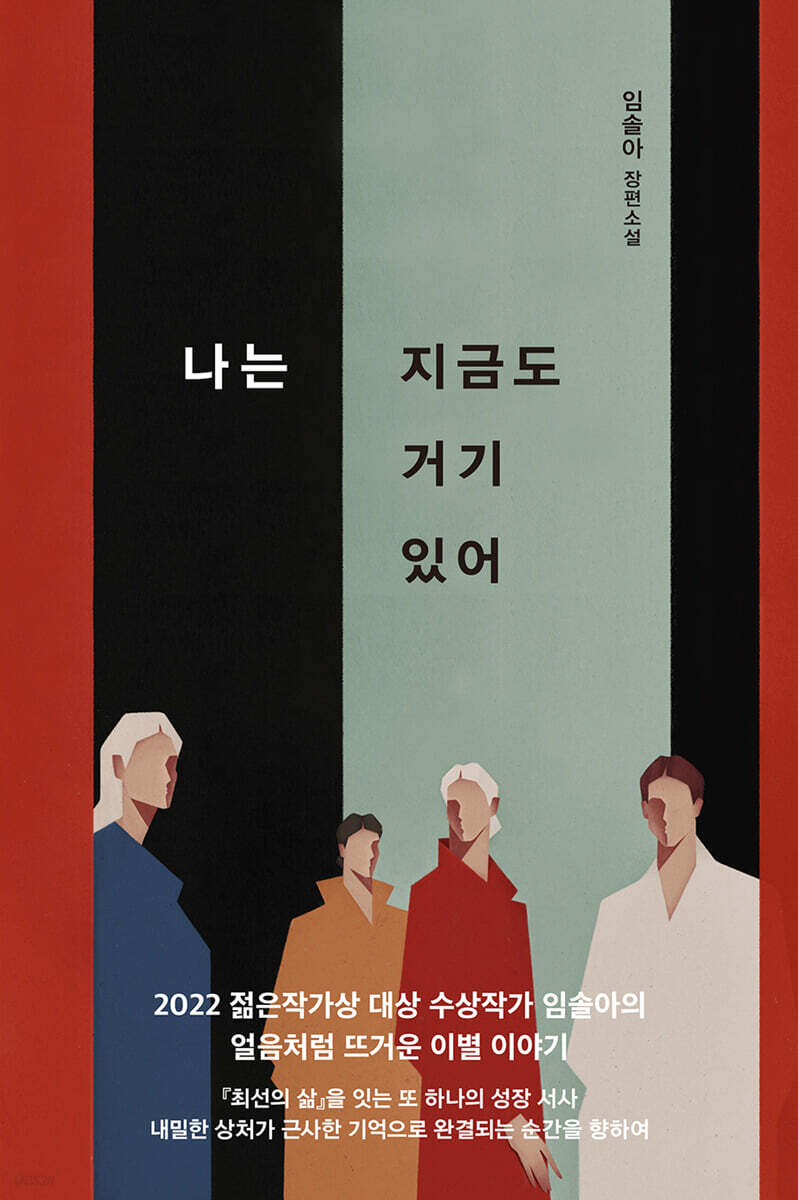
I'm still there
 |
Description
Book Introduction
- A word from MD
- After the hurt and the breakup, we finally grew.A new work by Lim Sol-a, winner of the 2022 Young Writer Award and representative of contemporary sensibilities.
Four people who have been hurt in their relationships with others come together to create a work of art.
It depicts the process of awkwardly coming together, dealing with past separations, and growing.
A novel where the author's detailed writing style shines even brighter when met with a cool gaze.
October 4, 2023. Novel/Poetry PD Kim Yu-ri
2022 Young Writer Award Grand Prize Winner, Im Sol-ah
A breakup story as hot as ice
The second full-length novel, "I'm Still There," by author Im Sol-ah, who has been depicting the passionate movements of those who try to live without losing themselves in a world made up of others who are different from themselves, has been published.
This is a long story presented eight years after his first full-length novel, "The Best Life," which unhesitatingly follows the most ruthless and cruel path of growth experienced by a runaway youth.
In "The Best Life," Im Sol-ah's characters, who fiercely relive the nightmares of their teenage years that seemed impossible to escape, reach "I'm Still There," where they overcome their own intimate wounds and learn how to live a life prepared for them after their grief.
The novel follows the lives of four women who have lived different lives, from childhood to the present.
Each of them, who for their own reasons were considered a little different from others, have sacrificed themselves to fit into a desired group and to be with someone precious.
They experience firsthand through various heartbreaking breakups that relationships that can only be formed by losing oneself are bound to break.
Im Sol-ah portrays the affectionate and poignant feelings that the characters in the novel feel toward their lovers, friends, parents, and the complex and beautiful human beings with greater sensitivity than ever before.
As a result, even the icy moments of separation in this novel feel fiery, as if heated by invisible passions.
The commonality of having to erase themselves in order to be accepted by the outside world leads the four characters to participate in a group exhibition for artists struggling as minorities outside the establishment.
As four people who had no particular connection interact with each other, creating their own unique works of art from their lives, they discover that they can form affectionate relationships with one another without getting hurt.
Through my past breakups, I have found the right distance for me to be with others while still being myself.
The secret of life, that perhaps we have gone through painful times to reach this quietly shining moment of enlightenment, completes each of our deep wounds into a wonderful memory.
A breakup story as hot as ice
The second full-length novel, "I'm Still There," by author Im Sol-ah, who has been depicting the passionate movements of those who try to live without losing themselves in a world made up of others who are different from themselves, has been published.
This is a long story presented eight years after his first full-length novel, "The Best Life," which unhesitatingly follows the most ruthless and cruel path of growth experienced by a runaway youth.
In "The Best Life," Im Sol-ah's characters, who fiercely relive the nightmares of their teenage years that seemed impossible to escape, reach "I'm Still There," where they overcome their own intimate wounds and learn how to live a life prepared for them after their grief.
The novel follows the lives of four women who have lived different lives, from childhood to the present.
Each of them, who for their own reasons were considered a little different from others, have sacrificed themselves to fit into a desired group and to be with someone precious.
They experience firsthand through various heartbreaking breakups that relationships that can only be formed by losing oneself are bound to break.
Im Sol-ah portrays the affectionate and poignant feelings that the characters in the novel feel toward their lovers, friends, parents, and the complex and beautiful human beings with greater sensitivity than ever before.
As a result, even the icy moments of separation in this novel feel fiery, as if heated by invisible passions.
The commonality of having to erase themselves in order to be accepted by the outside world leads the four characters to participate in a group exhibition for artists struggling as minorities outside the establishment.
As four people who had no particular connection interact with each other, creating their own unique works of art from their lives, they discover that they can form affectionate relationships with one another without getting hurt.
Through my past breakups, I have found the right distance for me to be with others while still being myself.
The secret of life, that perhaps we have gone through painful times to reach this quietly shining moment of enlightenment, completes each of our deep wounds into a wonderful memory.
- You can preview some of the book's contents.
Preview
index
I.
I've been keeping my clothes on all day _007
II.
The End of Observation _085
III.
Chestnuts in the Brazier _171
IV.
I'm still there _247
Author's Note _324
I've been keeping my clothes on all day _007
II.
The End of Observation _085
III.
Chestnuts in the Brazier _171
IV.
I'm still there _247
Author's Note _324
Into the book
Hold on to the ladder and walk down into the water.
With each step you take, your body sinks into the water.
My feet don't touch the floor.
I'm not afraid of that anymore.
Rather, it is more free.
--- p.9
Seok-Hyeon was roller skating.
The roller skates rolled along making a clanking sound.
Seok-Hyeon roller-skated faster and faster.
The wedge, wedge sound began to be heard.
Seok-Hyeon ran well without falling.
Seok-Hyeon was so happy that he couldn't stop laughing.
The sound of the roller skates, creaking, creaking, creaking, the unending sound, only later did Seok-Hyeon realize it was the sound of a chainsaw.
It was the sound of a medical chainsaw cutting through Seok-Hyeon's arm bones.
Oh my, his eyes are open.
The nurse's face suddenly appeared.
Seok-Hyeon fell over while roller skating.
The sound of the chainsaw stopped.
--- p.44~45
Seok-Hyeon thought of the people he had been affectionate towards one by one.
Patients I met at the hospital.
Nurses and therapists.
Neighbors in the neighborhood.
People I met on the bus, subway, and convenience store.
And the kids who became Seok-Hyeon's friends.
It was an affectionate relationship, but it lacked depth.
The duration was also short.
So they could have been affectionate until the end.
It felt like I was living in an incubator.
I didn't consider their warmth to be pretentious or fake.
Like the expression on my grandfather's face as seen from behind the curtains of the hospital room, I didn't know that it was a look that could only be shown to someone who lacks persistence.
--- p.74
The universe has tasted the pleasure of excluding others.
The pleasure felt like the joy of friendship.
I came to understand why the girls in the universe's sample formed groups around people rather than play.
--- p.107
People were walking with their dogs.
The universe belatedly noticed the dog following the god.
That I wasn't thinking about Seonmi even though she wasn't by my side.
It was a desolate moment, like the moment I realized that the shadow that had been with me my entire life had disappeared.
The universe looked around.
He looked down at the palm of his hand.
It was as if he was trying to check if he was alive.
--- p.155
At the moment when one fell, the other did not fall.
There was silence as if they had made a promise.
Leaning on each other's silence for a moment, Woojoo and Seonmi safely separated.
--- p.165
At that moment, Bora knew.
I just didn't want to lose, I just never liked this job.
--- p.215~216
Innocent people who believe that just being together can change something.
I felt the excitement and innocence unique to dreamers.
That innocence seemed to Bora like that of a child who didn't know anything, but on the other hand, she hoped she was wrong.
Innocence is like a blush that comes out for a moment when you feel warm because someone is around you, so Bora also wanted to spend that time innocence.
At least that night, I wanted to look at their dreams.
--- p.243
Bora still fought.
Now, for Bora, fighting wasn't about glaring and clenching her fists.
It wasn't even about burning with the determination to win against someone or achieve victory.
It was a daily routine, like putting things in a shopping cart.
It was like looking around the stall, thinking about what foods you could make, and picking up a potato or a carrot.
--- p.245
Jeongsu still waited for Nuri's contact.
It was okay even if Nuri didn't say anything in the end.
I was still hearing that you didn't want to talk.
With each step you take, your body sinks into the water.
My feet don't touch the floor.
I'm not afraid of that anymore.
Rather, it is more free.
--- p.9
Seok-Hyeon was roller skating.
The roller skates rolled along making a clanking sound.
Seok-Hyeon roller-skated faster and faster.
The wedge, wedge sound began to be heard.
Seok-Hyeon ran well without falling.
Seok-Hyeon was so happy that he couldn't stop laughing.
The sound of the roller skates, creaking, creaking, creaking, the unending sound, only later did Seok-Hyeon realize it was the sound of a chainsaw.
It was the sound of a medical chainsaw cutting through Seok-Hyeon's arm bones.
Oh my, his eyes are open.
The nurse's face suddenly appeared.
Seok-Hyeon fell over while roller skating.
The sound of the chainsaw stopped.
--- p.44~45
Seok-Hyeon thought of the people he had been affectionate towards one by one.
Patients I met at the hospital.
Nurses and therapists.
Neighbors in the neighborhood.
People I met on the bus, subway, and convenience store.
And the kids who became Seok-Hyeon's friends.
It was an affectionate relationship, but it lacked depth.
The duration was also short.
So they could have been affectionate until the end.
It felt like I was living in an incubator.
I didn't consider their warmth to be pretentious or fake.
Like the expression on my grandfather's face as seen from behind the curtains of the hospital room, I didn't know that it was a look that could only be shown to someone who lacks persistence.
--- p.74
The universe has tasted the pleasure of excluding others.
The pleasure felt like the joy of friendship.
I came to understand why the girls in the universe's sample formed groups around people rather than play.
--- p.107
People were walking with their dogs.
The universe belatedly noticed the dog following the god.
That I wasn't thinking about Seonmi even though she wasn't by my side.
It was a desolate moment, like the moment I realized that the shadow that had been with me my entire life had disappeared.
The universe looked around.
He looked down at the palm of his hand.
It was as if he was trying to check if he was alive.
--- p.155
At the moment when one fell, the other did not fall.
There was silence as if they had made a promise.
Leaning on each other's silence for a moment, Woojoo and Seonmi safely separated.
--- p.165
At that moment, Bora knew.
I just didn't want to lose, I just never liked this job.
--- p.215~216
Innocent people who believe that just being together can change something.
I felt the excitement and innocence unique to dreamers.
That innocence seemed to Bora like that of a child who didn't know anything, but on the other hand, she hoped she was wrong.
Innocence is like a blush that comes out for a moment when you feel warm because someone is around you, so Bora also wanted to spend that time innocence.
At least that night, I wanted to look at their dreams.
--- p.243
Bora still fought.
Now, for Bora, fighting wasn't about glaring and clenching her fists.
It wasn't even about burning with the determination to win against someone or achieve victory.
It was a daily routine, like putting things in a shopping cart.
It was like looking around the stall, thinking about what foods you could make, and picking up a potato or a carrot.
--- p.245
Jeongsu still waited for Nuri's contact.
It was okay even if Nuri didn't say anything in the end.
I was still hearing that you didn't want to talk.
--- p.321
Publisher's Review
The effort to be yourself leaves scars
Wounds come together to become art.
Lim Sol-ah, who constantly questions the invisible line that divides the normal from the abnormal, brings together characters who straddle the world's various boundaries into her work.
The main characters of this novel are 'Hwayoung', who has an inconspicuous and legally unrecognized disability; 'Woojoo', a queer person who has been living with a fake identity but has found true love; 'Bora', a worker who paradoxically becomes the underdog while fighting against injustice; and 'Jeongsu', who suppressed her extraordinary creativity and empathy to live as a model student that society wanted, but has since discovered art.
The novel takes the form of four people's lives, each of which constitutes a separate chapter, and deals with the most actively discussed topics in Korean literature today through the lives of the characters.
Part 1: I've Protected My Clothes All Day - Hwayoung's Story
Hwayoung, who has lost hearing in one ear, retains hearing in the other ear, so according to the disability rating criteria, she is not recognized as having a disability.
Hwayoung, who struggles with daily life but is not disabled, has always felt anxious about not belonging anywhere.
Hwayoung's anxiety is further compounded by her inability to find a job after majoring in art theory, a field considered unconventional in the art world.
One day, Hwayoung receives an offer to participate as a critic in a group exhibition planned by the young artist Seokhyun.
Hwa-young, who was inspired by Seok-hyeon's passion to pursue artistic activities as much as he wanted without being restricted by his body despite having one of his wrists amputated, falls in love with him.
But as the passion that Seok-hyeon's disability may have brought out degenerates into selfishness that doesn't even consider Hwa-young, Hwa-young is forced to confront her true self, who had expected that the relationship between two people with disabilities would be different from that of non-disabled people.
What did you expect?
Why was Seok-Hyeon considered different?
Why did I ever think I could be different?
Did I ever think that the love between someone who had no hands and someone who was deaf in one ear would be different from that of other people, or that it should be so?
Was it because of my ears that I fell in love with Seok-Hyeon?
What if one ear could hear well?
But did I still fall in love with Seok-Hyeon? (Page 77)
Part 2: The End of Observation - The Story of the Universe
As a child, Woo-joo realized that he was different from his female friends of the same sex and hid his true self to fit in with his group of friends.
Woo-joo's daily life, always tense from observing and imitating the habits of his same-sex friends, changes when he meets Seon-mi after entering high school.
Woo-joo begins dating Seon-mi and spends time with her in her small room, enjoying time living as himself.
On the other hand, Seonmi is not satisfied with her life with the universe.
The universe does its best to make Seonmi's dream of living a comfortable and stable life come true.
But even if Sunmi goes to college, gets a job, and buys a car as she wants, Woo-joo, a biological woman, is destined to not be able to provide stability to Sunmi.
In order to somehow continue their relationship, which cannot be called lovers, Woo-joo imagines the kind of house Seon-mi would want to live in and creates a miniature model of it. He exhibits it in an exhibition planned by Seok-hyeon and invites Seon-mi to the exhibition.
“I want to say that you are my lover.”
Seonmi stared into space.
"lover?"
Seonmi tilted her head as if it was strange.
“I’m not your lover.”
(…)
“Then what is it?”
Seonmi scratched her forehead with her fingertips.
"doesn't exist.
The word that refers to us.” (pp. 158-159)
Part 3: Chestnuts in the Hearth Fire - Bora's Story
Bora grew up with parents who had a bad relationship and had to be careful.
Mom took advantage of the fact that Dad was particularly fond of Bora and told Bora to hug her Dad when they were fighting.
Bora always hugged her father for her mother, but her mother abandoned her when they divorced, saying she was closer to her father.
Bora, consumed by anger, blames herself for not being more aggressive in achieving what she wants, and begins to fight against the injustice with her whole body.
In the job she gets as an adult, instead of being influenced by her petty superior, Bora resists him and tries to remain a good person for her junior.
But no one pays attention to Bora's efforts.
Feeling empty, Bora leaves her job and becomes a "female special agent" who is mobilized for illegal sales promotions for a cigarette company targeting male consumers. She then changes jobs to become a tattoo artist, banned from doing business in Korea, and ends up living a life without institutional protection.
Before she knew it, Bora's fight had become less about doing the right thing and more about making a living.
Bora takes pictures of her tattoos and the eyes of the person who got them and exhibits them.
You should have fought instead of embracing.
As if I were going to throw everything away.
Bora released the two arms that had been wrapping around her body.
The fish tank is broken.
Water poured onto the floor.
Bora walked, treading water.
Open your eyes wide. (Page 190)
Part 4: I'm Still There - Jeongsu's Story
Although Jeongsu possesses outstanding empathy and exceptional expressiveness, his creativity was considered unusual and uncorrect as a child.
As he grows up, Jeong-su becomes a model student who behaves as society expects and gives the given answers.
There are instances where such integers fail to give the correct answer.
I failed to interpret my friend's intentions by looking at the picture he gave me.
As a result of that incident, Jeongsu became interested in the field of art, a field for which there are no set answers, and entered art school.
I listen to countless people's stories with all my heart, and create works to understand the parts of those stories that I, as a stranger, can never understand.
While preparing for the exhibition planned by Seok-hyeon, Jeong-su listens wholeheartedly to the stories of Hwa-yeong, Woo-joo, and Bora, and continues to participate in their stories even after the exhibition ends.
Jeongsu no longer dared to think of their story as his own.
But still, I didn't think of their story as someone else's story.
In the story, Jeongsu was in an invisible place. (Page 320)
As you turn the pages, the characters' narratives overlap and pile up, transforming the scenes in the novel into more vivid landscapes and becoming more meaningful.
As the four people gathered for the exhibition, each time someone's deep silence or seemingly meaningless words revealed personal struggles and sorrows, the feeling of understanding someone I didn't know well a little more deeply brought on a warm feeling and lingering emotion.
The unparalleled realism felt in fictional texts
Im Sol-a, the author who breaks down the layers of fiction and reality, presents
A very special novel experience
By the time readers reach Part 4, which contains Jeongsu's story, they will have a firsthand experience of the novel's sophisticated, multi-layered structure.
In Part 4, when we see that among the stories of various people that Jeong-su hears, there are contents reminiscent of the stories of Hwa-young, Woo-joo, and Bora, and that Jeong-su has been digesting the lives of others and expressing them in his own works, Parts 1-3, which were read as independent stories narrated by different characters, also come across as stories that Jeong-su heard from someone, processed, and told.
In that case, Part 4 can also be read as an epilogue in which Jeong-su, who has finished the previous story, tells his own story as the last character and then tells the remaining stories of the four main characters.
When understood in this way, this novel, which seemed to take the form of a serial novel, is woven into a long novel with a single, pervasive narrative.
The novel goes further and offers a very unique reading experience through its final scene.
It is an intense experience where the character Jeong-su in the novel and the reader outside the novel, who are in the same space and time, make eye contact.
Just as the narratives of Hwayoung, Woojoo, and Bora cross the frame, redefining the layers from the stories heard directly in their own voices to the stories within stories reborn through Jeongsu, the final scene of this novel nullifies the layers of fiction and reality, emerging from the story and appearing before our eyes as readers.
Or it draws us into the novel by giving readers outside the novel the possibility of becoming characters in the novel.
Lim Sol-ah, who successfully conducted an experiment that broke down the distinction between fiction and reality through her 2022 Young Writer's Award-winning work, "Caring for Fruit Flies," actively brings fiction and reality together in this full-length novel.
This passage suggests why the title of this novel was taken from Adrienne Rich's poem "A Scene," which expresses the resonance of multi-layered voices by overlapping the perspective of a narrator who cannot intervene in a tragic scene within the work with the limited perspective of an author outside the work.
In her “Author’s Note,” Im Sol-ah says, “Some days, I stayed up all night because my hands couldn’t stop writing novels,” and “I found this hardship so enjoyable during those days when my body was overworked,” and “I’m finally starting to understand a little bit why writers say writing novels is fun.”
It seems that the most interesting task for writers these days is to write a novel, a fictional text, in a way that evokes a special sense of reality in real readers.
For Im Sol-ah, a novel is neither a limited text that cannot transcend reality, nor an omnipotent work of art that can exist without real life.
Lim Sol-ah invites us to a place where novels confront readers with the same value as reality.
“I’m still there,” he said.
The person I knew the least about became the last person.
Only after writing the last sentence of the novel did I realize why Jeong-su was so faint, and why he had to be the last character in the novel.
I was glad that my novel had taken me to places I didn't know I could go.
I lost weight while writing the novel.
I was very sick for several months.
In the days when my body was being torn apart, I found this hardship so enjoyable.
Although writing novels has been painful before, this is the first time the pain has been this enjoyable.
Now I finally understand a little why writers say writing novels is fun.
_Im Sol-ah, from 'Author's Note'
Wounds come together to become art.
Lim Sol-ah, who constantly questions the invisible line that divides the normal from the abnormal, brings together characters who straddle the world's various boundaries into her work.
The main characters of this novel are 'Hwayoung', who has an inconspicuous and legally unrecognized disability; 'Woojoo', a queer person who has been living with a fake identity but has found true love; 'Bora', a worker who paradoxically becomes the underdog while fighting against injustice; and 'Jeongsu', who suppressed her extraordinary creativity and empathy to live as a model student that society wanted, but has since discovered art.
The novel takes the form of four people's lives, each of which constitutes a separate chapter, and deals with the most actively discussed topics in Korean literature today through the lives of the characters.
Part 1: I've Protected My Clothes All Day - Hwayoung's Story
Hwayoung, who has lost hearing in one ear, retains hearing in the other ear, so according to the disability rating criteria, she is not recognized as having a disability.
Hwayoung, who struggles with daily life but is not disabled, has always felt anxious about not belonging anywhere.
Hwayoung's anxiety is further compounded by her inability to find a job after majoring in art theory, a field considered unconventional in the art world.
One day, Hwayoung receives an offer to participate as a critic in a group exhibition planned by the young artist Seokhyun.
Hwa-young, who was inspired by Seok-hyeon's passion to pursue artistic activities as much as he wanted without being restricted by his body despite having one of his wrists amputated, falls in love with him.
But as the passion that Seok-hyeon's disability may have brought out degenerates into selfishness that doesn't even consider Hwa-young, Hwa-young is forced to confront her true self, who had expected that the relationship between two people with disabilities would be different from that of non-disabled people.
What did you expect?
Why was Seok-Hyeon considered different?
Why did I ever think I could be different?
Did I ever think that the love between someone who had no hands and someone who was deaf in one ear would be different from that of other people, or that it should be so?
Was it because of my ears that I fell in love with Seok-Hyeon?
What if one ear could hear well?
But did I still fall in love with Seok-Hyeon? (Page 77)
Part 2: The End of Observation - The Story of the Universe
As a child, Woo-joo realized that he was different from his female friends of the same sex and hid his true self to fit in with his group of friends.
Woo-joo's daily life, always tense from observing and imitating the habits of his same-sex friends, changes when he meets Seon-mi after entering high school.
Woo-joo begins dating Seon-mi and spends time with her in her small room, enjoying time living as himself.
On the other hand, Seonmi is not satisfied with her life with the universe.
The universe does its best to make Seonmi's dream of living a comfortable and stable life come true.
But even if Sunmi goes to college, gets a job, and buys a car as she wants, Woo-joo, a biological woman, is destined to not be able to provide stability to Sunmi.
In order to somehow continue their relationship, which cannot be called lovers, Woo-joo imagines the kind of house Seon-mi would want to live in and creates a miniature model of it. He exhibits it in an exhibition planned by Seok-hyeon and invites Seon-mi to the exhibition.
“I want to say that you are my lover.”
Seonmi stared into space.
"lover?"
Seonmi tilted her head as if it was strange.
“I’m not your lover.”
(…)
“Then what is it?”
Seonmi scratched her forehead with her fingertips.
"doesn't exist.
The word that refers to us.” (pp. 158-159)
Part 3: Chestnuts in the Hearth Fire - Bora's Story
Bora grew up with parents who had a bad relationship and had to be careful.
Mom took advantage of the fact that Dad was particularly fond of Bora and told Bora to hug her Dad when they were fighting.
Bora always hugged her father for her mother, but her mother abandoned her when they divorced, saying she was closer to her father.
Bora, consumed by anger, blames herself for not being more aggressive in achieving what she wants, and begins to fight against the injustice with her whole body.
In the job she gets as an adult, instead of being influenced by her petty superior, Bora resists him and tries to remain a good person for her junior.
But no one pays attention to Bora's efforts.
Feeling empty, Bora leaves her job and becomes a "female special agent" who is mobilized for illegal sales promotions for a cigarette company targeting male consumers. She then changes jobs to become a tattoo artist, banned from doing business in Korea, and ends up living a life without institutional protection.
Before she knew it, Bora's fight had become less about doing the right thing and more about making a living.
Bora takes pictures of her tattoos and the eyes of the person who got them and exhibits them.
You should have fought instead of embracing.
As if I were going to throw everything away.
Bora released the two arms that had been wrapping around her body.
The fish tank is broken.
Water poured onto the floor.
Bora walked, treading water.
Open your eyes wide. (Page 190)
Part 4: I'm Still There - Jeongsu's Story
Although Jeongsu possesses outstanding empathy and exceptional expressiveness, his creativity was considered unusual and uncorrect as a child.
As he grows up, Jeong-su becomes a model student who behaves as society expects and gives the given answers.
There are instances where such integers fail to give the correct answer.
I failed to interpret my friend's intentions by looking at the picture he gave me.
As a result of that incident, Jeongsu became interested in the field of art, a field for which there are no set answers, and entered art school.
I listen to countless people's stories with all my heart, and create works to understand the parts of those stories that I, as a stranger, can never understand.
While preparing for the exhibition planned by Seok-hyeon, Jeong-su listens wholeheartedly to the stories of Hwa-yeong, Woo-joo, and Bora, and continues to participate in their stories even after the exhibition ends.
Jeongsu no longer dared to think of their story as his own.
But still, I didn't think of their story as someone else's story.
In the story, Jeongsu was in an invisible place. (Page 320)
As you turn the pages, the characters' narratives overlap and pile up, transforming the scenes in the novel into more vivid landscapes and becoming more meaningful.
As the four people gathered for the exhibition, each time someone's deep silence or seemingly meaningless words revealed personal struggles and sorrows, the feeling of understanding someone I didn't know well a little more deeply brought on a warm feeling and lingering emotion.
The unparalleled realism felt in fictional texts
Im Sol-a, the author who breaks down the layers of fiction and reality, presents
A very special novel experience
By the time readers reach Part 4, which contains Jeongsu's story, they will have a firsthand experience of the novel's sophisticated, multi-layered structure.
In Part 4, when we see that among the stories of various people that Jeong-su hears, there are contents reminiscent of the stories of Hwa-young, Woo-joo, and Bora, and that Jeong-su has been digesting the lives of others and expressing them in his own works, Parts 1-3, which were read as independent stories narrated by different characters, also come across as stories that Jeong-su heard from someone, processed, and told.
In that case, Part 4 can also be read as an epilogue in which Jeong-su, who has finished the previous story, tells his own story as the last character and then tells the remaining stories of the four main characters.
When understood in this way, this novel, which seemed to take the form of a serial novel, is woven into a long novel with a single, pervasive narrative.
The novel goes further and offers a very unique reading experience through its final scene.
It is an intense experience where the character Jeong-su in the novel and the reader outside the novel, who are in the same space and time, make eye contact.
Just as the narratives of Hwayoung, Woojoo, and Bora cross the frame, redefining the layers from the stories heard directly in their own voices to the stories within stories reborn through Jeongsu, the final scene of this novel nullifies the layers of fiction and reality, emerging from the story and appearing before our eyes as readers.
Or it draws us into the novel by giving readers outside the novel the possibility of becoming characters in the novel.
Lim Sol-ah, who successfully conducted an experiment that broke down the distinction between fiction and reality through her 2022 Young Writer's Award-winning work, "Caring for Fruit Flies," actively brings fiction and reality together in this full-length novel.
This passage suggests why the title of this novel was taken from Adrienne Rich's poem "A Scene," which expresses the resonance of multi-layered voices by overlapping the perspective of a narrator who cannot intervene in a tragic scene within the work with the limited perspective of an author outside the work.
In her “Author’s Note,” Im Sol-ah says, “Some days, I stayed up all night because my hands couldn’t stop writing novels,” and “I found this hardship so enjoyable during those days when my body was overworked,” and “I’m finally starting to understand a little bit why writers say writing novels is fun.”
It seems that the most interesting task for writers these days is to write a novel, a fictional text, in a way that evokes a special sense of reality in real readers.
For Im Sol-ah, a novel is neither a limited text that cannot transcend reality, nor an omnipotent work of art that can exist without real life.
Lim Sol-ah invites us to a place where novels confront readers with the same value as reality.
“I’m still there,” he said.
The person I knew the least about became the last person.
Only after writing the last sentence of the novel did I realize why Jeong-su was so faint, and why he had to be the last character in the novel.
I was glad that my novel had taken me to places I didn't know I could go.
I lost weight while writing the novel.
I was very sick for several months.
In the days when my body was being torn apart, I found this hardship so enjoyable.
Although writing novels has been painful before, this is the first time the pain has been this enjoyable.
Now I finally understand a little why writers say writing novels is fun.
_Im Sol-ah, from 'Author's Note'
GOODS SPECIFICS
- Date of issue: September 21, 2023
- Page count, weight, size: 328 pages | 400g | 133*200*30mm
- ISBN13: 9788954699044
- ISBN10: 8954699049
You may also like
카테고리
korean


korean

![GQ KOREA Mark (Monthly): December [2025]](http://librairie.coreenne.fr/cdn/shop/files/8ef265dbbfbf186523ed75ba7319009d.jpg?v=1765340328&width=3840)


