

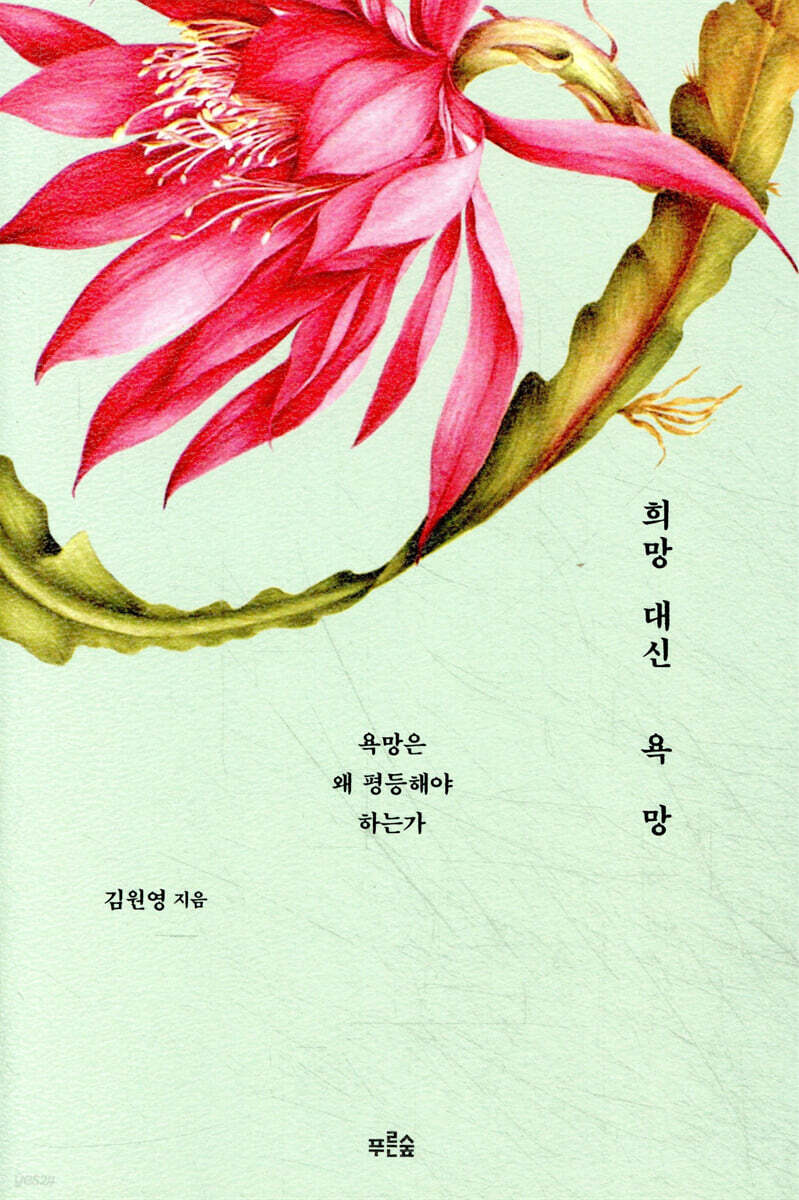
Desire instead of hope
 |
Description
Book Introduction
There is no human being who is not qualified in life, Anyone can have a bold desire "A Defense for the Disqualified," attorney Wonyoung Kim's first book. "I Want to Be a Hot Desire Rather than a Cold Hope" 2019 Revised Edition I have finally learned how to properly pay attention to both obstacles and desires - Yojo Attorney Won-Young Kim, who was named 'Author of the Year' by major media outlets and publishers several times in 2018 for his book 'A Defense for the Disqualified', has published a new book titled 'I Want to Be a Hot Desire Rather than a Cold Hope', written in his 20s, under the title 'Desire Instead of Hope'. In 『A Defense for the Disqualified』, Kim Won-young ‘defends’ the dignity of those whom the world treats as being ‘wrongly’ born, and in 『Desire Instead of Hope』, he continuously explores his own disabled body, exposes his life as it is, and ‘testifies’ to the power of freedom and solidarity. The revised edition includes a preface and an afterword, and supplements the appendix, “Reading Disability Issues Deeper,” for those who wish to understand disability issues in depth. Born with osteogenesis imperfecta, which causes frequent bone fractures, Kim Won-young's daily routine consisted of eating ice cream bought by his grandmother in his room, spending idle afternoons watching the dogs in the yard, and traveling around the world while completing his older sister's social studies degree. It was not until he turned fifteen that he took the high school qualification exam and entered a rehabilitation school, where he first stepped out into the world. He barely managed to overcome the high barrier of a regular high school that did not even sell him an application form simply because he was in a wheelchair, and entered the world of the "normal." After that, through hard work, he entered Seoul National University, jumped into the disability rights movement, and went on to law school. "Desire Instead of Hope" is a coming-of-age story about a weak boy who was once an "invisible being" until he appears on the stage of the world. But this book is far from a 'human victory drama'. The author rather rejects the narrative of hope that 'anyone can overcome any difficulty if they have the will.' In this book, Kim Won-young says that instead of maintaining a "cool" attitude as if disability is nothing in the face of the sympathetic gaze and cold prejudice of a society that treats people with disabilities as "insignificant things," we should become passionate beings who say we want to run and love, affirm our desires, and confidently demand our rights. When this book was first published in 2010, his declaration that he wanted to be “a hot desire rather than a cold hope” gained widespread support from people with and without disabilities alike. Through his meticulously written personal narrative and abundant examples, which are honest and dense, he boldly confronts the prejudices that ignore the individuality of disabled people, such as “disabled people are innocent” or “disabled people are pitiful,” or that consider disabled people to be beings without desire. In 2019, his declaration still holds true. |
- You can preview some of the book's contents.
Preview
index
Preface to the Revised Edition If You Are Not Afraid of Desire __ 5
Beginning with a yearning for the passionate and passionate confessions of small and weak beings __ 17
1.
A body like glass, a heart like thorns
Disabled person riding the subway __ 29
Invisible Being __ 33
I have osteogenesis imperfecta __ 37
Adolescence with only moonlight __ 45
A New World Opened by Learning, But a Cramped World __ 53
Between Hope and Limits __ 58
People Who Became Landscapes __ 64
On stage, the moment I appear to the world __ 73
Spring of Eighteen __ 78
Until my body and I become one __ 84
2.
Push your whole body into the world
Dreaming of Escape __ 91
The dizzying heights of the outside world __ 96
The World of the 'Special' and the World of the 'Ordinary' __ 103
Rights that require 'permission' __ 111
Becoming a Super Disabled Person __ 119
The most different yet closest friend, Cheon Myeong-ryun __ 126
3.
Creating new body memories
Falling has wheels __ 137
I can't keep living like this __ 141
People lying on the subway tracks __ 147
You can't change your body, but you can change society __ 153
A disabled person who overcame his disability? __ 158
I was not cured, but I was healed __ 167
The Changes Driven by Coming Out __ 172
4.
Between two worlds
A begging disabled person reading Kant __ 181
A Separate World __ 188
A Hellish Tale from an Abnormal World __ 194
People on display and people watching __ 203
Superiority, its cruel pleasure __ 209
Solidarity in the Rain Together __ 214
5.
I want to be a 'hot' disabled person
On the Sexiness of Upright Walking __ 255
Why can't we just be human instead of cool? __ 233
“Look at my legs” __ 237
A body that does not conform to fate __ 244
Freedom Crying Out from a 'Bad' Body __ 250
If it were my life, it would be hot __ 259
6.
Brain in a Vat, Become the Protagonist
I still can't even tie my shoelaces __ 267
Macbeth in a Wheelchair __ 273
Dream Size __ 278
The courageous people who turn the auditorium into a stage __ 283
The Weight of Freedom Given to Me __ 289
A helpless 20-something and an 880,000 won disabled person __ 295
In the face of the age-old commandment, "Don't stand out for no reason," __ 301
Testimony for My Body and Yours __ 306
In closing, we need anger __ 311
Postscript and 10 Years Later __ 318
Appendix Disability Issues Deep Reading __ 323
References __ 341
Beginning with a yearning for the passionate and passionate confessions of small and weak beings __ 17
1.
A body like glass, a heart like thorns
Disabled person riding the subway __ 29
Invisible Being __ 33
I have osteogenesis imperfecta __ 37
Adolescence with only moonlight __ 45
A New World Opened by Learning, But a Cramped World __ 53
Between Hope and Limits __ 58
People Who Became Landscapes __ 64
On stage, the moment I appear to the world __ 73
Spring of Eighteen __ 78
Until my body and I become one __ 84
2.
Push your whole body into the world
Dreaming of Escape __ 91
The dizzying heights of the outside world __ 96
The World of the 'Special' and the World of the 'Ordinary' __ 103
Rights that require 'permission' __ 111
Becoming a Super Disabled Person __ 119
The most different yet closest friend, Cheon Myeong-ryun __ 126
3.
Creating new body memories
Falling has wheels __ 137
I can't keep living like this __ 141
People lying on the subway tracks __ 147
You can't change your body, but you can change society __ 153
A disabled person who overcame his disability? __ 158
I was not cured, but I was healed __ 167
The Changes Driven by Coming Out __ 172
4.
Between two worlds
A begging disabled person reading Kant __ 181
A Separate World __ 188
A Hellish Tale from an Abnormal World __ 194
People on display and people watching __ 203
Superiority, its cruel pleasure __ 209
Solidarity in the Rain Together __ 214
5.
I want to be a 'hot' disabled person
On the Sexiness of Upright Walking __ 255
Why can't we just be human instead of cool? __ 233
“Look at my legs” __ 237
A body that does not conform to fate __ 244
Freedom Crying Out from a 'Bad' Body __ 250
If it were my life, it would be hot __ 259
6.
Brain in a Vat, Become the Protagonist
I still can't even tie my shoelaces __ 267
Macbeth in a Wheelchair __ 273
Dream Size __ 278
The courageous people who turn the auditorium into a stage __ 283
The Weight of Freedom Given to Me __ 289
A helpless 20-something and an 880,000 won disabled person __ 295
In the face of the age-old commandment, "Don't stand out for no reason," __ 301
Testimony for My Body and Yours __ 306
In closing, we need anger __ 311
Postscript and 10 Years Later __ 318
Appendix Disability Issues Deep Reading __ 323
References __ 341
Detailed image

Into the book
Nine years have passed and a lot has changed.
Personally, I've escaped basic livelihood security, become a lawyer, written extensively, including one book, founded a theater group that failed, and experienced new friendships and love.
However, the most fundamental desire I had at the time of publishing this book—to accept my disability as a part of myself rather than being ashamed of it, and to live proudly and beautifully with my disabled body without shrinking—remains unfulfilled.
--- p.6
In fact, desire is fleeting.
We know from the advice of sages throughout history that the greater our desires, the more suffering and frustration they bring. We hear the direct words of monks like Beopryun and Hyemin, and we learn from the experiences of our parents.
If you dream of space exploration in a country torn apart by war and poverty, or hope to live a long and healthy life with two children and a large dog in a village with a beautiful garden, this is likely to lead to even greater disappointment.
Even if you, a person born with a silver spoon in your mouth, dream of commuting to Samseong Station with a beautiful partner from your house in Cheongdam-dong (a dream of not having to commute), the possibility of that happening is very slim.
Above all, it is difficult to know which desires are entirely mine and not someone else's.
Hope, on the other hand, seems to speak of a more lofty dream that leads us toward a fulfilling life.
Society also readily approves of dreams that are brought up in the name of hope.
--- pp.10~11
Can we overcome my body, our body, a body that fears falling into poverty, disease, and ugliness? Despite my long struggle to overcome my disability, I still don't have a definitive answer to this question.
But one thing I have come to understand clearly is that disabled people can never overcome their disability, and the moment they overcome it, they are no longer disabled.
If someone were to say to me, "I am a disabled person who has overcome my disability," I would become a contradiction in that moment.
If I overcame my disability, why am I still disabled?
--- p.19
Is overcoming the only way to free ourselves from such conditions? I don't think so.
Rather, I believe we must stake our future on the challenge, solidarity, and imagination that place our conditions at the center of the world.
Most of us are not people who can overcome disability and poverty without any help and join the ranks of beauties through meticulous self-management and dieting, and in fact, there is no reason for us to do so.
--- pp.19~20
Puberty came when I was around twelve years old.
His voice grew deeper and his lower body became darker.
Although the number of fractures decreased thanks to my long stay in the hospital, my reality has hardly changed.
I was still spending my precious teenage passions opening the door and watching the children go to school, the dogs in the yard basking in the spring sun, or eating the ice cream my grandmother bought me.
--- p.45
The desk where I sat was covered with children's doodles.
It was written in a confusing manner, with things like, "So-and-so is dating so-and-so," and "That celebrity is the coolest."
I read the contents carefully.
A world that is disorganized and chaotic, yet somehow filled with diverse stimuli, a world where children's imaginations, desires, jealousy, freedom, and oppression are intertwined.
That was my first encounter with the 'real' world, outside of the hospital and my hometown.
--- p.49
This moment, when I stepped into a 'new world', may seem dramatic in itself, but I have no intention of distorting its meaning.
If a middle school student needs this much help from so many people and better grades than others to get into the high school of their choice, isn't that ridiculous in a country like South Korea where education is considered a fundamental right?
No middle school student worries about not getting into a school even though they have the help of a "support group," have "negotiations" with the principal, and have better grades than others.
Even if you are ranked 150th, not 15th, if you meet the admission criteria, you should be able to enter without any problems.
That's 'normal'.
--- pp.115~116
How can we get back on stage?
I don't want to be the lead.
But I want to at least 'appear'.
Becoming a so-called 'super disabled person'.
That was my choice.
Super-disabled people first challenge things that others never thought of, and overcome various obstacles with their cheerful and bold personalities.
Always armed with confidence and poise, he has the audacity to say, “People are looking at me because I’m handsome.”
Of course, you have to be good at studying, and you have to have athletic ability and dating skills.
Of course, the 'guts' that allow you to be courageous and not be discouraged in any situation are essential.
--- pp.121~122
Myungryun and I did a lot of things together.
I sneaked out of the dorm, bought some ramen, and walked up the long hill that was several hundred meters long.
To others, it might have seemed like Myeongryun was helping me unilaterally, but surprisingly, Myeongryun's mother would call me occasionally to thank me for being close to her.
Parents of children with disabilities often worry that their children might hurt their friends by helping them, or that hanging out with their friends might prevent them from socializing with their non-disabled peers.
However, Myeongryun's mother said that she was grateful that I was being a good older brother to Myeongryun.
--- p.129
Yes, that's right.
Yes, I am disabled.
But the fact that I am disabled and shouting “I am disabled” are two entirely different things.
I was a college student at Seoul National University in South Korea, where 50 percent of people with disabilities only graduate from elementary school.
I didn't want to once again put my identity as a disabled person before my pride and my dreams.
I didn't want to fall.
Can't I live without any connection to my disability?
Even though I just use a wheelchair, can't I have the skills, the job, the knowledge, the humor, the cheerfulness, etc. to the point where people around me wouldn't even notice that I'm disabled?
--- p.143
Contrary to the common belief that the rights of people with disabilities have improved in modern society, there are also studies that show that for some disabilities, the social status and quality of life were much higher during the Joseon Dynasty.
In particular, the visually impaired were considered to be of a higher social status at the time, and actively participated in the community through occupations such as pharmacists and fortune tellers.
Michael Oliver, a disabled British sociologist, also revealed how people with physical disabilities were marginalized from the community as society moved into the capitalist system and factory work became commonplace.
--- p.157
Changing some of the school's facilities was just one of the things we gained.
What's more important is that the fact that they entered Seoul National University itself, and the fact that disabled students who had been intoxicated by the praise from those around them for "overcoming their disabilities" because of it, began to look at themselves squarely.
Do we really need to 'overcome' our disabilities?
Is it even surmountable?
--- p.
161
I still can't walk.
But that doesn't mean I've failed in my struggle to get healthy.
Success or failure in the fight against the disease is not a matter of overcoming the disability or eliminating the cause of osteogenesis imperfecta from my body.
I grew into an adult who maintained a stable balance in this state.
Therefore, biological disease treatment and body healing are not the same concept.
I was not cured, but I was healed.
--- p.171
I find upright walking erotically appealing.
Movement of the shoulders and crossing of the arms and legs.
I'd argue that pushing a wheelchair once every 1.8 seconds is the sexiest thing ever, but that's really nothing.
The feeling of looking down on a world over 170 centimeters high, holding someone's hand on a date while riding the subway and bus, and strolling through campus with a coffee in one hand and a book in the other.
At some point I wanted to shout that I wanted to walk.
But at that time, I was the team leader of the Disability Rights Solidarity Team.
Disability is an identity, and our damaged bodies must soon become our own identities.
For me, saying, “Actually, I want to walk,” felt like a pathetic and cowardly confession.
--- p.227
I find it very unpleasant to be interrupted by someone while walking up the stairs, but even in this case, 'coolness' is essential.
Isn't it rude to show displeasure to those who help me?
So, it's essential to be able to say something cool even when you're holding someone's hand precariously on the stairs.
"Hey, this totally makes me feel like a king?" --- p.234
Bad Body claimed that the stigma attached to him and the discrimination he had suffered were in fact 'social'.
And the world changed.
Like Lucifer, who refused to be an angel and chose 'freedom', the bad body, especially the disabled, who are the representative of it, have now become political subjects.
--- p.248
Legal philosopher Ronald Dworkin distinguishes between misfortunes imposed by God and misfortunes created by society.
Misfortunes given by heaven include earthquakes, typhoons, and diseases that cannot be cured by modern medical technology.
On the other hand, misfortunes created by society include inequality caused by socioeconomic structures or policies, disasters that are more severe due to a lack of adequate countermeasures, and cases where curable diseases cannot be treated due to lack of medical expenses.
… However, the standards for ‘misfortune given by heaven’ and ‘misfortune created by society’ are ambiguous.
That is the 'body of a disabled person'.
--- p.255
The disability movement has successfully shifted many things that were once considered "heavenly misfortunes" to the realm of "social misfortunes."
Our problems, which have moved to social misfortune, have now become solvable challenges.
But even at this point in time, there still exist bodily conditions that seem like they will never move into the realm of social misfortune, that is, they will forever be considered only 'misfortunes given by heaven.'
That is a body with a severe disease, a body whose damage is so severe that no matter what society does, it will eventually have to prepare for death or focus solely on survival.
This also applies to the body that harbors desires and pain that cannot be overcome no matter how much social effort is made.
You can install an elevator for me who can't walk, but you can't fulfill my desire to run.
--- p.256
But even to me, who tried to act all smart but ended up just taking refuge inside myself, someone said, “I love you, loving is cooler,” “Go on stage, that’s sexier,” and “Write.
“If you write your story, you will be free,” he said, extending his hand.
--- p.305
My life has been completely transformed among those who have practiced this freedom with their whole being, and my freedom, my body, my love bear witness to it.
Therefore, I wrote this to testify to the power of freedom and solidarity.
I still lack the experience, ability, and courage to be the subject of practice.
But if I ever get another chance to write something in the future, I want to go beyond testimony and make a defense.
What that argument seeks to defend is the freedom of my body, your body, my friends' bodies, and all of our bodies.
Personally, I've escaped basic livelihood security, become a lawyer, written extensively, including one book, founded a theater group that failed, and experienced new friendships and love.
However, the most fundamental desire I had at the time of publishing this book—to accept my disability as a part of myself rather than being ashamed of it, and to live proudly and beautifully with my disabled body without shrinking—remains unfulfilled.
--- p.6
In fact, desire is fleeting.
We know from the advice of sages throughout history that the greater our desires, the more suffering and frustration they bring. We hear the direct words of monks like Beopryun and Hyemin, and we learn from the experiences of our parents.
If you dream of space exploration in a country torn apart by war and poverty, or hope to live a long and healthy life with two children and a large dog in a village with a beautiful garden, this is likely to lead to even greater disappointment.
Even if you, a person born with a silver spoon in your mouth, dream of commuting to Samseong Station with a beautiful partner from your house in Cheongdam-dong (a dream of not having to commute), the possibility of that happening is very slim.
Above all, it is difficult to know which desires are entirely mine and not someone else's.
Hope, on the other hand, seems to speak of a more lofty dream that leads us toward a fulfilling life.
Society also readily approves of dreams that are brought up in the name of hope.
--- pp.10~11
Can we overcome my body, our body, a body that fears falling into poverty, disease, and ugliness? Despite my long struggle to overcome my disability, I still don't have a definitive answer to this question.
But one thing I have come to understand clearly is that disabled people can never overcome their disability, and the moment they overcome it, they are no longer disabled.
If someone were to say to me, "I am a disabled person who has overcome my disability," I would become a contradiction in that moment.
If I overcame my disability, why am I still disabled?
--- p.19
Is overcoming the only way to free ourselves from such conditions? I don't think so.
Rather, I believe we must stake our future on the challenge, solidarity, and imagination that place our conditions at the center of the world.
Most of us are not people who can overcome disability and poverty without any help and join the ranks of beauties through meticulous self-management and dieting, and in fact, there is no reason for us to do so.
--- pp.19~20
Puberty came when I was around twelve years old.
His voice grew deeper and his lower body became darker.
Although the number of fractures decreased thanks to my long stay in the hospital, my reality has hardly changed.
I was still spending my precious teenage passions opening the door and watching the children go to school, the dogs in the yard basking in the spring sun, or eating the ice cream my grandmother bought me.
--- p.45
The desk where I sat was covered with children's doodles.
It was written in a confusing manner, with things like, "So-and-so is dating so-and-so," and "That celebrity is the coolest."
I read the contents carefully.
A world that is disorganized and chaotic, yet somehow filled with diverse stimuli, a world where children's imaginations, desires, jealousy, freedom, and oppression are intertwined.
That was my first encounter with the 'real' world, outside of the hospital and my hometown.
--- p.49
This moment, when I stepped into a 'new world', may seem dramatic in itself, but I have no intention of distorting its meaning.
If a middle school student needs this much help from so many people and better grades than others to get into the high school of their choice, isn't that ridiculous in a country like South Korea where education is considered a fundamental right?
No middle school student worries about not getting into a school even though they have the help of a "support group," have "negotiations" with the principal, and have better grades than others.
Even if you are ranked 150th, not 15th, if you meet the admission criteria, you should be able to enter without any problems.
That's 'normal'.
--- pp.115~116
How can we get back on stage?
I don't want to be the lead.
But I want to at least 'appear'.
Becoming a so-called 'super disabled person'.
That was my choice.
Super-disabled people first challenge things that others never thought of, and overcome various obstacles with their cheerful and bold personalities.
Always armed with confidence and poise, he has the audacity to say, “People are looking at me because I’m handsome.”
Of course, you have to be good at studying, and you have to have athletic ability and dating skills.
Of course, the 'guts' that allow you to be courageous and not be discouraged in any situation are essential.
--- pp.121~122
Myungryun and I did a lot of things together.
I sneaked out of the dorm, bought some ramen, and walked up the long hill that was several hundred meters long.
To others, it might have seemed like Myeongryun was helping me unilaterally, but surprisingly, Myeongryun's mother would call me occasionally to thank me for being close to her.
Parents of children with disabilities often worry that their children might hurt their friends by helping them, or that hanging out with their friends might prevent them from socializing with their non-disabled peers.
However, Myeongryun's mother said that she was grateful that I was being a good older brother to Myeongryun.
--- p.129
Yes, that's right.
Yes, I am disabled.
But the fact that I am disabled and shouting “I am disabled” are two entirely different things.
I was a college student at Seoul National University in South Korea, where 50 percent of people with disabilities only graduate from elementary school.
I didn't want to once again put my identity as a disabled person before my pride and my dreams.
I didn't want to fall.
Can't I live without any connection to my disability?
Even though I just use a wheelchair, can't I have the skills, the job, the knowledge, the humor, the cheerfulness, etc. to the point where people around me wouldn't even notice that I'm disabled?
--- p.143
Contrary to the common belief that the rights of people with disabilities have improved in modern society, there are also studies that show that for some disabilities, the social status and quality of life were much higher during the Joseon Dynasty.
In particular, the visually impaired were considered to be of a higher social status at the time, and actively participated in the community through occupations such as pharmacists and fortune tellers.
Michael Oliver, a disabled British sociologist, also revealed how people with physical disabilities were marginalized from the community as society moved into the capitalist system and factory work became commonplace.
--- p.157
Changing some of the school's facilities was just one of the things we gained.
What's more important is that the fact that they entered Seoul National University itself, and the fact that disabled students who had been intoxicated by the praise from those around them for "overcoming their disabilities" because of it, began to look at themselves squarely.
Do we really need to 'overcome' our disabilities?
Is it even surmountable?
--- p.
161
I still can't walk.
But that doesn't mean I've failed in my struggle to get healthy.
Success or failure in the fight against the disease is not a matter of overcoming the disability or eliminating the cause of osteogenesis imperfecta from my body.
I grew into an adult who maintained a stable balance in this state.
Therefore, biological disease treatment and body healing are not the same concept.
I was not cured, but I was healed.
--- p.171
I find upright walking erotically appealing.
Movement of the shoulders and crossing of the arms and legs.
I'd argue that pushing a wheelchair once every 1.8 seconds is the sexiest thing ever, but that's really nothing.
The feeling of looking down on a world over 170 centimeters high, holding someone's hand on a date while riding the subway and bus, and strolling through campus with a coffee in one hand and a book in the other.
At some point I wanted to shout that I wanted to walk.
But at that time, I was the team leader of the Disability Rights Solidarity Team.
Disability is an identity, and our damaged bodies must soon become our own identities.
For me, saying, “Actually, I want to walk,” felt like a pathetic and cowardly confession.
--- p.227
I find it very unpleasant to be interrupted by someone while walking up the stairs, but even in this case, 'coolness' is essential.
Isn't it rude to show displeasure to those who help me?
So, it's essential to be able to say something cool even when you're holding someone's hand precariously on the stairs.
"Hey, this totally makes me feel like a king?" --- p.234
Bad Body claimed that the stigma attached to him and the discrimination he had suffered were in fact 'social'.
And the world changed.
Like Lucifer, who refused to be an angel and chose 'freedom', the bad body, especially the disabled, who are the representative of it, have now become political subjects.
--- p.248
Legal philosopher Ronald Dworkin distinguishes between misfortunes imposed by God and misfortunes created by society.
Misfortunes given by heaven include earthquakes, typhoons, and diseases that cannot be cured by modern medical technology.
On the other hand, misfortunes created by society include inequality caused by socioeconomic structures or policies, disasters that are more severe due to a lack of adequate countermeasures, and cases where curable diseases cannot be treated due to lack of medical expenses.
… However, the standards for ‘misfortune given by heaven’ and ‘misfortune created by society’ are ambiguous.
That is the 'body of a disabled person'.
--- p.255
The disability movement has successfully shifted many things that were once considered "heavenly misfortunes" to the realm of "social misfortunes."
Our problems, which have moved to social misfortune, have now become solvable challenges.
But even at this point in time, there still exist bodily conditions that seem like they will never move into the realm of social misfortune, that is, they will forever be considered only 'misfortunes given by heaven.'
That is a body with a severe disease, a body whose damage is so severe that no matter what society does, it will eventually have to prepare for death or focus solely on survival.
This also applies to the body that harbors desires and pain that cannot be overcome no matter how much social effort is made.
You can install an elevator for me who can't walk, but you can't fulfill my desire to run.
--- p.256
But even to me, who tried to act all smart but ended up just taking refuge inside myself, someone said, “I love you, loving is cooler,” “Go on stage, that’s sexier,” and “Write.
“If you write your story, you will be free,” he said, extending his hand.
--- p.305
My life has been completely transformed among those who have practiced this freedom with their whole being, and my freedom, my body, my love bear witness to it.
Therefore, I wrote this to testify to the power of freedom and solidarity.
I still lack the experience, ability, and courage to be the subject of practice.
But if I ever get another chance to write something in the future, I want to go beyond testimony and make a defense.
What that argument seeks to defend is the freedom of my body, your body, my friends' bodies, and all of our bodies.
--- p.308
Publisher's Review
You can't change your body, but you can change society.
Freedom and solidarity explored with all his body by Kim Won-young in his 20s.
"Desire Instead of Hope" is also a testimony to those who transformed Kim Won-young into a "passionate and free" person, that is, those who practiced freedom with their whole body.
Having entered Seoul National University, which he believed to be the center of the world, he is frustrated by the stairs and high hills that make it difficult to move freely in a wheelchair.
The campus, filled with the energy of a confident twenty-something and cherry blossoms in full bloom, was truly the center of the world he longed for, but there was no place for him.
He had difficulty moving between classrooms, could not freely choose his classes, and could not even buy cup ramen in the dormitory. He gave up on becoming a "super disabled person" who could overcome the difficulties of reality, and joined the Disability Rights Solidarity Team to demand that disabled students be allowed to move and study as the owners of the school, not as "guests."
Many disabled students, including him, who sought to overcome reality by becoming "super disabled," realized that biological damage can never be "overcome," and that overcoming disability means overcoming the social discrimination imposed on a damaged body.
The author confesses that 'it was only then that I truly became disabled.'
I wanted to be Superman.
As a person with a level 1 disability, I graduated from Seoul National University and achieved remarkable success.
I wanted to be someone who could overcome life, overcome obstacles, and speak of hope and miracles.
However, in order to create a 'miracle', you need public transportation to ride while creating the miracle, books to read for the miracle, and cup ramen to eat while creating the miracle.
In the end, I had no choice but to join the Disability Rights Solidarity Team.
Because for me, I needed to remove the steps and obstacles that were immediately in front of me rather than pursue my dreams and hopes.
I had no choice, like most severely disabled people who came into the world at that point.
-159
The people who gave him the courage to come out and say, “I am disabled,” were severely disabled people who stopped the subway by tying themselves to the tracks, shouting, “I want to ride the subway.”
They went down to the tracks to demand the installation of an elevator following the accident where a disabled person fell from Oido Station in 2001.
The long-held desire of disabled people who could not use the subway, a 'public' means of transportation, has been fulfilled by stopping the subway.
The author introduces the 'social model of disability', which served as the backdrop for the 'mobility rights movement for people with disabilities' that exploded at the time, and various social science studies on it.
By reading interesting examples such as Martha's Vineyard, where the percentage of hearing-impaired people is high and sign language is used as an everyday language, and research showing that the social status and quality of life of the visually impaired during the Joseon Dynasty were much higher, you will gain a new perspective on the issue of disability, which states that "just because an individual suffers biological 'damage' does not necessarily mean that they will have a 'disability' that excludes them from society."
A begging disabled person reading Kant
How the normal and abnormal worlds connect
Suddenly, an old man came forward, pushing through the crowd.
The man standing in front of me slowly searched through his pockets (I was starting to feel uneasy) and took out a crumpled one-thousand-won bill.
My ominous premonition seemed to be coming true, and my grandfather soon placed the bill firmly in my hand.
My face turned red in an instant.
The long eyes of Toegye Seonsaeng depicted on the crumpled banknote seemed to mimic the gazes of all the people in the world.
If I were you today, the moment I saw Toegye's face, I might have said something like, "If I'm going to do it, I'll give you a ten-thousand won bill..." But when I was a child and first got on the subway, I had no idea how to react the moment I received the bill.
Grandfather patted me on the shoulder twice, telling me not to be discouraged and to work hard.
I was frustrated.
-Page 32
The author, standing with a law book in one hand and a 1,000 won bill handed to him by a passerby in the other, looks back on the history of his own body, which has lived with these two worlds mixed up in a dizzying way, and vividly shows the gap between the general perception of people with disabilities and the reality they actually face.
Just as he lived in a room until he was fifteen, most people with disabilities spend their entire lives in institutions or small rooms.
They live each day with minimal education, no meaningful relationships beyond their fellow disabled people and volunteers, and their needs as men and women are ignored.
A human being with an ugly and damaged appearance was not supposed to be good, or at least not to reveal personal desires.
The moment such a desire was revealed, it was met with a sledgehammer by the old saying, “A crippled person is like a sledgehammer.”
-Page 247
The author recounts his experiences as a rehab student, sitting with his mother next to the "celebrities" who had sponsored his tuition, and being silently exhibited, and his experience as a bedridden man with a rare disease exhibited during the worship service at his high school.
The awkwardness of having to catch everyone's attention with "My Happy Home" playing in the background while trying to get on the elevator at the subway station, and instead of receiving benefits, being told "Why don't you go to a place like Kkotdongne and do some volunteer work?"
What is it like to become insensitive to those who use you as a means of soul purification, saying, “Then I become truly grateful for my life?”
He directly criticizes the terrible reality in which the inhabitants of the normal world confirm their superiority through the inhabitants of the abnormal world whom they consider inferior to themselves.
The onlookers, the inhabitants of the normal world, need the inhabitants of the abnormal clock that is constantly on display.
Just as one can only feel relieved about one's 'normality' after going to a flower village and doing volunteer work, normality is established by defining 'abnormality'.
-Page 213
In this book, he says that the insults that permeate our society are fundamentally due to the fact that people with disabilities are viewed as beings who only need to be provided with food, clothing, and shelter, as beings without desires, and as beings who are far from deep thought or intense emotions.
Making disabled restrooms unisex and reacting to disabled women having their first period with comments like “You’re a woman after all” are also things that happen in this context.
However, through the author and the severely disabled people he introduces who stop buses and subways and crawl for five hours to cross the Han River Bridge in search of their rights as human beings, we can confirm that disabled people are also beings with human desires, and that they are beings who fiercely contemplate and are angry about the 'self' and 'society'.
Instead of telling Kim Won-young, “Don’t come out for no reason; it’ll only make you uglier,” he had family, colleagues, and friends who guided him out into the world, saying, “Go on stage; it’s sexier,” and “Write; if you write your story, you’ll be free.”
Standing between two separate worlds, the normal world and the abnormal world, he hopes that the two worlds will become one not through pity, charity, or negativity, but through sincere solidarity, that is, a solidarity of 'getting rain together.'
Why we need to dream of 'desire' in the era of 'small but certain happiness'
Don't we need to have desires to make our flowers bloom?
Kim Won-young, in his 20s, was also part of the '880,000 won generation.'
I don't know what I did wrong, but the life of a 20-year-old who was not even given the opportunity to go out into society was helpless, and when he was a college student, 10 people committed suicide at Seoul National University over the course of two years.
In this book, he suggested at the time, "We must boldly reveal the boiling anger toward a society that does not give us a chance to appear in the world no matter how hard we try."
A young man in his 20s who declared himself a 'hot' disabled person and extended a helping hand to his friends of the same age has become a lawyer in his 30s.
He escaped from the status of a basic livelihood security recipient and wrote many articles, including one book.
The author argues that while society has changed over the past few years, with the lives of social minorities, including people with disabilities, receiving far more weight than in the past, and minorities actively expressing their "desires" and forming solidarity, blatant discrimination, hatred, and conflict have actually become more severe than in 2010.
He also pursues small and certain happiness rather than fleeting desires, and in this era where most people find it difficult to dream of anything, whether it be desire or hope, he asks himself whether the argument raised in "Desire Instead of Hope" is still valid.
He says that a "new solidarity" will be formed when people with disabilities, workers, college students, women, men, youth, refugees, sexual minorities, and the elderly face their differences, honestly confront the discrimination and oppression they face, and reveal their desires.
The desire he speaks of is 'a longing for a life in which I can dream, love, work, travel, and die as an individual, while being acknowledged as it is in the specific circumstances and conditions that I most wanted to hide and avoid, but at the same time, truly wanted to be accepted and embraced within the community.'
This book makes us reflect on whether we have been discriminating against even our own 'desires' and whether we have been hesitant to have 'desires' ourselves.
When we acknowledge the desires each of us possesses and recognize that anyone can confidently pursue those desires, our society will be able to move forward.
This book, which is both a personal story of Kim Won-young's growth and a testimony to social solidarity, deserves renewed attention ahead of April 20th, the International Day of Persons with Disabilities.
Nevertheless, what I'm trying to say in this book is that for anyone who has directly or indirectly heard the saying, "You shouldn't be greedy and try to live like everyone else," harboring these worldly and fleeting desires is a subversive and rebellious act.
Isn't that very act of "realizing the fleetingness of life after having done everything" a precious life opportunity that should be equally distributed to all members of our society? (Page 13)
Freedom and solidarity explored with all his body by Kim Won-young in his 20s.
"Desire Instead of Hope" is also a testimony to those who transformed Kim Won-young into a "passionate and free" person, that is, those who practiced freedom with their whole body.
Having entered Seoul National University, which he believed to be the center of the world, he is frustrated by the stairs and high hills that make it difficult to move freely in a wheelchair.
The campus, filled with the energy of a confident twenty-something and cherry blossoms in full bloom, was truly the center of the world he longed for, but there was no place for him.
He had difficulty moving between classrooms, could not freely choose his classes, and could not even buy cup ramen in the dormitory. He gave up on becoming a "super disabled person" who could overcome the difficulties of reality, and joined the Disability Rights Solidarity Team to demand that disabled students be allowed to move and study as the owners of the school, not as "guests."
Many disabled students, including him, who sought to overcome reality by becoming "super disabled," realized that biological damage can never be "overcome," and that overcoming disability means overcoming the social discrimination imposed on a damaged body.
The author confesses that 'it was only then that I truly became disabled.'
I wanted to be Superman.
As a person with a level 1 disability, I graduated from Seoul National University and achieved remarkable success.
I wanted to be someone who could overcome life, overcome obstacles, and speak of hope and miracles.
However, in order to create a 'miracle', you need public transportation to ride while creating the miracle, books to read for the miracle, and cup ramen to eat while creating the miracle.
In the end, I had no choice but to join the Disability Rights Solidarity Team.
Because for me, I needed to remove the steps and obstacles that were immediately in front of me rather than pursue my dreams and hopes.
I had no choice, like most severely disabled people who came into the world at that point.
-159
The people who gave him the courage to come out and say, “I am disabled,” were severely disabled people who stopped the subway by tying themselves to the tracks, shouting, “I want to ride the subway.”
They went down to the tracks to demand the installation of an elevator following the accident where a disabled person fell from Oido Station in 2001.
The long-held desire of disabled people who could not use the subway, a 'public' means of transportation, has been fulfilled by stopping the subway.
The author introduces the 'social model of disability', which served as the backdrop for the 'mobility rights movement for people with disabilities' that exploded at the time, and various social science studies on it.
By reading interesting examples such as Martha's Vineyard, where the percentage of hearing-impaired people is high and sign language is used as an everyday language, and research showing that the social status and quality of life of the visually impaired during the Joseon Dynasty were much higher, you will gain a new perspective on the issue of disability, which states that "just because an individual suffers biological 'damage' does not necessarily mean that they will have a 'disability' that excludes them from society."
A begging disabled person reading Kant
How the normal and abnormal worlds connect
Suddenly, an old man came forward, pushing through the crowd.
The man standing in front of me slowly searched through his pockets (I was starting to feel uneasy) and took out a crumpled one-thousand-won bill.
My ominous premonition seemed to be coming true, and my grandfather soon placed the bill firmly in my hand.
My face turned red in an instant.
The long eyes of Toegye Seonsaeng depicted on the crumpled banknote seemed to mimic the gazes of all the people in the world.
If I were you today, the moment I saw Toegye's face, I might have said something like, "If I'm going to do it, I'll give you a ten-thousand won bill..." But when I was a child and first got on the subway, I had no idea how to react the moment I received the bill.
Grandfather patted me on the shoulder twice, telling me not to be discouraged and to work hard.
I was frustrated.
-Page 32
The author, standing with a law book in one hand and a 1,000 won bill handed to him by a passerby in the other, looks back on the history of his own body, which has lived with these two worlds mixed up in a dizzying way, and vividly shows the gap between the general perception of people with disabilities and the reality they actually face.
Just as he lived in a room until he was fifteen, most people with disabilities spend their entire lives in institutions or small rooms.
They live each day with minimal education, no meaningful relationships beyond their fellow disabled people and volunteers, and their needs as men and women are ignored.
A human being with an ugly and damaged appearance was not supposed to be good, or at least not to reveal personal desires.
The moment such a desire was revealed, it was met with a sledgehammer by the old saying, “A crippled person is like a sledgehammer.”
-Page 247
The author recounts his experiences as a rehab student, sitting with his mother next to the "celebrities" who had sponsored his tuition, and being silently exhibited, and his experience as a bedridden man with a rare disease exhibited during the worship service at his high school.
The awkwardness of having to catch everyone's attention with "My Happy Home" playing in the background while trying to get on the elevator at the subway station, and instead of receiving benefits, being told "Why don't you go to a place like Kkotdongne and do some volunteer work?"
What is it like to become insensitive to those who use you as a means of soul purification, saying, “Then I become truly grateful for my life?”
He directly criticizes the terrible reality in which the inhabitants of the normal world confirm their superiority through the inhabitants of the abnormal world whom they consider inferior to themselves.
The onlookers, the inhabitants of the normal world, need the inhabitants of the abnormal clock that is constantly on display.
Just as one can only feel relieved about one's 'normality' after going to a flower village and doing volunteer work, normality is established by defining 'abnormality'.
-Page 213
In this book, he says that the insults that permeate our society are fundamentally due to the fact that people with disabilities are viewed as beings who only need to be provided with food, clothing, and shelter, as beings without desires, and as beings who are far from deep thought or intense emotions.
Making disabled restrooms unisex and reacting to disabled women having their first period with comments like “You’re a woman after all” are also things that happen in this context.
However, through the author and the severely disabled people he introduces who stop buses and subways and crawl for five hours to cross the Han River Bridge in search of their rights as human beings, we can confirm that disabled people are also beings with human desires, and that they are beings who fiercely contemplate and are angry about the 'self' and 'society'.
Instead of telling Kim Won-young, “Don’t come out for no reason; it’ll only make you uglier,” he had family, colleagues, and friends who guided him out into the world, saying, “Go on stage; it’s sexier,” and “Write; if you write your story, you’ll be free.”
Standing between two separate worlds, the normal world and the abnormal world, he hopes that the two worlds will become one not through pity, charity, or negativity, but through sincere solidarity, that is, a solidarity of 'getting rain together.'
Why we need to dream of 'desire' in the era of 'small but certain happiness'
Don't we need to have desires to make our flowers bloom?
Kim Won-young, in his 20s, was also part of the '880,000 won generation.'
I don't know what I did wrong, but the life of a 20-year-old who was not even given the opportunity to go out into society was helpless, and when he was a college student, 10 people committed suicide at Seoul National University over the course of two years.
In this book, he suggested at the time, "We must boldly reveal the boiling anger toward a society that does not give us a chance to appear in the world no matter how hard we try."
A young man in his 20s who declared himself a 'hot' disabled person and extended a helping hand to his friends of the same age has become a lawyer in his 30s.
He escaped from the status of a basic livelihood security recipient and wrote many articles, including one book.
The author argues that while society has changed over the past few years, with the lives of social minorities, including people with disabilities, receiving far more weight than in the past, and minorities actively expressing their "desires" and forming solidarity, blatant discrimination, hatred, and conflict have actually become more severe than in 2010.
He also pursues small and certain happiness rather than fleeting desires, and in this era where most people find it difficult to dream of anything, whether it be desire or hope, he asks himself whether the argument raised in "Desire Instead of Hope" is still valid.
He says that a "new solidarity" will be formed when people with disabilities, workers, college students, women, men, youth, refugees, sexual minorities, and the elderly face their differences, honestly confront the discrimination and oppression they face, and reveal their desires.
The desire he speaks of is 'a longing for a life in which I can dream, love, work, travel, and die as an individual, while being acknowledged as it is in the specific circumstances and conditions that I most wanted to hide and avoid, but at the same time, truly wanted to be accepted and embraced within the community.'
This book makes us reflect on whether we have been discriminating against even our own 'desires' and whether we have been hesitant to have 'desires' ourselves.
When we acknowledge the desires each of us possesses and recognize that anyone can confidently pursue those desires, our society will be able to move forward.
This book, which is both a personal story of Kim Won-young's growth and a testimony to social solidarity, deserves renewed attention ahead of April 20th, the International Day of Persons with Disabilities.
Nevertheless, what I'm trying to say in this book is that for anyone who has directly or indirectly heard the saying, "You shouldn't be greedy and try to live like everyone else," harboring these worldly and fleeting desires is a subversive and rebellious act.
Isn't that very act of "realizing the fleetingness of life after having done everything" a precious life opportunity that should be equally distributed to all members of our society? (Page 13)
GOODS SPECIFICS
- Date of issue: April 20, 2019
- Page count, weight, size: 342 pages | 448g | 145*215*30mm
- ISBN13: 9791156757818
- ISBN10: 1156757819
You may also like
카테고리
korean


korean

![GQ KOREA Mark (Monthly): December [2025]](http://librairie.coreenne.fr/cdn/shop/files/8ef265dbbfbf186523ed75ba7319009d.jpg?v=1765340328&width=3840)


