

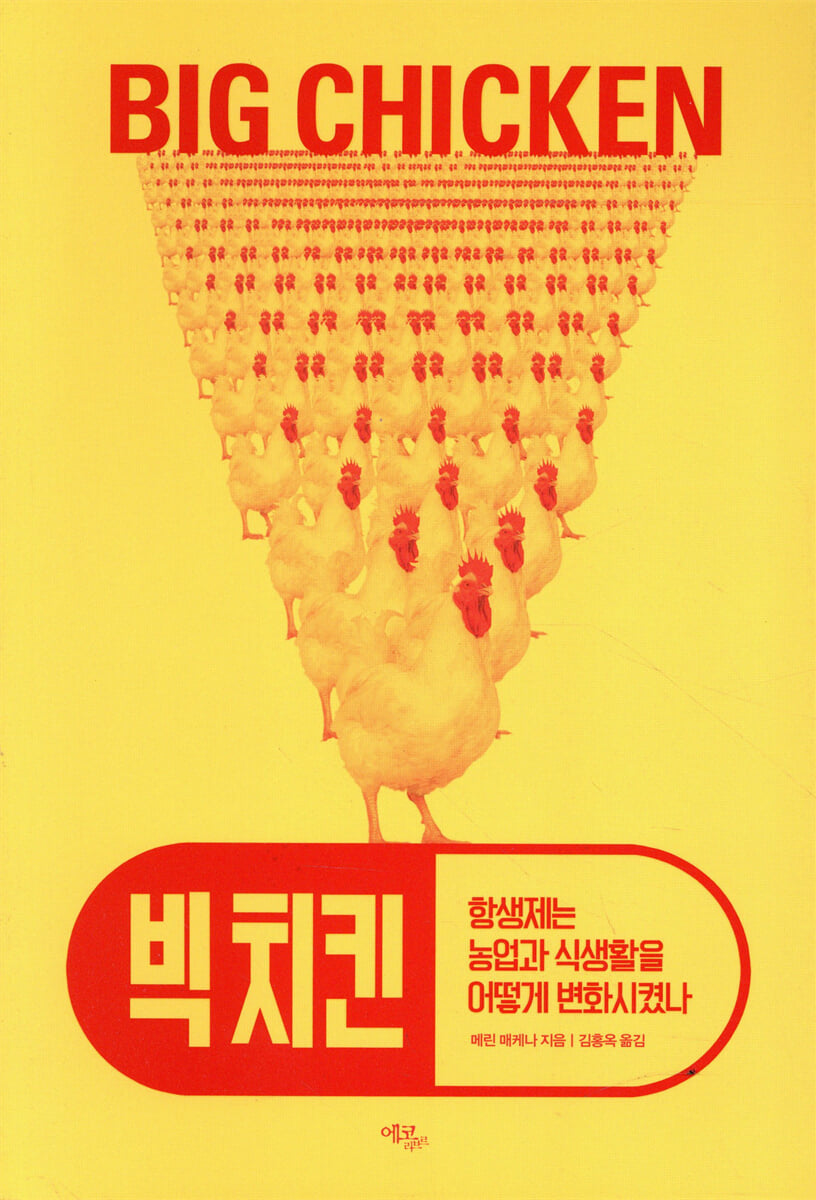
Big Chicken
 |
Description
Book Introduction
The title of the book, 'Big Chicken', tells you what the book is trying to say without any further explanation.
Like the term 'Big Pharma', which refers to global pharmaceutical giants.
Big Chicken is a term used to describe today's giant poultry enterprises, characterized by factory farming, and the fast-growing, meaty, so-called "puffed chickens" they produce.
So, in a nutshell, this book contains the story of how Big Chicken emerged in the midst of the wave of industrialization, the light and shadow of Big Chicken, and the fruits of reflective efforts to counter it.
Some people have said that after reading this book, you will never look at chicken nuggets the same way again, and that is absolutely true.
Before reading this book, most people, despite consuming chicken almost every day, probably never thought deeply about how chickens are raised, slaughtered, and processed to end up on our tables.
You can find videos on YouTube of the factory-style poultry farms and automated slaughterhouses mentioned in this book. You can see the bewildered and miserable start to life of newly hatched chicks being tossed around on conveyor belts, the pitiful sight of unhealthy-looking chickens being raised in unsanitary factory-style chicken farms, and the sight of them being hung upside down by shackles on the ankles, still alive, as they are carried along the conveyor belt until they reach slaughter weight, slowly transforming into chickens, their original destination.
First of all, one cannot help but be amazed by the fact that this entire process is almost completely automated and that the machinery operates so precisely and beautifully(?).
Like the term 'Big Pharma', which refers to global pharmaceutical giants.
Big Chicken is a term used to describe today's giant poultry enterprises, characterized by factory farming, and the fast-growing, meaty, so-called "puffed chickens" they produce.
So, in a nutshell, this book contains the story of how Big Chicken emerged in the midst of the wave of industrialization, the light and shadow of Big Chicken, and the fruits of reflective efforts to counter it.
Some people have said that after reading this book, you will never look at chicken nuggets the same way again, and that is absolutely true.
Before reading this book, most people, despite consuming chicken almost every day, probably never thought deeply about how chickens are raised, slaughtered, and processed to end up on our tables.
You can find videos on YouTube of the factory-style poultry farms and automated slaughterhouses mentioned in this book. You can see the bewildered and miserable start to life of newly hatched chicks being tossed around on conveyor belts, the pitiful sight of unhealthy-looking chickens being raised in unsanitary factory-style chicken farms, and the sight of them being hung upside down by shackles on the ankles, still alive, as they are carried along the conveyor belt until they reach slaughter weight, slowly transforming into chickens, their original destination.
First of all, one cannot help but be amazed by the fact that this entire process is almost completely automated and that the machinery operates so precisely and beautifully(?).
- You can preview some of the book's contents.
Preview
index
preface
Part 1: How Chickens Became So Important
01 Disease and an unlucky year
02 A better life through chemistry
03 Meat for the price of bread
04 Introspection begins
05 Identifying the Problem
Part 2: How Chickens Became Dangerous
06 Epidemics as evidence
07 Crossbreed dog
08 The Price of Pollution
09 Unpredictable Risks
Part 3: How Chickens Have Changed
10 The Value of Smallness
11 Choose cooperation
12 Perspectives from the Livestock Shed
13 Market Opens Its Mouth
14 Seeing the future from the past
Conclusion
Acknowledgements
main
Translator's Note
References
Search
Part 1: How Chickens Became So Important
01 Disease and an unlucky year
02 A better life through chemistry
03 Meat for the price of bread
04 Introspection begins
05 Identifying the Problem
Part 2: How Chickens Became Dangerous
06 Epidemics as evidence
07 Crossbreed dog
08 The Price of Pollution
09 Unpredictable Risks
Part 3: How Chickens Have Changed
10 The Value of Smallness
11 Choose cooperation
12 Perspectives from the Livestock Shed
13 Market Opens Its Mouth
14 Seeing the future from the past
Conclusion
Acknowledgements
main
Translator's Note
References
Search
Into the book
This book deals with two related stories.
First, how did we come to use antibiotics and question them? How did we come to produce industrial chickens and rethink them? Second, what lessons does human history offer us as we weigh the pros and cons of food production methods? I traveled extensively to dozens of states and countries, meeting and talking with farmers, chemists, lawyers, historians, microbiologists, bureaucrats, disease investigators, politicians, chefs, and a wonderful French poultry dealer.
--- p.15
Drug-related infections are common in all walks of life, including children in daycare, athletes, teenagers with body piercings, and people working out at the gym.
Although drug resistance is common, it is a serious threat that is on the rise.
The germ is responsible for the deaths of at least 700,000 babies each year - 23,000 in the United States, 25,000 in Europe and 63,000 in India.
Moreover, antibiotic resistance causes millions of illnesses—2 million annually in the United States alone—costing billions of dollars in health care costs, reducing wages, and diminishing national productivity.
By 2050, antibiotic resistance is estimated to cost the world $100 trillion annually and cause a staggering 10 million deaths.
--- p.27
Since the early days of the antibiotic era, this drug has been used for another, different purpose.
It was administered to animals raised for food.
Eighty percent of antibiotics sold in the United States and more than half of those sold worldwide are consumed by animals, not humans.
Animals destined for meat are routinely given antibiotics in their feed and water, most of which, unlike those used in humans, are not intended to treat disease.
Antibiotics are used to help food animals gain weight faster than they would otherwise, or to prevent diseases that make them vulnerable to overcrowding.
About two-thirds of the antibiotics consumed for this purpose are compounds also used to treat human diseases.
This means that if resistance develops to drugs used in livestock farming, the usefulness of those drugs for human use will eventually be reduced.
--- p.29
It was a proprietary process that guaranteed special certification, allowing only a few slaughterhouses in a given region to use it, as a preservation method that prevented meat from spoiling.
It was modern, scientific, and changing the way meat was sold.
In fact, the secret was antibiotics.
Acronizing was an invention of Lederley's parent company, American Cyanamide.
It was another use for chlortetracycline (a drug the company marketed under the name Aureomycin), in addition to its use as a growth promoter and preventative measure to protect animals from diseases that spread among us.
Acronizing was a method of administering the drug to live chickens by slaughtering the chickens and removing their internal organs.
Chickens (and later fish) advertised as acrylized were actually soaked in a diluted antibiotic solution during slaughter.
The solution contained enough drugs to coat the meat with a thin film.
The barrier remained on the chicken until it was packaged for sale, stored in retail refrigerators, and finally reached the kitchens of individual homes, preventing bacteria that could spoil the meat from growing on its surface.
The goal of this treatment was to extend the shelf life of raw meat not by a few days, but by weeks, or even up to a month, which is far beyond the natural limit.
--- p.86
The Animal Health Institute claims that 17.8 million pounds of antibiotics were used in agriculture - either as growth promoters or to prevent or treat disease - but only 3 million pounds of that was used as growth promoters.
But the document by Concerned Scientists was more detailed.
According to him, cattle are given 3.7 million pounds of antibiotics each year, more than is given to humans.
Pigs were receiving 10.4 million pounds, and chickens, the most numerous but short-lived animal, were receiving 10.5 million pounds.
If the human drug were used in these doses, it would be considered illegal.
This is because it was only used to promote growth or prevent disease, and was never used to treat disease.
In a cost-benefit analysis of whether or not to take the risk of creating antibiotic resistance, that dose produced only costs without any benefits.
--- p.170
If FDA regulations become enforceable and companies keep their promises, eliminating antibiotics from meat production could reduce the threat that antibiotic use poses to farm workers and neighbors living near farms.
It would also reduce the continued introduction of resistant bacteria into the environment,13 reducing the amount of unaltered antibiotics that can flow into river basins, and reducing the amount of unaltered compounds that can fuel bacterial evolution and potentially impact the human microbiome.
Above all, eliminating the use of antibiotics in meat production would significantly reduce the number of resistant foodborne illnesses and the silent threat posed by resistant genes – genes that escape the foodborne pathogens that carry them and can then be carried by plasmids to cause drug-resistant infections far from their original farms.
--- p.354
If antibiotic abandonment is truly successful, the desired outcome will be to bring diversity to chicken production.
This means pursuing diversity not only in the genetic characteristics of the chickens, but also in the size of the farm, sustainability, price, and taste.
This is truly a wonderful and excellent value, something that could only be found in an advisory committee report.
But chicken is the most popular meat in the industrialized world and will soon become the most sought-after meat worldwide.
Efforts to transform the chicken industry involve transforming the planet's meat economy and everything it affects: land use, water use, waste disposal, resource consumption, the role of labor, the concept of animal rights, and the diets of billions of people living on the planet.
First, how did we come to use antibiotics and question them? How did we come to produce industrial chickens and rethink them? Second, what lessons does human history offer us as we weigh the pros and cons of food production methods? I traveled extensively to dozens of states and countries, meeting and talking with farmers, chemists, lawyers, historians, microbiologists, bureaucrats, disease investigators, politicians, chefs, and a wonderful French poultry dealer.
--- p.15
Drug-related infections are common in all walks of life, including children in daycare, athletes, teenagers with body piercings, and people working out at the gym.
Although drug resistance is common, it is a serious threat that is on the rise.
The germ is responsible for the deaths of at least 700,000 babies each year - 23,000 in the United States, 25,000 in Europe and 63,000 in India.
Moreover, antibiotic resistance causes millions of illnesses—2 million annually in the United States alone—costing billions of dollars in health care costs, reducing wages, and diminishing national productivity.
By 2050, antibiotic resistance is estimated to cost the world $100 trillion annually and cause a staggering 10 million deaths.
--- p.27
Since the early days of the antibiotic era, this drug has been used for another, different purpose.
It was administered to animals raised for food.
Eighty percent of antibiotics sold in the United States and more than half of those sold worldwide are consumed by animals, not humans.
Animals destined for meat are routinely given antibiotics in their feed and water, most of which, unlike those used in humans, are not intended to treat disease.
Antibiotics are used to help food animals gain weight faster than they would otherwise, or to prevent diseases that make them vulnerable to overcrowding.
About two-thirds of the antibiotics consumed for this purpose are compounds also used to treat human diseases.
This means that if resistance develops to drugs used in livestock farming, the usefulness of those drugs for human use will eventually be reduced.
--- p.29
It was a proprietary process that guaranteed special certification, allowing only a few slaughterhouses in a given region to use it, as a preservation method that prevented meat from spoiling.
It was modern, scientific, and changing the way meat was sold.
In fact, the secret was antibiotics.
Acronizing was an invention of Lederley's parent company, American Cyanamide.
It was another use for chlortetracycline (a drug the company marketed under the name Aureomycin), in addition to its use as a growth promoter and preventative measure to protect animals from diseases that spread among us.
Acronizing was a method of administering the drug to live chickens by slaughtering the chickens and removing their internal organs.
Chickens (and later fish) advertised as acrylized were actually soaked in a diluted antibiotic solution during slaughter.
The solution contained enough drugs to coat the meat with a thin film.
The barrier remained on the chicken until it was packaged for sale, stored in retail refrigerators, and finally reached the kitchens of individual homes, preventing bacteria that could spoil the meat from growing on its surface.
The goal of this treatment was to extend the shelf life of raw meat not by a few days, but by weeks, or even up to a month, which is far beyond the natural limit.
--- p.86
The Animal Health Institute claims that 17.8 million pounds of antibiotics were used in agriculture - either as growth promoters or to prevent or treat disease - but only 3 million pounds of that was used as growth promoters.
But the document by Concerned Scientists was more detailed.
According to him, cattle are given 3.7 million pounds of antibiotics each year, more than is given to humans.
Pigs were receiving 10.4 million pounds, and chickens, the most numerous but short-lived animal, were receiving 10.5 million pounds.
If the human drug were used in these doses, it would be considered illegal.
This is because it was only used to promote growth or prevent disease, and was never used to treat disease.
In a cost-benefit analysis of whether or not to take the risk of creating antibiotic resistance, that dose produced only costs without any benefits.
--- p.170
If FDA regulations become enforceable and companies keep their promises, eliminating antibiotics from meat production could reduce the threat that antibiotic use poses to farm workers and neighbors living near farms.
It would also reduce the continued introduction of resistant bacteria into the environment,13 reducing the amount of unaltered antibiotics that can flow into river basins, and reducing the amount of unaltered compounds that can fuel bacterial evolution and potentially impact the human microbiome.
Above all, eliminating the use of antibiotics in meat production would significantly reduce the number of resistant foodborne illnesses and the silent threat posed by resistant genes – genes that escape the foodborne pathogens that carry them and can then be carried by plasmids to cause drug-resistant infections far from their original farms.
--- p.354
If antibiotic abandonment is truly successful, the desired outcome will be to bring diversity to chicken production.
This means pursuing diversity not only in the genetic characteristics of the chickens, but also in the size of the farm, sustainability, price, and taste.
This is truly a wonderful and excellent value, something that could only be found in an advisory committee report.
But chicken is the most popular meat in the industrialized world and will soon become the most sought-after meat worldwide.
Efforts to transform the chicken industry involve transforming the planet's meat economy and everything it affects: land use, water use, waste disposal, resource consumption, the role of labor, the concept of animal rights, and the diets of billions of people living on the planet.
--- p.356
Publisher's Review
The title of the book, 'Big Chicken', tells you what the book is trying to say without any further explanation.
Like the term 'Big Pharma', which refers to global pharmaceutical giants.
Big Chicken is a term used to describe today's giant poultry enterprises, characterized by factory farming, and the fast-growing, meaty, so-called "puffed chickens" they produce.
So, in a nutshell, this book contains the story of how Big Chicken emerged in the midst of the wave of industrialization, the light and shadow of Big Chicken, and the fruits of reflective efforts to counter it.
Some people have said that after reading this book, you will never look at chicken nuggets the same way again, and that is absolutely true.
Before reading this book, most people, despite consuming chicken almost every day, probably never thought deeply about how chickens are raised, slaughtered, and processed to end up on our tables.
You can find videos on YouTube of the factory-style poultry farms and automated slaughterhouses mentioned in this book. You can see the bewildered and miserable start to life of newly hatched chicks being tossed around on conveyor belts, the pitiful sight of unhealthy-looking chickens being raised in unsanitary factory-style chicken farms, and the sight of them being hung upside down by shackles on the ankles, still alive, as they are carried along the conveyor belt until they reach slaughter weight, slowly transforming into chickens, their original destination.
First of all, one cannot help but be amazed by the fact that this entire process is almost completely automated and that the machinery operates so precisely and beautifully(?).
To match this, it is understandable that chickens must be raised as a product with a certain weight and height.
But the most important emotion is still discomfort.
But that's not all.
There was a more serious problem: antibiotics.
1
Parts 1 and 2 answer the questions: How did we come to use antibiotics and question them, and how did we come to produce industrial chicken and rethink it?
So, it reads as if the process of industrialization that runs through modern and contemporary history has been reconstructed around chickens.
Industrialization, which emphasized mass production, mass consumption, mechanization, speed, efficiency, consistency, and uniformity, was carried out, and in the process, numerous side effects were revealed, such as environmental destruction and pollution, the collapse of traditional values, the downfall of small and medium-sized or independent businesses due to the monopoly of a small number of large corporations, and the destruction of community-oriented sensibilities. This is the process of reflection and introspection that followed.
The author explains that the industrialization of chickens was made possible entirely by antibiotics, and that the reflection and introspection on this stemmed from the realization that the antibiotics routinely used on farms had created resistance, posing an unexpected risk to human health.
In the past, there were far more cases of people losing their lives, by today's standards, due to trauma-related infections than to lifestyle-related diseases such as cancer, heart disease, and diabetes.
This situation changed dramatically in 1943, when penicillin became widely available and the antibiotic era began.
The epidemic that was like a death sentence was finally defeated in a matter of days.
People cheered antibiotics enthusiastically, calling them miracle drugs.
But now, just over 70 years later, we are faced with the prospect of a post-antibiotic era.
This is the price we pay for recklessly consuming the benefits of antibiotics.
The price was antibiotic resistance.
All living things that survived the evolutionary process are the fittest who succeeded in developing new defense systems to counter attacks directed at them.
Bacteria also responded in the same way they always did to protect themselves against antibiotics that attacked them.
We humans have been engaged in a kind of jumping game, an arms race, with bacteria.
In other words, when humans develop a drug, organisms develop resistance to it, and when humans develop a new drug to counter it, bacteria develop resistance to it again, and this process is repeated endlessly.
With the emergence of superbugs due to the misuse of antibiotics, situations may arise that are impossible to treat with even new drugs.
Antibiotic resistance seems like a stern warning from nature to humans who have tried to go against nature.
If we don't stop the routine use of antibiotics, we will only continue to feed the bacteria, and humans will never be able to win the fight against them through the development of new drugs.
Because evolution always wins.
It is said that there has never been a single drug that has not developed resistance.
Moreover, pharmaceutical companies have to invest 10 to 15 years and an astronomical amount of money, 1 billion dollars, to develop a single new drug, but all that effort is in vain as resistance develops, rendering the drug useless in an instant. As a result, they have lost the will to develop new drugs.
It was determined that the production of antibiotics was no longer profitable because bacteria were developing resistance too quickly.
This is a fatal conclusion for the treatment of human diseases.
This is largely a human-caused problem.
Introspection is an inevitable product of evolution, demonstrating in real time that natural selection is taking place, but we are responsible for hastening the process.
By using antibiotics when they are not absolutely necessary, humans have provided bacteria with countless opportunities to breach the defenses we have created.
While the overuse of antibiotics for human treatment is problematic, what is even more serious is the fact that they are routinely used to promote the growth of meat animals and prevent diseases that may spread in their unsanitary factory farms.
It is said that 80 percent of antibiotics sold in the United States and more than half of antibiotics sold worldwide are consumed by livestock, not humans.
Without even carefully considering the possible consequences, it was done haphazardly.
Penicillin was available over-the-counter until the 1950s, and many antibiotics are still available over-the-counter in many developing countries.
Alexander Fleming, who discovered penicillin, said this in an interview a few months before receiving the Nobel Prize:
The most common mistake in self-medication is using too little.
This would teach microbes to resist penicillin without being able to fight the infection.
Many penicillin-resistant bacteria can reproduce through cross-breeding and spread to other organisms, ultimately leading to pneumonia or sepsis.
In the end, penicillin cannot save them.
Those thoughtless people who played with penicillin treatment like this are morally responsible for the deaths of people infected with penicillin-resistant bacteria.
I just hope that such harm does not occur.
People did not heed his prescient warnings, and as a result, we ended up in the situation he feared.
As we indiscriminately suck up the benefits of that drug, we are now on the verge of the advent of the 'post-antibiotic era'.
What can we do to put the brakes on that flow, or at least slow it down?
2
Part 3 covers the multi-layered, multi-level efforts to crack the massive wall of traditional poultry production built on antibiotics.
A group of farmers realized that the conclusion of a scientist who tried to release cheap protein into the world at the risk of sickening the world with resistant bacteria was wrong from the beginning.
And finally, with the support of scientists, government officials, consumers, and chefs, we have shown from various angles that it is possible to produce poultry without antibiotic resistance and to practice intensive farming without destroying the environment.
Dutch farmers willingly giving up antibiotics, and several American companies, including Purdue, have demonstrated that industrial-scale production is possible without the use of growth promoters or preventative antibiotics.
The success of Maizadur, Rue, and White Oak demonstrates that even small and medium-sized farms can gain a foothold in the newly restructured meat economy.
Whole Foods' return to slow-growing chicken breeds has proven that eliminating antibiotics can restore diversity in poultry production.
New models may be high-tech, like those in the Netherlands, or built on less intensive systems, like a Third World version of the Labellouze farm.
All these efforts amount to nothing more than a declaration that antibiotics will be used as sparingly as possible, not to fatten animals or vaguely protect them, but only to treat them when they are sick.
The authors argue that this is the only way to ensure that antibiotics can be used to treat human diseases while reducing the risk of antibiotic resistance.
The author shows deep insight by adding this at the end of the concluding remarks:
Antibiotic resistance is similar to the problem of climate change in three ways:
First, it is a serious threat, created over decades by the decisions of millions of individuals and reinforced by industry actions.
Second, this is because emerging economies in Africa, Latin America, and Asia are creating discord with advanced Western countries.
A quarter of the planet that has already enjoyed cheap protein from factory farming is now regretting it.
But the remaining three-quarters would not want to give up without even trying that opportunity.
Third, it is insufficient to simply observe a polar bear falling into water and take personal action, such as buying a fluorescent light bulb.
Just as with climate change, we have no time to waste on antibiotic resistance.
Because the merciless pace of bacterial evolution tells us so.
The considerable space devoted to the bibliography and acknowledgments is a testament to the book's rigorous research and diligent on-the-ground reporting.
This book also reveals the intense effort made to guard against the sensationalism that investigative reporting can easily fall into.
We can see through dozens of pages of notes that the author bases his arguments on evidence or observations on every page.
The names of the farmers revealed in the book and the farms where they raise poultry and other meat animals can also be viewed on YouTube.
If you read the text while thinking about their faces, the content will become much more realistic.
Marine McKenna says:
“Chicken is the most popular meat in the industrialized world and will soon become the most sought-after meat worldwide.
“Efforts to transform the chicken industry are about transforming the planet’s meat economy and everything it affects—land use, water use, waste disposal, resource consumption, the role of labor, the concept of animal rights, and the diets of billions of people on this planet.” Her assessment that she is a modern-day Upton Sinclair is no exaggeration.
Like the term 'Big Pharma', which refers to global pharmaceutical giants.
Big Chicken is a term used to describe today's giant poultry enterprises, characterized by factory farming, and the fast-growing, meaty, so-called "puffed chickens" they produce.
So, in a nutshell, this book contains the story of how Big Chicken emerged in the midst of the wave of industrialization, the light and shadow of Big Chicken, and the fruits of reflective efforts to counter it.
Some people have said that after reading this book, you will never look at chicken nuggets the same way again, and that is absolutely true.
Before reading this book, most people, despite consuming chicken almost every day, probably never thought deeply about how chickens are raised, slaughtered, and processed to end up on our tables.
You can find videos on YouTube of the factory-style poultry farms and automated slaughterhouses mentioned in this book. You can see the bewildered and miserable start to life of newly hatched chicks being tossed around on conveyor belts, the pitiful sight of unhealthy-looking chickens being raised in unsanitary factory-style chicken farms, and the sight of them being hung upside down by shackles on the ankles, still alive, as they are carried along the conveyor belt until they reach slaughter weight, slowly transforming into chickens, their original destination.
First of all, one cannot help but be amazed by the fact that this entire process is almost completely automated and that the machinery operates so precisely and beautifully(?).
To match this, it is understandable that chickens must be raised as a product with a certain weight and height.
But the most important emotion is still discomfort.
But that's not all.
There was a more serious problem: antibiotics.
1
Parts 1 and 2 answer the questions: How did we come to use antibiotics and question them, and how did we come to produce industrial chicken and rethink it?
So, it reads as if the process of industrialization that runs through modern and contemporary history has been reconstructed around chickens.
Industrialization, which emphasized mass production, mass consumption, mechanization, speed, efficiency, consistency, and uniformity, was carried out, and in the process, numerous side effects were revealed, such as environmental destruction and pollution, the collapse of traditional values, the downfall of small and medium-sized or independent businesses due to the monopoly of a small number of large corporations, and the destruction of community-oriented sensibilities. This is the process of reflection and introspection that followed.
The author explains that the industrialization of chickens was made possible entirely by antibiotics, and that the reflection and introspection on this stemmed from the realization that the antibiotics routinely used on farms had created resistance, posing an unexpected risk to human health.
In the past, there were far more cases of people losing their lives, by today's standards, due to trauma-related infections than to lifestyle-related diseases such as cancer, heart disease, and diabetes.
This situation changed dramatically in 1943, when penicillin became widely available and the antibiotic era began.
The epidemic that was like a death sentence was finally defeated in a matter of days.
People cheered antibiotics enthusiastically, calling them miracle drugs.
But now, just over 70 years later, we are faced with the prospect of a post-antibiotic era.
This is the price we pay for recklessly consuming the benefits of antibiotics.
The price was antibiotic resistance.
All living things that survived the evolutionary process are the fittest who succeeded in developing new defense systems to counter attacks directed at them.
Bacteria also responded in the same way they always did to protect themselves against antibiotics that attacked them.
We humans have been engaged in a kind of jumping game, an arms race, with bacteria.
In other words, when humans develop a drug, organisms develop resistance to it, and when humans develop a new drug to counter it, bacteria develop resistance to it again, and this process is repeated endlessly.
With the emergence of superbugs due to the misuse of antibiotics, situations may arise that are impossible to treat with even new drugs.
Antibiotic resistance seems like a stern warning from nature to humans who have tried to go against nature.
If we don't stop the routine use of antibiotics, we will only continue to feed the bacteria, and humans will never be able to win the fight against them through the development of new drugs.
Because evolution always wins.
It is said that there has never been a single drug that has not developed resistance.
Moreover, pharmaceutical companies have to invest 10 to 15 years and an astronomical amount of money, 1 billion dollars, to develop a single new drug, but all that effort is in vain as resistance develops, rendering the drug useless in an instant. As a result, they have lost the will to develop new drugs.
It was determined that the production of antibiotics was no longer profitable because bacteria were developing resistance too quickly.
This is a fatal conclusion for the treatment of human diseases.
This is largely a human-caused problem.
Introspection is an inevitable product of evolution, demonstrating in real time that natural selection is taking place, but we are responsible for hastening the process.
By using antibiotics when they are not absolutely necessary, humans have provided bacteria with countless opportunities to breach the defenses we have created.
While the overuse of antibiotics for human treatment is problematic, what is even more serious is the fact that they are routinely used to promote the growth of meat animals and prevent diseases that may spread in their unsanitary factory farms.
It is said that 80 percent of antibiotics sold in the United States and more than half of antibiotics sold worldwide are consumed by livestock, not humans.
Without even carefully considering the possible consequences, it was done haphazardly.
Penicillin was available over-the-counter until the 1950s, and many antibiotics are still available over-the-counter in many developing countries.
Alexander Fleming, who discovered penicillin, said this in an interview a few months before receiving the Nobel Prize:
The most common mistake in self-medication is using too little.
This would teach microbes to resist penicillin without being able to fight the infection.
Many penicillin-resistant bacteria can reproduce through cross-breeding and spread to other organisms, ultimately leading to pneumonia or sepsis.
In the end, penicillin cannot save them.
Those thoughtless people who played with penicillin treatment like this are morally responsible for the deaths of people infected with penicillin-resistant bacteria.
I just hope that such harm does not occur.
People did not heed his prescient warnings, and as a result, we ended up in the situation he feared.
As we indiscriminately suck up the benefits of that drug, we are now on the verge of the advent of the 'post-antibiotic era'.
What can we do to put the brakes on that flow, or at least slow it down?
2
Part 3 covers the multi-layered, multi-level efforts to crack the massive wall of traditional poultry production built on antibiotics.
A group of farmers realized that the conclusion of a scientist who tried to release cheap protein into the world at the risk of sickening the world with resistant bacteria was wrong from the beginning.
And finally, with the support of scientists, government officials, consumers, and chefs, we have shown from various angles that it is possible to produce poultry without antibiotic resistance and to practice intensive farming without destroying the environment.
Dutch farmers willingly giving up antibiotics, and several American companies, including Purdue, have demonstrated that industrial-scale production is possible without the use of growth promoters or preventative antibiotics.
The success of Maizadur, Rue, and White Oak demonstrates that even small and medium-sized farms can gain a foothold in the newly restructured meat economy.
Whole Foods' return to slow-growing chicken breeds has proven that eliminating antibiotics can restore diversity in poultry production.
New models may be high-tech, like those in the Netherlands, or built on less intensive systems, like a Third World version of the Labellouze farm.
All these efforts amount to nothing more than a declaration that antibiotics will be used as sparingly as possible, not to fatten animals or vaguely protect them, but only to treat them when they are sick.
The authors argue that this is the only way to ensure that antibiotics can be used to treat human diseases while reducing the risk of antibiotic resistance.
The author shows deep insight by adding this at the end of the concluding remarks:
Antibiotic resistance is similar to the problem of climate change in three ways:
First, it is a serious threat, created over decades by the decisions of millions of individuals and reinforced by industry actions.
Second, this is because emerging economies in Africa, Latin America, and Asia are creating discord with advanced Western countries.
A quarter of the planet that has already enjoyed cheap protein from factory farming is now regretting it.
But the remaining three-quarters would not want to give up without even trying that opportunity.
Third, it is insufficient to simply observe a polar bear falling into water and take personal action, such as buying a fluorescent light bulb.
Just as with climate change, we have no time to waste on antibiotic resistance.
Because the merciless pace of bacterial evolution tells us so.
The considerable space devoted to the bibliography and acknowledgments is a testament to the book's rigorous research and diligent on-the-ground reporting.
This book also reveals the intense effort made to guard against the sensationalism that investigative reporting can easily fall into.
We can see through dozens of pages of notes that the author bases his arguments on evidence or observations on every page.
The names of the farmers revealed in the book and the farms where they raise poultry and other meat animals can also be viewed on YouTube.
If you read the text while thinking about their faces, the content will become much more realistic.
Marine McKenna says:
“Chicken is the most popular meat in the industrialized world and will soon become the most sought-after meat worldwide.
“Efforts to transform the chicken industry are about transforming the planet’s meat economy and everything it affects—land use, water use, waste disposal, resource consumption, the role of labor, the concept of animal rights, and the diets of billions of people on this planet.” Her assessment that she is a modern-day Upton Sinclair is no exaggeration.
GOODS SPECIFICS
- Date of publication: March 12, 2019
- Page count, weight, size: 512 pages | 702g | 148*217*25mm
- ISBN13: 9788962631920
- ISBN10: 896263192X
You may also like
카테고리
korean


korean

![GQ KOREA Mark (Monthly): December [2025]](http://librairie.coreenne.fr/cdn/shop/files/8ef265dbbfbf186523ed75ba7319009d.jpg?v=1765340328&width=3840)


