

We didn't punish anyone.
 |
Description
Book Introduction
- A word from MD
-
The anti-democratic act of blacklistingDiversity in culture, arts, and the media is a fundamental requirement of a democratic society.
The very existence of a cultural blacklist was an anti-democratic act.
But how could anti-democratic behavior be possible in a democratic society rather than a dictatorship?
This book examines various cases and answers these questions.
March 12, 2019. Social and Political PD Son Min-gyu
The cultural blacklist situation revisited through the eyes of a historian.
A report on the only way to tie up the history of that evil.
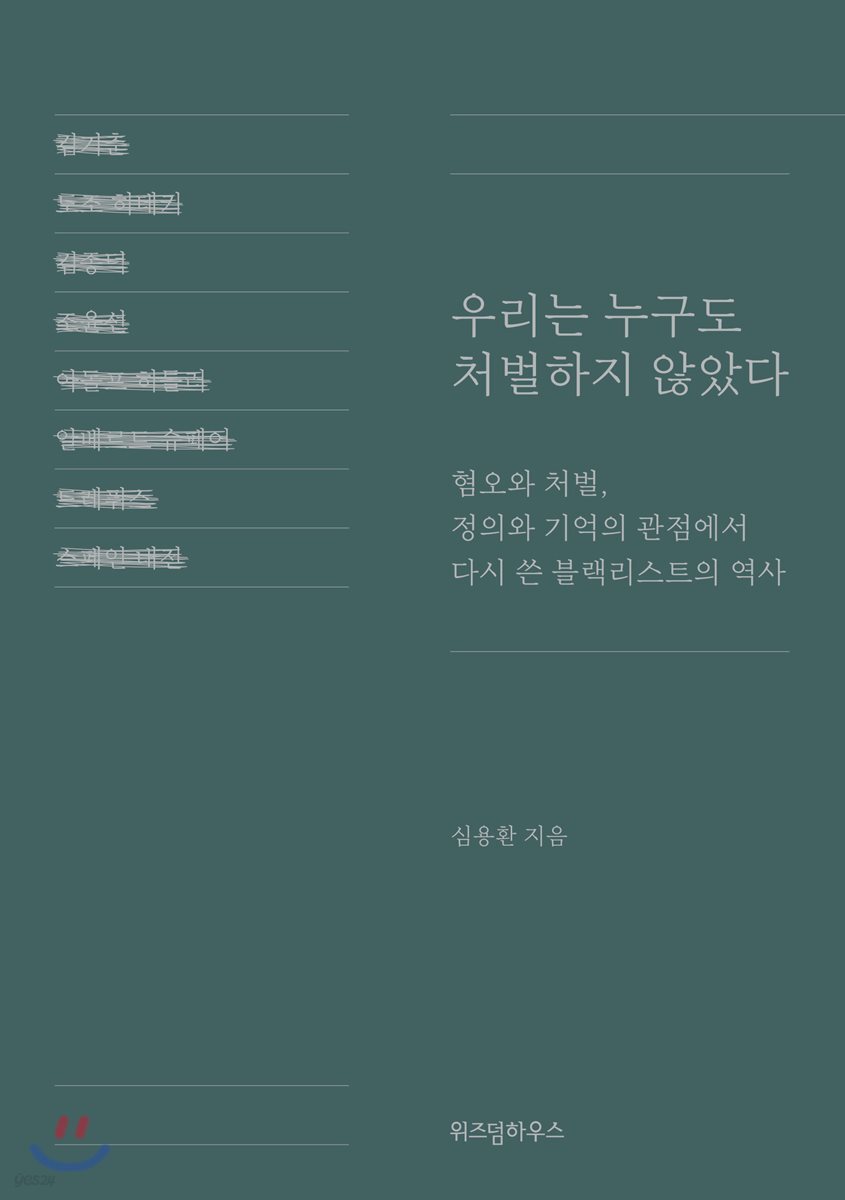
This book, based on the results of a two-year fact-finding investigation into the Park Geun-hye administration's creation and implementation of a blacklist in the cultural and artistic world that shocked South Korea in 2016, examines the current history of the blacklist, examining the consequences of surveillance and censorship in South Korean society, whether our punishment was justified, and how history will remember us today, through a comparison of World War II war criminals Hideki Tojo and Kim Ki-chun.
"We Punished No One" (Wisdom House, 2019) is the result of a historian's intense effort to move beyond the excessively irrelevant historical discussions and consider history as a tool for solving today's problems.
Author Sim Yong-hwan says that today's reality is so new that it overwhelms the past history of the Republic of Korea, and that is why today's historians must respond to the blacklist incident with "current history" rather than "modern history."
Because I believe that the answers to problems that cannot be understood or resolved by simply skimming the headlines of a few articles are hidden in a serious and sober review.
The book summons World War II war criminal Hideki Tojo as a subject of comparative analysis in order to describe Kim Ki-chun, the main culprit behind the blacklisting incident in the cultural and artistic world, as a “figure of contemporary history.”
In addition, to understand the blind obedience of former Minister of Culture, Sports and Tourism Cho Yoon-sun and Kim Jong-deok, we compare them with Albert Speer, a staunch follower of the cultural and artistic world during the Hitler era.
Their decal-like behavior proves that history is doomed to repeat itself when the same choices are made, and at the same time, it shows that no society progresses without just punishment.
A report on the only way to tie up the history of that evil.
This book, based on the results of a two-year fact-finding investigation into the Park Geun-hye administration's creation and implementation of a blacklist in the cultural and artistic world that shocked South Korea in 2016, examines the current history of the blacklist, examining the consequences of surveillance and censorship in South Korean society, whether our punishment was justified, and how history will remember us today, through a comparison of World War II war criminals Hideki Tojo and Kim Ki-chun.
"We Punished No One" (Wisdom House, 2019) is the result of a historian's intense effort to move beyond the excessively irrelevant historical discussions and consider history as a tool for solving today's problems.
Author Sim Yong-hwan says that today's reality is so new that it overwhelms the past history of the Republic of Korea, and that is why today's historians must respond to the blacklist incident with "current history" rather than "modern history."
Because I believe that the answers to problems that cannot be understood or resolved by simply skimming the headlines of a few articles are hidden in a serious and sober review.
The book summons World War II war criminal Hideki Tojo as a subject of comparative analysis in order to describe Kim Ki-chun, the main culprit behind the blacklisting incident in the cultural and artistic world, as a “figure of contemporary history.”
In addition, to understand the blind obedience of former Minister of Culture, Sports and Tourism Cho Yoon-sun and Kim Jong-deok, we compare them with Albert Speer, a staunch follower of the cultural and artistic world during the Hitler era.
Their decal-like behavior proves that history is doomed to repeat itself when the same choices are made, and at the same time, it shows that no society progresses without just punishment.
- You can preview some of the book's contents.
Preview
index
Recommendation
The history of the West Gate Blacklist demands a response.
Chapter 1: The Birth of Evil: How the Blacklist Was Created
Excuse: Hideki Tojo's Self-Rationalization
The Sword Dance of the Blacklist: Kim Ki-chun
[On the Shoulders of Philosophy] On Cruelty, Hypocrisy, Vulgarity, Betrayal, and Misanthropy: Judith Shklar's Everyday Vices
Chapter 2: The Blindly Obedient Civil Servant: Why Do Bureaucrats Obey Power?
Hitler's Blacklist Project and Speer
Minister Kim Jong-deok and Cho Yoon-sun: A True Product of the Arts and Culture World
[On the Shoulders of Philosophy] Maintaining Invalid Beliefs: Leon Festinger's "Cognitive Dissonance Theory"
Chapter 3: On Just Punishment: What's Needed After the Truth Has Been Revealed
The Failure of 19th-Century France: The Dreyfus Affair
Confusion: How to Deal with the Subordinates
[On the Shoulder of Philosophy] Why Wrongdoing Must Be Punished: Thomas Hobbes's Leviathan
Chapter 4: The Value of Memory: How Should We Reflect on the Blacklist?
The Spanish Civil War: How Will We Remember It?
How Memories Become Reality: Artists Create Their Own Stories
[On the Shoulders of Philosophy] How to Create a 'Unit': Beatrice Webb and Sydney Webb's "Industrial Democracy"
Conclusion: The collection of wills becomes the driving force
Reference books, reports and papers
main
The history of the West Gate Blacklist demands a response.
Chapter 1: The Birth of Evil: How the Blacklist Was Created
Excuse: Hideki Tojo's Self-Rationalization
The Sword Dance of the Blacklist: Kim Ki-chun
[On the Shoulders of Philosophy] On Cruelty, Hypocrisy, Vulgarity, Betrayal, and Misanthropy: Judith Shklar's Everyday Vices
Chapter 2: The Blindly Obedient Civil Servant: Why Do Bureaucrats Obey Power?
Hitler's Blacklist Project and Speer
Minister Kim Jong-deok and Cho Yoon-sun: A True Product of the Arts and Culture World
[On the Shoulders of Philosophy] Maintaining Invalid Beliefs: Leon Festinger's "Cognitive Dissonance Theory"
Chapter 3: On Just Punishment: What's Needed After the Truth Has Been Revealed
The Failure of 19th-Century France: The Dreyfus Affair
Confusion: How to Deal with the Subordinates
[On the Shoulder of Philosophy] Why Wrongdoing Must Be Punished: Thomas Hobbes's Leviathan
Chapter 4: The Value of Memory: How Should We Reflect on the Blacklist?
The Spanish Civil War: How Will We Remember It?
How Memories Become Reality: Artists Create Their Own Stories
[On the Shoulders of Philosophy] How to Create a 'Unit': Beatrice Webb and Sydney Webb's "Industrial Democracy"
Conclusion: The collection of wills becomes the driving force
Reference books, reports and papers
main
Into the book
For a long time, Korean history has been obsessed with empirically exploring stories from the past that are excessively unrelated to reality.
However, the reality before our eyes is so new that it overwhelms the past history of the Republic of Korea, and demands that historians respond by writing 'present history' rather than 'modern history.'
We need to review the blacklist incident with sober reason and cool-headed emotion, not with a few obvious headlines that we believe are common sense.
Because there is such an accurate answer there.
--- p.11
Kim Ki-chun, who is he? What categories would be appropriate to define him, even roughly?
Rule of law, strict punishment, anti-communism, careerism, nepotism, special ties to the Park Chung-hee family, excellent networking and the unwavering ability to always remain in the social leadership, and fabrication of communist spies, corruption…
He lived his entire life as a soldier and has a different side from Hideki Tojo, a leader of the Japanese imperial era who had a very simple and multi-layered personality.
Kim Ki-chun was more career-oriented and seemed to have spent a lot of time enjoying numerous vested interests, and he moved between the legal and political worlds.
His life could be seen as a microcosm of Korea's harsh modern history.
But if he had been a careerist, his end could not have been so simple and violent.
Just as Hideki Tojo would not have been able to wage such reckless wars so actively if he had simply been obedient to the teachings of the emperor and the military.
--- pp.69~70
The blacklisting project directly led to personnel actions such as demotions of several employees at the Ministry of Culture, Sports and Tourism.
Director Kim Sang-wook (former Arts Policy Officer) was reprimanded by the Minister for “supporting progressive literary magazines such as Changbi” and was subject to personnel action, and Director Jeong Hyang-mi (former Publishing and Printing Industry Division) was similarly transferred to the National Institute of the Korean Language due to insufficient management of the Publication Culture Promotion Agency.
Former Content Policy Director Kim Jae-won, former Director of the Video Content Industry Division Kim Hye-seon, and former Secretary Yoon Moon-won of the Video Content Industry Division were all 'marked' and given written warnings because of their immature responses to current issues such as the movie [Diving Bell]. (...) Kim Ki-choon, who has experience leading the prosecution and is familiar with the operating principles of the Korean organizational world, including civil servants, while working in various public offices, is trying to boldly remove several obstacles and 'make' the 'document' 'real' through the Ministry of Culture, Sports and Tourism.
Since the head cannot act as the hands and feet, it uses the bureaucracy and a few loyal or compliant ministers.
--- pp.77~79
Rather than criticizing or condemning individuals, we need to reflect on the elite structure that Korean society inevitably produces, or the reality that Korean elites must follow with both eyes closed.
Albert Speer, Kim Jong-deok, and Jo Yoon-seon.
Despite the enormous differences in time and space, they share the commonality of voluntarily submitting to their leaders.
Although they had to endure a certain amount of conscience, it led to tremendous personal success beyond their wildest dreams.
In the process, they committed unbelievable illegal acts. So is this a historically proven way to get ahead, or is it a social pathology that must be corrected?
--- p.168
Crises can strike at any time, and they create ripple effects that can be cascading, creating strange opportunities for many people.
The freedom to conceal sin, the freedom to hate someone, the freedom to terrorize society by promoting baseless conspiracy theories.
However, by the time the incident was resolved, all these irresponsible behaviors could no longer be pointed out or punished, and they simply disappeared into history.
France in the late 19th century was following a typical example of historical error.
--- p.206
It is self-evident that we did not do what we should have done and did what we should not have done.
So what should we do?
A 'sincere apology' is merely a consolation for the insult.
The appropriate consequences for the crime of breaching a contract and threatening natural rights should begin with 'punishment'.
Moreover, they despised the law, the law-makers, the contracts made through the law, and the natural rights that the law had to create.
The order is already set.
The reason punishment must be the starting point is because punishment is what is achieved, and there are things that must be systematically addressed after punishment. If we view the blacklist from the perspective of "resolution and processing," the point at which the "growing pains" of the process must reach is perfectly accurate.
There is only a rational and exemplary 'punishment and then some'.
--- p.241
Since democratization, the history of the Republic of Korea has repeated several patterns.
'Victory in struggle' and 'delegating the task of reform to those in power' have been the foundation of all reforms.
Added to this are the advancement of activists closely related to the issue into politics and the strengthening of the influence of related civic groups.
More fundamentally, it means that almost all issues have ultimately been resolved based on 'political interest', but the current process is truly different.
Coincidentally, differences arose in the very place where they had been so oppressed, even to the point of creating a blacklist.
--- p.282
Over the past 70 years, the people of the Republic of Korea have demonstrated a capacity for exercising their right to resist to a degree unprecedented in world history.
At the same time, they were very active in establishing leaders of their own choice and in promoting reform and social change through these leaders.
This is a fundamental virtue of a democratic republican citizen that must continue into the future. However, the fatigue is also not ordinary.
Despite the fact that the superintendent election prohibits partisan voting in order to preserve and strengthen its unique characteristics, the election is still being held as a thoroughly political election, with elections being held in the format of “progressive superintendent, conservative superintendent.”
Local elections, such as those for the mayor of Seoul and the governor of Gyeonggi Province, are literally elections for "regional autonomy," but they also carry the exact meaning of midterm elections and are subordinate to central politics.
Yet, on the other hand, voting supremacy is rampant.
--- p.300
In the end, it has to start with a willful decision, a gathering of wills.
Has there ever been a moment in history without challenges?
Conditions are created, and goals are achieved based on them.
I will fight my battle in the situation I am in.
I have no doubt that at some point, countless wills will come together to form mountains and rivers, once again achieving the fervent progress of history.
However, the reality before our eyes is so new that it overwhelms the past history of the Republic of Korea, and demands that historians respond by writing 'present history' rather than 'modern history.'
We need to review the blacklist incident with sober reason and cool-headed emotion, not with a few obvious headlines that we believe are common sense.
Because there is such an accurate answer there.
--- p.11
Kim Ki-chun, who is he? What categories would be appropriate to define him, even roughly?
Rule of law, strict punishment, anti-communism, careerism, nepotism, special ties to the Park Chung-hee family, excellent networking and the unwavering ability to always remain in the social leadership, and fabrication of communist spies, corruption…
He lived his entire life as a soldier and has a different side from Hideki Tojo, a leader of the Japanese imperial era who had a very simple and multi-layered personality.
Kim Ki-chun was more career-oriented and seemed to have spent a lot of time enjoying numerous vested interests, and he moved between the legal and political worlds.
His life could be seen as a microcosm of Korea's harsh modern history.
But if he had been a careerist, his end could not have been so simple and violent.
Just as Hideki Tojo would not have been able to wage such reckless wars so actively if he had simply been obedient to the teachings of the emperor and the military.
--- pp.69~70
The blacklisting project directly led to personnel actions such as demotions of several employees at the Ministry of Culture, Sports and Tourism.
Director Kim Sang-wook (former Arts Policy Officer) was reprimanded by the Minister for “supporting progressive literary magazines such as Changbi” and was subject to personnel action, and Director Jeong Hyang-mi (former Publishing and Printing Industry Division) was similarly transferred to the National Institute of the Korean Language due to insufficient management of the Publication Culture Promotion Agency.
Former Content Policy Director Kim Jae-won, former Director of the Video Content Industry Division Kim Hye-seon, and former Secretary Yoon Moon-won of the Video Content Industry Division were all 'marked' and given written warnings because of their immature responses to current issues such as the movie [Diving Bell]. (...) Kim Ki-choon, who has experience leading the prosecution and is familiar with the operating principles of the Korean organizational world, including civil servants, while working in various public offices, is trying to boldly remove several obstacles and 'make' the 'document' 'real' through the Ministry of Culture, Sports and Tourism.
Since the head cannot act as the hands and feet, it uses the bureaucracy and a few loyal or compliant ministers.
--- pp.77~79
Rather than criticizing or condemning individuals, we need to reflect on the elite structure that Korean society inevitably produces, or the reality that Korean elites must follow with both eyes closed.
Albert Speer, Kim Jong-deok, and Jo Yoon-seon.
Despite the enormous differences in time and space, they share the commonality of voluntarily submitting to their leaders.
Although they had to endure a certain amount of conscience, it led to tremendous personal success beyond their wildest dreams.
In the process, they committed unbelievable illegal acts. So is this a historically proven way to get ahead, or is it a social pathology that must be corrected?
--- p.168
Crises can strike at any time, and they create ripple effects that can be cascading, creating strange opportunities for many people.
The freedom to conceal sin, the freedom to hate someone, the freedom to terrorize society by promoting baseless conspiracy theories.
However, by the time the incident was resolved, all these irresponsible behaviors could no longer be pointed out or punished, and they simply disappeared into history.
France in the late 19th century was following a typical example of historical error.
--- p.206
It is self-evident that we did not do what we should have done and did what we should not have done.
So what should we do?
A 'sincere apology' is merely a consolation for the insult.
The appropriate consequences for the crime of breaching a contract and threatening natural rights should begin with 'punishment'.
Moreover, they despised the law, the law-makers, the contracts made through the law, and the natural rights that the law had to create.
The order is already set.
The reason punishment must be the starting point is because punishment is what is achieved, and there are things that must be systematically addressed after punishment. If we view the blacklist from the perspective of "resolution and processing," the point at which the "growing pains" of the process must reach is perfectly accurate.
There is only a rational and exemplary 'punishment and then some'.
--- p.241
Since democratization, the history of the Republic of Korea has repeated several patterns.
'Victory in struggle' and 'delegating the task of reform to those in power' have been the foundation of all reforms.
Added to this are the advancement of activists closely related to the issue into politics and the strengthening of the influence of related civic groups.
More fundamentally, it means that almost all issues have ultimately been resolved based on 'political interest', but the current process is truly different.
Coincidentally, differences arose in the very place where they had been so oppressed, even to the point of creating a blacklist.
--- p.282
Over the past 70 years, the people of the Republic of Korea have demonstrated a capacity for exercising their right to resist to a degree unprecedented in world history.
At the same time, they were very active in establishing leaders of their own choice and in promoting reform and social change through these leaders.
This is a fundamental virtue of a democratic republican citizen that must continue into the future. However, the fatigue is also not ordinary.
Despite the fact that the superintendent election prohibits partisan voting in order to preserve and strengthen its unique characteristics, the election is still being held as a thoroughly political election, with elections being held in the format of “progressive superintendent, conservative superintendent.”
Local elections, such as those for the mayor of Seoul and the governor of Gyeonggi Province, are literally elections for "regional autonomy," but they also carry the exact meaning of midterm elections and are subordinate to central politics.
Yet, on the other hand, voting supremacy is rampant.
--- p.300
In the end, it has to start with a willful decision, a gathering of wills.
Has there ever been a moment in history without challenges?
Conditions are created, and goals are achieved based on them.
I will fight my battle in the situation I am in.
I have no doubt that at some point, countless wills will come together to form mountains and rivers, once again achieving the fervent progress of history.
--- p.303
Publisher's Review
“History always serves justice on the side of memory, not oblivion!”
A look at the blacklist situation that is about to end with 'suspended sentences' and 'no charges'
A historian's persistent and meticulous record of historical struggles
In the winter of 2016, when the name Choi Soon-sil swept through South Korea like a wildfire, we discovered the names of Kim Ki-choon and Cho Yoon-sun beneath the shadow of that absurdity.
It was shocking that at the top of the democratic republic there was an unqualified ruler unknown to anyone, but it was even more bizarre that the names of Kim Ki-chun and Cho Yoon-sun were on the list of his minions.
It was certainly difficult to understand why Kim Ki-choon, the architect of the Yushin Constitution and a figure who had never moved from the highest position in society, and Cho Yoon-sun, the subject of numerous number one titles and a "powerful minister," would so thoroughly and blindly follow a mere acquaintance of the president.
The list of 9,473 people on the blacklist from the cultural and artistic world that was later revealed showed just how shameless and bold the regime really was.
The widespread and indiscriminate censorship, seemingly boasting of "we can do this much," was carried out in petty ways, such as by excluding subsidies, forcing many artists and artists to wage a desperate struggle for survival. The struggle culminated in candlelight vigils in the plazas, and ultimately, it seemed as if the power of rational citizens had triumphed. However, that was the end of it. Kim Ki-chun and Jo Yoon-sun received only three years in prison and a suspended sentence (first trial), but no one wonders why their sentences were so lenient.
Why do our struggles always end in gathering together and getting angry?
Why don't we care about them receiving just punishment?
"We Punished No One" (Wisdom House, 2019) is the result of a historian's intense effort to move beyond the excessively irrelevant historical discussions and consider history as a tool for solving today's problems.
Author Sim Yong-hwan says that today's reality is so new that it overwhelms the past history of the Republic of Korea, and that is why today's historians must respond to the blacklist incident with "current history" rather than "modern history."
Because I believe that the answers to problems that cannot be understood or resolved by simply skimming the headlines of a few articles are hidden in a serious and sober review.
The book summons World War II war criminal Hideki Tojo as a subject of comparative analysis in order to describe Kim Ki-chun, the main culprit behind the blacklisting incident in the cultural and artistic world, as a “figure of contemporary history.”
In addition, to understand the blind obedience of former Minister of Culture, Sports and Tourism Cho Yoon-sun and Kim Jong-deok, we compare them with Albert Speer, a staunch follower of the cultural and artistic world during the Hitler era.
Their decal-like behavior proves that history is doomed to repeat itself when the same choices are made, and at the same time, it shows that no society progresses without just punishment.
Punishment should vary depending on the consequences of the action.
The Dreyfus Affair and the Spanish Civil War: The Issues of Just Punishment and Memory
The book questions what is needed after the truth is revealed, through the madness and self-reflection of 19th-century French society that accused the Jewish soldier Dreyfus of being a spy.
The state of French society at the time, which was under the mass hypnosis that 'Jews are spies', is similar to that of South Korea just before the blacklist incident.
The media churns out fake news in a sensationalist manner, and the majority of the public is uncritically swayed by this propaganda, choosing targets of disgust and hatred without rational judgment.
Even after the truth was revealed, they remained silent about the suffering suffered by the victims, and above all, they completely ignored the issue of punishing the perpetrators.
The reality that the victims' lives are completely ruined, yet no one is punished and thus no one becomes a perpetrator is something that Dreyfus experienced in the 1890s, and also something that the Korean cultural and arts world is experiencing in 2018.
The book raises questions about the punishment of those who were actively or passively involved in the blacklisting incident.
Did Kim Ki-choon and Cho Yoon-sun receive just punishment? How severe is the punishment for high-ranking officials who, under orders from their superiors, ordered their subordinates to compile and implement a blacklist? Are those who, simply because they were at the bottom, had no choice but to follow orders free from punishment? The author retraces the mistakes of our history, granting impunity to those who collaborated with Japan, dictatorship, and even crimes, demonstrating that historical progress without punishment is impossible.
He also mentions the massive social chaos that occurred after both sides agreed to "forget" the horrific crimes committed during the Spanish Civil War, and emphasizes that only a society that constantly remembers and raises issues, even if it means enduring conflict, can enjoy peace.
History with a perspective from the shoulders of philosophy
Four philosophical theories as navigators offering alternatives
At the end of each chapter, the book provides a philosophical basis for a more in-depth interpretation of the topic of each chapter.
Chapter 1, which traces the birth of the blacklist and human psychology, uses Judith Shklar's "Ordinary Vices"; Chapter 2, which criticizes the bureaucracy blindly subservient to power, uses Leon Festinger's "Cognitive Dissonance Theory"; Chapter 3, which raises the issue of punishment for dealing with collaborators, uses Thomas Hobbes's "Leviathan"; and Chapter 4, which discusses the issue of memory, uses Beatrice and Sidney Webb's "Industrial Democracy" to try to overcome the limitations of the problems argued in each chapter in reality.
This has solidified the book's argument, which could easily end up as a critique without alternatives, and will provide readers with the pleasure of reading a refined humanities book, something they cannot experience from a simple report.
A look at the blacklist situation that is about to end with 'suspended sentences' and 'no charges'
A historian's persistent and meticulous record of historical struggles
In the winter of 2016, when the name Choi Soon-sil swept through South Korea like a wildfire, we discovered the names of Kim Ki-choon and Cho Yoon-sun beneath the shadow of that absurdity.
It was shocking that at the top of the democratic republic there was an unqualified ruler unknown to anyone, but it was even more bizarre that the names of Kim Ki-chun and Cho Yoon-sun were on the list of his minions.
It was certainly difficult to understand why Kim Ki-choon, the architect of the Yushin Constitution and a figure who had never moved from the highest position in society, and Cho Yoon-sun, the subject of numerous number one titles and a "powerful minister," would so thoroughly and blindly follow a mere acquaintance of the president.
The list of 9,473 people on the blacklist from the cultural and artistic world that was later revealed showed just how shameless and bold the regime really was.
The widespread and indiscriminate censorship, seemingly boasting of "we can do this much," was carried out in petty ways, such as by excluding subsidies, forcing many artists and artists to wage a desperate struggle for survival. The struggle culminated in candlelight vigils in the plazas, and ultimately, it seemed as if the power of rational citizens had triumphed. However, that was the end of it. Kim Ki-chun and Jo Yoon-sun received only three years in prison and a suspended sentence (first trial), but no one wonders why their sentences were so lenient.
Why do our struggles always end in gathering together and getting angry?
Why don't we care about them receiving just punishment?
"We Punished No One" (Wisdom House, 2019) is the result of a historian's intense effort to move beyond the excessively irrelevant historical discussions and consider history as a tool for solving today's problems.
Author Sim Yong-hwan says that today's reality is so new that it overwhelms the past history of the Republic of Korea, and that is why today's historians must respond to the blacklist incident with "current history" rather than "modern history."
Because I believe that the answers to problems that cannot be understood or resolved by simply skimming the headlines of a few articles are hidden in a serious and sober review.
The book summons World War II war criminal Hideki Tojo as a subject of comparative analysis in order to describe Kim Ki-chun, the main culprit behind the blacklisting incident in the cultural and artistic world, as a “figure of contemporary history.”
In addition, to understand the blind obedience of former Minister of Culture, Sports and Tourism Cho Yoon-sun and Kim Jong-deok, we compare them with Albert Speer, a staunch follower of the cultural and artistic world during the Hitler era.
Their decal-like behavior proves that history is doomed to repeat itself when the same choices are made, and at the same time, it shows that no society progresses without just punishment.
Punishment should vary depending on the consequences of the action.
The Dreyfus Affair and the Spanish Civil War: The Issues of Just Punishment and Memory
The book questions what is needed after the truth is revealed, through the madness and self-reflection of 19th-century French society that accused the Jewish soldier Dreyfus of being a spy.
The state of French society at the time, which was under the mass hypnosis that 'Jews are spies', is similar to that of South Korea just before the blacklist incident.
The media churns out fake news in a sensationalist manner, and the majority of the public is uncritically swayed by this propaganda, choosing targets of disgust and hatred without rational judgment.
Even after the truth was revealed, they remained silent about the suffering suffered by the victims, and above all, they completely ignored the issue of punishing the perpetrators.
The reality that the victims' lives are completely ruined, yet no one is punished and thus no one becomes a perpetrator is something that Dreyfus experienced in the 1890s, and also something that the Korean cultural and arts world is experiencing in 2018.
The book raises questions about the punishment of those who were actively or passively involved in the blacklisting incident.
Did Kim Ki-choon and Cho Yoon-sun receive just punishment? How severe is the punishment for high-ranking officials who, under orders from their superiors, ordered their subordinates to compile and implement a blacklist? Are those who, simply because they were at the bottom, had no choice but to follow orders free from punishment? The author retraces the mistakes of our history, granting impunity to those who collaborated with Japan, dictatorship, and even crimes, demonstrating that historical progress without punishment is impossible.
He also mentions the massive social chaos that occurred after both sides agreed to "forget" the horrific crimes committed during the Spanish Civil War, and emphasizes that only a society that constantly remembers and raises issues, even if it means enduring conflict, can enjoy peace.
History with a perspective from the shoulders of philosophy
Four philosophical theories as navigators offering alternatives
At the end of each chapter, the book provides a philosophical basis for a more in-depth interpretation of the topic of each chapter.
Chapter 1, which traces the birth of the blacklist and human psychology, uses Judith Shklar's "Ordinary Vices"; Chapter 2, which criticizes the bureaucracy blindly subservient to power, uses Leon Festinger's "Cognitive Dissonance Theory"; Chapter 3, which raises the issue of punishment for dealing with collaborators, uses Thomas Hobbes's "Leviathan"; and Chapter 4, which discusses the issue of memory, uses Beatrice and Sidney Webb's "Industrial Democracy" to try to overcome the limitations of the problems argued in each chapter in reality.
This has solidified the book's argument, which could easily end up as a critique without alternatives, and will provide readers with the pleasure of reading a refined humanities book, something they cannot experience from a simple report.
GOODS SPECIFICS
- Date of issue: March 15, 2019
- Page count, weight, size: 336 pages | 536g | 148*210*19mm
- ISBN13: 9791189938413
- ISBN10: 1189938413
You may also like
카테고리
korean


korean

![GQ KOREA Mark (Monthly): December [2025]](http://librairie.coreenne.fr/cdn/shop/files/8ef265dbbfbf186523ed75ba7319009d.jpg?v=1765340328&width=3840)


