

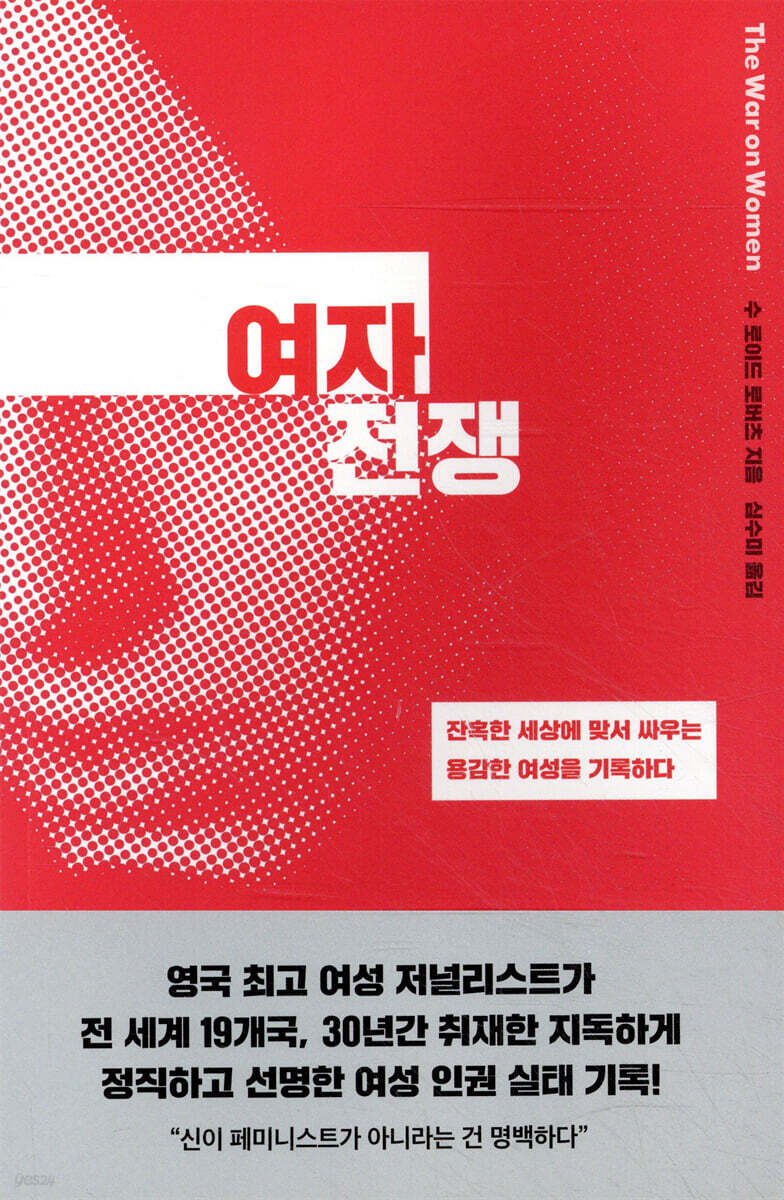
Women's War
 |
Description
Book Introduction
Reportage on women's rights around the world from Britain's top female journalist
Based on 30 years of reporting in 19 countries around the world
A vivid and honest record of the state of women's human rights!
The Women's War is the only solo book by Sue Lloyd Roberts, one of the BBC's top journalists.
Sue Lloyd Roberts is a leading BBC video journalist who has successfully conducted undercover and undercover reporting, breaking the boundaries of female reporters' reporting, which had previously been focused on the British royal family and flower shows, and traveling to the former Soviet Union and other difficult places around the world with a small camera.
As his nickname, "a reporter specializing in unanswerable questions," suggests, he persistently and tenaciously delved into issues and reported on them, and he considered human rights and women's issues as his mission.
Sue Lloyd Roberts had planned to publish this book in time for International Women's Day, but unfortunately, she passed away from leukemia in October 2015 while she was writing it. Three years later, on International Women's Day, the book was finally published in Korea.
This book, "Women's War," is so vivid and sincere that it can be called a textbook on women's rights reportage.
It's about women forced to undergo genital mutilation, women who lose their daughters and sons and confront state power, women who are branded and exploited, women who are imprisoned without freedom of choice, and women who experience unfair wage discrimination.
But this book is also the story of women who bravely stood up to misogyny and ultimately survived.
The synergy of Sue Lloyd Roberts' passion and investigative expertise creates a book that is sometimes so gruesome that it's almost impossible to turn the page. However, the interviews with the people involved, which are also valuable as data, make the story even more vivid and vivid.
It may seem like a story from a faraway land, but the similarities in the way women are exploited, the words that suddenly appear everywhere that every woman has heard, and the violence that resembles our own history are deeply troubling.
But this book does not only talk about the harsh reality and despair.
In the stories of courageous women who bravely and clearly speak out against a cruel world, and in the gradual changes in society that unfold in the meantime, we may find great comfort and courage, and perhaps even find answers to the challenges that lie before us.
Based on 30 years of reporting in 19 countries around the world
A vivid and honest record of the state of women's human rights!
The Women's War is the only solo book by Sue Lloyd Roberts, one of the BBC's top journalists.
Sue Lloyd Roberts is a leading BBC video journalist who has successfully conducted undercover and undercover reporting, breaking the boundaries of female reporters' reporting, which had previously been focused on the British royal family and flower shows, and traveling to the former Soviet Union and other difficult places around the world with a small camera.
As his nickname, "a reporter specializing in unanswerable questions," suggests, he persistently and tenaciously delved into issues and reported on them, and he considered human rights and women's issues as his mission.
Sue Lloyd Roberts had planned to publish this book in time for International Women's Day, but unfortunately, she passed away from leukemia in October 2015 while she was writing it. Three years later, on International Women's Day, the book was finally published in Korea.
This book, "Women's War," is so vivid and sincere that it can be called a textbook on women's rights reportage.
It's about women forced to undergo genital mutilation, women who lose their daughters and sons and confront state power, women who are branded and exploited, women who are imprisoned without freedom of choice, and women who experience unfair wage discrimination.
But this book is also the story of women who bravely stood up to misogyny and ultimately survived.
The synergy of Sue Lloyd Roberts' passion and investigative expertise creates a book that is sometimes so gruesome that it's almost impossible to turn the page. However, the interviews with the people involved, which are also valuable as data, make the story even more vivid and vivid.
It may seem like a story from a faraway land, but the similarities in the way women are exploited, the words that suddenly appear everywhere that every woman has heard, and the violence that resembles our own history are deeply troubling.
But this book does not only talk about the harsh reality and despair.
In the stories of courageous women who bravely and clearly speak out against a cruel world, and in the gradual changes in society that unfold in the meantime, we may find great comfort and courage, and perhaps even find answers to the challenges that lie before us.
- You can preview some of the book's contents.
Preview
index
Acknowledgements
Opening remarks
Entering
1 The most brutal blade, female genital mutilation: Gambia
2 Grandmothers of May Square: Argentina
3 'Fallen Women' Persecuted by Religion: Ireland
4. The World's Largest Women's Prison: Saudi Arabia
5 Sexual Violence in a Square Calling for Democracy: Egypt
6 Girls Disappearing Through Human Trafficking: Former Soviet Union Countries
7 Where UN peacekeeping forces pass through: Bosnia and Kosovo
8 Forced Marriage Shuttles Connecting Two Cities: Pakistan and the UK
9 Honor Killings Without Honor: Pakistan and Jordan
10 Worst Places in the World to Be a Woman: India
11 Rape as a Weapon of War: Bosnia and the Democratic Republic of the Congo
12 Institutionalized Misogyny: Britain
Conclusion
Translator's Note
annotation
Opening remarks
Entering
1 The most brutal blade, female genital mutilation: Gambia
2 Grandmothers of May Square: Argentina
3 'Fallen Women' Persecuted by Religion: Ireland
4. The World's Largest Women's Prison: Saudi Arabia
5 Sexual Violence in a Square Calling for Democracy: Egypt
6 Girls Disappearing Through Human Trafficking: Former Soviet Union Countries
7 Where UN peacekeeping forces pass through: Bosnia and Kosovo
8 Forced Marriage Shuttles Connecting Two Cities: Pakistan and the UK
9 Honor Killings Without Honor: Pakistan and Jordan
10 Worst Places in the World to Be a Woman: India
11 Rape as a Weapon of War: Bosnia and the Democratic Republic of the Congo
12 Institutionalized Misogyny: Britain
Conclusion
Translator's Note
annotation
Into the book
This book is a tribute to the weak of the world who refuse to accept their fate and remain silent.
So this book is for the brave people who are fighting against injustice.
My mother, a passionate feminist, taught me from a very young age to never depend on men.
Maimuna's destiny was to perform circumcision.
From her mother, grandmother, and generations before her, they have been doing their duty to the community.
After deciding to break with her family tradition, she knew she had to run away from the village.
--- From "The Most Cruel Blade, Female Circumcision"
At the time, I was only about twenty-three or so, but I was very impressed by the way those women reacted to their husbands.
I used to say this.
From "Shut Up" I don't care if they kill me or you.
“I need to know where my children have been taken.” The mothers began to meet one by one outside the walls of the newspaper office and police station, and gradually they became organized.
--- From "The Grandmothers of May Square"
It was all too easy to label any woman who appeared to be behaving in any way contrary to traditional Irish morals as a 'fallen woman'.
Some women were even sent to laundromats as a 'preventive measure'.
The nuns who taught the children at school sent girls with particularly outstanding looks to the laundries, saying they were 'at high risk of corruption.'
--- From "The 'Fallen Women' Persecuted by Religion"
The average Saudi man claims that women live a more comfortable and "privileged" life.
It's a life of sitting in a luxurious home with a Filipino maid doing housework, waiting for her husband, and then going to and from the shopping mall in a car driven by a Pakistani chauffeur.
“Why would women want to work?” --- From “The World’s Largest Women’s Prison”
The women were later taken to a military prison, where they were beaten again.
A female military doctor even visited, saying she would conduct a 'virginity test'.
“I told you to take off your clothes.
I was so exhausted from the beatings and electric shocks that I just did as I was told.
She examined me in front of soldiers who were clapping, laughing, and cheering as if they were watching a variety show.
It was intentional to cause shame.
“I went to the square to fight for freedom, and this is how I was repaid.” --- From “Sexual Violence in the Square Calling for Democracy”
“Tanya seemed like a kind woman.
There were no jobs for our daughter Elena in this town, so she felt like a godsend.
Tanya said she had a friend who runs a hotel in Istanbul and needed a smart, hard-working housekeeper, and she also knew another family looking for an au pair.” Tanya and Elena drove away with the blessings and goodbyes of their families.
--- From "Girls Disappearing Through Human Trafficking"
Again, it's the logic that 'all men are like that'.
When peacekeepers first arrived in Kosovo, locals welcomed them, hoping that the soldiers would help rebuild the Albanian community after Serbian attacks.
But now, they are beginning to question whether they should be protecting themselves from these so-called peacekeepers.
--- From "Where the UN Peacekeeping Forces Pass"
Razia, who had pushed aside the attendants and made a path, came face to face with the minister.
“The government needs to do something.
"The Asian community won't do as you say." "Do you really not understand that you need to stop these scumbags pretending to be loving husbands from coming into this country? Can't you see what's happening? It's immigration fraud." O'Brien, unable to hide his embarrassment, made an excuse and left.
--- "Forced marriage shuttle connecting two cities
“Why did you kill your brother?” “Because I had to.
“There was no other choice,” Hamid said with a perfectly calm expression.
“One of our four brothers agreed that she should be killed, and I said I would gladly do it.
“She ran away, saying she would marry the man she loved, abandoning the groom our family had prepared for her.” --- From “Honorless Killings”
The rapists claimed that this horrific crime was Joti's fault.
“When you are raped, you shouldn’t have even resisted.
Why don't you just quietly allow the rape?
Then, after doing that to the woman, he would just let her go and hit only the man.” --- From “The Hardest Place in the World to Live as a Woman”
Rape during war is not just sexual violence.
It is an act of hate and an exercise of power.
Most of the women who bravely spoke about their experiences during and after the war testified that rape was often accompanied by serious physical assault.
--- From "Rape: A Weapon of War"
They feel that they have been victims of a conspiracy by men on both sides.
Not only employers, but also male-dominated unions that should have represented them.
Regarding the compensation offer, “I remember when I was meeting with our local union leader, he yelled at me, ‘You shouldn’t have accepted the offer.’
They didn't even try to find out.
“I just found out that another union has a female local union member, so I’m thinking of switching unions.” --- From “Institutionalized Misogyny”
So this book is for the brave people who are fighting against injustice.
My mother, a passionate feminist, taught me from a very young age to never depend on men.
Maimuna's destiny was to perform circumcision.
From her mother, grandmother, and generations before her, they have been doing their duty to the community.
After deciding to break with her family tradition, she knew she had to run away from the village.
--- From "The Most Cruel Blade, Female Circumcision"
At the time, I was only about twenty-three or so, but I was very impressed by the way those women reacted to their husbands.
I used to say this.
From "Shut Up" I don't care if they kill me or you.
“I need to know where my children have been taken.” The mothers began to meet one by one outside the walls of the newspaper office and police station, and gradually they became organized.
--- From "The Grandmothers of May Square"
It was all too easy to label any woman who appeared to be behaving in any way contrary to traditional Irish morals as a 'fallen woman'.
Some women were even sent to laundromats as a 'preventive measure'.
The nuns who taught the children at school sent girls with particularly outstanding looks to the laundries, saying they were 'at high risk of corruption.'
--- From "The 'Fallen Women' Persecuted by Religion"
The average Saudi man claims that women live a more comfortable and "privileged" life.
It's a life of sitting in a luxurious home with a Filipino maid doing housework, waiting for her husband, and then going to and from the shopping mall in a car driven by a Pakistani chauffeur.
“Why would women want to work?” --- From “The World’s Largest Women’s Prison”
The women were later taken to a military prison, where they were beaten again.
A female military doctor even visited, saying she would conduct a 'virginity test'.
“I told you to take off your clothes.
I was so exhausted from the beatings and electric shocks that I just did as I was told.
She examined me in front of soldiers who were clapping, laughing, and cheering as if they were watching a variety show.
It was intentional to cause shame.
“I went to the square to fight for freedom, and this is how I was repaid.” --- From “Sexual Violence in the Square Calling for Democracy”
“Tanya seemed like a kind woman.
There were no jobs for our daughter Elena in this town, so she felt like a godsend.
Tanya said she had a friend who runs a hotel in Istanbul and needed a smart, hard-working housekeeper, and she also knew another family looking for an au pair.” Tanya and Elena drove away with the blessings and goodbyes of their families.
--- From "Girls Disappearing Through Human Trafficking"
Again, it's the logic that 'all men are like that'.
When peacekeepers first arrived in Kosovo, locals welcomed them, hoping that the soldiers would help rebuild the Albanian community after Serbian attacks.
But now, they are beginning to question whether they should be protecting themselves from these so-called peacekeepers.
--- From "Where the UN Peacekeeping Forces Pass"
Razia, who had pushed aside the attendants and made a path, came face to face with the minister.
“The government needs to do something.
"The Asian community won't do as you say." "Do you really not understand that you need to stop these scumbags pretending to be loving husbands from coming into this country? Can't you see what's happening? It's immigration fraud." O'Brien, unable to hide his embarrassment, made an excuse and left.
--- "Forced marriage shuttle connecting two cities
“Why did you kill your brother?” “Because I had to.
“There was no other choice,” Hamid said with a perfectly calm expression.
“One of our four brothers agreed that she should be killed, and I said I would gladly do it.
“She ran away, saying she would marry the man she loved, abandoning the groom our family had prepared for her.” --- From “Honorless Killings”
The rapists claimed that this horrific crime was Joti's fault.
“When you are raped, you shouldn’t have even resisted.
Why don't you just quietly allow the rape?
Then, after doing that to the woman, he would just let her go and hit only the man.” --- From “The Hardest Place in the World to Live as a Woman”
Rape during war is not just sexual violence.
It is an act of hate and an exercise of power.
Most of the women who bravely spoke about their experiences during and after the war testified that rape was often accompanied by serious physical assault.
--- From "Rape: A Weapon of War"
They feel that they have been victims of a conspiracy by men on both sides.
Not only employers, but also male-dominated unions that should have represented them.
Regarding the compensation offer, “I remember when I was meeting with our local union leader, he yelled at me, ‘You shouldn’t have accepted the offer.’
They didn't even try to find out.
“I just found out that another union has a female local union member, so I’m thinking of switching unions.” --- From “Institutionalized Misogyny”
--- From "Institutionalized Misogyny"
GOODS SPECIFICS
- Date of issue: March 8, 2019
- Page count, weight, size: 408 pages | 632g | 140*210*24mm
- ISBN13: 9791188907571
- ISBN10: 1188907573
You may also like
카테고리
korean


korean

![GQ KOREA Mark (Monthly): December [2025]](http://librairie.coreenne.fr/cdn/shop/files/8ef265dbbfbf186523ed75ba7319009d.jpg?v=1765340328&width=3840)


