

Everyone has blossomed
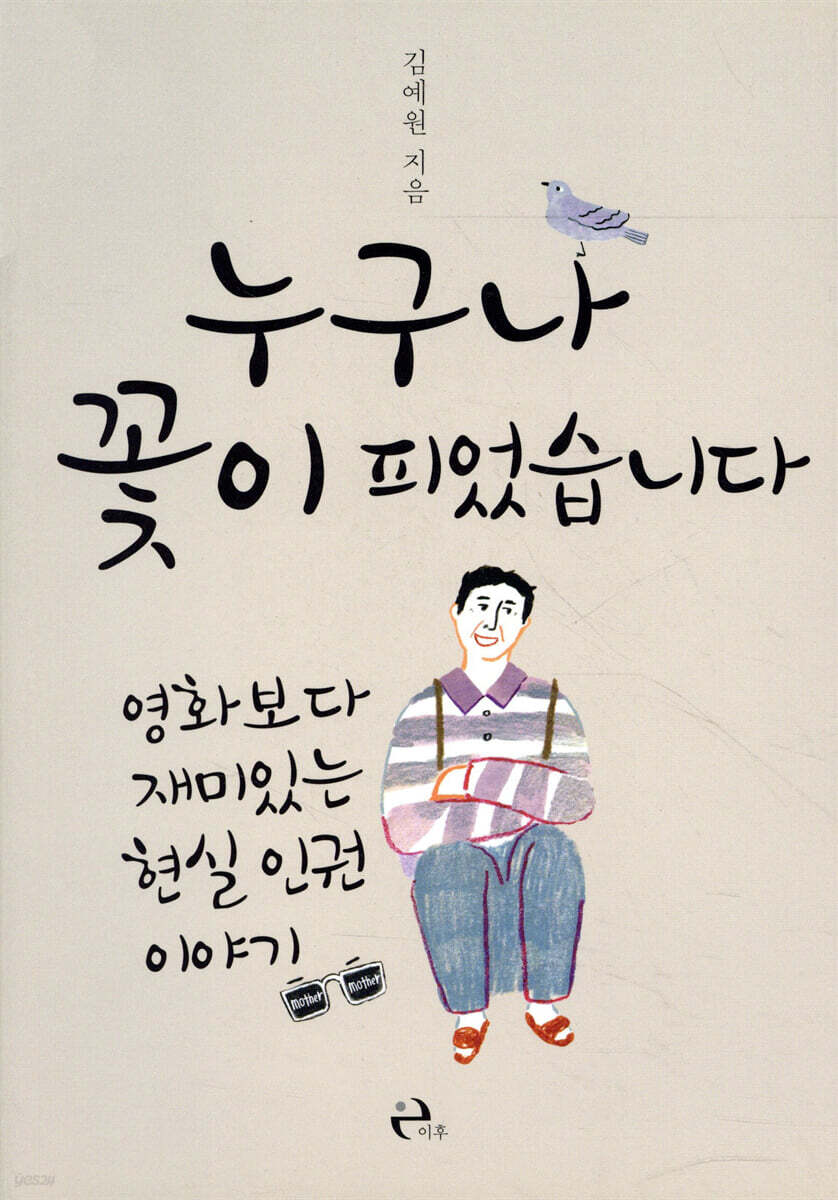 |
Description
Book Introduction
- A word from MD
-
Reality of Human Rights Read through FilmThe sloth episode in the movie is a funny scene for many people.
Author Kim Ye-won, a human rights lawyer, interprets the labor of disabled people in that scene.
The film introduced in the book is familiar to us, but the human rights story the author unfolds is unfamiliar.
Nevertheless, it is a reality we must face.
February 26, 2019. Social and Political PD Son Min-gyu
Problematic lawyer Kim Ye-won speaks out about human rights in film.
“A lawyer who brings a newborn baby into court,” “A disabled lawyer who defends a case while holding an artificial eye,” “A lawyer who is a mother of three who defends a case while breastfeeding” are just some of the many adjectives that describe lawyer Kim Ye-won.
It's quite an unusual adjective for a legal professional.
Kim Ye-won, who lost one eye due to a medical accident at birth, is an ultra-optimist who says, “Is it because I’m too pretty and I’m too popular and I’m worried I’ll get tired of it?”
Although I have never thought of myself as disabled, I am a person with empathy who moves first when I see the powerless and weak suffering injustice.
It's not that I decided to become a disabled person's rights lawyer because I'm disabled. It's just that I naturally ended up on that path because I lived by the values I believed in.
Attorney Kim Ye-won describes herself as “a person whose personality has become her profession.”
When I see something unfair, I can't easily overlook it.
When I personally experienced the reality that people with only one eye could not obtain a Class 1 driver's license, I thought that the law should be changed to break the prejudice that people with only one eye can only see half of the world.
After proposing a revision to the Road Traffic Act and its enforcement ordinance, it was ultimately successful.
It is rare to find someone whose knowledge and life are so aligned.
Attorney Kim Ye-won's only hobby since she was studying for the bar exam was watching movies.
I wanted to share the discrimination and prejudice within us through film.
It tells the story of real people living in a reality more cinematic than a movie, along with the story of the movie.
As a lawyer and a woman with a disability, she serves as a barometer to gauge the world's distorted perspectives.
With this one book, readers will be able to check their level of empathy.
“A lawyer who brings a newborn baby into court,” “A disabled lawyer who defends a case while holding an artificial eye,” “A lawyer who is a mother of three who defends a case while breastfeeding” are just some of the many adjectives that describe lawyer Kim Ye-won.
It's quite an unusual adjective for a legal professional.
Kim Ye-won, who lost one eye due to a medical accident at birth, is an ultra-optimist who says, “Is it because I’m too pretty and I’m too popular and I’m worried I’ll get tired of it?”
Although I have never thought of myself as disabled, I am a person with empathy who moves first when I see the powerless and weak suffering injustice.
It's not that I decided to become a disabled person's rights lawyer because I'm disabled. It's just that I naturally ended up on that path because I lived by the values I believed in.
Attorney Kim Ye-won describes herself as “a person whose personality has become her profession.”
When I see something unfair, I can't easily overlook it.
When I personally experienced the reality that people with only one eye could not obtain a Class 1 driver's license, I thought that the law should be changed to break the prejudice that people with only one eye can only see half of the world.
After proposing a revision to the Road Traffic Act and its enforcement ordinance, it was ultimately successful.
It is rare to find someone whose knowledge and life are so aligned.
Attorney Kim Ye-won's only hobby since she was studying for the bar exam was watching movies.
I wanted to share the discrimination and prejudice within us through film.
It tells the story of real people living in a reality more cinematic than a movie, along with the story of the movie.
As a lawyer and a woman with a disability, she serves as a barometer to gauge the world's distorted perspectives.
With this one book, readers will be able to check their level of empathy.
- You can preview some of the book's contents.
Preview
index
· Recommended articles
· Entering
1.
Even sloths have jobs, but disabled people don't. How did the sloths in "Zootopia" get jobs?
Thinking Together 1 When I first met a disabled person
2.
A proud urban life for women with disabilities
"Josee", you don't need a man like that!
3.
I hate being told to stay home when I'm sick the most.
And among the many names, why "Aeja"?
4.
You're saying I'm grateful because you fed me and gave me a place to sleep?
The "barefoot Kibongs" living around us
Think Together 2: People with Developmental Disabilities on Trial
5.
Don't treat me like an 'invisible person'
Was Won Bin in "Mother" happy thanks to his mother?
6.
I just want to live together
"Cinema Paradiso" and a paradise for the disabled!
7.
Is integrated education automatically achieved simply by being "together"? The hearts of the children living and breathing within "us"
Think Together 3 If people with disabilities only live in facilities
8.
Don't be afraid of the world. How did Shin-ae from "Miryang" live after leaving the mental hospital?
9.
Do you need qualifications for community service? Toilet qualifications in "The Help," and community service qualifications for people with disabilities.
10.
You're talking about something like 'principle'
The Story of "I, Daniel Blake"
Think Together 4 Wrong laws must be changed
11.
Can people with severe disabilities and people without disabilities become friends? The possibility of the 1% friendship in "The Untouchables"
12.
It's not on purpose, it's just natural for me. "Marathon"'s Grassland and Zebra Butt
13.
Was it really a gift? The truth about the gift Ye-seung's father received in "Miracle in Room 7."
Disability Rights Center
· Entering
1.
Even sloths have jobs, but disabled people don't. How did the sloths in "Zootopia" get jobs?
Thinking Together 1 When I first met a disabled person
2.
A proud urban life for women with disabilities
"Josee", you don't need a man like that!
3.
I hate being told to stay home when I'm sick the most.
And among the many names, why "Aeja"?
4.
You're saying I'm grateful because you fed me and gave me a place to sleep?
The "barefoot Kibongs" living around us
Think Together 2: People with Developmental Disabilities on Trial
5.
Don't treat me like an 'invisible person'
Was Won Bin in "Mother" happy thanks to his mother?
6.
I just want to live together
"Cinema Paradiso" and a paradise for the disabled!
7.
Is integrated education automatically achieved simply by being "together"? The hearts of the children living and breathing within "us"
Think Together 3 If people with disabilities only live in facilities
8.
Don't be afraid of the world. How did Shin-ae from "Miryang" live after leaving the mental hospital?
9.
Do you need qualifications for community service? Toilet qualifications in "The Help," and community service qualifications for people with disabilities.
10.
You're talking about something like 'principle'
The Story of "I, Daniel Blake"
Think Together 4 Wrong laws must be changed
11.
Can people with severe disabilities and people without disabilities become friends? The possibility of the 1% friendship in "The Untouchables"
12.
It's not on purpose, it's just natural for me. "Marathon"'s Grassland and Zebra Butt
13.
Was it really a gift? The truth about the gift Ye-seung's father received in "Miracle in Room 7."
Disability Rights Center
Publisher's Review
The people within it, rather than the law or the system
Do you know how much people working in workshops for the disabled earn each month? A million won? A million and a half won? Our common sense is far removed from the reality that disabled people face.
What if a teacher's efforts to be considerate of a child with a disability ultimately resulted in other children attacking that child? Did you know that disabled people were never eligible to receive community service instead of a fine in the first place? A disabled person mistaken for a sexual predator said, "I'm sorry," in a state of fear and confusion, and the police, accepting that as a confession, demanded that the child write a statement as they were told.
So when she was put in a situation where she had to go to court, her mother, who had always taught her to apologize to people first, felt incredibly guilty.
But is that really Mom's fault? The shocking reality is overflowing.
Weaving together film as the warp and real-life stories as the weft, it tells the story of how people with disabilities and attorney Kim Ye-won have battled the stifling reality.
The moment I close the book, I find myself saying, "Thank goodness we have attorney Kim Ye-won."
A little bit sad and somewhat touching
There are 13 films covered in the book.
It covers a wide range of films, from old classics to the latest animations, independent films, and blockbuster hits.
"Josee, the Tiger and the Fish" tells the story of a disabled woman, the animated film "Zootopia" tells the story of workers in a workshop for the disabled, "Barefoot Kids" tells the story of bad people who approach with good intentions, "Cinema Paradiso" tells the story of wise living with people who are different from oneself, and "Miracle in Cell No. 7" tells the story of the reality in which criminals are created due to prejudice.
Whether it's a well-known movie or a somewhat unfamiliar one, it's accompanied by friendly explanations to help readers understand, so even those who haven't seen the movie can easily follow along.
In a society where it is thought acceptable to say, “If you’re sick, just stay home,” even when a disabled person is trying to park in a disabled parking space, it is difficult for not only disabled people but also non-disabled people to live.
That is a self-evident fact.
It took a tremendous amount of time and effort for the United States to break free from a society where it was acceptable to say the injustice of "Black people and we can't use the same bathroom."
Even if we cannot openly separate or discriminate, there are countless invisible distinctions.
Only by recognizing this and listening to the voices of those who strive to raise awareness of human rights will we be able to take even one step closer to normalcy in this society.
I hope this book can provide some small help along the way.
Do you know how much people working in workshops for the disabled earn each month? A million won? A million and a half won? Our common sense is far removed from the reality that disabled people face.
What if a teacher's efforts to be considerate of a child with a disability ultimately resulted in other children attacking that child? Did you know that disabled people were never eligible to receive community service instead of a fine in the first place? A disabled person mistaken for a sexual predator said, "I'm sorry," in a state of fear and confusion, and the police, accepting that as a confession, demanded that the child write a statement as they were told.
So when she was put in a situation where she had to go to court, her mother, who had always taught her to apologize to people first, felt incredibly guilty.
But is that really Mom's fault? The shocking reality is overflowing.
Weaving together film as the warp and real-life stories as the weft, it tells the story of how people with disabilities and attorney Kim Ye-won have battled the stifling reality.
The moment I close the book, I find myself saying, "Thank goodness we have attorney Kim Ye-won."
A little bit sad and somewhat touching
There are 13 films covered in the book.
It covers a wide range of films, from old classics to the latest animations, independent films, and blockbuster hits.
"Josee, the Tiger and the Fish" tells the story of a disabled woman, the animated film "Zootopia" tells the story of workers in a workshop for the disabled, "Barefoot Kids" tells the story of bad people who approach with good intentions, "Cinema Paradiso" tells the story of wise living with people who are different from oneself, and "Miracle in Cell No. 7" tells the story of the reality in which criminals are created due to prejudice.
Whether it's a well-known movie or a somewhat unfamiliar one, it's accompanied by friendly explanations to help readers understand, so even those who haven't seen the movie can easily follow along.
In a society where it is thought acceptable to say, “If you’re sick, just stay home,” even when a disabled person is trying to park in a disabled parking space, it is difficult for not only disabled people but also non-disabled people to live.
That is a self-evident fact.
It took a tremendous amount of time and effort for the United States to break free from a society where it was acceptable to say the injustice of "Black people and we can't use the same bathroom."
Even if we cannot openly separate or discriminate, there are countless invisible distinctions.
Only by recognizing this and listening to the voices of those who strive to raise awareness of human rights will we be able to take even one step closer to normalcy in this society.
I hope this book can provide some small help along the way.
GOODS SPECIFICS
- Date of issue: February 21, 2019
- Page count, weight, size: 184 pages | 290g | 140*200*12mm
- ISBN13: 9788961570961
- ISBN10: 896157096X
You may also like
카테고리
korean


korean

![GQ KOREA Mark (Monthly): December [2025]](http://librairie.coreenne.fr/cdn/shop/files/8ef265dbbfbf186523ed75ba7319009d.jpg?v=1765340328&width=3840)


