

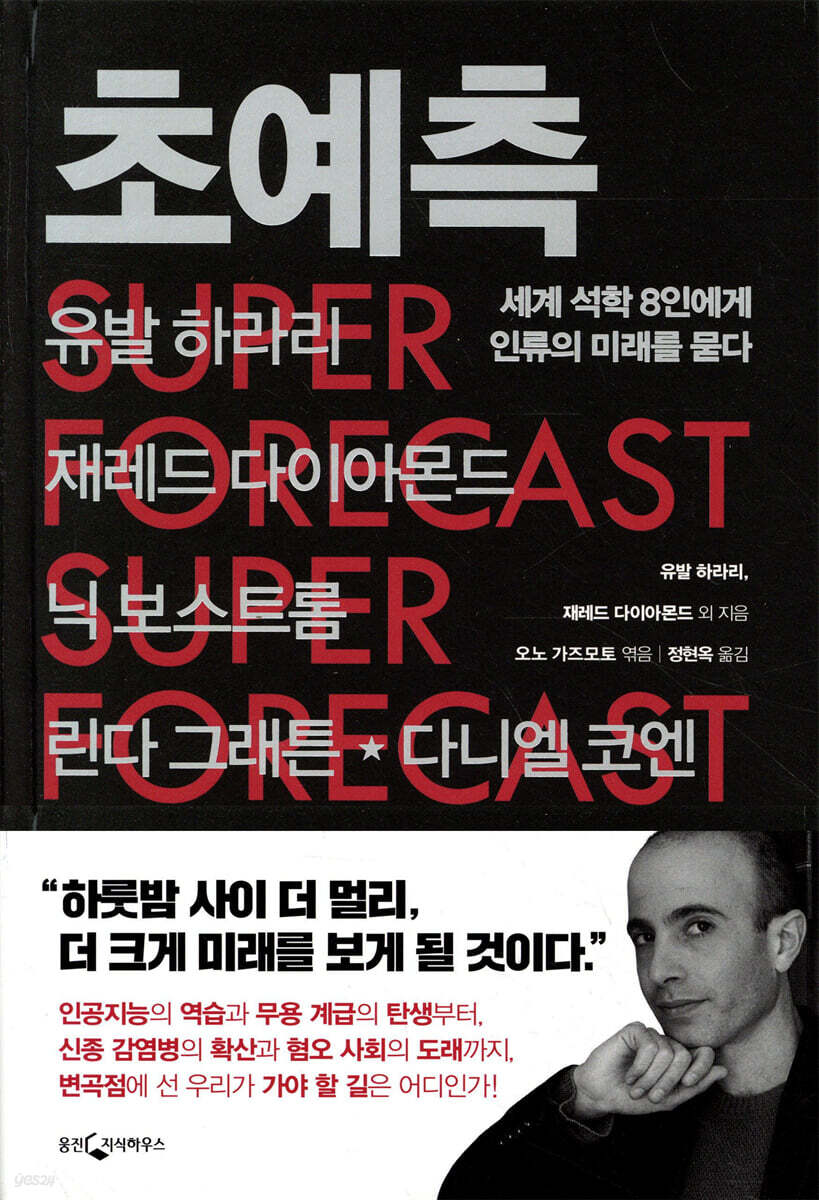
Superforecast
 |
Description
Book Introduction
- A word from MD
-
A global collapse could occur.Terrorism, war, refugees, inequality, hate, climate change, pandemics, populism.
Human civilization faces a huge challenge.
Eight world-renowned scholars, including Yuval Harari, author of Sapiens, and Jared Diamond, author of Guns, Germs, and Steel, diagnose the current state of human civilization and examine the possibility of its collapse.
February 15, 2019. Social and Political PD Son Min-gyu
Predicting future dangers at the crossroads of civilization
Insights from world-renowned scholars!
A massive change that will determine the fate of humanity is accelerating.
The fear that most humans will lose their value and be relegated to the useless class when machine intelligence surpasses human intelligence and biotechnology surpasses the laws of evolution is becoming a reality.
Science and technology, which have exponentially increased life expectancy, have dismantled the three stages of life—education, work, and retirement—and destroyed the life cycle formula that has persisted for hundreds of years.
These changes have further concentrated wealth and power in the hands of a tiny minority, and the frustration and anger of those left behind in the competition have escalated into hatred of the weak, hatred of the privileged, and distrust of democracy, shaking the very foundations of 20th-century progress and peace.
Has modern civilization passed its peak? What future awaits Sapiens? Facing an unusual turning point, with signs of collapse emerging everywhere, we desperately need a sense of civilizational direction beyond short-term perspectives.
"Superforecasts," written by eight world-renowned scholars with keen insight into the tectonic shifts looming over our civilization, will empower you to navigate change without being swept away by it and find the best path forward.
The program was hosted by Kazumoto Ono, an experienced international journalist who has conducted exclusive interviews with key figures around the world, including Noam Chomsky, Michael Sandel, and Jim Rogers.
The book's depth is enriched by the sharp questions posed by veteran journalists and the bold insights of world-renowned scholars.
Additionally, the extensive content is organized into concise sections, allowing for dense reading in a short period of time.
"Superforecast" will serve as an excellent guide for all citizens who, at a crossroads of transition, seek to create a better future rather than simply accepting the predetermined future.
Insights from world-renowned scholars!
A massive change that will determine the fate of humanity is accelerating.
The fear that most humans will lose their value and be relegated to the useless class when machine intelligence surpasses human intelligence and biotechnology surpasses the laws of evolution is becoming a reality.
Science and technology, which have exponentially increased life expectancy, have dismantled the three stages of life—education, work, and retirement—and destroyed the life cycle formula that has persisted for hundreds of years.
These changes have further concentrated wealth and power in the hands of a tiny minority, and the frustration and anger of those left behind in the competition have escalated into hatred of the weak, hatred of the privileged, and distrust of democracy, shaking the very foundations of 20th-century progress and peace.
Has modern civilization passed its peak? What future awaits Sapiens? Facing an unusual turning point, with signs of collapse emerging everywhere, we desperately need a sense of civilizational direction beyond short-term perspectives.
"Superforecasts," written by eight world-renowned scholars with keen insight into the tectonic shifts looming over our civilization, will empower you to navigate change without being swept away by it and find the best path forward.
The program was hosted by Kazumoto Ono, an experienced international journalist who has conducted exclusive interviews with key figures around the world, including Noam Chomsky, Michael Sandel, and Jim Rogers.
The book's depth is enriched by the sharp questions posed by veteran journalists and the bold insights of world-renowned scholars.
Additionally, the extensive content is organized into concise sections, allowing for dense reading in a short period of time.
"Superforecast" will serve as an excellent guide for all citizens who, at a crossroads of transition, seek to create a better future rather than simply accepting the predetermined future.
- You can preview some of the book's contents.
Preview
index
prolog
Chapter 1: What Will Be Humanity's Fate? (Yuval Harari)
Chapter 2: Can Modern Civilization Sustain? (Jared Diamond)
Chapter 3: How to Control Artificial Intelligence (Nick Bostrom)
Chapter 4: How the 100-Year Lifestyle Will Change Life (Linda Gratton)
Chapter 5: Does Technology Make Us Happy? (Daniel Cohen)
Chapter 6: What Threatens Democracy? (Joan Williams)
Chapter 7: How Hatred and Conflict Divide Society (Nell Painter)
Chapter 8: Is a Nuclear-Free Northeast Asia Possible? (William Perry)
Epilogue
Chapter 1: What Will Be Humanity's Fate? (Yuval Harari)
Chapter 2: Can Modern Civilization Sustain? (Jared Diamond)
Chapter 3: How to Control Artificial Intelligence (Nick Bostrom)
Chapter 4: How the 100-Year Lifestyle Will Change Life (Linda Gratton)
Chapter 5: Does Technology Make Us Happy? (Daniel Cohen)
Chapter 6: What Threatens Democracy? (Joan Williams)
Chapter 7: How Hatred and Conflict Divide Society (Nell Painter)
Chapter 8: Is a Nuclear-Free Northeast Asia Possible? (William Perry)
Epilogue
Detailed image

Publisher's Review
Why now, super-forecast?
The world is changing so fast that it's dizzying.
Now, predicting the future by deriving patterns from existing data is no longer feasible.
Science and technology are running wild like a runaway calf, and the established system that guaranteed 20th-century wealth and peace is rapidly collapsing.
As a result, the anxiety and nervousness we feel in this extreme complexity and uncertainty are almost at the level of fear.
As human civilization approaches a qualitatively different phase, we desperately need wisdom that allows us to actively think about the future by analyzing the direction and intensity of change in a three-dimensional way, rather than relying on short-term predictions based on a few numbers and abbreviations.
"Superforecast" is a book that compiles conversations with eight world-renowned scholars with such foresight.
In this book, historian Yuval Harari, author of Sapiens and a thinker about the future of humanity, Jared Diamond, author of the Pulitzer Prize-winning Guns, Germs, and Steel and a world-renowned scholar of civilization, as well as artificial intelligence researcher Nick Bostrom, talent theory authority Linda Gratton, economist Daniel Cohen, labor law expert Joanne Williams, race historian Nell Painter, and former U.S. Secretary of Defense William Perry share their thoughts on the future with readers.
The program was hosted by Kazumoto Ono, an experienced international journalist who has conducted exclusive interviews with key figures around the world, including Noam Chomsky, Michael Sandel, and Jim Rogers.
The book's depth is enriched by the sharp questions posed by veteran journalists and the bold insights of world-renowned scholars.
Additionally, the extensive content is organized into concise sections, allowing for dense reading in a short period of time.
"Superforecast" will serve as an excellent guide for all citizens who, at a crossroads of transition, seek to create a better future rather than simply accepting the predetermined future.
“No one can perfectly predict the future.
But if we can utilize their foresight, wouldn't we be able to at least get a rough outline?
“If we can draw a picture of the future in even a little more detail, the work we must do now becomes clearer.” - From “Prologue”
Asking about the future of human civilization
The first chapter of the book begins with a conversation with Yuval Harari, author of the international bestseller Sapiens.
He warns that the rapid advancement of science and technology could lead most humans to lose their economic and political value and fall into a "useless class."
Humans, whose physical abilities are inferior to those of machines and whose mental abilities are even overwhelmed by artificial intelligence, may soon be replaced by weaponized life forms.
Harari, who says it is his calling as a scholar to present all possibilities, including the worst-case scenario, urges us to act now before the crisis becomes a reality.
“Perhaps the 4 billion year history of organic life will soon come to an end, and inorganic life will take its place.
So the countless decisions we make in the next 30 years will not simply shake up the political landscape; they will shape the future of life itself.”
Next, Jared Diamond, a world-renowned scholar of civilization and author of Guns, Germs, and Steel, which is ranked first in Seoul National University Library borrowings, focuses on how modern civilization can overcome the crisis it faces.
In today's world, where everything is connected, even the slightest shock can cause collapse.
In particular, he lists new infectious diseases, terrorism, and migration as the three threats facing us in the future, and argues that international efforts must be made to reduce the gaps between countries that cause these threats.
“Humanity now faces the question of whether it can create a sustainable economy and ensure a certain standard of living equitably across the globe.
We are destroying the environment and consuming enormous amounts of resources.
“There is a huge gap in consumption levels between countries, and as long as this is left unchecked, the world will remain unstable.”
The next chapter features Nick Bostrom, a renowned artificial intelligence researcher and author of the book Superintelligence, which predicts the emergence of superintelligence that surpasses humans.
He emphasizes that we must seriously consider the question of 'how to control artificial intelligence' from now on to avoid dystopia.
As human intelligence improves through genetic manipulation and other means, it will become easier to create even smarter artificial intelligence. Bostrom discusses how to ensure the stability of artificial intelligence in this dilemma.
“When designing the artificial intelligence of the future, we must ensure that its temperament perfectly matches ours.
“The key will be whether we can shape the thinking of superintelligence in a way that aligns with human values and will.”
Asking about personal life and happiness
How will our lives, including work, leisure, and hobbies, change in the future? Linda Gratton, a global authority on talent and organizational theory and author of "The 100-Year Life," declares that the three-stage life cycle of "education-work-retirement" is over in an era of 100-year life expectancy.
And he advises that only those who flexibly arrange their learning and rest periods and actively manage intangible assets such as health, adaptability, and connections rather than tangible assets such as money or a house will enjoy a happier life as their lifespan increases.
“Until now, there have only been three stages in life: education, work, and retirement.
And since everyone went through these three stages, individuals didn't even need to be conscious of the changes at each stage.
However, in a multi-level life, you must control and decide the direction, degree, and timing of change yourself.
Every time, I have to think about what I want to become and make a choice.”
Daniel Cohen, a leading French thinker and economist who shares the same academic track as Thomas Piketty, sharply examines why the modern assumption that technological advancement increases material abundance and thus happiness has been shattered.
He sounds the alarm against the complacent belief that technological innovation will solve everything, and argues that human happiness lies not in becoming one with computers and enjoying immortality, but in becoming more and more human.
“What we need now is not to beat computers, nor to become computers themselves.
“I believe what we truly need is a future where our humanity is secured while we fully utilize computers as a means.”
Asking about the future of the Republic of Korea
As seen in the AlphaGo shock of 2016, the candlelight revolution of 2017, the Jeju refugee crisis and the North Korean denuclearization agreement of 2018, we too are not free from the flow of great change.
What does the future hold for South Korea? To begin, if we wish to examine the crisis of democracy, the return of populism, and the advent of a hate society through the lens of the United States, we should pay attention to the conversation between Joanne Williams, an expert in labor law, and Nell Painter, an expert in racial history, on the 2016 election of President Trump.
Also, regarding the normalization of relations with North Korea in 2018, an interview with former U.S. Secretary of Defense William Perry, who had a history of overcoming the first North Korean nuclear crisis through diplomatic negotiations, is helpful.
The sobering analysis and assessments of world-renowned scholars will provide new ideas on how to overcome the current crisis facing our society and prepare for future dangers.
- About refugees and immigration
“In America, people are divided into two groups.
One group is people who are full of energy and willing to take risks.
The other group are the unambitious ones who want to stick to the process they've been doing so far.
Immigration is for those who have the courage to take risks.
People who are afraid of risk cannot even think about immigrating.
“America has gained the most ambitious people in the world by welcoming immigrants.” —Jared Diamond
-On the political behavior of the arm of memory
“What a ridiculous idea to want to go back to the past.
When did we experience the golden age?
Are you talking about the 1950s? That's ridiculous.
The world we live in is changing rapidly.
“We need to face reality rather than yearn for the past.” —Linda Gratton
-On the universalism of innovation
“It is difficult to maintain economic growth through science and technology alone.
“For economic growth, we need to increase worker productivity, but at present, new technologies are more likely to take away jobs.” —Daniel Cohen
-On social inequality
“America’s elite pride themselves on their concern for social inequality, but their understanding of class is low.
They don't realize that their starting points are different.
They believe that the reason they are in professional or managerial positions is because they are smart.
But the truth is different.
If they truly want to understand the class issue, they must recognize that they have been on third base since birth.
“The point is that if you hit a triple and ran to third base, you were there from the start, and therefore have a much better chance of reaching home than someone who has never been at the plate before.” —Joan Williams
-Regarding North Korea's denuclearization agreement
“For decades, North Korea has consistently suspected that the United States is attempting to overthrow its regime by force.
And I believed that nuclear weapons would be the only way to deter such an America.
In the current situation, even if North Korea agrees to denuclearization, it will likely back out again.
The key to success is finding alternative means to ensure the survival of the North Korean regime beyond nuclear deterrence.” —William Perry
The world is changing so fast that it's dizzying.
Now, predicting the future by deriving patterns from existing data is no longer feasible.
Science and technology are running wild like a runaway calf, and the established system that guaranteed 20th-century wealth and peace is rapidly collapsing.
As a result, the anxiety and nervousness we feel in this extreme complexity and uncertainty are almost at the level of fear.
As human civilization approaches a qualitatively different phase, we desperately need wisdom that allows us to actively think about the future by analyzing the direction and intensity of change in a three-dimensional way, rather than relying on short-term predictions based on a few numbers and abbreviations.
"Superforecast" is a book that compiles conversations with eight world-renowned scholars with such foresight.
In this book, historian Yuval Harari, author of Sapiens and a thinker about the future of humanity, Jared Diamond, author of the Pulitzer Prize-winning Guns, Germs, and Steel and a world-renowned scholar of civilization, as well as artificial intelligence researcher Nick Bostrom, talent theory authority Linda Gratton, economist Daniel Cohen, labor law expert Joanne Williams, race historian Nell Painter, and former U.S. Secretary of Defense William Perry share their thoughts on the future with readers.
The program was hosted by Kazumoto Ono, an experienced international journalist who has conducted exclusive interviews with key figures around the world, including Noam Chomsky, Michael Sandel, and Jim Rogers.
The book's depth is enriched by the sharp questions posed by veteran journalists and the bold insights of world-renowned scholars.
Additionally, the extensive content is organized into concise sections, allowing for dense reading in a short period of time.
"Superforecast" will serve as an excellent guide for all citizens who, at a crossroads of transition, seek to create a better future rather than simply accepting the predetermined future.
“No one can perfectly predict the future.
But if we can utilize their foresight, wouldn't we be able to at least get a rough outline?
“If we can draw a picture of the future in even a little more detail, the work we must do now becomes clearer.” - From “Prologue”
Asking about the future of human civilization
The first chapter of the book begins with a conversation with Yuval Harari, author of the international bestseller Sapiens.
He warns that the rapid advancement of science and technology could lead most humans to lose their economic and political value and fall into a "useless class."
Humans, whose physical abilities are inferior to those of machines and whose mental abilities are even overwhelmed by artificial intelligence, may soon be replaced by weaponized life forms.
Harari, who says it is his calling as a scholar to present all possibilities, including the worst-case scenario, urges us to act now before the crisis becomes a reality.
“Perhaps the 4 billion year history of organic life will soon come to an end, and inorganic life will take its place.
So the countless decisions we make in the next 30 years will not simply shake up the political landscape; they will shape the future of life itself.”
Next, Jared Diamond, a world-renowned scholar of civilization and author of Guns, Germs, and Steel, which is ranked first in Seoul National University Library borrowings, focuses on how modern civilization can overcome the crisis it faces.
In today's world, where everything is connected, even the slightest shock can cause collapse.
In particular, he lists new infectious diseases, terrorism, and migration as the three threats facing us in the future, and argues that international efforts must be made to reduce the gaps between countries that cause these threats.
“Humanity now faces the question of whether it can create a sustainable economy and ensure a certain standard of living equitably across the globe.
We are destroying the environment and consuming enormous amounts of resources.
“There is a huge gap in consumption levels between countries, and as long as this is left unchecked, the world will remain unstable.”
The next chapter features Nick Bostrom, a renowned artificial intelligence researcher and author of the book Superintelligence, which predicts the emergence of superintelligence that surpasses humans.
He emphasizes that we must seriously consider the question of 'how to control artificial intelligence' from now on to avoid dystopia.
As human intelligence improves through genetic manipulation and other means, it will become easier to create even smarter artificial intelligence. Bostrom discusses how to ensure the stability of artificial intelligence in this dilemma.
“When designing the artificial intelligence of the future, we must ensure that its temperament perfectly matches ours.
“The key will be whether we can shape the thinking of superintelligence in a way that aligns with human values and will.”
Asking about personal life and happiness
How will our lives, including work, leisure, and hobbies, change in the future? Linda Gratton, a global authority on talent and organizational theory and author of "The 100-Year Life," declares that the three-stage life cycle of "education-work-retirement" is over in an era of 100-year life expectancy.
And he advises that only those who flexibly arrange their learning and rest periods and actively manage intangible assets such as health, adaptability, and connections rather than tangible assets such as money or a house will enjoy a happier life as their lifespan increases.
“Until now, there have only been three stages in life: education, work, and retirement.
And since everyone went through these three stages, individuals didn't even need to be conscious of the changes at each stage.
However, in a multi-level life, you must control and decide the direction, degree, and timing of change yourself.
Every time, I have to think about what I want to become and make a choice.”
Daniel Cohen, a leading French thinker and economist who shares the same academic track as Thomas Piketty, sharply examines why the modern assumption that technological advancement increases material abundance and thus happiness has been shattered.
He sounds the alarm against the complacent belief that technological innovation will solve everything, and argues that human happiness lies not in becoming one with computers and enjoying immortality, but in becoming more and more human.
“What we need now is not to beat computers, nor to become computers themselves.
“I believe what we truly need is a future where our humanity is secured while we fully utilize computers as a means.”
Asking about the future of the Republic of Korea
As seen in the AlphaGo shock of 2016, the candlelight revolution of 2017, the Jeju refugee crisis and the North Korean denuclearization agreement of 2018, we too are not free from the flow of great change.
What does the future hold for South Korea? To begin, if we wish to examine the crisis of democracy, the return of populism, and the advent of a hate society through the lens of the United States, we should pay attention to the conversation between Joanne Williams, an expert in labor law, and Nell Painter, an expert in racial history, on the 2016 election of President Trump.
Also, regarding the normalization of relations with North Korea in 2018, an interview with former U.S. Secretary of Defense William Perry, who had a history of overcoming the first North Korean nuclear crisis through diplomatic negotiations, is helpful.
The sobering analysis and assessments of world-renowned scholars will provide new ideas on how to overcome the current crisis facing our society and prepare for future dangers.
- About refugees and immigration
“In America, people are divided into two groups.
One group is people who are full of energy and willing to take risks.
The other group are the unambitious ones who want to stick to the process they've been doing so far.
Immigration is for those who have the courage to take risks.
People who are afraid of risk cannot even think about immigrating.
“America has gained the most ambitious people in the world by welcoming immigrants.” —Jared Diamond
-On the political behavior of the arm of memory
“What a ridiculous idea to want to go back to the past.
When did we experience the golden age?
Are you talking about the 1950s? That's ridiculous.
The world we live in is changing rapidly.
“We need to face reality rather than yearn for the past.” —Linda Gratton
-On the universalism of innovation
“It is difficult to maintain economic growth through science and technology alone.
“For economic growth, we need to increase worker productivity, but at present, new technologies are more likely to take away jobs.” —Daniel Cohen
-On social inequality
“America’s elite pride themselves on their concern for social inequality, but their understanding of class is low.
They don't realize that their starting points are different.
They believe that the reason they are in professional or managerial positions is because they are smart.
But the truth is different.
If they truly want to understand the class issue, they must recognize that they have been on third base since birth.
“The point is that if you hit a triple and ran to third base, you were there from the start, and therefore have a much better chance of reaching home than someone who has never been at the plate before.” —Joan Williams
-Regarding North Korea's denuclearization agreement
“For decades, North Korea has consistently suspected that the United States is attempting to overthrow its regime by force.
And I believed that nuclear weapons would be the only way to deter such an America.
In the current situation, even if North Korea agrees to denuclearization, it will likely back out again.
The key to success is finding alternative means to ensure the survival of the North Korean regime beyond nuclear deterrence.” —William Perry
GOODS SPECIFICS
- Date of issue: February 8, 2019
- Format: Hardcover book binding method guide
- Pages, weight, size: 232 pages | 481g | 150*218*22mm
- ISBN13: 9788901229614
- ISBN10: 8901229617
You may also like
카테고리
korean


korean

![GQ KOREA Mark (Monthly): December [2025]](http://librairie.coreenne.fr/cdn/shop/files/8ef265dbbfbf186523ed75ba7319009d.jpg?v=1765340328&width=3840)


