

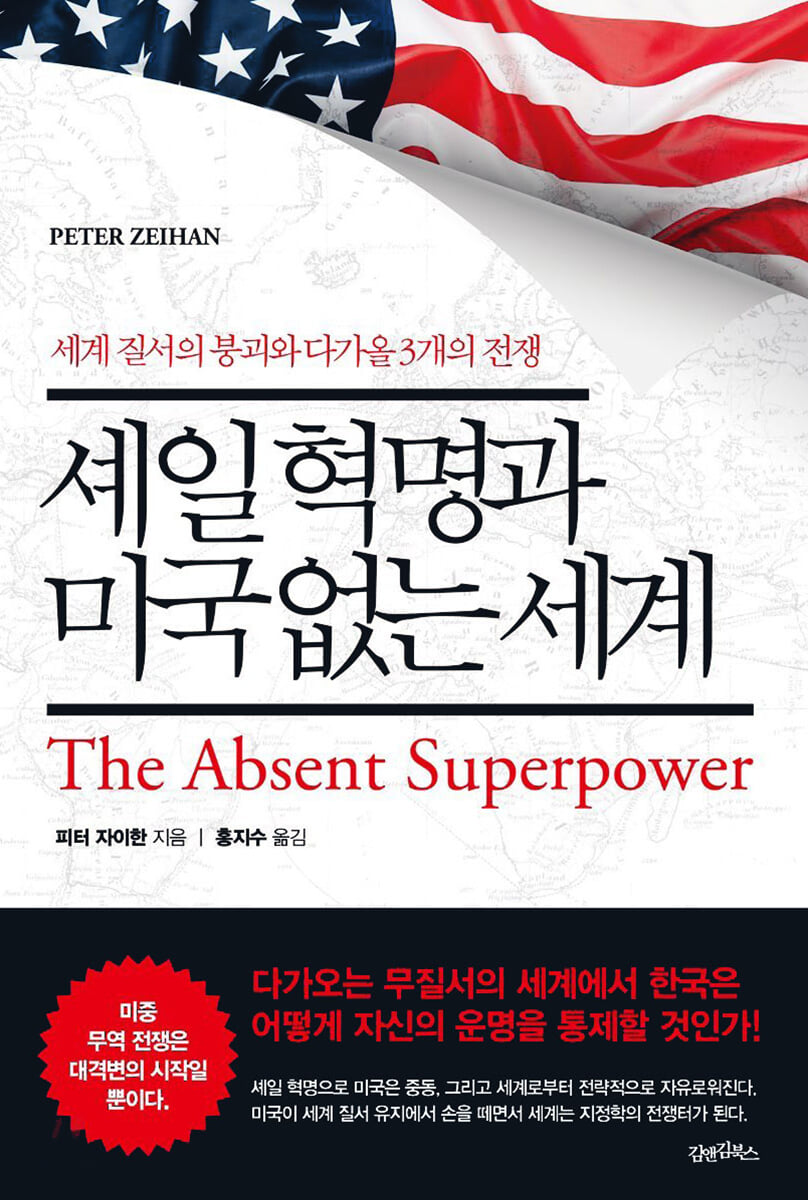
The Shale Revolution and a World Without America
 |
Description
Book Introduction
- A word from MD
-
The end of the familiar world orderAfter World War II, the United States took on the role of the world's policeman.
Now, the US-led world order is beginning to crumble.
As President Trump has said, the United States has no interest in maintaining world order.
The international situation has become unstable.
This book analyzes the turbulent world order from a geopolitical perspective.
February 12, 2019. Social and Political PD Son Min-gyu
The world we knew is ending.
The US-China trade war is just the beginning of a cataclysm.
On December 20, 2018, US President Donald Trump announced the full withdrawal of US troops from Syria, and a few days later, during a visit to the US Al-Asad Air Base in Iraq, he declared, “The United States cannot be the world’s policeman, and the United States is not the world’s puppet.”
It has been a year since he declared the era of economic subservience was over, declaring a "new American era" in his State of the Union address.
The global security system and free trade order, led and led by the United States, are collapsing.
America's strategic goal is to maintain its hegemony, not to maintain world order.
Rather, the United States is tired of maintaining the world order and is therefore actively undermining it.
The US-China trade war means that the Bretton Woods system, which was characterized by US-led security alliances and free trade, is coming to an end.
The problem is that the United States will be leaving the world at a time when global consumption is shrinking and the global economy is entering a period of austerity, as the world's demographics are rapidly reversing.
The moment the United States withdraws from maintaining world order, the geopolitical conflicts it has controlled will erupt, plunging the world into massive chaos.
"The Shale Revolution and a World Without America" is Peter Zeihan's second book, following "American Hegemony and Geopolitics in the 21st Century."
In "American Hegemony and Geopolitics in the 21st Century," Zaihan analyzes the sources of American power, the nature of the post-World War II world order, and how demographic changes, geopolitics, and the shale revolution are leading the 21st century world into chaos.
"The Shale Revolution and a World Without America" delves deeper into how the shale revolution, which began in earnest in the United States after 2014, became possible and how it will transform the world as a game changer.
Furthermore, it presents with remarkable analytical power why the superpower United States is withdrawing from maintaining world order and what geopolitical conflicts will unfold as a result in the power centers of the Eastern Hemisphere.
In particular, the geopolitical analysis of the series of conflicts that will unfold between China, Japan, and Korea in East Asia in the future can be considered a textbook on East Asian geopolitics.
The US-China trade war is just the beginning of a cataclysm.
On December 20, 2018, US President Donald Trump announced the full withdrawal of US troops from Syria, and a few days later, during a visit to the US Al-Asad Air Base in Iraq, he declared, “The United States cannot be the world’s policeman, and the United States is not the world’s puppet.”
It has been a year since he declared the era of economic subservience was over, declaring a "new American era" in his State of the Union address.
The global security system and free trade order, led and led by the United States, are collapsing.
America's strategic goal is to maintain its hegemony, not to maintain world order.
Rather, the United States is tired of maintaining the world order and is therefore actively undermining it.
The US-China trade war means that the Bretton Woods system, which was characterized by US-led security alliances and free trade, is coming to an end.
The problem is that the United States will be leaving the world at a time when global consumption is shrinking and the global economy is entering a period of austerity, as the world's demographics are rapidly reversing.
The moment the United States withdraws from maintaining world order, the geopolitical conflicts it has controlled will erupt, plunging the world into massive chaos.
"The Shale Revolution and a World Without America" is Peter Zeihan's second book, following "American Hegemony and Geopolitics in the 21st Century."
In "American Hegemony and Geopolitics in the 21st Century," Zaihan analyzes the sources of American power, the nature of the post-World War II world order, and how demographic changes, geopolitics, and the shale revolution are leading the 21st century world into chaos.
"The Shale Revolution and a World Without America" delves deeper into how the shale revolution, which began in earnest in the United States after 2014, became possible and how it will transform the world as a game changer.
Furthermore, it presents with remarkable analytical power why the superpower United States is withdrawing from maintaining world order and what geopolitical conflicts will unfold as a result in the power centers of the Eastern Hemisphere.
In particular, the geopolitical analysis of the series of conflicts that will unfold between China, Japan, and Korea in East Asia in the future can be considered a textbook on East Asian geopolitics.
- You can preview some of the book's contents.
Preview
index
Author's Preface to the Korean Edition
Lee Chun-geun's recommended preface
Introduction
Part 1: Shale Creates a New World
01 The First Shale Revolution
shale rock
The coming shale revolution
02 The Second Shale Revolution
Survival Strategies in a Crashing Oil Price Environment
Reduce, reuse, and recycle
Combine, integrate, and expand
Micro-Seismic Revolution
Branch out
Is this enough stimulation?
The next step for the shale industry
Another Side of Shale
03 The Third Shale Revolution
The fuel used for cooking these days is...
economies of scale
Job creation
04 American, all too American energy
Geographic conditions
manpower
private property rights
capital
Infrastructure
Countries that chase after the United States with furrowed brows but cannot catch up.
Reshaping the world
Part 2: Disorder
05 The End of the Old World
Geographical conditions required for a global power
Trade and the World We Know
Population Structure and a Fluid World
Energy Strategy
2007: The World at the Dawn of the Shale Age
2015: Shale and a Fluid World
War of Disorder
Chapter 6: The War of the Earth: Europe and Russia
Russia's Geography: A Painful Lesson
Soviet solution
What should I do?
Step 1: Destroy Ukraine and divide Europe.
Stage 2: Scandinavia
Step 3: Central Axis
Step 4: Southern Border
Turn your attention to Syria
Which side should you bet on in the global war?
America's role in the global war
The Aftermath of War: Europe and Russia
07 Persian Gulf War: Iran-Saudi Arabia
Meeting with neighbors
Persian Dreams and Unique Strategies
Step 1: Knife
Step 2: Purchase
battlefield
Iran's Difficult Problem
Step 1: Close the Persian Gulf
Stage 2: Rebellion
Stage 3: Invasion
America's role (or lack thereof) in the Persian Gulf War
Aftershock: The Persian Gulf's Deepening Rift
08 Tanker Wars: China and Japan
The amazing power of Japan
China: A Perfect Example of Vulnerability
The crowbar called Taiwan
Who will Korea join hands with?
Enemies at hand: Vietnam, the Philippines, and Malaysia
War is a golden opportunity to make money: Singapore, Indonesia, Thailand, Myanmar
Role reversal in South Asia
Aftershock: Asia's Coast and Beyond
09 16 countries that benefit from fishing
Now it's time for some good news.
A long journey home
10 The World of Supermajors
The State of Energy in the United States
Fighting deglobalization
The State of Energy in Europe
France: The Return to Empire
Britain: Supplying Fuel for the War
Italy: The Geopolitics of Business Lunches
Bringing order to chaos
Part 3: America's Role
11 Available resources in the United States
No country still has military power comparable to that of the United States.
The capabilities of the US military are not limited to the US military.
The US economy is largely unaffected by the collapse of the global system.
12 Dollar Diplomacy in Southeast Asia
Making a splash in Southeast Asia
Beyond Southeast Asia
13 Dollar Diplomacy in Latin America
Geographical conditions are merciless
Politics under adverse geographical conditions
Three exceptions
The Light and Shadow of the Latin American Energy Industry
Venezuela: Good times are gone...
Brazil: The terrible times are gone...
Argentina: Hope for the Future
Trinidad and Tobago: A Bridge to Somewhere
Colombia: Doing it right
Peru: Literary hardship
Ecuador: No Entry!
The Caribbean and Central America: Forced Transition, Forced Integration
A superpower that doesn't completely let go
Conclusion: Shale's New World
Appendix I: Shale and the Transformation of Climate Change
Appendix II: Other Shale-Related Concerns
Appendix III Oil and Natural Gas Related Materials
Acknowledgements
Lee Chun-geun's recommended preface
Introduction
Part 1: Shale Creates a New World
01 The First Shale Revolution
shale rock
The coming shale revolution
02 The Second Shale Revolution
Survival Strategies in a Crashing Oil Price Environment
Reduce, reuse, and recycle
Combine, integrate, and expand
Micro-Seismic Revolution
Branch out
Is this enough stimulation?
The next step for the shale industry
Another Side of Shale
03 The Third Shale Revolution
The fuel used for cooking these days is...
economies of scale
Job creation
04 American, all too American energy
Geographic conditions
manpower
private property rights
capital
Infrastructure
Countries that chase after the United States with furrowed brows but cannot catch up.
Reshaping the world
Part 2: Disorder
05 The End of the Old World
Geographical conditions required for a global power
Trade and the World We Know
Population Structure and a Fluid World
Energy Strategy
2007: The World at the Dawn of the Shale Age
2015: Shale and a Fluid World
War of Disorder
Chapter 6: The War of the Earth: Europe and Russia
Russia's Geography: A Painful Lesson
Soviet solution
What should I do?
Step 1: Destroy Ukraine and divide Europe.
Stage 2: Scandinavia
Step 3: Central Axis
Step 4: Southern Border
Turn your attention to Syria
Which side should you bet on in the global war?
America's role in the global war
The Aftermath of War: Europe and Russia
07 Persian Gulf War: Iran-Saudi Arabia
Meeting with neighbors
Persian Dreams and Unique Strategies
Step 1: Knife
Step 2: Purchase
battlefield
Iran's Difficult Problem
Step 1: Close the Persian Gulf
Stage 2: Rebellion
Stage 3: Invasion
America's role (or lack thereof) in the Persian Gulf War
Aftershock: The Persian Gulf's Deepening Rift
08 Tanker Wars: China and Japan
The amazing power of Japan
China: A Perfect Example of Vulnerability
The crowbar called Taiwan
Who will Korea join hands with?
Enemies at hand: Vietnam, the Philippines, and Malaysia
War is a golden opportunity to make money: Singapore, Indonesia, Thailand, Myanmar
Role reversal in South Asia
Aftershock: Asia's Coast and Beyond
09 16 countries that benefit from fishing
Now it's time for some good news.
A long journey home
10 The World of Supermajors
The State of Energy in the United States
Fighting deglobalization
The State of Energy in Europe
France: The Return to Empire
Britain: Supplying Fuel for the War
Italy: The Geopolitics of Business Lunches
Bringing order to chaos
Part 3: America's Role
11 Available resources in the United States
No country still has military power comparable to that of the United States.
The capabilities of the US military are not limited to the US military.
The US economy is largely unaffected by the collapse of the global system.
12 Dollar Diplomacy in Southeast Asia
Making a splash in Southeast Asia
Beyond Southeast Asia
13 Dollar Diplomacy in Latin America
Geographical conditions are merciless
Politics under adverse geographical conditions
Three exceptions
The Light and Shadow of the Latin American Energy Industry
Venezuela: Good times are gone...
Brazil: The terrible times are gone...
Argentina: Hope for the Future
Trinidad and Tobago: A Bridge to Somewhere
Colombia: Doing it right
Peru: Literary hardship
Ecuador: No Entry!
The Caribbean and Central America: Forced Transition, Forced Integration
A superpower that doesn't completely let go
Conclusion: Shale's New World
Appendix I: Shale and the Transformation of Climate Change
Appendix II: Other Shale-Related Concerns
Appendix III Oil and Natural Gas Related Materials
Acknowledgements
Publisher's Review
The world we knew is ending.
The US-China trade war is just the beginning of a cataclysm.
On December 20, 2018, US President Donald Trump announced the full withdrawal of US troops from Syria, and a few days later, during a visit to the US Al-Asad Air Base in Iraq, he declared, “The United States cannot be the world’s policeman, and the United States is not the world’s puppet.”
It has been a year since he declared the era of economic subservience was over, declaring a "new American era" in his State of the Union address.
The global security system and free trade order, led and led by the United States, are collapsing.
America's strategic goal is to maintain its hegemony, not to maintain world order.
Rather, the United States is tired of maintaining the world order and is therefore actively undermining it.
The US-China trade war means that the Bretton Woods system, which was characterized by US-led security alliances and free trade, is coming to an end.
The problem is that the United States will be leaving the world at a time when global consumption is shrinking and the global economy is entering a period of austerity, as the world's demographics are rapidly reversing.
The moment the United States withdraws from maintaining world order, the geopolitical conflicts it has controlled will erupt, plunging the world into massive chaos.
"The Shale Revolution and a World Without America" is Peter Zeihan's second book, following "American Hegemony and Geopolitics in the 21st Century."
In "American Hegemony and Geopolitics in the 21st Century," Zaihan analyzes the sources of American power, the nature of the post-World War II world order, and how demographic changes, geopolitics, and the shale revolution are leading the 21st century world into chaos.
"The Shale Revolution and a World Without America" delves deeper into how the shale revolution, which began in earnest in the United States after 2014, became possible and how it will transform the world as a game changer.
Furthermore, it presents with remarkable analytical power why the superpower United States is withdrawing from maintaining world order and what geopolitical conflicts will unfold as a result in the power centers of the Eastern Hemisphere.
In particular, the geopolitical analysis of the series of conflicts that will unfold between China, Japan, and Korea in East Asia in the future can be considered a textbook on East Asian geopolitics.
Why America Is Destroying the World Order
The world feels America's influence more deeply through its absence.
Peter Zeihan argues that the current world order stems from America's global strategy to counter the Soviet empire.
It is seen as a way to buy off its allies economically and give them its markets in order to build a security alliance against the Soviet empire.
But the Soviet empire collapsed over 30 years ago.
Russia is not the Soviet Union, and China cannot become the Soviet Union.
Rather, the one who benefits most from the free trade order is China, which is challenging its hegemony.
Both security alliances and free trade have now outlived their usefulness.
Moreover, the United States has already achieved energy self-sufficiency through the shale revolution.
America no longer has anything to be sorry about in the world, and the world has come to regret America.
In the 21st century, the United States remains a superpower, but it is becoming less involved in world affairs.
The security alliance led by the United States is being dismantled or weakened.
The North Atlantic Treaty Organization becomes a dead letter.
Russia is not strong enough to threaten Germany and Western Europe, and Western Europe is not weak enough to be occupied by Russia.
Moreover, Germany depends on Russia for more than 35% of its energy.
The United States will be watching the world descend into chaos for a considerable period of time.
It leaves its potential competitors in a situation where they are at odds with each other.
We cannot allow competitors to continue to rise through market access to the United States.
Even former allies will no longer allow unilateral market access.
But the moment the United States withdraws from Europe, the Middle East, and Northeast Asia, the Eastern Hemisphere will be torn apart by geopolitical conflict.
Paradoxically, America's absence has allowed it to increase its presence and gain a strategic advantage.
Everyone will need America, but America will not need the world very much.
The United States is in a position of overwhelming advantage when dealing with individual countries, whether on security or market issues.
If you have something that will interest the United States, you're lucky.
Most countries that do not even have that are helplessly dragged into the world's chaos.
How the Shale Revolution Will Change the World
The powerful link between the world and America is broken.
Oil is not just the fuel that lights up our lights and makes our cars run.
It is used as a material to make almost all things.
Without oil, there would be no internet, no cell phones, and no proper agriculture.
In 2006, the United States imported 12.4 mbpd of oil.
This is more than the combined imports of Japan, China, and Germany.
By 2016, the United States was nearly energy self-sufficient, and by 2019, it would become a net energy exporter.
The U.S. shale industry suffered significant losses during the oil price wars, but survived three revolutions.
Even now, technological innovation continues to lower the break-even price.
North America has some of the world's largest and best shale deposits.
More importantly, only the United States has the geology, legal and regulatory framework, available capital, and a workforce with the technology and experience to mine shale.
From a geopolitical perspective, the shale revolution is a purely American event.
The question now is not whether shale will become the core of the U.S. energy industry, but what the world will look like when the U.S. is no longer tied to global energy markets.
This book analyzes the changes taking place in the U.S. shale industry and the impact these changes will have on the global system.
If the United States no longer imports energy from outside North America, it would not only sever the most crucial link connecting the United States to the world.
Reindustrialization in the United States will accelerate the collapse of the world order, leading to a series of widespread military conflicts that will shape the world for the next two decades.
The shale revolution will be a game changer that will transform the 21st century world order.
The moment America lets go, the world becomes a geopolitical battlefield.
Three wars are coming that will shatter the world.
The United States no longer intervenes directly in military conflicts occurring in the power centers of the Eastern Hemisphere.
As soon as the possibility of American intervention is judged low, Russian troops cross the Ukrainian border.
With the dissolution of the Soviet Union in 1991, Russia's borders were pushed back significantly, but the length of the border to defend actually grew longer.
The buffer zone has shrunk and the distance from the border to Moscow has become shorter.
With its population rapidly declining, Russia's strategic position is deteriorating from merely precarious to catastrophic.
The best option for Russia is to change its geopolitical situation so that it becomes a country that can be sufficiently defended by a small army.
Russia's only option for securing the more secure borders it desires is expansion.
If Russia wants to survive its population decline, it has no choice but to absorb its neighbors, including Ukraine, Belarus, the Baltic states, and Armenia.
A devastating military conflict between Russia and Europe, spread over a vast area, would define the borders between Europe and Russia for decades to come.
The key to this war is not how the United States, but how Germany will respond to Russia's provocations.
With no global alliances to defend, no global trade to protect for global alliances, and no global energy flows to protect for global trade, stability in the Middle East is no longer a primary concern for the United States.
The number of US troops stationed in the Middle East, which once exceeded 250,000, now stands at around 15,000.
Even the largest aircraft carriers are out of the Persian Gulf for more than half the year.
With the US withdrawal, the Middle East is returning to the pre-Bretton Woods balance of power, and the conflict between Iran and Saudi Arabia, both of which are vying for regional hegemony, has already reached a critical point.
Just as they become convinced that the US will not intervene, Iranian forces cross the desert to seize control of Saudi Arabia's oil fields.
Regardless of the outcome of the two wars, the world, except for the North American continent, and especially Northeast Asia, will face a serious energy crisis.
The countries of Northeast Asia, located at the end of the supply chain and furthest from the Persian Gulf, not only have to pay much higher prices than other countries, but may not even have access to crude oil.
For countries like China, Japan, and South Korea, the only way to keep their economies functioning is to sail thousands of miles to the Persian Gulf, buy what little crude oil remains, and then escort the tankers back the long way.
China and Japan, which need to secure and transport stable crude oil supplies and control strongholds in the South China Sea and Southeast Asia, will engage in a naval war, and neighboring countries will also be swept up in it.
Who Will Win the East Asian Tanker War?
If China and Japan clash, what are Korea's options?
The Japanese Navy, the second most powerful naval force in the world, is powerful enough to engage the main US fleet at a moment's notice.
If the United States decides to step back from East Asia, it will effectively hand over the seas in this region to Japan.
Japan's geographical location gives it the ability to exert forces far beyond its own military power.
Japan's Honshu island curves eastward into the Pacific Ocean, making it difficult to access, and any attack from the Asian mainland would require overcoming a series of mountain ranges.
This is why historically, Japan's major islands have never been properly invaded.
Japan is also highly adaptable to the volatile global energy supply situation and possesses the strategic flexibility to secure any energy source from any partner.
Moreover, the Sakhalin oil field, a secret weapon, is nearby.
The only opponent to which Japan is truly vulnerable is another country with a powerful navy capable of cutting off Japan's supply lines and attacking Japan from the east without the support of land-based air power.
China is definitely not.
Although China's dependence on imported oil is relatively low compared to Japan's, in absolute terms, the amount of oil China needs to import is 8 mbpd, which is twice that of Japan.
China will do whatever it takes to import more oil.
China relies on far more open sea routes and markets than Japan.
Connections with the global market are virtually the foundation of China's system.
If the United States no longer plays a role in ensuring the safety of the world's sea lanes for all nations and the trade system collapses, Japan will fall into a multi-year recession, while China will lose its economic and political cohesion.
If military conflicts in Europe and the Middle East lead to an energy crisis, China and Japan will not only have to compete for drastically reduced energy supplies, but also for naval bases to secure sea lanes.
Because Japan and Taiwan completely block its north and east, China has no choice but to sail south.
Ultimately, the South China Sea is experiencing a repeat of the armed conflicts that erupted during World War II over control of the region's waterways.
Peter Zeihan says that regardless of whether South Korea allies with China or Japan, it is Japan that will effectively form an alliance with all the countries bordering the sea routes that South Korea uses to import energy and raw materials and export goods.
It may seem obvious who Korea should join hands with, but it is not so obvious whether it will be able to make that obvious choice.
Ultimately, if South Korea misplays its strategy, the East Asian tanker war could end up as a short sequel, with Japan following China in trampling on South Korea's dreams.
Where is the United States, the superpower, in a world of chaos?
America's 21st-century global strategy is revealed.
As the United States withdraws from maintaining world order and geopolitical conflicts erupt around the world, no country has the will or capacity to upset the United States.
America's traditional competitors, Russia, China, and Iran, also do not necessarily seek to provoke conflict with the United States.
As a maritime power, the core of America's strategic direction was to control the oceans and use that control to manipulate world events to its advantage.
Because of the Bretton Woods system, the United States had to shoulder the responsibility of managing world affairs from land, but now it is returning to being a traditional maritime power.
The United States, a continental economy, has very little dependence on external factors.
In the United States, global trade accounts for only 8.25% of GDP for exports and 12.9% for imports.
Excluding trade with Canada and Mexico, both export and import shares fall by a third.
If the Bretton Woods system were to be dismantled, free access to the US market would no longer be possible.
Now each country must negotiate individually with the United States.
America's trading partners must offer something the United States wants before they can trade with the United States.
Moreover, thanks to its natural geography, the shale revolution, and the millennial generation, the United States already has everything it needs.
And the moment a tanker or cargo ship comes under fire in Northern Europe, the Persian Gulf, or East Asia, shipping costs soar and stability plummets.
Ultimately, a significant portion of the world's manufacturing will return to North America.
The United States will avoid direct intervention until it determines that the chaos and dysfunction caused by disorder are unduly detrimental to its own interests.
While the Eastern Hemisphere descended into chaos and war, the United States built a group of partners centered around the Five Eyes countries: Canada, the United Kingdom, Australia, and New Zealand.
Some countries, such as Japan and France, may gain membership.
Peter Zeihan is not sure whether South Korea will join the group of American partners.
In a world of chaos, American foreign policy takes on a form similar to that of "dollar diplomacy," which was America's foreign policy before World War I.
This book analyzes in detail how the United States pursued dollar diplomacy to bring Southeast Asia and Latin America, relatively safe from global chaos, under its influence.
How will Korea control its destiny in the coming world of chaos?
The only way for Korea to escape the shackles of geopolitics is through an alliance with an extra-regional power.
As President Trump declared, the United States is no longer the world's market or the world's policeman, and the United States has no intention or need to continue to play a role in maintaining world order.
The US-led security alliance has effectively lost its strategic value, and the shale revolution has strategically liberated the United States from the Middle East and the world.
If you want to block the challenge of China, which has emerged as a hegemonic challenger by leveraging the free trade order you have established, you can simply dismantle the free trade order.
If the United States withdraws from maintaining world order, geopolitical conflicts that have been suppressed by the United States will erupt again in the power centers of the Eastern Hemisphere.
Europe, the Middle East, and East Asia are all dragged into a world of endless war and survival of the fittest.
This is amidst a looming demographic crisis and a shrinking global economy.
Korean geopolitics is a mess.
Peter Zeihan writes in the preface to the Korean edition: “Korea is returning to the past it so fears.
And it's natural to be afraid.
If the United States withdraws, Korea's dire geographic conditions will once again be revealed.
Korea is stuck between China, an opponent it has never defeated on land, and Japan, an opponent it is far superior to at sea.”
Is there any way for Korea to break free from the shackles of this age-old geopolitics? For the past 70 years, Korea has been part of the American world.
For the first time in history, neither China nor Japan threatened Korea's security, and it achieved remarkable economic growth through free access to the U.S. market.
If a world without the United States were to emerge, South Korea would lose its greatest strategic asset.
The United States came to Korea to protect the free world from the Soviet communist forces.
South Korea was a testing ground for America's commitment to the free world.
Now that the Soviet empire has collapsed, South Korea must ask itself the hard question of what strategic value it holds to the United States.
As Peter Zeihan predicts, China is not in a position to challenge American hegemony, and instead faces a difficult situation of internal collapse.
In this case, the likelihood of the United States continuing to be militarily involved in East Asia decreases.
However, it is difficult to predict when that will be.
South Korea should note that while the United States is concerned about China's rise, it also does not want Japan to dominate the Asian sea lanes as it did during World War II.
Without the United States, Korea could become a decisive variable in the coming Sino-Japanese confrontation, or it could become their tragic battleground.
Without Korea, the United States will also have difficulty controlling the Sino-Japanese conflict and its aftermath.
For South Korea, the United States is the only way to escape the geopolitical shackles of being caught between China and Japan.
For the United States, South Korea could be a strategic choice for controlling both China and Japan simultaneously.
The future of the 21st-century alliance between South Korea and the United States depends on how much strategic value they share with each other.
This book is a textbook on 21st century geopolitics.
All political, military, and economic events taking place anywhere in the world are consistently explained and understood within a geopolitical context.
In particular, this book deals with the geopolitical conditions of Korea, China, and Japan more deeply than any other book.
I recommend this book to anyone concerned about Korea's future.
The US-China trade war is just the beginning of a cataclysm.
On December 20, 2018, US President Donald Trump announced the full withdrawal of US troops from Syria, and a few days later, during a visit to the US Al-Asad Air Base in Iraq, he declared, “The United States cannot be the world’s policeman, and the United States is not the world’s puppet.”
It has been a year since he declared the era of economic subservience was over, declaring a "new American era" in his State of the Union address.
The global security system and free trade order, led and led by the United States, are collapsing.
America's strategic goal is to maintain its hegemony, not to maintain world order.
Rather, the United States is tired of maintaining the world order and is therefore actively undermining it.
The US-China trade war means that the Bretton Woods system, which was characterized by US-led security alliances and free trade, is coming to an end.
The problem is that the United States will be leaving the world at a time when global consumption is shrinking and the global economy is entering a period of austerity, as the world's demographics are rapidly reversing.
The moment the United States withdraws from maintaining world order, the geopolitical conflicts it has controlled will erupt, plunging the world into massive chaos.
"The Shale Revolution and a World Without America" is Peter Zeihan's second book, following "American Hegemony and Geopolitics in the 21st Century."
In "American Hegemony and Geopolitics in the 21st Century," Zaihan analyzes the sources of American power, the nature of the post-World War II world order, and how demographic changes, geopolitics, and the shale revolution are leading the 21st century world into chaos.
"The Shale Revolution and a World Without America" delves deeper into how the shale revolution, which began in earnest in the United States after 2014, became possible and how it will transform the world as a game changer.
Furthermore, it presents with remarkable analytical power why the superpower United States is withdrawing from maintaining world order and what geopolitical conflicts will unfold as a result in the power centers of the Eastern Hemisphere.
In particular, the geopolitical analysis of the series of conflicts that will unfold between China, Japan, and Korea in East Asia in the future can be considered a textbook on East Asian geopolitics.
Why America Is Destroying the World Order
The world feels America's influence more deeply through its absence.
Peter Zeihan argues that the current world order stems from America's global strategy to counter the Soviet empire.
It is seen as a way to buy off its allies economically and give them its markets in order to build a security alliance against the Soviet empire.
But the Soviet empire collapsed over 30 years ago.
Russia is not the Soviet Union, and China cannot become the Soviet Union.
Rather, the one who benefits most from the free trade order is China, which is challenging its hegemony.
Both security alliances and free trade have now outlived their usefulness.
Moreover, the United States has already achieved energy self-sufficiency through the shale revolution.
America no longer has anything to be sorry about in the world, and the world has come to regret America.
In the 21st century, the United States remains a superpower, but it is becoming less involved in world affairs.
The security alliance led by the United States is being dismantled or weakened.
The North Atlantic Treaty Organization becomes a dead letter.
Russia is not strong enough to threaten Germany and Western Europe, and Western Europe is not weak enough to be occupied by Russia.
Moreover, Germany depends on Russia for more than 35% of its energy.
The United States will be watching the world descend into chaos for a considerable period of time.
It leaves its potential competitors in a situation where they are at odds with each other.
We cannot allow competitors to continue to rise through market access to the United States.
Even former allies will no longer allow unilateral market access.
But the moment the United States withdraws from Europe, the Middle East, and Northeast Asia, the Eastern Hemisphere will be torn apart by geopolitical conflict.
Paradoxically, America's absence has allowed it to increase its presence and gain a strategic advantage.
Everyone will need America, but America will not need the world very much.
The United States is in a position of overwhelming advantage when dealing with individual countries, whether on security or market issues.
If you have something that will interest the United States, you're lucky.
Most countries that do not even have that are helplessly dragged into the world's chaos.
How the Shale Revolution Will Change the World
The powerful link between the world and America is broken.
Oil is not just the fuel that lights up our lights and makes our cars run.
It is used as a material to make almost all things.
Without oil, there would be no internet, no cell phones, and no proper agriculture.
In 2006, the United States imported 12.4 mbpd of oil.
This is more than the combined imports of Japan, China, and Germany.
By 2016, the United States was nearly energy self-sufficient, and by 2019, it would become a net energy exporter.
The U.S. shale industry suffered significant losses during the oil price wars, but survived three revolutions.
Even now, technological innovation continues to lower the break-even price.
North America has some of the world's largest and best shale deposits.
More importantly, only the United States has the geology, legal and regulatory framework, available capital, and a workforce with the technology and experience to mine shale.
From a geopolitical perspective, the shale revolution is a purely American event.
The question now is not whether shale will become the core of the U.S. energy industry, but what the world will look like when the U.S. is no longer tied to global energy markets.
This book analyzes the changes taking place in the U.S. shale industry and the impact these changes will have on the global system.
If the United States no longer imports energy from outside North America, it would not only sever the most crucial link connecting the United States to the world.
Reindustrialization in the United States will accelerate the collapse of the world order, leading to a series of widespread military conflicts that will shape the world for the next two decades.
The shale revolution will be a game changer that will transform the 21st century world order.
The moment America lets go, the world becomes a geopolitical battlefield.
Three wars are coming that will shatter the world.
The United States no longer intervenes directly in military conflicts occurring in the power centers of the Eastern Hemisphere.
As soon as the possibility of American intervention is judged low, Russian troops cross the Ukrainian border.
With the dissolution of the Soviet Union in 1991, Russia's borders were pushed back significantly, but the length of the border to defend actually grew longer.
The buffer zone has shrunk and the distance from the border to Moscow has become shorter.
With its population rapidly declining, Russia's strategic position is deteriorating from merely precarious to catastrophic.
The best option for Russia is to change its geopolitical situation so that it becomes a country that can be sufficiently defended by a small army.
Russia's only option for securing the more secure borders it desires is expansion.
If Russia wants to survive its population decline, it has no choice but to absorb its neighbors, including Ukraine, Belarus, the Baltic states, and Armenia.
A devastating military conflict between Russia and Europe, spread over a vast area, would define the borders between Europe and Russia for decades to come.
The key to this war is not how the United States, but how Germany will respond to Russia's provocations.
With no global alliances to defend, no global trade to protect for global alliances, and no global energy flows to protect for global trade, stability in the Middle East is no longer a primary concern for the United States.
The number of US troops stationed in the Middle East, which once exceeded 250,000, now stands at around 15,000.
Even the largest aircraft carriers are out of the Persian Gulf for more than half the year.
With the US withdrawal, the Middle East is returning to the pre-Bretton Woods balance of power, and the conflict between Iran and Saudi Arabia, both of which are vying for regional hegemony, has already reached a critical point.
Just as they become convinced that the US will not intervene, Iranian forces cross the desert to seize control of Saudi Arabia's oil fields.
Regardless of the outcome of the two wars, the world, except for the North American continent, and especially Northeast Asia, will face a serious energy crisis.
The countries of Northeast Asia, located at the end of the supply chain and furthest from the Persian Gulf, not only have to pay much higher prices than other countries, but may not even have access to crude oil.
For countries like China, Japan, and South Korea, the only way to keep their economies functioning is to sail thousands of miles to the Persian Gulf, buy what little crude oil remains, and then escort the tankers back the long way.
China and Japan, which need to secure and transport stable crude oil supplies and control strongholds in the South China Sea and Southeast Asia, will engage in a naval war, and neighboring countries will also be swept up in it.
Who Will Win the East Asian Tanker War?
If China and Japan clash, what are Korea's options?
The Japanese Navy, the second most powerful naval force in the world, is powerful enough to engage the main US fleet at a moment's notice.
If the United States decides to step back from East Asia, it will effectively hand over the seas in this region to Japan.
Japan's geographical location gives it the ability to exert forces far beyond its own military power.
Japan's Honshu island curves eastward into the Pacific Ocean, making it difficult to access, and any attack from the Asian mainland would require overcoming a series of mountain ranges.
This is why historically, Japan's major islands have never been properly invaded.
Japan is also highly adaptable to the volatile global energy supply situation and possesses the strategic flexibility to secure any energy source from any partner.
Moreover, the Sakhalin oil field, a secret weapon, is nearby.
The only opponent to which Japan is truly vulnerable is another country with a powerful navy capable of cutting off Japan's supply lines and attacking Japan from the east without the support of land-based air power.
China is definitely not.
Although China's dependence on imported oil is relatively low compared to Japan's, in absolute terms, the amount of oil China needs to import is 8 mbpd, which is twice that of Japan.
China will do whatever it takes to import more oil.
China relies on far more open sea routes and markets than Japan.
Connections with the global market are virtually the foundation of China's system.
If the United States no longer plays a role in ensuring the safety of the world's sea lanes for all nations and the trade system collapses, Japan will fall into a multi-year recession, while China will lose its economic and political cohesion.
If military conflicts in Europe and the Middle East lead to an energy crisis, China and Japan will not only have to compete for drastically reduced energy supplies, but also for naval bases to secure sea lanes.
Because Japan and Taiwan completely block its north and east, China has no choice but to sail south.
Ultimately, the South China Sea is experiencing a repeat of the armed conflicts that erupted during World War II over control of the region's waterways.
Peter Zeihan says that regardless of whether South Korea allies with China or Japan, it is Japan that will effectively form an alliance with all the countries bordering the sea routes that South Korea uses to import energy and raw materials and export goods.
It may seem obvious who Korea should join hands with, but it is not so obvious whether it will be able to make that obvious choice.
Ultimately, if South Korea misplays its strategy, the East Asian tanker war could end up as a short sequel, with Japan following China in trampling on South Korea's dreams.
Where is the United States, the superpower, in a world of chaos?
America's 21st-century global strategy is revealed.
As the United States withdraws from maintaining world order and geopolitical conflicts erupt around the world, no country has the will or capacity to upset the United States.
America's traditional competitors, Russia, China, and Iran, also do not necessarily seek to provoke conflict with the United States.
As a maritime power, the core of America's strategic direction was to control the oceans and use that control to manipulate world events to its advantage.
Because of the Bretton Woods system, the United States had to shoulder the responsibility of managing world affairs from land, but now it is returning to being a traditional maritime power.
The United States, a continental economy, has very little dependence on external factors.
In the United States, global trade accounts for only 8.25% of GDP for exports and 12.9% for imports.
Excluding trade with Canada and Mexico, both export and import shares fall by a third.
If the Bretton Woods system were to be dismantled, free access to the US market would no longer be possible.
Now each country must negotiate individually with the United States.
America's trading partners must offer something the United States wants before they can trade with the United States.
Moreover, thanks to its natural geography, the shale revolution, and the millennial generation, the United States already has everything it needs.
And the moment a tanker or cargo ship comes under fire in Northern Europe, the Persian Gulf, or East Asia, shipping costs soar and stability plummets.
Ultimately, a significant portion of the world's manufacturing will return to North America.
The United States will avoid direct intervention until it determines that the chaos and dysfunction caused by disorder are unduly detrimental to its own interests.
While the Eastern Hemisphere descended into chaos and war, the United States built a group of partners centered around the Five Eyes countries: Canada, the United Kingdom, Australia, and New Zealand.
Some countries, such as Japan and France, may gain membership.
Peter Zeihan is not sure whether South Korea will join the group of American partners.
In a world of chaos, American foreign policy takes on a form similar to that of "dollar diplomacy," which was America's foreign policy before World War I.
This book analyzes in detail how the United States pursued dollar diplomacy to bring Southeast Asia and Latin America, relatively safe from global chaos, under its influence.
How will Korea control its destiny in the coming world of chaos?
The only way for Korea to escape the shackles of geopolitics is through an alliance with an extra-regional power.
As President Trump declared, the United States is no longer the world's market or the world's policeman, and the United States has no intention or need to continue to play a role in maintaining world order.
The US-led security alliance has effectively lost its strategic value, and the shale revolution has strategically liberated the United States from the Middle East and the world.
If you want to block the challenge of China, which has emerged as a hegemonic challenger by leveraging the free trade order you have established, you can simply dismantle the free trade order.
If the United States withdraws from maintaining world order, geopolitical conflicts that have been suppressed by the United States will erupt again in the power centers of the Eastern Hemisphere.
Europe, the Middle East, and East Asia are all dragged into a world of endless war and survival of the fittest.
This is amidst a looming demographic crisis and a shrinking global economy.
Korean geopolitics is a mess.
Peter Zeihan writes in the preface to the Korean edition: “Korea is returning to the past it so fears.
And it's natural to be afraid.
If the United States withdraws, Korea's dire geographic conditions will once again be revealed.
Korea is stuck between China, an opponent it has never defeated on land, and Japan, an opponent it is far superior to at sea.”
Is there any way for Korea to break free from the shackles of this age-old geopolitics? For the past 70 years, Korea has been part of the American world.
For the first time in history, neither China nor Japan threatened Korea's security, and it achieved remarkable economic growth through free access to the U.S. market.
If a world without the United States were to emerge, South Korea would lose its greatest strategic asset.
The United States came to Korea to protect the free world from the Soviet communist forces.
South Korea was a testing ground for America's commitment to the free world.
Now that the Soviet empire has collapsed, South Korea must ask itself the hard question of what strategic value it holds to the United States.
As Peter Zeihan predicts, China is not in a position to challenge American hegemony, and instead faces a difficult situation of internal collapse.
In this case, the likelihood of the United States continuing to be militarily involved in East Asia decreases.
However, it is difficult to predict when that will be.
South Korea should note that while the United States is concerned about China's rise, it also does not want Japan to dominate the Asian sea lanes as it did during World War II.
Without the United States, Korea could become a decisive variable in the coming Sino-Japanese confrontation, or it could become their tragic battleground.
Without Korea, the United States will also have difficulty controlling the Sino-Japanese conflict and its aftermath.
For South Korea, the United States is the only way to escape the geopolitical shackles of being caught between China and Japan.
For the United States, South Korea could be a strategic choice for controlling both China and Japan simultaneously.
The future of the 21st-century alliance between South Korea and the United States depends on how much strategic value they share with each other.
This book is a textbook on 21st century geopolitics.
All political, military, and economic events taking place anywhere in the world are consistently explained and understood within a geopolitical context.
In particular, this book deals with the geopolitical conditions of Korea, China, and Japan more deeply than any other book.
I recommend this book to anyone concerned about Korea's future.
GOODS SPECIFICS
- Date of issue: January 29, 2019
- Page count, weight, size: 544 pages | 776g | 152*225*35mm
- ISBN13: 9788989566755
- ISBN10: 8989566754
You may also like
카테고리
korean


korean

![GQ KOREA Mark (Monthly): December [2025]](http://librairie.coreenne.fr/cdn/shop/files/8ef265dbbfbf186523ed75ba7319009d.jpg?v=1765340328&width=3840)


