

Sync Again (Recover Black Edition)
 |
Description
Book Introduction
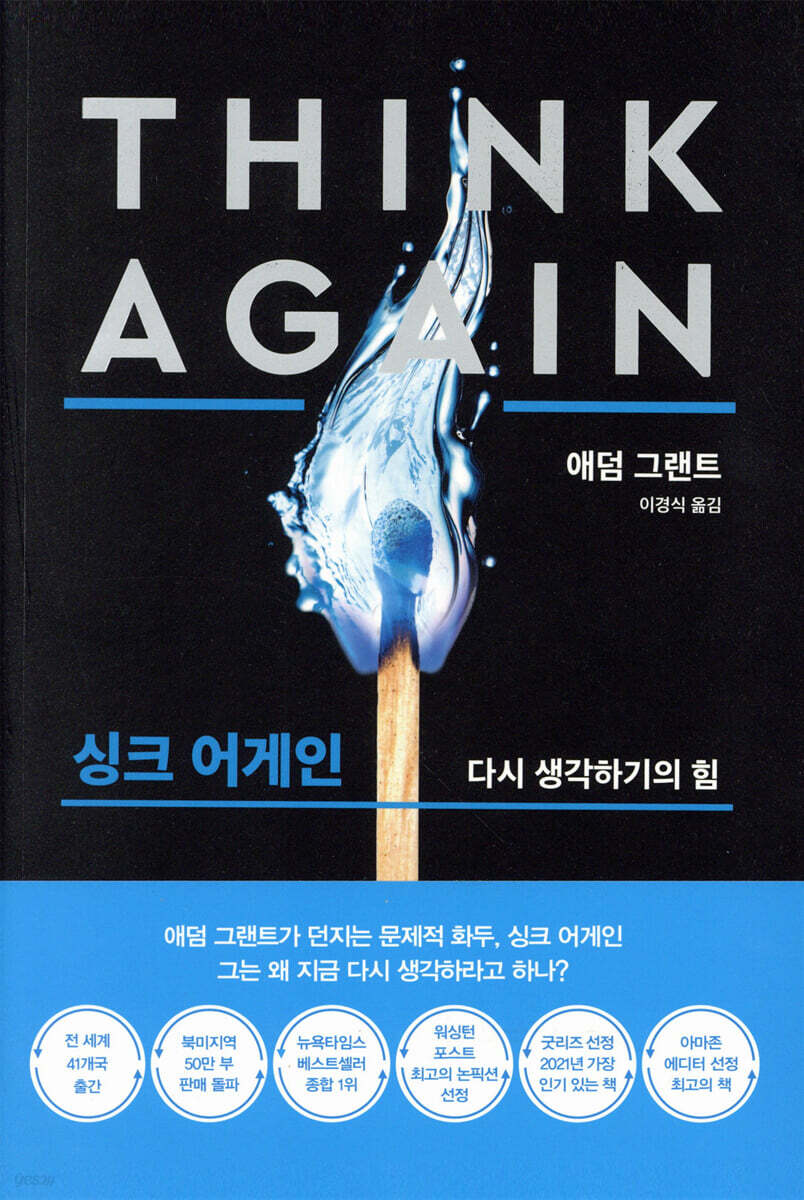
In a world filled with uncertainty, the ability to know what you don't know is also part of intelligence. Why you need to escape the self-defeating "confirmation trap" of confirmation bias, wishful thinking, and other biases. Adam Grant, who presented a new type of talent in his previous work, "Originals," who does not conform to the trend, goes against the times, and rejects outdated traditions, once again provokes us to question all our beliefs and knowledge in "Think Again." He has always presented a new worldview by overturning our common sense and conventional wisdom. This time, he again undeniably breaks down our knowledge system, injects fresh thoughts and concepts, and examines the crucial mindset of 'rethinking.' Most people take pride in their knowledge and expertise and take pride in sticking to their beliefs and opinions. But the problem is that the world we live in is one that is changing rapidly and indefinably. Adam Grant asks, "What is knowledge?" and suggests that we discard knowledge or opinions that are no longer useful, and focus our sense of self on flexibility rather than consistency. Emphasizing the discomfort of doubt over the comfort of certainty, this book presents methods to foster flexibility and agility in thinking through Adam Grant's characteristically rich intellectual examples and engaging storytelling. If we master the skill of 'rethinking,' we will certainly be better positioned to achieve success in our careers and happiness in life. Rethinking helps us find new solutions to old problems and revisit old solutions to new problems. Plus, thinking back is a shortcut to learning more from the people around me and having fewer regrets as I go through life. This book teaches us that wisdom lies in knowing when to let go of some of our most precious tools and some of the most precious parts of our identity. |
- You can preview some of the book's contents.
Preview
index
prolog
[Part 1] Rethinking at the Individual Level
:Update your views
Chapter 1.
The evangelist, prosecutor, politician, and scientist in our hearts
Chapter 2.
Armchair Quarterback and Masked Conman
Finding the optimal point of confidence
Chapter 3.
The joy of being wrong
The thrill of not believing everything you think
Chapter 4.
What a great fight club
The Psychology of Constructive Conflict
[Part 2] Rethinking the relationship between individuals
:Opening the other person's heart
Chapter 5.
Dance with the Enemy
How to Win an Argument and Influence Your Opponents
Chapter 6.
Bad blood on diamonds
?Shaking stereotypes to reduce prejudice
Chapter 7.
The vaccine whisperer and the soft-spoken interrogator
Proper listening changes the other person.
[Part 3] Rethinking at the Group Level
:Creating a Lifelong Learning Community
Chapter 8.
heated conversation
?Melting parallel debates into one
Chapter 9.
Rewriting textbooks
?Teach them to doubt their own knowledge
Chapter 10.
That's not how we've always done it.
Building a Learning Culture in the Workplace
[Part 4] Conclusion
Chapter 11.
Escape tunnel vision
?Revisiting the career and life plans I thought were the best.
Epilogue
Code of Conduct
Acknowledgements
main
Image source
[Part 1] Rethinking at the Individual Level
:Update your views
Chapter 1.
The evangelist, prosecutor, politician, and scientist in our hearts
Chapter 2.
Armchair Quarterback and Masked Conman
Finding the optimal point of confidence
Chapter 3.
The joy of being wrong
The thrill of not believing everything you think
Chapter 4.
What a great fight club
The Psychology of Constructive Conflict
[Part 2] Rethinking the relationship between individuals
:Opening the other person's heart
Chapter 5.
Dance with the Enemy
How to Win an Argument and Influence Your Opponents
Chapter 6.
Bad blood on diamonds
?Shaking stereotypes to reduce prejudice
Chapter 7.
The vaccine whisperer and the soft-spoken interrogator
Proper listening changes the other person.
[Part 3] Rethinking at the Group Level
:Creating a Lifelong Learning Community
Chapter 8.
heated conversation
?Melting parallel debates into one
Chapter 9.
Rewriting textbooks
?Teach them to doubt their own knowledge
Chapter 10.
That's not how we've always done it.
Building a Learning Culture in the Workplace
[Part 4] Conclusion
Chapter 11.
Escape tunnel vision
?Revisiting the career and life plans I thought were the best.
Epilogue
Code of Conduct
Acknowledgements
main
Image source
Detailed image

Into the book
This book explores the value of rethinking.
This book deals with mental flexibility, the kind that saved Fire Chief Wagner Dodge's life.
The book also addresses where Dodge failed: how to spark flexibility and agility in thinking in people other than yourself.
--- p.22, from "Prologue"
My goal in this book is to explore how rethinking happens.
I've uncovered the most compelling evidence and identified some of the world's most skilled rethinkers.
Readers will now know:
Why a forward-thinking entrepreneur once fell into a trap, why a longtime candidate for public office came to see imposter syndrome as a strength rather than a weakness, why a Nobel Prize-winning scientist didn't grieve when he was wrong, but rather celebrated, how the world's best forecasters update their views, and how an Oscar-winning filmmaker wages productive battles.
--- p.26~27, from “Prologue”
Most people take pride in their knowledge and expertise and take pride in sticking to their beliefs and opinions.
In a stable world where people are rewarded for being confident in their own ideas, this approach makes sense.
But the problem is that the world we live in is changing so fast that it makes our eyes spin.
In a world like this, we have to spend as much time rethinking as we do thinking.
--- p.34, from “Chapter 1: The Evangelist, Prosecutor, Politician, and Scientist in Our Hearts”
The highest mortality rate in hospitals is in June, when new residents begin to take up their positions and begin providing treatment.
The reason may lie right here.
It is not the lack of ability of new doctors that is dangerous, but their mindset (way of thinking) that overestimates their own abilities.
The cycle of rethinking can be broken when moving from beginner to amateur.
As people gain experience, they lose their humility.
--- p.78, from “Chapter 2 The Armchair Quarterback and the Masked Conman”
Later, at lunch with Kahneman, I asked him about his reaction.
Because the way he kept blinking his eyes with an expression of great amusement seemed to me like 'the joy of realizing that you are wrong.'
He said that although no one had ever said that to him in his 85 years of life, he was truly glad to know that he was wrong.
Because it meant he was now less wrong than before, that he had learned something new that he didn't know before.
--- p.105, from “Chapter 3 The Joy of Being Wrong”
One study found that simply framing a dispute as a discussion rather than a disagreement signals to the other party that they have considered the disagreeable viewpoint and may change their mind, thereby motivating them to provide more information.
Disagreements are personal and potentially even hostile.
When we have any discussion, we expect to argue about concepts or ideas, not emotions.
--- p.154, from “Chapter 4: A Wonderful Fight Club”
One difference between laypeople and experts becomes apparent even before they sit down at the negotiating table.
Before the negotiation began, the researchers asked both groups what their negotiation plans were.
At this time, the average negotiator did not look into or take care of the expected agreement separately, but only focused on preparing for battle.
However, professional negotiators have already established the types and order of steps they can take with their counterparts.
In other words, one-third of the entire negotiation plan was devoted to finding something that could be agreed upon with the other party.
--- p.172, from “Chapter 5 Dancing with the Enemy”
Sometimes, letting go of stereotypes means realizing that many members of the group you hate aren't actually the ones you want to hate at all.
And this realization happens even better when you meet the members in person.
Social scientists have been testing the effects of contact between groups for over 50 years.
A meta-analysis of over 500 studies involving a total of 250,000 participants found that in 94 percent of cases, interacting in any way with people from other groups reduced their prejudice.
--- p.228, from “Chapter 6: Bad Blood on Diamonds”
Empathizing with the other person, not prioritizing personal judgment, and listening to what the other person has to say frees the other person from anxiety and defensiveness.
In these instances, the other person felt less pressured to avoid conflict with the person in front of them, and this allowed them to delve deeper into their own attitudes and views, recognizing subtle differences.
--- p.257, from “Chapter 7 The Vaccine Whisperer and the Gentle Interrogator”
What helps us is not to change our perspective to the other person's, but to find out what their perspective is.
That means you have to actually talk to that person and find out the subtle differences in their opinions.
This is exactly what great scientists do.
Rather than drawing vague conclusions about others based on minimal clues, scientists test their hypotheses through conversation.
--- p.290, from “Chapter 8: A Heated Conversation”
I believe that good teachers lead to new ideas, but great teachers lead to new ways of thinking.
While a student gathering knowledge from a certain teacher may help that student solve the day's homework, understanding a certain teacher's way of thinking can help that student navigate life's challenges.
--- p.327, from “Chapter 9 Rewriting Textbooks”
How do you know that? This is a question we often ask ourselves.
To yourself and to others.
The power of this question lies in the honesty it demands.
This question is intended to avoid personal judgment.
It is an honest expression of doubt and curiosity that does not put people on the defensive.
--- p.339, from “Chapter 10: That’s Not the Way We’ve Always Done It”
Ultimately, we fall into the trap of the overconfidence cycle, taking pride in our pursuit of a professional identity and surrounding ourselves only with people who support and validate our convictions.
But by the time you realize that this was the wrong choice, it's already too late to think again.
At that point, it seems like you'd have to give up too much - salary, status, expertise, time - to find a new path.
Let me be clear, I think it's better to lose what you've achieved in the past two years than to waste the next twenty.
This book deals with mental flexibility, the kind that saved Fire Chief Wagner Dodge's life.
The book also addresses where Dodge failed: how to spark flexibility and agility in thinking in people other than yourself.
--- p.22, from "Prologue"
My goal in this book is to explore how rethinking happens.
I've uncovered the most compelling evidence and identified some of the world's most skilled rethinkers.
Readers will now know:
Why a forward-thinking entrepreneur once fell into a trap, why a longtime candidate for public office came to see imposter syndrome as a strength rather than a weakness, why a Nobel Prize-winning scientist didn't grieve when he was wrong, but rather celebrated, how the world's best forecasters update their views, and how an Oscar-winning filmmaker wages productive battles.
--- p.26~27, from “Prologue”
Most people take pride in their knowledge and expertise and take pride in sticking to their beliefs and opinions.
In a stable world where people are rewarded for being confident in their own ideas, this approach makes sense.
But the problem is that the world we live in is changing so fast that it makes our eyes spin.
In a world like this, we have to spend as much time rethinking as we do thinking.
--- p.34, from “Chapter 1: The Evangelist, Prosecutor, Politician, and Scientist in Our Hearts”
The highest mortality rate in hospitals is in June, when new residents begin to take up their positions and begin providing treatment.
The reason may lie right here.
It is not the lack of ability of new doctors that is dangerous, but their mindset (way of thinking) that overestimates their own abilities.
The cycle of rethinking can be broken when moving from beginner to amateur.
As people gain experience, they lose their humility.
--- p.78, from “Chapter 2 The Armchair Quarterback and the Masked Conman”
Later, at lunch with Kahneman, I asked him about his reaction.
Because the way he kept blinking his eyes with an expression of great amusement seemed to me like 'the joy of realizing that you are wrong.'
He said that although no one had ever said that to him in his 85 years of life, he was truly glad to know that he was wrong.
Because it meant he was now less wrong than before, that he had learned something new that he didn't know before.
--- p.105, from “Chapter 3 The Joy of Being Wrong”
One study found that simply framing a dispute as a discussion rather than a disagreement signals to the other party that they have considered the disagreeable viewpoint and may change their mind, thereby motivating them to provide more information.
Disagreements are personal and potentially even hostile.
When we have any discussion, we expect to argue about concepts or ideas, not emotions.
--- p.154, from “Chapter 4: A Wonderful Fight Club”
One difference between laypeople and experts becomes apparent even before they sit down at the negotiating table.
Before the negotiation began, the researchers asked both groups what their negotiation plans were.
At this time, the average negotiator did not look into or take care of the expected agreement separately, but only focused on preparing for battle.
However, professional negotiators have already established the types and order of steps they can take with their counterparts.
In other words, one-third of the entire negotiation plan was devoted to finding something that could be agreed upon with the other party.
--- p.172, from “Chapter 5 Dancing with the Enemy”
Sometimes, letting go of stereotypes means realizing that many members of the group you hate aren't actually the ones you want to hate at all.
And this realization happens even better when you meet the members in person.
Social scientists have been testing the effects of contact between groups for over 50 years.
A meta-analysis of over 500 studies involving a total of 250,000 participants found that in 94 percent of cases, interacting in any way with people from other groups reduced their prejudice.
--- p.228, from “Chapter 6: Bad Blood on Diamonds”
Empathizing with the other person, not prioritizing personal judgment, and listening to what the other person has to say frees the other person from anxiety and defensiveness.
In these instances, the other person felt less pressured to avoid conflict with the person in front of them, and this allowed them to delve deeper into their own attitudes and views, recognizing subtle differences.
--- p.257, from “Chapter 7 The Vaccine Whisperer and the Gentle Interrogator”
What helps us is not to change our perspective to the other person's, but to find out what their perspective is.
That means you have to actually talk to that person and find out the subtle differences in their opinions.
This is exactly what great scientists do.
Rather than drawing vague conclusions about others based on minimal clues, scientists test their hypotheses through conversation.
--- p.290, from “Chapter 8: A Heated Conversation”
I believe that good teachers lead to new ideas, but great teachers lead to new ways of thinking.
While a student gathering knowledge from a certain teacher may help that student solve the day's homework, understanding a certain teacher's way of thinking can help that student navigate life's challenges.
--- p.327, from “Chapter 9 Rewriting Textbooks”
How do you know that? This is a question we often ask ourselves.
To yourself and to others.
The power of this question lies in the honesty it demands.
This question is intended to avoid personal judgment.
It is an honest expression of doubt and curiosity that does not put people on the defensive.
--- p.339, from “Chapter 10: That’s Not the Way We’ve Always Done It”
Ultimately, we fall into the trap of the overconfidence cycle, taking pride in our pursuit of a professional identity and surrounding ourselves only with people who support and validate our convictions.
But by the time you realize that this was the wrong choice, it's already too late to think again.
At that point, it seems like you'd have to give up too much - salary, status, expertise, time - to find a new path.
Let me be clear, I think it's better to lose what you've achieved in the past two years than to waste the next twenty.
--- p.374, from “Chapter 11: Escaping Tunnel Vision”
Publisher's Review
Adam Grant, author of the international bestseller "Originals," has released his first new book in five years.
“There has never been a time when rethinking was more necessary than now!”
★★★ Amazon Bestseller Upon Publication ★★★
★★★ Highly recommended by Bill and Melinda Gates ★★★
★★★ Published in 32 countries worldwide ★★★
Question the assumptions you've long taken for granted.
'Rethinking' Becomes a New Insightful Technique
We usually don't want to rethink something we believe in.
This is because they consider it a threat to their identity to admit that the knowledge or beliefs they have believed in are different from or have changed.
"I want to change my answer, but if I do, it'll definitely be wrong." "If I were the coach, I'd do better than that guy!" "To win an argument, analyze your opponent's opinion piece by piece and then attack it." "People who support that political party don't care about environmental issues." "You can't even have a conversation with someone who supports that baseball team!"
No one is free from these thoughts, and no one easily thinks of changing them.
We think and act within countless rigid thoughts, distorted concepts, and entrenched prejudices.
Adam Grant describes this tendency of ours as living with the identities of a preacher, a prosecutor, and a politician.
In other words, when our sacred beliefs are threatened, we become evangelists and preach to protect and elevate our ideals. Then, when we find errors in others' logic, we become prosecutors and present a long list of arguments proving that the other person is wrong and we are right. When we need to gain the consent of others, we quickly transform into politicians and engage in political maneuvering, such as lobbying.
We do not even think that there may be errors in our knowledge or thinking, or that we are overconfident in our knowledge and beliefs.
However, this tendency to settle for existing opinions or practices and choose the easy way out is not appropriate in a rapidly changing world.
In the midst of the tremendous acceleration of change now taking place, we must question and rethink our knowledge and beliefs more quickly than ever before.
'Think again' and 'doubt'.
Adam Grant asserts that this is the most useful skill for navigating this unpredictable world.
Feel joy when you discover that you are wrong
'Rethinking' is a skill of communication and understanding.
Adam Grant explores the ways to acquire these two skills, sharing the stories of those who failed because they couldn't apply them, those who discovered their inner strength and entered a new phase through "rethinking," and those who became more creative through fiercely questioning and denying everything.
The utility of "rethinking" and "doubting"—discovered through countless research papers, personal experiences, and real-life examples—shows that anyone can apply these techniques to improve themselves.
A humble confidence in one's own expertise, a flexibility that recognizes that the self is not fixed, empathy and solidarity through listening and questioning, and an attitude that recognizes the spectrum of complexity rather than simple clarity lead us to a world of deeper knowledge, enable broader communication, and lead to the expression of more original creativity.
As we follow Adam Grant's story, we ultimately come to realize that 'rethinking' is a skill for communicating with oneself and understanding the world and others.
It makes us 'rethink' what 'knowledge' and 'wisdom' are by examining how we can coordinate our opinions and achieve harmony with others in arguments with people who stand in completely different positions, and how we can persuade others who are entrenched in fossilized prejudices.
It is not knowledge to gain an advantage over someone else, or knowledge to defeat others, but rather, by being curious about the information you lack and continuously learning at every stage of life, finding perspectives on others and the world that you did not know about, and rebuilding your own identity within those subtle differences, that is the realization that true knowledge and wisdom are achieved.
Run the rethink cycle periodically.
Knowing when to discard something by "thinking again" is the wisdom of life.
We believe that our identity should not be easily changed.
But Adam Grant says otherwise.
He emphasizes that wisdom lies in knowing when to let go of some of the tools you hold most dear, and some of the most precious parts of your identity.
He says that by breaking free from the cycle of overconfidence in oneself and others and creating a cycle of rethinking, a culture that values learning can be created, and when this culture spreads, the performance-oriented workplace culture can be improved, the power distance narrowed, and work efficiency and creativity increased.
When we confidently express our thoughts and opinions, challenging established norms and fostering a culture where productive disagreement and a good fight are not averse, we can re-engage with our identities and reset them with open minds and emotional stability.
Even though we become adults, we are not yet perfect beings.
It is a transitional entity still in progress toward completion.
That is why we must always ask ourselves, or others, this question:
“How do you know that?” By asking this question with doubt and curiosity, we can learn everything again and break free from all conventions, old ideologies, and narrow knowledge.
When we have such an open mind, we can create a more mature self and a better world.
Adam Grant challenges existing prejudices and awakens us with new knowledge that counters them.
In this book, he tells us to periodically activate the cycle of rethinking.
It will be an essential element that provides solutions to complex problems such as pandemics, climate change, and political polarization, as well as in personal growth.
The world evolves simply by putting on a scientist's goggles and looking at it with skeptical eyes.
“There has never been a time when rethinking was more necessary than now!”
★★★ Amazon Bestseller Upon Publication ★★★
★★★ Highly recommended by Bill and Melinda Gates ★★★
★★★ Published in 32 countries worldwide ★★★
Question the assumptions you've long taken for granted.
'Rethinking' Becomes a New Insightful Technique
We usually don't want to rethink something we believe in.
This is because they consider it a threat to their identity to admit that the knowledge or beliefs they have believed in are different from or have changed.
"I want to change my answer, but if I do, it'll definitely be wrong." "If I were the coach, I'd do better than that guy!" "To win an argument, analyze your opponent's opinion piece by piece and then attack it." "People who support that political party don't care about environmental issues." "You can't even have a conversation with someone who supports that baseball team!"
No one is free from these thoughts, and no one easily thinks of changing them.
We think and act within countless rigid thoughts, distorted concepts, and entrenched prejudices.
Adam Grant describes this tendency of ours as living with the identities of a preacher, a prosecutor, and a politician.
In other words, when our sacred beliefs are threatened, we become evangelists and preach to protect and elevate our ideals. Then, when we find errors in others' logic, we become prosecutors and present a long list of arguments proving that the other person is wrong and we are right. When we need to gain the consent of others, we quickly transform into politicians and engage in political maneuvering, such as lobbying.
We do not even think that there may be errors in our knowledge or thinking, or that we are overconfident in our knowledge and beliefs.
However, this tendency to settle for existing opinions or practices and choose the easy way out is not appropriate in a rapidly changing world.
In the midst of the tremendous acceleration of change now taking place, we must question and rethink our knowledge and beliefs more quickly than ever before.
'Think again' and 'doubt'.
Adam Grant asserts that this is the most useful skill for navigating this unpredictable world.
Feel joy when you discover that you are wrong
'Rethinking' is a skill of communication and understanding.
Adam Grant explores the ways to acquire these two skills, sharing the stories of those who failed because they couldn't apply them, those who discovered their inner strength and entered a new phase through "rethinking," and those who became more creative through fiercely questioning and denying everything.
The utility of "rethinking" and "doubting"—discovered through countless research papers, personal experiences, and real-life examples—shows that anyone can apply these techniques to improve themselves.
A humble confidence in one's own expertise, a flexibility that recognizes that the self is not fixed, empathy and solidarity through listening and questioning, and an attitude that recognizes the spectrum of complexity rather than simple clarity lead us to a world of deeper knowledge, enable broader communication, and lead to the expression of more original creativity.
As we follow Adam Grant's story, we ultimately come to realize that 'rethinking' is a skill for communicating with oneself and understanding the world and others.
It makes us 'rethink' what 'knowledge' and 'wisdom' are by examining how we can coordinate our opinions and achieve harmony with others in arguments with people who stand in completely different positions, and how we can persuade others who are entrenched in fossilized prejudices.
It is not knowledge to gain an advantage over someone else, or knowledge to defeat others, but rather, by being curious about the information you lack and continuously learning at every stage of life, finding perspectives on others and the world that you did not know about, and rebuilding your own identity within those subtle differences, that is the realization that true knowledge and wisdom are achieved.
Run the rethink cycle periodically.
Knowing when to discard something by "thinking again" is the wisdom of life.
We believe that our identity should not be easily changed.
But Adam Grant says otherwise.
He emphasizes that wisdom lies in knowing when to let go of some of the tools you hold most dear, and some of the most precious parts of your identity.
He says that by breaking free from the cycle of overconfidence in oneself and others and creating a cycle of rethinking, a culture that values learning can be created, and when this culture spreads, the performance-oriented workplace culture can be improved, the power distance narrowed, and work efficiency and creativity increased.
When we confidently express our thoughts and opinions, challenging established norms and fostering a culture where productive disagreement and a good fight are not averse, we can re-engage with our identities and reset them with open minds and emotional stability.
Even though we become adults, we are not yet perfect beings.
It is a transitional entity still in progress toward completion.
That is why we must always ask ourselves, or others, this question:
“How do you know that?” By asking this question with doubt and curiosity, we can learn everything again and break free from all conventions, old ideologies, and narrow knowledge.
When we have such an open mind, we can create a more mature self and a better world.
Adam Grant challenges existing prejudices and awakens us with new knowledge that counters them.
In this book, he tells us to periodically activate the cycle of rethinking.
It will be an essential element that provides solutions to complex problems such as pandemics, climate change, and political polarization, as well as in personal growth.
The world evolves simply by putting on a scientist's goggles and looking at it with skeptical eyes.
GOODS SPECIFICS
- Publication date: March 30, 2021
- Page count, weight, size: 480 pages | 840g | 152*225*29mm
- ISBN13: 9788947547079
- ISBN10: 8947547077
You may also like
카테고리
korean


korean

![ELLE 엘르 스페셜 에디션 A형 : 12월 [2025]](http://librairie.coreenne.fr/cdn/shop/files/b8e27a3de6c9538896439686c6b0e8fb.jpg?v=1766436872&width=3840)


