

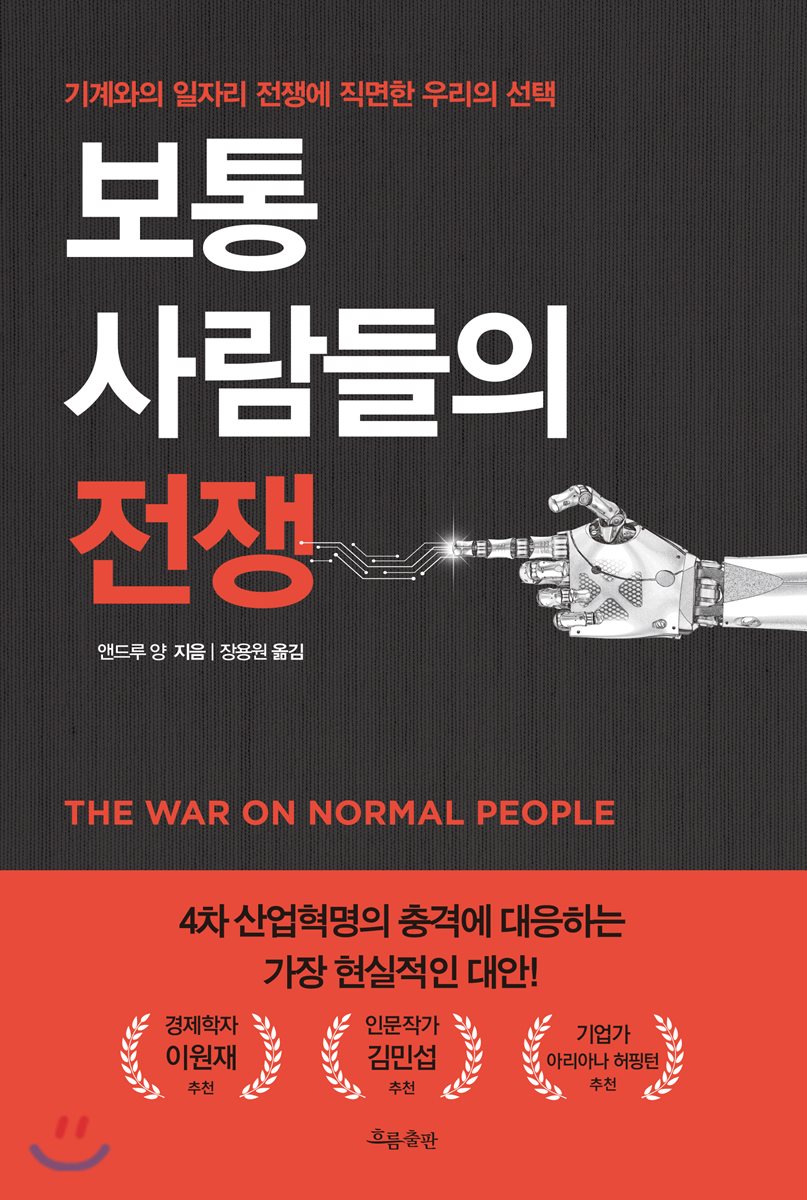
The War of Ordinary People
 |
Description
Book Introduction
“A must-read for our lives and our children’s future!” Highly recommended by neuroscientist Jaeseung Jeong, KAIST professor; economist Wonjae Lee, CEO of LAB2050; and humanities writer Minseop Kim. An in-depth report tracking the reality of how technology is replacing ordinary people's jobs! This is an in-depth report that tracks the war for ordinary people's jobs taking place in the United States, the heart of the technological revolution. Andrew Yang, who has helped launch new businesses in cities across the United States over the past decade with the goal of creating 100,000 jobs, has personally traced and detailed the technological revolution and changes in the labor market, the greatest economic transformation in human history. From high-paying jobs like drivers, clerks, administrators, counselors, and salespeople to pharmacists, surgeons, lawyers, and journalists, this book explains in an accessible and concise style how technology is systematically eliminating jobs and what impact this has on human lives. It demonstrates that jobs are not simply a means of making a living, but a crucial element that enables human life to continue properly, and through this, it explains what choices we must make for children who will live in a more mechanized world than we do today. |
- You can preview some of the book's contents.
Preview
index
Prologue: The Era of Mass Unemployment
Part 1: What's Happening at Work
Chapter 1 The Path I Have Walked
Chapter 2 Why did this happen?
Chapter 3: What Kind of Person Is an Ordinary Person?
Chapter 4: What We Do to Make a Living
Chapter 5: Factory Workers and Truck Drivers
Chapter 6: White-collar jobs will disappear too.
Chapter 7 Humanity and Work
Chapter 8: Common Objections
Part 2: What's Happening to Humans
Chapter 9: Life in a Bubble
Chapter 10: The Mindset of Abundance and Deprivation
Chapter 11: Where You Live Determines Your Child's Fate
Chapter 12 Men, Women, and Children
Chapter 13: The Face of Great Unemployment: A Permanent Class Without a Reality
Chapter 14: Video Games and the Meaning of Men's Lives
Chapter 15: The Collapse of Society: Our Current Situation
Part 3: Solutions and Human Capitalism
Chapter 16: Free Dividends
Chapter 17: Universal Basic Income in the Real World
Chapter 18: Time is a New Concept of Currency
Chapter 19: Human Capitalism
Chapter 20: A Strong Nation, a New Civic Spirit
Chapter 21: Medical Issues in a Jobless World
Chapter 22: Creating People
Epilogue: We have the right to live as masters.
Acknowledgements
Huzhou
Part 1: What's Happening at Work
Chapter 1 The Path I Have Walked
Chapter 2 Why did this happen?
Chapter 3: What Kind of Person Is an Ordinary Person?
Chapter 4: What We Do to Make a Living
Chapter 5: Factory Workers and Truck Drivers
Chapter 6: White-collar jobs will disappear too.
Chapter 7 Humanity and Work
Chapter 8: Common Objections
Part 2: What's Happening to Humans
Chapter 9: Life in a Bubble
Chapter 10: The Mindset of Abundance and Deprivation
Chapter 11: Where You Live Determines Your Child's Fate
Chapter 12 Men, Women, and Children
Chapter 13: The Face of Great Unemployment: A Permanent Class Without a Reality
Chapter 14: Video Games and the Meaning of Men's Lives
Chapter 15: The Collapse of Society: Our Current Situation
Part 3: Solutions and Human Capitalism
Chapter 16: Free Dividends
Chapter 17: Universal Basic Income in the Real World
Chapter 18: Time is a New Concept of Currency
Chapter 19: Human Capitalism
Chapter 20: A Strong Nation, a New Civic Spirit
Chapter 21: Medical Issues in a Jobless World
Chapter 22: Creating People
Epilogue: We have the right to live as masters.
Acknowledgements
Huzhou
Detailed image
.jpg)
Into the book
I remember the moment when I became fully aware of the situation.
I was reading a CNN article that analyzed the millions of manufacturing jobs lost to automation between 2000 and 2015.
It is said that there are four times more jobs lost to globalization.
I've personally visited several cities that were once manufacturing centers, including Cleveland, Cincinnati, Indianapolis, Detroit, Pittsburgh, St. Louis, and Baltimore.
Besides, I knew what my friends were doing and what was going to happen next.
As I put all the puzzle pieces together, my heart sank and all sorts of thoughts came to mind.
There is no one who can stop this phenomenon.
The economies and cultures of these regions were annihilated, and the same thing would happen to others in the future.
American lives and families are falling apart.
Pervasive economic problems have now become the new normal.
We are facing the third or fourth great economic transformation in human history, yet no one seems to be talking about it or even planning a response.
--- p.35
What happens to the 40 percent of manufacturing workers who lose their jobs and can't find new ones? The simple answer is that many fall into extreme poverty and apply for disability benefits.
The number of applicants for disability benefits began to increase rapidly in 2000, increasing by a total of 3.5 million.
The number has increased significantly, particularly in manufacturing-heavy states such as Ohio, Michigan, and Pennsylvania.
In Michigan, nearly half of the 310,000 people who lost their jobs between 2003 and 2013 applied for disability benefits.
Many of those who were forced out of their jobs joined the ranks of the lowest class, dependent on the government.
It's a good indicator of what would happen if truck drivers lost their jobs.
--- pp.76~77
One reason the wave of automation is coming is that, from a perspective where getting work done is the sole goal, people are much more difficult to manage than machines.
There is no need to look at it negatively for thinking this way.
Only by accepting this fact can we begin to work toward a solution.
It can also be an opportunity to think deeply about what makes humans valuable.
We need to consider the fact that there are many things that humans are not actually best suited to do.
The opposite is also true.
Are most jobs truly suited to humans? That is, if humans aren't suited to work, is work truly suited to humans? --- p.106
'US Financial Diary', an in-depth analysis of the incomes of 235 middle- and lower-class households
Jonathan Morduch, project manager of the Financial Diaries project, says:
“Since the 1970s, it has become increasingly difficult to find stable, predictable jobs that pay a living wage.
These changes have led to greater income volatility for many households.” According to a JPMorgan Chase survey, roughly 80 percent of consumers do not have enough spare cash to manage the difference between their monthly income and expenses.
Therefore, unexpected expenses like hospital bills or car repairs can derail a household's finances for the year. JP Morgan Chase says the income level where income volatility is not a problem is around $105,000 per year.
This is far beyond the income of most households.
--- p.159
According to a Pew Research Center survey, many men are giving up or delaying marriage due to financial insecurity.
In the same survey, the most important condition for women in finding a spouse was a stable job.
Marriage is something that happens when you have optimism, stability, and financial ability.
Marriage is bound to cost money.
If you don't have a stable job, it will be difficult to meet the conditions mentioned above.
Marriage rates have fallen across all demographics over the past 40 years.
However, the decline rate was particularly notable among those with a high school diploma or lower.
The marriage rate among the working class, which was 70 percent in 1970, is now only 45 percent.
The decline in marriage rates accelerated in 2000.
This is roughly the same time that manufacturing jobs began to disappear.
--- pp.184~186
The best way to secure the public interest in the wake of automation would be a value-added tax (VAT), paid when people or businesses purchase goods or services.
From a business perspective, this money is reflected in the cost of production at each stage.
If a value-added tax is introduced, it will become much more difficult for even the most tax-savvy corporations to exploit America's infrastructure and workforce to make money without paying taxes.
It will also play a role in encouraging all citizens to support technological advancement.
Even an auto mechanic in Appalachia would feel like his stake increased every time someone made money.
Of the 193 countries worldwide, 160 already impose value-added tax (VAT) or goods and services tax.
Among developed countries, the United States is the only one without VAT.
The average VAT rate in Europe is 20 percent. VAT is well-established and proven to be efficient.
If we introduced a VAT at half the average European rate, we could provide a universal basic income to every American adult.
--- pp.240~241
Let us now consider a new form of capitalist economy focused on maximizing human well-being and value realization.
There may be times when these goals and the goal of GDP growth are aligned.
But sometimes the two goals don't align.
For example, an airline that removes passengers who have already boarded in order to increase profits may be good for capital, but it is not good for people.
The same goes for pharmaceutical companies that sell life-saving drugs at ridiculously high prices.
I think most people would agree that airlines should accept a decline in revenue, and pharmaceutical companies should make a reasonable profit.
What if this thinking continues to spread throughout the economy? Let's call this human-centered capitalism, or human capitalism for short.
The core principles of human capitalism would be:
--- p.277
Universities have been overrated as if they were the answer to all our economic problems related to jobs.
According to the most recent survey, the six-year graduation rate for first-time full-time college students is 59 percent.
This means that only 59 percent of students who started college in 2009 had earned a bachelor's degree by 2015.
This ratio has remained virtually unchanged over the past few years.
For students attending top private universities, this figure may seem excessively low.
This is because in so-called first-class universities, this ratio reaches 88 percent.
The six-year graduation rate for universities with open admissions was 32 percent, while for-profit universities it was only 23 percent.
Similarly, only 29.1 percent of students graduated from two-year colleges within three years.
Colleges, not high schools, are the real dropout factories in America.
--- p.319
I have often sat down with people who will lead our society.
The machine has no power.
The system is important.
Usually, what we wish wasn't true is often true.
I wrote this book in the hope that you will see what I have seen.
Then we can create a much better world.
People generally believe that ideas change the world.
That's wrong.
People change the world.
People who dedicate themselves and sacrifice, and who fight against the forces that seek to destroy our society, are the ones who change the world.
Who are we serving? Humans or the market? Are we opioid addicts hurtling towards a grim fate beyond our control, or are we an elite isolated in our own spheres? Do we even have the grit, will, confidence, and self-reliance to do what's necessary to rebuild the world? Do we have enough empathy? Capital doesn't care about us.
We must move beyond capital as the primary measure of value.
Human capitalism will give us the opportunity to see clearly what is important to us and how to pursue it.
I was reading a CNN article that analyzed the millions of manufacturing jobs lost to automation between 2000 and 2015.
It is said that there are four times more jobs lost to globalization.
I've personally visited several cities that were once manufacturing centers, including Cleveland, Cincinnati, Indianapolis, Detroit, Pittsburgh, St. Louis, and Baltimore.
Besides, I knew what my friends were doing and what was going to happen next.
As I put all the puzzle pieces together, my heart sank and all sorts of thoughts came to mind.
There is no one who can stop this phenomenon.
The economies and cultures of these regions were annihilated, and the same thing would happen to others in the future.
American lives and families are falling apart.
Pervasive economic problems have now become the new normal.
We are facing the third or fourth great economic transformation in human history, yet no one seems to be talking about it or even planning a response.
--- p.35
What happens to the 40 percent of manufacturing workers who lose their jobs and can't find new ones? The simple answer is that many fall into extreme poverty and apply for disability benefits.
The number of applicants for disability benefits began to increase rapidly in 2000, increasing by a total of 3.5 million.
The number has increased significantly, particularly in manufacturing-heavy states such as Ohio, Michigan, and Pennsylvania.
In Michigan, nearly half of the 310,000 people who lost their jobs between 2003 and 2013 applied for disability benefits.
Many of those who were forced out of their jobs joined the ranks of the lowest class, dependent on the government.
It's a good indicator of what would happen if truck drivers lost their jobs.
--- pp.76~77
One reason the wave of automation is coming is that, from a perspective where getting work done is the sole goal, people are much more difficult to manage than machines.
There is no need to look at it negatively for thinking this way.
Only by accepting this fact can we begin to work toward a solution.
It can also be an opportunity to think deeply about what makes humans valuable.
We need to consider the fact that there are many things that humans are not actually best suited to do.
The opposite is also true.
Are most jobs truly suited to humans? That is, if humans aren't suited to work, is work truly suited to humans? --- p.106
'US Financial Diary', an in-depth analysis of the incomes of 235 middle- and lower-class households
Jonathan Morduch, project manager of the Financial Diaries project, says:
“Since the 1970s, it has become increasingly difficult to find stable, predictable jobs that pay a living wage.
These changes have led to greater income volatility for many households.” According to a JPMorgan Chase survey, roughly 80 percent of consumers do not have enough spare cash to manage the difference between their monthly income and expenses.
Therefore, unexpected expenses like hospital bills or car repairs can derail a household's finances for the year. JP Morgan Chase says the income level where income volatility is not a problem is around $105,000 per year.
This is far beyond the income of most households.
--- p.159
According to a Pew Research Center survey, many men are giving up or delaying marriage due to financial insecurity.
In the same survey, the most important condition for women in finding a spouse was a stable job.
Marriage is something that happens when you have optimism, stability, and financial ability.
Marriage is bound to cost money.
If you don't have a stable job, it will be difficult to meet the conditions mentioned above.
Marriage rates have fallen across all demographics over the past 40 years.
However, the decline rate was particularly notable among those with a high school diploma or lower.
The marriage rate among the working class, which was 70 percent in 1970, is now only 45 percent.
The decline in marriage rates accelerated in 2000.
This is roughly the same time that manufacturing jobs began to disappear.
--- pp.184~186
The best way to secure the public interest in the wake of automation would be a value-added tax (VAT), paid when people or businesses purchase goods or services.
From a business perspective, this money is reflected in the cost of production at each stage.
If a value-added tax is introduced, it will become much more difficult for even the most tax-savvy corporations to exploit America's infrastructure and workforce to make money without paying taxes.
It will also play a role in encouraging all citizens to support technological advancement.
Even an auto mechanic in Appalachia would feel like his stake increased every time someone made money.
Of the 193 countries worldwide, 160 already impose value-added tax (VAT) or goods and services tax.
Among developed countries, the United States is the only one without VAT.
The average VAT rate in Europe is 20 percent. VAT is well-established and proven to be efficient.
If we introduced a VAT at half the average European rate, we could provide a universal basic income to every American adult.
--- pp.240~241
Let us now consider a new form of capitalist economy focused on maximizing human well-being and value realization.
There may be times when these goals and the goal of GDP growth are aligned.
But sometimes the two goals don't align.
For example, an airline that removes passengers who have already boarded in order to increase profits may be good for capital, but it is not good for people.
The same goes for pharmaceutical companies that sell life-saving drugs at ridiculously high prices.
I think most people would agree that airlines should accept a decline in revenue, and pharmaceutical companies should make a reasonable profit.
What if this thinking continues to spread throughout the economy? Let's call this human-centered capitalism, or human capitalism for short.
The core principles of human capitalism would be:
--- p.277
Universities have been overrated as if they were the answer to all our economic problems related to jobs.
According to the most recent survey, the six-year graduation rate for first-time full-time college students is 59 percent.
This means that only 59 percent of students who started college in 2009 had earned a bachelor's degree by 2015.
This ratio has remained virtually unchanged over the past few years.
For students attending top private universities, this figure may seem excessively low.
This is because in so-called first-class universities, this ratio reaches 88 percent.
The six-year graduation rate for universities with open admissions was 32 percent, while for-profit universities it was only 23 percent.
Similarly, only 29.1 percent of students graduated from two-year colleges within three years.
Colleges, not high schools, are the real dropout factories in America.
--- p.319
I have often sat down with people who will lead our society.
The machine has no power.
The system is important.
Usually, what we wish wasn't true is often true.
I wrote this book in the hope that you will see what I have seen.
Then we can create a much better world.
People generally believe that ideas change the world.
That's wrong.
People change the world.
People who dedicate themselves and sacrifice, and who fight against the forces that seek to destroy our society, are the ones who change the world.
Who are we serving? Humans or the market? Are we opioid addicts hurtling towards a grim fate beyond our control, or are we an elite isolated in our own spheres? Do we even have the grit, will, confidence, and self-reliance to do what's necessary to rebuild the world? Do we have enough empathy? Capital doesn't care about us.
We must move beyond capital as the primary measure of value.
Human capitalism will give us the opportunity to see clearly what is important to us and how to pursue it.
--- pp.332~333
Publisher's Review
“More than 5.1 million jobs will disappear by 2020.” —World Economic Forum Future of Jobs Report (2016)
_ The true face of the technological revolution, which began systematically eliminating jobs in the name of efficiency.
At the end of 2018, South Korea experienced a general strike by taxi drivers.
The main reason was that the carpooling service of a huge company called Kakao threatened the jobs of taxi drivers.
A taxi driver who participated in the general strike attempted self-immolation in his taxi and ultimately died.
Providing a service that allows anyone with a mobile phone app to use carpooling instead of taxis was no different from a major attack that threatened the immediate livelihood of taxi drivers.
At first glance, this incident was a battle for rice bowls between large corporations and the taxi industry, but on the other hand, it was the most direct incident that made visible the imminent danger that technological advancements would take away ordinary people's jobs.
The World Economic Forum announced the following in its 2016 Future of Jobs Report:
“More than 5.1 million jobs will disappear by 2020 due to technological advancements.” Also, when the public learned of the emergence of AI (artificial intelligence) that surpassed even human intuition, as evidenced by the match between Google’s AlphaGo and Go player Lee Sedol, the public expressed shock and serious concern.
When human jobs are replaced by AI, there is no clear alternative for how people who have lost their income will sustain their lives.
"When the jobs that sustain us disappear, how will ordinary people survive? How can we reverse the absurd situation where humans must compete with technology for efficiency? Why does the technological revolution threaten rather than enhance our lives?" "The War on Normal People" (original title) comprehensively addresses these questions.
In the book's introduction, author Andrew Yang identifies the technological revolution as the biggest reason why ordinary people are being forced into the job war:
Ordinary people.
Seventy percent of Americans consider themselves middle class.
You who read this will probably think so too.
Even now, some brilliant minds are scheming to replace you with cheaper workers overseas, or to gradually replace you with widgets, software, and robots.
It's not that I do it out of malice.
This is because the market structure rewards managers who increase efficiency.
Efficiency doesn't usually like people.
Efficiency favors the method that is most effective relative to the cost.
(Page 7)
The replacement of labor by machines and software is already a reality.
However, since no specific occupation has disappeared overnight, it is not easy to resist as strongly as the taxi industry.
However, at some point, fewer new employees were hired, workers were retiring early, and the number of people involuntarily unemployed due to lack of jobs was steadily increasing.
In addition, income inequality and economic polarization are also worsening, coupled with rising unemployment rates.
For this reason, the lives of ordinary people are in a situation where they can fall into poverty at any time.
That's why the title of this book is 'The War of Ordinary People'.
“What’s happening at the heart of the technological revolution right now!”
An in-depth report vividly tracking the changes in the jobs and lives of ordinary people across the United States.
The 'normal people' mentioned in 'The War of the Ordinary People' are those at the median income, not the average.
That is, it refers to the people in the middle when lined up based on income level.
In most countries, it is also the most populous group.
The reason this book focuses on ordinary people is that those who will be most severely affected by unemployment due to technological advancements are those in the median.
These are people who can somehow manage their lives when they have a job, but are likely to fall into the abyss in an instant if they lose their job.
As automation advances, a tsunami of unemployment will hit.
This is not a story of the distant future, but something that is happening right now.
A recent survey in the United States predicts that 13 million Americans will lose their jobs within the next seven years.
Of course, there will be no replacement jobs.
What will happen in a near future society where social unrest and chronic unemployment are rampant?
The author, Andrew Yang, is a lawyer-turned-entrepreneur who founded the non-profit Venture for America, where he spent two years supporting the creation and stable operation of new companies in major U.S. cities.
To this end, we traveled to dozens of cities across the United States, including Detroit, New Orleans, and Cincinnati.
These cities were vibrant industrial centers in the late 19th and 20th centuries, but as the 20th century drew to a close, they suffered population decline and economic decline.
He and his company have been featured in major media outlets such as The New York Times, The Washington Post, and Fast Company for their successful efforts in discovering and incubating new businesses in these cities, and Andrew Yang was even named one of Fast Company's "100 Most Creative People in Business."
Andrew Yang, a white-collar worker from the upper class of the United States who graduated from Brown University and Columbia Law School, travels to various cities to foster venture companies and experiences firsthand the impact of joblessness on both society and human life.
Andrew Yang recalls seeing a bleak vision of the future as he watched the depressed and frustrated people he rarely saw in wealthy cities on the East Coast, including New York, and the empty, crime-infested mega-malls.
But the bigger problem is that these areas are not decreasing, but rather increasing.
A report published by the White House in December 2016 predicted that 83 percent of jobs paying less than $20 an hour could be automated or replaced by machines.
Additionally, it is predicted that the advent of self-driving cars will result in the loss of 2.2 to 3.1 million passenger car, bus, and truck driver jobs in the United States alone.
Innovative technologies that could take away jobs like cashiers, fast-food workers, customer service representatives, and secretaries are also on the horizon.
High-income white-collar workers such as property managers, lawyers, and insurance brokers are no exception.
The emergence of such technologies appears likely to occur within a very short period of time.
Then, millions of people who suddenly lose their jobs will be scrambling to find new ones.
This blow will hit those lower down the skill ladder harder.
(Pages 8-9)
What Andrew Yang is noticing is that even the startups he helped create to create jobs are now looking for ways to eliminate jobs.
The reality is that most startups are focusing on developing technologies that increase efficiency, such as software that replaces human consultants, delivery apps, logistics automation systems, and AI-powered response software that automatically responds to customers.
This is why the irony of creating jobs often leads to the destruction of other jobs continues to occur.
For example, as technological advancements have made online shopping more widespread, large-scale offline stores have experienced a sharp decline in sales, leading to job losses among salespeople.
2017 will go down in history as the year that ushered in what has been called the "retail apocalypse."
Between October 2016 and May 2017, 100,000 department store workers lost their jobs.
That's more than the total number of workers in the coal industry in the United States combined.
The New York Times published the following article in April 2017:
"The loss of retail jobs could have unforeseen social and political consequences, as a massive number of low-wage retail workers would become economically insecure, much as manufacturing workers have been in recent decades." (p. 60)
This led to a decline in shoppers, which ultimately led to the closure of numerous offline stores.
The emergence of autonomous robots also puts delivery workers' jobs at risk.
Andrew Yang says that as of 2016, the largest job losses were seen in office and administrative occupations, which employ the most people in the United States.
“McKinsey estimates that 64 to 69 percent of data collection and processing, the most common administrative tasks, can be automated.
Google, Apple, and Amazon are pouring billions of dollars into developing AI administrative assistants that can do this job.
There are many jobs like this in large companies.
“When the next economic crisis hits, they will try to replace human workers by combining software, bots, and artificial intelligence.” (pp. 56-57)
The phenomenon of replacing human resources with technology is also becoming visible in Korea.
The closest example is the introduction of unmanned checkout counters in many fast food restaurants and supermarkets, eliminating the need for people to directly take orders or assist with payments.
It can be seen that to that extent, human jobs have disappeared.
So, have the unemployed found new jobs? Andrew Yang's research shows that they are stuck in unemployment.
In the United States, companies that prioritize efficiency above all else have either already replaced jobs with technology or are now demanding far more skills from job applicants than were required in their previous jobs.
This gap is not something that can be filled by completing government programs.
In reality, many of them have dropped out of the economically active population.
According to a 2012 survey by the Department of Labor, 41 percent of manufacturing workers who lost their jobs between 2009 and 2011 either failed to find work by then or were out of the labor market within three years of losing their jobs.
(…) Of the 200,000 transportation equipment and primary metals manufacturing workers who lost their jobs in Indiana between 2003 and 2014, 44 percent had no record of receiving any paychecks by 2014, and only 3 percent of them had graduated from college in the interim.
The study report said, "Few people are returning to school to study, and few seem to be taking advantage of the numerous government programs supporting unemployed workers."
(Pages 75-76)
“What should we choose in a reality where jobs are disappearing?”
_ Realizing human capitalism that makes technology work for humans
"The Ordinary Man's War" also vividly depicts the impact on society and families as artificial intelligence, robotics, and automated software threaten the livelihoods of millions of Americans.
The repercussions of unemployment are already manifesting in communities across the country in the form of political unrest, drug use, and other social ills.
But government agencies and leaders are failing to respond effectively to the new reality.
Most politicians are vaguely turning a blind eye to the reality of mass unemployment, leaving it to the "invisible hand of the market"—i.e., corporations—and these corporations are only accelerating mass unemployment to cut costs.
Andrew Yang is furious at this reality, saying, “Uber’s essence is to transport passengers efficiently at the lowest cost, not to create jobs.”
Therefore, I argue that we should all encourage the government to redefine work as a means of earning a living, rather than as a primary value, given its "spiritual and social benefits."
.
Except for a few wealthy states, many states in the United States where blue-collar or manufacturing industries have declined have been reduced to rubble, and many neighborhoods are filled with unemployed white men staying home during the day.
Just like in the movie [Mad Max], the neighborhood scenery is becoming more brutal, and people are becoming addicted to alcohol and drugs, domestic violence is on the rise, and various mental illnesses and social maladjustments are being mass-produced.
It is clear that the future of children growing up in such families will be bleak.
Andrew Yang is the author of the best-selling JD, which stirred up American society in 2017.
Citing Vance's "Hillbilly Elegy," he argues that the same anxiety and fear that Vance experienced as a child in an unstable home environment will have a serious negative impact on children's futures.
And if this phenomenon spreads to the middle class, he says, social chaos will be uncontrollable.
In fact, some Silicon Valley billionaires are said to have even built personal bunkers to protect themselves from riots by angry commoners.
So, in this era of job loss, what should we prepare for our lives and our children's future? Andrew Yang predicts that occupations requiring interpersonal skills, such as "people management, highly specialized jobs, and jobs that mitigate conflicts by interacting face-to-face with stakeholders," will survive in the future.
They say that our education system must change now, and cannot help but change, because these jobs will prioritize "empathy, creativity, and judgment" over "the ability to memorize and analyze more facts."
Economically, it also advocates a future where work and money do not necessarily need to be linked.
At the heart of this vision is universal basic income.
The concept of a universal basic income, which would provide a guaranteed income to all citizens, is rapidly spreading among politicians and economists concerned about the future.
Andrew Yang says universal basic income is an essential tool for moving towards a new sustainable economy.
He calls this new economy “human capitalism.”
The author, who calls himself a “fervent capitalist,” argues that “instead of humans working for the market as they do now, we need to make the market work for humans.”
The logic of a 'ability-based society' is leading us to destruction.
Because in those words, we are already all prepared to ignore the voices of millions of people caught in the whirlwind of automation and innovation and left in economic distress.
We think they are complaining or suffering because they are losers.
We must break this market logic before it's too late.
We all need to hurry and change society so that we can live better lives than we do now.
We need to find new ways to make society work regardless of the value the market places on each of us.
We are people whose worth should not be judged by the amount written on our paychecks.
(Page 17)
The job war with cutting-edge technologies such as cloud computing, big data, and artificial intelligence is a phenomenon that is gradually becoming visible in Korean society.
However, because it is happening gradually, many people do not know the exact cause and severity.
All of us ordinary people are already engaged in a war against machines for jobs.
There is a difference between being at the front where you feel the full impact and being at the back where you only feel the subtle changes.
Technological advancements have the potential to take away our jobs overnight, leaving us no time to prepare.
Therefore, we must start thinking about strategies for future changes from now on.
The core value of this book is to provide an opportunity to make clearer decisions about what we should choose for our own and our children's future.
_ The true face of the technological revolution, which began systematically eliminating jobs in the name of efficiency.
At the end of 2018, South Korea experienced a general strike by taxi drivers.
The main reason was that the carpooling service of a huge company called Kakao threatened the jobs of taxi drivers.
A taxi driver who participated in the general strike attempted self-immolation in his taxi and ultimately died.
Providing a service that allows anyone with a mobile phone app to use carpooling instead of taxis was no different from a major attack that threatened the immediate livelihood of taxi drivers.
At first glance, this incident was a battle for rice bowls between large corporations and the taxi industry, but on the other hand, it was the most direct incident that made visible the imminent danger that technological advancements would take away ordinary people's jobs.
The World Economic Forum announced the following in its 2016 Future of Jobs Report:
“More than 5.1 million jobs will disappear by 2020 due to technological advancements.” Also, when the public learned of the emergence of AI (artificial intelligence) that surpassed even human intuition, as evidenced by the match between Google’s AlphaGo and Go player Lee Sedol, the public expressed shock and serious concern.
When human jobs are replaced by AI, there is no clear alternative for how people who have lost their income will sustain their lives.
"When the jobs that sustain us disappear, how will ordinary people survive? How can we reverse the absurd situation where humans must compete with technology for efficiency? Why does the technological revolution threaten rather than enhance our lives?" "The War on Normal People" (original title) comprehensively addresses these questions.
In the book's introduction, author Andrew Yang identifies the technological revolution as the biggest reason why ordinary people are being forced into the job war:
Ordinary people.
Seventy percent of Americans consider themselves middle class.
You who read this will probably think so too.
Even now, some brilliant minds are scheming to replace you with cheaper workers overseas, or to gradually replace you with widgets, software, and robots.
It's not that I do it out of malice.
This is because the market structure rewards managers who increase efficiency.
Efficiency doesn't usually like people.
Efficiency favors the method that is most effective relative to the cost.
(Page 7)
The replacement of labor by machines and software is already a reality.
However, since no specific occupation has disappeared overnight, it is not easy to resist as strongly as the taxi industry.
However, at some point, fewer new employees were hired, workers were retiring early, and the number of people involuntarily unemployed due to lack of jobs was steadily increasing.
In addition, income inequality and economic polarization are also worsening, coupled with rising unemployment rates.
For this reason, the lives of ordinary people are in a situation where they can fall into poverty at any time.
That's why the title of this book is 'The War of Ordinary People'.
“What’s happening at the heart of the technological revolution right now!”
An in-depth report vividly tracking the changes in the jobs and lives of ordinary people across the United States.
The 'normal people' mentioned in 'The War of the Ordinary People' are those at the median income, not the average.
That is, it refers to the people in the middle when lined up based on income level.
In most countries, it is also the most populous group.
The reason this book focuses on ordinary people is that those who will be most severely affected by unemployment due to technological advancements are those in the median.
These are people who can somehow manage their lives when they have a job, but are likely to fall into the abyss in an instant if they lose their job.
As automation advances, a tsunami of unemployment will hit.
This is not a story of the distant future, but something that is happening right now.
A recent survey in the United States predicts that 13 million Americans will lose their jobs within the next seven years.
Of course, there will be no replacement jobs.
What will happen in a near future society where social unrest and chronic unemployment are rampant?
The author, Andrew Yang, is a lawyer-turned-entrepreneur who founded the non-profit Venture for America, where he spent two years supporting the creation and stable operation of new companies in major U.S. cities.
To this end, we traveled to dozens of cities across the United States, including Detroit, New Orleans, and Cincinnati.
These cities were vibrant industrial centers in the late 19th and 20th centuries, but as the 20th century drew to a close, they suffered population decline and economic decline.
He and his company have been featured in major media outlets such as The New York Times, The Washington Post, and Fast Company for their successful efforts in discovering and incubating new businesses in these cities, and Andrew Yang was even named one of Fast Company's "100 Most Creative People in Business."
Andrew Yang, a white-collar worker from the upper class of the United States who graduated from Brown University and Columbia Law School, travels to various cities to foster venture companies and experiences firsthand the impact of joblessness on both society and human life.
Andrew Yang recalls seeing a bleak vision of the future as he watched the depressed and frustrated people he rarely saw in wealthy cities on the East Coast, including New York, and the empty, crime-infested mega-malls.
But the bigger problem is that these areas are not decreasing, but rather increasing.
A report published by the White House in December 2016 predicted that 83 percent of jobs paying less than $20 an hour could be automated or replaced by machines.
Additionally, it is predicted that the advent of self-driving cars will result in the loss of 2.2 to 3.1 million passenger car, bus, and truck driver jobs in the United States alone.
Innovative technologies that could take away jobs like cashiers, fast-food workers, customer service representatives, and secretaries are also on the horizon.
High-income white-collar workers such as property managers, lawyers, and insurance brokers are no exception.
The emergence of such technologies appears likely to occur within a very short period of time.
Then, millions of people who suddenly lose their jobs will be scrambling to find new ones.
This blow will hit those lower down the skill ladder harder.
(Pages 8-9)
What Andrew Yang is noticing is that even the startups he helped create to create jobs are now looking for ways to eliminate jobs.
The reality is that most startups are focusing on developing technologies that increase efficiency, such as software that replaces human consultants, delivery apps, logistics automation systems, and AI-powered response software that automatically responds to customers.
This is why the irony of creating jobs often leads to the destruction of other jobs continues to occur.
For example, as technological advancements have made online shopping more widespread, large-scale offline stores have experienced a sharp decline in sales, leading to job losses among salespeople.
2017 will go down in history as the year that ushered in what has been called the "retail apocalypse."
Between October 2016 and May 2017, 100,000 department store workers lost their jobs.
That's more than the total number of workers in the coal industry in the United States combined.
The New York Times published the following article in April 2017:
"The loss of retail jobs could have unforeseen social and political consequences, as a massive number of low-wage retail workers would become economically insecure, much as manufacturing workers have been in recent decades." (p. 60)
This led to a decline in shoppers, which ultimately led to the closure of numerous offline stores.
The emergence of autonomous robots also puts delivery workers' jobs at risk.
Andrew Yang says that as of 2016, the largest job losses were seen in office and administrative occupations, which employ the most people in the United States.
“McKinsey estimates that 64 to 69 percent of data collection and processing, the most common administrative tasks, can be automated.
Google, Apple, and Amazon are pouring billions of dollars into developing AI administrative assistants that can do this job.
There are many jobs like this in large companies.
“When the next economic crisis hits, they will try to replace human workers by combining software, bots, and artificial intelligence.” (pp. 56-57)
The phenomenon of replacing human resources with technology is also becoming visible in Korea.
The closest example is the introduction of unmanned checkout counters in many fast food restaurants and supermarkets, eliminating the need for people to directly take orders or assist with payments.
It can be seen that to that extent, human jobs have disappeared.
So, have the unemployed found new jobs? Andrew Yang's research shows that they are stuck in unemployment.
In the United States, companies that prioritize efficiency above all else have either already replaced jobs with technology or are now demanding far more skills from job applicants than were required in their previous jobs.
This gap is not something that can be filled by completing government programs.
In reality, many of them have dropped out of the economically active population.
According to a 2012 survey by the Department of Labor, 41 percent of manufacturing workers who lost their jobs between 2009 and 2011 either failed to find work by then or were out of the labor market within three years of losing their jobs.
(…) Of the 200,000 transportation equipment and primary metals manufacturing workers who lost their jobs in Indiana between 2003 and 2014, 44 percent had no record of receiving any paychecks by 2014, and only 3 percent of them had graduated from college in the interim.
The study report said, "Few people are returning to school to study, and few seem to be taking advantage of the numerous government programs supporting unemployed workers."
(Pages 75-76)
“What should we choose in a reality where jobs are disappearing?”
_ Realizing human capitalism that makes technology work for humans
"The Ordinary Man's War" also vividly depicts the impact on society and families as artificial intelligence, robotics, and automated software threaten the livelihoods of millions of Americans.
The repercussions of unemployment are already manifesting in communities across the country in the form of political unrest, drug use, and other social ills.
But government agencies and leaders are failing to respond effectively to the new reality.
Most politicians are vaguely turning a blind eye to the reality of mass unemployment, leaving it to the "invisible hand of the market"—i.e., corporations—and these corporations are only accelerating mass unemployment to cut costs.
Andrew Yang is furious at this reality, saying, “Uber’s essence is to transport passengers efficiently at the lowest cost, not to create jobs.”
Therefore, I argue that we should all encourage the government to redefine work as a means of earning a living, rather than as a primary value, given its "spiritual and social benefits."
.
Except for a few wealthy states, many states in the United States where blue-collar or manufacturing industries have declined have been reduced to rubble, and many neighborhoods are filled with unemployed white men staying home during the day.
Just like in the movie [Mad Max], the neighborhood scenery is becoming more brutal, and people are becoming addicted to alcohol and drugs, domestic violence is on the rise, and various mental illnesses and social maladjustments are being mass-produced.
It is clear that the future of children growing up in such families will be bleak.
Andrew Yang is the author of the best-selling JD, which stirred up American society in 2017.
Citing Vance's "Hillbilly Elegy," he argues that the same anxiety and fear that Vance experienced as a child in an unstable home environment will have a serious negative impact on children's futures.
And if this phenomenon spreads to the middle class, he says, social chaos will be uncontrollable.
In fact, some Silicon Valley billionaires are said to have even built personal bunkers to protect themselves from riots by angry commoners.
So, in this era of job loss, what should we prepare for our lives and our children's future? Andrew Yang predicts that occupations requiring interpersonal skills, such as "people management, highly specialized jobs, and jobs that mitigate conflicts by interacting face-to-face with stakeholders," will survive in the future.
They say that our education system must change now, and cannot help but change, because these jobs will prioritize "empathy, creativity, and judgment" over "the ability to memorize and analyze more facts."
Economically, it also advocates a future where work and money do not necessarily need to be linked.
At the heart of this vision is universal basic income.
The concept of a universal basic income, which would provide a guaranteed income to all citizens, is rapidly spreading among politicians and economists concerned about the future.
Andrew Yang says universal basic income is an essential tool for moving towards a new sustainable economy.
He calls this new economy “human capitalism.”
The author, who calls himself a “fervent capitalist,” argues that “instead of humans working for the market as they do now, we need to make the market work for humans.”
The logic of a 'ability-based society' is leading us to destruction.
Because in those words, we are already all prepared to ignore the voices of millions of people caught in the whirlwind of automation and innovation and left in economic distress.
We think they are complaining or suffering because they are losers.
We must break this market logic before it's too late.
We all need to hurry and change society so that we can live better lives than we do now.
We need to find new ways to make society work regardless of the value the market places on each of us.
We are people whose worth should not be judged by the amount written on our paychecks.
(Page 17)
The job war with cutting-edge technologies such as cloud computing, big data, and artificial intelligence is a phenomenon that is gradually becoming visible in Korean society.
However, because it is happening gradually, many people do not know the exact cause and severity.
All of us ordinary people are already engaged in a war against machines for jobs.
There is a difference between being at the front where you feel the full impact and being at the back where you only feel the subtle changes.
Technological advancements have the potential to take away our jobs overnight, leaving us no time to prepare.
Therefore, we must start thinking about strategies for future changes from now on.
The core value of this book is to provide an opportunity to make clearer decisions about what we should choose for our own and our children's future.
GOODS SPECIFICS
- Date of issue: January 19, 2019
- Page count, weight, size: 368 pages | 552g | 152*220*30mm
- ISBN13: 9788965962977
- ISBN10: 8965962978
You may also like
카테고리
korean


korean

![GQ KOREA Mark (Monthly): December [2025]](http://librairie.coreenne.fr/cdn/shop/files/8ef265dbbfbf186523ed75ba7319009d.jpg?v=1765340328&width=3840)


