

Why is this not a job?
 |
Description
Book Introduction
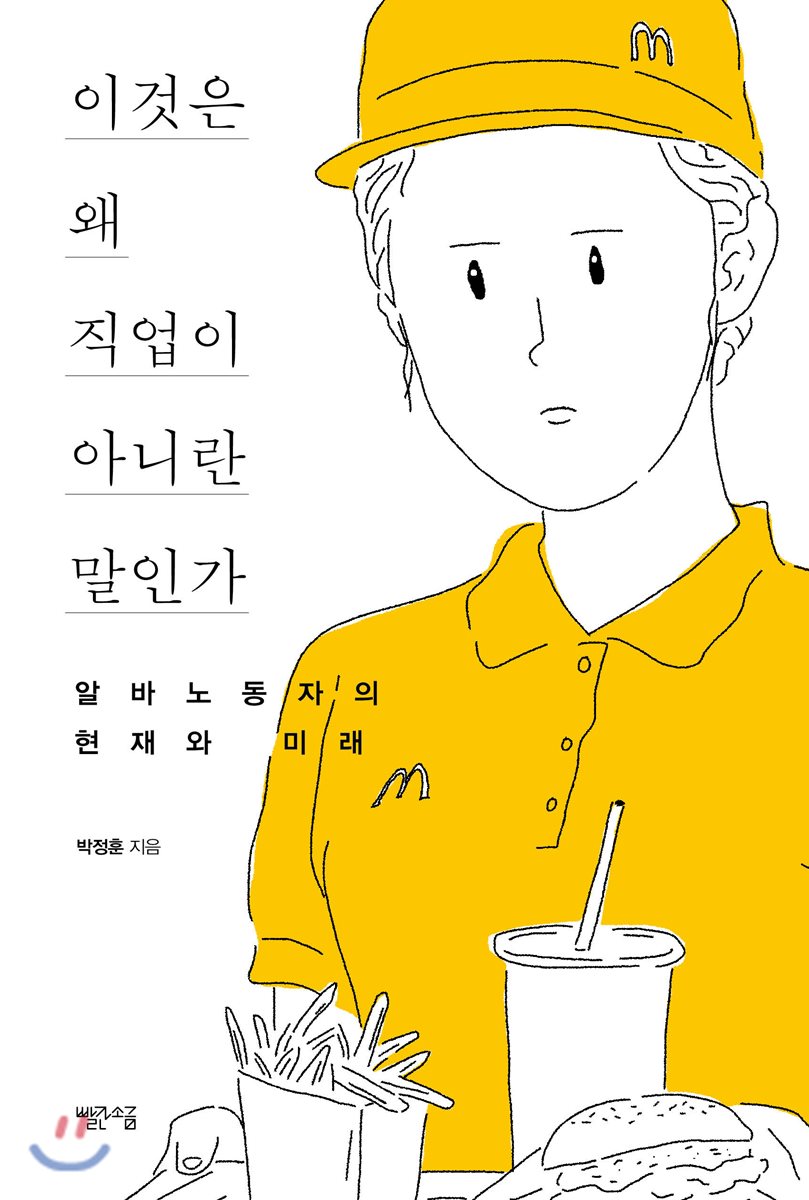
A refreshing story about part-timers who will blow away the sweet potato-like world! McDonald's is called the 'Samsung of part-time jobs.' Even though there is high-intensity labor, there are no violations of the minimum wage or labor standards law. The 24-hour convenience store symbolizes the glamor of urban civilization, but the lives of convenience store part-timers are anything but glamorous. CGV female part-timers wear red lipstick, but if it lacks luster, they must apply colorless lip gloss. Until now, part-time work has been considered as a means of providing pocket money for students, money for side dishes for housewives, and even work to protect the health of the elderly. It was the labor of those who had failed to get so-called 'normal' jobs, that is, the labor of the unemployed and the unemployed. But when large corporate franchises began to use them systematically, a labor market was created. Part-time work has now become an essential element for the growth of the franchise industry. The author calls this changed part-time job market the "third labor market," distinguishing it from the first labor market (regular workers) and the second labor market (non-regular workers). This book delves into the essence of low wages, long working hours, violations of the Labor Standards Act, verbal and physical abuse, customer abuse, and the phenomenon of part-time workers being subjected to forced labor in the third labor market, through the testimonies of part-time workers working at McDonald's, convenience stores, movie theaters, and other places. In doing so, we examine the conditions necessary to create a world where ‘part-time jobs become a profession’ is a utopia, not a dystopia. |
- You can preview some of the book's contents.
Preview
index
Preface: Here are the part-time workers.
1.
The emergence of a third labor market
2.
McDonald's, the Samsung of part-time jobs
3.
Convenience stores account for 1% of the Korean economy
4.
How female part-time workers live
5.
illegal labor
6.
A nation abandoned by its people
7.
Another life is possible
1.
The emergence of a third labor market
2.
McDonald's, the Samsung of part-time jobs
3.
Convenience stores account for 1% of the Korean economy
4.
How female part-time workers live
5.
illegal labor
6.
A nation abandoned by its people
7.
Another life is possible
Into the book
“To get a full-time position at Hyundai Motors, you need to have around 20 million won.”
I doubted my ears for a moment, but my colleagues were serious.
The factory's wages were the minimum wage at the time, 2,840 won per hour.
When Hyundai Motor Company had a lot of orders, they had to work overtime, and when there were no orders, they had to be paid minimum wage.
When there were no orders, my salary was less than 700,000 won.
When the workload was at its peak, they tried to avoid overtime work by saying, “Isn’t Sunday supposed to be a day off?”, but all the lines stopped and the foremen were called in by the factory manager and scolded.
If there was overtime or special work, I would die from exhaustion, and if there wasn't, I would die from not having enough money to live on.
If they were not satisfied with the job, they often quit and moved to another factory with similar conditions.
Most of them were young workers.
For them, being a regular worker at a large corporation was an unattainable dream that could only be achieved by paying a bribe.
--- p.20
“I’m a regular here, but the part-timer has no sense.
He said, 'Do I have to pay compensation for just a thousand won?'
I was so shocked that I laughed and said, "I only have 1,000 won," and then he suddenly dropped his phone on the ground and came over and slapped me.
I got angry and asked him about it, and he kept cursing at me, saying things like, "Where did that part-timer come from?" and "How old are you?"
I've heard the phrase 'on the topic of part-time workers' about 10 times.
In the end, I got compensated because he kept demanding 'pay me' while I was hit, but he threw the card away. " --- p.206
The human ideal that every person is valuable simply by existing has already been realized in the political realm.
All citizens of Korea have the same right to vote.
There is no difference in value between each table.
Now is the time to examine the issue of qualifications in the economic sphere.
It is not ‘part-time job = minimum hourly wage’, but ‘part-time job = citizen and human being’.
There is no such thing as clothes that suit part-time workers, a house that suits part-time workers, or food that suits part-time workers.
All you need is a country that suits Alba.
However, sympathy is forbidden.
Within the framework of who is protecting whom, it is impossible to resist with dignity.
There are no good, poor part-time workers who deserve pity.
Part-time workers are neither insignificant nor pitiful part-time workers, but simply human beings living their own lives.
The same applies to people with disabilities, women, youth, and sexual minorities filling part-time positions.
We need solidarity and respect, not insults and pity; guarantees, not protection.
I doubted my ears for a moment, but my colleagues were serious.
The factory's wages were the minimum wage at the time, 2,840 won per hour.
When Hyundai Motor Company had a lot of orders, they had to work overtime, and when there were no orders, they had to be paid minimum wage.
When there were no orders, my salary was less than 700,000 won.
When the workload was at its peak, they tried to avoid overtime work by saying, “Isn’t Sunday supposed to be a day off?”, but all the lines stopped and the foremen were called in by the factory manager and scolded.
If there was overtime or special work, I would die from exhaustion, and if there wasn't, I would die from not having enough money to live on.
If they were not satisfied with the job, they often quit and moved to another factory with similar conditions.
Most of them were young workers.
For them, being a regular worker at a large corporation was an unattainable dream that could only be achieved by paying a bribe.
--- p.20
“I’m a regular here, but the part-timer has no sense.
He said, 'Do I have to pay compensation for just a thousand won?'
I was so shocked that I laughed and said, "I only have 1,000 won," and then he suddenly dropped his phone on the ground and came over and slapped me.
I got angry and asked him about it, and he kept cursing at me, saying things like, "Where did that part-timer come from?" and "How old are you?"
I've heard the phrase 'on the topic of part-time workers' about 10 times.
In the end, I got compensated because he kept demanding 'pay me' while I was hit, but he threw the card away. " --- p.206
The human ideal that every person is valuable simply by existing has already been realized in the political realm.
All citizens of Korea have the same right to vote.
There is no difference in value between each table.
Now is the time to examine the issue of qualifications in the economic sphere.
It is not ‘part-time job = minimum hourly wage’, but ‘part-time job = citizen and human being’.
There is no such thing as clothes that suit part-time workers, a house that suits part-time workers, or food that suits part-time workers.
All you need is a country that suits Alba.
However, sympathy is forbidden.
Within the framework of who is protecting whom, it is impossible to resist with dignity.
There are no good, poor part-time workers who deserve pity.
Part-time workers are neither insignificant nor pitiful part-time workers, but simply human beings living their own lives.
The same applies to people with disabilities, women, youth, and sexual minorities filling part-time positions.
We need solidarity and respect, not insults and pity; guarantees, not protection.
--- p.261
Publisher's Review
Ten Years After the "880,000 Won Generation," the Emergence of the Third Labor Market
2007, ten years after the IMF, was the era of irregular workers and the '880,000 won generation.'
Regular jobs are being converted to non-regular jobs, subcontractors are sprouting up like mushrooms, and dispatch companies that deal in human labor have emerged.
Since the company needed people to run the business anyway, a change occurred whereby employees were laid off and then brought back as non-regular workers or new employees were hired as non-regular workers.
And 10 years after the '880,000 Won Generation', the result of labor flexibility, youth unemployment, and jobless growth was the emergence of part-time workers.
As of 2016, there were approximately 7.5 million part-time workers in the wholesale and retail trade, service industries such as food and lodging, and transportation industries.
Conservatively, assuming that irregular workers account for 50%, it is estimated that between 3.75 million and 4 million people are part-time workers.
According to the 2016 Statistics Korea data, among the 26 million employed people (including the self-employed), there are approximately 4.4 million people who work less than 35 hours a week, most of whom are estimated to be part-time workers.
This figure excludes self-employed people who are practically part-time workers but have the status of CEO.
Of course, the labor market outside of regular jobs still existed regardless of the IMF.
It was the so-called 'part-timer' labor market.
Even day laborers existed during the Joseon Dynasty.
Until now, part-time work has been considered as a means of providing pocket money for students, money for side dishes for housewives, and even work to protect the health of the elderly.
It was the labor of those who had failed to get so-called 'normal' jobs, that is, the labor of the unemployed and the unemployed.
But when large corporate franchises began to use them systematically, a labor market was created.
Part-time work has now become an essential element for the growth of the franchise industry.
The author calls this changed part-time job market the "third labor market," distinguishing it from the first labor market (regular workers) and the second labor market (non-regular workers).
The workers who run the franchise industry, which symbolizes a splendid civilization, job seekers who have to simultaneously prepare for work and employment, the laid-off and retired people, another name for the unemployed, and workers at the bottom of the labor market are the protagonists of this "third labor market."
The world of part-time work, told through the vivid voices of part-time workers.
Park Jeong-hoon, the author of this book, is a former union leader and current McDonald's delivery worker (rider).
He is famous for his hunger strike in front of the National Assembly in 2016 demanding a minimum wage of 10,000 won and his one-man protest in 2018 demanding a heatwave allowance of 100 won.
The author vividly portrays the lives of part-time workers today by adding survey data, counseling cases, and testimonies gleaned from his own part-time work experience to part-time workers' union activities.
In particular, we focus on the stories of part-time workers at McDonald's, convenience stores, and female part-time workers, who occupy a large portion of the part-time labor market.
McDonald's is often called the 'Samsung of part-time jobs.'
This is because they provide various allowances such as minimum wage and holiday pay.
You can also adjust your schedule freely.
According to the Labor Standards Act, a 30-minute break is guaranteed after 4 hours of work.
They even give out free hamburgers.
However, behind the minimum wage and various allowances, there is the constant risk of high-intensity labor and burns.
Behind the freedom to adjust one's schedule is overwork.
Even if you work 8 hours a day, it is difficult to have a leisurely meal because you only get 30-minute breaks.
The hamburgers served during meal times vary depending on rank.
Convenience stores account for 1% of the Korean economy in terms of sales and number of employees.
But convenience stores play a bigger role in the Korean economy than their share.
In addition to stores, convenience stores also take on various forms, including community centers, banks, restaurants, cafes, beer halls, party rooms, performance halls, and lunchbox shops.
It is also lit 24 hours a day, serving as a 'city guardhouse'.
Of course, part-time workers at convenience stores perform various roles, such as restaurant owners, beer house workers, fish cake vendors, baristas, and security guards.
Contrary to social prejudice, their work is never easy.
However, convenience stores in Korea are so lawless that they are called "display shelves that violate the Labor Standards Act."
Problems such as violation of employment contracts, holiday pay, break times, overtime, and verbal and physical abuse occur frequently.
The female employment rate in 2015 was 49.9%, about 10% lower than the Korean average of 60%.
While male irregular workers account for 71.4% and male irregular workers account for 25.5%, female irregular workers account for 40.3%.
Among irregular workers, 21.9% of men and 47.7% of women are part-time workers.
So, if you are born a woman in Korea, one out of two women cannot find a job, and even if they do find a job, half of them are irregular workers.
Among irregular workers, there is a high possibility that they will be part-time workers rather than irregular workers who work a stable five-day week.
Here, low-wage, irregular, and part-time workers refer to part-time workers.
In other words, the majority of part-time workers are women.
In addition to these economic hardships, female part-time workers face complex difficulties.
Society tends to assign a flowery role to female workers.
Neat appearance, makeup, a smile, and kindness are synonymous with female part-time workers. According to CGV's "Smile Keeper Appearance and Dress Code," female part-time workers should wear red lipstick, but if it lacks shine, they should apply a layer of colorless lip gloss.
In addition, issues of gender discrimination, sexual harassment, rude customers, and emotional labor in the workplace are always present.
The book also contains stories about the wage discount wars waged by employers against part-time workers (probationary periods and training hours, fines and overtime pay, and holiday pay), labor inspectors who are more on the side of employers than part-time workers, and labor laws that always stop short of workplaces with fewer than five employees when it comes to welfare issues.
Reversing the "Part-time Worker = Minimum Hourly Wage" Rationale
There are some rather peculiar people in the third labor market.
These are people who voluntarily chose part-time work.
These are 'active part-time workers' who seek leisure and value in life by breaking away from a life of work.
Kim Min-seong, 44, who had suffered from a congenital pituitary tumor, chose to work as a McDonald's delivery worker to make the most of his free time.
Jeong Seung-beom, born in 1980, works as a delivery man because he wants to continue playing guitar in a band.
Designer H, 38, chose part-time work because he wanted to live a leisurely life.
S, who works at a publishing company, hopes not for a lot of money, but for enough money to live on while working fewer hours (see Chapter 7, “A Different Life is Possible”).
In fact, according to the 'Seoul City Youth Part-time Job Ecosystem Survey', the average desired income for part-time workers was 1.76 million won, and the weekly working hours were 35 hours.
So, are the desires for sufficient income and sufficient rest truly incompatible desires? This age-old dream, in a nutshell, is a shift from job security to income security.
It is about destroying the structure in which income is earned solely through wages.
With that weapon, the author proposes a triangular compass of 'reducing working hours - minimum wage of 10,000 won - basic income'.
And the starting point is the overturn of the equivalent exchange of ‘part-time worker = minimum hourly wage.’
Because what is exchanged in the ‘part-time worker = minimum hourly wage’ is not only human labor.
Part-time workers' desires (housing, consumption, hobbies, travel, learning, etc.), social values and reputation, human rights, and government support are also exchanged for the value of the minimum wage.
Additionally, the past, present, and future of part-time workers are exchanged.
In this formula, the past of the person in the left-hand side is transformed into a history worthy of receiving the minimum wage.
It doesn't really matter how you lived.
It's just that I was lazy in the past and ended up agreeing to trade for the minimum wage.
Therefore, most conclusions are gathered by changing the left-hand side rather than the right-hand side.
It's just a matter of finding a way to increase your own value.
Why can't we imagine swapping the right-hand side of the equation "Part-time worker = minimum hourly wage"? In fact, this tradeoff isn't a decision based on economic principles.
It is a formula created through negotiations between workers and management and government intervention.
Therefore, what part-time workers must do is to overturn this equivalent exchange, and the lever for this overturn is basic income.
Part-time workers are entitled to a certain income from society, even if it is not exchanged for wages.
It has value just by existing.
2007, ten years after the IMF, was the era of irregular workers and the '880,000 won generation.'
Regular jobs are being converted to non-regular jobs, subcontractors are sprouting up like mushrooms, and dispatch companies that deal in human labor have emerged.
Since the company needed people to run the business anyway, a change occurred whereby employees were laid off and then brought back as non-regular workers or new employees were hired as non-regular workers.
And 10 years after the '880,000 Won Generation', the result of labor flexibility, youth unemployment, and jobless growth was the emergence of part-time workers.
As of 2016, there were approximately 7.5 million part-time workers in the wholesale and retail trade, service industries such as food and lodging, and transportation industries.
Conservatively, assuming that irregular workers account for 50%, it is estimated that between 3.75 million and 4 million people are part-time workers.
According to the 2016 Statistics Korea data, among the 26 million employed people (including the self-employed), there are approximately 4.4 million people who work less than 35 hours a week, most of whom are estimated to be part-time workers.
This figure excludes self-employed people who are practically part-time workers but have the status of CEO.
Of course, the labor market outside of regular jobs still existed regardless of the IMF.
It was the so-called 'part-timer' labor market.
Even day laborers existed during the Joseon Dynasty.
Until now, part-time work has been considered as a means of providing pocket money for students, money for side dishes for housewives, and even work to protect the health of the elderly.
It was the labor of those who had failed to get so-called 'normal' jobs, that is, the labor of the unemployed and the unemployed.
But when large corporate franchises began to use them systematically, a labor market was created.
Part-time work has now become an essential element for the growth of the franchise industry.
The author calls this changed part-time job market the "third labor market," distinguishing it from the first labor market (regular workers) and the second labor market (non-regular workers).
The workers who run the franchise industry, which symbolizes a splendid civilization, job seekers who have to simultaneously prepare for work and employment, the laid-off and retired people, another name for the unemployed, and workers at the bottom of the labor market are the protagonists of this "third labor market."
The world of part-time work, told through the vivid voices of part-time workers.
Park Jeong-hoon, the author of this book, is a former union leader and current McDonald's delivery worker (rider).
He is famous for his hunger strike in front of the National Assembly in 2016 demanding a minimum wage of 10,000 won and his one-man protest in 2018 demanding a heatwave allowance of 100 won.
The author vividly portrays the lives of part-time workers today by adding survey data, counseling cases, and testimonies gleaned from his own part-time work experience to part-time workers' union activities.
In particular, we focus on the stories of part-time workers at McDonald's, convenience stores, and female part-time workers, who occupy a large portion of the part-time labor market.
McDonald's is often called the 'Samsung of part-time jobs.'
This is because they provide various allowances such as minimum wage and holiday pay.
You can also adjust your schedule freely.
According to the Labor Standards Act, a 30-minute break is guaranteed after 4 hours of work.
They even give out free hamburgers.
However, behind the minimum wage and various allowances, there is the constant risk of high-intensity labor and burns.
Behind the freedom to adjust one's schedule is overwork.
Even if you work 8 hours a day, it is difficult to have a leisurely meal because you only get 30-minute breaks.
The hamburgers served during meal times vary depending on rank.
Convenience stores account for 1% of the Korean economy in terms of sales and number of employees.
But convenience stores play a bigger role in the Korean economy than their share.
In addition to stores, convenience stores also take on various forms, including community centers, banks, restaurants, cafes, beer halls, party rooms, performance halls, and lunchbox shops.
It is also lit 24 hours a day, serving as a 'city guardhouse'.
Of course, part-time workers at convenience stores perform various roles, such as restaurant owners, beer house workers, fish cake vendors, baristas, and security guards.
Contrary to social prejudice, their work is never easy.
However, convenience stores in Korea are so lawless that they are called "display shelves that violate the Labor Standards Act."
Problems such as violation of employment contracts, holiday pay, break times, overtime, and verbal and physical abuse occur frequently.
The female employment rate in 2015 was 49.9%, about 10% lower than the Korean average of 60%.
While male irregular workers account for 71.4% and male irregular workers account for 25.5%, female irregular workers account for 40.3%.
Among irregular workers, 21.9% of men and 47.7% of women are part-time workers.
So, if you are born a woman in Korea, one out of two women cannot find a job, and even if they do find a job, half of them are irregular workers.
Among irregular workers, there is a high possibility that they will be part-time workers rather than irregular workers who work a stable five-day week.
Here, low-wage, irregular, and part-time workers refer to part-time workers.
In other words, the majority of part-time workers are women.
In addition to these economic hardships, female part-time workers face complex difficulties.
Society tends to assign a flowery role to female workers.
Neat appearance, makeup, a smile, and kindness are synonymous with female part-time workers. According to CGV's "Smile Keeper Appearance and Dress Code," female part-time workers should wear red lipstick, but if it lacks shine, they should apply a layer of colorless lip gloss.
In addition, issues of gender discrimination, sexual harassment, rude customers, and emotional labor in the workplace are always present.
The book also contains stories about the wage discount wars waged by employers against part-time workers (probationary periods and training hours, fines and overtime pay, and holiday pay), labor inspectors who are more on the side of employers than part-time workers, and labor laws that always stop short of workplaces with fewer than five employees when it comes to welfare issues.
Reversing the "Part-time Worker = Minimum Hourly Wage" Rationale
There are some rather peculiar people in the third labor market.
These are people who voluntarily chose part-time work.
These are 'active part-time workers' who seek leisure and value in life by breaking away from a life of work.
Kim Min-seong, 44, who had suffered from a congenital pituitary tumor, chose to work as a McDonald's delivery worker to make the most of his free time.
Jeong Seung-beom, born in 1980, works as a delivery man because he wants to continue playing guitar in a band.
Designer H, 38, chose part-time work because he wanted to live a leisurely life.
S, who works at a publishing company, hopes not for a lot of money, but for enough money to live on while working fewer hours (see Chapter 7, “A Different Life is Possible”).
In fact, according to the 'Seoul City Youth Part-time Job Ecosystem Survey', the average desired income for part-time workers was 1.76 million won, and the weekly working hours were 35 hours.
So, are the desires for sufficient income and sufficient rest truly incompatible desires? This age-old dream, in a nutshell, is a shift from job security to income security.
It is about destroying the structure in which income is earned solely through wages.
With that weapon, the author proposes a triangular compass of 'reducing working hours - minimum wage of 10,000 won - basic income'.
And the starting point is the overturn of the equivalent exchange of ‘part-time worker = minimum hourly wage.’
Because what is exchanged in the ‘part-time worker = minimum hourly wage’ is not only human labor.
Part-time workers' desires (housing, consumption, hobbies, travel, learning, etc.), social values and reputation, human rights, and government support are also exchanged for the value of the minimum wage.
Additionally, the past, present, and future of part-time workers are exchanged.
In this formula, the past of the person in the left-hand side is transformed into a history worthy of receiving the minimum wage.
It doesn't really matter how you lived.
It's just that I was lazy in the past and ended up agreeing to trade for the minimum wage.
Therefore, most conclusions are gathered by changing the left-hand side rather than the right-hand side.
It's just a matter of finding a way to increase your own value.
Why can't we imagine swapping the right-hand side of the equation "Part-time worker = minimum hourly wage"? In fact, this tradeoff isn't a decision based on economic principles.
It is a formula created through negotiations between workers and management and government intervention.
Therefore, what part-time workers must do is to overturn this equivalent exchange, and the lever for this overturn is basic income.
Part-time workers are entitled to a certain income from society, even if it is not exchanged for wages.
It has value just by existing.
GOODS SPECIFICS
- Date of issue: January 11, 2019
- Page count, weight, size: 256 pages | 358g | 145*215*20mm
- ISBN13: 9791196585907
- ISBN10: 1196585903
You may also like
카테고리
korean


korean

![GQ KOREA Mark (Monthly): December [2025]](http://librairie.coreenne.fr/cdn/shop/files/8ef265dbbfbf186523ed75ba7319009d.jpg?v=1765340328&width=3840)


