

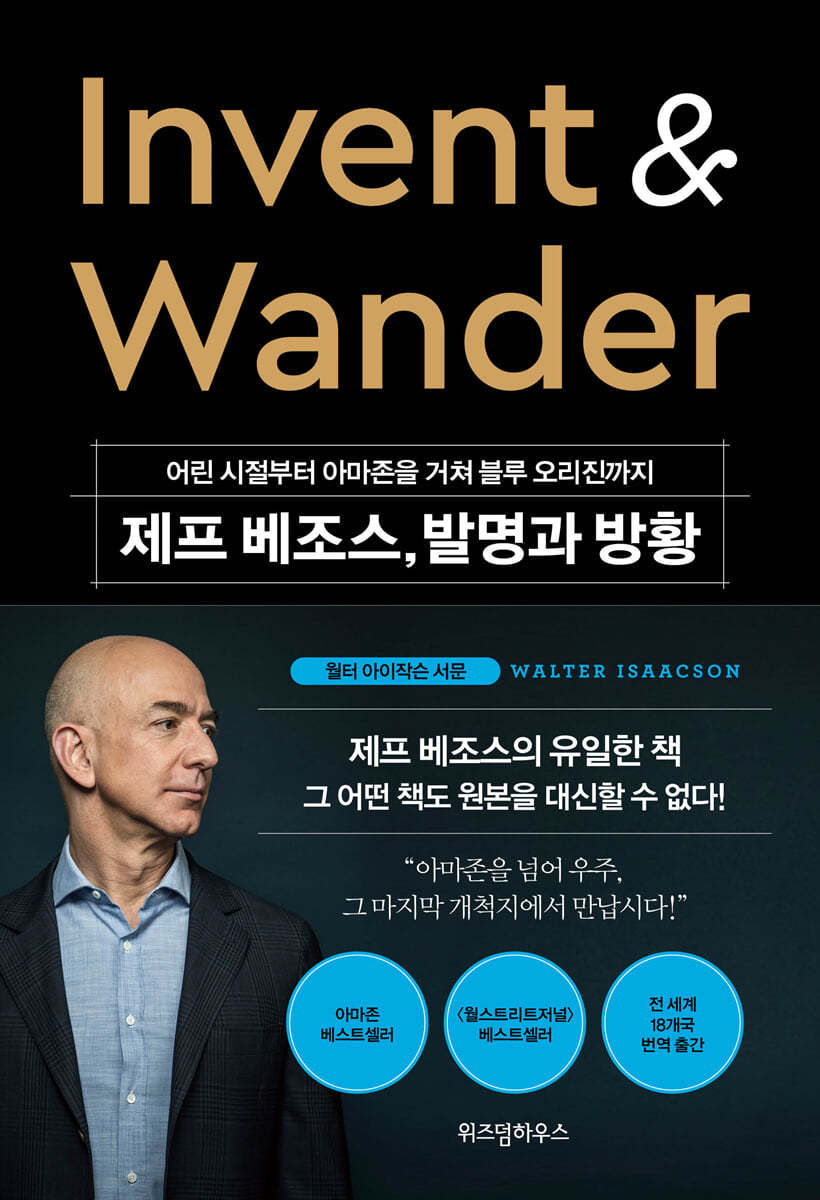
Jeff Bezos, Invent & Wander
 |
Description
Book Introduction
- A word from MD
-
The only book written by Amazon CEO Jeff Bezos himself.Jeff Bezos, the world's richest man and CEO of Amazon, is now leaving his title as CEO behind and pursuing his lifelong dream of exploring space as his next goal.
Bezos, who has walked an extraordinary path in life, explains the 'force that moves me' in this book with two keywords.
It is ‘invention’ and ‘wandering’.
March 5, 2021. Economics and Management PD Kang Hyeon-jeong
Jeff Bezos, who is heading beyond Amazon, the world's leading company, into space.
The past, present, and future heard directly through his voice
Jeff Bezos recently shocked many people by announcing that he would step down as Amazon CEO.
Despite his fame and influence as the head of one of the world's leading companies, he remained somewhat of an enigma.
"Jeff Bezos: Invention and Wandering" is Jeff Bezos' only book, in which he talks about how he founded and succeeded at Amazon, and the core principles and philosophy of his management.
Additionally, the preface to this book was written by Walter Isaacson, the world-renowned bestselling author of Steve Jobs.
In the introduction, Isaacson summarizes Bezos's story in an accessible way, helping readers first understand how his unique and original ideas came to be and what kind of future he envisions.
The past, present, and future heard directly through his voice
Jeff Bezos recently shocked many people by announcing that he would step down as Amazon CEO.
Despite his fame and influence as the head of one of the world's leading companies, he remained somewhat of an enigma.
"Jeff Bezos: Invention and Wandering" is Jeff Bezos' only book, in which he talks about how he founded and succeeded at Amazon, and the core principles and philosophy of his management.
Additionally, the preface to this book was written by Walter Isaacson, the world-renowned bestselling author of Steve Jobs.
In the introduction, Isaacson summarizes Bezos's story in an accessible way, helping readers first understand how his unique and original ideas came to be and what kind of future he envisions.
- You can preview some of the book's contents.
Preview
index
Foreword | Walter Isaacson
Part 1 Life and Work
The gift of life
A defining moment at Princeton
We are the result of the choices we make (2010 Princeton University Commencement Address)
base
Why I, a hedge fund manager, started selling books
Find the root cause
Wealth creation
The idea of Prime
Looking ahead three years
Where did the idea for Amazon Web Services come from?
Alexa, AI, and machine learning
Offline stores and Whole Foods
Acquisition of the Washington Post
faith
Work-life balance
Recruiting Talent: Are You a Mercenary or a Missionary?
decision
competition
Government investigations and large corporations
Climate Pledge
Bezos Day One Fund
Purpose of going to space
It's still the first day for the US
Part 2 Shareholder Letter
The most important thing is a long-term perspective (1997)
Obsession (1998)
Building the Future (1999)
Long-term perspective (2000)
Customer Engagement is Our Most Valuable Asset (2001)
What's Good for Customers is Good for Shareholders (2002)
Long-Term Thinking (2003)
Thoughts on Finance (2004)
Decision Making (2005)
Growth of new businesses (2006)
A team of missionaries (2007)
Thinking Backwards from the Customer (2008)
Goal Setting (2009)
Fundamental Tools (2010)
The Power of Invention (2011)
Leadership from Within (2012)
"Oh my goodness" (2013)
Three Important Ideas (2014)
Great success makes up for countless failed experiments (2015)
Day 2 (2016)
Building a Culture of High Standards (2017)
The Power of Intuition, Curiosity, and Wandering (2018)
Continued scale expansion (2019)
Source
Part 1 Life and Work
The gift of life
A defining moment at Princeton
We are the result of the choices we make (2010 Princeton University Commencement Address)
base
Why I, a hedge fund manager, started selling books
Find the root cause
Wealth creation
The idea of Prime
Looking ahead three years
Where did the idea for Amazon Web Services come from?
Alexa, AI, and machine learning
Offline stores and Whole Foods
Acquisition of the Washington Post
faith
Work-life balance
Recruiting Talent: Are You a Mercenary or a Missionary?
decision
competition
Government investigations and large corporations
Climate Pledge
Bezos Day One Fund
Purpose of going to space
It's still the first day for the US
Part 2 Shareholder Letter
The most important thing is a long-term perspective (1997)
Obsession (1998)
Building the Future (1999)
Long-term perspective (2000)
Customer Engagement is Our Most Valuable Asset (2001)
What's Good for Customers is Good for Shareholders (2002)
Long-Term Thinking (2003)
Thoughts on Finance (2004)
Decision Making (2005)
Growth of new businesses (2006)
A team of missionaries (2007)
Thinking Backwards from the Customer (2008)
Goal Setting (2009)
Fundamental Tools (2010)
The Power of Invention (2011)
Leadership from Within (2012)
"Oh my goodness" (2013)
Three Important Ideas (2014)
Great success makes up for countless failed experiments (2015)
Day 2 (2016)
Building a Culture of High Standards (2017)
The Power of Intuition, Curiosity, and Wandering (2018)
Continued scale expansion (2019)
Source
Detailed image
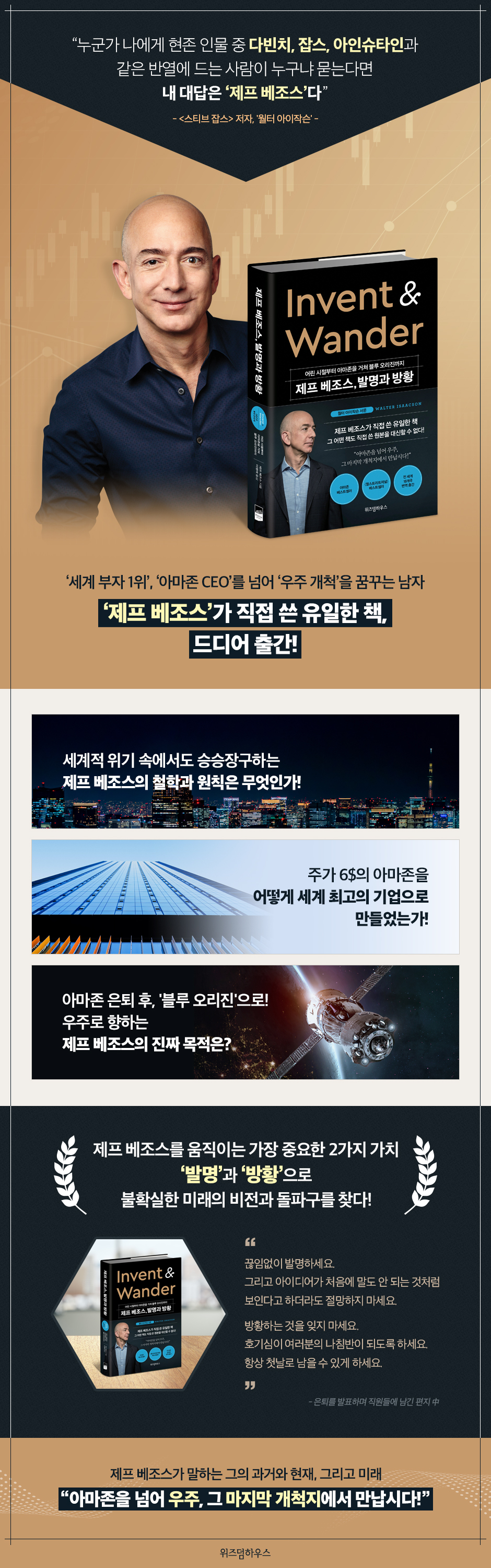
Into the book
People often ask this question:
Is there anyone alive today whose biographies I have written that I would consider to be in the same league as Leonardo da Vinci, Benjamin Franklin, Ada Lovelace, Steve Jobs, and Albert Einstein?
They are all very bright people.
But what makes them special isn't their intellectual ability.
There are plenty of bright people.
So clarity is not such a big deal.
What matters is rich creativity and imagination.
That's what makes a person a true innovator.
Here's why my answer to people's questions is 'Jeff Bezos.'
--- p.8
In late 1999, I was an editor at Time magazine, and we made the somewhat unconventional decision to name Bezos, a world-renowned leader and politician, as our Person of the Year.
I've always believed that the people who have the greatest influence on our lives are those in business and technology.
Even if you didn't see it on the front page of the newspaper often in the early days of your career.
For example, we named Intel's Andy Grove our Person of the Year in late 1997.
Because I felt that the explosion of microchips would have a greater impact on our society than any prime minister, president, or treasury secretary.
But the Time issue with Bezos on the cover was published near the end of 1999.
At the time, the dot-com bubble was beginning to burst, and there were concerns that internet stocks like Amazon would begin to collapse, and my prediction turned out to be accurate.
That's why I asked Time's CEO, Don Logan, whether choosing Bezos was a mistake, a decision that will look foolish in a few years when the internet bubble bursts.
Money replied like this.
"no.
Push your choice forward.
Jeff Bezos is in the customer service business, not the internet business.
He'll be around for decades, long after people have forgotten about the dot-com bubble."
--- p.25~26
Ultimately, it is the challenges, failures, and lack of success that you face that make progress.
In times like these, you have to get up and try again.
Every time you experience setbacks, you get up and try again.
You have to be resourceful.
You must be self-reliant.
You have to break out of the box and invent your own unique way.
There are countless examples of Amazon having to do this.
We've had a lot of failures, and I think Amazon is a great place to fail.
We are very good at failing.
Because I've been practicing a lot.
--- p.64~65
Most of the inventions we make at Amazon happen through this process:
First, someone comes up with an idea, and then other people develop that idea.
If other people object here, citing reasons why it won't work, we address those objections.
It's a very interesting process.
We've always wondered what kind of rewards program would be best for our customers.
Then a software engineer came up with an idea.
The idea was to offer customers unlimited, fast, free shipping.
The finance team modeled the idea, and the results were disastrous.
The shipping cost was too high.
But customers love free shipping.
You have to use your heart and intuition.
You have to take risks.
You have to trust your instincts.
All good decisions should be made that way.
And it has to be done by many people.
It also requires a very humble attitude.
Because being wrong isn't such a bad thing.
It's just another incident.
Amazon has made many mistakes too.
I won't list all the failed experiments here, but countless special things we've invented, including the Fire Phone, have failed.
But great successes make up for thousands of failed experiments.
--- p.75~76
Blue Origin is the most important thing I'm doing right now.
I have strong conviction about this.
At its foundation lies a very simple argument.
This is the argument that 'Earth is the best planet'.
There is an important question we must think deeply about.
"Why should we go to space?" My answer differs from the typical "Plan B" argument: that the Earth's environment is being destroyed, so we need to find somewhere else.
This argument doesn't excite me at all.
When I was in high school, I wrote something like this:
“The Earth is finite.
“If the world economy and population continue to expand and grow, space exploration is the only way forward.” I still believe this.
--- p.126~127
We will always focus on our customers, no matter what.
We will always make investment decisions from a long-term market leader's perspective, unswayed by short-term profits or Wall Street reactions.
We will continuously measure and analyze the effectiveness of our programs and investments, eliminating programs that fail to meet acceptable standards and strengthening our investment in those that deliver the best results.
We will continue to learn from our successes and failures.
When there is a strong possibility of gaining an advantage as a market leader, we will make bold investments rather than timid ones.
Some investments will succeed and some will not, but in either case, we will learn valuable lessons.
--- p.169
Inventions come in many forms and on many scales.
Radical and transformative inventions often empower people to unleash their creativity and pursue their dreams.
That's what most of what's happening now is through Amazon Web Services, Fulfillment by Amazon, and KDP.
Building on these services, we are building a powerful self-service platform.
It's a platform that empowers thousands of people to boldly experiment and achieve things that would otherwise be impossible or impractical.
These innovative, large-scale platforms create tremendous value by creating win-win situations for developers, entrepreneurs, customers, writers, and readers, rather than zero-sum situations where everyone wins and everyone loses.
--- p.263
“Jeff, what happens on the second day?”
This is a question I was asked at our most recent general meeting.
For decades, I've been reminding myself, "Today is the first day."
The name of the Amazon building where I work is Day 1.
When we moved the building, we took that name with us.
I spend a lot of time thinking about this topic.
“The second day is stagnation.
Apathy follows, and then a profound and painful decline.
What follows is death.
This is why it should always be the first day.”
Let me be clear: this type of decline happens extremely slowly.
Well-established companies may experience a second day over several decades, but they will eventually meet their end.
My interest lies in the question, “How do we prevent the second day?”
What techniques and strategies are needed to achieve this? How can we maintain the energy of the first day even within a rapidly growing organization?
--- p.334~335
In business, there are times (and quite often times) when it becomes clear which direction is most efficient, and in those cases, you need to plan and execute accordingly to increase efficiency.
Wandering in business is far from efficient.
But the wandering at this time is not just wandering about doing whatever comes to mind, but wandering that is clearly moving in a certain direction.
It's a wandering driven by intuition, instinct, intuition, curiosity, and the conviction that even if it means getting lost and taking a few detours to find your way, it's worth it if the customer is satisfied.
Wandering is like a counterweight to efficiency, so we need both.
Great discoveries, 'nonlinear' discoveries, are very likely to be made through wandering.
--- p.368
During the current COVID-19 pandemic, much of my time and thought has been focused on how Amazon can help.
I am deeply grateful for the determination and ingenuity our Amazon family has shown as we navigate this situation.
Trust that we will gain insights and lessons from the crisis we face today and apply them as we move forward.
Is there anyone alive today whose biographies I have written that I would consider to be in the same league as Leonardo da Vinci, Benjamin Franklin, Ada Lovelace, Steve Jobs, and Albert Einstein?
They are all very bright people.
But what makes them special isn't their intellectual ability.
There are plenty of bright people.
So clarity is not such a big deal.
What matters is rich creativity and imagination.
That's what makes a person a true innovator.
Here's why my answer to people's questions is 'Jeff Bezos.'
--- p.8
In late 1999, I was an editor at Time magazine, and we made the somewhat unconventional decision to name Bezos, a world-renowned leader and politician, as our Person of the Year.
I've always believed that the people who have the greatest influence on our lives are those in business and technology.
Even if you didn't see it on the front page of the newspaper often in the early days of your career.
For example, we named Intel's Andy Grove our Person of the Year in late 1997.
Because I felt that the explosion of microchips would have a greater impact on our society than any prime minister, president, or treasury secretary.
But the Time issue with Bezos on the cover was published near the end of 1999.
At the time, the dot-com bubble was beginning to burst, and there were concerns that internet stocks like Amazon would begin to collapse, and my prediction turned out to be accurate.
That's why I asked Time's CEO, Don Logan, whether choosing Bezos was a mistake, a decision that will look foolish in a few years when the internet bubble bursts.
Money replied like this.
"no.
Push your choice forward.
Jeff Bezos is in the customer service business, not the internet business.
He'll be around for decades, long after people have forgotten about the dot-com bubble."
--- p.25~26
Ultimately, it is the challenges, failures, and lack of success that you face that make progress.
In times like these, you have to get up and try again.
Every time you experience setbacks, you get up and try again.
You have to be resourceful.
You must be self-reliant.
You have to break out of the box and invent your own unique way.
There are countless examples of Amazon having to do this.
We've had a lot of failures, and I think Amazon is a great place to fail.
We are very good at failing.
Because I've been practicing a lot.
--- p.64~65
Most of the inventions we make at Amazon happen through this process:
First, someone comes up with an idea, and then other people develop that idea.
If other people object here, citing reasons why it won't work, we address those objections.
It's a very interesting process.
We've always wondered what kind of rewards program would be best for our customers.
Then a software engineer came up with an idea.
The idea was to offer customers unlimited, fast, free shipping.
The finance team modeled the idea, and the results were disastrous.
The shipping cost was too high.
But customers love free shipping.
You have to use your heart and intuition.
You have to take risks.
You have to trust your instincts.
All good decisions should be made that way.
And it has to be done by many people.
It also requires a very humble attitude.
Because being wrong isn't such a bad thing.
It's just another incident.
Amazon has made many mistakes too.
I won't list all the failed experiments here, but countless special things we've invented, including the Fire Phone, have failed.
But great successes make up for thousands of failed experiments.
--- p.75~76
Blue Origin is the most important thing I'm doing right now.
I have strong conviction about this.
At its foundation lies a very simple argument.
This is the argument that 'Earth is the best planet'.
There is an important question we must think deeply about.
"Why should we go to space?" My answer differs from the typical "Plan B" argument: that the Earth's environment is being destroyed, so we need to find somewhere else.
This argument doesn't excite me at all.
When I was in high school, I wrote something like this:
“The Earth is finite.
“If the world economy and population continue to expand and grow, space exploration is the only way forward.” I still believe this.
--- p.126~127
We will always focus on our customers, no matter what.
We will always make investment decisions from a long-term market leader's perspective, unswayed by short-term profits or Wall Street reactions.
We will continuously measure and analyze the effectiveness of our programs and investments, eliminating programs that fail to meet acceptable standards and strengthening our investment in those that deliver the best results.
We will continue to learn from our successes and failures.
When there is a strong possibility of gaining an advantage as a market leader, we will make bold investments rather than timid ones.
Some investments will succeed and some will not, but in either case, we will learn valuable lessons.
--- p.169
Inventions come in many forms and on many scales.
Radical and transformative inventions often empower people to unleash their creativity and pursue their dreams.
That's what most of what's happening now is through Amazon Web Services, Fulfillment by Amazon, and KDP.
Building on these services, we are building a powerful self-service platform.
It's a platform that empowers thousands of people to boldly experiment and achieve things that would otherwise be impossible or impractical.
These innovative, large-scale platforms create tremendous value by creating win-win situations for developers, entrepreneurs, customers, writers, and readers, rather than zero-sum situations where everyone wins and everyone loses.
--- p.263
“Jeff, what happens on the second day?”
This is a question I was asked at our most recent general meeting.
For decades, I've been reminding myself, "Today is the first day."
The name of the Amazon building where I work is Day 1.
When we moved the building, we took that name with us.
I spend a lot of time thinking about this topic.
“The second day is stagnation.
Apathy follows, and then a profound and painful decline.
What follows is death.
This is why it should always be the first day.”
Let me be clear: this type of decline happens extremely slowly.
Well-established companies may experience a second day over several decades, but they will eventually meet their end.
My interest lies in the question, “How do we prevent the second day?”
What techniques and strategies are needed to achieve this? How can we maintain the energy of the first day even within a rapidly growing organization?
--- p.334~335
In business, there are times (and quite often times) when it becomes clear which direction is most efficient, and in those cases, you need to plan and execute accordingly to increase efficiency.
Wandering in business is far from efficient.
But the wandering at this time is not just wandering about doing whatever comes to mind, but wandering that is clearly moving in a certain direction.
It's a wandering driven by intuition, instinct, intuition, curiosity, and the conviction that even if it means getting lost and taking a few detours to find your way, it's worth it if the customer is satisfied.
Wandering is like a counterweight to efficiency, so we need both.
Great discoveries, 'nonlinear' discoveries, are very likely to be made through wandering.
--- p.368
During the current COVID-19 pandemic, much of my time and thought has been focused on how Amazon can help.
I am deeply grateful for the determination and ingenuity our Amazon family has shown as we navigate this situation.
Trust that we will gain insights and lessons from the crisis we face today and apply them as we move forward.
--- p.391
Publisher's Review
Jeff Bezos' Only Book
No book can replace the original!
“Let’s meet at the final frontier, beyond the Amazon and into space!”
From a curious childhood to building Amazon's success and dreaming of space,
Meet Jeff Bezos in person like you've never seen him before!
When news broke recently that Jeff Bezos was stepping down as Amazon CEO, many were busy speculating about his next move.
News reports say Bezos will choose 'space' as his next destination and focus on his aerospace company, Blue Origin.
But why did he step down from Amazon, the world's leading company, and choose Blue Origin? The answer can be found in this book, "Jeff Bezos: Invention and Wandering."
In fact, Jeff Bezos' passion for space is not new.
His first interest in space began when he watched the Apollo 11 moon landing with his family.
Even after that, the interest continued, and when he was selected as the valedictorian of his high school, the farewell speech he gave was also about space.
“Let’s meet in space, the final frontier!”
So when did he turn his attention from space to computers? It was when he enrolled at Princeton University to major in physics, but realized he lacked the aptitude for it and switched to electrical engineering and computer science.
And his studies in computer engineering eventually led to his interest in the Internet, which led to the creation of Amazon, a company that "sells everything in the world."
In "Jeff Bezos, Invention and Wandering," we hear about Jeff Bezos' past, something we never knew, directly from his own voice, from his childhood as the son of a high school single mother and spending his vacations on a Texas ranch to the story of the founding of Amazon and Blue Origin.
You can also learn about the thoughts and goals that have governed Amazon's operations to date, its philosophy and principles, the reasons for establishing Blue Origin, and its purpose for going into space.
★★★★★ Amazon, Wall Street Journal Bestseller
★★★★★ Published in 18 languages worldwide
Jeff Bezos' two most important values: invention and wanderlust.
The two values that Jeff Bezos considered important in life were ‘invention and wandering.’
As a child, he describes himself as an inventor.
Bezos, a mischievous inventor who has created automatic gate closers with cement-filled tires, solar cookers with foil and umbrellas, and alarms to scare his younger siblings with baking pans, has always emphasized the power of invention while running Amazon.
“Radical and transformative inventions give people the power to unleash their creativity and pursue their dreams,” he said, so inventions were a truly important value to him.
And another thing that is important to him is wandering.
Here, wandering means “not just wandering around doing whatever comes to mind, but wandering clearly toward a certain direction.”
Bezos' thoughts on invention and wandering are also reflected in the letter he left to employees announcing his departure from Amazon.
“Keep inventing.
And don't despair if your idea seems crazy at first.
Don't forget to wander.
Let curiosity be your compass.
“Make sure it always remains the first day.”
Walter Isaacson, author of the international bestseller “Steve Jobs,”
Jeff Bezos' five principles of success, as analyzed by him.
The preface to “Jeff Bezos, Invention and Wandering” was written by Walter Isaacson, a world-renowned biographer known for his works on “Steve Jobs” and “Leonardo da Vinci.”
In the introduction, Isaacson views Jeff Bezos as an innovator like Steve Jobs, Leonardo da Vinci, and Albert Einstein, and analyzes that Bezos' passion for the humanities, technology, and business is what made him the most successful and influential innovator of our time.
And he summarizes Bezos' success principles that he analyzed into five.
① Focus on a long-term perspective
“We will always make investment decisions with a long-term market leadership perspective, not swayed by short-term profits or Wall Street reactions.”
② Focus on customers persistently and passionately
“The core of our company is customer obsession, not competitive obsession.
The beauty of being customer-centric is that customers are never dissatisfied.
“Customers always want more, and that pushes us to do more.”
③ Avoid PowerPoint and slide presentations.
“At Amazon, we don’t do PowerPoint (or any other slide-centric) presentations.
Instead, we write six-page pieces with a narrative structure.
And at the beginning of every meeting, we have a kind of study time where we quietly read the text.”
④ Focus on big decisions
"What do senior executives do and get paid for? Executives are paid for making a small number of high-quality decisions.
“An executive’s job isn’t to make thousands of decisions every day.”
⑤ Hire the right people
“We work to create things that matter, things that are meaningful to our customers, things we can tell our grandchildren about.
How could such things be easy? Amazon is incredibly fortunate to have such dedicated employees.
“It is their sacrifice and passion that makes Amazon what it is.”
As Walter Isaacson said, “If you look at Bezos’ life story and writings, you can get a glimpse of what makes him tick,” and through this book, we can get a glimpse of what has driven Bezos and the history he will write.
No book can replace the original!
“Let’s meet at the final frontier, beyond the Amazon and into space!”
From a curious childhood to building Amazon's success and dreaming of space,
Meet Jeff Bezos in person like you've never seen him before!
When news broke recently that Jeff Bezos was stepping down as Amazon CEO, many were busy speculating about his next move.
News reports say Bezos will choose 'space' as his next destination and focus on his aerospace company, Blue Origin.
But why did he step down from Amazon, the world's leading company, and choose Blue Origin? The answer can be found in this book, "Jeff Bezos: Invention and Wandering."
In fact, Jeff Bezos' passion for space is not new.
His first interest in space began when he watched the Apollo 11 moon landing with his family.
Even after that, the interest continued, and when he was selected as the valedictorian of his high school, the farewell speech he gave was also about space.
“Let’s meet in space, the final frontier!”
So when did he turn his attention from space to computers? It was when he enrolled at Princeton University to major in physics, but realized he lacked the aptitude for it and switched to electrical engineering and computer science.
And his studies in computer engineering eventually led to his interest in the Internet, which led to the creation of Amazon, a company that "sells everything in the world."
In "Jeff Bezos, Invention and Wandering," we hear about Jeff Bezos' past, something we never knew, directly from his own voice, from his childhood as the son of a high school single mother and spending his vacations on a Texas ranch to the story of the founding of Amazon and Blue Origin.
You can also learn about the thoughts and goals that have governed Amazon's operations to date, its philosophy and principles, the reasons for establishing Blue Origin, and its purpose for going into space.
★★★★★ Amazon, Wall Street Journal Bestseller
★★★★★ Published in 18 languages worldwide
Jeff Bezos' two most important values: invention and wanderlust.
The two values that Jeff Bezos considered important in life were ‘invention and wandering.’
As a child, he describes himself as an inventor.
Bezos, a mischievous inventor who has created automatic gate closers with cement-filled tires, solar cookers with foil and umbrellas, and alarms to scare his younger siblings with baking pans, has always emphasized the power of invention while running Amazon.
“Radical and transformative inventions give people the power to unleash their creativity and pursue their dreams,” he said, so inventions were a truly important value to him.
And another thing that is important to him is wandering.
Here, wandering means “not just wandering around doing whatever comes to mind, but wandering clearly toward a certain direction.”
Bezos' thoughts on invention and wandering are also reflected in the letter he left to employees announcing his departure from Amazon.
“Keep inventing.
And don't despair if your idea seems crazy at first.
Don't forget to wander.
Let curiosity be your compass.
“Make sure it always remains the first day.”
Walter Isaacson, author of the international bestseller “Steve Jobs,”
Jeff Bezos' five principles of success, as analyzed by him.
The preface to “Jeff Bezos, Invention and Wandering” was written by Walter Isaacson, a world-renowned biographer known for his works on “Steve Jobs” and “Leonardo da Vinci.”
In the introduction, Isaacson views Jeff Bezos as an innovator like Steve Jobs, Leonardo da Vinci, and Albert Einstein, and analyzes that Bezos' passion for the humanities, technology, and business is what made him the most successful and influential innovator of our time.
And he summarizes Bezos' success principles that he analyzed into five.
① Focus on a long-term perspective
“We will always make investment decisions with a long-term market leadership perspective, not swayed by short-term profits or Wall Street reactions.”
② Focus on customers persistently and passionately
“The core of our company is customer obsession, not competitive obsession.
The beauty of being customer-centric is that customers are never dissatisfied.
“Customers always want more, and that pushes us to do more.”
③ Avoid PowerPoint and slide presentations.
“At Amazon, we don’t do PowerPoint (or any other slide-centric) presentations.
Instead, we write six-page pieces with a narrative structure.
And at the beginning of every meeting, we have a kind of study time where we quietly read the text.”
④ Focus on big decisions
"What do senior executives do and get paid for? Executives are paid for making a small number of high-quality decisions.
“An executive’s job isn’t to make thousands of decisions every day.”
⑤ Hire the right people
“We work to create things that matter, things that are meaningful to our customers, things we can tell our grandchildren about.
How could such things be easy? Amazon is incredibly fortunate to have such dedicated employees.
“It is their sacrifice and passion that makes Amazon what it is.”
As Walter Isaacson said, “If you look at Bezos’ life story and writings, you can get a glimpse of what makes him tick,” and through this book, we can get a glimpse of what has driven Bezos and the history he will write.
GOODS SPECIFICS
- Publication date: February 19, 2021
- Format: Hardcover book binding method guide
- Page count, weight, size: 396 pages | 714g | 140*210*30mm
- ISBN13: 9791191425581
- ISBN10: 1191425584
You may also like
카테고리
korean


korean

![GQ KOREA Mark (Monthly): December [2025]](http://librairie.coreenne.fr/cdn/shop/files/8ef265dbbfbf186523ed75ba7319009d.jpg?v=1765340328&width=3840)


