

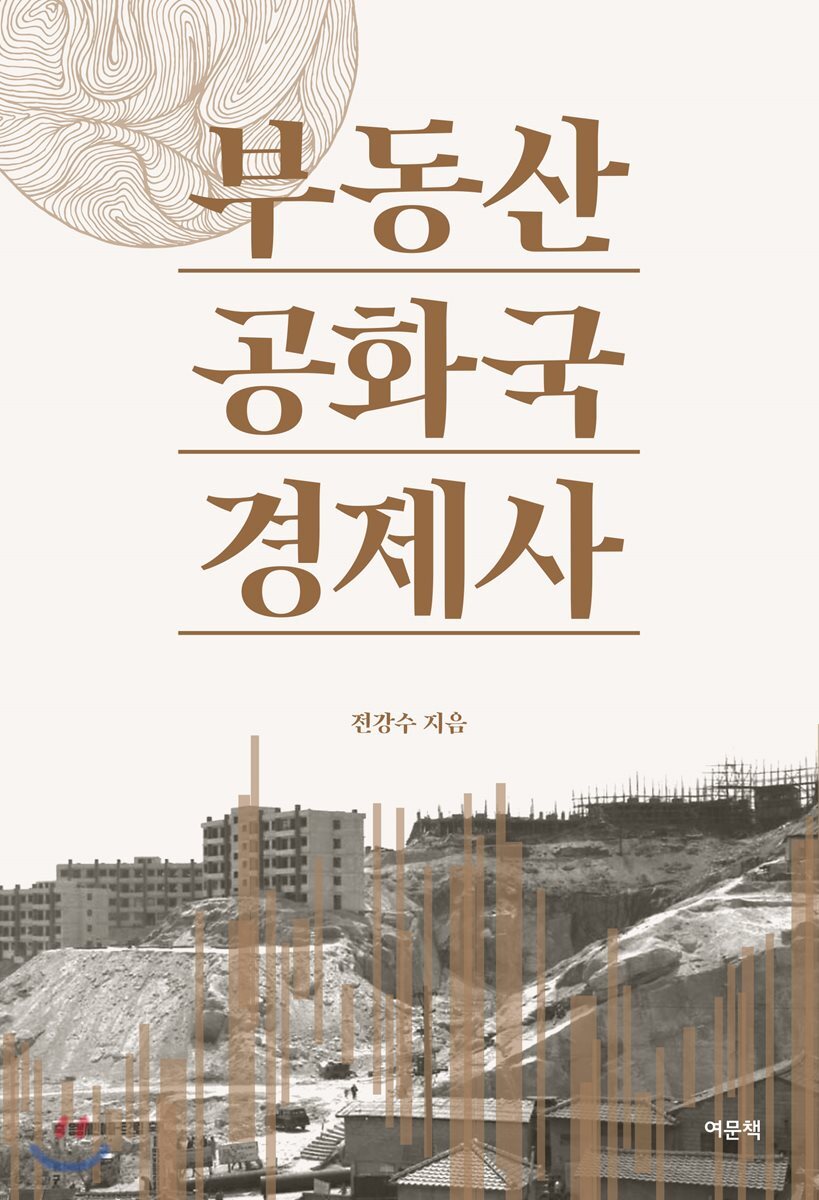
Economic History of the Real Estate Republic
 |
Description
Book Introduction
A society that has fallen from an equal land rights society to a society that seeks unearned income
Self-portrait of South Korea
After liberation, South Korea achieved a society of equal land rights (equal rights to land for all members of society) through land reform, but it did not have the institutional devices necessary to maintain that state.
As industrialization and urbanization rapidly progressed, the focus of land issues shifted from agricultural land to urban land. The problem is that indiscriminate real estate development has been taking place since the late 1960s without any countermeasures in place.
The main culprit behind indiscriminate real estate development was former President Park Chung-hee.
The development of Gangnam was the starting point, but in fact, it was not pursued for the grand purpose of implementing a blueprint for national land development, but rather for the somewhat odd purpose of securing land for the Gyeongbu Expressway and raising political funds.
The development of Gangnam, which began in this way, along with the reclamation project of the shared waters along the Han River, turned the Gangnam area into a densely populated area of apartments, which led to a surge in land prices.
Real estate speculation, which began in earnest at this time, continued to occur in cycles of about 10 years thereafter, and real estate emerged as a major topic of discussion for the Korean government and people.
After Park Chung-hee's development of Gangnam, Korean society became a society where those who worked hard and prospered, rather than a society where those who moved nimbly in pursuit of unearned income, prospered.
Politicians, construction workers, influential figures, conglomerates, and even small and medium-sized enterprises, the middle class, and even the common people all aim to strike it rich in real estate—this is the very picture of Korean society today.
How else can we describe this other than as a real estate republic?
Self-portrait of South Korea
After liberation, South Korea achieved a society of equal land rights (equal rights to land for all members of society) through land reform, but it did not have the institutional devices necessary to maintain that state.
As industrialization and urbanization rapidly progressed, the focus of land issues shifted from agricultural land to urban land. The problem is that indiscriminate real estate development has been taking place since the late 1960s without any countermeasures in place.
The main culprit behind indiscriminate real estate development was former President Park Chung-hee.
The development of Gangnam was the starting point, but in fact, it was not pursued for the grand purpose of implementing a blueprint for national land development, but rather for the somewhat odd purpose of securing land for the Gyeongbu Expressway and raising political funds.
The development of Gangnam, which began in this way, along with the reclamation project of the shared waters along the Han River, turned the Gangnam area into a densely populated area of apartments, which led to a surge in land prices.
Real estate speculation, which began in earnest at this time, continued to occur in cycles of about 10 years thereafter, and real estate emerged as a major topic of discussion for the Korean government and people.
After Park Chung-hee's development of Gangnam, Korean society became a society where those who worked hard and prospered, rather than a society where those who moved nimbly in pursuit of unearned income, prospered.
Politicians, construction workers, influential figures, conglomerates, and even small and medium-sized enterprises, the middle class, and even the common people all aim to strike it rich in real estate—this is the very picture of Korean society today.
How else can we describe this other than as a real estate republic?
- You can preview some of the book's contents.
Preview
index
prolog
Part 1: The advent of a society of equal land rights with liberation
Introduction | Why Equal Land Rights Matter
Chapter 1: The Land of the Country vs. the Landowner
Chapter 2: A society of equal land rights brought about by land reform
+ Choo Mi-ae's speech, Cho Bong-am and Roh Moo-hyun were seen
Part 2: South Korea's Descendance into a "Real Estate Republic"
Chapter 3: The Door to the Real Estate Republic Opened by Park Chung-hee
Chapter 4: The ever-blooming speculative frenzy and poor government policies
Chapter 5: The Sad Endowment Tax
Chapter 6: The Reality of the Real Estate Republic
+ The Lee Myung-bak government's real estate policy that hit the common people's economy hard
Part 3: Towards a world where sweat, not land, is rewarded
Chapter 7: Income-led growth or unearned income-led growth?
Chapter 8: Suggestions for Dismantling the Real Estate Republic
+ The birth of a basic income-linked land holding tax
Boron | A History of the Korean Land Justice Movement? Henry George's Thoughts Flourish in Korea
Epilogue
Americas | Glossary | References
Part 1: The advent of a society of equal land rights with liberation
Introduction | Why Equal Land Rights Matter
Chapter 1: The Land of the Country vs. the Landowner
Chapter 2: A society of equal land rights brought about by land reform
+ Choo Mi-ae's speech, Cho Bong-am and Roh Moo-hyun were seen
Part 2: South Korea's Descendance into a "Real Estate Republic"
Chapter 3: The Door to the Real Estate Republic Opened by Park Chung-hee
Chapter 4: The ever-blooming speculative frenzy and poor government policies
Chapter 5: The Sad Endowment Tax
Chapter 6: The Reality of the Real Estate Republic
+ The Lee Myung-bak government's real estate policy that hit the common people's economy hard
Part 3: Towards a world where sweat, not land, is rewarded
Chapter 7: Income-led growth or unearned income-led growth?
Chapter 8: Suggestions for Dismantling the Real Estate Republic
+ The birth of a basic income-linked land holding tax
Boron | A History of the Korean Land Justice Movement? Henry George's Thoughts Flourish in Korea
Epilogue
Americas | Glossary | References
Into the book
Supporters of the developmental state theory and New Right scholars attribute Korea's unprecedented high economic growth to Park Chung-hee's leadership.
They are overlooking the simple principle that major economic change is impossible without a drive from below.
Moreover, supporters of the developmental state theory and New Right scholars tend to believe that, prior to the May 16 coup, nepotism was rampant and a professional bureaucracy valuing ability could not take root, whereas, after Park Chung-hee came to power, he finally eradicated nepotism and established a professional bureaucracy based on ability.
But that is not true.
The meritocracy, which appoints officials through examinations, had already begun to take root during the Syngman Rhee administration, when land reform brought about the realization of a society with equal land rights and the development of education.
It was from then on that the country secured autonomy from powerful interest groups and established a foundation for implementing policies favorable to growth.
Therefore, for developing countries seeking to learn from Korea's growth experience, it is more important to share the experience of land reform rather than teaching Park Chung-hee.
--- pp.50-51
Many view the Roh Moo-hyun administration's real estate policy as a failure, but the truth is the opposite.
The only reason cited by those who believe that the Roh Moo-hyun administration's real estate policy failed is that it failed to control housing prices. This criticism does not take into account the fact that at the time, due to the unprecedented expansion of liquidity, real estate prices soared in countries around the world, while Korea's price increase was relatively low--- p. [Figure 5]).
Moreover, the policy content is so outstanding that no other government in South Korea has dared to attempt it, so it is absurd to define the Roh Moo-hyun administration's real estate policy as a failure.
The Roh Moo-hyun administration implemented monumental policies, including actively pursuing a policy of strengthening property taxes, not implementing real estate stimulus measures even during the recession, imposing heavy capital gains taxes on those with excessive real estate holdings, dramatically increasing the transparency of real estate transactions by introducing a real transaction price system, expanding the supply of long-term public rental housing for the general public, and disclosing land ownership distribution statistics for the first time ever.
Nevertheless, the Roh Moo-hyun administration's real estate policy was forced to yield to the persistent attacks of the privileged class, which cannot be anything other than a historical tragedy.
--- pp.143-144
It is also a huge mistake not to implement expansionary fiscal policy when the self-employed are crying out and youth unemployment is so serious that it exceeds 10 percent.
The Moon Jae-in administration's income-led growth policy, while moving in the right direction, failed to produce results largely due to its failure to implement bold welfare and macroeconomic policies.
--- p.187
The opposition party and conservative media's argument that the Moon Jae-in administration is to blame is at first glance valid, as it points out the Moon Jae-in administration's policy confusion and the fact that real estate prices are rising much faster than under the previous administration.
However, the problem is that they have tried to ignore the obvious fact that the Lee Myung-bak and Park Geun-hye administrations attempted to blatantly stimulate the real estate market for nine years, and that the relaxation of reconstruction and financial regulations during the Park Geun-hye administration was the starting point of the real estate frenzy in Gangnam.
The easing of reconstruction regulations is also seriously flawed in its logic, as it was presented as a solution to the speculative frenzy, despite it being a policy that contributed to it.
They are overlooking the simple principle that major economic change is impossible without a drive from below.
Moreover, supporters of the developmental state theory and New Right scholars tend to believe that, prior to the May 16 coup, nepotism was rampant and a professional bureaucracy valuing ability could not take root, whereas, after Park Chung-hee came to power, he finally eradicated nepotism and established a professional bureaucracy based on ability.
But that is not true.
The meritocracy, which appoints officials through examinations, had already begun to take root during the Syngman Rhee administration, when land reform brought about the realization of a society with equal land rights and the development of education.
It was from then on that the country secured autonomy from powerful interest groups and established a foundation for implementing policies favorable to growth.
Therefore, for developing countries seeking to learn from Korea's growth experience, it is more important to share the experience of land reform rather than teaching Park Chung-hee.
--- pp.50-51
Many view the Roh Moo-hyun administration's real estate policy as a failure, but the truth is the opposite.
The only reason cited by those who believe that the Roh Moo-hyun administration's real estate policy failed is that it failed to control housing prices. This criticism does not take into account the fact that at the time, due to the unprecedented expansion of liquidity, real estate prices soared in countries around the world, while Korea's price increase was relatively low--- p. [Figure 5]).
Moreover, the policy content is so outstanding that no other government in South Korea has dared to attempt it, so it is absurd to define the Roh Moo-hyun administration's real estate policy as a failure.
The Roh Moo-hyun administration implemented monumental policies, including actively pursuing a policy of strengthening property taxes, not implementing real estate stimulus measures even during the recession, imposing heavy capital gains taxes on those with excessive real estate holdings, dramatically increasing the transparency of real estate transactions by introducing a real transaction price system, expanding the supply of long-term public rental housing for the general public, and disclosing land ownership distribution statistics for the first time ever.
Nevertheless, the Roh Moo-hyun administration's real estate policy was forced to yield to the persistent attacks of the privileged class, which cannot be anything other than a historical tragedy.
--- pp.143-144
It is also a huge mistake not to implement expansionary fiscal policy when the self-employed are crying out and youth unemployment is so serious that it exceeds 10 percent.
The Moon Jae-in administration's income-led growth policy, while moving in the right direction, failed to produce results largely due to its failure to implement bold welfare and macroeconomic policies.
--- p.187
The opposition party and conservative media's argument that the Moon Jae-in administration is to blame is at first glance valid, as it points out the Moon Jae-in administration's policy confusion and the fact that real estate prices are rising much faster than under the previous administration.
However, the problem is that they have tried to ignore the obvious fact that the Lee Myung-bak and Park Geun-hye administrations attempted to blatantly stimulate the real estate market for nine years, and that the relaxation of reconstruction and financial regulations during the Park Geun-hye administration was the starting point of the real estate frenzy in Gangnam.
The easing of reconstruction regulations is also seriously flawed in its logic, as it was presented as a solution to the speculative frenzy, despite it being a policy that contributed to it.
--- p.201
Publisher's Review
A look at the economic history of the Republic of Korea with a focus on real estate issues
The biggest buzzword that shook Korean society in 2018 was 'Smart Hanchae.'
The entire nation was in an uproar over the speculative frenzy that swept through with tremendous momentum, and articles about the skyrocketing apartment prices in Seoul, especially in Gangnam, were reported daily, driving ordinary citizens into a state of relative deprivation and anxiety.
The government, startled, hurriedly came up with the September 13th measures, which helped to calm the speculative winds to some extent. However, these were more like stopgap measures rather than fundamental solutions, and it is unclear when the powder keg could explode again.
How did South Korea, once the most egalitarian country in the world in land distribution around 1960, degenerate into a society where everyone is obsessed with unearned income? Professor Jeon Kang-soo, a leading Korean Georgist scholar and real estate expert who has consistently served as a practical intellectual, offers a clear answer to this question.
According to Professor Jeon, the limitations of land reform—namely, the exclusion of urban land and forests from the reform target and the insufficient institutional mechanisms to prevent the recurrence of land ownership inequality—as well as the indiscriminate development of Gangnam pushed by the Park Chung-hee regime were major factors in Korea's decline into a real estate republic since the 1970s.
“The process by which an equal rights society was established and then retreated in Korea has a very important meaning.
“Unprecedented high growth, real estate speculation, the formation of vested interests, inequality and polarization, and economic crisis are all related to it.”
As a scholar who was greatly influenced by the ideas of Henry George, author of Progress and Poverty, a world-renowned book that sold the second-best after the Bible in the United States until the late 19th century, Professor Jeon Kang-su has consistently preached land justice for 27 years against the logic of vested interests, speculative forces, and New Right historians.
This new book, "Economic History of the Real Estate Republic," can be said to be the definitive edition of Korean society's chronic real estate problems and their solutions.
It helps readers understand the content by providing various visual aids and helpful glossary of terms, while focusing on dismantling myths about real estate issues that have been widely misunderstood by the public and informing them of the truth through an easy and clear writing style and logic.
It also included specific policy proposals that the Moon Jae-in administration, which started out riding on the back of the "candlelight public sentiment" like Noh Do, must adopt to ensure its success.
With public sentiment turning against the sluggish reforms, this may be the last chance. I sincerely hope that the public and policymakers will listen to the author's solutions and find a groundbreaking solution to the real estate problem, the very foundation of social reform.
Myths and Truths Surrounding Real Estate Issues
Professor Jeon Kang-su first clearly points out the false myths about real estate issues that have been deeply rooted in our society.
〈Myth 1〉 The land reform after liberation was so insufficient that it is difficult to call it a reform.
〈Myth 2〉 Land reform is Syngman Rhee’s work.
〈Myth 3〉 Korea's high economic growth is thanks to Park Chung-hee's leadership.
〈Myth 4〉 Park Chung-hee’s development of Gangnam originated from patriotism.
〈Myth 5〉 The Roh Moo-hyun administration’s real estate policy failed.
〈Myth 6〉 The Moon Jae-in administration has been working to fundamentally resolve the real estate problem.
〈Myth 7〉 The Moon Jae-in government’s real estate policy is a reprint of the participatory government’s policy.
〈Myth 8〉 The concept of public land is unconstitutional or socialist.
〈Myth 9〉 Strengthening the property tax is impossible to implement due to strong tax resistance.
Next, through the main text and epilogue, we will explain in detail how the above myths are false, based on specific evidence.
〈Truth 1〉 The land reform was so successful that the proportion of owner-farmers after the reform was higher than in Japan.
It is also significant in that it removed obstacles to economic growth by dismantling the landlord system.
〈Truth 2〉 Syngman Rhee’s purpose in promoting land reform was entirely political.
He once even ordered the suspension of land reform.
The protagonists of the land reform were the first Minister of Agriculture and Forestry, Cho Bong-am, officials of the Ministry of Agriculture and Forestry, and the young members of the National Assembly.
〈Truth 3〉 Korea is famous for achieving fair and high growth, and the driving force behind this came from the equality achieved through land reform.
〈Truth 4〉 Park Chung-hee pushed for the development of Gangnam to secure land for the Gyeongbu Expressway and raise political funds.
〈Truth 5〉 The Roh Moo-hyun administration's real estate policy was a monumental achievement that raised the level of Korean real estate policy to a new level.
〈Truth 6〉 Strangely enough, the Moon Jae-in administration has been avoiding strengthening the property tax, which is a fundamental real estate policy, and has focused on short-term market regulation and housing welfare.
〈Truth 7〉 While the Roh Moo-hyun administration engaged in a head-on confrontation with the myth of invincibility in real estate, the Moon Jae-in administration is merely managing it, so there is not much similarity between the two administrations.
〈Truth 8〉 The current constitution has a provision on the concept of public land.
Therefore, the land public concept policy is pro-constitutional.
Furthermore, the concept of public land creates a society in which people are rewarded for their efforts by blocking and recovering unearned income.
This is not socialism, this is true capitalism.
〈Truth 9〉 Strengthening the property tax will be met with tax resistance, but this can be easily overcome by combining it with basic income or by promoting national reconstruction projects.
How was land reform possible?
Some people still shake their heads at the fact that Korean society once achieved "fair land reform."
There are also forces that question the communist activities of Cho Bong-am, the first Minister of Agriculture and Forestry during the Syngman Rhee administration, and try to disguise Cho Bong-am's achievements as Syngman Rhee's work.
But this is nothing more than an absurd statement that distorts clear historical facts.
How was land reform, a major event that realized equal land rights in our society, possible?
Korean farmers, who had suffered from extreme exploitation during the Japanese colonial period and were liberated, believed that the day had come when they could be free from the oppression and exploitation of landlords, produce with peace of mind, freely dispose of their harvests, and live without worrying about food.
In such a social atmosphere, the issue of land reform immediately after liberation inevitably emerged as a major socioeconomic issue that no political force, regardless of left or right, could ignore.
Over the years, much research has been accumulated on Korea's land reform. Professor Jeon Kang-su synthesizes these findings and argues that the following factors combined and worked simultaneously to achieve this.
First, the role of the United States.
The United States wanted to make South Korea a bastion of anti-communism, and so it did everything it could to prevent the spread of communist forces.
Land reform was part of this U.S. policy toward the Korean Peninsula.
In fact, the United States made it impossible to reverse the flow of land reform by selling off the lands under its military government to the general public, and even after the Korean government took office, it strongly demanded land reform through various channels.
Second, Syngman Rhee's political strategy.
Syngman Rhee basically complied with the American position and sought to gain the support of the peasants by weakening the power of the landlords.
That is why Syngman Rhee, who was an extreme right-wing conservative, was active in radical reform measures such as land reform.
Third, there is a strong demand from the farmers.
Farmers who had been extorted from landlords at high rents during the Japanese colonial period strongly demanded the abolition of the colonial landlord system and the implementation of land reform after liberation.
The process of nation-building could not proceed smoothly without ignoring their demands.
Fourth, the impact of North Korea's land reform.
North Korea implemented land reform, focusing on unpaid confiscation and unpaid distribution, within a month in March 1946.
If the South Korean government did not implement land reform, there was a risk that South Korean farmers' hearts would turn toward North Korea and communism.
Against this backdrop, Korea was finally able to achieve tremendous reforms that transformed the long-standing "country of large landowners" into a "country of small farmers," a miracle brought about by the circumstances of the times.
The author further adds that he believes that land reform played a significant role in the high level of educational enthusiasm that is unique to Koreans and is recognized worldwide.
With basic equality achieved through land reform, the majority of the people began to stake their lives on education for a better future. However, as corruption spread throughout society, leading to increasingly unequal and unfair conditions, wouldn't they have no choice but to rely on education even more?
As the author says, this is “an interesting topic that requires empirical research.”
Equal rights are not socialist reforms.
There are three countries that achieved equal land rights through land reform after World War II.
They are Taiwan, Korea, and Japan.
These three countries achieved high long-term economic growth rates by implementing land reforms based on paid confiscation and paid distribution.
In contrast, several Central and South American countries that failed to reform their land monopolies despite their severe land monopolies, such as Peru, Venezuela, Colombia, Paraguay, and Guatemala, have extremely low long-term economic growth rates (see Figure 1 on page 20).
As such, there is a clear correlation between the land distribution status of each country and its subsequent long-term economic growth rate.
When discussing "equal land rights," which states that all members of a society have equal rights to land because land is a "natural resource" that is given for free, some people first think of socialist land reform.
However, while equal land rights recognize the market economy and exclusive use of land, socialist land reform denies both and ultimately aims for nationalization and collective use of land, so the two are completely different in nature.
In fact, after World War II, several Eastern European countries implemented land reforms, including the free confiscation and free distribution of land as part of the people's democratic revolution, as a means of achieving equal land rights. However, the fact that they subsequently pursued agricultural collectivization policies and ended up establishing a socialist land sharing system that was completely inconsistent with the ideal of equal land rights proves this.
The real estate speculation frenzy that heated up our society last year has heightened social interest in the concept of 'land public ownership.'
The founder of the concept of public land is Henry George, and in 1987, fueled by the fervor of the democratization movement, our country incorporated a provision on the concept of public land into the Constitution to prevent the concentration of land ownership and unearned income from land.
Unfortunately, this fact is not yet widely known to the public.
In any case, the concept of land public ownership, which is stipulated in the current Korean Constitution and also included in the constitutional amendment proposed by President Moon Jae-in in 2018 but failed, was introduced more than 30 years later than in Taiwan, and its content is abstract and ambiguous, making it difficult to properly implement the law containing its spirit when enacting it.
Therefore, laws that embody the spirit of the concept of land public ownership have always had to suffer from criticism that they are unconstitutional.
However, considering that the current Constitution has already expired in many ways and the need for constitutional amendment is inevitably increasing day by day, and that the "Candlelight Government" is tasked with carrying out fundamental social reforms so that the majority of ordinary citizens can live without worrying about housing prices or rent, the Moon Jae-in administration should, from now on, more actively promote the concept of land public ownership and make every effort to realize a more advanced equal land rights society than before.
It's time to re-establish our fundamental philosophy on real estate.
What are the reasons why policies to block and recover unearned income from real estate have failed to be properly implemented in Korea? The author cites the fact that, in the decades since land reform, a class of real estate tycoons and construction magnates have emerged, desperately seeking unearned income from real estate. Conservative media, economic bureaucrats, and market-oriented scholars have colluded with these individuals to forge a powerful coalition that dominates the real estate republic.
He then points out that “the middle class and working class who barely make ends meet, owning only one house and sending their children to school, felt a sense of kinship with this ruling alliance simply because they owned real estate and faithfully played the role of supporters,” and he points out that the anti-comprehensive real estate tax movement during the Roh Moo-hyun administration was a representative example of the middle class and working class who owned real estate sympathizing with the tax resistance of the ruling alliance of the real estate republic.
The information about real estate taxes introduced in an investigative journalism program in October 2018 was shocking in itself.
It was a comparison of the taxes of a person who owns an apartment in Mokdong with a assessed value of 1.2 billion won and a rental business owner who owns 100 small houses in Gayang-dong with a total assessed value of 27 billion won.
The only people who weren't shocked by the fact that while a single-home owner in Mokdong pays 300,000 won in property tax per year, 29 million won in capital gains tax if selling after 10 years of ownership, and 750,000 won in comprehensive real estate tax, the owner of 100 houses in Gayang-dong pays no taxes at all due to exemption from property tax, capital gains tax, and comprehensive real estate tax were probably unearned income earners like the landlord.
In order to rectify the shocking reality where phrases like "building owner above the creator" and "water owner" are casually passed around and the number one future hope of the growing generation is to be a "building owner," we must approach real estate from the perspective of housing rights and usage rights, not ownership as a tool for generating unearned income. In addition, fundamental institutional reform must be carried out on a social atmosphere that looks down on excessive unearned income earners.
Wouldn't it be possible to call a society a "just society" only when people who work hard and sweat prosper?
Professor Jeon Kang-su states that there are three ways to realize the ideal of equal rights in a capitalist society.
There are three ways to achieve this: a method of equally distributing the land itself, expanding public land and leasing it to the private sector to collect rent (land public lease system), and a method of maintaining the land ownership system but increasing land holding taxes to recover unearned income from land (land value tax system).
The problem is that policymakers, while aware of this fact, are turning a blind eye to fundamental reforms, perhaps because they are unable to overcome the 'inheritance tax trauma' of the Roh Moo-hyun administration.
But there is still hope.
First of all, the citizens of that time and the 'candlelight citizens' of today are very different.
And the majority of the "candlelight citizens" earnestly hope that the Moon Jae-in administration will achieve clear-cutting of deep-rooted evils and social reform, no less than improving inter-Korean relations and establishing peace on the Korean Peninsula.
A fundamental solution to the real estate problem revealed by the proponent of a "basic income-linked land holding tax."
Professor Jeon Kang-soo was one of the key figures in creating the three-part pledge that Gyeonggi Province Governor Lee Jae-myung made when he ran as the Democratic Party of Korea's presidential candidate in the last election: a land holding tax, basic income, and local gift certificates.
What is interesting, however, is that he revealed that the reason he actively supported candidate Lee Jae-myung was because he did not think there was any chance that he would become the Democratic Party's presidential candidate.
The reason he supported this candidate to the end, enduring many twists and turns and difficult processes, was because of the desperation of the opportunity to freely express his opinions through a 'large speaker'.
And this is precisely what differentiates Professor Jeon Kang-su from some unscrupulous 'polyprofessors' who have forgotten their duty as scholars.
While this former professor asserts that the Roh Moo-hyun administration's real estate policy was monumental, he also does not forget to clearly point out the limitations of the comprehensive real estate tax.
Because the comprehensive real estate tax is levied only on a very small number of excessive real estate owners, there is little room for tax increases, making it an inappropriate means of meaningfully promoting stronger property taxes.
It is also easy to provoke fierce tax resistance from a small number of cohesive groups.
There are also serious issues of equity.
Therefore, Professor Jeon argues that a land holding tax should be introduced instead of a comprehensive real estate tax to compensate for this.
[The land holding tax], unlike the comprehensive real estate tax, is levied only on land, and is levied on all landowners, not just a very small number of excessive real estate owners.
The reason buildings are not taxed is because the property tax on buildings creates inefficiencies that discourage construction activities.
You may be concerned about the issue of tax resistance, but that will be resolved by distributing the net increase in land holding tax revenue to all citizens as a land dividend, with each citizen receiving 1/n of the increase.
The land holding tax abolishes the differential taxation by purpose, which is pointed out as a fundamental problem with the current holding tax system, and imposes a progressive tax by adding up all land by person.
(Page 232)
Land dividends paid as a net increase in land holding tax revenues can be combined with other basic incomes, such as life cycle dividends or special dividends.
In that case, the proportion of households with net benefits will increase and the amount of benefits will also increase.
Moreover, if all basic income, including land dividends, is paid in local currency, it could serve as a catalyst for revitalizing the local economy.
(syncopation)
Let's consider the expected socioeconomic effects of introducing a land holding tax in combination with basic income.
The introduction of a land holding tax is a direct hit to the real estate republic and real estate privileges.
When this tax reaches the point where it can take full effect, the rent-seeking tendency that is currently prevalent in our society will decrease, and the productive economy will be activated to that extent.
People who own land for speculative purposes sell more land than they need, thus alleviating land ownership inequality.
Since the late 2000s, conglomerates and large corporations that have been focusing on land acquisition are also turning their attention to productive investment while disposing of excess land.
As real estate ownership inequality is reduced, income inequality will naturally decrease.
Moreover, the downward stabilization of land and real estate prices also leads to a decline in housing and business start-up costs.
This will increase the likelihood that companies that have moved overseas due to high wage burdens and land costs will return.
If all citizens receive land dividends, there will be a great change in the people's sense of sovereignty.
The consciousness that one is the real owner of a democratic republic arises.
What do you think? Isn't this truly a remarkable transformation? (pp. 236-237)
In addition, the author proposes establishing and implementing the first principle of the tax system: 'Taxation should be given priority to those with privileged interests.'
In addition to the introduction of a land holding tax, other policy tools that can be mobilized include increasing corporate taxes on conglomerates and large corporations, raising the top rate of the progressive income tax, raising the top rate of the inheritance tax and gift tax, and normalizing natural resource usage fees and environmental pollution taxes.
All of this presupposes a process of social consensus and consensus among members, and must be preceded by more detailed policy development.
There is no magic bullet that can solve chronic social problems that have accumulated over decades, and no policy can satisfy all citizens.
However, only by developing, proposing, and widely publicizing policies for the majority of the democratic republic's members, experts and policymakers from various fields can we pioneer a better future based on social compromise.
Isn't it clear what choices we must make to address serious social inequalities and ensure the well-being of future generations?
The biggest buzzword that shook Korean society in 2018 was 'Smart Hanchae.'
The entire nation was in an uproar over the speculative frenzy that swept through with tremendous momentum, and articles about the skyrocketing apartment prices in Seoul, especially in Gangnam, were reported daily, driving ordinary citizens into a state of relative deprivation and anxiety.
The government, startled, hurriedly came up with the September 13th measures, which helped to calm the speculative winds to some extent. However, these were more like stopgap measures rather than fundamental solutions, and it is unclear when the powder keg could explode again.
How did South Korea, once the most egalitarian country in the world in land distribution around 1960, degenerate into a society where everyone is obsessed with unearned income? Professor Jeon Kang-soo, a leading Korean Georgist scholar and real estate expert who has consistently served as a practical intellectual, offers a clear answer to this question.
According to Professor Jeon, the limitations of land reform—namely, the exclusion of urban land and forests from the reform target and the insufficient institutional mechanisms to prevent the recurrence of land ownership inequality—as well as the indiscriminate development of Gangnam pushed by the Park Chung-hee regime were major factors in Korea's decline into a real estate republic since the 1970s.
“The process by which an equal rights society was established and then retreated in Korea has a very important meaning.
“Unprecedented high growth, real estate speculation, the formation of vested interests, inequality and polarization, and economic crisis are all related to it.”
As a scholar who was greatly influenced by the ideas of Henry George, author of Progress and Poverty, a world-renowned book that sold the second-best after the Bible in the United States until the late 19th century, Professor Jeon Kang-su has consistently preached land justice for 27 years against the logic of vested interests, speculative forces, and New Right historians.
This new book, "Economic History of the Real Estate Republic," can be said to be the definitive edition of Korean society's chronic real estate problems and their solutions.
It helps readers understand the content by providing various visual aids and helpful glossary of terms, while focusing on dismantling myths about real estate issues that have been widely misunderstood by the public and informing them of the truth through an easy and clear writing style and logic.
It also included specific policy proposals that the Moon Jae-in administration, which started out riding on the back of the "candlelight public sentiment" like Noh Do, must adopt to ensure its success.
With public sentiment turning against the sluggish reforms, this may be the last chance. I sincerely hope that the public and policymakers will listen to the author's solutions and find a groundbreaking solution to the real estate problem, the very foundation of social reform.
Myths and Truths Surrounding Real Estate Issues
Professor Jeon Kang-su first clearly points out the false myths about real estate issues that have been deeply rooted in our society.
〈Myth 1〉 The land reform after liberation was so insufficient that it is difficult to call it a reform.
〈Myth 2〉 Land reform is Syngman Rhee’s work.
〈Myth 3〉 Korea's high economic growth is thanks to Park Chung-hee's leadership.
〈Myth 4〉 Park Chung-hee’s development of Gangnam originated from patriotism.
〈Myth 5〉 The Roh Moo-hyun administration’s real estate policy failed.
〈Myth 6〉 The Moon Jae-in administration has been working to fundamentally resolve the real estate problem.
〈Myth 7〉 The Moon Jae-in government’s real estate policy is a reprint of the participatory government’s policy.
〈Myth 8〉 The concept of public land is unconstitutional or socialist.
〈Myth 9〉 Strengthening the property tax is impossible to implement due to strong tax resistance.
Next, through the main text and epilogue, we will explain in detail how the above myths are false, based on specific evidence.
〈Truth 1〉 The land reform was so successful that the proportion of owner-farmers after the reform was higher than in Japan.
It is also significant in that it removed obstacles to economic growth by dismantling the landlord system.
〈Truth 2〉 Syngman Rhee’s purpose in promoting land reform was entirely political.
He once even ordered the suspension of land reform.
The protagonists of the land reform were the first Minister of Agriculture and Forestry, Cho Bong-am, officials of the Ministry of Agriculture and Forestry, and the young members of the National Assembly.
〈Truth 3〉 Korea is famous for achieving fair and high growth, and the driving force behind this came from the equality achieved through land reform.
〈Truth 4〉 Park Chung-hee pushed for the development of Gangnam to secure land for the Gyeongbu Expressway and raise political funds.
〈Truth 5〉 The Roh Moo-hyun administration's real estate policy was a monumental achievement that raised the level of Korean real estate policy to a new level.
〈Truth 6〉 Strangely enough, the Moon Jae-in administration has been avoiding strengthening the property tax, which is a fundamental real estate policy, and has focused on short-term market regulation and housing welfare.
〈Truth 7〉 While the Roh Moo-hyun administration engaged in a head-on confrontation with the myth of invincibility in real estate, the Moon Jae-in administration is merely managing it, so there is not much similarity between the two administrations.
〈Truth 8〉 The current constitution has a provision on the concept of public land.
Therefore, the land public concept policy is pro-constitutional.
Furthermore, the concept of public land creates a society in which people are rewarded for their efforts by blocking and recovering unearned income.
This is not socialism, this is true capitalism.
〈Truth 9〉 Strengthening the property tax will be met with tax resistance, but this can be easily overcome by combining it with basic income or by promoting national reconstruction projects.
How was land reform possible?
Some people still shake their heads at the fact that Korean society once achieved "fair land reform."
There are also forces that question the communist activities of Cho Bong-am, the first Minister of Agriculture and Forestry during the Syngman Rhee administration, and try to disguise Cho Bong-am's achievements as Syngman Rhee's work.
But this is nothing more than an absurd statement that distorts clear historical facts.
How was land reform, a major event that realized equal land rights in our society, possible?
Korean farmers, who had suffered from extreme exploitation during the Japanese colonial period and were liberated, believed that the day had come when they could be free from the oppression and exploitation of landlords, produce with peace of mind, freely dispose of their harvests, and live without worrying about food.
In such a social atmosphere, the issue of land reform immediately after liberation inevitably emerged as a major socioeconomic issue that no political force, regardless of left or right, could ignore.
Over the years, much research has been accumulated on Korea's land reform. Professor Jeon Kang-su synthesizes these findings and argues that the following factors combined and worked simultaneously to achieve this.
First, the role of the United States.
The United States wanted to make South Korea a bastion of anti-communism, and so it did everything it could to prevent the spread of communist forces.
Land reform was part of this U.S. policy toward the Korean Peninsula.
In fact, the United States made it impossible to reverse the flow of land reform by selling off the lands under its military government to the general public, and even after the Korean government took office, it strongly demanded land reform through various channels.
Second, Syngman Rhee's political strategy.
Syngman Rhee basically complied with the American position and sought to gain the support of the peasants by weakening the power of the landlords.
That is why Syngman Rhee, who was an extreme right-wing conservative, was active in radical reform measures such as land reform.
Third, there is a strong demand from the farmers.
Farmers who had been extorted from landlords at high rents during the Japanese colonial period strongly demanded the abolition of the colonial landlord system and the implementation of land reform after liberation.
The process of nation-building could not proceed smoothly without ignoring their demands.
Fourth, the impact of North Korea's land reform.
North Korea implemented land reform, focusing on unpaid confiscation and unpaid distribution, within a month in March 1946.
If the South Korean government did not implement land reform, there was a risk that South Korean farmers' hearts would turn toward North Korea and communism.
Against this backdrop, Korea was finally able to achieve tremendous reforms that transformed the long-standing "country of large landowners" into a "country of small farmers," a miracle brought about by the circumstances of the times.
The author further adds that he believes that land reform played a significant role in the high level of educational enthusiasm that is unique to Koreans and is recognized worldwide.
With basic equality achieved through land reform, the majority of the people began to stake their lives on education for a better future. However, as corruption spread throughout society, leading to increasingly unequal and unfair conditions, wouldn't they have no choice but to rely on education even more?
As the author says, this is “an interesting topic that requires empirical research.”
Equal rights are not socialist reforms.
There are three countries that achieved equal land rights through land reform after World War II.
They are Taiwan, Korea, and Japan.
These three countries achieved high long-term economic growth rates by implementing land reforms based on paid confiscation and paid distribution.
In contrast, several Central and South American countries that failed to reform their land monopolies despite their severe land monopolies, such as Peru, Venezuela, Colombia, Paraguay, and Guatemala, have extremely low long-term economic growth rates (see Figure 1 on page 20).
As such, there is a clear correlation between the land distribution status of each country and its subsequent long-term economic growth rate.
When discussing "equal land rights," which states that all members of a society have equal rights to land because land is a "natural resource" that is given for free, some people first think of socialist land reform.
However, while equal land rights recognize the market economy and exclusive use of land, socialist land reform denies both and ultimately aims for nationalization and collective use of land, so the two are completely different in nature.
In fact, after World War II, several Eastern European countries implemented land reforms, including the free confiscation and free distribution of land as part of the people's democratic revolution, as a means of achieving equal land rights. However, the fact that they subsequently pursued agricultural collectivization policies and ended up establishing a socialist land sharing system that was completely inconsistent with the ideal of equal land rights proves this.
The real estate speculation frenzy that heated up our society last year has heightened social interest in the concept of 'land public ownership.'
The founder of the concept of public land is Henry George, and in 1987, fueled by the fervor of the democratization movement, our country incorporated a provision on the concept of public land into the Constitution to prevent the concentration of land ownership and unearned income from land.
Unfortunately, this fact is not yet widely known to the public.
In any case, the concept of land public ownership, which is stipulated in the current Korean Constitution and also included in the constitutional amendment proposed by President Moon Jae-in in 2018 but failed, was introduced more than 30 years later than in Taiwan, and its content is abstract and ambiguous, making it difficult to properly implement the law containing its spirit when enacting it.
Therefore, laws that embody the spirit of the concept of land public ownership have always had to suffer from criticism that they are unconstitutional.
However, considering that the current Constitution has already expired in many ways and the need for constitutional amendment is inevitably increasing day by day, and that the "Candlelight Government" is tasked with carrying out fundamental social reforms so that the majority of ordinary citizens can live without worrying about housing prices or rent, the Moon Jae-in administration should, from now on, more actively promote the concept of land public ownership and make every effort to realize a more advanced equal land rights society than before.
It's time to re-establish our fundamental philosophy on real estate.
What are the reasons why policies to block and recover unearned income from real estate have failed to be properly implemented in Korea? The author cites the fact that, in the decades since land reform, a class of real estate tycoons and construction magnates have emerged, desperately seeking unearned income from real estate. Conservative media, economic bureaucrats, and market-oriented scholars have colluded with these individuals to forge a powerful coalition that dominates the real estate republic.
He then points out that “the middle class and working class who barely make ends meet, owning only one house and sending their children to school, felt a sense of kinship with this ruling alliance simply because they owned real estate and faithfully played the role of supporters,” and he points out that the anti-comprehensive real estate tax movement during the Roh Moo-hyun administration was a representative example of the middle class and working class who owned real estate sympathizing with the tax resistance of the ruling alliance of the real estate republic.
The information about real estate taxes introduced in an investigative journalism program in October 2018 was shocking in itself.
It was a comparison of the taxes of a person who owns an apartment in Mokdong with a assessed value of 1.2 billion won and a rental business owner who owns 100 small houses in Gayang-dong with a total assessed value of 27 billion won.
The only people who weren't shocked by the fact that while a single-home owner in Mokdong pays 300,000 won in property tax per year, 29 million won in capital gains tax if selling after 10 years of ownership, and 750,000 won in comprehensive real estate tax, the owner of 100 houses in Gayang-dong pays no taxes at all due to exemption from property tax, capital gains tax, and comprehensive real estate tax were probably unearned income earners like the landlord.
In order to rectify the shocking reality where phrases like "building owner above the creator" and "water owner" are casually passed around and the number one future hope of the growing generation is to be a "building owner," we must approach real estate from the perspective of housing rights and usage rights, not ownership as a tool for generating unearned income. In addition, fundamental institutional reform must be carried out on a social atmosphere that looks down on excessive unearned income earners.
Wouldn't it be possible to call a society a "just society" only when people who work hard and sweat prosper?
Professor Jeon Kang-su states that there are three ways to realize the ideal of equal rights in a capitalist society.
There are three ways to achieve this: a method of equally distributing the land itself, expanding public land and leasing it to the private sector to collect rent (land public lease system), and a method of maintaining the land ownership system but increasing land holding taxes to recover unearned income from land (land value tax system).
The problem is that policymakers, while aware of this fact, are turning a blind eye to fundamental reforms, perhaps because they are unable to overcome the 'inheritance tax trauma' of the Roh Moo-hyun administration.
But there is still hope.
First of all, the citizens of that time and the 'candlelight citizens' of today are very different.
And the majority of the "candlelight citizens" earnestly hope that the Moon Jae-in administration will achieve clear-cutting of deep-rooted evils and social reform, no less than improving inter-Korean relations and establishing peace on the Korean Peninsula.
A fundamental solution to the real estate problem revealed by the proponent of a "basic income-linked land holding tax."
Professor Jeon Kang-soo was one of the key figures in creating the three-part pledge that Gyeonggi Province Governor Lee Jae-myung made when he ran as the Democratic Party of Korea's presidential candidate in the last election: a land holding tax, basic income, and local gift certificates.
What is interesting, however, is that he revealed that the reason he actively supported candidate Lee Jae-myung was because he did not think there was any chance that he would become the Democratic Party's presidential candidate.
The reason he supported this candidate to the end, enduring many twists and turns and difficult processes, was because of the desperation of the opportunity to freely express his opinions through a 'large speaker'.
And this is precisely what differentiates Professor Jeon Kang-su from some unscrupulous 'polyprofessors' who have forgotten their duty as scholars.
While this former professor asserts that the Roh Moo-hyun administration's real estate policy was monumental, he also does not forget to clearly point out the limitations of the comprehensive real estate tax.
Because the comprehensive real estate tax is levied only on a very small number of excessive real estate owners, there is little room for tax increases, making it an inappropriate means of meaningfully promoting stronger property taxes.
It is also easy to provoke fierce tax resistance from a small number of cohesive groups.
There are also serious issues of equity.
Therefore, Professor Jeon argues that a land holding tax should be introduced instead of a comprehensive real estate tax to compensate for this.
[The land holding tax], unlike the comprehensive real estate tax, is levied only on land, and is levied on all landowners, not just a very small number of excessive real estate owners.
The reason buildings are not taxed is because the property tax on buildings creates inefficiencies that discourage construction activities.
You may be concerned about the issue of tax resistance, but that will be resolved by distributing the net increase in land holding tax revenue to all citizens as a land dividend, with each citizen receiving 1/n of the increase.
The land holding tax abolishes the differential taxation by purpose, which is pointed out as a fundamental problem with the current holding tax system, and imposes a progressive tax by adding up all land by person.
(Page 232)
Land dividends paid as a net increase in land holding tax revenues can be combined with other basic incomes, such as life cycle dividends or special dividends.
In that case, the proportion of households with net benefits will increase and the amount of benefits will also increase.
Moreover, if all basic income, including land dividends, is paid in local currency, it could serve as a catalyst for revitalizing the local economy.
(syncopation)
Let's consider the expected socioeconomic effects of introducing a land holding tax in combination with basic income.
The introduction of a land holding tax is a direct hit to the real estate republic and real estate privileges.
When this tax reaches the point where it can take full effect, the rent-seeking tendency that is currently prevalent in our society will decrease, and the productive economy will be activated to that extent.
People who own land for speculative purposes sell more land than they need, thus alleviating land ownership inequality.
Since the late 2000s, conglomerates and large corporations that have been focusing on land acquisition are also turning their attention to productive investment while disposing of excess land.
As real estate ownership inequality is reduced, income inequality will naturally decrease.
Moreover, the downward stabilization of land and real estate prices also leads to a decline in housing and business start-up costs.
This will increase the likelihood that companies that have moved overseas due to high wage burdens and land costs will return.
If all citizens receive land dividends, there will be a great change in the people's sense of sovereignty.
The consciousness that one is the real owner of a democratic republic arises.
What do you think? Isn't this truly a remarkable transformation? (pp. 236-237)
In addition, the author proposes establishing and implementing the first principle of the tax system: 'Taxation should be given priority to those with privileged interests.'
In addition to the introduction of a land holding tax, other policy tools that can be mobilized include increasing corporate taxes on conglomerates and large corporations, raising the top rate of the progressive income tax, raising the top rate of the inheritance tax and gift tax, and normalizing natural resource usage fees and environmental pollution taxes.
All of this presupposes a process of social consensus and consensus among members, and must be preceded by more detailed policy development.
There is no magic bullet that can solve chronic social problems that have accumulated over decades, and no policy can satisfy all citizens.
However, only by developing, proposing, and widely publicizing policies for the majority of the democratic republic's members, experts and policymakers from various fields can we pioneer a better future based on social compromise.
Isn't it clear what choices we must make to address serious social inequalities and ensure the well-being of future generations?
GOODS SPECIFICS
- Date of issue: January 21, 2019
- Page count, weight, size: 304 pages | 438g | 150*220*30mm
- ISBN13: 9791187700289
- ISBN10: 1187700282
You may also like
카테고리
korean


korean

![GQ KOREA Mark (Monthly): December [2025]](http://librairie.coreenne.fr/cdn/shop/files/8ef265dbbfbf186523ed75ba7319009d.jpg?v=1765340328&width=3840)


