

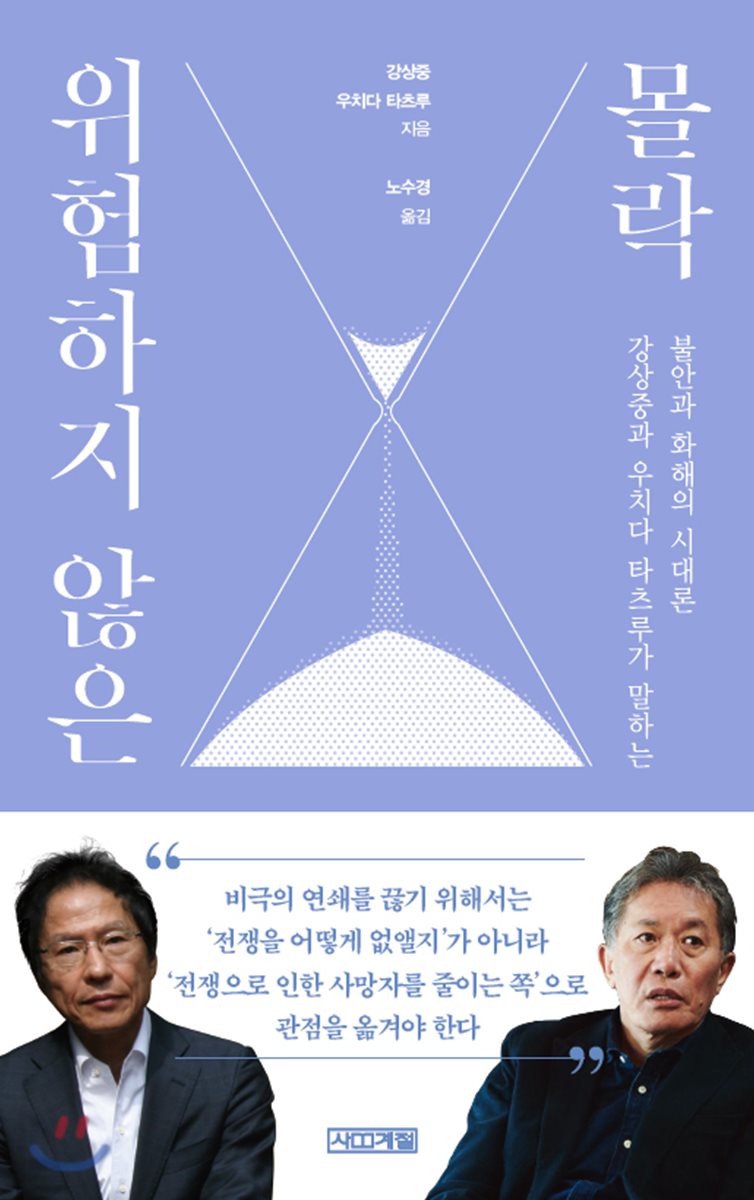
A harmless downfall
 |
Description
Book Introduction
Two representative thinkers of modern Japan,
Kang Sang-jung and Uchida Tatsuro's Theory of the Age of Anxiety and Reconciliation
Kang Sang-jung and Uchida Tatsuro, who were born in Japan around 1950 and established themselves as critical intellectuals representing Japanese society while reflecting on the process of modernization, met for the first time.
In "The Dangerous Fall," the two men look back on the shadow of modernization and the world today, and warn that humanity, which is once again hurtling toward the tragedy of history, must "be humbled and reborn through tragedies such as misery and hardship, sorrow and anguish, death and disease."
In this sharp yet nuanced dialogue between two intellectuals, readers will discover the reasons for the anxiety we face today and find clues to reconciliation with it.
Kang Sang-jung and Uchida Tatsuro's Theory of the Age of Anxiety and Reconciliation
Kang Sang-jung and Uchida Tatsuro, who were born in Japan around 1950 and established themselves as critical intellectuals representing Japanese society while reflecting on the process of modernization, met for the first time.
In "The Dangerous Fall," the two men look back on the shadow of modernization and the world today, and warn that humanity, which is once again hurtling toward the tragedy of history, must "be humbled and reborn through tragedies such as misery and hardship, sorrow and anguish, death and disease."
In this sharp yet nuanced dialogue between two intellectuals, readers will discover the reasons for the anxiety we face today and find clues to reconciliation with it.
- You can preview some of the book's contents.
Preview
index
Preface to the Korean Edition: The Age of Anxiety and Reconciliation, Vol. 5
In the midst of the tragedy that is overflowing, 9
Is the world headed toward a 'final war'?
Simultaneous Paris Terrorist Attacks 19 | The Beginning of the Cold War and World War I 20 | 100 Years of Peace, 200 Years of Development 22 | The Ideology of Freedom That Dominates the West 23 | Rebellion Against Freedom: Kanji Ishiwara's "On the World's Final War" 27 | The Curse That Spreads in France 28 | The Increase in Terrorism After 9/11 31
Chapter 1: Liquefying Nation-States and Terrorism
Immigrant youth deprived of opportunity 37 | Extreme colonial exploitation and the resulting debt 41 | Lack of self-criticism as a defeated nation 48 | The continued persistence of the French far right 57 | The emergence of a far-right presidential candidate in the US 64 | The ressentiment of defeat 75 | The liquefaction of the nation-state - the flow of history cannot be stopped 84 | The consequences of globalization: refugees 86 | Neoliberalism in the constitutional amendment 89
Chapter 2: We Live in a Medical Exhibition System
War, Terrorism, and Everyday Life 97 | If We See War in Numbers, Not Principles 101 | We Live in a Wartime System 107 | Life is More Valuable Than Money 110
Chapter 3: Reorganization of the Empire and the Activation of Commune-Type Communities
The Disintegration of the Nation-State and the Imperialization of the World 119 | Cosmology and Religion in Imperial Restructuring 122 | Communal Federations as the Axis 131 | Community Support for Refugees: A Sense of Belonging 142
Chapter 4: The Idea of Globalism
Meiji 150 Years, the Ambition of a Japanese Prime Minister 157 | A Ruined Coal Mine and a Nuclear Power Plant Immediately After the Great Earthquake 159 | The Power of Modernity Sustained by "Human Pillars" 166 | Growth and Shadows of 150 Years of Modernity 169 | Slave Labor Sustaining Modern American Industry 174 | The Errors of the American Model 176 | America's Success, Human Misfortune 184 | A Creaking Great Power, a Swaying Small Nation 186 | The Weakening of the American Model 189
Chapter 5: Singapore-izing Japan
The Singaporeization of Japan 199 | Dictators Destroying Homeland 204 | Young Filmmakers Drawing the Shadow of Singapore 211 | The Progressive Singaporeization 213 | The Growth Myth: The Weaknesses of Liberalism 216 | The Normal Economy and the Future 218 | The Illusion of Postwar Democracy 226 | The Whereabouts of Anglo-Saxon Liberalists 231 | The Emergence of a New Generation Unbaptized in Ideology 235 | The Stability of a Unified Germany 240
Chapter 6: To prevent the tyranny of an unpleasant era
When will America's stagnation begin? 249 | Acknowledging each other's worlds 251 | The dangerous anti-American resentment hidden in Japan 254 | The prospect of World War III - Turkey or the Korean Peninsula? 263 | The spread of disgust, tired of 70 years of peace 269 | Politicians hoping for the collapse of the system 274 | Learning from history the ending of an unpleasant era 280 | Withdrawal and reduction are the only ways to return to humanity's true nature 284 | The dilemma of returning home - Questions from a person from Ishinomaki 288 | Singapore and the architectural culture of the winners - Questions from Yusuke Koshima (architect, designer of Kaifukan) 292 | Architecture for the strong will not be left to posterity 294 | Public architecture that welcomes the weak 297
In conclusion 300
In the midst of the tragedy that is overflowing, 9
Is the world headed toward a 'final war'?
Simultaneous Paris Terrorist Attacks 19 | The Beginning of the Cold War and World War I 20 | 100 Years of Peace, 200 Years of Development 22 | The Ideology of Freedom That Dominates the West 23 | Rebellion Against Freedom: Kanji Ishiwara's "On the World's Final War" 27 | The Curse That Spreads in France 28 | The Increase in Terrorism After 9/11 31
Chapter 1: Liquefying Nation-States and Terrorism
Immigrant youth deprived of opportunity 37 | Extreme colonial exploitation and the resulting debt 41 | Lack of self-criticism as a defeated nation 48 | The continued persistence of the French far right 57 | The emergence of a far-right presidential candidate in the US 64 | The ressentiment of defeat 75 | The liquefaction of the nation-state - the flow of history cannot be stopped 84 | The consequences of globalization: refugees 86 | Neoliberalism in the constitutional amendment 89
Chapter 2: We Live in a Medical Exhibition System
War, Terrorism, and Everyday Life 97 | If We See War in Numbers, Not Principles 101 | We Live in a Wartime System 107 | Life is More Valuable Than Money 110
Chapter 3: Reorganization of the Empire and the Activation of Commune-Type Communities
The Disintegration of the Nation-State and the Imperialization of the World 119 | Cosmology and Religion in Imperial Restructuring 122 | Communal Federations as the Axis 131 | Community Support for Refugees: A Sense of Belonging 142
Chapter 4: The Idea of Globalism
Meiji 150 Years, the Ambition of a Japanese Prime Minister 157 | A Ruined Coal Mine and a Nuclear Power Plant Immediately After the Great Earthquake 159 | The Power of Modernity Sustained by "Human Pillars" 166 | Growth and Shadows of 150 Years of Modernity 169 | Slave Labor Sustaining Modern American Industry 174 | The Errors of the American Model 176 | America's Success, Human Misfortune 184 | A Creaking Great Power, a Swaying Small Nation 186 | The Weakening of the American Model 189
Chapter 5: Singapore-izing Japan
The Singaporeization of Japan 199 | Dictators Destroying Homeland 204 | Young Filmmakers Drawing the Shadow of Singapore 211 | The Progressive Singaporeization 213 | The Growth Myth: The Weaknesses of Liberalism 216 | The Normal Economy and the Future 218 | The Illusion of Postwar Democracy 226 | The Whereabouts of Anglo-Saxon Liberalists 231 | The Emergence of a New Generation Unbaptized in Ideology 235 | The Stability of a Unified Germany 240
Chapter 6: To prevent the tyranny of an unpleasant era
When will America's stagnation begin? 249 | Acknowledging each other's worlds 251 | The dangerous anti-American resentment hidden in Japan 254 | The prospect of World War III - Turkey or the Korean Peninsula? 263 | The spread of disgust, tired of 70 years of peace 269 | Politicians hoping for the collapse of the system 274 | Learning from history the ending of an unpleasant era 280 | Withdrawal and reduction are the only ways to return to humanity's true nature 284 | The dilemma of returning home - Questions from a person from Ishinomaki 288 | Singapore and the architectural culture of the winners - Questions from Yusuke Koshima (architect, designer of Kaifukan) 292 | Architecture for the strong will not be left to posterity 294 | Public architecture that welcomes the weak 297
In conclusion 300
Into the book
When World War II ended, many people swore, "Never again."
Now, we must never again repeat the tragedy of war.
With that oath, the post-war era began, and the wish to be 'born again' moved history.
But the slaughter never stopped, and tragedies both large and small occurred all over the world.
People's lives have been constantly lost like dew on the guillotine called history.
Today, a quarter of a century after the end of the Cold War, freedom has triumphed almost everywhere, yet paradoxically, the world is turning toward suppressing that freedom.
The tragedies of refugees and terrorism are spilling over borders.
It is no longer possible to confine the problems of modernity to some 'invisible place'.
--- p.11
The Middle East was plunged into a period of upheaval as a nation emerged that held the banner of "Islamic revivalism" rather than a nation that embraced freedom as its fundamental principle.
The Gulf War was the starting point.
(Omitted) With the transnational terrorism and the refugee flow heading to Europe, the very modern era based on the ‘West’ was shaken, and even countries that had adopted the principle of freedom as their ‘national policy’ seemed to be leaning towards denying freedom.
No country has been as consistently militarily involved in the Middle East as France or the United States.
--- p.27
Many people mistakenly believe that intelligence comes from a sharp tongue that points out the flaws of others, but that is not true.
Intelligence is judged by whether one can clearly explain the origins and progression of one's sins and failures.
If an intellectual can explain his own failures in clear and concise terms, his intellect is likely to function adequately in other matters as well.
But the post-war French intellectual community neglected that responsibility.
--- pp.49-50
The United States has held up the banner of free trade since its founding, so it is likely that free trade was its national policy.
This is the belief that I absolutely cannot compromise on.
That's why we persistently advocate for free trade, the abolition of tariff barriers, and market opening.
(Omitted) The belief that tariff barriers are evil in themselves and that market closures themselves are evil forms the very foundation of the founding of the United States.
--- p.80
I came to think that the discussion on 'how to prevent war' (omitted) should shift its perspective to 'a matter of degree', 'we cannot eliminate war, but let's think about how we can reduce the number of deaths.'
I think it would make more sense to do it that way.
War cannot be eradicated.
Terrorism cannot be eradicated either.
However, this does not mean that we should think nihilistically.
Wouldn't it be reasonable to consider, both technically and quantitatively, how to reduce the number of soldiers and civilians killed in war and the number of citizens killed by terrorism?
--- p.105
Globalization is a local movement, although it is being driven by the superpower known as the United States.
'Global orientation' is a chronic disease in America.
The United States is the only country that seeks to make its own standards the world's standards.
It is difficult to see this as truly ‘global-oriented’.
As the United States declines and its presence in the international community diminishes, there will be no country that leads globalization.
Of course, global corporations will still operate, but the political forces that demand that every country in the world open its markets and that it use the same language, currency, weights and measures, and values will decline.
--- p.139
In the shadow of modern growth, there has always been a shadow of the unknown.
(Omitted) This is not something that appears in success stories such as, ‘Japan suffered while switching the foundation of its industry from coal to oil energy, but overcame it and developed.’
It's not an old story.
In today's society of disparity, young people who have been pushed out of society, working at so-called "black companies" that force them to work themselves to death or wandering from internet cafe to internet cafe are no different from Gi-min.
--- p.173
After the Civil War, slavery was legally outlawed.
But soon after, in 1901, oil was discovered at Spindletop, Texas.
As soon as we lost the cheap energy source of slave labor, the next energy source that was 'virtually free', oil, appeared.
As a result, an industrial system based on the internal combustion engine was completed in the United States.
American industry was built on three centuries of continuous access to slave labor and cheap energy in the form of oil.
This is an exception that has occurred only in the United States, in the whole world.
--- p.176
We must quickly abandon the argument for a higher level, that is, a shared form of government, a shared principle of separation of church and state, or a shared understanding of democracy and human rights.
I think it's enough to just involve yourself to this extent without asking for that much.
No, there is no other way to do this.
As the United States loses its power to set global standards, such "reinforced and harmonious coexistence" may finally become possible.
--- pp.
252-253
The World War was a 'breakaway from the Meiji system.'
The war leadership of the Empire of Japan in the 1930s and 1940s destroyed the Meiji system.
The beneficiaries of the Meiji system, who were at the center of the system and exercised extra-legal power, rushed toward overthrowing the system as if possessed by something.
And as if to show off, everything that had been built up over the past 70 years since the Meiji Restoration was turned into nothing.
Now, we must never again repeat the tragedy of war.
With that oath, the post-war era began, and the wish to be 'born again' moved history.
But the slaughter never stopped, and tragedies both large and small occurred all over the world.
People's lives have been constantly lost like dew on the guillotine called history.
Today, a quarter of a century after the end of the Cold War, freedom has triumphed almost everywhere, yet paradoxically, the world is turning toward suppressing that freedom.
The tragedies of refugees and terrorism are spilling over borders.
It is no longer possible to confine the problems of modernity to some 'invisible place'.
--- p.11
The Middle East was plunged into a period of upheaval as a nation emerged that held the banner of "Islamic revivalism" rather than a nation that embraced freedom as its fundamental principle.
The Gulf War was the starting point.
(Omitted) With the transnational terrorism and the refugee flow heading to Europe, the very modern era based on the ‘West’ was shaken, and even countries that had adopted the principle of freedom as their ‘national policy’ seemed to be leaning towards denying freedom.
No country has been as consistently militarily involved in the Middle East as France or the United States.
--- p.27
Many people mistakenly believe that intelligence comes from a sharp tongue that points out the flaws of others, but that is not true.
Intelligence is judged by whether one can clearly explain the origins and progression of one's sins and failures.
If an intellectual can explain his own failures in clear and concise terms, his intellect is likely to function adequately in other matters as well.
But the post-war French intellectual community neglected that responsibility.
--- pp.49-50
The United States has held up the banner of free trade since its founding, so it is likely that free trade was its national policy.
This is the belief that I absolutely cannot compromise on.
That's why we persistently advocate for free trade, the abolition of tariff barriers, and market opening.
(Omitted) The belief that tariff barriers are evil in themselves and that market closures themselves are evil forms the very foundation of the founding of the United States.
--- p.80
I came to think that the discussion on 'how to prevent war' (omitted) should shift its perspective to 'a matter of degree', 'we cannot eliminate war, but let's think about how we can reduce the number of deaths.'
I think it would make more sense to do it that way.
War cannot be eradicated.
Terrorism cannot be eradicated either.
However, this does not mean that we should think nihilistically.
Wouldn't it be reasonable to consider, both technically and quantitatively, how to reduce the number of soldiers and civilians killed in war and the number of citizens killed by terrorism?
--- p.105
Globalization is a local movement, although it is being driven by the superpower known as the United States.
'Global orientation' is a chronic disease in America.
The United States is the only country that seeks to make its own standards the world's standards.
It is difficult to see this as truly ‘global-oriented’.
As the United States declines and its presence in the international community diminishes, there will be no country that leads globalization.
Of course, global corporations will still operate, but the political forces that demand that every country in the world open its markets and that it use the same language, currency, weights and measures, and values will decline.
--- p.139
In the shadow of modern growth, there has always been a shadow of the unknown.
(Omitted) This is not something that appears in success stories such as, ‘Japan suffered while switching the foundation of its industry from coal to oil energy, but overcame it and developed.’
It's not an old story.
In today's society of disparity, young people who have been pushed out of society, working at so-called "black companies" that force them to work themselves to death or wandering from internet cafe to internet cafe are no different from Gi-min.
--- p.173
After the Civil War, slavery was legally outlawed.
But soon after, in 1901, oil was discovered at Spindletop, Texas.
As soon as we lost the cheap energy source of slave labor, the next energy source that was 'virtually free', oil, appeared.
As a result, an industrial system based on the internal combustion engine was completed in the United States.
American industry was built on three centuries of continuous access to slave labor and cheap energy in the form of oil.
This is an exception that has occurred only in the United States, in the whole world.
--- p.176
We must quickly abandon the argument for a higher level, that is, a shared form of government, a shared principle of separation of church and state, or a shared understanding of democracy and human rights.
I think it's enough to just involve yourself to this extent without asking for that much.
No, there is no other way to do this.
As the United States loses its power to set global standards, such "reinforced and harmonious coexistence" may finally become possible.
--- pp.
252-253
The World War was a 'breakaway from the Meiji system.'
The war leadership of the Empire of Japan in the 1930s and 1940s destroyed the Meiji system.
The beneficiaries of the Meiji system, who were at the center of the system and exercised extra-legal power, rushed toward overthrowing the system as if possessed by something.
And as if to show off, everything that had been built up over the past 70 years since the Meiji Restoration was turned into nothing.
--- p.276
Publisher's Review
Yes, that's right.
We are children of the modern age
Through modern times, humanity has secured the rights that it naturally enjoys as a human being based on the ideas of freedom and equality.
The torch of modernity gave birth to a civil revolution and gave birth to a nation where the rights of its citizens were guaranteed under a constitution. Furthermore, the brilliant power of reason presented humanity with infinite possibilities.
We, the children of modern times born within it, believed that we could sang peace forever.
But the modern era that seemed so solid is now coming to an end.
Today, as terrorism invades the daily lives of ordinary citizens and global capitalism and neoliberalism swirl, the nation-state system that has sustained modernity is drawing its last breath, and the world is entering the final stage of war.
Where did the problem start?
Can human history once again open the door to a new world beyond the 'barbarism of the 21st century'?
In this book, leading Japanese thinkers Kang Sang-jung and Uchida Tatsuro argue that the sinking of modernity is unstoppable and seek ways for the world to reach the next stage more safely.
Entering the 'World's Final War' phase
It was believed that world history unfolded based on the example of the countries of revolution and independence revolution that claimed to be the orthodoxy of modern times.
The term 'orthodoxy' used here means a new nation created according to specific principles and principles of revolution, and in short, it means that freedom is its fundamental principle.
_Kang Sang-jung, pp. 24-26
The United States and France, founded on the foundations of freedom and equality, have advanced history, taking pride in being leaders in ideas and culture.
But it is a modern irony that at this very moment these very two countries have become targets of terrorism.
"The Dangerous Fall" traces the causes of this catastrophic situation.
According to Kang Sang-jung, at the moment when the Cold War ended and 'modernity' became the world's standard and the entire world began to follow the example of the United States and France and create countries, societies, and institutions based on the principle of freedom, the illusion of the 'sole and pure modern model' began to be shattered with the emergence of countries in the Middle East that raised the banner of 'Islamic revival.'
The United States and France intervened militarily under the pretext of relieving the chaos in the Middle East and restoring world order.
The wars and conflicts in the Middle East have resulted in countless casualties and refugees, and the victims have developed feelings of anger and revenge toward the United States and France.
Here, Kang Sang-jung seeks the origins of terrorism, which has now infiltrated everyday life in Western metropolises.
The Rise of New Barbarism, a Global Rightward Shift
The world experienced two world wars and the Cold War in the 20th century, and realized the dangers of the illusion of totalitarianism.
But as time passed, memories of the past faded.
The rise of President Trump in the United States, the great strides of the National Front in France, and the long-term rule of Prime Minister Abe in Japan are all examples of a shift toward the right around the world.
Tatsuro Uchida warns that this phenomenon is a sign of the “new barbarism of the 21st century.”
According to him, since the 17th century, the modern world has been able to survive under the common condition of the ‘nation-state.’
Following the model of the nation-state system, the world has standardized its systems and culture and has run toward the sole goal of economic growth.
Finally, when 'capital and market' became the fundamental principle, the nation-state system could no longer be a condition for economic growth.
While capital and markets wanted to move freely across national borders, states wanted to protect and operate capital and markets within their borders.
The analysis is that in the fierce conflict between the state and the market that raged until the end of the 20th century, the market finally won, and in response, the phenomenon of a "rightward shift" to build high walls along one's own borders has resurfaced.
Tatsuro Uchida also clearly explains the current political situation in Japan.
He says that the Japan that Prime Minister Abe wants is a country that combines North Korea and Singapore.
Politically, it is modeled after North Korea, a dictatorial state that does not allow its citizens freedom, and economically, it is modeled after Singapore, where the state's sole goal is growth and all social institutions are designed solely for profit-making.
Ultimately, what matters between the two models is the economic model, and the far-right totalitarian state is merely a process to achieve that ultimate goal.
This is where Marx's plan, which included the development of capitalism in the process toward the victory of socialism, overlaps.
Are we trapped in an age of uncertainty?
Kang Sang-jung and Uchida Tatsuro worry that the Japanese are 'possessed' by the anxious atmosphere of the times.
The media is encouraging war, saying North Korea is no big deal, and the government is wiping out the local economy without properly dealing with the Fukushima nuclear accident, and is ultimately trying to revise the constitution to make Japan a country capable of war.
Tatsuro Uchida analyzes that the ruling Liberal Democratic Party has established an economic growth model in this process.
This pace cannot be maintained by republican consensus-building procedures or decentralized systems.
To maintain speed, we have no choice but to centralize all power in the Prime Minister's Office and create a structure in which the judiciary and legislature follow the executive branch's instructions.
_Uchida Tatsuro, page 200
If we establish a structure in which all citizens work in the city and purchase all their necessities as commodities in the market, GDP will be maintained to a certain extent.
To do that, we need to create a structure in the city where people cannot survive without doing wage labor.
_Uchida Tatsuro, p. 206
The key to preventing sinking is a spirit of tolerance and hospitality.
In this book, the conversation between the two intellectuals does not stop at analyzing risks.
The thoughts of two people who had been endlessly expanding to find a way to overcome the barbarism of the 21st century come to a halt at the same time.
This is Germany right after World War II.
After the war, Germany reflected on its responsibility for the war more intensely than any other country in the world, and built the foundation of a new nation on that reflective thinking.
Germany, which has adopted the national ideology of assuming a higher level of humanitarian and ethical responsibility than other countries, has even explicitly included a provision for 'refugee acceptance' in its constitution.
This sense of ethical obligation persists to this day, and Germany remains one of the most resilient European countries in terms of accepting refugees from the Middle East and Africa.
Furthermore, Kang Sang-jung explains that Germany's reflection and sense of ethical debt became the basis for the unification of East and West Germany.
The lesson that the entire nation learned through the experience of World War II was that we must be tolerant of others.
The two also present the Islamic community's 'Zakat culture' as another key to solving today's crisis.
Rather than the egalitarian logic of 'If we give in, you give in too,' I say that the attitude of tolerance in which I give in first is the beginning of coexistence and reconciliation.
You never know when you might find yourself wandering in the wilderness without food or water.
(Omitted) It is difficult to survive if you meet a good person and die if you meet a miser.
In any case, if you find a tent in the desert, you should be able to get help.
As a result, the morality of always sharing with others the resources necessary for survival in the wilderness became embodied.
_Uchida Tatsuro, page 126
Imagining the future in a small community
At the end of the book, the two reassure the reader that the world will be rebuilt into small community units.
As the world's only growth model, the United States, loses its power and the nation-state system liquefies, the world is expected to expand into several units, such as the Islamic world, the European world, and the Confucian world, while at the same time, small regional communities are re-established to complement them.
Tatsuro Uchida says that the 'normal economy' will be restored through the process of localization.
Humans have been engaged in economic activities for 70,000 years.
For most of that time, it was a normal economy, with little change in the forms of production and exchange from the time an individual was born until he died.
Because before the Industrial Revolution, mankind had never seen figures like how much growth there was in a year.
(Omitted) Even services that require a very high price when purchased as a commodity in the market can be resolved by saying, “Please do me a favor” within a mutual aid community.
The price is paid by responding to someone's 'please' on another occasion, in another form.
_Uchida Tatsuro, p. 219
Kang Sang-jung and Uchida Tatsuro place a trade-centered reciprocal economic system on the opposite side of the ultra-high-speed monetary economic system.
A future where diverse communities, each with its own historical background and geographical conditions, determine the best model in a world where economic activities with completely different characteristics coexist.
A new history for humanity began to slowly advance in the direction pointed by the two men.
We are children of the modern age
Through modern times, humanity has secured the rights that it naturally enjoys as a human being based on the ideas of freedom and equality.
The torch of modernity gave birth to a civil revolution and gave birth to a nation where the rights of its citizens were guaranteed under a constitution. Furthermore, the brilliant power of reason presented humanity with infinite possibilities.
We, the children of modern times born within it, believed that we could sang peace forever.
But the modern era that seemed so solid is now coming to an end.
Today, as terrorism invades the daily lives of ordinary citizens and global capitalism and neoliberalism swirl, the nation-state system that has sustained modernity is drawing its last breath, and the world is entering the final stage of war.
Where did the problem start?
Can human history once again open the door to a new world beyond the 'barbarism of the 21st century'?
In this book, leading Japanese thinkers Kang Sang-jung and Uchida Tatsuro argue that the sinking of modernity is unstoppable and seek ways for the world to reach the next stage more safely.
Entering the 'World's Final War' phase
It was believed that world history unfolded based on the example of the countries of revolution and independence revolution that claimed to be the orthodoxy of modern times.
The term 'orthodoxy' used here means a new nation created according to specific principles and principles of revolution, and in short, it means that freedom is its fundamental principle.
_Kang Sang-jung, pp. 24-26
The United States and France, founded on the foundations of freedom and equality, have advanced history, taking pride in being leaders in ideas and culture.
But it is a modern irony that at this very moment these very two countries have become targets of terrorism.
"The Dangerous Fall" traces the causes of this catastrophic situation.
According to Kang Sang-jung, at the moment when the Cold War ended and 'modernity' became the world's standard and the entire world began to follow the example of the United States and France and create countries, societies, and institutions based on the principle of freedom, the illusion of the 'sole and pure modern model' began to be shattered with the emergence of countries in the Middle East that raised the banner of 'Islamic revival.'
The United States and France intervened militarily under the pretext of relieving the chaos in the Middle East and restoring world order.
The wars and conflicts in the Middle East have resulted in countless casualties and refugees, and the victims have developed feelings of anger and revenge toward the United States and France.
Here, Kang Sang-jung seeks the origins of terrorism, which has now infiltrated everyday life in Western metropolises.
The Rise of New Barbarism, a Global Rightward Shift
The world experienced two world wars and the Cold War in the 20th century, and realized the dangers of the illusion of totalitarianism.
But as time passed, memories of the past faded.
The rise of President Trump in the United States, the great strides of the National Front in France, and the long-term rule of Prime Minister Abe in Japan are all examples of a shift toward the right around the world.
Tatsuro Uchida warns that this phenomenon is a sign of the “new barbarism of the 21st century.”
According to him, since the 17th century, the modern world has been able to survive under the common condition of the ‘nation-state.’
Following the model of the nation-state system, the world has standardized its systems and culture and has run toward the sole goal of economic growth.
Finally, when 'capital and market' became the fundamental principle, the nation-state system could no longer be a condition for economic growth.
While capital and markets wanted to move freely across national borders, states wanted to protect and operate capital and markets within their borders.
The analysis is that in the fierce conflict between the state and the market that raged until the end of the 20th century, the market finally won, and in response, the phenomenon of a "rightward shift" to build high walls along one's own borders has resurfaced.
Tatsuro Uchida also clearly explains the current political situation in Japan.
He says that the Japan that Prime Minister Abe wants is a country that combines North Korea and Singapore.
Politically, it is modeled after North Korea, a dictatorial state that does not allow its citizens freedom, and economically, it is modeled after Singapore, where the state's sole goal is growth and all social institutions are designed solely for profit-making.
Ultimately, what matters between the two models is the economic model, and the far-right totalitarian state is merely a process to achieve that ultimate goal.
This is where Marx's plan, which included the development of capitalism in the process toward the victory of socialism, overlaps.
Are we trapped in an age of uncertainty?
Kang Sang-jung and Uchida Tatsuro worry that the Japanese are 'possessed' by the anxious atmosphere of the times.
The media is encouraging war, saying North Korea is no big deal, and the government is wiping out the local economy without properly dealing with the Fukushima nuclear accident, and is ultimately trying to revise the constitution to make Japan a country capable of war.
Tatsuro Uchida analyzes that the ruling Liberal Democratic Party has established an economic growth model in this process.
This pace cannot be maintained by republican consensus-building procedures or decentralized systems.
To maintain speed, we have no choice but to centralize all power in the Prime Minister's Office and create a structure in which the judiciary and legislature follow the executive branch's instructions.
_Uchida Tatsuro, page 200
If we establish a structure in which all citizens work in the city and purchase all their necessities as commodities in the market, GDP will be maintained to a certain extent.
To do that, we need to create a structure in the city where people cannot survive without doing wage labor.
_Uchida Tatsuro, p. 206
The key to preventing sinking is a spirit of tolerance and hospitality.
In this book, the conversation between the two intellectuals does not stop at analyzing risks.
The thoughts of two people who had been endlessly expanding to find a way to overcome the barbarism of the 21st century come to a halt at the same time.
This is Germany right after World War II.
After the war, Germany reflected on its responsibility for the war more intensely than any other country in the world, and built the foundation of a new nation on that reflective thinking.
Germany, which has adopted the national ideology of assuming a higher level of humanitarian and ethical responsibility than other countries, has even explicitly included a provision for 'refugee acceptance' in its constitution.
This sense of ethical obligation persists to this day, and Germany remains one of the most resilient European countries in terms of accepting refugees from the Middle East and Africa.
Furthermore, Kang Sang-jung explains that Germany's reflection and sense of ethical debt became the basis for the unification of East and West Germany.
The lesson that the entire nation learned through the experience of World War II was that we must be tolerant of others.
The two also present the Islamic community's 'Zakat culture' as another key to solving today's crisis.
Rather than the egalitarian logic of 'If we give in, you give in too,' I say that the attitude of tolerance in which I give in first is the beginning of coexistence and reconciliation.
You never know when you might find yourself wandering in the wilderness without food or water.
(Omitted) It is difficult to survive if you meet a good person and die if you meet a miser.
In any case, if you find a tent in the desert, you should be able to get help.
As a result, the morality of always sharing with others the resources necessary for survival in the wilderness became embodied.
_Uchida Tatsuro, page 126
Imagining the future in a small community
At the end of the book, the two reassure the reader that the world will be rebuilt into small community units.
As the world's only growth model, the United States, loses its power and the nation-state system liquefies, the world is expected to expand into several units, such as the Islamic world, the European world, and the Confucian world, while at the same time, small regional communities are re-established to complement them.
Tatsuro Uchida says that the 'normal economy' will be restored through the process of localization.
Humans have been engaged in economic activities for 70,000 years.
For most of that time, it was a normal economy, with little change in the forms of production and exchange from the time an individual was born until he died.
Because before the Industrial Revolution, mankind had never seen figures like how much growth there was in a year.
(Omitted) Even services that require a very high price when purchased as a commodity in the market can be resolved by saying, “Please do me a favor” within a mutual aid community.
The price is paid by responding to someone's 'please' on another occasion, in another form.
_Uchida Tatsuro, p. 219
Kang Sang-jung and Uchida Tatsuro place a trade-centered reciprocal economic system on the opposite side of the ultra-high-speed monetary economic system.
A future where diverse communities, each with its own historical background and geographical conditions, determine the best model in a world where economic activities with completely different characteristics coexist.
A new history for humanity began to slowly advance in the direction pointed by the two men.
GOODS SPECIFICS
- Date of publication: December 28, 2018
- Page count, weight, size: 304 pages | 372g | 140*211*30mm
- ISBN13: 9791160944204
- ISBN10: 1160944202
You may also like
카테고리
korean


korean

![GQ KOREA Mark (Monthly): December [2025]](http://librairie.coreenne.fr/cdn/shop/files/8ef265dbbfbf186523ed75ba7319009d.jpg?v=1765340328&width=3840)


