

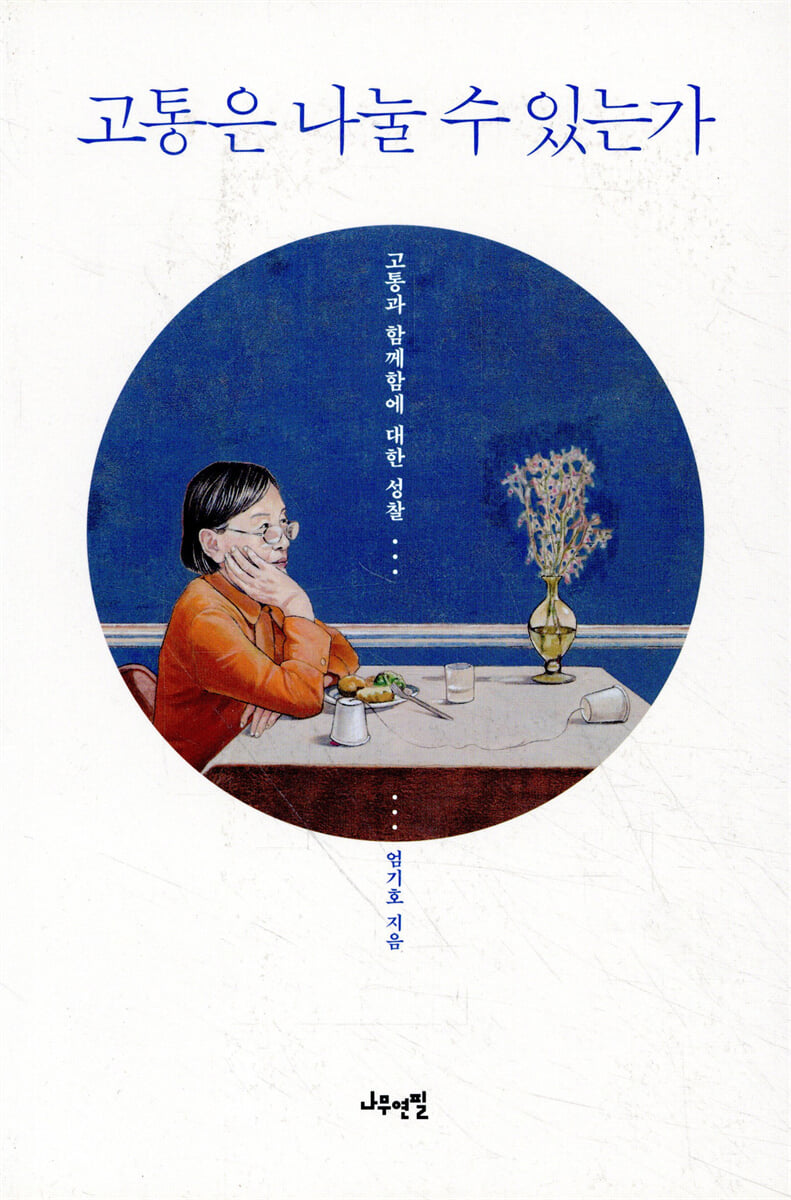
Can pain be shared?
 |
Description
Book Introduction
“Will this suffering ever really end?”
My body hurts, my mind is heavy, and the breakup is sad.
People who can't live in a world like this...
Those who are struggling and holding on, and those who look around them
A world of thoughtful and thoughtful stories
Korean society has long suppressed talk about pain.
He condemned pain as shameful and speaking of pain as weak.
Because of this, those who suffer have tried to hide it, unable to express their pain and create words for it.
Those who suffered suffered extreme pain in a situation of 'no language'.
But now those who suffer are beginning to say that the absence of pain is not 'normal', that pain is always present.
It's a positive shift that we're starting to talk about suffering, as it signals a shift in the fundamental values we hold about people and society.
These stories come together to prepare our society to listen to and respond to suffering, which can occur anytime, anywhere, rather than ignoring it, suppressing those who suffer, or removing them from social space.
But are we handling this situation well now?
In the name of love and justice, aren't we consuming our suffering while displaying it in order to exist socially?
Isn't it true that not only those who are suffering, but also those who are by their side are collapsing together?
This book is a work by sociologist Eom Ki-ho, who has exposed the deep-seated nature of Korean society, and reveals the geology of suffering in our time, discovered and reflected on by looking into the layers of suffering that have piled up one by one.
My body hurts, my mind is heavy, and the breakup is sad.
People who can't live in a world like this...
Those who are struggling and holding on, and those who look around them
A world of thoughtful and thoughtful stories
Korean society has long suppressed talk about pain.
He condemned pain as shameful and speaking of pain as weak.
Because of this, those who suffer have tried to hide it, unable to express their pain and create words for it.
Those who suffered suffered extreme pain in a situation of 'no language'.
But now those who suffer are beginning to say that the absence of pain is not 'normal', that pain is always present.
It's a positive shift that we're starting to talk about suffering, as it signals a shift in the fundamental values we hold about people and society.
These stories come together to prepare our society to listen to and respond to suffering, which can occur anytime, anywhere, rather than ignoring it, suppressing those who suffer, or removing them from social space.
But are we handling this situation well now?
In the name of love and justice, aren't we consuming our suffering while displaying it in order to exist socially?
Isn't it true that not only those who are suffering, but also those who are by their side are collapsing together?
This book is a work by sociologist Eom Ki-ho, who has exposed the deep-seated nature of Korean society, and reveals the geology of suffering in our time, discovered and reflected on by looking into the layers of suffering that have piled up one by one.
- You can preview some of the book's contents.
Preview
index
At the beginning of the book
How Stories About Pain Are Created
Part 1: Strata of Pain
On the side of suffering, on that desolate landscape
1 I realized what kind of person I am after being in pain: Pain helps you discover yourself.
2 You do not know my injustice and loneliness: extreme suffering destroys the inner self and the world of an individual.
3 The Lord knows what I mean: when we rely on God, animals, or plants to solve our existential crisis.
4 That's it, so what happens then: when we rely on the language of institutions to find social solutions?
5 I don't need everything, but I want to hold on to something: There is no magic language that can neatly describe pain.
6 There are things that cannot be said no matter how much you talk: you must confront that unspeakable impossibility.
7 I thought I was the only one who was lonely, but it turns out that everyone who is sick is lonely: the loneliness brought on by pain, that loneliness resonates.
Part 2: The Sociology of Pain
On the mechanism of displaying and consuming pain
1. You have to speak louder to attract attention: The landscape of sex and society that puts their presence at risk
2. What on earth do you believe in and how do you love?: Love that doesn't know respect, destroying the world of intimacy.
3. Hey, is that all you can do?: On the anxiety that I might be replaced by someone else.
4 That kid, he's still funny: Those who find fun in the suffering of others and display it.
5. No matter how close you are, it's terrible to have your identity revealed: Guan Zong, a carnival of personal attacks in the name of 'justice'
6 How many likes did my story get?: The era of platforms that turn victims into spectators.
7. In the end, everyone hates everyone but themselves: The public sphere has become a coliseum where suffering is confronted.
Part 3: The Ethics of Pain
About the side that creates stories of suffering
1 Where to Talk About Suffering: On Standing by Suffering
2. Even those in pain need someone to be with them: How to protect those who stand by their side in pain
3 Moving from 'Right Now' to 'Here and Now': We Need Gaps and Perspectives to Mediate Pain
4 Is it possible to write to support the world?: Beyond the language of mobilization, in search of the language of companionship.
In lieu of references
For careful reading and writing
At the end of the book
Finding a detour to connect with suffering
How Stories About Pain Are Created
Part 1: Strata of Pain
On the side of suffering, on that desolate landscape
1 I realized what kind of person I am after being in pain: Pain helps you discover yourself.
2 You do not know my injustice and loneliness: extreme suffering destroys the inner self and the world of an individual.
3 The Lord knows what I mean: when we rely on God, animals, or plants to solve our existential crisis.
4 That's it, so what happens then: when we rely on the language of institutions to find social solutions?
5 I don't need everything, but I want to hold on to something: There is no magic language that can neatly describe pain.
6 There are things that cannot be said no matter how much you talk: you must confront that unspeakable impossibility.
7 I thought I was the only one who was lonely, but it turns out that everyone who is sick is lonely: the loneliness brought on by pain, that loneliness resonates.
Part 2: The Sociology of Pain
On the mechanism of displaying and consuming pain
1. You have to speak louder to attract attention: The landscape of sex and society that puts their presence at risk
2. What on earth do you believe in and how do you love?: Love that doesn't know respect, destroying the world of intimacy.
3. Hey, is that all you can do?: On the anxiety that I might be replaced by someone else.
4 That kid, he's still funny: Those who find fun in the suffering of others and display it.
5. No matter how close you are, it's terrible to have your identity revealed: Guan Zong, a carnival of personal attacks in the name of 'justice'
6 How many likes did my story get?: The era of platforms that turn victims into spectators.
7. In the end, everyone hates everyone but themselves: The public sphere has become a coliseum where suffering is confronted.
Part 3: The Ethics of Pain
About the side that creates stories of suffering
1 Where to Talk About Suffering: On Standing by Suffering
2. Even those in pain need someone to be with them: How to protect those who stand by their side in pain
3 Moving from 'Right Now' to 'Here and Now': We Need Gaps and Perspectives to Mediate Pain
4 Is it possible to write to support the world?: Beyond the language of mobilization, in search of the language of companionship.
In lieu of references
For careful reading and writing
At the end of the book
Finding a detour to connect with suffering
Into the book
If through one suffering you can come to know yourself and enjoy the joy that knowledge brings, then the suffering becomes bearable and worth experiencing.
But the story of suffering does not end with a happy ending.
The pain repeats itself just when you think it's over.
The moment you think you can handle it, something even more unmanageable comes along.
The joy I had achieved through such pain crumbles without a trace, and I feel to my bones that the knowledge I had achieved was not knowledge at all.
(……)
Self-knowledge is the process of knowing and dealing with oneself as one experiences problems in that way, not of knowing the cause of suffering and eliminating it.
Rather, self-knowledge creates the illusion that the cause of suffering can be eliminated by controlling the self, as if the cause of suffering were the same as the reason for suffering.
In this situation, there are often cases where the pain is not properly seen and only the cause is aggravated by self-inflicted pain.
Unremoved causes often return in worse and more unmanageable forms.
At such times, self-knowledge collapses helplessly.
--- pp.39-40
Pain is absolute and cannot be communicated.
But its absoluteness is universal.
That is why pain pushes people into a world of their own.
But that absoluteness makes me realize that it is not only me that remains in me, but also you.
People can feel compassion for each other when they realize that you are as lonely as I am.
Pain itself is absolute and cannot be sympathized with or communicated with, but the moment we discover that this very inability to sympathize or communicate is something we have in common, it becomes capable of sympathizing and communicating.
The absoluteness of pain itself becomes ‘common.’
Here it becomes possible to talk about suffering.
I can talk about the loneliness that the absoluteness of pain creates, and about myself trying to face and overcome that loneliness.
Loneliness has destroyed the world and isolated people, but it is through the realization that loneliness is universal that loneliness becomes permeable.
I have a story to tell to others who are struggling right now.
About his own struggles.
Suffering becomes loneliness.
Therefore, only those who know that suffering is lonely can sympathize and communicate with each other.
--- pp.125-126
The language of suffering comes from the stark awareness that suffering cannot be spoken of.
Because we cannot say anything, we need to go through the arduous process of finding out what we can say.
In the process, we discern and divide what can be said and what cannot be said.
By saying what can be said, we also become able to say what cannot be said.
Language has a mysterious power, which, by indicating the unspeakable, silences others before it and makes them respect the absoluteness of the suffering they have endured.
--- p.209
The person suffering may know and speak best about himself, but paradoxically, the most important thing that makes a story a story is missing from his words.
A story continues and continues to be told as the listener shares and adds to it.
However, the person suffering cannot add to and share his experience with anyone else.
Because it makes a sound that cannot be responded to.
The words of the parties reject and destroy all acts of addition and division, and place in their place only their own appeal, that is, their own voice.
There should be no misunderstanding.
Can the sufferer never speak of their suffering? Do they necessarily need others? No.
This means that the parties cannot speak from their 'position', not that the parties cannot speak.
In order for the person to talk about his or her suffering, he or she must step out of his or her own shoes.
This is not a place to say this, but a place to say it.
Therefore, the person suffering stands by your side, and that becomes a place where the person suffering can talk about his or her suffering.
Words are made in the presence of others.
--- pp.233-234
Pain knows no companionship.
Accompanying is done by the person who stays by your side.
Therefore, when the one suffering stands by his own suffering, the position of the one standing by becomes that of the suffering.
To be by the side of suffering like this, to be by the side of suffering, that is the greatest joy of the one who stays by the side of suffering.
Only then will those who stand by the suffering be able to talk to the suffering person.
Conversely, when someone who is suffering has someone by their side, that person by their side cannot give up on this hopeless hope.
The key is to build a presence beside the pain, beside it.
But the story of suffering does not end with a happy ending.
The pain repeats itself just when you think it's over.
The moment you think you can handle it, something even more unmanageable comes along.
The joy I had achieved through such pain crumbles without a trace, and I feel to my bones that the knowledge I had achieved was not knowledge at all.
(……)
Self-knowledge is the process of knowing and dealing with oneself as one experiences problems in that way, not of knowing the cause of suffering and eliminating it.
Rather, self-knowledge creates the illusion that the cause of suffering can be eliminated by controlling the self, as if the cause of suffering were the same as the reason for suffering.
In this situation, there are often cases where the pain is not properly seen and only the cause is aggravated by self-inflicted pain.
Unremoved causes often return in worse and more unmanageable forms.
At such times, self-knowledge collapses helplessly.
--- pp.39-40
Pain is absolute and cannot be communicated.
But its absoluteness is universal.
That is why pain pushes people into a world of their own.
But that absoluteness makes me realize that it is not only me that remains in me, but also you.
People can feel compassion for each other when they realize that you are as lonely as I am.
Pain itself is absolute and cannot be sympathized with or communicated with, but the moment we discover that this very inability to sympathize or communicate is something we have in common, it becomes capable of sympathizing and communicating.
The absoluteness of pain itself becomes ‘common.’
Here it becomes possible to talk about suffering.
I can talk about the loneliness that the absoluteness of pain creates, and about myself trying to face and overcome that loneliness.
Loneliness has destroyed the world and isolated people, but it is through the realization that loneliness is universal that loneliness becomes permeable.
I have a story to tell to others who are struggling right now.
About his own struggles.
Suffering becomes loneliness.
Therefore, only those who know that suffering is lonely can sympathize and communicate with each other.
--- pp.125-126
The language of suffering comes from the stark awareness that suffering cannot be spoken of.
Because we cannot say anything, we need to go through the arduous process of finding out what we can say.
In the process, we discern and divide what can be said and what cannot be said.
By saying what can be said, we also become able to say what cannot be said.
Language has a mysterious power, which, by indicating the unspeakable, silences others before it and makes them respect the absoluteness of the suffering they have endured.
--- p.209
The person suffering may know and speak best about himself, but paradoxically, the most important thing that makes a story a story is missing from his words.
A story continues and continues to be told as the listener shares and adds to it.
However, the person suffering cannot add to and share his experience with anyone else.
Because it makes a sound that cannot be responded to.
The words of the parties reject and destroy all acts of addition and division, and place in their place only their own appeal, that is, their own voice.
There should be no misunderstanding.
Can the sufferer never speak of their suffering? Do they necessarily need others? No.
This means that the parties cannot speak from their 'position', not that the parties cannot speak.
In order for the person to talk about his or her suffering, he or she must step out of his or her own shoes.
This is not a place to say this, but a place to say it.
Therefore, the person suffering stands by your side, and that becomes a place where the person suffering can talk about his or her suffering.
Words are made in the presence of others.
--- pp.233-234
Pain knows no companionship.
Accompanying is done by the person who stays by your side.
Therefore, when the one suffering stands by his own suffering, the position of the one standing by becomes that of the suffering.
To be by the side of suffering like this, to be by the side of suffering, that is the greatest joy of the one who stays by the side of suffering.
Only then will those who stand by the suffering be able to talk to the suffering person.
Conversely, when someone who is suffering has someone by their side, that person by their side cannot give up on this hopeless hope.
The key is to build a presence beside the pain, beside it.
--- p.249
Publisher's Review
Geology of Pain : On People in Pain and the Landscapes Surrounding Them
Seon-ah, whose relationship with her husband has been strained, is receiving group counseling to control her wavering emotions.
But when she learns that her husband's business has failed, her resolve crumbles.
He is struggling alone, raising his children, working, and surviving his daily life without even telling his parents the truth.
Seung-woo, who was suddenly diagnosed with leukemia at a young age, harbors mixed feelings: he finds it bothersome when people come to visit him, but also feels lonely and resentful when no one comes to see him.
Although he was a strong Christian, he was in despair, unable to understand why such a trial had to befall him.
Jae-hee's mother, who not only led the household in her youth but also raised her children well and was active in society, began to suffer from all sorts of geriatric diseases as she passed the age of seventy.
Due to the physical pain, he repeatedly complains and blames his family.
I go from hospital to hospital, always saying, “You don’t know how much I’m suffering.”
Deokryong's father, a university professor and devout Buddhist, severed his relationships with those around him after the death of his beloved wife in his old age.
Because talking to them meant nothing to him.
Then, Deokryong's father, through his younger brother, came across a new religion and began to recite spells to overcome his sense of isolation.
Jun-seok, who was betrayed by his lover, was hurt not only by the heartbreak but also by the words of those around him.
Because he couldn't believe the words of those who consoled him and said that the cause of the problem was because he was 'innocent'.
The first thing he started to touch was plants.
To him, mute plants seemed more honest than people.
In the case of Lee Chung-yeon, who appears in the movie [Joint Criminal], he does not speak out about his existential pain.
He divides the existential and social aspects of suffering, and then talks to prominent figures who can speak out on the social front to tell the world about the tragedy he has experienced.
People around him sometimes look at him coldly.
Taeseok, an alternative school teacher, has always believed that teaching students is his calling.
But no matter how hard I tried, I couldn't break the students' stubborn lethargy, and my own frustration didn't go away.
He eventually comes to the conclusion that this is because of 'neoliberalism', but people are increasingly distancing themselves from Taeseok, who has become a 'neoliberalism evangelist'.
The Linguistics of Pain : On Facing Pain and the Language It Uses
Part 1 of this book tells the stories of those who suffer.
In some ways, these are not so provocative scenes that we often encounter in our daily lives.
This landscape of suffering, depicted and revealed by Eom Ki-ho, shows how the language of those who suffer does not expect a response and cannot respond, thus driving those around them to ruin.
Those who are trapped in their own suffering recite 'spells' that others cannot understand.
Of course, those who are suffering need a spell.
The reason most religions have 'mantras' is because they serve as 'means' to help people endure the difficult process of reaching enlightenment.
However, when this spell goes beyond expediency and becomes a reality, the 'side' is destroyed beyond control.
It may make you forget the pain for a while, but in the end, it doesn't bring you to your senses, but makes you a slave to the spell.
It prevents us from realizing that there is a point in pain that cannot be spoken of.
Instead of making us grateful to those who stand by those in extreme pain, it makes us criticize them for not sharing that order.
Even relying on internal or social language, we cannot clearly express all of our suffering.
Pain is not 'stitched' together in one language.
To those who suffer, this is despair.
This is because no matter how you say it, you are faced with the fact that you cannot fully express it and make others understand.
So, is pain indescribable?
People in pain can only cry out in despair at its meaninglessness.
But that doesn't mean we should give up all linguistic possibilities.
This is not to say that all languages are ultimately futile and that we should give up even trying.
This is not to say that suffering can only lead to the destruction of the world and that there can be no new construction.
The catastrophic conclusion about the possibility of such language is only a match for the deception of 'order'.
Eom Ki-ho cautions against the deception that the person involved can clearly articulate their pain, but also contends with the barrier that there is no need to speak of their pain and that there is nothing they can say.
It is not about being frustrated by the impossibility, but rather about facing and fighting against it so that we can record and share it.
The Sociology of Pain : On the Mechanisms of Consuming and Exhibiting Pain
Part 2 of this book examines the sociological aspects of suffering.
Our society today focuses only on the misery of suffering.
And only through the display of that misery can one gain the attention of society.
Otherwise, you will become a socially forgotten being.
Even while suffering, he becomes a ghost with no presence and wanders around this society.
It is a cruel society that only notices the existence of these ghosts when they are dead.
So, in order not to become a ghost, we must emphasize and display the misery and misery of suffering.
Only by suffering and showing it can one become socially visible.
This has become the politics and economy of this society.
What is even more ominous is that this is being done in the name of love and justice.
While they recite spells and display their suffering to exist socially, their side is quickly destroyed.
Instead, I expect you to remain silent and indifferent to the person who is suffering.
Even this has been ethicalized and aestheticized in the saying, “The best person for someone getting wet is someone who gets wet together.”
In this aesthetics and ethics, the one standing beside it must be a being that simply 'exists'.
Presence simply means existing before your eyes.
You have to listen without expecting a response, and you have to respond without expecting a response.
If those who suffer can barely escape the ghost and exist in society by displaying their suffering, then those who stand by them must exist only as ghosts in the name of love and justice.
Presence becomes pain, not joy.
By forcing presence like this, we face the catastrophe of 'everything is over' from 'not everything is over yet'.
How should we cope with this catastrophe? The opposite of what we expected from the word "society" was true.
Just as important as supporting someone who is suffering is supporting those who are by their side.
Those who stand by the suffering must be able to bear it.
You must be able to retreat safely if you cannot hold on.
There must be mechanisms in place to care for those who are suffering so that they do not feel guilty about stepping down.
You must make sure that the person standing next to you does not use 'Dokbak' and that his life is not destroyed.
That is the role of society.
But what is society like now?
Isn't this a world where 'spectators' run rampant, seeking to attract attention by destroying the personality and dignity of others and displaying their misery?
Aren't we in an age where they are having a carnival of body hair, turning the world into a zoo by stripping people naked?
As these incidents continue, the reputation of the perpetrators rises even more, and isn't this a society where sensational platforms that even turn victims into perpetrators have become a daily occurrence?
Eom Ki-ho explains this by comparing it to the Colosseum in Roman times.
On one hand, there are the slave traders, the vassals, who constantly bring people in to be fed to lions.
On the other hand, there are the sufferers, the gladiators who expose their own suffering by pushing away the misery and suffering of others in order to survive.
And above all, there is an audience watching this.
These are the ones who maintain and sustain the Colosseum.
They bring popcorn and watch and consume all this from the safest seat possible.
Sometimes they send cheap sympathy, but their attention soon moves on to something new.
The public sphere of this era has been turned upside down, not allowing us to read and advance the world in greater detail through high-resolution language.
What rules this coliseum is hatred for humanity.
Can we escape this vicious cycle where everyone hates everyone else?
There is only one way.
It's about stepping back from the Colosseum.
To protect oneself from becoming prey to the spectators, to avoid consuming the horrors of those suffering while in the audience, and at the same time to preserve compassion for oneself and humanity, one chooses to ‘disappear.’
The Ethics of Pain : On the Story of Pain
The final third part addresses the ethical question of how to deal with suffering in such a society.
What the author focuses on here is not the person suffering, but the 'side' of the suffering next to them.
Ideally, the role of the person by his or her side is to help the person in pain to come out of his or her own suffering and stand by his or her side.
Those who suffer are usually in a state of collapse on the outside and self-absorbed.
What these parties need is a gap and a perspective that mediates their pain.
Only when we free ourselves from the compulsion to communicate our pain to others right now can we gain the perspective to reflect on ourselves.
Moreover, it is only through the loneliness of not being able to express one's pain that one can finally communicate with others.
But if there is someone by the side of someone who is suffering, it becomes a basis for hope.
Those who suffer by seeing this presence at their side come to think that there is a place for them to escape the spell and return to, and that they must create the language to return to that place.
Even if it is only sporadic moments.
If things go well, the presence of the side will allow you to come out of that sunken hole and stand by your side.
To achieve this, rather than displaying and consuming unspeakable pain, the suffering must be able to speak.
In the name of love and justice, we must not exploit and consume the presence of others.
We must realize that the side of suffering is not a place to listen to stories, but a place where stories about suffering are created.
This is where language is needed and created, not destroyed.
Also, there needs to be another side to the suffering next to the 'ground zero' where suffering resides.
In such times, those who are by the side of the suffering cannot give up hope without hope.
Finally, my question is about the ethical way to reveal it in a world where the coliseum of suffering unfolds.
It is a question of whether it is right to step back from the solid mechanism of the Colosseum and disappear like that.
Eom Ki-ho says that what should replace the 'technology of disappearance' that we have chosen to escape the competition for attention from others and the hatred for humanity, is the 'technology of discreetly revealing ourselves' to assist the world.
And he says that it should be about creating a society where that can be protected.
This is probably why the problem of 'pain', which can be extremely personal, must be considered within society.
Seon-ah, whose relationship with her husband has been strained, is receiving group counseling to control her wavering emotions.
But when she learns that her husband's business has failed, her resolve crumbles.
He is struggling alone, raising his children, working, and surviving his daily life without even telling his parents the truth.
Seung-woo, who was suddenly diagnosed with leukemia at a young age, harbors mixed feelings: he finds it bothersome when people come to visit him, but also feels lonely and resentful when no one comes to see him.
Although he was a strong Christian, he was in despair, unable to understand why such a trial had to befall him.
Jae-hee's mother, who not only led the household in her youth but also raised her children well and was active in society, began to suffer from all sorts of geriatric diseases as she passed the age of seventy.
Due to the physical pain, he repeatedly complains and blames his family.
I go from hospital to hospital, always saying, “You don’t know how much I’m suffering.”
Deokryong's father, a university professor and devout Buddhist, severed his relationships with those around him after the death of his beloved wife in his old age.
Because talking to them meant nothing to him.
Then, Deokryong's father, through his younger brother, came across a new religion and began to recite spells to overcome his sense of isolation.
Jun-seok, who was betrayed by his lover, was hurt not only by the heartbreak but also by the words of those around him.
Because he couldn't believe the words of those who consoled him and said that the cause of the problem was because he was 'innocent'.
The first thing he started to touch was plants.
To him, mute plants seemed more honest than people.
In the case of Lee Chung-yeon, who appears in the movie [Joint Criminal], he does not speak out about his existential pain.
He divides the existential and social aspects of suffering, and then talks to prominent figures who can speak out on the social front to tell the world about the tragedy he has experienced.
People around him sometimes look at him coldly.
Taeseok, an alternative school teacher, has always believed that teaching students is his calling.
But no matter how hard I tried, I couldn't break the students' stubborn lethargy, and my own frustration didn't go away.
He eventually comes to the conclusion that this is because of 'neoliberalism', but people are increasingly distancing themselves from Taeseok, who has become a 'neoliberalism evangelist'.
The Linguistics of Pain : On Facing Pain and the Language It Uses
Part 1 of this book tells the stories of those who suffer.
In some ways, these are not so provocative scenes that we often encounter in our daily lives.
This landscape of suffering, depicted and revealed by Eom Ki-ho, shows how the language of those who suffer does not expect a response and cannot respond, thus driving those around them to ruin.
Those who are trapped in their own suffering recite 'spells' that others cannot understand.
Of course, those who are suffering need a spell.
The reason most religions have 'mantras' is because they serve as 'means' to help people endure the difficult process of reaching enlightenment.
However, when this spell goes beyond expediency and becomes a reality, the 'side' is destroyed beyond control.
It may make you forget the pain for a while, but in the end, it doesn't bring you to your senses, but makes you a slave to the spell.
It prevents us from realizing that there is a point in pain that cannot be spoken of.
Instead of making us grateful to those who stand by those in extreme pain, it makes us criticize them for not sharing that order.
Even relying on internal or social language, we cannot clearly express all of our suffering.
Pain is not 'stitched' together in one language.
To those who suffer, this is despair.
This is because no matter how you say it, you are faced with the fact that you cannot fully express it and make others understand.
So, is pain indescribable?
People in pain can only cry out in despair at its meaninglessness.
But that doesn't mean we should give up all linguistic possibilities.
This is not to say that all languages are ultimately futile and that we should give up even trying.
This is not to say that suffering can only lead to the destruction of the world and that there can be no new construction.
The catastrophic conclusion about the possibility of such language is only a match for the deception of 'order'.
Eom Ki-ho cautions against the deception that the person involved can clearly articulate their pain, but also contends with the barrier that there is no need to speak of their pain and that there is nothing they can say.
It is not about being frustrated by the impossibility, but rather about facing and fighting against it so that we can record and share it.
The Sociology of Pain : On the Mechanisms of Consuming and Exhibiting Pain
Part 2 of this book examines the sociological aspects of suffering.
Our society today focuses only on the misery of suffering.
And only through the display of that misery can one gain the attention of society.
Otherwise, you will become a socially forgotten being.
Even while suffering, he becomes a ghost with no presence and wanders around this society.
It is a cruel society that only notices the existence of these ghosts when they are dead.
So, in order not to become a ghost, we must emphasize and display the misery and misery of suffering.
Only by suffering and showing it can one become socially visible.
This has become the politics and economy of this society.
What is even more ominous is that this is being done in the name of love and justice.
While they recite spells and display their suffering to exist socially, their side is quickly destroyed.
Instead, I expect you to remain silent and indifferent to the person who is suffering.
Even this has been ethicalized and aestheticized in the saying, “The best person for someone getting wet is someone who gets wet together.”
In this aesthetics and ethics, the one standing beside it must be a being that simply 'exists'.
Presence simply means existing before your eyes.
You have to listen without expecting a response, and you have to respond without expecting a response.
If those who suffer can barely escape the ghost and exist in society by displaying their suffering, then those who stand by them must exist only as ghosts in the name of love and justice.
Presence becomes pain, not joy.
By forcing presence like this, we face the catastrophe of 'everything is over' from 'not everything is over yet'.
How should we cope with this catastrophe? The opposite of what we expected from the word "society" was true.
Just as important as supporting someone who is suffering is supporting those who are by their side.
Those who stand by the suffering must be able to bear it.
You must be able to retreat safely if you cannot hold on.
There must be mechanisms in place to care for those who are suffering so that they do not feel guilty about stepping down.
You must make sure that the person standing next to you does not use 'Dokbak' and that his life is not destroyed.
That is the role of society.
But what is society like now?
Isn't this a world where 'spectators' run rampant, seeking to attract attention by destroying the personality and dignity of others and displaying their misery?
Aren't we in an age where they are having a carnival of body hair, turning the world into a zoo by stripping people naked?
As these incidents continue, the reputation of the perpetrators rises even more, and isn't this a society where sensational platforms that even turn victims into perpetrators have become a daily occurrence?
Eom Ki-ho explains this by comparing it to the Colosseum in Roman times.
On one hand, there are the slave traders, the vassals, who constantly bring people in to be fed to lions.
On the other hand, there are the sufferers, the gladiators who expose their own suffering by pushing away the misery and suffering of others in order to survive.
And above all, there is an audience watching this.
These are the ones who maintain and sustain the Colosseum.
They bring popcorn and watch and consume all this from the safest seat possible.
Sometimes they send cheap sympathy, but their attention soon moves on to something new.
The public sphere of this era has been turned upside down, not allowing us to read and advance the world in greater detail through high-resolution language.
What rules this coliseum is hatred for humanity.
Can we escape this vicious cycle where everyone hates everyone else?
There is only one way.
It's about stepping back from the Colosseum.
To protect oneself from becoming prey to the spectators, to avoid consuming the horrors of those suffering while in the audience, and at the same time to preserve compassion for oneself and humanity, one chooses to ‘disappear.’
The Ethics of Pain : On the Story of Pain
The final third part addresses the ethical question of how to deal with suffering in such a society.
What the author focuses on here is not the person suffering, but the 'side' of the suffering next to them.
Ideally, the role of the person by his or her side is to help the person in pain to come out of his or her own suffering and stand by his or her side.
Those who suffer are usually in a state of collapse on the outside and self-absorbed.
What these parties need is a gap and a perspective that mediates their pain.
Only when we free ourselves from the compulsion to communicate our pain to others right now can we gain the perspective to reflect on ourselves.
Moreover, it is only through the loneliness of not being able to express one's pain that one can finally communicate with others.
But if there is someone by the side of someone who is suffering, it becomes a basis for hope.
Those who suffer by seeing this presence at their side come to think that there is a place for them to escape the spell and return to, and that they must create the language to return to that place.
Even if it is only sporadic moments.
If things go well, the presence of the side will allow you to come out of that sunken hole and stand by your side.
To achieve this, rather than displaying and consuming unspeakable pain, the suffering must be able to speak.
In the name of love and justice, we must not exploit and consume the presence of others.
We must realize that the side of suffering is not a place to listen to stories, but a place where stories about suffering are created.
This is where language is needed and created, not destroyed.
Also, there needs to be another side to the suffering next to the 'ground zero' where suffering resides.
In such times, those who are by the side of the suffering cannot give up hope without hope.
Finally, my question is about the ethical way to reveal it in a world where the coliseum of suffering unfolds.
It is a question of whether it is right to step back from the solid mechanism of the Colosseum and disappear like that.
Eom Ki-ho says that what should replace the 'technology of disappearance' that we have chosen to escape the competition for attention from others and the hatred for humanity, is the 'technology of discreetly revealing ourselves' to assist the world.
And he says that it should be about creating a society where that can be protected.
This is probably why the problem of 'pain', which can be extremely personal, must be considered within society.
GOODS SPECIFICS
- Date of publication: December 7, 2018
- Page count, weight, size: 304 pages | 458g | 140*210*30mm
- ISBN13: 9791187890126
- ISBN10: 118789012X
You may also like
카테고리
korean


korean

![GQ KOREA Mark (Monthly): December [2025]](http://librairie.coreenne.fr/cdn/shop/files/8ef265dbbfbf186523ed75ba7319009d.jpg?v=1765340328&width=3840)


