

Camouflage environmentalism
 |
Description
Book Introduction
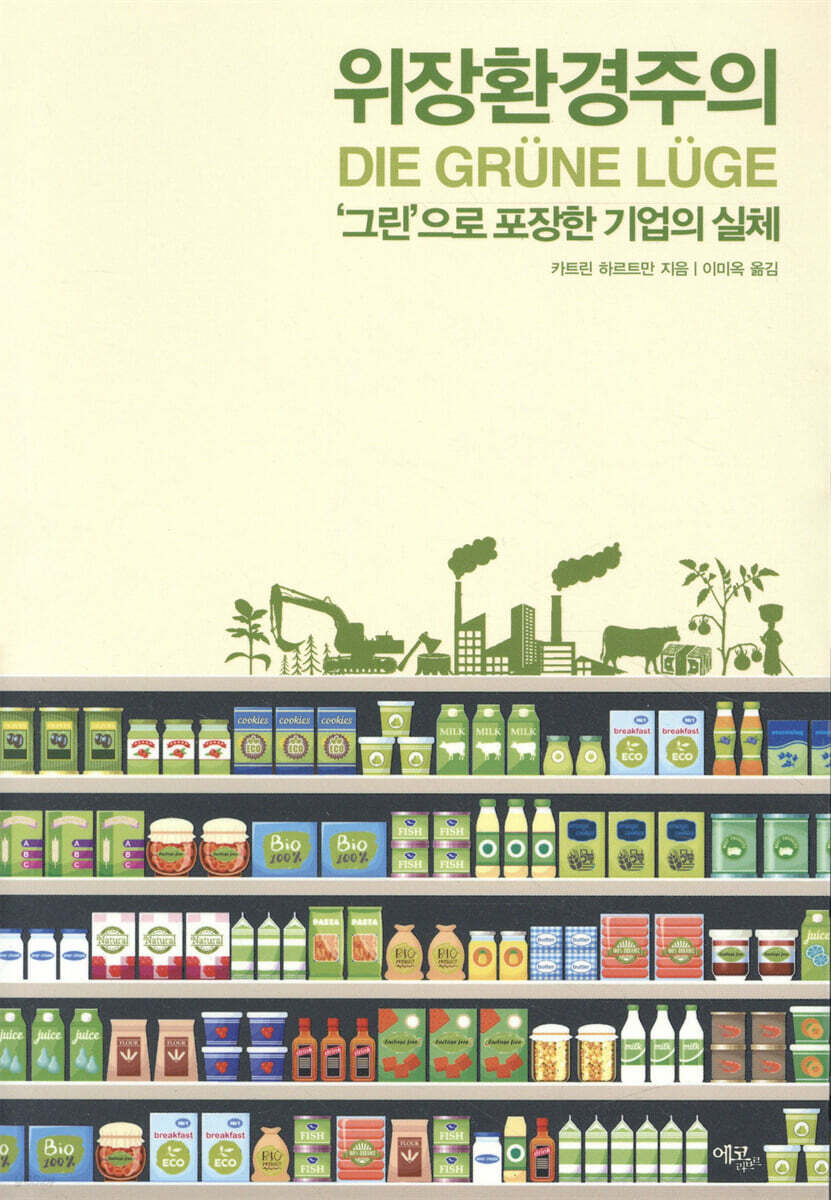
How Multinational Corporations Use the Environment to Disguise Their Actions
The scope of the environment is wide and deep.
Among them, the hottest topic right now is global warming.
There are countless causes of rising temperatures.
The rise in temperature caused by greenhouse gas emissions has proven to be the most fatal to human survival in the long term.
Global efforts to curb rising temperatures have been made in various ways, but have failed time and time again.
So what caused this failure? This book is an effort to uncover the most fundamental truths among these causes.
This is because we persistently track and analyze the true nature of multinational corporations and some NGOs that cleverly exploit the environment to continuously satisfy their greed.
The scope of the environment is wide and deep.
Among them, the hottest topic right now is global warming.
There are countless causes of rising temperatures.
The rise in temperature caused by greenhouse gas emissions has proven to be the most fatal to human survival in the long term.
Global efforts to curb rising temperatures have been made in various ways, but have failed time and time again.
So what caused this failure? This book is an effort to uncover the most fundamental truths among these causes.
This is because we persistently track and analyze the true nature of multinational corporations and some NGOs that cleverly exploit the environment to continuously satisfy their greed.
- You can preview some of the book's contents.
Preview
index
preface
1 The green clothes worn by the emperor
2 The catastrophe of sustainability
3. Buying more can save the ocean?
4 Third-rate theaters
Greenwashing in 5 countries
6 Meat and Blood
7 All that is righteous!
Acknowledgements
main
Search
1 The green clothes worn by the emperor
2 The catastrophe of sustainability
3. Buying more can save the ocean?
4 Third-rate theaters
Greenwashing in 5 countries
6 Meat and Blood
7 All that is righteous!
Acknowledgements
main
Search
Publisher's Review
In the case of Nestlé
This book begins with a story about capsule coffee from the global food company Nestlé.
Nestlé sells a variety of coffee capsules in over 400 stores worldwide.
The number has more than tripled from 3 billion in 2006 to 10 billion today.
Buying coffee beans for $2 a kilogram and selling capsule coffee for 80 euros a kilogram is problematic, but the bigger environmental problem lies in the aluminum used in the capsules.
At least 8,000 tons of aluminum capsules come from Nespresso every year.
However, producing one ton of aluminum requires enough electricity to power a two-person household for more than five years, which emits eight tons of carbon dioxide.
Aluminum production accounts for 3 percent of global electricity consumption.
It would be fortunate if at least the recovery was done properly.
On the Nespresso website, it says, “A cup of coffee has a positive impact.
We believe that a cup of Nespresso coffee not only prepares you for the moment you enjoy it, but also does something good for the environment and the well-being of the community,” it reads.
In this way, Nespresso calls its “Cup of Positivity” a “vision of sustainability.”
Nestlé says it aims to “manage responsibly” its aluminum and increase its “recovery rate” to 100 percent by 2020.
In fact, when recycled, aluminum requires only 5 percent of the energy required to produce it from bauxite.
However, Nespresso leaves the processing and collection entirely up to the customer.
In other words, we ask customers to put their coffee capsules in a yellow bag, a yellow bin, or a recycling bin.
This means that Nespresso will cover the cost of recycling the capsules.
But no one knows how many capsules end up in the recycling bin instead of the trash, and no one knows how much recycled aluminum Nespresso uses.
But Nespresso says it is partnering with the world's largest aluminium producers, Alcan, Norsk Hydra and Rio Tinto, to accelerate "sustainable aluminium production".
They, like Nestlé, are only interested in increasing production.
Rio Tinto alone increased production from 16 million tonnes to 42 million tonnes between 2006 and 2014.
Companies that cause significant environmental damage, such as Audi, BMW, Coca-Cola, and Jaguar, are part of the Aluminum Stewardship Initiative, which manages and certifies the quality of the entire aluminum production process.
Even BMW, Nespresso and Rio Tinto are on the board of directors of this aluminum management plan, as is the renowned environmental group World Wildlife Fund (WWF).
Swiss NGO Solidarity Switzerland accuses the world's most expensive coffee of being unfairly traded.
To counter such claims, Nespresso has created a program called “Sustainable Coffee.”
We developed a program called 'Nespresso AAA Sustainable Quality' together with the US-based Rainforest Alliance.
However, the Rainforest Alliance has certified bananas, coffee, tea, palm oil and beef produced by problematic companies such as Chiquita, Dole, Lidl and McDonald's as safe.
Nespresso's sustainability program does not mean that the coffee is grown in an environmentally friendly manner and traded fairly.
Yet, it sounds as if they are grown in an environmentally friendly and fairly traded manner.
Wouldn't it have been ecologically and socially just if Nespresso had never been introduced to the market in the first place? Of course.
But in this continuously developing consumer society, such questions are not even asked.
Quite the opposite.
This results in a massive waste stream, an overly expensive coffee system that wastes resources and exploits small farmers.
This coffee system not only ignores ecological considerations, but even pretends to be good for people, nature, and the climate.
The reality of other companies
Nespresso isn't the only company engaging in bizarre behavior.
Just search for the word 'sustainable' on Google.
16 million come out.
If you search for 'sustainable' in English, a whopping 300 million articles appear.
You can quickly find out by reading just a little bit of media reports, articles from large corporations, NGOs, or numerous portals related to 'ethical consumption'.
The fact that everything that was once considered harmful and despicable is now being used to save the world.
Squid steaks, a ton of cars, Formula One, stock funds, air travel, fur coats, vegetables imported from southern Spain, vegetable fuels, palm oil, genetically modified soybeans, coal-fired power plants, dams, oil extracted from the Arctic – all these things are now presented as 'sustainable', 'eco-friendly' or 'responsible' products.
Oil giant Shell advertises itself as a wind farm, while Coca-Cola portrays itself as a champion of protecting the world's groundwater reserves by pumping water from poor countries until all the springs are dry.
Monsanto sells genetically modified seeds and toxic pesticides, yet it sees itself as helping to fight hunger.
Chemical giant Henkel partners with energy giants to keep nuclear and coal-fired power plants running, while also putting stickers on wind turbines that say, "Major contribution to renewable energy."
RWE, Europe's largest carbon dioxide emitter, claims its charcoal kilns protect species.
The reason is that birds are building nests in the power plant's cooling tower.
Paul Polman, the chairman of Unilever, makes this point quite seriously:
“Unilever is the world’s largest NGO.” Yet, this food giant, which produces everyday staples like instant soups and sauce powders, consumes eight tons of raw materials (beef, soybeans, palm oil, etc.) every year, half of which comes from destroying forests around the world.
Even military manufacturers make lethal weapons with the environment in mind.
For example, Rheinmetall has the slogan “Protecting the natural foundations of life is of utmost importance,” while Krauss-Maffei Wegmann-Group (German arms manufacturer) claims “We place great value on quality and sustainability in our production processes.”
If you keep coming across this kind of content, you will start to feel good.
If people only chose products from conscious companies, it would seem like they could help save the world.
Aren't individuals doing this? Aren't consumers, industry, and politics pursuing the same goals? Aren't many actions moving in the right direction? Aren't things getting better?
It's not that there aren't any improved aspects.
But on the other side of the world, where the environment appears to be thriving, destruction is occurring at a rapid pace.
According to the Global Foodprint Network, people around the world live as if there were 1.6 Earths on our planet.
If everyone in the world consumed like Germans, we would need more than three Earths to meet the 'demand'.
The Global Footprint Network calculates what it calls "Earth Overshoot Day" each year.
It refers to the number of days that the Earth's environment can endure in a year, or in other words, the day when all the world's resources that can be used ecologically and socially are exhausted and can no longer accommodate waste and greenhouse gases.
But every year this day is coming earlier.
In 2015, it was on August 13th, but a year later, in 2016, it was moved up to August 8th.
And in 2017, it was August 2nd.
It was October 8th in 2000.
Between 1980 and 2010, the amount of biological, mineral raw materials, and fossil fuels consumed worldwide doubled from 40 billion tonnes to 80 billion tonnes.
We no longer talk about "peak oil," which refers to the peak of oil production, but rather "peak everything," which means that all resources are dwindling.
Every minute, forests the size of 36 football fields are destroyed.
58,000 animal species are disappearing every year, and 24 billion tons of fertile land are lost every year.
The number of hungry people has increased to 815 million.
Despite producing unprecedented amounts of food, two billion people suffer from malnutrition.
The gap between the poor and the rich has widened to a grotesque extent.
According to Oxfam, eight billionaires have as much wealth as half the world's poor.
Today, 46 million people are working themselves to the bone like modern slaves.
At least 3.5 million tons of waste is produced worldwide every day, and 13 million tons of plastic waste flows into the ocean every year.
And yet, despite repeated pledges from around the world to save the climate, greenhouse gas emissions continue to rise.
So, is there nothing new? Do people know all this? Of course, none of this is a secret.
There are more opportunities than ever to provide clear information about the harm that the lives of Westerners living in abundance have on countries where they do not.
Yet, big business successfully hides its dirty, profitable nuclear industry under a green cloak.
These corporations, while promising to directly address the problems they themselves have created, are strangling the politicians who can limit their profits through production and regulations.
At the same time, large companies also sell their customers the added value of conscience.
The strategy they use at this time is to disguise themselves as if they are protecting the environment, and this attitude is called 'greenwashing'.
What has been said so far is a summary of the contents of Chapter 1.
Chapter 2 examines how BP used cover-up tactics to cover up the explosion of the Deepwater Horizon oil rig in the Gulf of Mexico on April 20, 2010, which caused the most horrific oil spill in history. Chapter 3 scathingly examines how the world's most extravagant fashion industry is dumping so much plastic into the ocean through polyester fibers, and how it uses greenwashing to cover it up.
Greenwashing in the fashion industry
“Our society produces 288 million tons of plastic every year.
This plastic is neither biodegradable nor biologically degradable.
Instead, it flows straight into the ocean, polluting and threatening the animal and plant world.” This kind of content should be published in Greenpeace Magazine, but it is published on the Bunte magazine’s homepage.
〈Bunte〉 does not generally advocate the virtue of moderation, nor does it warn us about our ecological consciousness.
On the contrary, the magazine is not shy about showcasing the extravagant and wasteful lifestyles of the rich and celebrities.
As if this way of life were truly worth pursuing.
But these reports of the plastic disaster were not accompanied by photos of dead marine animals (with plastic found in their stomachs).
Nor did it feature photos of a piece of trash the size of Central Europe floating in the world's oceans.
(270,000 tons of plastic are floating in the ocean.)
Instead, 〈Bunte〉 featured a photo of world-renowned musician and designer Pharrell Williams.
He was wearing the famous Vivienne Westwood hat (the one that made this hat popular).
But recently, this dazzling and stylish gentleman has been given another label: he is the world's savior.
That's because Williams, who was designing new jewelry and sunglasses for Louis Vuitton, came up with a product called "raw material salvaged from the sea" for Dutch brand G-Star.
It's the first collection of jeans made entirely from recycled plastic from the Pacific Ocean.
Williams, who has a fortune of $215 million and is known for his extravagant lifestyle and trend-consciousness, is also a shareholder in Bionic Yarn.
The company recycles ocean waste into cotton and recycles it into synthetic yarn, which Williams then beautifully designs.
Therefore, those who choose jeans made from 'raw materials from the ocean' are not victims of fashion, but rather become environmental activists who rescue plastic from the ocean by purchasing them.
In other words, the more you buy this product, the better it is for the environment.
Thus, Williams creates a 'win-win situation'.
Recycling doesn't just solve the problem of ocean pollution (though this isn't a confirmed result, it's just a claim).
In other words, waste itself can not only help the fashion industry, but can also be used as a 'sustainable' raw material as a 'solution' to the unfulfilled desire for raw materials.
100 billion pieces of clothing are produced worldwide every year.
Half of them are made of cotton.
For this purpose, 26 million tons of raw material (cotton) are produced each year from 2.4 percent of the world's cultivated land.
However, only 1 percent of cotton production is grown ecologically, while 70 percent is genetically modified and sprayed with 8,000 different pesticides.
Twenty-five percent of all insecticides and 11 percent of all pesticides and herbicides used are applied when cotton is planted, including the highly toxic herbicide paraquat.
Chemical products used to control weeds not only degrade soil quality, but also toxicize water and destroy biodiversity.
These chemicals make local people living in cotton-growing areas sick and even cause fatal poisoning.
Cotton farming alone causes over 200,000 cases of pesticide poisoning each year, resulting in 20,000 deaths.
It takes 2,700 liters of water to produce a single T-shirt, and even 8,000 liters to produce a single pair of jeans.
Half of cotton farms are artificially irrigated.
A clear example of what the consequences are is the Aral Sea in Central Asia.
In the 1960s, the Aral Sea, which was about the size of Bavaria, Germany, had dried up by 70 percent.
This is because water was drawn from the rivers that flow into the Aral Sea to irrigate cotton plantations in the deserts of Kazakhstan and Uzbekistan.
This depletion of what was once the world's fourth-largest inland sea is known as one of the most devastating environmental disasters caused by humans.
In short, it was a sacrifice to the textile industry.
Above all, the textile industry is considered the third largest contributor to environmental destruction.
But this industry doesn't stop at receiving applause from the magazine Bunte.
“A fashion brand has discovered an ecological conscience,” hailed the German magazine Stern.
In a five-page lifestyle report titled “Green Living,” Stern ran an article about making clothes from plastic salvaged from the ocean, saying, “Sustainability and style are no longer at odds.”
But their claim that the fashion industry is saving the oceans is nothing more than a green lie.
In other words, sneakers made from plastic salvaged from the ocean account for only 0.5 percent of the more than 300 million products Adidas produces each year.
For this project, adidas is working with marine environmental organization Parley for the Oceans.
The organization, which collects plastic from the world's oceans for the textile industry, also developed G-Star's "Ocean Resources" line with Pharrell Williams.
Adidas then received the UN's blessing for a project to create sneakers made from ocean plastic.
In short, the giant took the opportunity to unveil a sneaker prototype made from plastic caught in fishing nets in the Arctic Ocean, alongside Parley for the Oceans, at the United Nations headquarters in New York.
Pop star Williams collaborated with Adidas and sang a song praising it.
It's entirely possible that Williams, as a celebrity and designer who endorses products, has received significant money from Adidas.
He developed the 'Originals Super Color Pack' for Adidas.
These sneakers come in 50 different colors.
These sneakers are, of course, just like Williams' new model, the Signature Tennis Hu Primeknit, which is a completely normal plastic product.
Adidas advertised the product with a serious attitude, calling it “an homage to humanity.”
The company offered Williams excellent working conditions, which were significantly better than those offered by Adidas' factories in Asia and Central America.
The terms and conditions of supply with the factories that supply the products are truly appalling.
They make people work and pay them just enough to keep them from starving to death.
Is it okay to exploit labor like that and then brag about saving the ocean, or in other words, doing a great service to humanity?
Palm oil and agro-livestock farming are destroying forests in Indonesia and the Amazon.
Chapters 4 and 6 contain almost similar content.
Chapter 4 shows how Unilever destroys Indonesian forests to obtain palm oil while covering up its own wrongdoings, and Chapter 6 exposes how agribusiness steals land and life from the indigenous peoples of the Amazon basin, while also revealing how it subtly whitewashes this.
These two chapters have something in common.
The fact is that forests are being destroyed, indigenous people are being driven out of their homes, and they are being reduced to low-wage workers.
Let's take a closer look at Chapter 6.
It is said that 40 million cows are slaughtered in Brazil every year to become steaks and sausages.
And over the past 50 years, global meat production has quadrupled, from 78 million tonnes to 308 million tonnes.
It is projected to increase to 500 million tons by 2050.
Currently, one-third of the Earth's ice-free surface and 70 percent of the world's agricultural land are used for livestock farming, and 33 percent of the world's cropland is planted to feed animals, primarily soybeans.
Ninety-eight percent of the soybeans produced in Latin America end up in animal feed bins, not human stomachs.
Meanwhile, only 67 percent of all plants grown worldwide are used as human food, with the rest being processed into feed, biofuels, and other products.
According to research from the University of Minnesota, if the harvested grains were processed into food, they could feed 4 billion people.
And if OECD member countries consumed just one-third less meat than they do now, an area the size of Germany could be created and used to produce food for humans.
While nearly a billion people are starving, the 20 billion animals slaughtered worldwide consume half of all grain harvested.
A useful plant that provides 100 calories of energy, used as animal feed but not for humans, is used to produce meat, which provides only a third of that energy.
Producing one kilogram of beef requires 7 to 16 kilograms of feed and 600,000 liters of water.
Additionally, 70 percent of direct greenhouse gas emissions come from raising animal products.
In her much-cited book, “The Environmental Impact of Beef Production in the United States: A Comparison of 1977 and 2007,” Judith Capper, “Bovidiva,” concluded:
“‘Modern’ intensive farming, fed grains like soybeans, consumes less land, feed and water than the mass farming of the 1970s, which fed grass and hay, and is therefore much more environmentally friendly.” Of course, Capper kept secret not only the use of antibiotics, beta-blockers (drugs that relax the heart and reduce stress), and hormones, but also the effects of soy monoculture and heavy pesticide use on plant diversity and health.
Caper does not consider small-scale farming, local farming that is tailored to each region and takes agricultural ecology into consideration, without monoculture and excessive fertilizer and pesticide use, and consuming much less meat than we do now.
These are not the claims of eco-blind romantics, as Capper suggests, but of the 2008 World Agriculture Report submitted by over 400 experts and scientists from around the world and of small-scale farmer movements active in the Global South.
“Do you eat beef? If so, what kind of meat do you buy?” Breakthrough Research asked Capper at the end of the interview.
“Yes! When I was in the US, feeding grain as feed was common.
I'm back in England, and it's a different system.
Hormone injections and beta-blockers are banned in the European Union.
So, I have no other alternative, so I buy ‘wild’ beef.”
Europeans are eating environmentally friendly beef that hasn't been injected with beta-blockers or hormones! This is a huge scandal.
Of course, the world cannot be saved that way.
Distorting the facts, exaggerating fragmentary facts, and hiding crucial details.
This is how green lies are born, and the industry presents them to the world as scientific evidence.
The mass production of so-called green fake news, which claims that the status quo is the only alternative, has replaced traditional propaganda.
That's the propaganda once popularized by climate change deniers.
People like Caper are truly fortunate in a meat industry that claims to be a sustainable business.
It's no surprise that Caper is an external advisor and observer for the World Roundtable on Sustainable Beef.
In 2014, 23 animal welfare and environmental groups sent an open letter to the board of directors of the World Roundtable for Sustainable Beef.
The criteria for this roundtable were that it was “at best a collection of widely accepted, laudatory wish lists.”
The goal set by the roundtable is to continue doing business as usual, but to present it as "sustainable."
So the Beef Roundtable does not ban antibiotics, but only directs that the medications injected into animals be administered responsibly.
Hormones and beta blockers are not even mentioned, nor are the painful dehorning and castration.
It is vaguely defined as “animals should be raised in an environment that allows them to be healthy and behave normally, and minimize discomfort.”
And they say they have to be fed “sustainably produced feed,” which might be possible if such feed exists.
What exactly is "sustainable feed"? There's no mention of it either.
He also said that not only would fewer trees be cut down to increase cattle farming, but logging “could be avoided altogether.”
In this way, the roundtable has established a system in which serious ecological and social damage has been inflicted for decades, yet this is celebrated as progress, and further expansion of such progress is described as sustainability.
The "efficiency" they're talking about here is an effort to get animals to slaughterhouses in the shortest possible time, which is ultimately intended to hide the fact that they want to process a lot of animals into steaks.
Only now has global warming become a global problem.
Chapter 6 exposes numerous examples of how politics protects corporations and violates human rights.
Chapter 7 explores what we need to do next.
A particularly interesting passage is the story of the lawsuit brought by Saul Luciano Iuya, a resident of Huaraz, a city in the Peruvian Andes, against RWE, Germany's largest energy company.
Iuya reports that he witnesses climate change every time he guides tourists up the 7,000-meter mountain.
There he said he always encountered new lakes formed by melting ice, and thousands of snowfields that he could no longer walk through.
Glaciers continue to shrink, while lakes formed by melting glaciers are growing larger.
For example, 20 kilometers north of Huaraz is Lake Palcacocha, formed by glacial melt.
The lake, located at 4,560 meters above sea level, contains 17 million cubic meters of water.
The amount of water has increased 30 times compared to 40 years ago and is still increasing rapidly.
It has increased fourfold since 2003.
If it continues to grow like this, the 50,000 residents living in this area, including Iwuya, will be at risk.
That means if glaciers continue to melt, soil collapses, and snow and ice accumulate, the lake's waters could collapse its banks.
Water 30 meters high could devastate the city.
Scientists at the University of Texas, who studied the lakes there, used computer simulations to support that possibility.
It was precisely this disaster that Iuya wanted to protect himself and his hometown from.
So, we decided to take energy giant RWE to court and hold them accountable.
RWE's 30 coal-fired power plants in Germany emit 250 million tonnes of carbon dioxide.
That's five times the combined transport, electricity and heat emissions of all of Peru.
Three of the five largest carbon dioxide-emitting brown coal power plants in Europe belong to this Essen-based conglomerate.
These are Neurath, Niederaußem, and Weisweiler.
RWE alone is responsible for 0.5 percent of global climate change through greenhouse gases from its brown coal power plants.
Scientists recorded such figures in their report.
Because of this, Iuya argued that RWE should be held accountable for its climate change impacts and should pay 0.47 percent, or about €17,000, of the cost Peruvians would have to invest in flood prevention.
For a large corporation with annual sales of 460 trillion euros, this was a ridiculous amount.
That's probably a lot less than what the energy giant is paying to hire Freshfields Bruckhaus Deringer LLP, a London-based multinational law firm.
But in this trial, money is not important.
Rather, it raises a simple but global question.
For example, can we hold a single company (in this case a German company) responsible for compensating for climate change occurring on the other side of the world when it pollutes the planet?
“RWE’s emissions of pollutants are limited, but they have a definite impact on the climate and their contribution to global warming can be calculated,” said Mojib Latif, a renowned climate researcher who is also president of the German Climate Association and the German Club of Rome, and was invited by the plaintiffs to the appeals court.
Presiding Judge Rolf Meyer cited Benno Mugdan's Collected Materials for a Civil Code (1899).
“Above all, it is difficult to limit the far-reaching impact to a specific area.
We basically live breathing the same air.
In such circumstances, human actions cannot help but extend far.
But if we are to decide whether to allow or disallow such air pollution, we should not consider only our neighbors, but rather make it a right for everyone.”
It was clear that Judge Meyer accepted the opinion of Lee Woo-ya's lawyer.
The audience sitting in the courtroom applauded and cheered loudly.
On this very day, in this very courtroom, two worlds collided.
One was the world of the rich Northern Hemisphere, which sought to legitimize the injustices it committed around the world for its own benefit.
The other was the world of the Southern Hemisphere, which could no longer tolerate such injustices taking place in reality.
Through this lawsuit, Lee Woo-ya not only brought climate change to the forefront as a major global concern, but also showed the true face of an externalized society.
A society that externalizes itself by making other nations shoulder the consequences of the economic activities and colonial lifestyles of the Northern Hemisphere nations, even as they live through relationships with other people.
It is no coincidence, Judge Meyer said, that the plaintiff sitting in the courtroom is not from Bavaria, Baden-Württemberg or any of the wealthy European countries, but rather from Peru.
“If it had been Europe, people would have protected themselves, and there would have been stable dams.”
In addition, we will introduce stories from various regions and finally mention what we will do in the future.
“You can participate in civic action against mass farming and industrialized agriculture, and against the privatization of public resources, including water.
You can join the fight for a car-free city center and a movement to put energy in the hands of citizens.
You can oppose coal mining, free trade, and labor exploitation.
You can support unions engaged in global struggles for social and ecological justice, petitions against aid that promotes racial abuse, and protests against the construction of new airstrips and ports.
We can prevent mergers between giant corporations (like Bayer and Monsanto) that would put our food in their exclusive hands.
All of this helps us get closer to our goal of dismantling power relations in society and establishing justice around the world.”
This book begins with a story about capsule coffee from the global food company Nestlé.
Nestlé sells a variety of coffee capsules in over 400 stores worldwide.
The number has more than tripled from 3 billion in 2006 to 10 billion today.
Buying coffee beans for $2 a kilogram and selling capsule coffee for 80 euros a kilogram is problematic, but the bigger environmental problem lies in the aluminum used in the capsules.
At least 8,000 tons of aluminum capsules come from Nespresso every year.
However, producing one ton of aluminum requires enough electricity to power a two-person household for more than five years, which emits eight tons of carbon dioxide.
Aluminum production accounts for 3 percent of global electricity consumption.
It would be fortunate if at least the recovery was done properly.
On the Nespresso website, it says, “A cup of coffee has a positive impact.
We believe that a cup of Nespresso coffee not only prepares you for the moment you enjoy it, but also does something good for the environment and the well-being of the community,” it reads.
In this way, Nespresso calls its “Cup of Positivity” a “vision of sustainability.”
Nestlé says it aims to “manage responsibly” its aluminum and increase its “recovery rate” to 100 percent by 2020.
In fact, when recycled, aluminum requires only 5 percent of the energy required to produce it from bauxite.
However, Nespresso leaves the processing and collection entirely up to the customer.
In other words, we ask customers to put their coffee capsules in a yellow bag, a yellow bin, or a recycling bin.
This means that Nespresso will cover the cost of recycling the capsules.
But no one knows how many capsules end up in the recycling bin instead of the trash, and no one knows how much recycled aluminum Nespresso uses.
But Nespresso says it is partnering with the world's largest aluminium producers, Alcan, Norsk Hydra and Rio Tinto, to accelerate "sustainable aluminium production".
They, like Nestlé, are only interested in increasing production.
Rio Tinto alone increased production from 16 million tonnes to 42 million tonnes between 2006 and 2014.
Companies that cause significant environmental damage, such as Audi, BMW, Coca-Cola, and Jaguar, are part of the Aluminum Stewardship Initiative, which manages and certifies the quality of the entire aluminum production process.
Even BMW, Nespresso and Rio Tinto are on the board of directors of this aluminum management plan, as is the renowned environmental group World Wildlife Fund (WWF).
Swiss NGO Solidarity Switzerland accuses the world's most expensive coffee of being unfairly traded.
To counter such claims, Nespresso has created a program called “Sustainable Coffee.”
We developed a program called 'Nespresso AAA Sustainable Quality' together with the US-based Rainforest Alliance.
However, the Rainforest Alliance has certified bananas, coffee, tea, palm oil and beef produced by problematic companies such as Chiquita, Dole, Lidl and McDonald's as safe.
Nespresso's sustainability program does not mean that the coffee is grown in an environmentally friendly manner and traded fairly.
Yet, it sounds as if they are grown in an environmentally friendly and fairly traded manner.
Wouldn't it have been ecologically and socially just if Nespresso had never been introduced to the market in the first place? Of course.
But in this continuously developing consumer society, such questions are not even asked.
Quite the opposite.
This results in a massive waste stream, an overly expensive coffee system that wastes resources and exploits small farmers.
This coffee system not only ignores ecological considerations, but even pretends to be good for people, nature, and the climate.
The reality of other companies
Nespresso isn't the only company engaging in bizarre behavior.
Just search for the word 'sustainable' on Google.
16 million come out.
If you search for 'sustainable' in English, a whopping 300 million articles appear.
You can quickly find out by reading just a little bit of media reports, articles from large corporations, NGOs, or numerous portals related to 'ethical consumption'.
The fact that everything that was once considered harmful and despicable is now being used to save the world.
Squid steaks, a ton of cars, Formula One, stock funds, air travel, fur coats, vegetables imported from southern Spain, vegetable fuels, palm oil, genetically modified soybeans, coal-fired power plants, dams, oil extracted from the Arctic – all these things are now presented as 'sustainable', 'eco-friendly' or 'responsible' products.
Oil giant Shell advertises itself as a wind farm, while Coca-Cola portrays itself as a champion of protecting the world's groundwater reserves by pumping water from poor countries until all the springs are dry.
Monsanto sells genetically modified seeds and toxic pesticides, yet it sees itself as helping to fight hunger.
Chemical giant Henkel partners with energy giants to keep nuclear and coal-fired power plants running, while also putting stickers on wind turbines that say, "Major contribution to renewable energy."
RWE, Europe's largest carbon dioxide emitter, claims its charcoal kilns protect species.
The reason is that birds are building nests in the power plant's cooling tower.
Paul Polman, the chairman of Unilever, makes this point quite seriously:
“Unilever is the world’s largest NGO.” Yet, this food giant, which produces everyday staples like instant soups and sauce powders, consumes eight tons of raw materials (beef, soybeans, palm oil, etc.) every year, half of which comes from destroying forests around the world.
Even military manufacturers make lethal weapons with the environment in mind.
For example, Rheinmetall has the slogan “Protecting the natural foundations of life is of utmost importance,” while Krauss-Maffei Wegmann-Group (German arms manufacturer) claims “We place great value on quality and sustainability in our production processes.”
If you keep coming across this kind of content, you will start to feel good.
If people only chose products from conscious companies, it would seem like they could help save the world.
Aren't individuals doing this? Aren't consumers, industry, and politics pursuing the same goals? Aren't many actions moving in the right direction? Aren't things getting better?
It's not that there aren't any improved aspects.
But on the other side of the world, where the environment appears to be thriving, destruction is occurring at a rapid pace.
According to the Global Foodprint Network, people around the world live as if there were 1.6 Earths on our planet.
If everyone in the world consumed like Germans, we would need more than three Earths to meet the 'demand'.
The Global Footprint Network calculates what it calls "Earth Overshoot Day" each year.
It refers to the number of days that the Earth's environment can endure in a year, or in other words, the day when all the world's resources that can be used ecologically and socially are exhausted and can no longer accommodate waste and greenhouse gases.
But every year this day is coming earlier.
In 2015, it was on August 13th, but a year later, in 2016, it was moved up to August 8th.
And in 2017, it was August 2nd.
It was October 8th in 2000.
Between 1980 and 2010, the amount of biological, mineral raw materials, and fossil fuels consumed worldwide doubled from 40 billion tonnes to 80 billion tonnes.
We no longer talk about "peak oil," which refers to the peak of oil production, but rather "peak everything," which means that all resources are dwindling.
Every minute, forests the size of 36 football fields are destroyed.
58,000 animal species are disappearing every year, and 24 billion tons of fertile land are lost every year.
The number of hungry people has increased to 815 million.
Despite producing unprecedented amounts of food, two billion people suffer from malnutrition.
The gap between the poor and the rich has widened to a grotesque extent.
According to Oxfam, eight billionaires have as much wealth as half the world's poor.
Today, 46 million people are working themselves to the bone like modern slaves.
At least 3.5 million tons of waste is produced worldwide every day, and 13 million tons of plastic waste flows into the ocean every year.
And yet, despite repeated pledges from around the world to save the climate, greenhouse gas emissions continue to rise.
So, is there nothing new? Do people know all this? Of course, none of this is a secret.
There are more opportunities than ever to provide clear information about the harm that the lives of Westerners living in abundance have on countries where they do not.
Yet, big business successfully hides its dirty, profitable nuclear industry under a green cloak.
These corporations, while promising to directly address the problems they themselves have created, are strangling the politicians who can limit their profits through production and regulations.
At the same time, large companies also sell their customers the added value of conscience.
The strategy they use at this time is to disguise themselves as if they are protecting the environment, and this attitude is called 'greenwashing'.
What has been said so far is a summary of the contents of Chapter 1.
Chapter 2 examines how BP used cover-up tactics to cover up the explosion of the Deepwater Horizon oil rig in the Gulf of Mexico on April 20, 2010, which caused the most horrific oil spill in history. Chapter 3 scathingly examines how the world's most extravagant fashion industry is dumping so much plastic into the ocean through polyester fibers, and how it uses greenwashing to cover it up.
Greenwashing in the fashion industry
“Our society produces 288 million tons of plastic every year.
This plastic is neither biodegradable nor biologically degradable.
Instead, it flows straight into the ocean, polluting and threatening the animal and plant world.” This kind of content should be published in Greenpeace Magazine, but it is published on the Bunte magazine’s homepage.
〈Bunte〉 does not generally advocate the virtue of moderation, nor does it warn us about our ecological consciousness.
On the contrary, the magazine is not shy about showcasing the extravagant and wasteful lifestyles of the rich and celebrities.
As if this way of life were truly worth pursuing.
But these reports of the plastic disaster were not accompanied by photos of dead marine animals (with plastic found in their stomachs).
Nor did it feature photos of a piece of trash the size of Central Europe floating in the world's oceans.
(270,000 tons of plastic are floating in the ocean.)
Instead, 〈Bunte〉 featured a photo of world-renowned musician and designer Pharrell Williams.
He was wearing the famous Vivienne Westwood hat (the one that made this hat popular).
But recently, this dazzling and stylish gentleman has been given another label: he is the world's savior.
That's because Williams, who was designing new jewelry and sunglasses for Louis Vuitton, came up with a product called "raw material salvaged from the sea" for Dutch brand G-Star.
It's the first collection of jeans made entirely from recycled plastic from the Pacific Ocean.
Williams, who has a fortune of $215 million and is known for his extravagant lifestyle and trend-consciousness, is also a shareholder in Bionic Yarn.
The company recycles ocean waste into cotton and recycles it into synthetic yarn, which Williams then beautifully designs.
Therefore, those who choose jeans made from 'raw materials from the ocean' are not victims of fashion, but rather become environmental activists who rescue plastic from the ocean by purchasing them.
In other words, the more you buy this product, the better it is for the environment.
Thus, Williams creates a 'win-win situation'.
Recycling doesn't just solve the problem of ocean pollution (though this isn't a confirmed result, it's just a claim).
In other words, waste itself can not only help the fashion industry, but can also be used as a 'sustainable' raw material as a 'solution' to the unfulfilled desire for raw materials.
100 billion pieces of clothing are produced worldwide every year.
Half of them are made of cotton.
For this purpose, 26 million tons of raw material (cotton) are produced each year from 2.4 percent of the world's cultivated land.
However, only 1 percent of cotton production is grown ecologically, while 70 percent is genetically modified and sprayed with 8,000 different pesticides.
Twenty-five percent of all insecticides and 11 percent of all pesticides and herbicides used are applied when cotton is planted, including the highly toxic herbicide paraquat.
Chemical products used to control weeds not only degrade soil quality, but also toxicize water and destroy biodiversity.
These chemicals make local people living in cotton-growing areas sick and even cause fatal poisoning.
Cotton farming alone causes over 200,000 cases of pesticide poisoning each year, resulting in 20,000 deaths.
It takes 2,700 liters of water to produce a single T-shirt, and even 8,000 liters to produce a single pair of jeans.
Half of cotton farms are artificially irrigated.
A clear example of what the consequences are is the Aral Sea in Central Asia.
In the 1960s, the Aral Sea, which was about the size of Bavaria, Germany, had dried up by 70 percent.
This is because water was drawn from the rivers that flow into the Aral Sea to irrigate cotton plantations in the deserts of Kazakhstan and Uzbekistan.
This depletion of what was once the world's fourth-largest inland sea is known as one of the most devastating environmental disasters caused by humans.
In short, it was a sacrifice to the textile industry.
Above all, the textile industry is considered the third largest contributor to environmental destruction.
But this industry doesn't stop at receiving applause from the magazine Bunte.
“A fashion brand has discovered an ecological conscience,” hailed the German magazine Stern.
In a five-page lifestyle report titled “Green Living,” Stern ran an article about making clothes from plastic salvaged from the ocean, saying, “Sustainability and style are no longer at odds.”
But their claim that the fashion industry is saving the oceans is nothing more than a green lie.
In other words, sneakers made from plastic salvaged from the ocean account for only 0.5 percent of the more than 300 million products Adidas produces each year.
For this project, adidas is working with marine environmental organization Parley for the Oceans.
The organization, which collects plastic from the world's oceans for the textile industry, also developed G-Star's "Ocean Resources" line with Pharrell Williams.
Adidas then received the UN's blessing for a project to create sneakers made from ocean plastic.
In short, the giant took the opportunity to unveil a sneaker prototype made from plastic caught in fishing nets in the Arctic Ocean, alongside Parley for the Oceans, at the United Nations headquarters in New York.
Pop star Williams collaborated with Adidas and sang a song praising it.
It's entirely possible that Williams, as a celebrity and designer who endorses products, has received significant money from Adidas.
He developed the 'Originals Super Color Pack' for Adidas.
These sneakers come in 50 different colors.
These sneakers are, of course, just like Williams' new model, the Signature Tennis Hu Primeknit, which is a completely normal plastic product.
Adidas advertised the product with a serious attitude, calling it “an homage to humanity.”
The company offered Williams excellent working conditions, which were significantly better than those offered by Adidas' factories in Asia and Central America.
The terms and conditions of supply with the factories that supply the products are truly appalling.
They make people work and pay them just enough to keep them from starving to death.
Is it okay to exploit labor like that and then brag about saving the ocean, or in other words, doing a great service to humanity?
Palm oil and agro-livestock farming are destroying forests in Indonesia and the Amazon.
Chapters 4 and 6 contain almost similar content.
Chapter 4 shows how Unilever destroys Indonesian forests to obtain palm oil while covering up its own wrongdoings, and Chapter 6 exposes how agribusiness steals land and life from the indigenous peoples of the Amazon basin, while also revealing how it subtly whitewashes this.
These two chapters have something in common.
The fact is that forests are being destroyed, indigenous people are being driven out of their homes, and they are being reduced to low-wage workers.
Let's take a closer look at Chapter 6.
It is said that 40 million cows are slaughtered in Brazil every year to become steaks and sausages.
And over the past 50 years, global meat production has quadrupled, from 78 million tonnes to 308 million tonnes.
It is projected to increase to 500 million tons by 2050.
Currently, one-third of the Earth's ice-free surface and 70 percent of the world's agricultural land are used for livestock farming, and 33 percent of the world's cropland is planted to feed animals, primarily soybeans.
Ninety-eight percent of the soybeans produced in Latin America end up in animal feed bins, not human stomachs.
Meanwhile, only 67 percent of all plants grown worldwide are used as human food, with the rest being processed into feed, biofuels, and other products.
According to research from the University of Minnesota, if the harvested grains were processed into food, they could feed 4 billion people.
And if OECD member countries consumed just one-third less meat than they do now, an area the size of Germany could be created and used to produce food for humans.
While nearly a billion people are starving, the 20 billion animals slaughtered worldwide consume half of all grain harvested.
A useful plant that provides 100 calories of energy, used as animal feed but not for humans, is used to produce meat, which provides only a third of that energy.
Producing one kilogram of beef requires 7 to 16 kilograms of feed and 600,000 liters of water.
Additionally, 70 percent of direct greenhouse gas emissions come from raising animal products.
In her much-cited book, “The Environmental Impact of Beef Production in the United States: A Comparison of 1977 and 2007,” Judith Capper, “Bovidiva,” concluded:
“‘Modern’ intensive farming, fed grains like soybeans, consumes less land, feed and water than the mass farming of the 1970s, which fed grass and hay, and is therefore much more environmentally friendly.” Of course, Capper kept secret not only the use of antibiotics, beta-blockers (drugs that relax the heart and reduce stress), and hormones, but also the effects of soy monoculture and heavy pesticide use on plant diversity and health.
Caper does not consider small-scale farming, local farming that is tailored to each region and takes agricultural ecology into consideration, without monoculture and excessive fertilizer and pesticide use, and consuming much less meat than we do now.
These are not the claims of eco-blind romantics, as Capper suggests, but of the 2008 World Agriculture Report submitted by over 400 experts and scientists from around the world and of small-scale farmer movements active in the Global South.
“Do you eat beef? If so, what kind of meat do you buy?” Breakthrough Research asked Capper at the end of the interview.
“Yes! When I was in the US, feeding grain as feed was common.
I'm back in England, and it's a different system.
Hormone injections and beta-blockers are banned in the European Union.
So, I have no other alternative, so I buy ‘wild’ beef.”
Europeans are eating environmentally friendly beef that hasn't been injected with beta-blockers or hormones! This is a huge scandal.
Of course, the world cannot be saved that way.
Distorting the facts, exaggerating fragmentary facts, and hiding crucial details.
This is how green lies are born, and the industry presents them to the world as scientific evidence.
The mass production of so-called green fake news, which claims that the status quo is the only alternative, has replaced traditional propaganda.
That's the propaganda once popularized by climate change deniers.
People like Caper are truly fortunate in a meat industry that claims to be a sustainable business.
It's no surprise that Caper is an external advisor and observer for the World Roundtable on Sustainable Beef.
In 2014, 23 animal welfare and environmental groups sent an open letter to the board of directors of the World Roundtable for Sustainable Beef.
The criteria for this roundtable were that it was “at best a collection of widely accepted, laudatory wish lists.”
The goal set by the roundtable is to continue doing business as usual, but to present it as "sustainable."
So the Beef Roundtable does not ban antibiotics, but only directs that the medications injected into animals be administered responsibly.
Hormones and beta blockers are not even mentioned, nor are the painful dehorning and castration.
It is vaguely defined as “animals should be raised in an environment that allows them to be healthy and behave normally, and minimize discomfort.”
And they say they have to be fed “sustainably produced feed,” which might be possible if such feed exists.
What exactly is "sustainable feed"? There's no mention of it either.
He also said that not only would fewer trees be cut down to increase cattle farming, but logging “could be avoided altogether.”
In this way, the roundtable has established a system in which serious ecological and social damage has been inflicted for decades, yet this is celebrated as progress, and further expansion of such progress is described as sustainability.
The "efficiency" they're talking about here is an effort to get animals to slaughterhouses in the shortest possible time, which is ultimately intended to hide the fact that they want to process a lot of animals into steaks.
Only now has global warming become a global problem.
Chapter 6 exposes numerous examples of how politics protects corporations and violates human rights.
Chapter 7 explores what we need to do next.
A particularly interesting passage is the story of the lawsuit brought by Saul Luciano Iuya, a resident of Huaraz, a city in the Peruvian Andes, against RWE, Germany's largest energy company.
Iuya reports that he witnesses climate change every time he guides tourists up the 7,000-meter mountain.
There he said he always encountered new lakes formed by melting ice, and thousands of snowfields that he could no longer walk through.
Glaciers continue to shrink, while lakes formed by melting glaciers are growing larger.
For example, 20 kilometers north of Huaraz is Lake Palcacocha, formed by glacial melt.
The lake, located at 4,560 meters above sea level, contains 17 million cubic meters of water.
The amount of water has increased 30 times compared to 40 years ago and is still increasing rapidly.
It has increased fourfold since 2003.
If it continues to grow like this, the 50,000 residents living in this area, including Iwuya, will be at risk.
That means if glaciers continue to melt, soil collapses, and snow and ice accumulate, the lake's waters could collapse its banks.
Water 30 meters high could devastate the city.
Scientists at the University of Texas, who studied the lakes there, used computer simulations to support that possibility.
It was precisely this disaster that Iuya wanted to protect himself and his hometown from.
So, we decided to take energy giant RWE to court and hold them accountable.
RWE's 30 coal-fired power plants in Germany emit 250 million tonnes of carbon dioxide.
That's five times the combined transport, electricity and heat emissions of all of Peru.
Three of the five largest carbon dioxide-emitting brown coal power plants in Europe belong to this Essen-based conglomerate.
These are Neurath, Niederaußem, and Weisweiler.
RWE alone is responsible for 0.5 percent of global climate change through greenhouse gases from its brown coal power plants.
Scientists recorded such figures in their report.
Because of this, Iuya argued that RWE should be held accountable for its climate change impacts and should pay 0.47 percent, or about €17,000, of the cost Peruvians would have to invest in flood prevention.
For a large corporation with annual sales of 460 trillion euros, this was a ridiculous amount.
That's probably a lot less than what the energy giant is paying to hire Freshfields Bruckhaus Deringer LLP, a London-based multinational law firm.
But in this trial, money is not important.
Rather, it raises a simple but global question.
For example, can we hold a single company (in this case a German company) responsible for compensating for climate change occurring on the other side of the world when it pollutes the planet?
“RWE’s emissions of pollutants are limited, but they have a definite impact on the climate and their contribution to global warming can be calculated,” said Mojib Latif, a renowned climate researcher who is also president of the German Climate Association and the German Club of Rome, and was invited by the plaintiffs to the appeals court.
Presiding Judge Rolf Meyer cited Benno Mugdan's Collected Materials for a Civil Code (1899).
“Above all, it is difficult to limit the far-reaching impact to a specific area.
We basically live breathing the same air.
In such circumstances, human actions cannot help but extend far.
But if we are to decide whether to allow or disallow such air pollution, we should not consider only our neighbors, but rather make it a right for everyone.”
It was clear that Judge Meyer accepted the opinion of Lee Woo-ya's lawyer.
The audience sitting in the courtroom applauded and cheered loudly.
On this very day, in this very courtroom, two worlds collided.
One was the world of the rich Northern Hemisphere, which sought to legitimize the injustices it committed around the world for its own benefit.
The other was the world of the Southern Hemisphere, which could no longer tolerate such injustices taking place in reality.
Through this lawsuit, Lee Woo-ya not only brought climate change to the forefront as a major global concern, but also showed the true face of an externalized society.
A society that externalizes itself by making other nations shoulder the consequences of the economic activities and colonial lifestyles of the Northern Hemisphere nations, even as they live through relationships with other people.
It is no coincidence, Judge Meyer said, that the plaintiff sitting in the courtroom is not from Bavaria, Baden-Württemberg or any of the wealthy European countries, but rather from Peru.
“If it had been Europe, people would have protected themselves, and there would have been stable dams.”
In addition, we will introduce stories from various regions and finally mention what we will do in the future.
“You can participate in civic action against mass farming and industrialized agriculture, and against the privatization of public resources, including water.
You can join the fight for a car-free city center and a movement to put energy in the hands of citizens.
You can oppose coal mining, free trade, and labor exploitation.
You can support unions engaged in global struggles for social and ecological justice, petitions against aid that promotes racial abuse, and protests against the construction of new airstrips and ports.
We can prevent mergers between giant corporations (like Bayer and Monsanto) that would put our food in their exclusive hands.
All of this helps us get closer to our goal of dismantling power relations in society and establishing justice around the world.”
GOODS SPECIFICS
- Date of issue: December 5, 2018
- Page count, weight, size: 250 pages | 376g | 148*217*20mm
- ISBN13: 9788962631890
- ISBN10: 896263189X
You may also like
카테고리
korean


korean

![GQ KOREA Mark (Monthly): December [2025]](http://librairie.coreenne.fr/cdn/shop/files/8ef265dbbfbf186523ed75ba7319009d.jpg?v=1765340328&width=3840)


