

Cloud Cuckoo Land
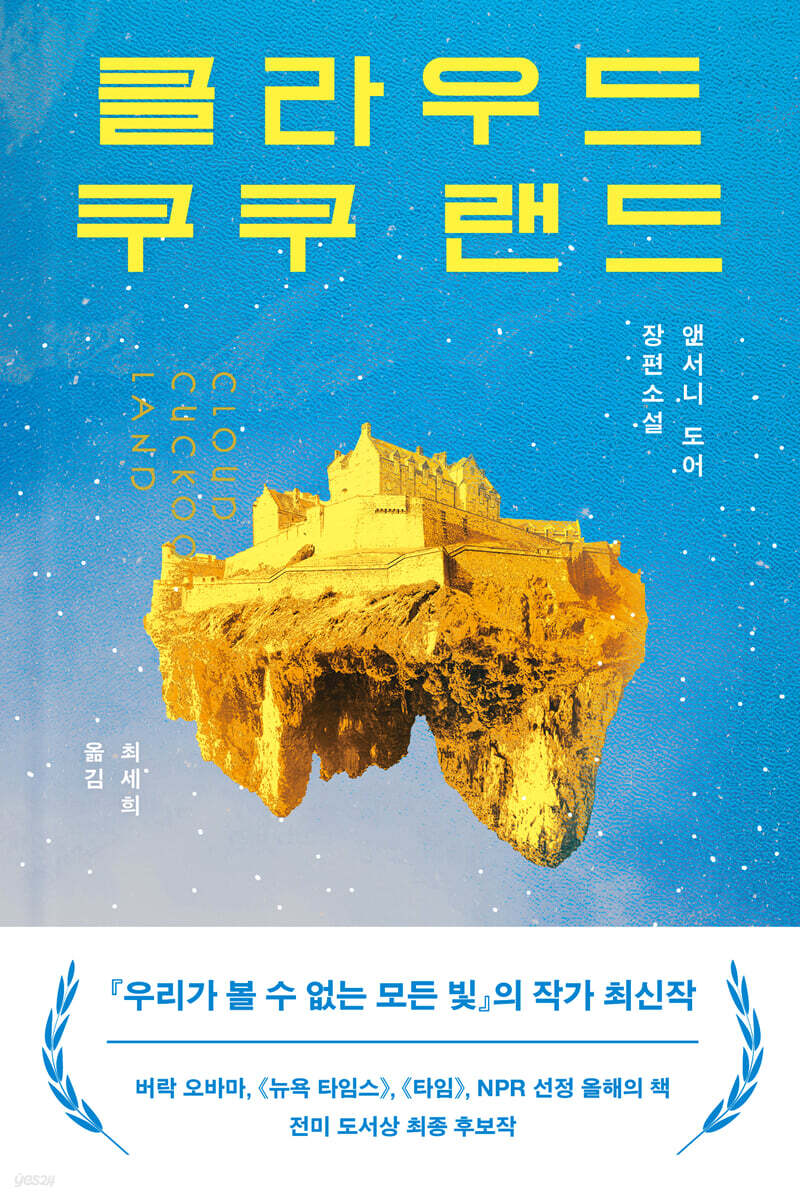 |
Description
Book Introduction
Pulitzer Prize-winning author Anthony Doerr's latest work Barack Obama's "Book of the Year" by Time, The New York Times, NPR, and Entertainment Weekly National Book Award finalist Anthony Doerr, winner of the 2015 Pulitzer Prize for All the Light We Cannot See, has published his latest work, Cloud Cuckoo Land, by Minumsa. Cloud Cuckoo Land is a story about five characters that unfolds over 700 years based on the fictional work "Cloud Cuckoo Land" written by the real-life ancient Greek writer Antonius Diogenes. This is the author's first work in seven years since winning the Pulitzer Prize. It received consistent support from readers and the media after its publication, and later that year, it was selected as a "Book of the Year" by major media outlets such as Time, The New York Times, and NPR, as well as former U.S. President Barack Obama. It was also nominated for the 2022 National Book Award, the Carnegie Medal, the Dayton Peace Prize for Literature, and the Dublin Literary Award in Ireland, and won the Prix de l'Americane in France, which is awarded to the most distinguished American novel translated that year. 'Cloud cuckoo land' means 'world of dreams', and in this novel, it refers to the utopia that the protagonist of the Greek novel of the same name goes to in search of, and 'a place other than here' that the five protagonists seek to reach to escape the painful reality. An orphan girl in 15th-century Constantinople, a deaf boy from a Bulgarian mountain village, a gay elderly man and a boy on the autistic spectrum in 21st-century America, and a girl on an interstellar spaceship in search of a new home for humanity in the 22nd century—the five protagonists are all marginalized minorities in their own worlds, struggling toward a better reality. And at a desperate moment, each of them encounters the ancient Greek novel "Cloud Cuckoo Land" and, using that book as a light, takes a step forward. Despite its seemingly complex structure and massive scale, Anthony Doerr's signature fluid composition, beautiful sentences that touch on emotional lines at precisely the right moment, and effective scene placement make this lengthy novel a smooth read. The opening chapters of "Cloud Cuckoo Land" and the stories of the main characters resonate, and the moments when the stories of the main characters living in non-overlapping spaces and times are tied together as if by a sophisticated clockwork mechanism, provide a rare pleasure of reading. The novel is enriched by the delicate incorporation of diverse themes such as metallurgy, climate change, eco-terrorism, ancient Greece, the Renaissance, the Ottoman Empire, and the economic crisis. |
- You can preview some of the book's contents.
Preview
index
Prologue 13
1 21
2 45
3 97
4 149
5 169
6 187
7 245
8 293
9 327
10 393
11 411
12 437
13 489
14 525
15 579
16 593
17 607
18 635
19 667
20 691
21 709
22 735
23 753
24 781
Epilogue 805
Author's Note 819
Acknowledgments 821
1 21
2 45
3 97
4 149
5 169
6 187
7 245
8 293
9 327
10 393
11 411
12 437
13 489
14 525
15 579
16 593
17 607
18 635
19 667
20 691
21 709
22 735
23 753
24 781
Epilogue 805
Author's Note 819
Acknowledgments 821
Into the book
Gino hunches over and sits down on the first row of seats.
Every time I blink, memories swirl under my eyelids.
Father falls on his butt into a snowdrift.
A librarian pulling open a drawer containing a card list.
A man in a prisoner of war camp writing Greek letters by scraping dirt with his fingers.
Sharif shows the children the dressing room he has set up behind three bookshelves.
In a room filled with props and stage costumes, Olivia pulls off a latex hat and pulls it over her head, applying bald makeup; Christopher drags a microwave box painted to look like a marble coffin to center stage; Alex reaches out and touches a painted tower; and Natalie pulls a laptop computer from her backpack.
Marianne's phone vibrates.
“The pizza is ready,” she says into Gino’s ear.
“I’ll go and get it.
“I’ll go and come back with my eyebrows raised.”
“Mr. Nini?” Rachel taps Gino on the shoulder.
Her red hair was gathered and braided back, the snow on her shoulders was melted and dripping, and her eyes were large and clear.
“Did you make all this? For us?”
--- pp.30~31
When I went to the square, everyone was sitting on long chairs.
They were frightened when they saw a crow, a raven, and a great hoopoe dancing before them, as big as a man.
It turned out they were gentle birds, and two of their friends told them about a wonderful city they planned to build in the clouds between the earth and the sky.
It is a place truly far from the strife of humankind, a place only those with wings can reach, where no one knows pain and everyone is wise.
A vision leaped into my mind: a palace of golden towers in the clouds, with falcons, red-crowned snipes, quails, water hen and cuckoos circling around it, with water taps spouting rivers of meat soup, turtles rolling around carrying honey cakes on their backs, and wine flowing in canals on both sides of the streets.
When I saw all this with my own eyes, I jumped up and said,
“Why stay here when I can go there?” I threw down the bottle of wine, got up, and set off for Thessaly, which, as we all know, is a land of magic, to find a witch who will transform me… … .
--- pp.47~48
When the wind blows a piece of paper from the booklet beneath his fingers, Anna quickly runs to catch it, dusts it off, and places it back on his lap.
Licinius does not lift his eyelids for a long time.
“Treasure trove.” He finally opens his mouth.
“Do you know this? A haven.
A document—a book—is a refuge containing the memories of those who have gone before.
“It’s a way to make sure that memories remain there forever, even after the soul has traveled a long way.”
The next moment his eyes are wide open, and he seems to be looking into a vast darkness.
“But books, like people, die.
They may be burned, swept away by floods, eaten by insects, or killed by capricious tyrants.
If you don't protect the book, it will escape into the world.
And when the book disappears from the world, the memory dies once again.”
--- pp.77~78
He had never gone a day without imagining what adventures awaited him beyond the mountain's shadow, but now all he wanted was for the seasons to change while he crouched here, leaning against the woodpile in the barn, and for those visitors to become a memory of the past, and for everything to return to the way it was before.
“I don’t want to go.”
“Once upon a time,” the grandfather says, finally looking up at him.
“There is a city where everyone, from beggars to the poor and even the king, turned to stone because they rejected God’s calling.
Every single person in the city, women and children, was turned to stone.
“This is something that cannot be disobeyed.”
Beyond this wall, the trees and moonlight are asleep, and the image of the two guys' ribs rising and falling simultaneously is vivid before my eyes.
“You will gain honor,” says the grandfather.
“Then I’ll come back home.”
--- p.96
The two librarians tilt their heads at exactly the same angle.
One of them sits him down in a bar-backed chair in front of the fireplace, while the other disappears between the bookshelves and returns carrying a lemon-covered, cloth-bound book.
“Ah,” says the older sister.
“Excellent choice.” And the two sit on either side of him, and the one who brought the book says.
“On days like this, it’s so gloomy and humid that the cold just won’t go away.
“Sometimes, just reading Greek solves the problem.” She shows him a page in a book, densely packed with words.
“I will take you and fly away to a place far away where it is hot, rocky, and sunny.”
As the lights flicker and the brass handles on the index card drawers glow softly, Gino sits with his hands under his thighs, and the younger twin begins to read a book.
In the story, a lonely sailor, the loneliest man in the world, wanders on a raft for eighteen days until he encounters a terrible storm.
The raft is wrecked and he is swept naked into the sea, washed ashore on a rocky beach on an island.
But a goddess named Athena disguises herself as a girl carrying a water jug and leads him to an enchanted city.
--- pp.105~106
Eee-eeee? Eee-ee-ee-eeet?
Seymour felt as if all the hairs on his arms were standing up.
The owl is so well camouflaged that it hoots three more times before the boy's eyes find it, and the sight takes his breath away.
The owl blinks three or four times.
If you close your eyelids in the shadow cast by the tree bark, it will disappear without a trace.
When you open your eyes again, this creature will return to its original form.
It's the size of Tony Molinary.
The pupils are the color of tennis balls.
I'm looking straight at Seymour right now.
Seymour stands at the base of a tall tree, his head raised, the owl looks down, the forest breathes, and something happens.
The uncomfortable sound that had been constantly murmuring at the edge of the boy's consciousness while he was awake—a scream—was beginning to subside.
There's magic in this place.
It seems like the owl is talking.
Just sit still, breathe, and wait, and the magic will find you.
Seymour sits, breathes, and waits, while Earth circles another thousand kilometers along its original orbit.
Deep inside the boy, a knot that had been tight since birth begins to loosen.
--- pp.126~127
“And in the story of Noah and the ark with the books, what is the flood?”
Anna shakes her head.
“It’s time.
Day by day, year by year, time erases old books from this world.
You know that manuscript you brought us last time? It was written by Aerian, a scholar who lived during the Roman Empire.
To arrive at us in this room, at this very moment, the sentences in that book had to endure twelve centuries.
A scribe had to copy the book, and decades later a second scribe would copy the first copy, rebinding what had been a scroll into a book, and many years after that second scribe was buried, only his bones remained, a third scribe would come along and copy it again, and all the while the book was being unearthed.
“One ill-tempered abbot, one indolent monk, one barbarian who invades this land, one fallen candle, one hungry insect, and centuries of time will fly away.”
A thin candle flame flickers.
His eyes seem to draw in all the light in the room.
“My child, there are things in the world that seem unchanging—mountains, wealth, empires—but eternity is nothing more than an illusion.
It's because our lives are so short that they always seem to stay the same.
In the eyes of God, this city is like an anthill, existing for a short time and then disappearing.
The young sultan is now mustering his army.
He has a new war machine that can tear down walls and leave nothing but air behind.”
Anna feels her stomach churning.
Himerius creeps towards the coins on the table.
“The ark has hit a reef, my child.
So the tide is coming in.”
--- pp.239~240
“Yes, dear.
We all know that Beta Oph2's atmosphere is similar to Earth's, that it has liquid water like Earth, and that it has several types of forests.
But we will never live to see them with our own eyes.
No one here.
“We are the generation that builds bridges, the ones who connect in the middle, the ones who prepare in advance for the next generation.”
Constance presses both palms hard against the desk.
I feel like I'm going to faint at any moment.
“The truth is so hard to accept.
I know too.
That's why we bring children to the library.
“I’ll wait until you’re old enough to accept it.”
Mrs. Flowers picks up a piece of paper from the box and writes something.
“Come here.
“There’s one more thing I’d like to show you.” The woman put the paper in the slot, and after a moment a tattered book, as wide and long as the entrance to compartment 17, came tumbling out from the second shelf of the bookshelf, fluttered limply a few times, and then flew down to them, unfolding itself.
The page is pitch black, like a doorway just opened at the edge of an abyss of unfathomable depth.
“Atlas,” says Mrs. Flowers.
“Unfortunately, it was a while ago.
I introduced it to all the kids who celebrated Library Day, and later I noticed that they all liked things that were a little bit smoother and more immersive.
“Touch it.”
Constance pokes her finger into the page and pulls it back.
Then take one step forward.
As Mrs. Flowers takes her hand, Constance closes her eyes tightly, steels herself, and the two walk into it together.
--- pp.285~286
Stars hang on the mountain seen through a crack in the warehouse wall.
Gino feels Rex's body pressing against his cold back.
Both were so skinny that their skin and bones were almost glued together.
θεο? means 'gods' and is the nominative plural form.
?πεκλ?σαντο is the negative past tense and means 'they spun the thread'.
?νθρ?ποι? is 'humans', dative plural.
Gino breathes, the fire crackles, the warehouse walls slowly recede, and from the folds of his mind, the meaning of that sentence, unreachable by guards, hunger, or pain, surges through the centuries.
“That is the work of the gods,” says Rex.
“They weave the thread of ruins, using human life as their canvas, and all of it becomes a song to be told to future generations.”
Rex looks at the Greek written on the plank, then looks back at Gino, then looks back at the Greek.
He shakes his head.
“Oh, that’s really great.
“It’s really, really great.”
Every time I blink, memories swirl under my eyelids.
Father falls on his butt into a snowdrift.
A librarian pulling open a drawer containing a card list.
A man in a prisoner of war camp writing Greek letters by scraping dirt with his fingers.
Sharif shows the children the dressing room he has set up behind three bookshelves.
In a room filled with props and stage costumes, Olivia pulls off a latex hat and pulls it over her head, applying bald makeup; Christopher drags a microwave box painted to look like a marble coffin to center stage; Alex reaches out and touches a painted tower; and Natalie pulls a laptop computer from her backpack.
Marianne's phone vibrates.
“The pizza is ready,” she says into Gino’s ear.
“I’ll go and get it.
“I’ll go and come back with my eyebrows raised.”
“Mr. Nini?” Rachel taps Gino on the shoulder.
Her red hair was gathered and braided back, the snow on her shoulders was melted and dripping, and her eyes were large and clear.
“Did you make all this? For us?”
--- pp.30~31
When I went to the square, everyone was sitting on long chairs.
They were frightened when they saw a crow, a raven, and a great hoopoe dancing before them, as big as a man.
It turned out they were gentle birds, and two of their friends told them about a wonderful city they planned to build in the clouds between the earth and the sky.
It is a place truly far from the strife of humankind, a place only those with wings can reach, where no one knows pain and everyone is wise.
A vision leaped into my mind: a palace of golden towers in the clouds, with falcons, red-crowned snipes, quails, water hen and cuckoos circling around it, with water taps spouting rivers of meat soup, turtles rolling around carrying honey cakes on their backs, and wine flowing in canals on both sides of the streets.
When I saw all this with my own eyes, I jumped up and said,
“Why stay here when I can go there?” I threw down the bottle of wine, got up, and set off for Thessaly, which, as we all know, is a land of magic, to find a witch who will transform me… … .
--- pp.47~48
When the wind blows a piece of paper from the booklet beneath his fingers, Anna quickly runs to catch it, dusts it off, and places it back on his lap.
Licinius does not lift his eyelids for a long time.
“Treasure trove.” He finally opens his mouth.
“Do you know this? A haven.
A document—a book—is a refuge containing the memories of those who have gone before.
“It’s a way to make sure that memories remain there forever, even after the soul has traveled a long way.”
The next moment his eyes are wide open, and he seems to be looking into a vast darkness.
“But books, like people, die.
They may be burned, swept away by floods, eaten by insects, or killed by capricious tyrants.
If you don't protect the book, it will escape into the world.
And when the book disappears from the world, the memory dies once again.”
--- pp.77~78
He had never gone a day without imagining what adventures awaited him beyond the mountain's shadow, but now all he wanted was for the seasons to change while he crouched here, leaning against the woodpile in the barn, and for those visitors to become a memory of the past, and for everything to return to the way it was before.
“I don’t want to go.”
“Once upon a time,” the grandfather says, finally looking up at him.
“There is a city where everyone, from beggars to the poor and even the king, turned to stone because they rejected God’s calling.
Every single person in the city, women and children, was turned to stone.
“This is something that cannot be disobeyed.”
Beyond this wall, the trees and moonlight are asleep, and the image of the two guys' ribs rising and falling simultaneously is vivid before my eyes.
“You will gain honor,” says the grandfather.
“Then I’ll come back home.”
--- p.96
The two librarians tilt their heads at exactly the same angle.
One of them sits him down in a bar-backed chair in front of the fireplace, while the other disappears between the bookshelves and returns carrying a lemon-covered, cloth-bound book.
“Ah,” says the older sister.
“Excellent choice.” And the two sit on either side of him, and the one who brought the book says.
“On days like this, it’s so gloomy and humid that the cold just won’t go away.
“Sometimes, just reading Greek solves the problem.” She shows him a page in a book, densely packed with words.
“I will take you and fly away to a place far away where it is hot, rocky, and sunny.”
As the lights flicker and the brass handles on the index card drawers glow softly, Gino sits with his hands under his thighs, and the younger twin begins to read a book.
In the story, a lonely sailor, the loneliest man in the world, wanders on a raft for eighteen days until he encounters a terrible storm.
The raft is wrecked and he is swept naked into the sea, washed ashore on a rocky beach on an island.
But a goddess named Athena disguises herself as a girl carrying a water jug and leads him to an enchanted city.
--- pp.105~106
Eee-eeee? Eee-ee-ee-eeet?
Seymour felt as if all the hairs on his arms were standing up.
The owl is so well camouflaged that it hoots three more times before the boy's eyes find it, and the sight takes his breath away.
The owl blinks three or four times.
If you close your eyelids in the shadow cast by the tree bark, it will disappear without a trace.
When you open your eyes again, this creature will return to its original form.
It's the size of Tony Molinary.
The pupils are the color of tennis balls.
I'm looking straight at Seymour right now.
Seymour stands at the base of a tall tree, his head raised, the owl looks down, the forest breathes, and something happens.
The uncomfortable sound that had been constantly murmuring at the edge of the boy's consciousness while he was awake—a scream—was beginning to subside.
There's magic in this place.
It seems like the owl is talking.
Just sit still, breathe, and wait, and the magic will find you.
Seymour sits, breathes, and waits, while Earth circles another thousand kilometers along its original orbit.
Deep inside the boy, a knot that had been tight since birth begins to loosen.
--- pp.126~127
“And in the story of Noah and the ark with the books, what is the flood?”
Anna shakes her head.
“It’s time.
Day by day, year by year, time erases old books from this world.
You know that manuscript you brought us last time? It was written by Aerian, a scholar who lived during the Roman Empire.
To arrive at us in this room, at this very moment, the sentences in that book had to endure twelve centuries.
A scribe had to copy the book, and decades later a second scribe would copy the first copy, rebinding what had been a scroll into a book, and many years after that second scribe was buried, only his bones remained, a third scribe would come along and copy it again, and all the while the book was being unearthed.
“One ill-tempered abbot, one indolent monk, one barbarian who invades this land, one fallen candle, one hungry insect, and centuries of time will fly away.”
A thin candle flame flickers.
His eyes seem to draw in all the light in the room.
“My child, there are things in the world that seem unchanging—mountains, wealth, empires—but eternity is nothing more than an illusion.
It's because our lives are so short that they always seem to stay the same.
In the eyes of God, this city is like an anthill, existing for a short time and then disappearing.
The young sultan is now mustering his army.
He has a new war machine that can tear down walls and leave nothing but air behind.”
Anna feels her stomach churning.
Himerius creeps towards the coins on the table.
“The ark has hit a reef, my child.
So the tide is coming in.”
--- pp.239~240
“Yes, dear.
We all know that Beta Oph2's atmosphere is similar to Earth's, that it has liquid water like Earth, and that it has several types of forests.
But we will never live to see them with our own eyes.
No one here.
“We are the generation that builds bridges, the ones who connect in the middle, the ones who prepare in advance for the next generation.”
Constance presses both palms hard against the desk.
I feel like I'm going to faint at any moment.
“The truth is so hard to accept.
I know too.
That's why we bring children to the library.
“I’ll wait until you’re old enough to accept it.”
Mrs. Flowers picks up a piece of paper from the box and writes something.
“Come here.
“There’s one more thing I’d like to show you.” The woman put the paper in the slot, and after a moment a tattered book, as wide and long as the entrance to compartment 17, came tumbling out from the second shelf of the bookshelf, fluttered limply a few times, and then flew down to them, unfolding itself.
The page is pitch black, like a doorway just opened at the edge of an abyss of unfathomable depth.
“Atlas,” says Mrs. Flowers.
“Unfortunately, it was a while ago.
I introduced it to all the kids who celebrated Library Day, and later I noticed that they all liked things that were a little bit smoother and more immersive.
“Touch it.”
Constance pokes her finger into the page and pulls it back.
Then take one step forward.
As Mrs. Flowers takes her hand, Constance closes her eyes tightly, steels herself, and the two walk into it together.
--- pp.285~286
Stars hang on the mountain seen through a crack in the warehouse wall.
Gino feels Rex's body pressing against his cold back.
Both were so skinny that their skin and bones were almost glued together.
θεο? means 'gods' and is the nominative plural form.
?πεκλ?σαντο is the negative past tense and means 'they spun the thread'.
?νθρ?ποι? is 'humans', dative plural.
Gino breathes, the fire crackles, the warehouse walls slowly recede, and from the folds of his mind, the meaning of that sentence, unreachable by guards, hunger, or pain, surges through the centuries.
“That is the work of the gods,” says Rex.
“They weave the thread of ruins, using human life as their canvas, and all of it becomes a song to be told to future generations.”
Rex looks at the Greek written on the plank, then looks back at Gino, then looks back at the Greek.
He shakes his head.
“Oh, that’s really great.
“It’s really, really great.”
--- p.337
Publisher's Review
In an era dominated by AI and digital,
A novel that asks what and how to pass it on to future generations.
A single book survives for thousands of years, and people living in different times and spaces discover it in their own way, read it, expand their own world, and live out their own new stories.
Books, especially narratives like myths, folktales, and novels, have been read in this way throughout history, influencing countless lives and contributing to the creation of new works of art.
"Cloud Cuckoo Land" is a novel that serves as a hymn to the nameless people who have protected the stories (storytelling) and books that have become the foundation of the rich culture that humanity enjoys today, and it is a novel that eloquently demonstrates the greatness of literature that saves lives beyond its functions of entertainment and comfort.
The author goes further and asks us a question.
In an age where everything is digitalized and artificial intelligence takes over even creative work, what and how will we pass on our legacy to future generations? Readers will find the answer within this novel.
“A book is a sanctuary filled with the memories of those who have gone before.
But books, like people, die.
If you don't protect it, it will escape into the world.
And when the book disappears from the world, the memory dies once again.”
700 years, five characters, and one book.
The character who opens the first chapter of the novel is Constance, a girl aboard the spaceship Argos.
It has been 65 years since humanity left the devastated Earth and embarked on a mission to find a new home.
Constance has been living alone in a room with only the artificial intelligence Sybil for almost a year.
What the girl is looking at are pieces of paper that contain facts about the ancient Greek prose tale "Cloud Cuckoo Land."
"Cloud Cuckoo Land" is a retelling of a story written on a tablet discovered by a writer named Antonius Diogenes in the late 1st century AD in a tomb where a shepherd named Aeton, who lived on a man, a donkey, a fish, and a crow, is said to have been buried.
And the scene shifts to Lakeport, Idaho, USA, late February 2020.
Gino, an old man in his eighties, heads to the public library with five fifth-grade students, fighting his way through the snow.
Tomorrow night, he and the children will be putting on a play called "Cloud Cuckoo Land."
After a manuscript of Cloud Cuckoo Land was discovered in the Vatican Library, amateur translator Gino devoted himself to translating the text into English.
As a lonely child, he came to this place where he had no connections, and the only place that welcomed him was the public library, where he learned about Homer. Later, he met Rex, an Englishman who served in the Korean War and taught classical literature in a prisoner-of-war camp, and he opened his eyes to the beauty of ancient Greek literature and fell in love with him.
Now, in the twilight of his life, he looks back on the love he never had and his heart swells with emotion.
After a long time, I came here, drawn by the power of books.
In a car on the side of the road, a few steps from the library.
High school student Seymour is planning to carry out a bomb attack.
The destination was the Lakeport Public Library.
Thanks to the librarian there, I learned more about my beloved great gray owl, but the library is the closest thing to the real estate building.
He has been harboring resentment toward the indiscriminate real estate development in the area for several years.
The forest behind his house was destroyed by land development, and his only friend, a great gray owl, died.
For him, who had sensory processing problems, the forest was a sanctuary and a solace.
He decided to sound the alarm to the world by joining an environmental terrorist organization he learned about through the Internet.
Today is D-Day.
And in the mid-15th century, Constantinople.
Anna, who lost her parents and now works in an embroidery studio with her older sister Maria, is a slacker with terrible sewing skills.
Anna, who longs for a wider world, learns how to read and the meaning of a book from Licinius, an old man who teaches only boys to read, and inherits a manuscript of the Odyssey.
However, the owner of the studio thinks the book belongs to Maria and beats her, burning the book along with it.
To cure her sister, who has become blind due to her master's violence, Anna steals abandoned books from a ruined monastery and sells them to Italian scribes.
But with the imminent Ottoman invasion, the Italians return home, leaving Anna with a manuscript that no one will buy.
It is a book called "Cloud Cuckoo Land" that contains the story of Aiton, a shepherd who sets out on a journey to a non-existent land called Cloud Cuckoo Land.
At the same time, outside the walls of Constantinople.
There is a boy named Omeir who transported the Sultan's cannon from a village in the mountains of Bulgaria to here.
Born deaf and almost abandoned, he narrowly escaped death and is a loner who is better at communicating with animals than people.
He left his family and was drafted into war with his beloved twin brothers, Namu and Dalbit, but he hated neither the spoils of war nor the bigger world.
He dreamed of a new world like the one in his grandfather's old stories, but the world outside his hometown he experienced was cruel and painful.
And then, on her tenth birthday, Constance is invited to the virtual library for the first time.
There, she discovers a book called 'Atlas', where she can find answers to all her questions, and embarks on a journey into it.
There is a video of Earth captured decades ago before humans left the planet.
Constance, fascinated by the homeland she has never lived in, travels to Atlas whenever she gets the chance, and there she encounters the truth that everyone wants to keep hidden… … .
To protect one book,
A story of hope, dedicated to the courage and dedication of the most ordinary people.
Anthony Dore, fascinated by 15th-century Europe, where many technologies, including the printing press, the compass, and gunpowder, were explosively emerging, was drawn to the Byzantine library after reading that the walls of Constantinople, which had been impregnable for a thousand years, had fallen because of gunpowder.
A library within the walls.
Thanks to the walls remaining intact for so many years, many Greek and Roman classics have been preserved to this day.
The author was deeply moved by this fact and decided to write the story of books that transcend time and space and the people who protect them.
In this novel, all those who protect the book are marginalized minorities.
They find salvation in Diogenes' "Cloud Cuckoo Land" in moments of life and death, and they do not hesitate to risk their lives to pass on its value to future generations.
Ultimately, Cloud Cuckoo Land is a story about the courage, dedication, and hope of the most ordinary people.
Rumors of an imminent apocalypse rage in Constantinople, where an Ottoman invasion is imminent, and in the 21st-century American Midwest, where the climate crisis continues to rage, the apocalyptic atmosphere is palpable.
The crew of the Argus, bound for Beta Oph2, are forced to spend their entire lives aboard the ship, never having set foot on their new home.
Isn't it true that passing on generations and creating history is only possible if we harbor hope even in such darkness?
As Sharif, the children's librarian in the novel, says.
““There is something my mother often said while she was in the hospital before she passed away.
“Hope is the pillar that supports the world.” This novel conveys to us the message that hope is only possible through kindness and a good heart toward others.
And the fact that libraries are places where such kindness and hospitality are shown resonates deeply with those who love books and literature.
Praise poured in for this book
With Cloud Cuckoo Land, Anthony Doerr has firmly established himself alongside Tolkien, J.K. Rowling, and David Mitchell.
This novel is an impressive achievement and a joy to read.
_times
A masterpiece of broad scope, grand scale, and joy, presented by a seasoned writer after his great success.
"Cloud Cuckoo Land" is like a breath of fresh air.
A book like a gift presented by a novel.
_Guardian
A vast and imaginative epic spanning centuries, celebrating outsiders, writers, and book defenders.
Ultimately, it is a novel about hope, life-affirming, and the essence of love, literature, and art.
_Irish Independent
A love letter to libraries and bibliophiles, as familiar as a bedtime story.
_O Magazine
An ambitious and imaginative novel that stretches out in all directions.
Door is a rare artist who has achieved both universality and uniqueness.
His stories, vast yet intimate, are dazzling and at times dizzying in scope.
Cloud Cuckoo Land is unlike anything you've ever read.
_San Francisco Chronicle
After reading this novel, you will feel a greater appreciation for the unseen qualities that have bound human life together through the ages, like a love of a good story and the joy of returning home.
_Wired
The greatest joy of Cloud Cuckoo Land is watching the pieces fall into place.
It is the quietest kind of epic, whispering for 600 years in a voice no louder than a librarian.
_NPR
A novel that asks what and how to pass it on to future generations.
A single book survives for thousands of years, and people living in different times and spaces discover it in their own way, read it, expand their own world, and live out their own new stories.
Books, especially narratives like myths, folktales, and novels, have been read in this way throughout history, influencing countless lives and contributing to the creation of new works of art.
"Cloud Cuckoo Land" is a novel that serves as a hymn to the nameless people who have protected the stories (storytelling) and books that have become the foundation of the rich culture that humanity enjoys today, and it is a novel that eloquently demonstrates the greatness of literature that saves lives beyond its functions of entertainment and comfort.
The author goes further and asks us a question.
In an age where everything is digitalized and artificial intelligence takes over even creative work, what and how will we pass on our legacy to future generations? Readers will find the answer within this novel.
“A book is a sanctuary filled with the memories of those who have gone before.
But books, like people, die.
If you don't protect it, it will escape into the world.
And when the book disappears from the world, the memory dies once again.”
700 years, five characters, and one book.
The character who opens the first chapter of the novel is Constance, a girl aboard the spaceship Argos.
It has been 65 years since humanity left the devastated Earth and embarked on a mission to find a new home.
Constance has been living alone in a room with only the artificial intelligence Sybil for almost a year.
What the girl is looking at are pieces of paper that contain facts about the ancient Greek prose tale "Cloud Cuckoo Land."
"Cloud Cuckoo Land" is a retelling of a story written on a tablet discovered by a writer named Antonius Diogenes in the late 1st century AD in a tomb where a shepherd named Aeton, who lived on a man, a donkey, a fish, and a crow, is said to have been buried.
And the scene shifts to Lakeport, Idaho, USA, late February 2020.
Gino, an old man in his eighties, heads to the public library with five fifth-grade students, fighting his way through the snow.
Tomorrow night, he and the children will be putting on a play called "Cloud Cuckoo Land."
After a manuscript of Cloud Cuckoo Land was discovered in the Vatican Library, amateur translator Gino devoted himself to translating the text into English.
As a lonely child, he came to this place where he had no connections, and the only place that welcomed him was the public library, where he learned about Homer. Later, he met Rex, an Englishman who served in the Korean War and taught classical literature in a prisoner-of-war camp, and he opened his eyes to the beauty of ancient Greek literature and fell in love with him.
Now, in the twilight of his life, he looks back on the love he never had and his heart swells with emotion.
After a long time, I came here, drawn by the power of books.
In a car on the side of the road, a few steps from the library.
High school student Seymour is planning to carry out a bomb attack.
The destination was the Lakeport Public Library.
Thanks to the librarian there, I learned more about my beloved great gray owl, but the library is the closest thing to the real estate building.
He has been harboring resentment toward the indiscriminate real estate development in the area for several years.
The forest behind his house was destroyed by land development, and his only friend, a great gray owl, died.
For him, who had sensory processing problems, the forest was a sanctuary and a solace.
He decided to sound the alarm to the world by joining an environmental terrorist organization he learned about through the Internet.
Today is D-Day.
And in the mid-15th century, Constantinople.
Anna, who lost her parents and now works in an embroidery studio with her older sister Maria, is a slacker with terrible sewing skills.
Anna, who longs for a wider world, learns how to read and the meaning of a book from Licinius, an old man who teaches only boys to read, and inherits a manuscript of the Odyssey.
However, the owner of the studio thinks the book belongs to Maria and beats her, burning the book along with it.
To cure her sister, who has become blind due to her master's violence, Anna steals abandoned books from a ruined monastery and sells them to Italian scribes.
But with the imminent Ottoman invasion, the Italians return home, leaving Anna with a manuscript that no one will buy.
It is a book called "Cloud Cuckoo Land" that contains the story of Aiton, a shepherd who sets out on a journey to a non-existent land called Cloud Cuckoo Land.
At the same time, outside the walls of Constantinople.
There is a boy named Omeir who transported the Sultan's cannon from a village in the mountains of Bulgaria to here.
Born deaf and almost abandoned, he narrowly escaped death and is a loner who is better at communicating with animals than people.
He left his family and was drafted into war with his beloved twin brothers, Namu and Dalbit, but he hated neither the spoils of war nor the bigger world.
He dreamed of a new world like the one in his grandfather's old stories, but the world outside his hometown he experienced was cruel and painful.
And then, on her tenth birthday, Constance is invited to the virtual library for the first time.
There, she discovers a book called 'Atlas', where she can find answers to all her questions, and embarks on a journey into it.
There is a video of Earth captured decades ago before humans left the planet.
Constance, fascinated by the homeland she has never lived in, travels to Atlas whenever she gets the chance, and there she encounters the truth that everyone wants to keep hidden… … .
To protect one book,
A story of hope, dedicated to the courage and dedication of the most ordinary people.
Anthony Dore, fascinated by 15th-century Europe, where many technologies, including the printing press, the compass, and gunpowder, were explosively emerging, was drawn to the Byzantine library after reading that the walls of Constantinople, which had been impregnable for a thousand years, had fallen because of gunpowder.
A library within the walls.
Thanks to the walls remaining intact for so many years, many Greek and Roman classics have been preserved to this day.
The author was deeply moved by this fact and decided to write the story of books that transcend time and space and the people who protect them.
In this novel, all those who protect the book are marginalized minorities.
They find salvation in Diogenes' "Cloud Cuckoo Land" in moments of life and death, and they do not hesitate to risk their lives to pass on its value to future generations.
Ultimately, Cloud Cuckoo Land is a story about the courage, dedication, and hope of the most ordinary people.
Rumors of an imminent apocalypse rage in Constantinople, where an Ottoman invasion is imminent, and in the 21st-century American Midwest, where the climate crisis continues to rage, the apocalyptic atmosphere is palpable.
The crew of the Argus, bound for Beta Oph2, are forced to spend their entire lives aboard the ship, never having set foot on their new home.
Isn't it true that passing on generations and creating history is only possible if we harbor hope even in such darkness?
As Sharif, the children's librarian in the novel, says.
““There is something my mother often said while she was in the hospital before she passed away.
“Hope is the pillar that supports the world.” This novel conveys to us the message that hope is only possible through kindness and a good heart toward others.
And the fact that libraries are places where such kindness and hospitality are shown resonates deeply with those who love books and literature.
Praise poured in for this book
With Cloud Cuckoo Land, Anthony Doerr has firmly established himself alongside Tolkien, J.K. Rowling, and David Mitchell.
This novel is an impressive achievement and a joy to read.
_times
A masterpiece of broad scope, grand scale, and joy, presented by a seasoned writer after his great success.
"Cloud Cuckoo Land" is like a breath of fresh air.
A book like a gift presented by a novel.
_Guardian
A vast and imaginative epic spanning centuries, celebrating outsiders, writers, and book defenders.
Ultimately, it is a novel about hope, life-affirming, and the essence of love, literature, and art.
_Irish Independent
A love letter to libraries and bibliophiles, as familiar as a bedtime story.
_O Magazine
An ambitious and imaginative novel that stretches out in all directions.
Door is a rare artist who has achieved both universality and uniqueness.
His stories, vast yet intimate, are dazzling and at times dizzying in scope.
Cloud Cuckoo Land is unlike anything you've ever read.
_San Francisco Chronicle
After reading this novel, you will feel a greater appreciation for the unseen qualities that have bound human life together through the ages, like a love of a good story and the joy of returning home.
_Wired
The greatest joy of Cloud Cuckoo Land is watching the pieces fall into place.
It is the quietest kind of epic, whispering for 600 years in a voice no louder than a librarian.
_NPR
GOODS SPECIFICS
- Date of issue: June 12, 2023
- Page count, weight, size: 824 pages | 900g | 140*210*40mm
- ISBN13: 9788937427923
- ISBN10: 8937427923
You may also like
카테고리
korean


korean

![GQ KOREA Mark (Monthly): December [2025]](http://librairie.coreenne.fr/cdn/shop/files/8ef265dbbfbf186523ed75ba7319009d.jpg?v=1765340328&width=3840)


