

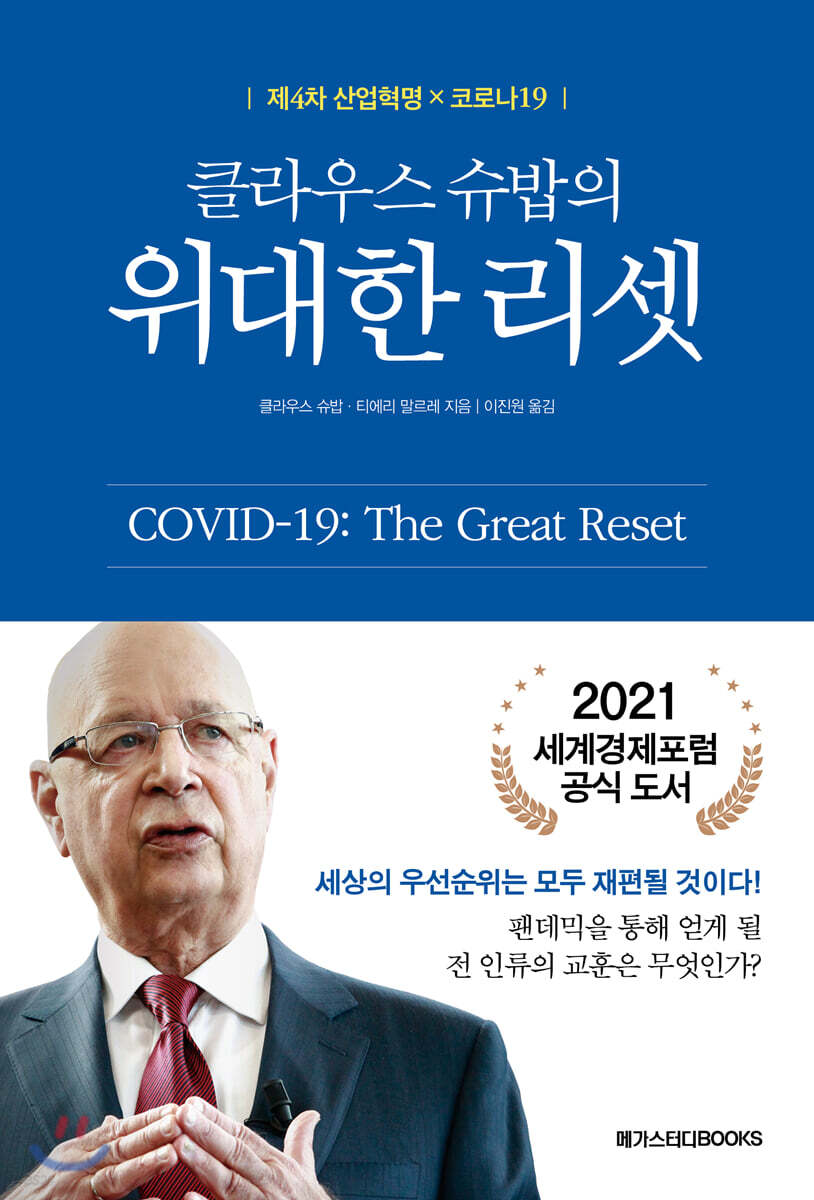
Klaus Schwab's Great Reset
 |
Description
Book Introduction
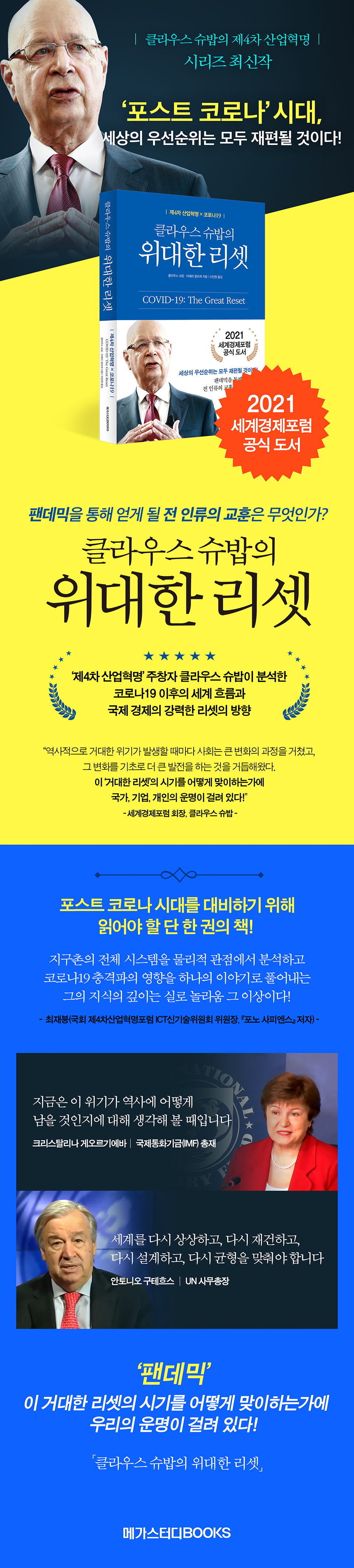
Analysis by Klaus Schwab, the proponent of the 'Fourth Industrial Revolution' Post-COVID-19 global trends and the direction of a powerful reset for the international economy. Contains the core agenda of the 2021 World Economic Forum's official theme, 'The Great Reset' The most objective and reliable analysis! The one book you need to read to prepare for the post-COVID era! “Historically, whenever a great crisis has occurred, society has gone through a process of great change, Based on that change, a new economic market has been created and has continued to develop further. The fate of nations, companies, and individuals hinges on how we navigate this period of “great reset.” - Klaus Schwab Since its first appearance on the world stage, COVID-19 has fundamentally disrupted the fundamental order of how we govern our nations, communicate with others, and conduct global economic activity. Klaus Schwab's "The Great Reset", written by Klaus Schwab, the chairman of the World Economic Forum and advocate of the "Fourth Industrial Revolution," is a book that contains the extensive and dramatic impact that COVID-19 will have on the future world, and specific guidelines for governments, businesses, and individuals who will have to live in the era of the "new normal." This book, which contains the core agenda of "The Great Reset," the official theme of the 2021 World Economic Forum, speaks to the reality of the socio-economic systems shattered by COVID-19 and the direction of a powerful and sophisticated reset to build a robust and sustainable new order in the post-pandemic era. Chairman Schwab warns that the pandemic will bring about radical and comprehensive changes across the globe, including a partial rollback of globalization, an intensifying conflict between the US and China, the threat of sophisticated and automated surveillance, immigration issues, new monetary policies, radical welfare and tax measures, and bold geopolitical realignment. He argues that a rapid, joint global response encompassing all social and economic aspects is necessary to achieve better results in overcoming the pandemic. |
- You can preview some of the book's contents.
Preview
index
Preface to the Korean edition by the author
Recommendation | Finding Survival Strategies in an Age of Absolute Chaos Through the Insights of Klaus Schwab_ Choi Jae-boong
Introduction: Now is the time to 'reset' the world we live in.
Part 1.
Macro-level reset
Chapter 1.
Conceptual Framework - Three Characteristics That Define Today's World
1.
interdependence
2.
speed
3.
complexity
Chapter 2.
economic reset
1.
COVID-19 Economics
Uncertainty | The economic fallacy of sacrificing lives for growth
2.
Growth and Employment
Economic Growth | Employment | What Will Future Growth Look Like?
3.
Fiscal and monetary policy
Deflation or Inflation? | The Fate of the US Dollar
Chapter 3.
social reset
1.
The significance of social reset
2.
inequality
3.
social anxiety
4.
The return of 'big' government
5.
social contract
Chapter 4.
Geopolitical reset
1.
The significance of a geopolitical reset
2.
Globalization and Nationalism
3.
Global Governance
4.
Growing competition between China and the United States
5.
Fragile and declining states
Chapter 5.
Environmental reset
1.
The significance of environmental reset
2.
Coronavirus and the environment
Nature and Zoonotic Diseases | Air Pollution and the Risk of Pandemic | Lockdowns and Carbon Emissions
2. The Impact of COVID-19 on Climate Change and Other Environmental Policies
Chapter 6.
Technical reset
1.
The significance of a technological reset
2.
Accelerating digital transformation
Uncertainty | The economic fallacy of sacrificing lives for growth
3.
Contact tracing and surveillance
4.
Dystopian Risk
Part 2.
Micro-Level Resets - Industry and Business
Chapter 1.
Micro trends
1.
Acceleration of digitalization
2.
Resilient supply chain
3.
Government and business
4.
Stakeholder Capitalism and ESG
Chapter 2.
Industrial reset
1.
Social interaction and de-densification
2.
Behavior Change - Permanent vs. Transitional
3.
resilience
Part 3.
Reset on a personal level
Chapter 1.
Redefining humanity
1.
The better angels of our nature
2.
moral choice
Chapter 2.
Mental Health and Well-being
1.
The Impact of the Pandemic on Mental Health
Chapter 3.
Change priorities
1.
Changes in priorities
2.
creativity
3.
hour
4.
consumption
5.
Nature and Well-being
conclusion
Acknowledgements
annotation
Recommendation | Finding Survival Strategies in an Age of Absolute Chaos Through the Insights of Klaus Schwab_ Choi Jae-boong
Introduction: Now is the time to 'reset' the world we live in.
Part 1.
Macro-level reset
Chapter 1.
Conceptual Framework - Three Characteristics That Define Today's World
1.
interdependence
2.
speed
3.
complexity
Chapter 2.
economic reset
1.
COVID-19 Economics
Uncertainty | The economic fallacy of sacrificing lives for growth
2.
Growth and Employment
Economic Growth | Employment | What Will Future Growth Look Like?
3.
Fiscal and monetary policy
Deflation or Inflation? | The Fate of the US Dollar
Chapter 3.
social reset
1.
The significance of social reset
2.
inequality
3.
social anxiety
4.
The return of 'big' government
5.
social contract
Chapter 4.
Geopolitical reset
1.
The significance of a geopolitical reset
2.
Globalization and Nationalism
3.
Global Governance
4.
Growing competition between China and the United States
5.
Fragile and declining states
Chapter 5.
Environmental reset
1.
The significance of environmental reset
2.
Coronavirus and the environment
Nature and Zoonotic Diseases | Air Pollution and the Risk of Pandemic | Lockdowns and Carbon Emissions
2. The Impact of COVID-19 on Climate Change and Other Environmental Policies
Chapter 6.
Technical reset
1.
The significance of a technological reset
2.
Accelerating digital transformation
Uncertainty | The economic fallacy of sacrificing lives for growth
3.
Contact tracing and surveillance
4.
Dystopian Risk
Part 2.
Micro-Level Resets - Industry and Business
Chapter 1.
Micro trends
1.
Acceleration of digitalization
2.
Resilient supply chain
3.
Government and business
4.
Stakeholder Capitalism and ESG
Chapter 2.
Industrial reset
1.
Social interaction and de-densification
2.
Behavior Change - Permanent vs. Transitional
3.
resilience
Part 3.
Reset on a personal level
Chapter 1.
Redefining humanity
1.
The better angels of our nature
2.
moral choice
Chapter 2.
Mental Health and Well-being
1.
The Impact of the Pandemic on Mental Health
Chapter 3.
Change priorities
1.
Changes in priorities
2.
creativity
3.
hour
4.
consumption
5.
Nature and Well-being
conclusion
Acknowledgements
annotation
Detailed image
Into the book
"Like other regions, the pandemic situation in Korea is not over, but it is generally well controlled.
Once COVID-19 is gone, Korea will undoubtedly emerge stronger from this crisis.
I am confident that we will demonstrate that we can achieve a "great reset" not by going back to the past or doing things the same way as before, but by building more resilient societies and economies.
…after the pandemic, the world will have to choose between two paths.
One path will lead our societies and economies to a more inclusive, sustainable, and resilient future. The other will lead us to a more dangerous, unstable, and increasingly difficult world.
Korea has already clearly chosen the first path."
--- From 'Preface to the Korean Edition: To Korean Readers'
“As governments around the world scramble to prevent the recession from escalating into a catastrophic depression, measures that would have seemed unthinkable before the COVID-19 outbreak are now becoming the global norm.
There will likely be growing calls for the government to act as a "payer of last resort" to prevent or stem the surge in layoffs and corporate bankruptcies triggered by this crisis.
--- From 'Fiscal and Monetary Policy'
At this point, it is difficult to imagine that inflation could occur any time soon.
Reshoring of production activities (returning production bases to their home countries) may cause intermittent and localized inflation, but such occurrences are still limited.
Strong, long-term structural trends, such as an aging population and technological advancements that have a strong deflationary impact, and unusually high unemployment that will constrain wage growth for several years, all exert strong downward pressure on inflation.
It is not expected that consumer demand will be strong in the post-corona era.
Widespread unemployment, reduced incomes for many, and the suffering caused by uncertainty about the future could all lead to increased precautionary saving.
When social distancing measures are eventually eased, pent-up demand could trigger a small spike in inflation, but this is likely to be temporary and will not impact inflation expectations.
--- From 'Fiscal and Monetary Policy'
COVID-19 appears poised to spell the end for neoliberalism, which can be defined as favoring competition over solidarity, creative destruction over government intervention, and economic growth over social welfare.
For years, many commentators, business leaders, and policymakers have been ratcheting up the criticism of neoliberalism's "blind market fetishism," undermining its principles. COVID-19 has dealt a fatal blow.
It is no coincidence that the United States and the United Kingdom, the two countries that have most ardently embraced neoliberal policies over the past few years, are also the countries most affected by the COVID-19 pandemic.
The two coexisting forces of massive redistribution and the abandonment of neoliberal policies will have decisive implications for the organization of society, from how inequality can fuel social unrest to expanding the role of government and redefining the social contract.
---From 'The Significance of Social Reset'
In the post-corona era, the number of people who are unemployed, anxious, miserable, resentful, sick, and hungry will increase dramatically.
As personal tragedies pile up, anger, resentment, and rage will grow among many social groups, including the unemployed, the poor, immigrants, prisoners, the homeless, and all those marginalized.
How could such energy not explode? Social phenomena often exhibit the same characteristics as pandemics.
As we have seen above, both social phenomena and pandemics have moments or triggers when they suddenly undergo major changes.
When poverty, deprivation, and powerlessness reach a certain level, destructive social behavior often becomes a last resort.
---'Social Unrest'
As we saw in the previous chapter, a contraction in global trade is almost certain as companies shrink their supply chains and no longer rely on single countries or foreign companies for critical components and other goods.
De-integration may be a possibility, especially in sensitive industries such as pharmaceuticals and medical materials, and in sectors important to national security such as communications and energy.
This process is already being demanded in the United States, and the movement toward decoupling is likely to spread to other countries and sectors.
Geopolitics is also inflicting some economic pain through the so-called "weaponization of trade," raising fears among global businesses that international law may no longer be able to resolve trade disputes in an orderly and predictable manner.
--- From 'Globalization and Nationalism'
The argument that there will be no winners is based on an intriguing idea put forward by several scholars, notably Niall Ferguson.
Essentially, the COVID-19 crisis has highlighted the successes of small countries and exposed the failures of superpowers like the United States and China.
…as those who support this idea argue, large scale creates ‘diseconomies of scale.’
It means that the size has grown to a point where a nation or federation cannot govern effectively.
This ultimately explains why smaller economies like South Korea, Singapore, Iceland, and Israel appear to be better at containing and responding to the COVID-19 pandemic than the United States.
--- From 'There are no winners'
“The crucial difference between the time horizon of a pandemic and that of climate change and nature loss is that the risks posed by a pandemic require immediate action with rapid consequences, whereas climate change and nature loss also require immediate action, but their consequences – what economists often call ‘future rewards’ – occur with a lag.
(...) That is, unlike immediate and observable risks, climate change risks may seem distant in time and geography, which may lead people to not perceive them as risks that warrant serious attention.”
--- From 'The Significance of Environmental Reset'
“There is another phenomenon that supports the expansion of automation: ‘economic distancing,’ which may follow ‘social distancing.’
As countries nationalize and global corporations scale back their once-superefficient but highly fragile supply chains, demand for automation and robotics, which enable more domestic production while lowering costs, will soar.
--- 'Accelerating Digital Transformation'
When faced with a reset, some industry leaders and senior executives may be tempted to view it as an opportunity to restart, to return to the "old normal," to restore what worked in the past—traditions, proven procedures, and familiar ways of doing things—in short, to return to "business as usual."
But that is impossible.
'Ordinary life' must be seen as mostly dead or infected due to COVID-19.
(…) For most companies entering the post-corona era, the new challenge will be finding the right balance between what worked before and what is currently needed to thrive in the new normal.
--- From 'Microscopic Reset Introduction'
During lockdown, video conferencing has played a positive role in saving many people's personal and professional lives, allowing them to maintain relationships, long-distance relationships, and connections with colleagues.
However, video conferencing via Zoom has also caused mental fatigue, known as "Zoom fatigue," due to the increased concentration required.
(…) Video calls make it impossible to interpret these nonverbal cues that impart subtle meaning, forcing us to focus solely on the words being spoken and facial expressions dictated by the quality of the video.
When we have virtual conversations, we do nothing but maintain intense eye contact for extended periods of time.
This kind of eye contact can be overbearing or even threatening, especially when hierarchical relationships exist.
Once COVID-19 is gone, Korea will undoubtedly emerge stronger from this crisis.
I am confident that we will demonstrate that we can achieve a "great reset" not by going back to the past or doing things the same way as before, but by building more resilient societies and economies.
…after the pandemic, the world will have to choose between two paths.
One path will lead our societies and economies to a more inclusive, sustainable, and resilient future. The other will lead us to a more dangerous, unstable, and increasingly difficult world.
Korea has already clearly chosen the first path."
--- From 'Preface to the Korean Edition: To Korean Readers'
“As governments around the world scramble to prevent the recession from escalating into a catastrophic depression, measures that would have seemed unthinkable before the COVID-19 outbreak are now becoming the global norm.
There will likely be growing calls for the government to act as a "payer of last resort" to prevent or stem the surge in layoffs and corporate bankruptcies triggered by this crisis.
--- From 'Fiscal and Monetary Policy'
At this point, it is difficult to imagine that inflation could occur any time soon.
Reshoring of production activities (returning production bases to their home countries) may cause intermittent and localized inflation, but such occurrences are still limited.
Strong, long-term structural trends, such as an aging population and technological advancements that have a strong deflationary impact, and unusually high unemployment that will constrain wage growth for several years, all exert strong downward pressure on inflation.
It is not expected that consumer demand will be strong in the post-corona era.
Widespread unemployment, reduced incomes for many, and the suffering caused by uncertainty about the future could all lead to increased precautionary saving.
When social distancing measures are eventually eased, pent-up demand could trigger a small spike in inflation, but this is likely to be temporary and will not impact inflation expectations.
--- From 'Fiscal and Monetary Policy'
COVID-19 appears poised to spell the end for neoliberalism, which can be defined as favoring competition over solidarity, creative destruction over government intervention, and economic growth over social welfare.
For years, many commentators, business leaders, and policymakers have been ratcheting up the criticism of neoliberalism's "blind market fetishism," undermining its principles. COVID-19 has dealt a fatal blow.
It is no coincidence that the United States and the United Kingdom, the two countries that have most ardently embraced neoliberal policies over the past few years, are also the countries most affected by the COVID-19 pandemic.
The two coexisting forces of massive redistribution and the abandonment of neoliberal policies will have decisive implications for the organization of society, from how inequality can fuel social unrest to expanding the role of government and redefining the social contract.
---From 'The Significance of Social Reset'
In the post-corona era, the number of people who are unemployed, anxious, miserable, resentful, sick, and hungry will increase dramatically.
As personal tragedies pile up, anger, resentment, and rage will grow among many social groups, including the unemployed, the poor, immigrants, prisoners, the homeless, and all those marginalized.
How could such energy not explode? Social phenomena often exhibit the same characteristics as pandemics.
As we have seen above, both social phenomena and pandemics have moments or triggers when they suddenly undergo major changes.
When poverty, deprivation, and powerlessness reach a certain level, destructive social behavior often becomes a last resort.
---'Social Unrest'
As we saw in the previous chapter, a contraction in global trade is almost certain as companies shrink their supply chains and no longer rely on single countries or foreign companies for critical components and other goods.
De-integration may be a possibility, especially in sensitive industries such as pharmaceuticals and medical materials, and in sectors important to national security such as communications and energy.
This process is already being demanded in the United States, and the movement toward decoupling is likely to spread to other countries and sectors.
Geopolitics is also inflicting some economic pain through the so-called "weaponization of trade," raising fears among global businesses that international law may no longer be able to resolve trade disputes in an orderly and predictable manner.
--- From 'Globalization and Nationalism'
The argument that there will be no winners is based on an intriguing idea put forward by several scholars, notably Niall Ferguson.
Essentially, the COVID-19 crisis has highlighted the successes of small countries and exposed the failures of superpowers like the United States and China.
…as those who support this idea argue, large scale creates ‘diseconomies of scale.’
It means that the size has grown to a point where a nation or federation cannot govern effectively.
This ultimately explains why smaller economies like South Korea, Singapore, Iceland, and Israel appear to be better at containing and responding to the COVID-19 pandemic than the United States.
--- From 'There are no winners'
“The crucial difference between the time horizon of a pandemic and that of climate change and nature loss is that the risks posed by a pandemic require immediate action with rapid consequences, whereas climate change and nature loss also require immediate action, but their consequences – what economists often call ‘future rewards’ – occur with a lag.
(...) That is, unlike immediate and observable risks, climate change risks may seem distant in time and geography, which may lead people to not perceive them as risks that warrant serious attention.”
--- From 'The Significance of Environmental Reset'
“There is another phenomenon that supports the expansion of automation: ‘economic distancing,’ which may follow ‘social distancing.’
As countries nationalize and global corporations scale back their once-superefficient but highly fragile supply chains, demand for automation and robotics, which enable more domestic production while lowering costs, will soar.
--- 'Accelerating Digital Transformation'
When faced with a reset, some industry leaders and senior executives may be tempted to view it as an opportunity to restart, to return to the "old normal," to restore what worked in the past—traditions, proven procedures, and familiar ways of doing things—in short, to return to "business as usual."
But that is impossible.
'Ordinary life' must be seen as mostly dead or infected due to COVID-19.
(…) For most companies entering the post-corona era, the new challenge will be finding the right balance between what worked before and what is currently needed to thrive in the new normal.
--- From 'Microscopic Reset Introduction'
During lockdown, video conferencing has played a positive role in saving many people's personal and professional lives, allowing them to maintain relationships, long-distance relationships, and connections with colleagues.
However, video conferencing via Zoom has also caused mental fatigue, known as "Zoom fatigue," due to the increased concentration required.
(…) Video calls make it impossible to interpret these nonverbal cues that impart subtle meaning, forcing us to focus solely on the words being spoken and facial expressions dictated by the quality of the video.
When we have virtual conversations, we do nothing but maintain intense eye contact for extended periods of time.
This kind of eye contact can be overbearing or even threatening, especially when hierarchical relationships exist.
--- From 'The Impact of the Pandemic on Mental Health'
Publisher's Review
It works at the macro level - industry and business - and individual levels.
A new order for humanity after the pandemic
This book, consisting of three parts, provides a panoramic view of the future world.
Chapter 1 assesses the impact of the COVID-19 pandemic on five major macroeconomic categories: economic, social, geopolitical, environmental, and technological. Chapter 2 examines the impact of the pandemic on specific industries and companies. Chapter 3 presents hypotheses about the changes that may occur at the individual level, such as mental health, moral choices, and consumption patterns.
This book comprehensively and systematically covers the impact and key keywords of the pandemic, dividing it into macroeconomic aspects and the industrial, corporate, and individual levels. It helps readers gain a comprehensive overview of the predictions about changes in the post-COVID-19 era, which have been fragmented to date.
For all of us who have entered the new normal era
Klaus Schwab's brilliant insight
This book, compiled through a variety of examples and extensive research, differs from similar books on the coronavirus that are simply a patchwork of existing media interviews. Rather than presenting the individual opinions of individual individuals, this book offers a comprehensive analysis from both macro and micro perspectives, led by the World Economic Forum.
Klaus Schwab's The Great Reset will be the definitive analysis of the post-COVID-19 era, providing objective information and exceptional insights to corporate decision-makers and readers seeking to anticipate future trends and discover investment opportunities, business opportunities, and promising industries.
The book begins with a special preface for Korean readers, offering words of encouragement for Korea's response to COVID-19 and his expectations, as President of the World Economic Forum, for Korea's role on the global stage after the pandemic.
A new order for humanity after the pandemic
This book, consisting of three parts, provides a panoramic view of the future world.
Chapter 1 assesses the impact of the COVID-19 pandemic on five major macroeconomic categories: economic, social, geopolitical, environmental, and technological. Chapter 2 examines the impact of the pandemic on specific industries and companies. Chapter 3 presents hypotheses about the changes that may occur at the individual level, such as mental health, moral choices, and consumption patterns.
This book comprehensively and systematically covers the impact and key keywords of the pandemic, dividing it into macroeconomic aspects and the industrial, corporate, and individual levels. It helps readers gain a comprehensive overview of the predictions about changes in the post-COVID-19 era, which have been fragmented to date.
For all of us who have entered the new normal era
Klaus Schwab's brilliant insight
This book, compiled through a variety of examples and extensive research, differs from similar books on the coronavirus that are simply a patchwork of existing media interviews. Rather than presenting the individual opinions of individual individuals, this book offers a comprehensive analysis from both macro and micro perspectives, led by the World Economic Forum.
Klaus Schwab's The Great Reset will be the definitive analysis of the post-COVID-19 era, providing objective information and exceptional insights to corporate decision-makers and readers seeking to anticipate future trends and discover investment opportunities, business opportunities, and promising industries.
The book begins with a special preface for Korean readers, offering words of encouragement for Korea's response to COVID-19 and his expectations, as President of the World Economic Forum, for Korea's role on the global stage after the pandemic.
GOODS SPECIFICS
- Date of issue: February 1, 2021
- Page count, weight, size: 340 pages | 618g | 152*225*30mm
- ISBN13: 9791129707079
- ISBN10: 1129707075
You may also like
카테고리
korean


korean

![GQ KOREA Mark (Monthly): December [2025]](http://librairie.coreenne.fr/cdn/shop/files/8ef265dbbfbf186523ed75ba7319009d.jpg?v=1765340328&width=3840)


