

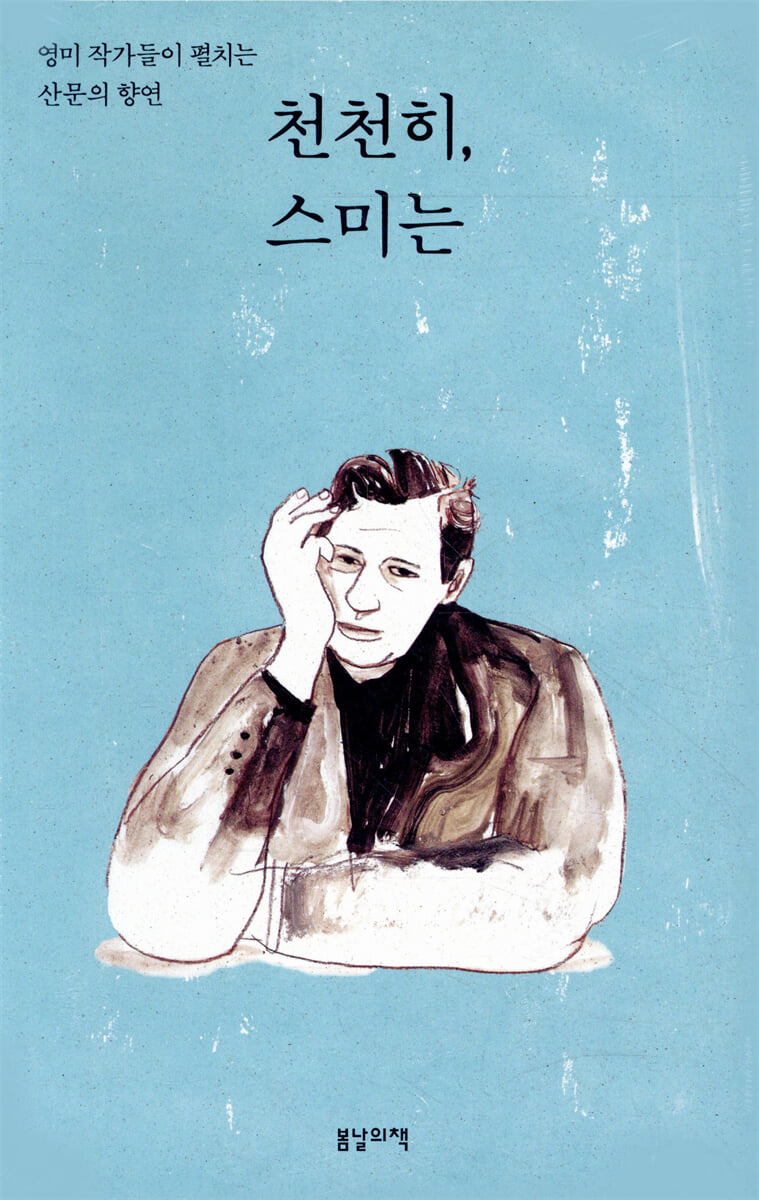
Slowly, Sumi
 |
Description
Book Introduction
“When we read a good essay, we feel that all our faculties are awakened and bathed in the sunlight of pleasure.
“A good essay also captivates us from the first sentence, drawing us into a more intense form of ecstasy.” ― Virginia Woolf
A feast of prose by British and American writers
This book, a collection of beautiful English prose written from the late 19th century to the mid-20th century, not too long ago, contains works by writers who have observed things and people with a broader and deeper perspective than we do, perhaps even more intently and for a longer period of time, and whose works resonate with us even now.
Sleep and Waking (F.
Scott Fitzgerald) Knoxville: Summer 1915 (James Agee) Overalls (James Agee) The Death of a Moth (Virginia Woolf) The Pangs of Childhood (Thomas de Quincey) His Name Was Pitt (William Faulkner) William and Mary (Max Beerbohm) The Rhythm of Life (Alice Meynell) The March of the Migratory Birds (John Burroughs) Some Thoughts on Toads (George Orwell) Thinking Like Mountains (Aldo Leopold) If I Were the Wind (Aldo Leopold) The Death of the Pines (Henry David Thoreau) The Pig Pays Its Debt (Marjorie Keenan Rawlings) The Crooked Road (Hilaire Belloc) Marrakesh (George Orwell) Thinking of Peace During an Air Raid (Virginia Woolf) Forgiveness (Dorothy Sayers) The Living Ethics of Jim Crow (Richard Wright) Certain Questions (Richard Wright) Preface (William Faulkner) How a Bibliophile Passes Time To Conquer (Holbrook Jackson) To Read or Not to Read (Oscar Wilde) Happy Margins (Kenneth Grahame) A Penny for Nothing, Two for Everything (Robert Louis Stevenson) The Toy Theatre (G.
K. Chesterton) The Secret Life of James Thurber (James Thurber) My Italian Lessons (Mark Twain) The Road to Mashhad (Robert Byron) Dulborough Town (Charles Dickens) Verona (Charles Dickens) The Walking Woman (Mary Hunter Austen)
“A good essay also captivates us from the first sentence, drawing us into a more intense form of ecstasy.” ― Virginia Woolf
A feast of prose by British and American writers
This book, a collection of beautiful English prose written from the late 19th century to the mid-20th century, not too long ago, contains works by writers who have observed things and people with a broader and deeper perspective than we do, perhaps even more intently and for a longer period of time, and whose works resonate with us even now.
Sleep and Waking (F.
Scott Fitzgerald) Knoxville: Summer 1915 (James Agee) Overalls (James Agee) The Death of a Moth (Virginia Woolf) The Pangs of Childhood (Thomas de Quincey) His Name Was Pitt (William Faulkner) William and Mary (Max Beerbohm) The Rhythm of Life (Alice Meynell) The March of the Migratory Birds (John Burroughs) Some Thoughts on Toads (George Orwell) Thinking Like Mountains (Aldo Leopold) If I Were the Wind (Aldo Leopold) The Death of the Pines (Henry David Thoreau) The Pig Pays Its Debt (Marjorie Keenan Rawlings) The Crooked Road (Hilaire Belloc) Marrakesh (George Orwell) Thinking of Peace During an Air Raid (Virginia Woolf) Forgiveness (Dorothy Sayers) The Living Ethics of Jim Crow (Richard Wright) Certain Questions (Richard Wright) Preface (William Faulkner) How a Bibliophile Passes Time To Conquer (Holbrook Jackson) To Read or Not to Read (Oscar Wilde) Happy Margins (Kenneth Grahame) A Penny for Nothing, Two for Everything (Robert Louis Stevenson) The Toy Theatre (G.
K. Chesterton) The Secret Life of James Thurber (James Thurber) My Italian Lessons (Mark Twain) The Road to Mashhad (Robert Byron) Dulborough Town (Charles Dickens) Verona (Charles Dickens) The Walking Woman (Mary Hunter Austen)
- You can preview some of the book's contents.
Preview
index
1 Even if life is not always poetic
Virginia Woolf, "The Death of a Moth"
F.
Scott Fitzgerald, "Sleep and Waking"
James Agee, "Knoxville: Summer 1915"
James Agee, "Overalls"
Thomas de Quincey, "The Pains of Childhood"
William Faulkner, "His Name Was Pete"
Max Beerbohm, "William and Mary"
Alice Meynell, "The Rhythm of Life"
2 If I were the wind
John Burroughs, "March of the Birds"
George Orwell, "Some Thoughts on Toads"
Aldo Leopold, "Thinking Like a Mountain"
Aldo Leopold, "If I Were the Wind"
Henry David Thoreau, "The Death of the Pines"
Marjorie Keenan Rawlings, "Piggy's Debt"
Hillaire Belloc, "The Winding Road"
3 Some questions
George Orwell, "Marrakesh"
Virginia Woolf, "Thoughts on Peace During a Night Raid"
Dorothy Sayers, "Forgiveness"
Richard Wright, "The Living Ethics of Jim Crow"
Richard Wright, "A Question"
William Faulkner, "Preface"
4 Small and secret
Robert Louis Stevenson, "A Penny Without Color, Two Pennies With Color"
G.
K. Chesterton, "Toy Theatre"
James Thurber, The Secret Life of James Thurber
Holbrook Jackson, "How Literature Lovers Conquer Time"
Oscar Wilde, "To Read or Not to Read"
Kenneth Grahame, "Happy Margins"
5 On the road
Mark Twain, "My Italian Lessons"
Robert Byron, "The Road to Mashhad"
Charles Dickens, "Dulborough Town"
Charles Dickens, "Verona"
Mary Hunter Austen, "Walking Woman"
Virginia Woolf, "The Death of a Moth"
F.
Scott Fitzgerald, "Sleep and Waking"
James Agee, "Knoxville: Summer 1915"
James Agee, "Overalls"
Thomas de Quincey, "The Pains of Childhood"
William Faulkner, "His Name Was Pete"
Max Beerbohm, "William and Mary"
Alice Meynell, "The Rhythm of Life"
2 If I were the wind
John Burroughs, "March of the Birds"
George Orwell, "Some Thoughts on Toads"
Aldo Leopold, "Thinking Like a Mountain"
Aldo Leopold, "If I Were the Wind"
Henry David Thoreau, "The Death of the Pines"
Marjorie Keenan Rawlings, "Piggy's Debt"
Hillaire Belloc, "The Winding Road"
3 Some questions
George Orwell, "Marrakesh"
Virginia Woolf, "Thoughts on Peace During a Night Raid"
Dorothy Sayers, "Forgiveness"
Richard Wright, "The Living Ethics of Jim Crow"
Richard Wright, "A Question"
William Faulkner, "Preface"
4 Small and secret
Robert Louis Stevenson, "A Penny Without Color, Two Pennies With Color"
G.
K. Chesterton, "Toy Theatre"
James Thurber, The Secret Life of James Thurber
Holbrook Jackson, "How Literature Lovers Conquer Time"
Oscar Wilde, "To Read or Not to Read"
Kenneth Grahame, "Happy Margins"
5 On the road
Mark Twain, "My Italian Lessons"
Robert Byron, "The Road to Mashhad"
Charles Dickens, "Dulborough Town"
Charles Dickens, "Verona"
Mary Hunter Austen, "Walking Woman"
Into the book
The fight is over.
The insignificant little creature has now accepted death.
As I looked at the dead butterfly, I felt a sense of wonder at this small victory achieved by such a great force over such a paltry foe.
As strange as life had been a little while ago, death was now strange.
The moth, which had turned over again as before, now lay very gracefully and peacefully without any complaints.
It seemed to say this.
is it so.
Death is stronger than me.
--- Virginia Woolf, from "The Death of a Moth"
It's sleep.
Real sleep.
Precious and lovely sleep.
A sleep like a lullaby.
The bed and pillows wrap me deep and warmly, plunging me into peace, into nothingness.
In my dreams, purified through dark times, young and lovely people now do young and lovely things.
There are girls with big brown eyes and real blonde hair that I used to know.
--- F.
Scott Fitzgerald, from "Sleep and Waking"
My family is all bigger than me and speaks softly and meaninglessly, like the voices of sleeping birds.
One person is a painter, and his uncle lives at home.
One is a musician, the other is an aunt who lives at home.
One is my loving mother, the other is my loving father.
How come they are here?
All on this earth.
Who can say anything about the sorrow of this world, the sorrow of lying on a quilt, surrounded by the sounds of a summer evening? May God bless our family, our uncle, our aunt, our mother, and our good father.
Oh, and remember them kindly.
Even when they were having a hard time, even when they were gone.
After a while I went into the house and laid her down on the bed.
Sleep gently smiles and pulls me closer.
And those who accept me and silently treat me as a familiar and loved presence in their home, but who will never, never, now, never, never tell me who I am.
--- James Agee, from "Knoxville: Summer 1915"
One could observe, touch, and study a single piece of clothing with one's eyes, fingers, and most sensitive lips for an almost infinite amount of time and still never fully understand it.
And I have never seen a single set of work clothes that did not contain a beautiful world of its own.
Finally, the top of the shirt shoulder and the curves are also changed.
The fabric is made like snow, sewn and patched.
The places that are sewn and added like this are torn again, sewn and added again, and torn again, so that stitches and pieces of cloth are added on top of stitches and pieces of cloth in many layers.
And then it's sewn and patched again, so that in the end there's barely any original fabric left on the shirt's shoulders.
--- James Agee, from "Overalls"
Hasn't it really changed? I wondered if her forehead, that calm and noble forehead, might really be the same.
But the frozen eyelids, the darkness that secretly spread beneath them, the marble lips, the stiff hands, palms pressed together as if repeatedly pleading for an end to the suffering.
Could I have mistaken these things for life? If so, why didn't I run to those heavenly lips, shedding tears, and kiss them forever? I didn't.
For a while I couldn't move.
A feeling of awe, not fear, came over me, and as I stood there, a solemn wind began to blow.
The most mournful wind I have ever heard.
How heartbreaking! Words can't even begin to express the feeling.
It was a wind that had swept across the fields of finite fate for a hundred centuries.
Many times since then, on summer days, when the sun was at its hottest, I have felt the same wind blowing, just as empty and solemn as that day, like Memnon, but sacred.
It is the only symbol of eternity that can be heard in this world.
--- Thomas de Quincey, from “The Pains of Childhood”
Born into this world without a past, I had little expectations and did not hope for anything like immortality.
Food (whatever it was, however little, he didn't care, as long as it was given with affection—in words he didn't understand or could answer, but with familiar voices and hands) and land to run to, air to breathe, sun and rain in their season, and a flock of pheasants, his inheritance from long before Pete knew the land and felt the sun, was enough.
Pete knew the scent of pheasant from his ancestors, who were faithful and loyal hunting dogs, even before he smelled it himself.
That's all Pete wanted.
--- William Faulkner, from "His Name Was Pete"
Books scattered here and there after being dragged out of William's cave, bright flowers from Mary's garden.
The rafters, stairs and tiles are still there.
Beyond this door, so close to me, despite the dust, cobwebs, and darkness.
I wondered what I would do if the door hinges slowly turned open as if by magic.
You probably shouldn't go in.
You can't even look at it.
I would not want to see the things that remain, even though everything that gave them meaning has disappeared, even though everything has been taken away.
But can we condemn those objects for remaining? How can we be sure that nothing from the past will come back to haunt them? That something from the past, someday, perhaps, will not return.
People know too little.
How can one not be softened by the things that the departed must have loved? --- Max Beerbohm, from "William and Mary"
Life may not always be poetic, but at least it has a rhythm.
The experience of the mind is governed by a periodicity that repeats itself at regular intervals along the trajectory of thought.
The distance is not measured, the interval is not measured, the speed is not certain, and the number of times is not known.
Still, it is clear that it is repeated.
What your heart went through last week or last year you may not be going through now, but you will go through it again next week or next year.
Happiness does not depend on events, but on the ebb and flow of the mind.
Even bottles have rhyme.
We move closer to death in ever-shorter cycles, and we move further away from recovery in ever-longer cycles.
I couldn't bear the sadness that came from one cause yesterday, and I won't be able to bear it tomorrow, but I can bear it today even though the cause hasn't disappeared.
Even the heavy, unresolved worries allow us to find a moment of peace of mind.
Regrets don't stay either.
Come back.
--- Alice Meynell, from "The Rhythm of Life"
Who among us, who grew up watching the festivals and parades of passenger pigeons in spring and autumn, wouldn't say that seeing them again would be the happiest moment of our lives? It's such a rich and joyous spectacle of magnificent animal life, such a fertile scene unfolding in the sky and the wild, that it's heartwarming to witness.
I have seen the fields and forests covered for a day or two with flocks of these blue and white birds, flapping their wings and crying out in a hoarse voice.
Around that time, the sky would sometimes appear to turn into a flock of pigeons.
--- John Burroughs, from "The March of the Birds"
By this time, the toads, having finished their long fast, have a very religious appearance, like Anglo-Catholics at the end of Lent.
The movements are weak but restrained, and the body is shrunken, while the eyes appear strangely large.
So people discover something they might not have noticed otherwise: that toads have some of the most beautiful eyes of any living creature.
The toad's eyes are like gold.
No, to be exact, it's like a gold semi-precious stone, probably called a chrysolite, that's sometimes set into signet rings.
--- George Orwell, from "Some Thoughts on Toads"
Is it dangerous to enjoy the changing seasons, especially spring? Or, more precisely, is it politically reprehensible to suggest that life is often worth living thanks to natural phenomena, such as a singing blackbird or a yellowing elm in October, which not only cost us nothing but have no class perspective that left-wing newspaper editors might call it? --- George Orwell, "Some Thoughts on Toads"
I believe that if we retain our love for the trees, fish, butterflies, and toads we loved as children, a peaceful and fulfilling future is more likely, while if we teach ourselves to uphold only steel and concrete, we will pour our surplus energy into hating one another and worshipping our leaders.
--- George Orwell, from "Some Thoughts on Toads"
A faint cry from the clouds can be heard in the distance, like the barking of a dog.
It's strange to see the whole world curious and listening.
The sound soon gets louder.
The geese are approaching, though their cry is not visible.
A flock of geese appears from the low clouds.
Old and worn flags of birds tumble and soar, fluttering up and down, fluttering together or separately, advancing.
The wind gently touches each wing of the birds as they fly.
As the flock of geese becomes a faint speck in the distant sky, the last cry is heard, the farewell trumpet sounding to bid farewell to summer.
The back of the log gets warm.
The wind has gone with the flock of geese.
I would go too - if I were the wind.
--- Aldo Leopold, from "November: If I Were the Wind"
The sky occupied by pine trees will be empty for the next two hundred years.
The pine tree has now become lumber.
He who felled the pine tree destroyed the sky.
When spring comes and the osprey returns to the banks of the Musketaquid River, they will circle around in vain, searching for a familiar branch to perch on, and the hawk will mourn the death of the pines that once stood tall enough to protect its young.
A plant that had been growing steadily toward the sky for two hundred years disappeared this afternoon.
Even as the cold weather eased in January this year, the pine tree tops were spreading their young branches, heralding the coming summer.
Why doesn't the village bell ring its mourning bell? The mourning bell's ringing is unheard.
There is not a single mourning procession visible on the streets or forest paths.
The squirrel jumped to another tree.
The falcon circles farther and farther away, settling down in a new nest, but the lumberjack is ready to chop it down as well.
--- Henry David Thoreau, from "The Death of the Pines"
People have brown faces.
And there are too many.
Are they truly human, like you? Do they have names? Or are they just indistinguishable brown things, like bees or coral larvae? They emerge from the earth, sweat and starve for years, and then return to the nameless mounds of dirt in the graveyard, without anyone noticing their disappearance.
Even the grave soon fades and returns to the earth.
--- George Orwell, from "Marrakech"
Everyone who does physical labor is invisible.
The more important something is, the more invisible it becomes.
At least white skin is always pretty visible.
If you see someone working in a field in Northern Europe, you'll probably look at them twice.
In hot countries, south of Gibraltar or east of Suez, it is easy to pass by workers without even noticing them.
This is something I have experienced over and over again.
In the tropics, our eyes seem to absorb everything in the landscape except people.
It sucks up the dry soil, the cacti, the palm trees, and the distant mountains, but the farmer who tills his small field never sees them.
The farmer is the same color as the ground and is much less interesting to look at than the others.
--- George Orwell, from "Marrakech"
She was accepting her place as an older woman.
So, it is a beast of burden.
When a family walks along the road, it is common to see the father and his grown son riding ahead on a donkey, while an older woman follows behind on foot, carrying a load.
But the strange thing about these people is that they are invisible.
For weeks, at almost the same time, a line of old women carrying firewood passed our house, and their images were imprinted on my retina, but I can't say I saw them.
Firewood passes by.
That's what I saw.
One day, as I was following him, the pile of firewood started to shake strangely up and down, and my eyes just happened to fall on the person underneath the pile of firewood.
It was only then that I first noticed the poor old body, the same color as the dirt.
A body that was nothing but skin and bones, its back bent under the crushing weight.
--- George Orwell, from "Marrakech"
The suffering of Buridan's donkey is nothing compared to the hesitation of a child who, blinded by the bundle of joy, is impatient to see and touch just a little more.
The child, who has seen and touched as much as he can, finally chooses the play, and the clerk, whose patience has run out, sweeps the rest into a gray filing cabinet.
The child comes out again.
I was a little late for dinner.
Streetlights burst into light in the bluish winter evening sky.
How brisk the steps of a child running toward the theater, with plays like "The Miller" or "The Pirates" tucked under his arm! How resounding his bright laughter! I can still hear that laughter in my ears.
--- Robert Louis Stevenson, from "A Penny Without Color, a Penny With Color"
It disappeared.
The two beautiful hawthorn trees, the hedges, the lawn, all the buttercups and daisies gave way to the ruthless, rattling railway.
Beyond the station, a hideous black tunnel monster was still gaping hungry, even after devouring them all.
The carriage that had carried me away had the cheerful name of 'Timson's Blue-Eyed Girl' and belonged to the Timson Omnibus Company up the road, but the locomotive that had carried me back had the solemn name of No. 97 and belonged to the SER (Southern Railway), and now spews ashes and boiling water onto the desolate ground.
The insignificant little creature has now accepted death.
As I looked at the dead butterfly, I felt a sense of wonder at this small victory achieved by such a great force over such a paltry foe.
As strange as life had been a little while ago, death was now strange.
The moth, which had turned over again as before, now lay very gracefully and peacefully without any complaints.
It seemed to say this.
is it so.
Death is stronger than me.
--- Virginia Woolf, from "The Death of a Moth"
It's sleep.
Real sleep.
Precious and lovely sleep.
A sleep like a lullaby.
The bed and pillows wrap me deep and warmly, plunging me into peace, into nothingness.
In my dreams, purified through dark times, young and lovely people now do young and lovely things.
There are girls with big brown eyes and real blonde hair that I used to know.
--- F.
Scott Fitzgerald, from "Sleep and Waking"
My family is all bigger than me and speaks softly and meaninglessly, like the voices of sleeping birds.
One person is a painter, and his uncle lives at home.
One is a musician, the other is an aunt who lives at home.
One is my loving mother, the other is my loving father.
How come they are here?
All on this earth.
Who can say anything about the sorrow of this world, the sorrow of lying on a quilt, surrounded by the sounds of a summer evening? May God bless our family, our uncle, our aunt, our mother, and our good father.
Oh, and remember them kindly.
Even when they were having a hard time, even when they were gone.
After a while I went into the house and laid her down on the bed.
Sleep gently smiles and pulls me closer.
And those who accept me and silently treat me as a familiar and loved presence in their home, but who will never, never, now, never, never tell me who I am.
--- James Agee, from "Knoxville: Summer 1915"
One could observe, touch, and study a single piece of clothing with one's eyes, fingers, and most sensitive lips for an almost infinite amount of time and still never fully understand it.
And I have never seen a single set of work clothes that did not contain a beautiful world of its own.
Finally, the top of the shirt shoulder and the curves are also changed.
The fabric is made like snow, sewn and patched.
The places that are sewn and added like this are torn again, sewn and added again, and torn again, so that stitches and pieces of cloth are added on top of stitches and pieces of cloth in many layers.
And then it's sewn and patched again, so that in the end there's barely any original fabric left on the shirt's shoulders.
--- James Agee, from "Overalls"
Hasn't it really changed? I wondered if her forehead, that calm and noble forehead, might really be the same.
But the frozen eyelids, the darkness that secretly spread beneath them, the marble lips, the stiff hands, palms pressed together as if repeatedly pleading for an end to the suffering.
Could I have mistaken these things for life? If so, why didn't I run to those heavenly lips, shedding tears, and kiss them forever? I didn't.
For a while I couldn't move.
A feeling of awe, not fear, came over me, and as I stood there, a solemn wind began to blow.
The most mournful wind I have ever heard.
How heartbreaking! Words can't even begin to express the feeling.
It was a wind that had swept across the fields of finite fate for a hundred centuries.
Many times since then, on summer days, when the sun was at its hottest, I have felt the same wind blowing, just as empty and solemn as that day, like Memnon, but sacred.
It is the only symbol of eternity that can be heard in this world.
--- Thomas de Quincey, from “The Pains of Childhood”
Born into this world without a past, I had little expectations and did not hope for anything like immortality.
Food (whatever it was, however little, he didn't care, as long as it was given with affection—in words he didn't understand or could answer, but with familiar voices and hands) and land to run to, air to breathe, sun and rain in their season, and a flock of pheasants, his inheritance from long before Pete knew the land and felt the sun, was enough.
Pete knew the scent of pheasant from his ancestors, who were faithful and loyal hunting dogs, even before he smelled it himself.
That's all Pete wanted.
--- William Faulkner, from "His Name Was Pete"
Books scattered here and there after being dragged out of William's cave, bright flowers from Mary's garden.
The rafters, stairs and tiles are still there.
Beyond this door, so close to me, despite the dust, cobwebs, and darkness.
I wondered what I would do if the door hinges slowly turned open as if by magic.
You probably shouldn't go in.
You can't even look at it.
I would not want to see the things that remain, even though everything that gave them meaning has disappeared, even though everything has been taken away.
But can we condemn those objects for remaining? How can we be sure that nothing from the past will come back to haunt them? That something from the past, someday, perhaps, will not return.
People know too little.
How can one not be softened by the things that the departed must have loved? --- Max Beerbohm, from "William and Mary"
Life may not always be poetic, but at least it has a rhythm.
The experience of the mind is governed by a periodicity that repeats itself at regular intervals along the trajectory of thought.
The distance is not measured, the interval is not measured, the speed is not certain, and the number of times is not known.
Still, it is clear that it is repeated.
What your heart went through last week or last year you may not be going through now, but you will go through it again next week or next year.
Happiness does not depend on events, but on the ebb and flow of the mind.
Even bottles have rhyme.
We move closer to death in ever-shorter cycles, and we move further away from recovery in ever-longer cycles.
I couldn't bear the sadness that came from one cause yesterday, and I won't be able to bear it tomorrow, but I can bear it today even though the cause hasn't disappeared.
Even the heavy, unresolved worries allow us to find a moment of peace of mind.
Regrets don't stay either.
Come back.
--- Alice Meynell, from "The Rhythm of Life"
Who among us, who grew up watching the festivals and parades of passenger pigeons in spring and autumn, wouldn't say that seeing them again would be the happiest moment of our lives? It's such a rich and joyous spectacle of magnificent animal life, such a fertile scene unfolding in the sky and the wild, that it's heartwarming to witness.
I have seen the fields and forests covered for a day or two with flocks of these blue and white birds, flapping their wings and crying out in a hoarse voice.
Around that time, the sky would sometimes appear to turn into a flock of pigeons.
--- John Burroughs, from "The March of the Birds"
By this time, the toads, having finished their long fast, have a very religious appearance, like Anglo-Catholics at the end of Lent.
The movements are weak but restrained, and the body is shrunken, while the eyes appear strangely large.
So people discover something they might not have noticed otherwise: that toads have some of the most beautiful eyes of any living creature.
The toad's eyes are like gold.
No, to be exact, it's like a gold semi-precious stone, probably called a chrysolite, that's sometimes set into signet rings.
--- George Orwell, from "Some Thoughts on Toads"
Is it dangerous to enjoy the changing seasons, especially spring? Or, more precisely, is it politically reprehensible to suggest that life is often worth living thanks to natural phenomena, such as a singing blackbird or a yellowing elm in October, which not only cost us nothing but have no class perspective that left-wing newspaper editors might call it? --- George Orwell, "Some Thoughts on Toads"
I believe that if we retain our love for the trees, fish, butterflies, and toads we loved as children, a peaceful and fulfilling future is more likely, while if we teach ourselves to uphold only steel and concrete, we will pour our surplus energy into hating one another and worshipping our leaders.
--- George Orwell, from "Some Thoughts on Toads"
A faint cry from the clouds can be heard in the distance, like the barking of a dog.
It's strange to see the whole world curious and listening.
The sound soon gets louder.
The geese are approaching, though their cry is not visible.
A flock of geese appears from the low clouds.
Old and worn flags of birds tumble and soar, fluttering up and down, fluttering together or separately, advancing.
The wind gently touches each wing of the birds as they fly.
As the flock of geese becomes a faint speck in the distant sky, the last cry is heard, the farewell trumpet sounding to bid farewell to summer.
The back of the log gets warm.
The wind has gone with the flock of geese.
I would go too - if I were the wind.
--- Aldo Leopold, from "November: If I Were the Wind"
The sky occupied by pine trees will be empty for the next two hundred years.
The pine tree has now become lumber.
He who felled the pine tree destroyed the sky.
When spring comes and the osprey returns to the banks of the Musketaquid River, they will circle around in vain, searching for a familiar branch to perch on, and the hawk will mourn the death of the pines that once stood tall enough to protect its young.
A plant that had been growing steadily toward the sky for two hundred years disappeared this afternoon.
Even as the cold weather eased in January this year, the pine tree tops were spreading their young branches, heralding the coming summer.
Why doesn't the village bell ring its mourning bell? The mourning bell's ringing is unheard.
There is not a single mourning procession visible on the streets or forest paths.
The squirrel jumped to another tree.
The falcon circles farther and farther away, settling down in a new nest, but the lumberjack is ready to chop it down as well.
--- Henry David Thoreau, from "The Death of the Pines"
People have brown faces.
And there are too many.
Are they truly human, like you? Do they have names? Or are they just indistinguishable brown things, like bees or coral larvae? They emerge from the earth, sweat and starve for years, and then return to the nameless mounds of dirt in the graveyard, without anyone noticing their disappearance.
Even the grave soon fades and returns to the earth.
--- George Orwell, from "Marrakech"
Everyone who does physical labor is invisible.
The more important something is, the more invisible it becomes.
At least white skin is always pretty visible.
If you see someone working in a field in Northern Europe, you'll probably look at them twice.
In hot countries, south of Gibraltar or east of Suez, it is easy to pass by workers without even noticing them.
This is something I have experienced over and over again.
In the tropics, our eyes seem to absorb everything in the landscape except people.
It sucks up the dry soil, the cacti, the palm trees, and the distant mountains, but the farmer who tills his small field never sees them.
The farmer is the same color as the ground and is much less interesting to look at than the others.
--- George Orwell, from "Marrakech"
She was accepting her place as an older woman.
So, it is a beast of burden.
When a family walks along the road, it is common to see the father and his grown son riding ahead on a donkey, while an older woman follows behind on foot, carrying a load.
But the strange thing about these people is that they are invisible.
For weeks, at almost the same time, a line of old women carrying firewood passed our house, and their images were imprinted on my retina, but I can't say I saw them.
Firewood passes by.
That's what I saw.
One day, as I was following him, the pile of firewood started to shake strangely up and down, and my eyes just happened to fall on the person underneath the pile of firewood.
It was only then that I first noticed the poor old body, the same color as the dirt.
A body that was nothing but skin and bones, its back bent under the crushing weight.
--- George Orwell, from "Marrakech"
The suffering of Buridan's donkey is nothing compared to the hesitation of a child who, blinded by the bundle of joy, is impatient to see and touch just a little more.
The child, who has seen and touched as much as he can, finally chooses the play, and the clerk, whose patience has run out, sweeps the rest into a gray filing cabinet.
The child comes out again.
I was a little late for dinner.
Streetlights burst into light in the bluish winter evening sky.
How brisk the steps of a child running toward the theater, with plays like "The Miller" or "The Pirates" tucked under his arm! How resounding his bright laughter! I can still hear that laughter in my ears.
--- Robert Louis Stevenson, from "A Penny Without Color, a Penny With Color"
It disappeared.
The two beautiful hawthorn trees, the hedges, the lawn, all the buttercups and daisies gave way to the ruthless, rattling railway.
Beyond the station, a hideous black tunnel monster was still gaping hungry, even after devouring them all.
The carriage that had carried me away had the cheerful name of 'Timson's Blue-Eyed Girl' and belonged to the Timson Omnibus Company up the road, but the locomotive that had carried me back had the solemn name of No. 97 and belonged to the SER (Southern Railway), and now spews ashes and boiling water onto the desolate ground.
--- Charles Dickens, from "Dulborough Town"
Publisher's Review
1 A feast of prose by British and American writers
This book, a collection of beautiful English prose written from the late 19th century to the mid-20th century, not too long ago, contains works by writers who have observed things and people with a broader and deeper perspective than we do, perhaps even more intently and for a longer period of time, and whose works resonate with us even now.
These are their works.
Sleep and Waking (F.
Scott Fitzgerald) Knoxville: Summer 1915 (James Agee) Overalls (James Agee) The Death of a Moth (Virginia Woolf) The Pangs of Childhood (Thomas de Quincey) His Name Was Pitt (William Faulkner) William and Mary (Max Beerbohm) The Rhythm of Life (Alice Meynell) The March of the Migratory Birds (John Burroughs) Some Thoughts on Toads (George Orwell) Thinking Like Mountains (Aldo Leopold) If I Were the Wind (Aldo Leopold) The Death of the Pines (Henry David Thoreau) The Pig Pays Its Debt (Marjorie Keenan Rawlings) The Crooked Road (Hilaire Belloc) Marrakesh (George Orwell) Thinking of Peace During an Air Raid (Virginia Woolf) Forgiveness (Dorothy Sayers) The Living Ethics of Jim Crow (Richard Wright) Certain Questions (Richard Wright) Preface (William Faulkner) How a Bibliophile Passes Time To Conquer (Holbrook Jackson) To Read or Not to Read (Oscar Wilde) Happy Margins (Kenneth Grahame) A Penny for Nothing, Two for Everything (Robert Louis Stevenson) The Toy Theatre (G.
K. Chesterton) The Secret Life of James Thurber (James Thurber) My Italian Lessons (Mark Twain) The Road to Mashhad (Robert Byron) Dulborough Town (Charles Dickens) Verona (Charles Dickens) The Walking Woman (Mary Hunter Austen)
2 Records of memory, records of observation, records of reflection
The author's personal and social memories, his precise observations of nature, objects, and people, and the unique expressions achieved through his eyes, are filled with precise, delicate, and beautiful passages.
Every single sentence, every single word, without leaving anything out.
Not only do they shine and stand out on their own, but they also add value and style, especially within the flow of the overall text.
For example, Virginia Woolf's The Death of a Moth, James Agee's Knoxville: Summer 1915, George Orwell's Marrakech, the writings of Aldo Leopold, and Thomas de Quincey's The Pains of Childhood.
Among them, De Quincey's prose can be said to have an overwhelming thrill that seems to put a microscope on human emotions, and Orwell's prose can be said to have made it possible to see invisible beings through his sincere observation of humans.
James Agee's writing was completed in 50 minutes, with the intention of "writing in sound," and, as he put it, it captivated my eardrums the entire time.
It was even more extraordinary to read it later when I learned that it was a piece about the last summer spent with my father, who passed away when I was six.
3. Articles on various topics come together in one place to create a unique harmony.
Writings that deal with the changes in life, space, and ecology brought about by rapid industrialization and urbanization, such as John Burroughs's "March of the Migratory Birds," Hilaire Belloc's "The Crooked Road," and Aldo Leopold's "Thinking Like a Mountain," overlap almost indistinguishably with the problems and realities of the here and now.
It can now be said to be a restrained lament for things that have disappeared and are no longer there.
Writings that are imbued with contemporary experiences of violence, discrimination, and fear that shaped the world today, such as George Orwell's "Marrakesh," Virginia Woolf's "Thoughts on Peace During the Blitz," and Richard Wright's "The Living Ethics of Jim Crow," not only vividly reveal inequality, conflict, anxiety, and impatience, but also subtly reveal the author's constant reflection and introspection on these phenomena and these emotions.
Prose works that contain stories about universal conditions of human existence, such as loss, death, and suffering, such as Virginia Woolf's "The Death of a Moth," Fitzgerald's "Sleep and Waking," and Thomas de Quincey's "The Pains of Childhood" form one axis.
Also, writings that give us a glimpse into the soil in which the works of these authors sprouted, such as those of Charles Dickens, Robert Louis Stevenson, Richard Wright, and William Faulkner, are of great help in broadening and deepening our understanding of their later works.
Addendum
It contains 32 works by 25 authors, more than two-thirds of which are being introduced in Korea for the first time.
The editor cites James Agee's Knoxville: Summer 1915 and Charles Dickens's Dulborough Town as the most beautiful prose.
This book, a collection of beautiful English prose written from the late 19th century to the mid-20th century, not too long ago, contains works by writers who have observed things and people with a broader and deeper perspective than we do, perhaps even more intently and for a longer period of time, and whose works resonate with us even now.
These are their works.
Sleep and Waking (F.
Scott Fitzgerald) Knoxville: Summer 1915 (James Agee) Overalls (James Agee) The Death of a Moth (Virginia Woolf) The Pangs of Childhood (Thomas de Quincey) His Name Was Pitt (William Faulkner) William and Mary (Max Beerbohm) The Rhythm of Life (Alice Meynell) The March of the Migratory Birds (John Burroughs) Some Thoughts on Toads (George Orwell) Thinking Like Mountains (Aldo Leopold) If I Were the Wind (Aldo Leopold) The Death of the Pines (Henry David Thoreau) The Pig Pays Its Debt (Marjorie Keenan Rawlings) The Crooked Road (Hilaire Belloc) Marrakesh (George Orwell) Thinking of Peace During an Air Raid (Virginia Woolf) Forgiveness (Dorothy Sayers) The Living Ethics of Jim Crow (Richard Wright) Certain Questions (Richard Wright) Preface (William Faulkner) How a Bibliophile Passes Time To Conquer (Holbrook Jackson) To Read or Not to Read (Oscar Wilde) Happy Margins (Kenneth Grahame) A Penny for Nothing, Two for Everything (Robert Louis Stevenson) The Toy Theatre (G.
K. Chesterton) The Secret Life of James Thurber (James Thurber) My Italian Lessons (Mark Twain) The Road to Mashhad (Robert Byron) Dulborough Town (Charles Dickens) Verona (Charles Dickens) The Walking Woman (Mary Hunter Austen)
2 Records of memory, records of observation, records of reflection
The author's personal and social memories, his precise observations of nature, objects, and people, and the unique expressions achieved through his eyes, are filled with precise, delicate, and beautiful passages.
Every single sentence, every single word, without leaving anything out.
Not only do they shine and stand out on their own, but they also add value and style, especially within the flow of the overall text.
For example, Virginia Woolf's The Death of a Moth, James Agee's Knoxville: Summer 1915, George Orwell's Marrakech, the writings of Aldo Leopold, and Thomas de Quincey's The Pains of Childhood.
Among them, De Quincey's prose can be said to have an overwhelming thrill that seems to put a microscope on human emotions, and Orwell's prose can be said to have made it possible to see invisible beings through his sincere observation of humans.
James Agee's writing was completed in 50 minutes, with the intention of "writing in sound," and, as he put it, it captivated my eardrums the entire time.
It was even more extraordinary to read it later when I learned that it was a piece about the last summer spent with my father, who passed away when I was six.
3. Articles on various topics come together in one place to create a unique harmony.
Writings that deal with the changes in life, space, and ecology brought about by rapid industrialization and urbanization, such as John Burroughs's "March of the Migratory Birds," Hilaire Belloc's "The Crooked Road," and Aldo Leopold's "Thinking Like a Mountain," overlap almost indistinguishably with the problems and realities of the here and now.
It can now be said to be a restrained lament for things that have disappeared and are no longer there.
Writings that are imbued with contemporary experiences of violence, discrimination, and fear that shaped the world today, such as George Orwell's "Marrakesh," Virginia Woolf's "Thoughts on Peace During the Blitz," and Richard Wright's "The Living Ethics of Jim Crow," not only vividly reveal inequality, conflict, anxiety, and impatience, but also subtly reveal the author's constant reflection and introspection on these phenomena and these emotions.
Prose works that contain stories about universal conditions of human existence, such as loss, death, and suffering, such as Virginia Woolf's "The Death of a Moth," Fitzgerald's "Sleep and Waking," and Thomas de Quincey's "The Pains of Childhood" form one axis.
Also, writings that give us a glimpse into the soil in which the works of these authors sprouted, such as those of Charles Dickens, Robert Louis Stevenson, Richard Wright, and William Faulkner, are of great help in broadening and deepening our understanding of their later works.
Addendum
It contains 32 works by 25 authors, more than two-thirds of which are being introduced in Korea for the first time.
The editor cites James Agee's Knoxville: Summer 1915 and Charles Dickens's Dulborough Town as the most beautiful prose.
GOODS SPECIFICS
- Date of publication: September 20, 2016
- Page count, weight, size: 304 pages | 496g | 140*220*18mm
- ISBN13: 9791186372074
- ISBN10: 1186372079
You may also like
카테고리
korean


korean

![GQ KOREA Mark (Monthly): December [2025]](http://librairie.coreenne.fr/cdn/shop/files/8ef265dbbfbf186523ed75ba7319009d.jpg?v=1765340328&width=3840)


