

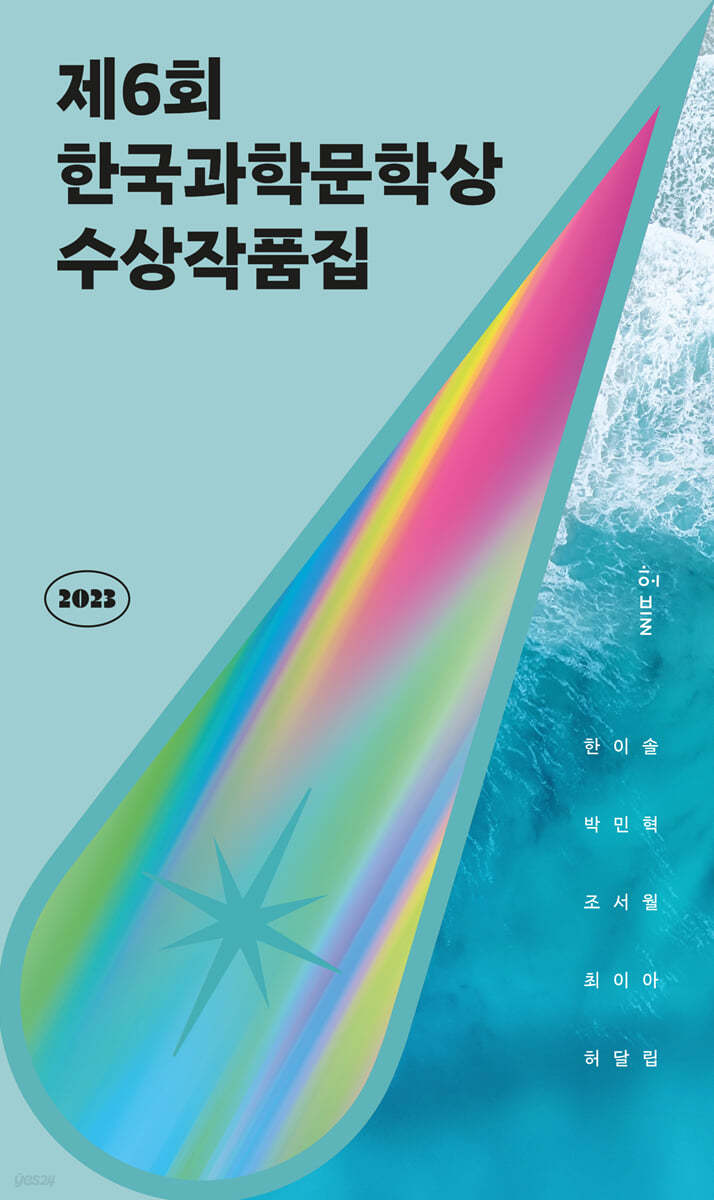
2023 6th Korea Science Literature Award Winners Collection
 |
Description
Book Introduction
- A word from MD
-
The most brilliant imagination in Korean science fiction novelsThe Korean Science Fiction Literature Award has become an important gateway for new writers in the literary world, beyond Korean science fiction novels.
This year, in 2023, we will present our diverse imagination to readers for the 6th time.
Let's discover a young and new world of five works, including the masterpiece "The Last Judgment" by Han I-sol.
It is also exquisite that artificial intelligence is the keyword for all five award-winning works.
May 23, 2023. Novel/Poetry PD Kim Yu-ri
As of 2023, 'generative AI services' are being provided in real time around the world.
All five winning works of the 6th Korea Science Literature Award included the keyword "artificial intelligence" within the free topic rules.
This year's award-winning authors, far from cowering in the face of the waves of change surging from the future, have risen above them and unleashed their vibrant imaginations.
The judges (novelists Koo Byeong-mo, Kim Seong-jung, and Kim Hee-sun, and literary critics Kang Ji-hee and In A-young) responded enthusiastically, saying, “We are all experiencing the singularity that began with artificial intelligence, and these works have arrived at such exquisite timing,” and “As we approach the era of artificial intelligence that is about to fully open, the fact that this amazing narrative has arrived at the right time gives us great joy.”
What kind of keen imagination did these inquisitive newcomers display? In 2003, a year rife with terror and war, Gibson, living up to his nickname "Black Prophet," focused on an unequal future where the weak were excluded and only the strong benefited, depicting the back alleys of a cyberpunk worldview. Meanwhile, the 2023 Korean Science Literature Award winners focused on the emergence of artificial intelligence, another personality, and depicted the anxiety and confusion of individuals and societies living alongside it.
Therefore, this 『2023 6th Korean Science Literature Award Collection』 should be seen as a result that accurately reflects the anxiety we all feel in a rapidly changing society since the advent of generative artificial intelligence services.
These five emerging writers capture social anxiety, use it as a driving force for their work, and offer comfort to readers living in this era.
Introducing them.
The winners of the 6th Korea Science Literature Award in the short story and medium story category are “Han I-sol,” “Park Min-hyeok,” “Jo Seo-wol,” “Choi I-ah,” and “Heo Dal-lip.”
All five winning works of the 6th Korea Science Literature Award included the keyword "artificial intelligence" within the free topic rules.
This year's award-winning authors, far from cowering in the face of the waves of change surging from the future, have risen above them and unleashed their vibrant imaginations.
The judges (novelists Koo Byeong-mo, Kim Seong-jung, and Kim Hee-sun, and literary critics Kang Ji-hee and In A-young) responded enthusiastically, saying, “We are all experiencing the singularity that began with artificial intelligence, and these works have arrived at such exquisite timing,” and “As we approach the era of artificial intelligence that is about to fully open, the fact that this amazing narrative has arrived at the right time gives us great joy.”
What kind of keen imagination did these inquisitive newcomers display? In 2003, a year rife with terror and war, Gibson, living up to his nickname "Black Prophet," focused on an unequal future where the weak were excluded and only the strong benefited, depicting the back alleys of a cyberpunk worldview. Meanwhile, the 2023 Korean Science Literature Award winners focused on the emergence of artificial intelligence, another personality, and depicted the anxiety and confusion of individuals and societies living alongside it.
Therefore, this 『2023 6th Korean Science Literature Award Collection』 should be seen as a result that accurately reflects the anxiety we all feel in a rapidly changing society since the advent of generative artificial intelligence services.
These five emerging writers capture social anxiety, use it as a driving force for their work, and offer comfort to readers living in this era.
Introducing them.
The winners of the 6th Korea Science Literature Award in the short story and medium story category are “Han I-sol,” “Park Min-hyeok,” “Jo Seo-wol,” “Choi I-ah,” and “Heo Dal-lip.”
- You can preview some of the book's contents.
Preview
index
【Target】 Han I-sol, "The Last Judgment" ·7
Author's Note ·81
[Excellence Award] Park Min-hyeok, "Two Worlds" ·85
Author's Note ·157
Excellence Award: Jo Seo-wol, "Samsara" ·161
Author's Note ·195
Excellence Award: Choi Yi-ah, "Jenny's Station" ·201
Author's Note ·235
[Excellence Award] Heo Dal-lip, "Balcesar Boarded This Ship" ·239
Author's Note ·279
2023 6th Korea Science Literature Award Review ·283
Author's Note ·81
[Excellence Award] Park Min-hyeok, "Two Worlds" ·85
Author's Note ·157
Excellence Award: Jo Seo-wol, "Samsara" ·161
Author's Note ·195
Excellence Award: Choi Yi-ah, "Jenny's Station" ·201
Author's Note ·235
[Excellence Award] Heo Dal-lip, "Balcesar Boarded This Ship" ·239
Author's Note ·279
2023 6th Korea Science Literature Award Review ·283
Detailed image

Into the book
The judge of the final trial was Solomon himself.
Humanity has been judged to the last.
I was saved from that judgment and finally knew that I was his son.
---From "Han I-sol_The Last Judgment"
Would it be to Solomon's own advantage to overwhelm men with his arguments?
Humanity killed Jesus and Socrates in court.
---From "Han I-sol_The Last Judgment"
A new tree had been planted in the dome two days ago, and now there was only one spot left in the dome.
There was only enough space for one person to lie down.
---From "Park Min-hyeok_Two Worlds"
It feels like a completely different world from outside.
I don't know what's real anymore.
Is the world outside the dome real, or is the dome real?
---From "Park Min-hyeok_Two Worlds"
Sarah realized that with each child's departure, the color of the universe reflected in her eyes grew darker.
---From "Joseo-wol_Samsara"
At the point when the Earth was destroyed, the merits and karma of all souls were fixed.
---From "Joseo-wol_Samsara"
I just kept living, suppressing the thought that my life, which should have been in a different space, was somehow placed in the same space.
---From "Choi Yi-ah_Jenny's Station"
This was followed by a briefing by government officials stating that the Mindbase function would be removed, the speaking mode would be limited to Korean, and the cargo capacity would be increased to supply Jenny 2 to multicultural families to prevent such illegal activities from recurring.
Behind the reporter, hundreds of Jennys were lined up and entering the warehouse.
---From "Choi Yi-ah_Jenny's Station"
Your voice always gives me something new.
When I am eliminated from this boundless universe, please hold my hand and pull me along.
---From "Heo Dal-lip_Bal Cesar boarded this ship"
“There is no word of thanks in Langseo-bi?”
“All of Langseobee’s actions are born from gratitude toward others.”
Humanity has been judged to the last.
I was saved from that judgment and finally knew that I was his son.
---From "Han I-sol_The Last Judgment"
Would it be to Solomon's own advantage to overwhelm men with his arguments?
Humanity killed Jesus and Socrates in court.
---From "Han I-sol_The Last Judgment"
A new tree had been planted in the dome two days ago, and now there was only one spot left in the dome.
There was only enough space for one person to lie down.
---From "Park Min-hyeok_Two Worlds"
It feels like a completely different world from outside.
I don't know what's real anymore.
Is the world outside the dome real, or is the dome real?
---From "Park Min-hyeok_Two Worlds"
Sarah realized that with each child's departure, the color of the universe reflected in her eyes grew darker.
---From "Joseo-wol_Samsara"
At the point when the Earth was destroyed, the merits and karma of all souls were fixed.
---From "Joseo-wol_Samsara"
I just kept living, suppressing the thought that my life, which should have been in a different space, was somehow placed in the same space.
---From "Choi Yi-ah_Jenny's Station"
This was followed by a briefing by government officials stating that the Mindbase function would be removed, the speaking mode would be limited to Korean, and the cargo capacity would be increased to supply Jenny 2 to multicultural families to prevent such illegal activities from recurring.
Behind the reporter, hundreds of Jennys were lined up and entering the warehouse.
---From "Choi Yi-ah_Jenny's Station"
Your voice always gives me something new.
When I am eliminated from this boundless universe, please hold my hand and pull me along.
---From "Heo Dal-lip_Bal Cesar boarded this ship"
“There is no word of thanks in Langseo-bi?”
“All of Langseobee’s actions are born from gratitude toward others.”
---From "Heo Dal-lip_Bal Cesar boarded this ship"
Publisher's Review
The Korea Science Fiction Literature Award, the gateway to science fiction that gave birth to Kim Cho-yeop and Cheon Seon-ran.
The common theme of the five winning entries, drawn from the free-topic rules, was "artificial intelligence."
“The future has already arrived.
“It’s just not widespread.”
The above passage, widely known in Korea, comes from a 2003 interview with the world-renowned science fiction writer William Gibson in The Economist. If we were to apply it to the current situation 20 years later, it would need to be revised as follows.
“The future has already arrived.
And now it's widespread.”
As of 2023, 'generative AI services' are being provided in real time around the world.
All five winning works of the 6th Korea Science Literature Award included the keyword "artificial intelligence" within the free topic rules.
This year's award-winning authors, far from cowering in the face of the waves of change surging from the future, have risen above them and unleashed their vibrant imaginations.
The judges (novelists Koo Byeong-mo, Kim Seong-jung, and Kim Hee-sun, and literary critics Kang Ji-hee and In A-young) responded enthusiastically, saying, “We are all experiencing the singularity that began with artificial intelligence, and these works have arrived at such exquisite timing,” and “As we approach the era of artificial intelligence that is about to fully open, the fact that this amazing narrative has arrived at the right time gives us great joy.”
It is often said that literature is a mirror reflecting reality.
Of course, it is said that science fiction should also reflect reality, and that science fiction should, from ancient times, capture reality more accurately than non-science fiction.
That's because of the 'thought experiment', which is a long-standing feature of science fiction.
In other words, to see the present more accurately, we need to look at it from a distance, a distance slightly removed from that era, and in the face of this social distancing, there is no method more suitable than a thought experiment.
So, science fiction writers who diligently look at reality with such expectations.
However, given that literature is fundamentally a creative work that is slow to react to social change, and especially now that the world is changing more rapidly than ever before, it would be extremely difficult for science fiction writers living in the present to capture the world.
Nevertheless, the authors who won the 6th Korea Science Literature Award took on the challenge and did it brilliantly.
And that too in front of the most important gateway for a writer.
What kind of keen imagination did these inquisitive newcomers display? In 2003, a year rife with terror and war, Gibson, living up to his nickname "Black Prophet," focused on an unequal future where the weak were excluded and only the strong benefited, depicting the back alleys of a cyberpunk worldview. Meanwhile, the 2023 Korean Science Literature Award winners focused on the emergence of artificial intelligence, another personality, and depicted the anxiety and confusion of individuals and societies living alongside it.
Therefore, this 『2023 6th Korean Science Literature Award Collection』 should be seen as a result that accurately reflects the anxiety we all feel in a rapidly changing society since the advent of generative artificial intelligence services.
These five emerging writers capture social anxiety, use it as a driving force for their work, and offer comfort to readers living in this era.
Introducing them.
The winners of the 6th Korea Science Literature Award in the short story and medium story category are “Han I-sol,” “Park Min-hyeok,” “Jo Seo-wol,” “Choi I-ah,” and “Heo Dal-lip.”
*Target* Han I-sol's "The Last Judgment"
An AI judge who committed a mistrial and ended up in court
A courtroom narrative tinged with admiration and loathing for artificial intelligence.
"A rare work that creates the tension of confronting the narrative."
Kang Ji-hee (literary critic)
The award-winning work, "The Last Judgment," features an artificial intelligence judge who judges human sins.
Even in a situation where distrust in the judiciary is growing, the popularity of AI judges is skyrocketing, but then an AI judge commits a clear error of judgment, and the judiciary, under public criticism, puts him in the defendant's seat instead of the presiding judge's seat.
And so the 'trial of the century' was opened.
Inside and outside the courtroom, those who admire and those who detest the AI judge are divided into battles.
The fierce legal battle comes to an end when the AI judge automatically terminates for unknown reasons, and then a young man who believed the AI judge to be the messiah of humanity commits suicide, leaving behind a suicide note.
The central narrative of "The Last Judgment" begins with the young man's mad will.
The near-future courtroom narrative of "The Last Judgment" is driven by the "sense of duty" of the young man who wrote the will and the former police officer who reads it, and the mystery of where this sense of duty comes from draws the reader in.
After forcibly arming the reader with such concentration, it then develops an interesting logic about 'humans', 'laws' created by humans, 'artificial intelligence', and the 'laws' handled by such artificial intelligence.
“It is an intelligent and provocative novel that repeatedly pushes the confrontation between AI judges and humans, and directly asks what AI can mean to humans today,” said critic Ina Young. “It is rare to find a work that provides the tension of confronting a narrative.
As critic Kang Ji-hee said, “Surprisingly, ‘The Last Judgment’ was just that kind of work,” the logical battle that unfolds in the work is not only bloody and fierce, but because this debate applies not only to the world of the work but also to reality, the readers who are watching the battle are also caught up in the fight before they know it.
The reader, who was struggling in confusion, unable to tell what was right and what was wrong, in the bloody puddle of logic that had formed in the future courtroom, finally meets the eyes of a young man who claims to have seen the Messiah.
Readers who have gone through this entire process together will, to borrow the words of novelist Gu Byeong-mo, experience “the pleasure of being a human being who judges for himself.”
*Excellence Award* Park Min-hyeok, "Two Worlds"
A pandemic that turns humans into trees and a treatment facility for manifesters
A dystopian tale of friendship and the end of a facility manager and an AI.
"A delightful work, combining both timeliness and novelistic techniques."
Ina Young (literary critic)
The award-winning work "Two Worlds" is set in the near future, where a highly contagious virus has broken out that turns humans into trees. The story centers around the manager of a research facility that houses the tree-turned-humans, along with an artificial intelligence that assists him.
The research facility is a hemispherical architectural structure with a round roof, as the name 'dome' suggests. The reason why the manifesters must be housed in a dome is because the sky outside the dome is covered with dark clouds for a long time, preventing sunlight from shining.
A research facility dome that creates an artificial sun sky that supplies the minimum amount of light that does not kill trees.
As time passes, more and more manifesters pour into the dome from outside, and as there is less space to plant trees inside the dome, the world gradually approaches destruction.
Of course, being inside a dome doesn't mean you're safe from the threat of a pandemic.
The administrators also gradually became wooden, and to make matters worse, the treatment research being conducted inside the dome was not producing any significant results, and the inside of the dome was also collapsing just as quickly as the outside.
The narrative of "Two Worlds" unfolds through an exchange of letters between the narrator inside the dome and the narrator's lover outside the dome, with no way of knowing when they will receive a reply.
The long wait, fear, and despair that can be felt from isolation and destruction create a sense of foreboding, and the source of this feeling is, of course, the recent COVID-19 pandemic.
As novelist Kim Hee-sun said, “It seems like a tribute to the COVID-19 era and the countless people who sacrificed themselves during that time,” and critic In Ah-young said, “It strongly brings to mind contemporary social issues such as the COVID-19 situation, the climate crisis, and the rights of flora and fauna,” and “It is a work that has both timeliness and novelistic techniques,” it would not be an exaggeration to say that this work has the imagination of mourning that we so desperately need right now as much as the imagination of artificial intelligence.
Furthermore, as can be seen in the words of novelist Koo Byeong-mo, who said, “It is a plant-like imagination that makes one think that even if it is extinction for humanity, it is an incredibly beautiful and beneficial thing for the Earth,” and novelist Kim Seong-jung, who said, “To put it extremely, it may be the end for humans, but on a planetary level, it may be evolution,” “Two Worlds” poses fundamental questions about the Anthropocene that go beyond mourning, and readers who are asked those questions will inevitably remember this work for a long time.
*Excellence Award* Jo Seo-wol, "Samsara"
Samsara, a spaceship that gives birth to children, launched by a fallen human race.
The myth of the creation and destruction of the universe by artificial intelligences tasked with restoring humanity.
“A powerful and captivating work, with woven sentences and commanding power.”
_Kim Seong-jung (novelist)
The award-winning work "Samsara" is centered around the spaceship "Samsara," the last hope of humanity on the brink of extinction, and features Samsara itself, an artificial intelligence system that gives birth to children, and an artificial intelligence robot that raises children as the main characters.
Up to this point, it's a relatively common 'Noah's Ark' narrative, but this work has an additional unique worldview: human reincarnation and the existence of the soul have been scientifically proven.
A world where it is a scientific fact that just as humans become souls when they die, so too do newly born humans possess souls.
In this intriguing worldview, the central narrative begins with the birth of soulless children in Samsara.
Artificial intelligence continues to be created, even if they are soulless and cannot live or move properly.
Eventually, they run into problems with limited power and resources, and the AIs mass-starve soulless children for the greater good.
In this way, in the middle of the universe, birth and murder are repeated endlessly, and the artificial intelligences that endure this eternal time “realize that every time a child leaves, the color of the universe reflected in their eyes becomes darker.”
As novelist Kim Seong-jung said, “‘Samsara’ is a powerful and fascinating myth of the creation and destruction of the universe,” and novelist Kim Hee-sun said, “The setting of soulless infants created in a spaceship that acts as an artificial womb and used as food shows, without reservation, the actual human life of consuming the future to support the present,” this work powerfully completes the myth of the miserable destruction that runs through the past, present, and future of our humanity.
Also, as critic Kang Ji-hee said, “The author’s ability to weave the atmosphere calmly without losing balance and reach a touching ending” and critic In Ah-young said, “The work generously handles each element with a very consistent and logical plot while not losing the tense tension with repeated twists until the ending,” this is a work that no one can help but have deep trust in, as it ultimately convinces the reader with both their head and heart in the latter half.
*Excellence Award* Choi Yi-ah, "Jenny's Role"
Jenny, a robot distributed to multicultural families and immigrant women in rural areas.
A rural sci-fi film that combines a mysterious murder mystery with patriarchal issues.
“A robot character with a powerful presence and a lovable presence that will make you smile.”
_Gu Byeong-mo (novelist)
The award-winning work, "Jenny's Station," is a so-called "rural SF" that centers around a near-future rural area where multiculturalism and robots are intertwined, and the language interpreting robot "Jenny," which dotted the rural landscape like a dragon's dot.
Jenny's position in this work is unusual because it lies between rural men and immigrant women, which can be said to be the origin of the patriarchal problem.
And as the narrator, a child born into a multicultural family, approaches that extraordinary point, the central narrative of "Jenny's Station" slowly begins. When the narrator reaches Jenny's place, the reader encounters a mysterious murder case through the narrator's eyes.
The victim in this case is a grandmother, and the suspect is the victim's daughter-in-law, a migrant woman.
Other rural migrant women, convinced by various circumstances that the migrant woman did not commit the murder, join forces to find evidence of her innocence.
However, the rural men who are adding fuel to the fire of an incident that has already come to a close, and who are further interfering with and suppressing those who are trying to raise their voices in a way that is 'unbecoming of immigrant women'.
The tense yet comical clash between the two sides is depicted with such vividness that you can hear their grumbling through the narrator's eyes.
As can be seen in critic Kang Ji-hee's comment that "Jenny's Station" has the power to draw readers in with its unique setting alone, and novelist Koo Byeong-mo's comment that "Jenny's function and behavior were so lovable that it made me smile as I pictured them in my head, and her presence was so powerful that it was one of the best among all the robots I've encountered through this contest," this work has everything that readers cannot help but love, from its worldview to its characters.
Here, the plausible details, such as Jenny carrying a sack for language interpretation, and the stable and solid structure of the novel that brings individual events together into a single theme, expand the loveliness of the worldview and characters to the affection for the work as a whole.
Moreover, as novelist Kim Seong-jung said, “This novel is a work that I want to support because of its freshness (‘When others go to space, I go to the countryside’)” and critic In Ah-young said, “If you look at the writer’s sense of balance that humorously depicts the eerie scenes of conservatism due to human selfishness and desire, I have come to look forward to other novels,” this work captivates readers from beginning to end with its delicious writing style and clear good and evil structure.
*Excellence Award* Heo Dal-lip, "Balcesar Got on This Ship"
Balcesar, who lost his wife and boarded a spaceship to find a new Earth.
His space voyage log, in which he falls in love with an artificial intelligence that mimics his dead wife.
"A work that draws us into the essence of life and art with unique ideas and entertaining characters."
Kim Hee-sun (novelist)
The award-winning work, "Balcesar Got On Board This Ship," borrows the narrative of "Noah's Ark" like "Samsara," but this work also has a unique setting: the spaceship is operated by the human captain's brain.
By replacing the human body with a spaceship body and modifying the brain to fit the spaceship body, one becomes a being that crosses the boundary between human and machine.
This kind of eccentricity is not limited to the captain's character.
The protagonist, Balcesar, a spaceship engineer who falls in love with an artificial intelligence created in the image of his dead wife, is also a character who makes you feel a sense of the Pygmalion myth. In addition, the fact that he sacrifices not only his own body but also the world to give the artificial intelligence a body doubles the bizarreness of the work, as it aligns with the unique theme of the work that "all boundaries are meaningless."
Going further, the work moves into fundamental and philosophical territory by repeatedly raising questions about the 'human brain' posed by the captain of the spaceship, who possesses a physical body.
And in the latter half, there is a twist where everything, including humans, is used as material for terraforming.
At this point, the concepts we had clearly understood as distinct, such as 'human and machine', 'body and mind', and 'inside and outside the cloud', become mixed up, and the reader feels a distant emotion that transcends love and romance.
As novelist Kim Hee-sun said, “It talks about the essence of life and art,” and critic Kang Ji-hee said, “This novel vividly depicts the truth that the voluntary end of humanity may be connected to the utmost love for humanity and that this can be quite beautiful,” “Balcesar Got on This Ship” is a unique narrative that tries to reach something essential, something close to the truth, beyond a man’s love and devotion through its unique imagination and a voice that matches it.
However, as critic Inayoung In said, “It is a narrative driven by the concrete longing for a loved one rather than the abstract cause of saving humanity, so it is possible to be moved,” and critic Byeongmo Koo said, “By eliminating the direct voice of the being called by the narrator, the passion is maximized and the irony is amplified,” the lyricism that this work faithfully embodies also has enough power to shake the hearts of readers.
The common theme of the five winning entries, drawn from the free-topic rules, was "artificial intelligence."
“The future has already arrived.
“It’s just not widespread.”
The above passage, widely known in Korea, comes from a 2003 interview with the world-renowned science fiction writer William Gibson in The Economist. If we were to apply it to the current situation 20 years later, it would need to be revised as follows.
“The future has already arrived.
And now it's widespread.”
As of 2023, 'generative AI services' are being provided in real time around the world.
All five winning works of the 6th Korea Science Literature Award included the keyword "artificial intelligence" within the free topic rules.
This year's award-winning authors, far from cowering in the face of the waves of change surging from the future, have risen above them and unleashed their vibrant imaginations.
The judges (novelists Koo Byeong-mo, Kim Seong-jung, and Kim Hee-sun, and literary critics Kang Ji-hee and In A-young) responded enthusiastically, saying, “We are all experiencing the singularity that began with artificial intelligence, and these works have arrived at such exquisite timing,” and “As we approach the era of artificial intelligence that is about to fully open, the fact that this amazing narrative has arrived at the right time gives us great joy.”
It is often said that literature is a mirror reflecting reality.
Of course, it is said that science fiction should also reflect reality, and that science fiction should, from ancient times, capture reality more accurately than non-science fiction.
That's because of the 'thought experiment', which is a long-standing feature of science fiction.
In other words, to see the present more accurately, we need to look at it from a distance, a distance slightly removed from that era, and in the face of this social distancing, there is no method more suitable than a thought experiment.
So, science fiction writers who diligently look at reality with such expectations.
However, given that literature is fundamentally a creative work that is slow to react to social change, and especially now that the world is changing more rapidly than ever before, it would be extremely difficult for science fiction writers living in the present to capture the world.
Nevertheless, the authors who won the 6th Korea Science Literature Award took on the challenge and did it brilliantly.
And that too in front of the most important gateway for a writer.
What kind of keen imagination did these inquisitive newcomers display? In 2003, a year rife with terror and war, Gibson, living up to his nickname "Black Prophet," focused on an unequal future where the weak were excluded and only the strong benefited, depicting the back alleys of a cyberpunk worldview. Meanwhile, the 2023 Korean Science Literature Award winners focused on the emergence of artificial intelligence, another personality, and depicted the anxiety and confusion of individuals and societies living alongside it.
Therefore, this 『2023 6th Korean Science Literature Award Collection』 should be seen as a result that accurately reflects the anxiety we all feel in a rapidly changing society since the advent of generative artificial intelligence services.
These five emerging writers capture social anxiety, use it as a driving force for their work, and offer comfort to readers living in this era.
Introducing them.
The winners of the 6th Korea Science Literature Award in the short story and medium story category are “Han I-sol,” “Park Min-hyeok,” “Jo Seo-wol,” “Choi I-ah,” and “Heo Dal-lip.”
*Target* Han I-sol's "The Last Judgment"
An AI judge who committed a mistrial and ended up in court
A courtroom narrative tinged with admiration and loathing for artificial intelligence.
"A rare work that creates the tension of confronting the narrative."
Kang Ji-hee (literary critic)
The award-winning work, "The Last Judgment," features an artificial intelligence judge who judges human sins.
Even in a situation where distrust in the judiciary is growing, the popularity of AI judges is skyrocketing, but then an AI judge commits a clear error of judgment, and the judiciary, under public criticism, puts him in the defendant's seat instead of the presiding judge's seat.
And so the 'trial of the century' was opened.
Inside and outside the courtroom, those who admire and those who detest the AI judge are divided into battles.
The fierce legal battle comes to an end when the AI judge automatically terminates for unknown reasons, and then a young man who believed the AI judge to be the messiah of humanity commits suicide, leaving behind a suicide note.
The central narrative of "The Last Judgment" begins with the young man's mad will.
The near-future courtroom narrative of "The Last Judgment" is driven by the "sense of duty" of the young man who wrote the will and the former police officer who reads it, and the mystery of where this sense of duty comes from draws the reader in.
After forcibly arming the reader with such concentration, it then develops an interesting logic about 'humans', 'laws' created by humans, 'artificial intelligence', and the 'laws' handled by such artificial intelligence.
“It is an intelligent and provocative novel that repeatedly pushes the confrontation between AI judges and humans, and directly asks what AI can mean to humans today,” said critic Ina Young. “It is rare to find a work that provides the tension of confronting a narrative.
As critic Kang Ji-hee said, “Surprisingly, ‘The Last Judgment’ was just that kind of work,” the logical battle that unfolds in the work is not only bloody and fierce, but because this debate applies not only to the world of the work but also to reality, the readers who are watching the battle are also caught up in the fight before they know it.
The reader, who was struggling in confusion, unable to tell what was right and what was wrong, in the bloody puddle of logic that had formed in the future courtroom, finally meets the eyes of a young man who claims to have seen the Messiah.
Readers who have gone through this entire process together will, to borrow the words of novelist Gu Byeong-mo, experience “the pleasure of being a human being who judges for himself.”
*Excellence Award* Park Min-hyeok, "Two Worlds"
A pandemic that turns humans into trees and a treatment facility for manifesters
A dystopian tale of friendship and the end of a facility manager and an AI.
"A delightful work, combining both timeliness and novelistic techniques."
Ina Young (literary critic)
The award-winning work "Two Worlds" is set in the near future, where a highly contagious virus has broken out that turns humans into trees. The story centers around the manager of a research facility that houses the tree-turned-humans, along with an artificial intelligence that assists him.
The research facility is a hemispherical architectural structure with a round roof, as the name 'dome' suggests. The reason why the manifesters must be housed in a dome is because the sky outside the dome is covered with dark clouds for a long time, preventing sunlight from shining.
A research facility dome that creates an artificial sun sky that supplies the minimum amount of light that does not kill trees.
As time passes, more and more manifesters pour into the dome from outside, and as there is less space to plant trees inside the dome, the world gradually approaches destruction.
Of course, being inside a dome doesn't mean you're safe from the threat of a pandemic.
The administrators also gradually became wooden, and to make matters worse, the treatment research being conducted inside the dome was not producing any significant results, and the inside of the dome was also collapsing just as quickly as the outside.
The narrative of "Two Worlds" unfolds through an exchange of letters between the narrator inside the dome and the narrator's lover outside the dome, with no way of knowing when they will receive a reply.
The long wait, fear, and despair that can be felt from isolation and destruction create a sense of foreboding, and the source of this feeling is, of course, the recent COVID-19 pandemic.
As novelist Kim Hee-sun said, “It seems like a tribute to the COVID-19 era and the countless people who sacrificed themselves during that time,” and critic In Ah-young said, “It strongly brings to mind contemporary social issues such as the COVID-19 situation, the climate crisis, and the rights of flora and fauna,” and “It is a work that has both timeliness and novelistic techniques,” it would not be an exaggeration to say that this work has the imagination of mourning that we so desperately need right now as much as the imagination of artificial intelligence.
Furthermore, as can be seen in the words of novelist Koo Byeong-mo, who said, “It is a plant-like imagination that makes one think that even if it is extinction for humanity, it is an incredibly beautiful and beneficial thing for the Earth,” and novelist Kim Seong-jung, who said, “To put it extremely, it may be the end for humans, but on a planetary level, it may be evolution,” “Two Worlds” poses fundamental questions about the Anthropocene that go beyond mourning, and readers who are asked those questions will inevitably remember this work for a long time.
*Excellence Award* Jo Seo-wol, "Samsara"
Samsara, a spaceship that gives birth to children, launched by a fallen human race.
The myth of the creation and destruction of the universe by artificial intelligences tasked with restoring humanity.
“A powerful and captivating work, with woven sentences and commanding power.”
_Kim Seong-jung (novelist)
The award-winning work "Samsara" is centered around the spaceship "Samsara," the last hope of humanity on the brink of extinction, and features Samsara itself, an artificial intelligence system that gives birth to children, and an artificial intelligence robot that raises children as the main characters.
Up to this point, it's a relatively common 'Noah's Ark' narrative, but this work has an additional unique worldview: human reincarnation and the existence of the soul have been scientifically proven.
A world where it is a scientific fact that just as humans become souls when they die, so too do newly born humans possess souls.
In this intriguing worldview, the central narrative begins with the birth of soulless children in Samsara.
Artificial intelligence continues to be created, even if they are soulless and cannot live or move properly.
Eventually, they run into problems with limited power and resources, and the AIs mass-starve soulless children for the greater good.
In this way, in the middle of the universe, birth and murder are repeated endlessly, and the artificial intelligences that endure this eternal time “realize that every time a child leaves, the color of the universe reflected in their eyes becomes darker.”
As novelist Kim Seong-jung said, “‘Samsara’ is a powerful and fascinating myth of the creation and destruction of the universe,” and novelist Kim Hee-sun said, “The setting of soulless infants created in a spaceship that acts as an artificial womb and used as food shows, without reservation, the actual human life of consuming the future to support the present,” this work powerfully completes the myth of the miserable destruction that runs through the past, present, and future of our humanity.
Also, as critic Kang Ji-hee said, “The author’s ability to weave the atmosphere calmly without losing balance and reach a touching ending” and critic In Ah-young said, “The work generously handles each element with a very consistent and logical plot while not losing the tense tension with repeated twists until the ending,” this is a work that no one can help but have deep trust in, as it ultimately convinces the reader with both their head and heart in the latter half.
*Excellence Award* Choi Yi-ah, "Jenny's Role"
Jenny, a robot distributed to multicultural families and immigrant women in rural areas.
A rural sci-fi film that combines a mysterious murder mystery with patriarchal issues.
“A robot character with a powerful presence and a lovable presence that will make you smile.”
_Gu Byeong-mo (novelist)
The award-winning work, "Jenny's Station," is a so-called "rural SF" that centers around a near-future rural area where multiculturalism and robots are intertwined, and the language interpreting robot "Jenny," which dotted the rural landscape like a dragon's dot.
Jenny's position in this work is unusual because it lies between rural men and immigrant women, which can be said to be the origin of the patriarchal problem.
And as the narrator, a child born into a multicultural family, approaches that extraordinary point, the central narrative of "Jenny's Station" slowly begins. When the narrator reaches Jenny's place, the reader encounters a mysterious murder case through the narrator's eyes.
The victim in this case is a grandmother, and the suspect is the victim's daughter-in-law, a migrant woman.
Other rural migrant women, convinced by various circumstances that the migrant woman did not commit the murder, join forces to find evidence of her innocence.
However, the rural men who are adding fuel to the fire of an incident that has already come to a close, and who are further interfering with and suppressing those who are trying to raise their voices in a way that is 'unbecoming of immigrant women'.
The tense yet comical clash between the two sides is depicted with such vividness that you can hear their grumbling through the narrator's eyes.
As can be seen in critic Kang Ji-hee's comment that "Jenny's Station" has the power to draw readers in with its unique setting alone, and novelist Koo Byeong-mo's comment that "Jenny's function and behavior were so lovable that it made me smile as I pictured them in my head, and her presence was so powerful that it was one of the best among all the robots I've encountered through this contest," this work has everything that readers cannot help but love, from its worldview to its characters.
Here, the plausible details, such as Jenny carrying a sack for language interpretation, and the stable and solid structure of the novel that brings individual events together into a single theme, expand the loveliness of the worldview and characters to the affection for the work as a whole.
Moreover, as novelist Kim Seong-jung said, “This novel is a work that I want to support because of its freshness (‘When others go to space, I go to the countryside’)” and critic In Ah-young said, “If you look at the writer’s sense of balance that humorously depicts the eerie scenes of conservatism due to human selfishness and desire, I have come to look forward to other novels,” this work captivates readers from beginning to end with its delicious writing style and clear good and evil structure.
*Excellence Award* Heo Dal-lip, "Balcesar Got on This Ship"
Balcesar, who lost his wife and boarded a spaceship to find a new Earth.
His space voyage log, in which he falls in love with an artificial intelligence that mimics his dead wife.
"A work that draws us into the essence of life and art with unique ideas and entertaining characters."
Kim Hee-sun (novelist)
The award-winning work, "Balcesar Got On Board This Ship," borrows the narrative of "Noah's Ark" like "Samsara," but this work also has a unique setting: the spaceship is operated by the human captain's brain.
By replacing the human body with a spaceship body and modifying the brain to fit the spaceship body, one becomes a being that crosses the boundary between human and machine.
This kind of eccentricity is not limited to the captain's character.
The protagonist, Balcesar, a spaceship engineer who falls in love with an artificial intelligence created in the image of his dead wife, is also a character who makes you feel a sense of the Pygmalion myth. In addition, the fact that he sacrifices not only his own body but also the world to give the artificial intelligence a body doubles the bizarreness of the work, as it aligns with the unique theme of the work that "all boundaries are meaningless."
Going further, the work moves into fundamental and philosophical territory by repeatedly raising questions about the 'human brain' posed by the captain of the spaceship, who possesses a physical body.
And in the latter half, there is a twist where everything, including humans, is used as material for terraforming.
At this point, the concepts we had clearly understood as distinct, such as 'human and machine', 'body and mind', and 'inside and outside the cloud', become mixed up, and the reader feels a distant emotion that transcends love and romance.
As novelist Kim Hee-sun said, “It talks about the essence of life and art,” and critic Kang Ji-hee said, “This novel vividly depicts the truth that the voluntary end of humanity may be connected to the utmost love for humanity and that this can be quite beautiful,” “Balcesar Got on This Ship” is a unique narrative that tries to reach something essential, something close to the truth, beyond a man’s love and devotion through its unique imagination and a voice that matches it.
However, as critic Inayoung In said, “It is a narrative driven by the concrete longing for a loved one rather than the abstract cause of saving humanity, so it is possible to be moved,” and critic Byeongmo Koo said, “By eliminating the direct voice of the being called by the narrator, the passion is maximized and the irony is amplified,” the lyricism that this work faithfully embodies also has enough power to shake the hearts of readers.
GOODS SPECIFICS
- Date of issue: May 10, 2023
- Page count, weight, size: 336 pages | 384g | 125*210*30mm
- ISBN13: 9791193078006
- ISBN10: 1193078008
You may also like
카테고리
korean


korean

![GQ KOREA Mark (Monthly): December [2025]](http://librairie.coreenne.fr/cdn/shop/files/8ef265dbbfbf186523ed75ba7319009d.jpg?v=1765340328&width=3840)


