

Is everything okay?
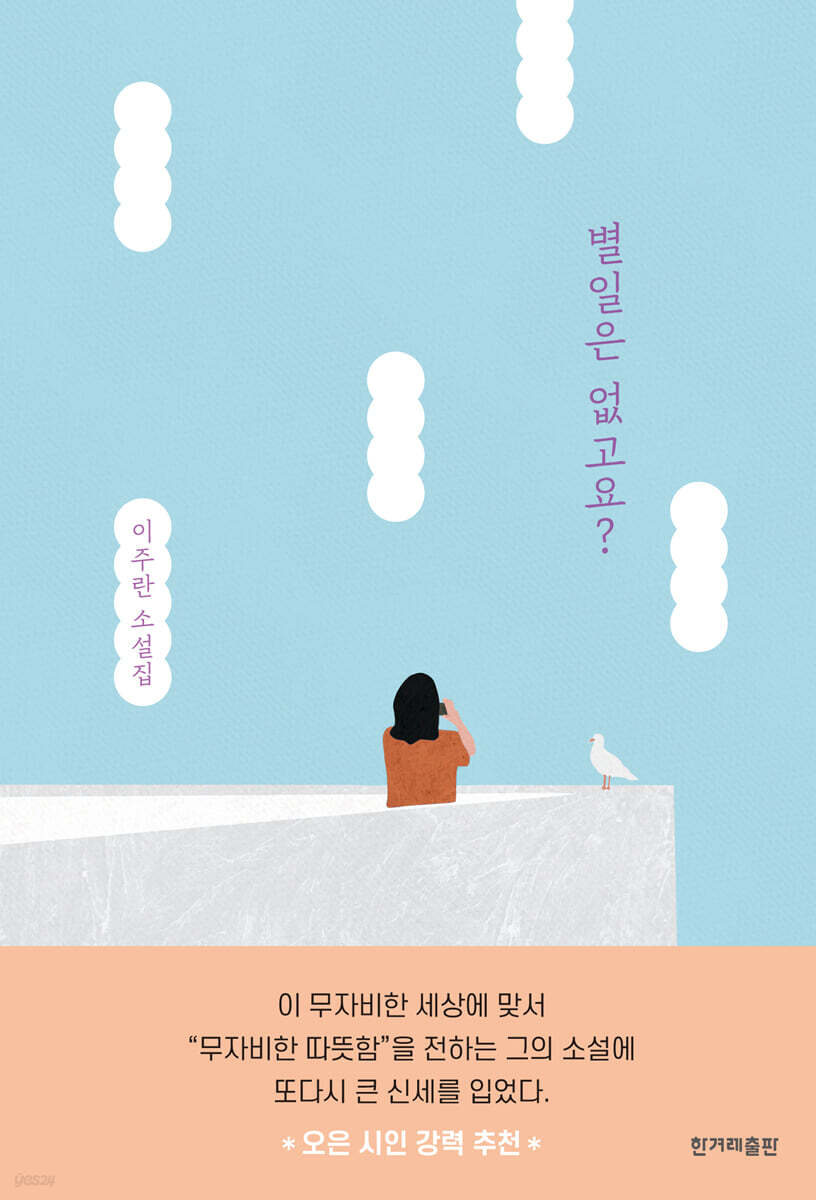 |
Description
Book Introduction
- A word from MD
-
Even in sadness, there is a heart that shinesA new work by author Lee Ju-ran, known for her warm and delicate gaze.
The characters in the novel want to live an ordinary life, but they are unable to do so and each suffer from their own pain.
These are small but shining stories of them stepping out into the world again with a strong heart as time passes.
You may often encounter surprising scenes that are so similar to ours.
May 16, 2023. Novel/Poetry PD Kim Yu-ri
Such a pure and clear world,
A New Lyricism in Korean Literature: Lee Ju-ran's New Novel
Now that we are torn apart, broken and collapsed,
Finally, the 'feeling that there is a next time' has arrived.
“I love Lee Ju-ran’s novels, which don’t rashly assume they know anything, but rather know how to step back and simply observe suffering” (novelist Park Sang-young), “They are consistently tense without dramatic scenes, perfect without a grand plot, full of poetry without poetry, and show the end of sadness without triumph” (poet Park Yeon-jun).
Since beginning her career in 2012, Lee Ju-ran has garnered unrivaled support for her unique lyricism that gently permeates rather than loudly asserts.
His novels have been praised as being 'stories that seem plain yet sparkle with wit, and stories that seem indifferent yet feel warm.'
The third collection of short stories by a thoughtful novelist who looks into the gaps between people and words, “Nothing Happened?” has been published.
The narrators in the novel wanted to live ordinary lives like everyone else, without any greed, but the world rejects them too easily.
'I' am staying in a small town with a wounded body, as if the rope I was holding on to with difficulty was let go.
There, I recover quietly and slowly by spending my daily life eating, drinking, walking, and talking with people.
Pain and sadness are everywhere, including memories of failure, childhood wounds, and separation from family, but even amidst them, warmth shines through in these eight short stories.
A New Lyricism in Korean Literature: Lee Ju-ran's New Novel
Now that we are torn apart, broken and collapsed,
Finally, the 'feeling that there is a next time' has arrived.
“I love Lee Ju-ran’s novels, which don’t rashly assume they know anything, but rather know how to step back and simply observe suffering” (novelist Park Sang-young), “They are consistently tense without dramatic scenes, perfect without a grand plot, full of poetry without poetry, and show the end of sadness without triumph” (poet Park Yeon-jun).
Since beginning her career in 2012, Lee Ju-ran has garnered unrivaled support for her unique lyricism that gently permeates rather than loudly asserts.
His novels have been praised as being 'stories that seem plain yet sparkle with wit, and stories that seem indifferent yet feel warm.'
The third collection of short stories by a thoughtful novelist who looks into the gaps between people and words, “Nothing Happened?” has been published.
The narrators in the novel wanted to live ordinary lives like everyone else, without any greed, but the world rejects them too easily.
'I' am staying in a small town with a wounded body, as if the rope I was holding on to with difficulty was let go.
There, I recover quietly and slowly by spending my daily life eating, drinking, walking, and talking with people.
Pain and sadness are everywhere, including memories of failure, childhood wounds, and separation from family, but even amidst them, warmth shines through in these eight short stories.
- You can preview some of the book's contents.
Preview
index
Is everything okay?
People
adult
summer night
for
People of this world
Seoul evening
In Paju
Author's Note
People
adult
summer night
for
People of this world
Seoul evening
In Paju
Author's Note
Into the book
You've worked hard so far, so take a break for a while.
I didn't say anything, but he said that to me.
I nodded obediently at my mother's words.
I felt sorry for myself because it seemed like I was the only one who broke down so easily.
---From "Nothing special?"
That night I cried quietly.
It was night, my mom was asleep, and I had taken a nap and woke up in the evening and couldn't fall back asleep.
I held my breath, but it was difficult to hide my crying in a 5-pyeong studio apartment, and my feelings were complicated.
It was past midnight, past 2 o'clock, and in my mother's room, there was my mother, the room, and me. My mother's snoring was small, the room was small, my crying was small, everything was small, it was that kind of night.
---From "Nothing special?"
If you're afraid of breaking up, just love more.
Right?
---From "Nothing special?"
For a moment, I remembered that room from long ago.
There are memories that you want to forget but can't, and there are memories that you don't want to forget but can be forgotten.
I think that memories are something that we must keep remembering and talking about.
I can't live every moment remembering, but I kind of hated it if it meant someone's death.
---From "Nothing special?"
And then I quietly closed my eyes.
There was no sound, only the occasional chirping of birds.
It wasn't a grand wish, but I just hoped that I would get to know myself as I changed, that we wouldn't fight every day, and if we did, that we would make up.
---From "Nothing special?"
After much thought, I quit my job and spent some quality time with my mom.
I thought I was stuck in a swamp, but it was so bad that I started to wonder if there was a good thing about being stuck in a swamp.
I thought, "It turned out so well, unexpectedly."
Maybe Mom felt the same way? Those were the saddest, yet happiest days of my life.
It was like my mother letting go of the rope she had been holding on to with such difficulty. I was sorry and grateful that she had been waiting for me to have time, and that she had been in pain. So we did our best for each other.
It was heartbreaking to hear my mom say things like, "Thank goodness, it's so good, I'm really happy now," but I think I held on with those thoughts, too.
I had only received from my mother my whole life, so back then I wanted to give her everything, but there wasn't much I could give her.
You will be alone now and you may cry a lot.
My mother said that, and whenever I hear crying coming from next door, I often think back to her words.
---From "People"
When I lived near the company where I worked with Eunyoung, I thought about my knees every day.
Every time I bent my knees, I thought of my knees.
I knew people were kneeling on each other's knees and looking up at the sky, but I used to think that my knees were just wearing out, that I was wearing them out myself.
---From "People"
I think people's minds are always changing.
In the meantime, you live with the memories of that day or with the feelings of that day.
People who live with such memories or with such feelings.
---From "People"
It was just tofu, I thought, and somehow it felt a little warm.
---From "Adult"
It was a road where the once lush things were drying up one by one, but there were still more things that were alive.
---From "Adult"
For four years now, I've been signing contracts every four months.
I kept working on the contract, but my heart was always pounding.
So, if I had put more passion into it, who would have believed me?
Who said that the more anxious and nervous you are, the more you try your best.
---From "Adult"
You have lived your life to the fullest.
The lady who gave me soju and beer while I was crying.
A middle-aged woman who only drinks beer but also drinks soju.
---From "Adult"
Even though I knew it wouldn't work, I kept going and I will keep going.
How can that be?
Just do it.
Because it would be good if you did it.
My mother was always the type of person who spoke to me through her actions.
I think the lady is honest.
---From "Adult"
I ate warmed up pumpkin porridge.
Then, suddenly, I shed a few tears. It wasn't because the pumpkin porridge was so delicious, nor because I was sad about something.
It was because of the merciless warmth that I was now receiving everything that my mother had lived her life to the fullest.
---From "Adult"
Eunyoung was a good person just by being with her and just looking at her, and even when I couldn't see her, she was still a good person.
Eunyoung is that kind of person to me.
---From "Adult"
How many laps did I go around?
Now I was running away from the lady and mixed in with other people, and when I got tired, I would stop for a moment and then run again.
The lady told me that it's good to do that when things are too hard.
---From "Adult"
I wonder if I can spend next spring with Eunyoung again.
On a dark night walk, I smell the faint scent of lilacs drifting from somewhere, and on weekends, I dig up mugwort in Jun-kyung's field and eat a simple meal with a bowl of mugwort soup and pickled cucumbers.
Eunyoung quietly disappeared one summer night during a period of prolonged tropical nights.
---From "Summer Night"
I wish life were just a two-hour climb up a low mountain like this.
I don't even want anything like healing.
---From "For"
I think it will be a home for you.
huh.
Let us be each other's home.
I was going to say that I thought he would be a burden, but I misspelled the letter ㅁ as ㅂ and instead he said that we should be each other's home.
I couldn't tell you it was a typo.
Because the words, “Let’s be each other’s home,” were so incredibly good.
It was so unbelievable and I wanted to believe it, but after a few days, I couldn't believe it either.
---From "People of This World"
If I think about it, I have my own way of dealing with sadness, but I also don't know what to do when I'm happy.
Maybe it's because there haven't been many happy things lately.
Lack of experience.
Lack of joy, so to speak.
I thought about it, and every time I did, I would chew over Bora's words that being happy and being joyful are probably different things.
---From "Evening in Seoul"
Because some words and feelings can never be expressed unless they are said at that time.
So, I will say what I want to say... ...when I really need to say it.
---From "Evening in Seoul"
next.
Yes, there is usually a next time.
I used to live with the thought that there would be a next time, and I had forgotten that thought for quite some time, but now I often take the next time for granted.
After the days when I was sure that words would never come again and the days when I promised myself not to live too happily, Bora and I share what's left.
So, that's how we became friends.
---From "Evening in Seoul"
Hyun-kyung held Jae-han's hand for a moment and then let go.
Hyun Kyung-ah.
well.
You have to live well.
Jaehan said again.
huh.
Live well.
Hyun-kyung said that and walked towards the taxi with the 'reservation' light blinking.
I didn't say anything, but he said that to me.
I nodded obediently at my mother's words.
I felt sorry for myself because it seemed like I was the only one who broke down so easily.
---From "Nothing special?"
That night I cried quietly.
It was night, my mom was asleep, and I had taken a nap and woke up in the evening and couldn't fall back asleep.
I held my breath, but it was difficult to hide my crying in a 5-pyeong studio apartment, and my feelings were complicated.
It was past midnight, past 2 o'clock, and in my mother's room, there was my mother, the room, and me. My mother's snoring was small, the room was small, my crying was small, everything was small, it was that kind of night.
---From "Nothing special?"
If you're afraid of breaking up, just love more.
Right?
---From "Nothing special?"
For a moment, I remembered that room from long ago.
There are memories that you want to forget but can't, and there are memories that you don't want to forget but can be forgotten.
I think that memories are something that we must keep remembering and talking about.
I can't live every moment remembering, but I kind of hated it if it meant someone's death.
---From "Nothing special?"
And then I quietly closed my eyes.
There was no sound, only the occasional chirping of birds.
It wasn't a grand wish, but I just hoped that I would get to know myself as I changed, that we wouldn't fight every day, and if we did, that we would make up.
---From "Nothing special?"
After much thought, I quit my job and spent some quality time with my mom.
I thought I was stuck in a swamp, but it was so bad that I started to wonder if there was a good thing about being stuck in a swamp.
I thought, "It turned out so well, unexpectedly."
Maybe Mom felt the same way? Those were the saddest, yet happiest days of my life.
It was like my mother letting go of the rope she had been holding on to with such difficulty. I was sorry and grateful that she had been waiting for me to have time, and that she had been in pain. So we did our best for each other.
It was heartbreaking to hear my mom say things like, "Thank goodness, it's so good, I'm really happy now," but I think I held on with those thoughts, too.
I had only received from my mother my whole life, so back then I wanted to give her everything, but there wasn't much I could give her.
You will be alone now and you may cry a lot.
My mother said that, and whenever I hear crying coming from next door, I often think back to her words.
---From "People"
When I lived near the company where I worked with Eunyoung, I thought about my knees every day.
Every time I bent my knees, I thought of my knees.
I knew people were kneeling on each other's knees and looking up at the sky, but I used to think that my knees were just wearing out, that I was wearing them out myself.
---From "People"
I think people's minds are always changing.
In the meantime, you live with the memories of that day or with the feelings of that day.
People who live with such memories or with such feelings.
---From "People"
It was just tofu, I thought, and somehow it felt a little warm.
---From "Adult"
It was a road where the once lush things were drying up one by one, but there were still more things that were alive.
---From "Adult"
For four years now, I've been signing contracts every four months.
I kept working on the contract, but my heart was always pounding.
So, if I had put more passion into it, who would have believed me?
Who said that the more anxious and nervous you are, the more you try your best.
---From "Adult"
You have lived your life to the fullest.
The lady who gave me soju and beer while I was crying.
A middle-aged woman who only drinks beer but also drinks soju.
---From "Adult"
Even though I knew it wouldn't work, I kept going and I will keep going.
How can that be?
Just do it.
Because it would be good if you did it.
My mother was always the type of person who spoke to me through her actions.
I think the lady is honest.
---From "Adult"
I ate warmed up pumpkin porridge.
Then, suddenly, I shed a few tears. It wasn't because the pumpkin porridge was so delicious, nor because I was sad about something.
It was because of the merciless warmth that I was now receiving everything that my mother had lived her life to the fullest.
---From "Adult"
Eunyoung was a good person just by being with her and just looking at her, and even when I couldn't see her, she was still a good person.
Eunyoung is that kind of person to me.
---From "Adult"
How many laps did I go around?
Now I was running away from the lady and mixed in with other people, and when I got tired, I would stop for a moment and then run again.
The lady told me that it's good to do that when things are too hard.
---From "Adult"
I wonder if I can spend next spring with Eunyoung again.
On a dark night walk, I smell the faint scent of lilacs drifting from somewhere, and on weekends, I dig up mugwort in Jun-kyung's field and eat a simple meal with a bowl of mugwort soup and pickled cucumbers.
Eunyoung quietly disappeared one summer night during a period of prolonged tropical nights.
---From "Summer Night"
I wish life were just a two-hour climb up a low mountain like this.
I don't even want anything like healing.
---From "For"
I think it will be a home for you.
huh.
Let us be each other's home.
I was going to say that I thought he would be a burden, but I misspelled the letter ㅁ as ㅂ and instead he said that we should be each other's home.
I couldn't tell you it was a typo.
Because the words, “Let’s be each other’s home,” were so incredibly good.
It was so unbelievable and I wanted to believe it, but after a few days, I couldn't believe it either.
---From "People of This World"
If I think about it, I have my own way of dealing with sadness, but I also don't know what to do when I'm happy.
Maybe it's because there haven't been many happy things lately.
Lack of experience.
Lack of joy, so to speak.
I thought about it, and every time I did, I would chew over Bora's words that being happy and being joyful are probably different things.
---From "Evening in Seoul"
Because some words and feelings can never be expressed unless they are said at that time.
So, I will say what I want to say... ...when I really need to say it.
---From "Evening in Seoul"
next.
Yes, there is usually a next time.
I used to live with the thought that there would be a next time, and I had forgotten that thought for quite some time, but now I often take the next time for granted.
After the days when I was sure that words would never come again and the days when I promised myself not to live too happily, Bora and I share what's left.
So, that's how we became friends.
---From "Evening in Seoul"
Hyun-kyung held Jae-han's hand for a moment and then let go.
Hyun Kyung-ah.
well.
You have to live well.
Jaehan said again.
huh.
Live well.
Hyun-kyung said that and walked towards the taxi with the 'reservation' light blinking.
---From "In Paju"
Publisher's Review
“You have lived well and done your best.”
The best stories, built with delicate daily life and emotions.
The world of Lee Ju-ran's novels is like a museum filled with detailed daily life and subtle emotions.
When you enter the museum, things that seem so trivial that you might pass them by are transformed into urgent and precious moments.
For example, it is the kind of emotion that is instantly evoked by “the faint scent of lilacs drifting from somewhere on a walk on a dark night, and the simple meal of digging mugwort in Jun-kyung’s field on the weekends and having a bowl of mugwort soup and pickled cucumbers” (p. 118).
Readers are invited to become part of an 'emotional community' filled with feelings of regret and gratitude, shame and pride, trustworthiness and warmth.
In the title piece, “Nothing Happened?”, after writing a letter of resignation to the company, “I” heads to see my mother, who lives in a place that is not even my hometown.
The arson incident committed by the man downstairs has solved a problem that has been bothering me for a long time.
'I', who came down to the quiet scenery of the unit, cried quietly that night in my mother's 5-pyeong studio apartment.
He continues his daily routine of painting all winter, teaching Korean to foreign workers at the factory where his mother cooks, and running errands at the hardware store.
As we spend days looking at each other, eating, talking, taking walks, and sharing our hearts, spring finally arrives and we meet Jaeseop.
On the way home after a chance trip to Seoul, I suddenly felt like crying when I saw Jaeseop's message asking, "Is everything okay?"
You've worked hard so far, so take a break for a while.
I didn't say anything, but he said that to me.
I nodded obediently at my mother's words.
I felt sorry for being the only one who broke so easily. _"Is everything okay?"
In "Adult," 'I' stays at a country house to sort out the belongings of the deceased after the funeral of my grandmother, my only remaining blood relative.
The 'ajumma' I met by chance a few years ago is an honest and generous person who has worked as a sewing machine seller in Cheonggyecheon for a long time, and she remains by my side to give me strength.
As a contract worker, I have been working every four months for four years.
Every time, my heart raced and I poured more passion into it. “I didn’t give up because I was anxious and nervous, but I did my best,” but of course, I didn’t receive any reward from the company.
I was able to endure the dreary life in Seoul thanks to my mother.
I can't bring myself to clean up my grandmother's house, so I cry and laugh with her and let out my feelings.
“I want you to cry freely” (p. 104).
The lady is the only adult who has affirmed my life, which I have lived to the fullest, by giving me soju and beer.
I run in the way the woman had told me, feeling “the merciless warmth of the fact that I am now sharing everything she has lived her life to the fullest” (p. 114).
When you feel tired, it is good to stop in the middle and then start running again. When you feel too tired, it is good to do that.
Just as life continues even after the story ends, the steps we take as we leave and return are directed towards hope.
I am deeply indebted to his novel, which conveys "merciless warmth" ("Adult") in the face of this merciless world. _Oh Eun (poet)
"The steps we take as we leave and return are directed toward hope."
A firm step forward after loss
Like a series of short stories, each one depicts a landscape of various wounds and loss.
"People" contains the story of 'me' who experienced the death of my mother and the few days I spent with my former coworker who also lost his mother and left after leaving.
"Evening in Seoul" tells the story of two days spent together on the anniversary of the death of a friend from a foreign land in their twenties.
"People of This World" is a novel written in the form of a response to a document about "him," a father who committed domestic violence.
I've moved countless times over the past 20 years and I live as if he's no longer of this world, but for me, who's consumed by hellish memories, I desperately need peace in my daily life.
"For" is a story about a day I spent with a girl next door who was in a similar situation to me when I was young. I had learned not to dream of anything since I was young due to my unfortunate circumstances, and I had been accustomed to thinking that it was only for my own sake.
But the fact that these novels do not simply represent loss is likely due to Lee Ju-ran's unique novelistic attitude.
In an interview, the author said that he wanted to write a novel that started from the state or emotion of sadness after it had passed and there was a bit of peace, rather than dwelling on it.
Loss or sadness is a subtle trace of life that comes from a certain time, someone, or emotion.
As the mother says in “Nothing much happened?”, “Even if it’s a new house, someone could die in that room someday” (page 25).
Meeting and parting, living and dying are all on the same path, and so we say goodbye every day.
Yet, Lee Ju-ran's novel vividly reminds us that every step along that path must ultimately lead towards hope.
I look at life as it flows by slowly, and I believe that there is always a 'next time'.
The final words of "In Paju," which depicts the journey of "Hyeon-gyeong," who went out into the world a few months after her husband's death, to meet her old lover, can be read as the author's encouragement to us who are about to take our next steps.
Hyun-kyung held Jae-han's hand for a moment and then let go.
Hyun Kyung-ah.
well.
You have to live well.
Jaehan said again.
huh.
Live well.
Hyun-kyung said that and walked toward the taxi with its "reservation" sign flashing. _「In Paju」
The best stories, built with delicate daily life and emotions.
The world of Lee Ju-ran's novels is like a museum filled with detailed daily life and subtle emotions.
When you enter the museum, things that seem so trivial that you might pass them by are transformed into urgent and precious moments.
For example, it is the kind of emotion that is instantly evoked by “the faint scent of lilacs drifting from somewhere on a walk on a dark night, and the simple meal of digging mugwort in Jun-kyung’s field on the weekends and having a bowl of mugwort soup and pickled cucumbers” (p. 118).
Readers are invited to become part of an 'emotional community' filled with feelings of regret and gratitude, shame and pride, trustworthiness and warmth.
In the title piece, “Nothing Happened?”, after writing a letter of resignation to the company, “I” heads to see my mother, who lives in a place that is not even my hometown.
The arson incident committed by the man downstairs has solved a problem that has been bothering me for a long time.
'I', who came down to the quiet scenery of the unit, cried quietly that night in my mother's 5-pyeong studio apartment.
He continues his daily routine of painting all winter, teaching Korean to foreign workers at the factory where his mother cooks, and running errands at the hardware store.
As we spend days looking at each other, eating, talking, taking walks, and sharing our hearts, spring finally arrives and we meet Jaeseop.
On the way home after a chance trip to Seoul, I suddenly felt like crying when I saw Jaeseop's message asking, "Is everything okay?"
You've worked hard so far, so take a break for a while.
I didn't say anything, but he said that to me.
I nodded obediently at my mother's words.
I felt sorry for being the only one who broke so easily. _"Is everything okay?"
In "Adult," 'I' stays at a country house to sort out the belongings of the deceased after the funeral of my grandmother, my only remaining blood relative.
The 'ajumma' I met by chance a few years ago is an honest and generous person who has worked as a sewing machine seller in Cheonggyecheon for a long time, and she remains by my side to give me strength.
As a contract worker, I have been working every four months for four years.
Every time, my heart raced and I poured more passion into it. “I didn’t give up because I was anxious and nervous, but I did my best,” but of course, I didn’t receive any reward from the company.
I was able to endure the dreary life in Seoul thanks to my mother.
I can't bring myself to clean up my grandmother's house, so I cry and laugh with her and let out my feelings.
“I want you to cry freely” (p. 104).
The lady is the only adult who has affirmed my life, which I have lived to the fullest, by giving me soju and beer.
I run in the way the woman had told me, feeling “the merciless warmth of the fact that I am now sharing everything she has lived her life to the fullest” (p. 114).
When you feel tired, it is good to stop in the middle and then start running again. When you feel too tired, it is good to do that.
Just as life continues even after the story ends, the steps we take as we leave and return are directed towards hope.
I am deeply indebted to his novel, which conveys "merciless warmth" ("Adult") in the face of this merciless world. _Oh Eun (poet)
"The steps we take as we leave and return are directed toward hope."
A firm step forward after loss
Like a series of short stories, each one depicts a landscape of various wounds and loss.
"People" contains the story of 'me' who experienced the death of my mother and the few days I spent with my former coworker who also lost his mother and left after leaving.
"Evening in Seoul" tells the story of two days spent together on the anniversary of the death of a friend from a foreign land in their twenties.
"People of This World" is a novel written in the form of a response to a document about "him," a father who committed domestic violence.
I've moved countless times over the past 20 years and I live as if he's no longer of this world, but for me, who's consumed by hellish memories, I desperately need peace in my daily life.
"For" is a story about a day I spent with a girl next door who was in a similar situation to me when I was young. I had learned not to dream of anything since I was young due to my unfortunate circumstances, and I had been accustomed to thinking that it was only for my own sake.
But the fact that these novels do not simply represent loss is likely due to Lee Ju-ran's unique novelistic attitude.
In an interview, the author said that he wanted to write a novel that started from the state or emotion of sadness after it had passed and there was a bit of peace, rather than dwelling on it.
Loss or sadness is a subtle trace of life that comes from a certain time, someone, or emotion.
As the mother says in “Nothing much happened?”, “Even if it’s a new house, someone could die in that room someday” (page 25).
Meeting and parting, living and dying are all on the same path, and so we say goodbye every day.
Yet, Lee Ju-ran's novel vividly reminds us that every step along that path must ultimately lead towards hope.
I look at life as it flows by slowly, and I believe that there is always a 'next time'.
The final words of "In Paju," which depicts the journey of "Hyeon-gyeong," who went out into the world a few months after her husband's death, to meet her old lover, can be read as the author's encouragement to us who are about to take our next steps.
Hyun-kyung held Jae-han's hand for a moment and then let go.
Hyun Kyung-ah.
well.
You have to live well.
Jaehan said again.
huh.
Live well.
Hyun-kyung said that and walked toward the taxi with its "reservation" sign flashing. _「In Paju」
GOODS SPECIFICS
- Date of issue: April 30, 2023
- Page count, weight, size: 280 pages | 312g | 128*188*20mm
- ISBN13: 9791160409932
- ISBN10: 1160409935
You may also like
카테고리
korean


korean

![GQ KOREA Mark (Monthly): December [2025]](http://librairie.coreenne.fr/cdn/shop/files/8ef265dbbfbf186523ed75ba7319009d.jpg?v=1765340328&width=3840)


