

History of this moment
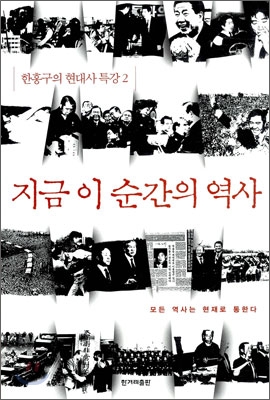 |
Description
Book Introduction
Modern History as Read by Progressive Korean Historian Han Hong-gu
Professor Han Hong-gu, who has been actively writing about modern and contemporary history, including 『History of the Republic of Korea』, describes modern Korean history.
Some say that modern history cannot be history.
This is because modern history is not free from power when viewed objectively.
Therefore, since a balanced narrative is difficult, it is said that it should be left to the next generation.
But the author has a different position.
The author, with the subjective belief that history is not something to be learned but rather created, described modern Korean history from 1980 to 2009.
A lot has happened since 1980.
Although the military dictatorship ended, the division between the two Kims in 1987 resulted in a transition to democracy that was less than half-baked, and the Kim Young-sam administration faced limitations from the start as a conservative coalition that hindered its ability to establish a proper history.
Miraculously, President Kim Dae-jung failed to change the government for the first time in South Korean history, but after the IMF bailout, as the saying goes, "the scales have shifted to the market," South Korea has been on a rough voyage, exposed to capital-led globalization and burdened with various social problems such as polarization and ideological conflict.
In this way, the book provides a clear analysis of the turbulent 30 years.
What the author is concerned about is that history does not always progress.
Rather, isn't it possible that our society is regressing to the past?
This book seriously poses these questions to readers.
Professor Han Hong-gu, who has been actively writing about modern and contemporary history, including 『History of the Republic of Korea』, describes modern Korean history.
Some say that modern history cannot be history.
This is because modern history is not free from power when viewed objectively.
Therefore, since a balanced narrative is difficult, it is said that it should be left to the next generation.
But the author has a different position.
The author, with the subjective belief that history is not something to be learned but rather created, described modern Korean history from 1980 to 2009.
A lot has happened since 1980.
Although the military dictatorship ended, the division between the two Kims in 1987 resulted in a transition to democracy that was less than half-baked, and the Kim Young-sam administration faced limitations from the start as a conservative coalition that hindered its ability to establish a proper history.
Miraculously, President Kim Dae-jung failed to change the government for the first time in South Korean history, but after the IMF bailout, as the saying goes, "the scales have shifted to the market," South Korea has been on a rough voyage, exposed to capital-led globalization and burdened with various social problems such as polarization and ideological conflict.
In this way, the book provides a clear analysis of the turbulent 30 years.
What the author is concerned about is that history does not always progress.
Rather, isn't it possible that our society is regressing to the past?
This book seriously poses these questions to readers.
- You can preview some of the book's contents.
Preview
index
Header_ What's Changed and What's Not
Prologue: Why is this moment history?
Lecture 1: Children of Gwangju and Roh Moo-hyun: Those Who Felt the Sorrow of the Survivors
Gwangju eve
Why was Gwangju so brutal?
The Longest Dawn Opens 'This Moment'
How is Gwangju remembered?
Lecture 2: Majestic Defeat, Great Resurrection_ May 1980 becomes June 1987
The Sons of Yushin: Their Own 'New Era'
A piece of carrot and a soul-crushing whip
Chun Doo-hwan, let's have a go!
100 people become 1 million
Lecture 3: Roh Tae-woo and Kim Young-sam's Water Tank Democratization: The Advance and Retreat of Democracy
The June Struggle: The Moment When the Streets Became Classrooms
The July, August, and September Workers' Struggles and Thicker Paychecks
Roh Tae-woo, watering down democracy
The civilian government lost its way
Lecture 4: Jin Indong Elementary School in Summer, Kim Dae-jung - The Last Spark of an Acting Conscience
Young politicians fighting against dictatorship
Years of hardship: exile, kidnapping, imprisonment, and death sentences
The first change of government since King Taejo Yi Seong-gye
“If you do nothing, you will definitely lose!”
Lecture 5: The Last Dragon from the Stream, Roh Moo-hyun: Dreaming of a World Where Justice Wins
A dragon born from a stream, setting people's hearts on fire
A sharp stone that breaks a rock
A golden opportunity brought about by impeachment
Tears of the Dragon Who Could Not Ascend
Lecture 6: The Lee Myung-bak Administration, Again in the Age of Death: Tteokbokki, Scarves, and the Fire Pit of Yongsan
The Rebellion of Yongsan and the Beopbis
How to Fight the Rich Barbarians
Boron History of the Opposition Party in the Republic of Korea
History of the Korean Conservative Opposition
History of Korean progressive parties
Prologue: Why is this moment history?
Lecture 1: Children of Gwangju and Roh Moo-hyun: Those Who Felt the Sorrow of the Survivors
Gwangju eve
Why was Gwangju so brutal?
The Longest Dawn Opens 'This Moment'
How is Gwangju remembered?
Lecture 2: Majestic Defeat, Great Resurrection_ May 1980 becomes June 1987
The Sons of Yushin: Their Own 'New Era'
A piece of carrot and a soul-crushing whip
Chun Doo-hwan, let's have a go!
100 people become 1 million
Lecture 3: Roh Tae-woo and Kim Young-sam's Water Tank Democratization: The Advance and Retreat of Democracy
The June Struggle: The Moment When the Streets Became Classrooms
The July, August, and September Workers' Struggles and Thicker Paychecks
Roh Tae-woo, watering down democracy
The civilian government lost its way
Lecture 4: Jin Indong Elementary School in Summer, Kim Dae-jung - The Last Spark of an Acting Conscience
Young politicians fighting against dictatorship
Years of hardship: exile, kidnapping, imprisonment, and death sentences
The first change of government since King Taejo Yi Seong-gye
“If you do nothing, you will definitely lose!”
Lecture 5: The Last Dragon from the Stream, Roh Moo-hyun: Dreaming of a World Where Justice Wins
A dragon born from a stream, setting people's hearts on fire
A sharp stone that breaks a rock
A golden opportunity brought about by impeachment
Tears of the Dragon Who Could Not Ascend
Lecture 6: The Lee Myung-bak Administration, Again in the Age of Death: Tteokbokki, Scarves, and the Fire Pit of Yongsan
The Rebellion of Yongsan and the Beopbis
How to Fight the Rich Barbarians
Boron History of the Opposition Party in the Republic of Korea
History of the Korean Conservative Opposition
History of Korean progressive parties
Into the book
The adults tried to stop him by throwing eggs at the rock, but the rock broke.
But the world did not change as much as the egg had dreamed.
The world hasn't changed, but the broken egg and its predecessors have become something.
Roh Moo-hyun became president, Lee Hae-chan became prime minister, Lim Chae-jung became speaker of the National Assembly, Kim Geun-tae and Yoo Si-min became ministers, the 386 student body presidents became members of the National Assembly, and countless others became something else.
I achieved a high and good position that I never dared to dream of in my 20s, but the world didn't get any better.
It was their own democracy.
… … If you ask how democratized Korea is, you could say that it has become democratized enough for someone like Roh Moo-hyun to become president.
If you ask how democratized Korea is, you should say that it is not so democratized that a president like Roh Moo-hyun would have to jump off a cliff.
--- pp.8~9
What exactly changed between the 1970s and the 1980s? Are the 1980s generation fools who don't think about the aftermath? No.
I did it knowing full well.
Why was that? Once my mind wanders to Gwangju, I can't calculate anything else.
It doesn't make sense.
The 1980s generation was a generation that couldn't do math.
There are people waiting for martial law troops at City Hall with guns, knowing full well they would die. Would they really kill them for demonstrating? I couldn't help but think that, ask that question.
Such people began to emerge.
Mutant variants.
Those people are the children of Gwangju.
--- p.59
Gwangju was a failed armed uprising in itself.
It was an uprising that was defeated miserably.
But in the long history of the world, it would be difficult to find a movement as successful as Gwangju.
Gwangju has truly opened a new era.
A generation's worth of history since the 1980s has originated in Gwangju.
The reason Gwangju, which was a lost battle, was able to open a new era was because it lost well.
How can we win day and night? We'll lose more often.
We have to win.
We are weak, so if we lose once, we get deeply hurt and it takes a long time to recover.
You shouldn't fight a fight you're not good at, and if you do fight, you should fight a fight you can win and make sure you win.
However, when you fight, there are times when you have to fight a fight that you inevitably lose.
You have to fight well.
Winning is important, but sometimes losing well is more important than winning.
The deaths in Gwangju, the majestic defeat of Gwangju, were greatly resurrected by countless children of Gwangju.
--- p.69
Finally, in April 1985, a strike broke out at Daewoo Motors.
I still remember the day the strike happened.
I went to graduate school to have a celebratory drink because Daewoo Motors was on strike.
What the heck is that? For the first time since liberation in South Korea, and for the first time since the Korean War, a strike has finally broken out at a large male-owned workplace.
It was something to celebrate.
What was it like until the 1970s? All strikes occurred in small and medium-sized businesses run by women.
The main strike sites, including Dongil Textile, YH, Bandosangsa, Hanil Synthetic Fiber, Namyang Nylon, Cheonggye Clothing, and Haitai, were small and medium-sized women's workplaces.
“Hey, why are only female workers participating in the labor movement?” This was a very important question.
There are still many research papers.
Now that I think about it, I think the question was wrong.
I think it's more appropriate to ask, "Why didn't men participate in the labor movement?" rather than "Why did only women participate in the labor movement?"
Why didn't men go on strike? I believe it's because South Korean men returned from the military and became "human beings," so they didn't engage in petty things like unionization or strikes.
--- p.112
In Korean society, the only organization that responded to the military was students.
So, the basic structure was a clash between students and the military.
Then, in June 1987, the military regime was overthrown by the June Struggle, and the military withdrew, and the student movement also retreated through 1991.
Many people believe that the student movement weakened after the 1990s, and while this is indeed true, I believe the reasons behind this need to be analyzed more deeply.
In a sense, it can be said that the excessive burden that the student movement had to bear was shared as each sector of civil society became organized.
--- p.173
What a strange coincidence, Kim Dae-jung ran for the 4th National Assembly election in Inje, Gangwon Province in 1958.
At that time, regionalism and nepotism were weak, so politicians moved around from region to region to run for office.
Kim Dae-jung also ran for office in Inje, Gangwon Province, a place he had no connections to, but the Liberal Party pressured him to invalidate his election registration.
The young Kim Dae-jung was furious and went to see the then 5th Division commander to ask for military help.
In Gangwon-do, the military has a lot of power.
But, the division commander was on a business trip so I couldn't meet him.
Who was that president? It was Park Chung-hee.
If Kim Dae-jung and Park Chung-hee had met then, would our history have taken a different path?
--- p.198
I think the reason we're having such a hard time is because we've missed three good opportunities since 1987.
One time was in 1987.
We lost an election that we had to win, an election that we could not afford to lose.
I think the second one was the foreign exchange crisis in 1997.
It was a real crisis.
But isn't it better to just get discharged from the hospital as quickly as possible? Wouldn't it be better to be discharged after a full recovery? I think I got out too quickly.
That was a golden opportunity to reform the chaebols and bureaucracy. The IMF called for chaebol and bureaucratic reform. The IMF didn't just recommend neoliberal restructuring or labor flexibility.
Of course, we also recommended labor flexibility.
We also need to restructure labor.
But why isn't there a capital restructuring? Capital restructuring is more urgent. If we look at the issues the IMF pointed out in order, labor flexibility was the fifth or sixth. The IMF first recommended chaebol reform and bureaucratic reform.
But what happened? What happened as we quickly escaped IMF control? The conglomerates and bureaucrats, who should have been the targets of reform, suddenly became evangelists for neoliberal restructuring.
And then he grabbed the handle of the knife and started hitting the labor side.
--- pp.227-278
To be honest, I didn't think very highly of President Kim Dae-jung.
There were many complaints.
But, as I went through the Roh Moo-hyun presidency, I got to see President Kim Dae-jung again.
And after seeing the last two months between the death of President Roh Moo-hyun and the hospitalization of President Kim Dae-jung, I came to respect him to the point of collapsing in shock.
--- pp.242-244
This is a very important point, but President Roh Moo-hyun is the first and only president in our country to have served in the military.
People like Park Chung-hee, Chun Doo-hwan, and Roh Tae-woo are, to put it simply, deserters.
You served in the military and drove a tank.
He became the first president to have served in the military, excluding those who entered the Blue House through the side door.
--- p.254
After President Roh Moo-hyun passed away, videos started popping up all over the internet.
I felt a lot while watching that video.
I was watching videos on the internet all night thinking, 'Oh yeah, that happened.
The thought that gradually sinks into your mind as you say, 'Yes, that's how it was' is 'Yes, that's how it was'.
He died because he talked like that.
I thought, 'You're dead because you talk like that in Korean society.'
And as I watched the video more, I started to think, 'No, no, that's why they killed him.'
Among them, the most impressive video was the speech he made when declaring his candidacy for president.
Candidate Roh Moo-hyun introduced the family motto his mother left him.
“Hey, you punk, a square peg in a round hole.
It's like throwing an egg at a rock.
“Just live your life observing the wind and waves.”
Later, as a lawyer, I defended young people who had been imprisoned for protesting in the 1980s, and I realized that their mothers were teaching them the same thing.
“You bastard.
It's like throwing an egg at a rock.
Stop it.
“You fall back.”
What's the story? Nobody teaches justice to young people.
It's not just your mother, but parents throughout our history, for the past 600 years, have been teaching us cowardly lessons.
What do you think, everyone? Do you teach your children to live justly? Or do you teach them not to stand up? No matter what injustice the world may face, no matter what injustice unfolds before our eyes, no matter how the powerful trample on the weak, we have all been forced to turn a blind eye, bow our heads, and ignore it. That's how we made a living.
That's how we avoided arrest and stabbings, but shouldn't we change that now? Shouldn't our young people proudly speak for justice and proudly stand up against injustice, creating a new history?
--- pp.265-267
For many who remember Roh Moo-hyun, who stood with the workers at the strike site, and especially for Kim Jin-sook, who was laid off from Hanjin Heavy Industries, the words President Roh Moo-hyun spoke after Chairman Kim Joo-ik hanged himself after a four-month-long sit-in on a high-altitude crane were deeply hurtful.
There was a saying, “The days when death was a means of struggle are over.”
Before becoming president, attorney Roh Moo-hyun was also Kim Joo-ik's attorney.
Kim Jin-suk concluded her article as follows:
“When you come to the next life, don’t come too smart.
Don't pass something like the bar exam.
I just want to meet him as a worker who eats oily rice as he was born.
I won't have to point fingers at you and call you a traitor, and you won't have to feel sorry for me and call me stiff and ignorant.
There is no need to leave or send us off, we are just comrades all the time.
So, as you once said, if it is the setting sun for capitalists, it is the rising sun for workers.
“I hope to meet you with the pure passion and extraordinary sense of justice that can put those wonderful words into practice.”
--- pp.296-297
What's really funny about the Lee Myung-bak administration is that it launches a lot of ideological attacks.
They are trying to change many policies while calling the progressive and democratic camps left-wing and communist.
But take a look at the policies we're trying to change.
Who struck the Green Belt? Park Chung-hee struck it.
Who did the equalization? Park Chung-hee did it.
Who created health insurance? Park Chung-hee did it.
Isn't this a truly ridiculous phenomenon? The progressive camp, which usually rails against Park Chung-hee, is now calling for the policies he established, while the conservative forces that once supported him are now trying to dismantle those policies. It's a truly ridiculous landscape.
--- pp.310-311
The law of the land is a new law born from the rule of law.
The people of Manchuria, even the Manchurians who collaborated with the Japanese, called the Japanese officials who only advocated the law “law-breakers.”
Those who use legal techniques as if they were safecracking techniques to advance their own interests are the legal idiots.
There is now a rebellion among the legal profession in South Korea.
The lawmakers have started a rebellion against the people.
They turn a blind eye to each other's mistakes, and they threaten to kill the people if they step on gold...
The insidious rule of law, wielded by cruel power against the sovereign, is the rebellion of the legal system.
--- p.312
I think our history is very honest.
History has changed as much as the tears shed by the people.
We enjoy what we fight for.
--- p.324
What was the plan the Democratic Party developed before President Roh Moo-hyun's death? It was called the "New Democratic Party Plan."
This is not one step to the right, it is two steps.
They are trying to use policies that are almost identical to those of the Grand National Party.
To put it simply, it is a “get rich” policy.
If you were rich, who would you vote for? The Grand National Party or the Democratic Party?
The question is how the opposition party can secure its own identity.
If the Democratic Party competes with the Grand National Party to become rich, it will be a losing game.
Why play that game? Because it's a good deal for some Democrats.
It works in one's own constituency.
But if you look at the Democratic Party as a whole, and the opposition party as a whole, it is a path to ruin.
But the world did not change as much as the egg had dreamed.
The world hasn't changed, but the broken egg and its predecessors have become something.
Roh Moo-hyun became president, Lee Hae-chan became prime minister, Lim Chae-jung became speaker of the National Assembly, Kim Geun-tae and Yoo Si-min became ministers, the 386 student body presidents became members of the National Assembly, and countless others became something else.
I achieved a high and good position that I never dared to dream of in my 20s, but the world didn't get any better.
It was their own democracy.
… … If you ask how democratized Korea is, you could say that it has become democratized enough for someone like Roh Moo-hyun to become president.
If you ask how democratized Korea is, you should say that it is not so democratized that a president like Roh Moo-hyun would have to jump off a cliff.
--- pp.8~9
What exactly changed between the 1970s and the 1980s? Are the 1980s generation fools who don't think about the aftermath? No.
I did it knowing full well.
Why was that? Once my mind wanders to Gwangju, I can't calculate anything else.
It doesn't make sense.
The 1980s generation was a generation that couldn't do math.
There are people waiting for martial law troops at City Hall with guns, knowing full well they would die. Would they really kill them for demonstrating? I couldn't help but think that, ask that question.
Such people began to emerge.
Mutant variants.
Those people are the children of Gwangju.
--- p.59
Gwangju was a failed armed uprising in itself.
It was an uprising that was defeated miserably.
But in the long history of the world, it would be difficult to find a movement as successful as Gwangju.
Gwangju has truly opened a new era.
A generation's worth of history since the 1980s has originated in Gwangju.
The reason Gwangju, which was a lost battle, was able to open a new era was because it lost well.
How can we win day and night? We'll lose more often.
We have to win.
We are weak, so if we lose once, we get deeply hurt and it takes a long time to recover.
You shouldn't fight a fight you're not good at, and if you do fight, you should fight a fight you can win and make sure you win.
However, when you fight, there are times when you have to fight a fight that you inevitably lose.
You have to fight well.
Winning is important, but sometimes losing well is more important than winning.
The deaths in Gwangju, the majestic defeat of Gwangju, were greatly resurrected by countless children of Gwangju.
--- p.69
Finally, in April 1985, a strike broke out at Daewoo Motors.
I still remember the day the strike happened.
I went to graduate school to have a celebratory drink because Daewoo Motors was on strike.
What the heck is that? For the first time since liberation in South Korea, and for the first time since the Korean War, a strike has finally broken out at a large male-owned workplace.
It was something to celebrate.
What was it like until the 1970s? All strikes occurred in small and medium-sized businesses run by women.
The main strike sites, including Dongil Textile, YH, Bandosangsa, Hanil Synthetic Fiber, Namyang Nylon, Cheonggye Clothing, and Haitai, were small and medium-sized women's workplaces.
“Hey, why are only female workers participating in the labor movement?” This was a very important question.
There are still many research papers.
Now that I think about it, I think the question was wrong.
I think it's more appropriate to ask, "Why didn't men participate in the labor movement?" rather than "Why did only women participate in the labor movement?"
Why didn't men go on strike? I believe it's because South Korean men returned from the military and became "human beings," so they didn't engage in petty things like unionization or strikes.
--- p.112
In Korean society, the only organization that responded to the military was students.
So, the basic structure was a clash between students and the military.
Then, in June 1987, the military regime was overthrown by the June Struggle, and the military withdrew, and the student movement also retreated through 1991.
Many people believe that the student movement weakened after the 1990s, and while this is indeed true, I believe the reasons behind this need to be analyzed more deeply.
In a sense, it can be said that the excessive burden that the student movement had to bear was shared as each sector of civil society became organized.
--- p.173
What a strange coincidence, Kim Dae-jung ran for the 4th National Assembly election in Inje, Gangwon Province in 1958.
At that time, regionalism and nepotism were weak, so politicians moved around from region to region to run for office.
Kim Dae-jung also ran for office in Inje, Gangwon Province, a place he had no connections to, but the Liberal Party pressured him to invalidate his election registration.
The young Kim Dae-jung was furious and went to see the then 5th Division commander to ask for military help.
In Gangwon-do, the military has a lot of power.
But, the division commander was on a business trip so I couldn't meet him.
Who was that president? It was Park Chung-hee.
If Kim Dae-jung and Park Chung-hee had met then, would our history have taken a different path?
--- p.198
I think the reason we're having such a hard time is because we've missed three good opportunities since 1987.
One time was in 1987.
We lost an election that we had to win, an election that we could not afford to lose.
I think the second one was the foreign exchange crisis in 1997.
It was a real crisis.
But isn't it better to just get discharged from the hospital as quickly as possible? Wouldn't it be better to be discharged after a full recovery? I think I got out too quickly.
That was a golden opportunity to reform the chaebols and bureaucracy. The IMF called for chaebol and bureaucratic reform. The IMF didn't just recommend neoliberal restructuring or labor flexibility.
Of course, we also recommended labor flexibility.
We also need to restructure labor.
But why isn't there a capital restructuring? Capital restructuring is more urgent. If we look at the issues the IMF pointed out in order, labor flexibility was the fifth or sixth. The IMF first recommended chaebol reform and bureaucratic reform.
But what happened? What happened as we quickly escaped IMF control? The conglomerates and bureaucrats, who should have been the targets of reform, suddenly became evangelists for neoliberal restructuring.
And then he grabbed the handle of the knife and started hitting the labor side.
--- pp.227-278
To be honest, I didn't think very highly of President Kim Dae-jung.
There were many complaints.
But, as I went through the Roh Moo-hyun presidency, I got to see President Kim Dae-jung again.
And after seeing the last two months between the death of President Roh Moo-hyun and the hospitalization of President Kim Dae-jung, I came to respect him to the point of collapsing in shock.
--- pp.242-244
This is a very important point, but President Roh Moo-hyun is the first and only president in our country to have served in the military.
People like Park Chung-hee, Chun Doo-hwan, and Roh Tae-woo are, to put it simply, deserters.
You served in the military and drove a tank.
He became the first president to have served in the military, excluding those who entered the Blue House through the side door.
--- p.254
After President Roh Moo-hyun passed away, videos started popping up all over the internet.
I felt a lot while watching that video.
I was watching videos on the internet all night thinking, 'Oh yeah, that happened.
The thought that gradually sinks into your mind as you say, 'Yes, that's how it was' is 'Yes, that's how it was'.
He died because he talked like that.
I thought, 'You're dead because you talk like that in Korean society.'
And as I watched the video more, I started to think, 'No, no, that's why they killed him.'
Among them, the most impressive video was the speech he made when declaring his candidacy for president.
Candidate Roh Moo-hyun introduced the family motto his mother left him.
“Hey, you punk, a square peg in a round hole.
It's like throwing an egg at a rock.
“Just live your life observing the wind and waves.”
Later, as a lawyer, I defended young people who had been imprisoned for protesting in the 1980s, and I realized that their mothers were teaching them the same thing.
“You bastard.
It's like throwing an egg at a rock.
Stop it.
“You fall back.”
What's the story? Nobody teaches justice to young people.
It's not just your mother, but parents throughout our history, for the past 600 years, have been teaching us cowardly lessons.
What do you think, everyone? Do you teach your children to live justly? Or do you teach them not to stand up? No matter what injustice the world may face, no matter what injustice unfolds before our eyes, no matter how the powerful trample on the weak, we have all been forced to turn a blind eye, bow our heads, and ignore it. That's how we made a living.
That's how we avoided arrest and stabbings, but shouldn't we change that now? Shouldn't our young people proudly speak for justice and proudly stand up against injustice, creating a new history?
--- pp.265-267
For many who remember Roh Moo-hyun, who stood with the workers at the strike site, and especially for Kim Jin-sook, who was laid off from Hanjin Heavy Industries, the words President Roh Moo-hyun spoke after Chairman Kim Joo-ik hanged himself after a four-month-long sit-in on a high-altitude crane were deeply hurtful.
There was a saying, “The days when death was a means of struggle are over.”
Before becoming president, attorney Roh Moo-hyun was also Kim Joo-ik's attorney.
Kim Jin-suk concluded her article as follows:
“When you come to the next life, don’t come too smart.
Don't pass something like the bar exam.
I just want to meet him as a worker who eats oily rice as he was born.
I won't have to point fingers at you and call you a traitor, and you won't have to feel sorry for me and call me stiff and ignorant.
There is no need to leave or send us off, we are just comrades all the time.
So, as you once said, if it is the setting sun for capitalists, it is the rising sun for workers.
“I hope to meet you with the pure passion and extraordinary sense of justice that can put those wonderful words into practice.”
--- pp.296-297
What's really funny about the Lee Myung-bak administration is that it launches a lot of ideological attacks.
They are trying to change many policies while calling the progressive and democratic camps left-wing and communist.
But take a look at the policies we're trying to change.
Who struck the Green Belt? Park Chung-hee struck it.
Who did the equalization? Park Chung-hee did it.
Who created health insurance? Park Chung-hee did it.
Isn't this a truly ridiculous phenomenon? The progressive camp, which usually rails against Park Chung-hee, is now calling for the policies he established, while the conservative forces that once supported him are now trying to dismantle those policies. It's a truly ridiculous landscape.
--- pp.310-311
The law of the land is a new law born from the rule of law.
The people of Manchuria, even the Manchurians who collaborated with the Japanese, called the Japanese officials who only advocated the law “law-breakers.”
Those who use legal techniques as if they were safecracking techniques to advance their own interests are the legal idiots.
There is now a rebellion among the legal profession in South Korea.
The lawmakers have started a rebellion against the people.
They turn a blind eye to each other's mistakes, and they threaten to kill the people if they step on gold...
The insidious rule of law, wielded by cruel power against the sovereign, is the rebellion of the legal system.
--- p.312
I think our history is very honest.
History has changed as much as the tears shed by the people.
We enjoy what we fight for.
--- p.324
What was the plan the Democratic Party developed before President Roh Moo-hyun's death? It was called the "New Democratic Party Plan."
This is not one step to the right, it is two steps.
They are trying to use policies that are almost identical to those of the Grand National Party.
To put it simply, it is a “get rich” policy.
If you were rich, who would you vote for? The Grand National Party or the Democratic Party?
The question is how the opposition party can secure its own identity.
If the Democratic Party competes with the Grand National Party to become rich, it will be a losing game.
Why play that game? Because it's a good deal for some Democrats.
It works in one's own constituency.
But if you look at the Democratic Party as a whole, and the opposition party as a whole, it is a path to ruin.
--- p.357
Publisher's Review
In 2009, we lost two former presidents.
In particular, Roh Moo-hyun's death was "an event that symbolized the end of an era in which the new generation of democratization movement that emerged after the Gwangju Uprising of 1980 was the main player."
Upon hearing of Roh Moo-hyun's sudden death, many citizens were outraged and puzzled, asking, "How could something like this happen?"
Then, I realized that I needed to understand modern Korean history and the history of the Korean democratization movement.
This is because Roh Moo-hyun's death was an event that immediately signified the limits and frustration of the Korean democracy movement.
Professor Han Hong-gu is preparing a special lecture to examine the deaths of the two former presidents and their historical significance.
Professor Han, who has already vividly conveyed the eight major issues of modern history that we are facing through 『Special Lecture - Han Hong-gu's Story of Modern Korean History』, looks back on the history of the past 30 years in his second special lecture on modern history, 『History of This Moment』, including the 5/18 Gwangju Democratization Movement, which can be said to be the birthplace of Korean democracy, the democratization movement of the 1980s that rose up after the majestic defeat in Gwangju, the transitional democratization under the Roh Tae-woo and Kim Young-sam administrations, the achievements and limitations of the 10 years of the Kim Dae-jung and Roh Moo-hyun democratic governments, and the current Lee Myung-bak administration's return to the authoritarian era.
Why is this moment in history?
It is often said that “history is a dialogue between the past and the present.”
And “all history is not the past itself, but the past recalled and interpreted from the perspective of the present.”
Here, Professor Han Hong-gu defines history more boldly.
“All history is contemporary history, the history of this moment.”
Every moment is a period of upheaval and every moment is marked by twists and turns in modern Korean history, but 2009 was a particularly special year.
At the beginning of the year, five citizens who climbed the roof of the Namildang building in Yongsan and shouted for tenants' rights lost their lives during a police crackdown, and in May, a former president who went back to his hometown threw himself off a rock.
And one summer, President Kim Dae-jung, a living history of Korean democracy, passed away.
It was a year in which we realized that each day we live adds up to create history.
So what is the historical significance of that devastating event we so vividly experienced? What was the significance of the rule of law of the Lee Myung-bak administration, which deployed the police to demand "no mediation or compromise!" from tenants who climbed onto rooftops to defend their right to live? What was the era like for the generation of democratization activists, who were forced to step back from the main stage of history with the deaths of two presidents? What was the democracy they achieved, and what was the "anti-democratic" attitude of the authoritarian government they fought against? To understand "the history of this moment," Professor Han Hong-koo traces the most recent events that shaped the present, the most profound changes that defined it.
And they say that the beginning was the 5?18 Gwangju Uprising.
30 Years of Modern Korean History in One Volume - 1980-2009
In modern Korean history, democracy began to function institutionally after the June Struggle of 1987, but it was the May 18 Gwangju Democratization Movement that played the biggest role.
And what Professor Han Hong-gu pays most attention to is the solemn choice of hundreds of Gwangju citizens who remained at the South Jeolla Provincial Office on the morning of May 27, 1980, calmly accepting their fate to die.
“People who knew they would die and stayed in that place while waiting for death”, through the “longest dawn” they kept, children of Gwangju were born who felt the “sorrow of the survivors” and decided to change their lives.
That power became the energy of sorrow of those who fought for democracy in the 1980s and 1990s, prepared to die, leading to the June Struggle of 1987 and the direct election of the president by the people through the gymnasium presidential election.
The book then breathlessly unfolds the process of regime change, from the birth of Roh Tae-woo's quasi-military government due to the division between the two Kims, to Kim Young-sam's civilian government through the merger of three parties, to Kim Dae-jung's People's Government that achieved a change of government that seemed impossible, to the participatory government of Roh Moo-hyun, a true dragon born from the gutter, and to the current Lee Myung-bak government.
These are historical facts that will be all too familiar to readers with even the slightest interest in modern history, but the colloquialism of the lecture, Professor Han Hong-gu's characteristic wit, and the rich examples and interpretations that capture the historical context make it a living, breathing, three-dimensional history, rather than a flat list of historical facts.
Furthermore, Professor Han's view that all everyday events are political events and that political upheaval inevitably has a concrete impact on the daily lives of the public goes beyond the limitations of vulgar political history, which ends up being anecdotes entangled with the divisions and strife between a few politicians and political forces, and is woven into a single narrative called "30 Years of Modern Korean History," a tumultuous period.
Three painful opportunities
Looking back on the past 30 years of modern history, Professor Han Hong-koo laments three moments: the defeat in the 1987 presidential election due to the division between the two Kims, the frustration of chaebol and bureaucratic reforms during the 1997 foreign exchange crisis, and the failure of reforms in the 2004 impeachment backlash that led to a majority-opposition party.
Korea's modern history has clearly been a history of success.
Among the countries that emerged from the Third World after World War II, we are the only one to have achieved a peaceful transfer of power and also achieved tremendous economic development.
However, it is regrettable that we missed the opportunity in those three stages to allow the majority of the people to enjoy the benefits of a more complete democracy sooner.
If the two Kims had not split in 1987, democracy could have been brought forward by at least five years, the conservatism in the Gyeongnam region following the three-party merger could have been prevented, and the democratic belt as it stands today would have been much wider.
In 1997, what the IMF demanded was not just labor flexibility or neoliberal structural adjustment.
Above all, it demanded a restructuring of capital.
However, “the conglomerates and bureaucrats who should have been the targets of reform suddenly became evangelists of neoliberal restructuring and began to attack labor with their swords in their hands.”
It was from that time that the problems of polarization and irregular employment began to worsen in earnest.
And the last opportunity was the situation of a minority government and a majority opposition party after the impeachment.
However, the so-called democratic forces that controlled the executive and legislative branches failed to pass the four major reform legislations, including the abolition of the National Security Act, and the proposal for a "grand coalition" was a "grenade thrown over there that exploded in their own camp," leading to their defeat in the presidential election.
There is a saying that there are no what-ifs in history, but the three missed opportunities by the democratic camp are the reality of an imperfect democracy that we must endure 'at this very moment.'
History is not something to be studied, but something to be created.
A person's daily life comes together to form a life, and their personal and family history comes together to form a nation's history.
Kim Eo-jun, the editor-in-chief of the Hankyoreh, once said, “You are the accumulation of your choices.”
In the same context, we can say that ‘the history of this moment’ is ‘the accumulation of historical choices over the years.’
While it is necessary to look back on past history to understand the 'history of this present moment,' ultimately, it can be said to be a prerequisite for choosing the direction of the history we must create.
This book, "The History of This Moment," also traces the meaning and historical context of the deaths of the two presidents we witnessed in 2009, starting with the May 18 Gwangju Democratization Movement.
So, what choices should we make in the historical moment that confronts us at every moment? In a world that forced even Roh Moo-hyun, who once said he wanted to create a society where just people thrive, to throw himself off a cliff, in a reality where many nod to the saying, "Injustice can be tolerated, but disadvantage cannot," what kind of history should we choose to create? Perhaps the most obvious truth is, "If we do nothing, we are destined to lose."
In particular, Roh Moo-hyun's death was "an event that symbolized the end of an era in which the new generation of democratization movement that emerged after the Gwangju Uprising of 1980 was the main player."
Upon hearing of Roh Moo-hyun's sudden death, many citizens were outraged and puzzled, asking, "How could something like this happen?"
Then, I realized that I needed to understand modern Korean history and the history of the Korean democratization movement.
This is because Roh Moo-hyun's death was an event that immediately signified the limits and frustration of the Korean democracy movement.
Professor Han Hong-gu is preparing a special lecture to examine the deaths of the two former presidents and their historical significance.
Professor Han, who has already vividly conveyed the eight major issues of modern history that we are facing through 『Special Lecture - Han Hong-gu's Story of Modern Korean History』, looks back on the history of the past 30 years in his second special lecture on modern history, 『History of This Moment』, including the 5/18 Gwangju Democratization Movement, which can be said to be the birthplace of Korean democracy, the democratization movement of the 1980s that rose up after the majestic defeat in Gwangju, the transitional democratization under the Roh Tae-woo and Kim Young-sam administrations, the achievements and limitations of the 10 years of the Kim Dae-jung and Roh Moo-hyun democratic governments, and the current Lee Myung-bak administration's return to the authoritarian era.
Why is this moment in history?
It is often said that “history is a dialogue between the past and the present.”
And “all history is not the past itself, but the past recalled and interpreted from the perspective of the present.”
Here, Professor Han Hong-gu defines history more boldly.
“All history is contemporary history, the history of this moment.”
Every moment is a period of upheaval and every moment is marked by twists and turns in modern Korean history, but 2009 was a particularly special year.
At the beginning of the year, five citizens who climbed the roof of the Namildang building in Yongsan and shouted for tenants' rights lost their lives during a police crackdown, and in May, a former president who went back to his hometown threw himself off a rock.
And one summer, President Kim Dae-jung, a living history of Korean democracy, passed away.
It was a year in which we realized that each day we live adds up to create history.
So what is the historical significance of that devastating event we so vividly experienced? What was the significance of the rule of law of the Lee Myung-bak administration, which deployed the police to demand "no mediation or compromise!" from tenants who climbed onto rooftops to defend their right to live? What was the era like for the generation of democratization activists, who were forced to step back from the main stage of history with the deaths of two presidents? What was the democracy they achieved, and what was the "anti-democratic" attitude of the authoritarian government they fought against? To understand "the history of this moment," Professor Han Hong-koo traces the most recent events that shaped the present, the most profound changes that defined it.
And they say that the beginning was the 5?18 Gwangju Uprising.
30 Years of Modern Korean History in One Volume - 1980-2009
In modern Korean history, democracy began to function institutionally after the June Struggle of 1987, but it was the May 18 Gwangju Democratization Movement that played the biggest role.
And what Professor Han Hong-gu pays most attention to is the solemn choice of hundreds of Gwangju citizens who remained at the South Jeolla Provincial Office on the morning of May 27, 1980, calmly accepting their fate to die.
“People who knew they would die and stayed in that place while waiting for death”, through the “longest dawn” they kept, children of Gwangju were born who felt the “sorrow of the survivors” and decided to change their lives.
That power became the energy of sorrow of those who fought for democracy in the 1980s and 1990s, prepared to die, leading to the June Struggle of 1987 and the direct election of the president by the people through the gymnasium presidential election.
The book then breathlessly unfolds the process of regime change, from the birth of Roh Tae-woo's quasi-military government due to the division between the two Kims, to Kim Young-sam's civilian government through the merger of three parties, to Kim Dae-jung's People's Government that achieved a change of government that seemed impossible, to the participatory government of Roh Moo-hyun, a true dragon born from the gutter, and to the current Lee Myung-bak government.
These are historical facts that will be all too familiar to readers with even the slightest interest in modern history, but the colloquialism of the lecture, Professor Han Hong-gu's characteristic wit, and the rich examples and interpretations that capture the historical context make it a living, breathing, three-dimensional history, rather than a flat list of historical facts.
Furthermore, Professor Han's view that all everyday events are political events and that political upheaval inevitably has a concrete impact on the daily lives of the public goes beyond the limitations of vulgar political history, which ends up being anecdotes entangled with the divisions and strife between a few politicians and political forces, and is woven into a single narrative called "30 Years of Modern Korean History," a tumultuous period.
Three painful opportunities
Looking back on the past 30 years of modern history, Professor Han Hong-koo laments three moments: the defeat in the 1987 presidential election due to the division between the two Kims, the frustration of chaebol and bureaucratic reforms during the 1997 foreign exchange crisis, and the failure of reforms in the 2004 impeachment backlash that led to a majority-opposition party.
Korea's modern history has clearly been a history of success.
Among the countries that emerged from the Third World after World War II, we are the only one to have achieved a peaceful transfer of power and also achieved tremendous economic development.
However, it is regrettable that we missed the opportunity in those three stages to allow the majority of the people to enjoy the benefits of a more complete democracy sooner.
If the two Kims had not split in 1987, democracy could have been brought forward by at least five years, the conservatism in the Gyeongnam region following the three-party merger could have been prevented, and the democratic belt as it stands today would have been much wider.
In 1997, what the IMF demanded was not just labor flexibility or neoliberal structural adjustment.
Above all, it demanded a restructuring of capital.
However, “the conglomerates and bureaucrats who should have been the targets of reform suddenly became evangelists of neoliberal restructuring and began to attack labor with their swords in their hands.”
It was from that time that the problems of polarization and irregular employment began to worsen in earnest.
And the last opportunity was the situation of a minority government and a majority opposition party after the impeachment.
However, the so-called democratic forces that controlled the executive and legislative branches failed to pass the four major reform legislations, including the abolition of the National Security Act, and the proposal for a "grand coalition" was a "grenade thrown over there that exploded in their own camp," leading to their defeat in the presidential election.
There is a saying that there are no what-ifs in history, but the three missed opportunities by the democratic camp are the reality of an imperfect democracy that we must endure 'at this very moment.'
History is not something to be studied, but something to be created.
A person's daily life comes together to form a life, and their personal and family history comes together to form a nation's history.
Kim Eo-jun, the editor-in-chief of the Hankyoreh, once said, “You are the accumulation of your choices.”
In the same context, we can say that ‘the history of this moment’ is ‘the accumulation of historical choices over the years.’
While it is necessary to look back on past history to understand the 'history of this present moment,' ultimately, it can be said to be a prerequisite for choosing the direction of the history we must create.
This book, "The History of This Moment," also traces the meaning and historical context of the deaths of the two presidents we witnessed in 2009, starting with the May 18 Gwangju Democratization Movement.
So, what choices should we make in the historical moment that confronts us at every moment? In a world that forced even Roh Moo-hyun, who once said he wanted to create a society where just people thrive, to throw himself off a cliff, in a reality where many nod to the saying, "Injustice can be tolerated, but disadvantage cannot," what kind of history should we choose to create? Perhaps the most obvious truth is, "If we do nothing, we are destined to lose."
GOODS SPECIFICS
- Date of issue: March 8, 2010
- Page count, weight, size: 385 pages | 578g | 153*224*30mm
- ISBN13: 9788984313774
- ISBN10: 8984313777
You may also like
카테고리
korean


korean

![GQ KOREA Mark (Monthly): December [2025]](http://librairie.coreenne.fr/cdn/shop/files/8ef265dbbfbf186523ed75ba7319009d.jpg?v=1765340328&width=3840)


