

Trend Korea 2021
 |
Description
Book Introduction
The future brought forward by COVID-19, the pace of change accelerated. Strategies for the Virus-Essentialed Economy: V-nomics 'Staying home' has become a part of everyday life, non-face-to-face interactions are now familiar to everyone, and it has become more awkward to not wear a mask. As the coronavirus becomes a part of our daily lives, people are slowly adapting to the 21st century pandemic. No matter what happens, life goes on and consumption takes place. Although it may seem like the coronavirus has brought about drastic changes in an instant, these changes have been gradually taking place for some time. The rise of contactless, home-centered lifestyles, and online shopping was already gaining ground, but this situation has only accelerated their spread. <Trend Korea 21> selected COWBOY HERO as one of the top 10 trend keywords for 2021, with the meaning of maintaining composure even in the midst of a pandemic, the Year of the Ox, which is the origin of vaccines, and facing reality but not losing hope. Like a cool cowboy who finally tames a running bull, it contains the hope that we can overcome the pandemic crisis with timely strategies. When explaining the overall flow of these 10 trends, the first thing that stands out is that not all trends are immune to the impact of the coronavirus pandemic. It is quite natural that trends are a reflection of society. The first keyword of this book, V-nomics, is a word that originates from the V in virus, and means “the economy that the virus has changed and will change.” Is a V-shaped recovery possible? How will existing values change? How far will the contactless trend evolve? How well we adapt to the new V-nomics paradigm will provide a strategy for overcoming the protracted COVID-19 era. The domestic economy is expected to show a K-shaped polarization overall, but it is expected to show various patterns such as V, U, W, S, and reverse V by industry. The criteria for dividing them are the degree of face-to-face interaction, the existence of substitutes, and how well they fit with existing trends. For example, while the representative COVID-specific markets of domestic travel, video communication, and the homewear market were classified as an inverted V-shape, online shopping, camping, staycations, and athleisure looks, which are highly non-face-to-face and in line with existing trends, were classified as an S-shape, which means that growth will accelerate even after COVID-19. |
- You can preview some of the book's contents.
Preview
index
Introduction 4
Top 10 Consumer Trend Keywords for 2021
1. A Review of 2020 Consumer Trends
Me and Myselves Multi-Persona 25
Immediate Satisfaction: The 'Last Fit Economy' 37
Goodness and Fairness Fair Player 49
Here and Now: The 'Streaming Life' Streaming Life 59
Technology of Hyper-personalization 71
You're with Us, 'Fansumer' Fansumer 81
Make or Break, Specialize or Die Specialized Survival 95
Iridescent OPAL: the New 5060 Generation Opal Generation 105
Convenience as a Premium 117
Elevate Yourself Upgrade Human 129
2. 2021 Consumer Trend Outlook
Coming of 'V-nomics' V-nomics 142
Omni-layered Homes 174
We Are the Money-Friendly Generation: Capitalist Kids 198
Best We Pivot Pivot Without Hesitation 222
On This Rollercoaster Life 252
Your Daily Sporty Life #OhAun, Today's Exercise 278
Heading to the Resell Market Nth New Product 304
Everyone Matters in the 'CX Universe' CX Universe 332
'Real Me': Searching for My Own Label Labeling Game 356
'Ontact', 'Untact', with a Human Touch 380
Trend Korea's Top 10 Trend Products of 2020: 406
Americas 434
Appendix 446
Top 10 Consumer Trend Keywords for 2021
1. A Review of 2020 Consumer Trends
Me and Myselves Multi-Persona 25
Immediate Satisfaction: The 'Last Fit Economy' 37
Goodness and Fairness Fair Player 49
Here and Now: The 'Streaming Life' Streaming Life 59
Technology of Hyper-personalization 71
You're with Us, 'Fansumer' Fansumer 81
Make or Break, Specialize or Die Specialized Survival 95
Iridescent OPAL: the New 5060 Generation Opal Generation 105
Convenience as a Premium 117
Elevate Yourself Upgrade Human 129
2. 2021 Consumer Trend Outlook
Coming of 'V-nomics' V-nomics 142
Omni-layered Homes 174
We Are the Money-Friendly Generation: Capitalist Kids 198
Best We Pivot Pivot Without Hesitation 222
On This Rollercoaster Life 252
Your Daily Sporty Life #OhAun, Today's Exercise 278
Heading to the Resell Market Nth New Product 304
Everyone Matters in the 'CX Universe' CX Universe 332
'Real Me': Searching for My Own Label Labeling Game 356
'Ontact', 'Untact', with a Human Touch 380
Trend Korea's Top 10 Trend Products of 2020: 406
Americas 434
Appendix 446
Detailed image
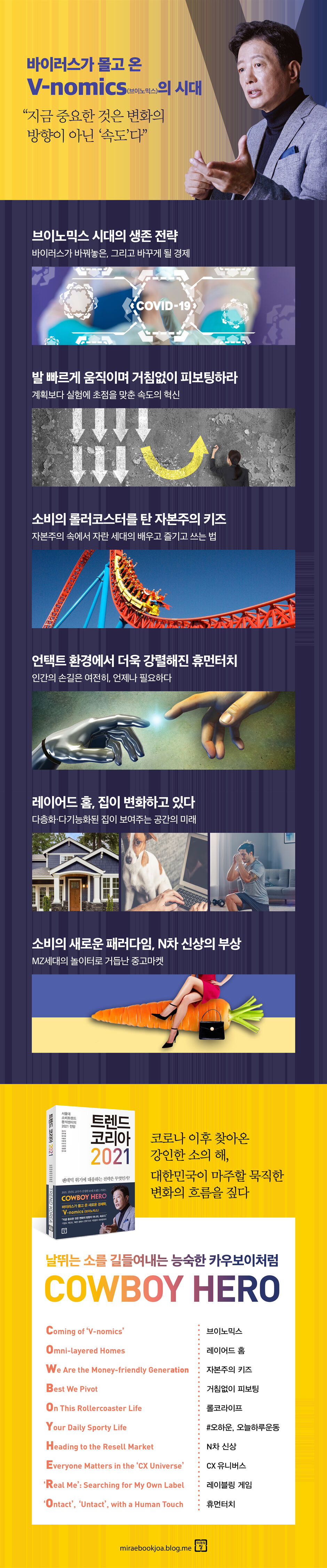
Into the book
COVID-19 has now become a part of life.
So how will consumer lives change, and how should we respond? The most frequently mentioned word since the COVID-19 outbreak is likely "untact."
Untact is a trend first named by the Seoul National University Consumer Trend Analysis Center in "Trend Korea 2018."
This keyword is now receiving explosive interest to the point where it has become established as an everyday term.
Initially, there was some criticism that it was Konglish (Korean-style English), but it has become a term used by global economic news outlets such as Bloomberg and the influential French media outlet Le Monde.
It's not just about untact.
Trend Korea's 2020 keywords 'Last Fit Economy', 'Streaming Life', 'Convenience Premium', and 'Upgraded Human'; 2019 keywords 'Cell Market', 'Newtro', 'Pil Environment Era', and 'Manner Consumer'; 2018 keywords 'Small Happiness', 'Kerencia', and 'Gig Relationship'; and 2017 keywords '1 Economy' and 'Each for Oneself' are all keywords that have become hot topics due to the current COVID-19 situation.
Trends that have been quietly popular for the past few years have come back into sharp relief this year.
On the other hand, among the new trends that emerged after COVID-19, there were almost no surprisingly new keywords that the "Trend Korea" series failed to mention.
What does this mean? While analyzing the shifting consumer trends related to COVID-19, I realized something important.
“What the coronavirus pandemic is changing is not the direction of trends, but their speed.”
--- From the preface
This book divides the recovery patterns by industry into five types: ① 'V-shaped' showing a rapid recovery, ② 'U-shaped' showing a relatively slow and gradual recovery, ③ 'W-shaped' showing ups and downs directly affected by the social distancing stage, ④ 'S-shaped' already on an upward trend but accelerating due to the COVID-19 situation, and ⑤ 'V-shaped' showing a temporary special demand due to the COVID-19 situation.
The variables that influence this typology are, firstly, the degree of face-to-face interaction.
The more essential face-to-face interaction is, the more directly and strongly the impact of the coronavirus is felt.
The second criterion is whether substitutes exist.
For example, bottled water purchased at the supermarket can be completely replaced by online shopping.
On the other hand, when the bar is closed, you can buy alcohol from the convenience store in front of your house and drink it at home, but 'home drinking' cannot replace a toast with friends or a kiss between lovers.
As news of reopening spreads, more people will start making dinner appointments.
If the replacement is not perfect.
In these cases, recovery is quick.
Third, how well it matches existing trends.
Untact or home-related consumption has been on the rise for some time, but it has accelerated due to COVID-19.
These industries are likely to continue growing even after the COVID-19 pandemic.
However, regardless of trends, if you enjoyed a 'special deal' due to COVID-19, you will likely return to your original position after the situation.
--- p.149, from "V-nomics"
In the age of COVID-19, homes are being reborn as new 'multifunctional' spaces, not by purpose or people.
In our homes, which have become the spaces where we spend most of our time, we begin to engage in all our activities: eating, sleeping, shopping, playing, exercising, studying, resting, and decorating.
And surprisingly, we are experiencing a new world where all these processes that seemed impossible are almost completely solved.
--- p.177, from "Layered Home"
In other words, flexing is not an act of those born rich, but rather an expression of the desire for recognition for one's efforts and abilities.
What is noteworthy is the attitude of capitalist kids toward this.
Rather than dismissing their blatant “spending money” as uncultured or extravagant and wasteful, they acknowledge that they “deserve it.”
He considers the consumption of those who can buy what they want to be a natural part of capitalism, and does not hide his envy of wanting to be like them.
In this way, capitalist kids go beyond being cool about advertising and are honest about their desire for consumption, the driving force behind the market economy.
I believe that acquiring something that is difficult to obtain and feeling a sense of accomplishment, and expressing oneself through consumption that differentiates oneself from others, are ways of pursuing happiness that are true to the capitalist instinct.
There is no longer an age too young to consume something.
Musinsa Store, which is mainly used by the 1020 generation, has over 1,400 'luxury goods' registered (as of August 2020).
In the case of a luxury T-shirt worth 190,000 won that recorded over 1,200 views in one month, 48% of the views were from people under the age of 18.
Among the 80,000 consumers who purchased imported cars in the first half of 2020, 37% were in their 10s to 30s.
--- p.207, from "Capitalist Kids"
Back when Kodak was synonymous with photography and cameras, the term 'Kodak Moment' meant a moment when a subject shines, a wonderful moment worthy of being captured in a photograph.
However, Kodak, which was the world's number one company in the film camera market in the 20th century, became complacent with the high profitability of the film business and ignored the market's demand for a transition to digital cameras, which ultimately led to its bankruptcy.
Since then, the term 'Kodak Moment' has come to mean a time of great transformation in the market, a moment of change where a company's fate is determined by its proactive response.
The COVID-19 pandemic and digital transformation facing our society in 2021 are once again providing countless companies with a Kodak moment.
The market, like a living organism, never stands still for a moment, but is always dynamic and evolving.
To cope with the ever-changing market, it's time to 'pivot without hesitation'.
--- p.25, from "Pivoting Without Hesitation"
Nongshim, Korea's leading ramen company, is receiving a great response from consumers by unexpectedly releasing fun new products, despite having long-running products like Shin Ramyun, Neoguri, and Jjapaghetti that maintain steady sales levels.
The representative new product is ‘Angry RtA’ ramen.
RtA started from an online story where a foreigner read 'Raccoon' backwards as 'RtA', and it became a nickname for Raccoon.
Nongshim then used the nickname that had become a hot topic as the name of a limited edition new product of Neoguri, and released it by making it three times spicier than the existing Neoguri. In just two weeks, more than 4 million units were sold, ranking third in sales after Shin Ramyun and Jjapaghetti.
This hit-and-run new product strategy is significant in that it makes consumers feel like the company is trendy, young, and a "hard-working company."
--- p.273, from "Rollco Life"
There are many characteristics that distinguish the MZ generation (Millennials + Generation Z) from the older generation, but the most notable difference in terms of consumption is their attitude toward 'second-hand transactions.'
For the older generation who lived through a time of poverty, the word 'used' had a negative image, meaning something passed down from someone else.
Used goods were often seen as a last resort when buying new was not an option, and were also seen as a symbol of poverty.
However, for the MZ generation, the second-hand market is a place where they can make valuable purchases at reasonable prices, a means of investment, trade their tastes, a playground for treasure hunting, and a space that connects people.
Now, 'how well you utilize second-hand transactions' is becoming the new standard for 'hipness'.
--- p.306, from “Nth New Product”
Improving CX using DT began with global companies.
Domino's Pizza launched the 'Domino's Anywhere' project to minimize the hassle of ordering and alleviate complaints about waiting times for pizza.
A strategy to enable consumers to order pizza through all digital means.
As a result, we developed a technology that allows you to easily order pizza through various routes such as Twitter, Facebook, emojis, TV, and AI assistants.
In particular, we developed PizzaTracker, a pizza tracker that allows customers to check the entire process of pizza cooking and delivery after ordering, creating a unique experience that allows customers to know how much of their pizza they ordered is ready and where it is at.
As a result, not only did Domino's Pizza's market share reach a record high, but its stock price also reached a record high. The stock price, which was around $11 in 2010, rose by a whopping 3,200% over the past 10 years to $375.55 (as of June 19, 2020).
This far surpasses the stock price increases of major US IT companies such as Netflix (2,325%), Amazon (1,967%), Apple (836%), and MS (632%) during the same period.
This is why Domino's Pizza is often cited as a successful example of digital transformation.
So how will consumer lives change, and how should we respond? The most frequently mentioned word since the COVID-19 outbreak is likely "untact."
Untact is a trend first named by the Seoul National University Consumer Trend Analysis Center in "Trend Korea 2018."
This keyword is now receiving explosive interest to the point where it has become established as an everyday term.
Initially, there was some criticism that it was Konglish (Korean-style English), but it has become a term used by global economic news outlets such as Bloomberg and the influential French media outlet Le Monde.
It's not just about untact.
Trend Korea's 2020 keywords 'Last Fit Economy', 'Streaming Life', 'Convenience Premium', and 'Upgraded Human'; 2019 keywords 'Cell Market', 'Newtro', 'Pil Environment Era', and 'Manner Consumer'; 2018 keywords 'Small Happiness', 'Kerencia', and 'Gig Relationship'; and 2017 keywords '1 Economy' and 'Each for Oneself' are all keywords that have become hot topics due to the current COVID-19 situation.
Trends that have been quietly popular for the past few years have come back into sharp relief this year.
On the other hand, among the new trends that emerged after COVID-19, there were almost no surprisingly new keywords that the "Trend Korea" series failed to mention.
What does this mean? While analyzing the shifting consumer trends related to COVID-19, I realized something important.
“What the coronavirus pandemic is changing is not the direction of trends, but their speed.”
--- From the preface
This book divides the recovery patterns by industry into five types: ① 'V-shaped' showing a rapid recovery, ② 'U-shaped' showing a relatively slow and gradual recovery, ③ 'W-shaped' showing ups and downs directly affected by the social distancing stage, ④ 'S-shaped' already on an upward trend but accelerating due to the COVID-19 situation, and ⑤ 'V-shaped' showing a temporary special demand due to the COVID-19 situation.
The variables that influence this typology are, firstly, the degree of face-to-face interaction.
The more essential face-to-face interaction is, the more directly and strongly the impact of the coronavirus is felt.
The second criterion is whether substitutes exist.
For example, bottled water purchased at the supermarket can be completely replaced by online shopping.
On the other hand, when the bar is closed, you can buy alcohol from the convenience store in front of your house and drink it at home, but 'home drinking' cannot replace a toast with friends or a kiss between lovers.
As news of reopening spreads, more people will start making dinner appointments.
If the replacement is not perfect.
In these cases, recovery is quick.
Third, how well it matches existing trends.
Untact or home-related consumption has been on the rise for some time, but it has accelerated due to COVID-19.
These industries are likely to continue growing even after the COVID-19 pandemic.
However, regardless of trends, if you enjoyed a 'special deal' due to COVID-19, you will likely return to your original position after the situation.
--- p.149, from "V-nomics"
In the age of COVID-19, homes are being reborn as new 'multifunctional' spaces, not by purpose or people.
In our homes, which have become the spaces where we spend most of our time, we begin to engage in all our activities: eating, sleeping, shopping, playing, exercising, studying, resting, and decorating.
And surprisingly, we are experiencing a new world where all these processes that seemed impossible are almost completely solved.
--- p.177, from "Layered Home"
In other words, flexing is not an act of those born rich, but rather an expression of the desire for recognition for one's efforts and abilities.
What is noteworthy is the attitude of capitalist kids toward this.
Rather than dismissing their blatant “spending money” as uncultured or extravagant and wasteful, they acknowledge that they “deserve it.”
He considers the consumption of those who can buy what they want to be a natural part of capitalism, and does not hide his envy of wanting to be like them.
In this way, capitalist kids go beyond being cool about advertising and are honest about their desire for consumption, the driving force behind the market economy.
I believe that acquiring something that is difficult to obtain and feeling a sense of accomplishment, and expressing oneself through consumption that differentiates oneself from others, are ways of pursuing happiness that are true to the capitalist instinct.
There is no longer an age too young to consume something.
Musinsa Store, which is mainly used by the 1020 generation, has over 1,400 'luxury goods' registered (as of August 2020).
In the case of a luxury T-shirt worth 190,000 won that recorded over 1,200 views in one month, 48% of the views were from people under the age of 18.
Among the 80,000 consumers who purchased imported cars in the first half of 2020, 37% were in their 10s to 30s.
--- p.207, from "Capitalist Kids"
Back when Kodak was synonymous with photography and cameras, the term 'Kodak Moment' meant a moment when a subject shines, a wonderful moment worthy of being captured in a photograph.
However, Kodak, which was the world's number one company in the film camera market in the 20th century, became complacent with the high profitability of the film business and ignored the market's demand for a transition to digital cameras, which ultimately led to its bankruptcy.
Since then, the term 'Kodak Moment' has come to mean a time of great transformation in the market, a moment of change where a company's fate is determined by its proactive response.
The COVID-19 pandemic and digital transformation facing our society in 2021 are once again providing countless companies with a Kodak moment.
The market, like a living organism, never stands still for a moment, but is always dynamic and evolving.
To cope with the ever-changing market, it's time to 'pivot without hesitation'.
--- p.25, from "Pivoting Without Hesitation"
Nongshim, Korea's leading ramen company, is receiving a great response from consumers by unexpectedly releasing fun new products, despite having long-running products like Shin Ramyun, Neoguri, and Jjapaghetti that maintain steady sales levels.
The representative new product is ‘Angry RtA’ ramen.
RtA started from an online story where a foreigner read 'Raccoon' backwards as 'RtA', and it became a nickname for Raccoon.
Nongshim then used the nickname that had become a hot topic as the name of a limited edition new product of Neoguri, and released it by making it three times spicier than the existing Neoguri. In just two weeks, more than 4 million units were sold, ranking third in sales after Shin Ramyun and Jjapaghetti.
This hit-and-run new product strategy is significant in that it makes consumers feel like the company is trendy, young, and a "hard-working company."
--- p.273, from "Rollco Life"
There are many characteristics that distinguish the MZ generation (Millennials + Generation Z) from the older generation, but the most notable difference in terms of consumption is their attitude toward 'second-hand transactions.'
For the older generation who lived through a time of poverty, the word 'used' had a negative image, meaning something passed down from someone else.
Used goods were often seen as a last resort when buying new was not an option, and were also seen as a symbol of poverty.
However, for the MZ generation, the second-hand market is a place where they can make valuable purchases at reasonable prices, a means of investment, trade their tastes, a playground for treasure hunting, and a space that connects people.
Now, 'how well you utilize second-hand transactions' is becoming the new standard for 'hipness'.
--- p.306, from “Nth New Product”
Improving CX using DT began with global companies.
Domino's Pizza launched the 'Domino's Anywhere' project to minimize the hassle of ordering and alleviate complaints about waiting times for pizza.
A strategy to enable consumers to order pizza through all digital means.
As a result, we developed a technology that allows you to easily order pizza through various routes such as Twitter, Facebook, emojis, TV, and AI assistants.
In particular, we developed PizzaTracker, a pizza tracker that allows customers to check the entire process of pizza cooking and delivery after ordering, creating a unique experience that allows customers to know how much of their pizza they ordered is ready and where it is at.
As a result, not only did Domino's Pizza's market share reach a record high, but its stock price also reached a record high. The stock price, which was around $11 in 2010, rose by a whopping 3,200% over the past 10 years to $375.55 (as of June 19, 2020).
This far surpasses the stock price increases of major US IT companies such as Netflix (2,325%), Amazon (1,967%), Apple (836%), and MS (632%) during the same period.
This is why Domino's Pizza is often cited as a successful example of digital transformation.
--- p.347, from "CX Universe"
Publisher's Review
The future brought forward by COVID-19, the pace of change accelerated.
Strategies for the Virus-Essentialed Economy: V-nomics
'Staying home' has become a part of everyday life, non-face-to-face interactions are now familiar to everyone, and it has become more awkward to not wear a mask.
As the coronavirus becomes a part of our daily lives, people are slowly adapting to the 21st century pandemic.
No matter what happens, life goes on and consumption takes place.
Although it may seem like the coronavirus has brought about drastic changes in an instant, these changes have been gradually taking place for some time.
The rise of contactless, home-centered lifestyles, and online shopping was already gaining ground, but this incident has only accelerated their spread.
<Trend Korea 21> selected COWBOY HERO as one of the top 10 trend keywords for 2021, with the meaning of maintaining composure even in the midst of a pandemic, the Year of the Ox, which is the origin of vaccines, and facing reality but not losing hope.
Like a cool cowboy who finally tames a running bull, it contains the hope that we can overcome the pandemic crisis with timely strategies.
When explaining the overall flow of these 10 trends, the first thing that stands out is that not all trends are immune to the impact of the coronavirus pandemic.
It is only natural that trends are a reflection of society.
The first keyword of this book, V-nomics, is a word that originates from the V in virus, and means “the economy that the virus has changed and will change.”
Is a V-shaped recovery possible? How will existing values change? How far will the contactless trend evolve? How well we adapt to the new V-nomics paradigm will provide a strategy for overcoming the protracted COVID-19 era.
The domestic economy is expected to show a K-shaped polarization overall, but it is expected to show various patterns such as V, U, W, S, and reverse V by industry.
The criteria for dividing them are the degree of face-to-face interaction, the existence of substitutes, and how well they fit with existing trends.
For example, while the representative COVID-specific markets of domestic travel, video communication, and the homewear market were classified as an inverted V-shape, online shopping, camping, staycations, and athleisure looks, which are highly non-face-to-face and in line with existing trends, were classified as an S-shape, which means that growth will accelerate even after COVID-19.
The current situation, characterized by the so-called VUCA (Volatility, Uncertainty, Complexity, and Ambiguity) demands rapid understanding of the situation and rapid adaptation from both businesses and individuals.
It's not an easy task.
To achieve this, flexible thinking is necessary above all else, as is the ability to boldly change direction and a tolerant attitude that tolerates failure.
Rather than long-term, elaborate strategies and marketing, it is more important to have an attitude of trying something first.
In other words, this is a time when the spirit of “Done is better than perfect (do it first rather than pursuing perfection)” is desperately needed.
This is why we need to pay attention to ‘pivoting’ based on a ‘rapid life cycle strategy.’
A notable trend in 2021 is the remarkable advancement of the MZ generation.
This MZ generation, represented by the "capitalist kids riding the roller coaster of consumption," is a new generation of consumers with no prejudices about money and consumption. They lead trends, dictate the direction of businesses, and determine the rise and fall of brands.
They are obsessed with the 'labeling game' to express their identity and prefer second-hand markets over new ones.
This is the background to the emergence of a new second-hand market that combines shared tastes and new financial technologies.
In addition, the evolution of homes in the COVID-19 era (layered homes), exercise becoming a part of daily life (#OhAun, exercise today), maximizing customer satisfaction experiences (CX Universe), and the human touch that cannot be replaced by technology (human touch) were selected as trends to watch in 2021.
COWBOY HERO
Coming of 'V-nomics' | V-nomics
What changes have the coronavirus brought about in the economy and consumption, and what will happen going forward? A quantitative contraction is inevitable.
The so-called '90% economy', where the economic scale shrinks to less than 90% of its previous size, continues and its repercussions are growing.
As the spread of the disease eases, it is expected that "revenge spending" will provide a stimulus to overcome the previous recession, but "revenge saving" is also rapidly increasing.
As social distancing continues globally and consumption patterns rapidly shift, industries are experiencing ups and downs, and efforts to transform and find new business models continue.
At a micro level, as the so-called untact trend shows new developments, interest in analog and essence is also increasing.
All these changes are a new economy brought about by the virus, or V-nomics, brought about by the V in the virus.
Omni-layered Homes | Layered Homes
The space that has undergone the biggest change since the coronavirus outbreak is, of course, ‘home.’
To summarize the accelerating changes in homes, space and function are differentiated into multiple layers.
It is a 'layered home' phenomenon where the layers are differentiated and overlapped, just like the layers in the image program Photoshop.
If the aspect of expanding the basic function of a home as a base for life is called 'Layer 1', the changes that occur when external activities such as work and school are conducted at home can be called 'Layer 2'.
Furthermore, the expansion of the so-called 'sleepy economy', where people live near their homes due to the strengthening of the phenomenon of living close to work and living near work, is 'Layer 3'.
The layered home trend signals a shift in the paradigm of future housing spaces beyond South Korea in 2021.
The way of thinking of people living in such a changing space will also gradually change.
It is certain that the home will be the cradle of change in the future consumer industry.
We Are the Money-Friendly Generation | Capitalist Kids
A new generation of consumers, unbiased about money and spending, is making strides.
A generation that has grown up in a world of capitalist elements such as advertising, investment, and financial management since childhood, and thus understands the physiology of capitalism well, has become the main consumers.
They are honest about their desires and do not hesitate to seek happiness through consumption. They know how to 'use' advertising, are generous with product placement, and are active in financial management and investment.
Unlike previous generations who experienced the fall of communism, this generation is extremely capitalist while also harboring anti-capitalist aspirations.
Not blindly materialistic or impulsive.
Those who know how to “be happy impulsively, but worry plannedly” will be armed with a new economic philosophy and lead V-nomics and beyond.
Best We Pivot | Pivot without hesitation
Pivoting is a sports term meaning to shift the axis, but recently it is more often used as an economic term referring to a business transformation.
When consumer markets rapidly change due to viruses or changing trends, agile business model transformation is a critical strategy that can determine an organization's survival.
But pivoting is no longer just a change of direction during a crisis; it's expanding into a significant trend across organizational operations.
In other words, it means a series of processes in which various hypotheses are established and continuously tested in all aspects of management, including products, strategies, and marketing, and the direction is constantly revised.
Pivoting is an essential skill for startups launching new products and technologies, but it has also become an unavoidable challenge for large corporations in today's VUCA (Volatility, Uncertainty, Complexity, Ambiguity) business environment.
On This Rollercoaster Life | Rollercoaster Life
People flock to the roller coaster and ride together.
Enjoy the thrilling ups and downs of the orbit.
It's a shame, but it's ending soon.
Those who got off quickly moved on to find new things to do.
A consumer trend that perfectly reflects the characteristics of this roller coaster is unfolding.
The masses, who flock to the funniest memes, enjoy the thrill of the ups and downs of short-term trends.
However, the phenomenon of quickly seeing the end and rushing to the next fun thing is increasing.
This trend is called 'roller coaster life' because it resembles a roller coaster, and those who enjoy this lifestyle are called 'roller coasters'.
Roll-up life is not the whim of a few young people, but rather a general change in the market that must be constantly addressed.
Now is the time for a "rapid lifecycle strategy" that can adapt to customer changes with honest and swift responses in both product and marketing.
Your Daily Sporty Life | #OhAun, Exercise Today
Exercise is booming.
Lines of people of all ages, all dressed in leggings, line the hiking trails, and golf and surfing, once considered exclusive to a select few, are becoming popular sports.
Traditional exercises like trail running, clean sessions, ghost crews, and floating yoga are given new twists.
It's important to note that this trend doesn't simply end with the sport itself. While enjoying fashion, certification shots, and challenges, it also fosters a positive social impact, personal growth, and the expansion of looser relationships with others.
The exercise craze is driven not only by the increased interest in health promotion and immune system enhancement due to the impact of the coronavirus, but also by a complex mix of factors, including the generational characteristics of the MZ generation, who are not complacent about their health, the tendency to seek fulfillment through exercise in an era of stagnation, and the growth of the related device and platform market.
As exercise expands into everyday life, brands will strengthen their role as activity designers, shaping consumers' overall lifestyles.
Heading to the Resell Market | Nth New Product
“Carrot” is becoming established as a verb.
The story of BTS member RM selling used pants once went viral on social media.
Now, the second-hand market is no longer just a place to buy and sell used items, but is becoming a playground for the MZ generation.
Not only sharing tastes, but also new ways to invest.
This is why the second-hand market is booming.
The so-called resale goes beyond the context of the existing 'used product transaction'.
It is a keyword that explains new purchasing behaviors such as the recent luxury goods craze and limited edition marketing such as raffles and drops.
Consumers now see their possessions not simply as commodities, but as assets, even investments that can be resold at higher prices, and this has become a new motivation for purchase.
In other words, the product you were using is no longer used, but is now a new product for the Nth time, or 'Nth new product'.
Resell will evolve into a new axis of transaction and distribution, following the lineage of omnichannel and cell market.
Everyone Matters in the 'CX Universe' | CX Universe
The number of products and brands customers encounter is exploding, and amidst the overflow of consumer information, customer loyalty is declining.
In this context, what's most crucial for managing a brand and achieving digital transformation (DT) for consumers optimized for digital convenience? It's "comprehensive management of the customer experience."
Customer experience is called CX (Customer eXperience), and when this CX goes beyond managing fragmented touchpoints and shares the worldview of a specific brand, like the Marvel Universe, it can be called a 'CX Universe.'
If you want to build a fandom like the Marvel Universe and have loyal customers expand their worldview with your brand, you should make 2021 the first year of CX customer experience innovation.
'Real Me': Searching for My Real Label | Labeling Game
If you were to describe yourself as a flower, what kind of flower would it be? Or a food, or a brand? Various personality tests have recently become popular. These rapidly trending tests, such as the MBTI, the Old Man Level, and university department tests, reflect the yearning of modern people to discover their "true" selves in this increasingly diverse society.
Modern people's search for self is not merely a matter of philosophy.
For consumers living in a consumer society, self is the most fundamental issue that determines consumption behavior.
In the past, people chose brands that fit their self-identity to express themselves, but now, the reverse causality is established: “Seeing that I buy this brand means that I am this type of person.”
As consumer reference groups diversify in an increasingly amorphous social environment, modern people's struggle to find their "true selves" is deepening.
'Ontact', 'Untact' with a Human Touch | Human Touch
The most highlighted trend since the coronavirus outbreak is 'untact.'
Beyond the term "untact," which means no contact between people, the term "ontact," which means everything is now done online, is also emerging.
Of course, there's a growing trend toward contactless and ontact consumption, but is that all there is? Perhaps the more we experience this, the more we yearn for the warmth of humanity. Human Touch is a trend that explores how to infuse as much human touch and emotion into as many aspects of organizational management and operations as possible.
The human element is becoming increasingly important across product development, marketing, service, sales, and customer management.
Key human touch methods include product development with human scale and storytelling, marketing that pursues direct communication with customers, and customer management through the heartwarming message, "You're doing well enough."
As we transition from digital selling to social selling, human touch will become the most powerful tool for creating the 'moment of truth (MOT).'
Trend Korea's Top 10 Trend Products of 2020 (Numbers, Korean, and English)
1990s
● The music and fashion of the 1990s, a time of cultural renaissance in Korea, were popular.
● A culture that is new to the younger generation and nostalgic to the older generation
Related Keywords: 〈2019〉 These Days, Old Times, Newtro
Domestic travel
● Domestic travel craze replacing overseas travel
New travel trends are emerging, including car camping and exploring lesser-known destinations.
Related Keywords: 〈2018〉 Small but Certain Happiness
helminth
● Inspiring pride in Korean cinema with Korea's first Academy Award in history
● Global consensus on the issue of polarization between the haves and have-nots
Related Keywords: 〈2020〉 Multi-persona
wireless earphones
● The role of social and psychological protection for modern people
● Growth of the smartphone-related peripherals market
● Evolved with various features such as noise cancellation and waterproofing
Related Keywords: 〈2018〉 My Own Kerencia, 〈2019〉 That's My World, Nanaland
Delivery service
Delivery services are becoming more active due to social distancing.
● Diversification of delivery items, including coffee and desserts, in addition to existing delivery food
● The emergence of specialized delivery applications
Related Keywords: 〈2020〉 Last Fit Economy, 〈2020〉 Convenience Premium
local currency
● Local government strategies to cope with the stagnation of local commercial districts
● Great popularity due to discount benefits in difficult economic times
● Synergy effect of consumption trends in the Seolse area and revitalization of local commercial districts
Related Keywords: 〈2020〉 Last Fit Economy
Trot
● A leap forward into a music genre loved by the entire nation
● A trot star who has taken over not only music programs but also the entertainment and advertising world.
● Active cultural activities of middle-aged and older people
Related Keywords: 〈2020〉 Opal Generation, 〈2020〉 Fansumer
Video communication
● The normalization of non-face-to-face video work and video education due to COVID-19
● The line between face-to-face and non-face-to-face interactions is becoming increasingly blurred.
Related Keywords: 〈2018〉 Untact Technology, 〈2018〉 Work-Life Balance Generation
KF mask
● KF mask shortage due to the spread of the COVID-19 virus
● The increasing importance of daily quarantine
Related Keywords: 〈2017〉 The Era of Each Person for Himself
OTT service
● Changes in content consumption patterns
Rapid growth due to continued indoor activities caused by COVID-19
Launch of various OTT service platforms
Related Keywords: 2020 Streaming Life, 2020 Hyper-Personalization Technology
Strategies for the Virus-Essentialed Economy: V-nomics
'Staying home' has become a part of everyday life, non-face-to-face interactions are now familiar to everyone, and it has become more awkward to not wear a mask.
As the coronavirus becomes a part of our daily lives, people are slowly adapting to the 21st century pandemic.
No matter what happens, life goes on and consumption takes place.
Although it may seem like the coronavirus has brought about drastic changes in an instant, these changes have been gradually taking place for some time.
The rise of contactless, home-centered lifestyles, and online shopping was already gaining ground, but this incident has only accelerated their spread.
<Trend Korea 21> selected COWBOY HERO as one of the top 10 trend keywords for 2021, with the meaning of maintaining composure even in the midst of a pandemic, the Year of the Ox, which is the origin of vaccines, and facing reality but not losing hope.
Like a cool cowboy who finally tames a running bull, it contains the hope that we can overcome the pandemic crisis with timely strategies.
When explaining the overall flow of these 10 trends, the first thing that stands out is that not all trends are immune to the impact of the coronavirus pandemic.
It is only natural that trends are a reflection of society.
The first keyword of this book, V-nomics, is a word that originates from the V in virus, and means “the economy that the virus has changed and will change.”
Is a V-shaped recovery possible? How will existing values change? How far will the contactless trend evolve? How well we adapt to the new V-nomics paradigm will provide a strategy for overcoming the protracted COVID-19 era.
The domestic economy is expected to show a K-shaped polarization overall, but it is expected to show various patterns such as V, U, W, S, and reverse V by industry.
The criteria for dividing them are the degree of face-to-face interaction, the existence of substitutes, and how well they fit with existing trends.
For example, while the representative COVID-specific markets of domestic travel, video communication, and the homewear market were classified as an inverted V-shape, online shopping, camping, staycations, and athleisure looks, which are highly non-face-to-face and in line with existing trends, were classified as an S-shape, which means that growth will accelerate even after COVID-19.
The current situation, characterized by the so-called VUCA (Volatility, Uncertainty, Complexity, and Ambiguity) demands rapid understanding of the situation and rapid adaptation from both businesses and individuals.
It's not an easy task.
To achieve this, flexible thinking is necessary above all else, as is the ability to boldly change direction and a tolerant attitude that tolerates failure.
Rather than long-term, elaborate strategies and marketing, it is more important to have an attitude of trying something first.
In other words, this is a time when the spirit of “Done is better than perfect (do it first rather than pursuing perfection)” is desperately needed.
This is why we need to pay attention to ‘pivoting’ based on a ‘rapid life cycle strategy.’
A notable trend in 2021 is the remarkable advancement of the MZ generation.
This MZ generation, represented by the "capitalist kids riding the roller coaster of consumption," is a new generation of consumers with no prejudices about money and consumption. They lead trends, dictate the direction of businesses, and determine the rise and fall of brands.
They are obsessed with the 'labeling game' to express their identity and prefer second-hand markets over new ones.
This is the background to the emergence of a new second-hand market that combines shared tastes and new financial technologies.
In addition, the evolution of homes in the COVID-19 era (layered homes), exercise becoming a part of daily life (#OhAun, exercise today), maximizing customer satisfaction experiences (CX Universe), and the human touch that cannot be replaced by technology (human touch) were selected as trends to watch in 2021.
COWBOY HERO
Coming of 'V-nomics' | V-nomics
What changes have the coronavirus brought about in the economy and consumption, and what will happen going forward? A quantitative contraction is inevitable.
The so-called '90% economy', where the economic scale shrinks to less than 90% of its previous size, continues and its repercussions are growing.
As the spread of the disease eases, it is expected that "revenge spending" will provide a stimulus to overcome the previous recession, but "revenge saving" is also rapidly increasing.
As social distancing continues globally and consumption patterns rapidly shift, industries are experiencing ups and downs, and efforts to transform and find new business models continue.
At a micro level, as the so-called untact trend shows new developments, interest in analog and essence is also increasing.
All these changes are a new economy brought about by the virus, or V-nomics, brought about by the V in the virus.
Omni-layered Homes | Layered Homes
The space that has undergone the biggest change since the coronavirus outbreak is, of course, ‘home.’
To summarize the accelerating changes in homes, space and function are differentiated into multiple layers.
It is a 'layered home' phenomenon where the layers are differentiated and overlapped, just like the layers in the image program Photoshop.
If the aspect of expanding the basic function of a home as a base for life is called 'Layer 1', the changes that occur when external activities such as work and school are conducted at home can be called 'Layer 2'.
Furthermore, the expansion of the so-called 'sleepy economy', where people live near their homes due to the strengthening of the phenomenon of living close to work and living near work, is 'Layer 3'.
The layered home trend signals a shift in the paradigm of future housing spaces beyond South Korea in 2021.
The way of thinking of people living in such a changing space will also gradually change.
It is certain that the home will be the cradle of change in the future consumer industry.
We Are the Money-Friendly Generation | Capitalist Kids
A new generation of consumers, unbiased about money and spending, is making strides.
A generation that has grown up in a world of capitalist elements such as advertising, investment, and financial management since childhood, and thus understands the physiology of capitalism well, has become the main consumers.
They are honest about their desires and do not hesitate to seek happiness through consumption. They know how to 'use' advertising, are generous with product placement, and are active in financial management and investment.
Unlike previous generations who experienced the fall of communism, this generation is extremely capitalist while also harboring anti-capitalist aspirations.
Not blindly materialistic or impulsive.
Those who know how to “be happy impulsively, but worry plannedly” will be armed with a new economic philosophy and lead V-nomics and beyond.
Best We Pivot | Pivot without hesitation
Pivoting is a sports term meaning to shift the axis, but recently it is more often used as an economic term referring to a business transformation.
When consumer markets rapidly change due to viruses or changing trends, agile business model transformation is a critical strategy that can determine an organization's survival.
But pivoting is no longer just a change of direction during a crisis; it's expanding into a significant trend across organizational operations.
In other words, it means a series of processes in which various hypotheses are established and continuously tested in all aspects of management, including products, strategies, and marketing, and the direction is constantly revised.
Pivoting is an essential skill for startups launching new products and technologies, but it has also become an unavoidable challenge for large corporations in today's VUCA (Volatility, Uncertainty, Complexity, Ambiguity) business environment.
On This Rollercoaster Life | Rollercoaster Life
People flock to the roller coaster and ride together.
Enjoy the thrilling ups and downs of the orbit.
It's a shame, but it's ending soon.
Those who got off quickly moved on to find new things to do.
A consumer trend that perfectly reflects the characteristics of this roller coaster is unfolding.
The masses, who flock to the funniest memes, enjoy the thrill of the ups and downs of short-term trends.
However, the phenomenon of quickly seeing the end and rushing to the next fun thing is increasing.
This trend is called 'roller coaster life' because it resembles a roller coaster, and those who enjoy this lifestyle are called 'roller coasters'.
Roll-up life is not the whim of a few young people, but rather a general change in the market that must be constantly addressed.
Now is the time for a "rapid lifecycle strategy" that can adapt to customer changes with honest and swift responses in both product and marketing.
Your Daily Sporty Life | #OhAun, Exercise Today
Exercise is booming.
Lines of people of all ages, all dressed in leggings, line the hiking trails, and golf and surfing, once considered exclusive to a select few, are becoming popular sports.
Traditional exercises like trail running, clean sessions, ghost crews, and floating yoga are given new twists.
It's important to note that this trend doesn't simply end with the sport itself. While enjoying fashion, certification shots, and challenges, it also fosters a positive social impact, personal growth, and the expansion of looser relationships with others.
The exercise craze is driven not only by the increased interest in health promotion and immune system enhancement due to the impact of the coronavirus, but also by a complex mix of factors, including the generational characteristics of the MZ generation, who are not complacent about their health, the tendency to seek fulfillment through exercise in an era of stagnation, and the growth of the related device and platform market.
As exercise expands into everyday life, brands will strengthen their role as activity designers, shaping consumers' overall lifestyles.
Heading to the Resell Market | Nth New Product
“Carrot” is becoming established as a verb.
The story of BTS member RM selling used pants once went viral on social media.
Now, the second-hand market is no longer just a place to buy and sell used items, but is becoming a playground for the MZ generation.
Not only sharing tastes, but also new ways to invest.
This is why the second-hand market is booming.
The so-called resale goes beyond the context of the existing 'used product transaction'.
It is a keyword that explains new purchasing behaviors such as the recent luxury goods craze and limited edition marketing such as raffles and drops.
Consumers now see their possessions not simply as commodities, but as assets, even investments that can be resold at higher prices, and this has become a new motivation for purchase.
In other words, the product you were using is no longer used, but is now a new product for the Nth time, or 'Nth new product'.
Resell will evolve into a new axis of transaction and distribution, following the lineage of omnichannel and cell market.
Everyone Matters in the 'CX Universe' | CX Universe
The number of products and brands customers encounter is exploding, and amidst the overflow of consumer information, customer loyalty is declining.
In this context, what's most crucial for managing a brand and achieving digital transformation (DT) for consumers optimized for digital convenience? It's "comprehensive management of the customer experience."
Customer experience is called CX (Customer eXperience), and when this CX goes beyond managing fragmented touchpoints and shares the worldview of a specific brand, like the Marvel Universe, it can be called a 'CX Universe.'
If you want to build a fandom like the Marvel Universe and have loyal customers expand their worldview with your brand, you should make 2021 the first year of CX customer experience innovation.
'Real Me': Searching for My Real Label | Labeling Game
If you were to describe yourself as a flower, what kind of flower would it be? Or a food, or a brand? Various personality tests have recently become popular. These rapidly trending tests, such as the MBTI, the Old Man Level, and university department tests, reflect the yearning of modern people to discover their "true" selves in this increasingly diverse society.
Modern people's search for self is not merely a matter of philosophy.
For consumers living in a consumer society, self is the most fundamental issue that determines consumption behavior.
In the past, people chose brands that fit their self-identity to express themselves, but now, the reverse causality is established: “Seeing that I buy this brand means that I am this type of person.”
As consumer reference groups diversify in an increasingly amorphous social environment, modern people's struggle to find their "true selves" is deepening.
'Ontact', 'Untact' with a Human Touch | Human Touch
The most highlighted trend since the coronavirus outbreak is 'untact.'
Beyond the term "untact," which means no contact between people, the term "ontact," which means everything is now done online, is also emerging.
Of course, there's a growing trend toward contactless and ontact consumption, but is that all there is? Perhaps the more we experience this, the more we yearn for the warmth of humanity. Human Touch is a trend that explores how to infuse as much human touch and emotion into as many aspects of organizational management and operations as possible.
The human element is becoming increasingly important across product development, marketing, service, sales, and customer management.
Key human touch methods include product development with human scale and storytelling, marketing that pursues direct communication with customers, and customer management through the heartwarming message, "You're doing well enough."
As we transition from digital selling to social selling, human touch will become the most powerful tool for creating the 'moment of truth (MOT).'
Trend Korea's Top 10 Trend Products of 2020 (Numbers, Korean, and English)
1990s
● The music and fashion of the 1990s, a time of cultural renaissance in Korea, were popular.
● A culture that is new to the younger generation and nostalgic to the older generation
Related Keywords: 〈2019〉 These Days, Old Times, Newtro
Domestic travel
● Domestic travel craze replacing overseas travel
New travel trends are emerging, including car camping and exploring lesser-known destinations.
Related Keywords: 〈2018〉 Small but Certain Happiness
helminth
● Inspiring pride in Korean cinema with Korea's first Academy Award in history
● Global consensus on the issue of polarization between the haves and have-nots
Related Keywords: 〈2020〉 Multi-persona
wireless earphones
● The role of social and psychological protection for modern people
● Growth of the smartphone-related peripherals market
● Evolved with various features such as noise cancellation and waterproofing
Related Keywords: 〈2018〉 My Own Kerencia, 〈2019〉 That's My World, Nanaland
Delivery service
Delivery services are becoming more active due to social distancing.
● Diversification of delivery items, including coffee and desserts, in addition to existing delivery food
● The emergence of specialized delivery applications
Related Keywords: 〈2020〉 Last Fit Economy, 〈2020〉 Convenience Premium
local currency
● Local government strategies to cope with the stagnation of local commercial districts
● Great popularity due to discount benefits in difficult economic times
● Synergy effect of consumption trends in the Seolse area and revitalization of local commercial districts
Related Keywords: 〈2020〉 Last Fit Economy
Trot
● A leap forward into a music genre loved by the entire nation
● A trot star who has taken over not only music programs but also the entertainment and advertising world.
● Active cultural activities of middle-aged and older people
Related Keywords: 〈2020〉 Opal Generation, 〈2020〉 Fansumer
Video communication
● The normalization of non-face-to-face video work and video education due to COVID-19
● The line between face-to-face and non-face-to-face interactions is becoming increasingly blurred.
Related Keywords: 〈2018〉 Untact Technology, 〈2018〉 Work-Life Balance Generation
KF mask
● KF mask shortage due to the spread of the COVID-19 virus
● The increasing importance of daily quarantine
Related Keywords: 〈2017〉 The Era of Each Person for Himself
OTT service
● Changes in content consumption patterns
Rapid growth due to continued indoor activities caused by COVID-19
Launch of various OTT service platforms
Related Keywords: 2020 Streaming Life, 2020 Hyper-Personalization Technology
GOODS SPECIFICS
- Publication date: October 14, 2020
- Page count, weight, size: 400 pages | 656g | 153*224*30mm
- ISBN13: 9788959896837
- ISBN10: 8959896837
You may also like
카테고리
korean


korean

![GQ KOREA Mark (Monthly): December [2025]](http://librairie.coreenne.fr/cdn/shop/files/8ef265dbbfbf186523ed75ba7319009d.jpg?v=1765340328&width=3840)


