

Future past tense
 |
Description
Book Introduction
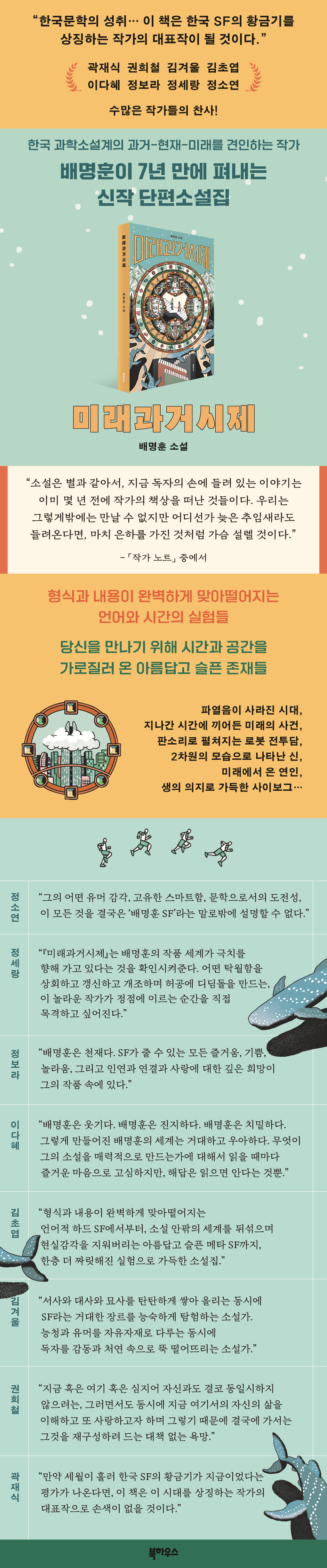
“This book will become a masterpiece by an author who symbolizes the golden age of Korean science fiction.”
Kwak Jae-sik, Kwon Hee-chul, Kim Gyul-wool, Kim Cho-yeop, Lee Da-hye, Jeong Bo-ra, Jeong Se-rang, Jeong So-yeon A wonderful writer who has been praised by countless writers Bae Myung-hoon's new novel collection, his first in seven years “A writer who introduced the potential of Korean SF to the public,” “A writer who has played a key role in ‘connection’ and ‘expansion’ in the world of science fiction,” “A writer who has broken down the boundaries and limitations of imagination,” “A writer who explodes the frustration of human existence that has not yet been expressed in the infinite space of space,” etc. Since his debut in 2005, Bae Myung-hoon has received much attention and love from many people. His new short story collection, ‘Future Past Tense,’ has been published. This is the third solo novel collection published in seven years since 『Art and the Acceleration of Gravity』, and contains nine novels written intensively over the past three years during the pandemic. In these works, the way the world is constructed has become more wondrous, and the perspective on existence has become deeper. The story of Masaro, a spending robot who goes deep into the ocean to admire paintings of whale sharks and falls into a trap ("Guardian of the Demand Curve"), a future world where plosives have been completely eliminated to block droplets ("With the Desire of Chakatapa"), a lovely mystery about a couple traveling through time ("Future Past Tense"), a unique and hilarious robot battle story told in the form of pansori ("Temporary Pilot"), alien beings who fly in in a two-dimensional form like paper ("Folding Gods"), and even the concept of sleeping consciousness and dual virtual reality ("When the Alarm Rings"), Bae Myung-hoon pushes the world of "dreams" and "what ifs" to the limit while moving language, time, and space in various ways, awakening the joy of reading that intertwines imagination and reflection. This collection of works will be particularly meaningful to readers who have consistently read Bae Myung-hoon's work, as well as to those who are encountering his world for the first time. |
- You can preview some of the book's contents.
Preview
index
Guardian of the Demand Curve
With the aspiration of Chakatapa
Future past tense
Folding Gods
Representative of humanity
temporary pilot
Home, Away
Half of existence
When the alarm rings
Recommendation
With the aspiration of Chakatapa
Future past tense
Folding Gods
Representative of humanity
temporary pilot
Home, Away
Half of existence
When the alarm rings
Recommendation
Detailed image
Into the book
"So how are you going to save the world? What can you do? Are you a creative robot?"
"You want me to do such a massive production job?"
“So what is this talent you have? You say it has functions and missions.
Whoever made it must have made it to do something.”
Masaro said, looking up at the ceiling where nothing could be seen.
“I mean…”
"Can you please stop being so timid like someone who's already lived their entire life? I'm just asking this question despite your busy schedule."
“Oh, sorry.
“I have a talent for spending money.”
"what?"
“Because I’m a consumer.”
“What consumer?”
“Anything.
I am a robot that puts the 'invisible hand' in place.
Guardian of the demand curve.
It does not participate in the supply curve.
Spend it generously and without regret.
Anything made by humans can be bought.
It's a test robot made for that purpose.
A successful test robot.
“Isn’t it cool?”
---From "The Guardian of the Demand Curve"
It was truly a time of upheaval.
It was a time when people would greet each other with a handshake and share food from the same bowl.
The practice of drinking from someone else's glass has become famous among the general public as it has appeared in various historical dramas.
It was a time when the Derrick Green was considered the future of display, and automatic doors had switches that could be pressed by hand.
No, if that's the case, why bother making automatic doors? (...) I was annoyed by the mouths of people of that era who diligently made squeaking noises.
So, no matter how important the speech scene was, it was difficult to watch it for a long time.
It didn't matter what the content was.
If it was a speech made up of aspirated consonants, it would be the same.
---From "Chakatapa's Aspirations"
A person with perfect beauty that never belongs to this world.
(…) Then one day, my first love suddenly disappeared without a trace or warning.
The only thing that young Kim Eun-kyung, who had little to lose, held dearly.
(…) An unambitious future person who can travel through time but only came to study history.
The one person whose face I could only briefly see in my dreams, the one person whose tears would flow just by thinking about him.
Eun-kyung finally reached her time.
---From "Future Past Tense"
“Origami is a very useful skill in space.
But it's not about folding paper, it's about folding something else.
The simplest thing is something like wings on a spaceship, right? Solar panels.
Since you can't launch a spaceship with its wings spread out, the design is to fold them up and launch them, then unfold them for their original purpose once they reach orbit.
The key is to fold it neatly so that it takes up as little space as possible and then unfold it neatly without any accidents.
But that's not all."
"then?"
“On the contrary, it is also possible to unfold and fold it.
It is transported by folding it flat like paper and then folding it again at the destination.
Sometimes it folds with a robotic arm, but sometimes it folds automatically.
“With electric fields or solar energy or something like that.”
“What are you folding?”
"What should I fold? What can I say?"
---From "Folding Gods"
“Was it absurd when you woke up?”
Eunsu asked, looking at the spaceship.
Woo Mae-hee also answered without taking her eyes off him.
"Isn't it just as I expected? When I woke up, it was exactly where I'd envisioned it before I fell asleep, exactly as I'd planned.
I wouldn't have panicked.
And I have no regrets.
“Because they probably picked out guys who originally liked that kind of stuff.”
“It’ll be shameless.”
“I am filled with a sense of mission.”
"You never dreamed you'd hear such a perplexing request, did you? I was hoping to bring something a little more serious."
---From "The Spokesman of Humanity"
(No, I don't) There must have been a young man named Jihaim who lived in Cheongpa-dong, Seoul a long time ago.
At the age of twenty, he had a great awakening and by the time he was thirty, he had mastered a rare talent, which he called robot control.
It was a rare talent that only a hundred or so people in the world had, but there was no red ocean between robots, with only about ten of them in the world.
After sleeping during the day and going out to earn pocket money in the evening for several years, I returned home one night and opened the envelope containing the notice in my mailbox. The cover said notice, but the content was a recruitment notice.
---From "Temporary Pilot"
It was a bit of a flashy writing application.
As the program began, two sets of athlete uniforms were seen.
One was white and one was sky blue.
When I chose white as Hanmunji instructed, a blank screen appeared.
'What do you want me to do?'
It didn't seem much different from other writing programs.
But as I typed the sentence 'What do you want me to do?' as it came to mind, a strange sound came out of nowhere.
It was a cheer.
Cheers at a sports stadium.
---From "Home, Away"
“Only half of my body remained.
The other half could not be found.
It might have disappeared altogether.
I might just have lost it.
Because I fell off the plane.
Anyway, the story from that time is too horrible to tell in words.
Even though I have no feelings whatsoever.
Anyway, my dad personally checked the remaining half on site.
“I recognized the pants.” (…) “Dad must have been quite shocked too.
Your judgment may have been clouded.
I think so.
Because it was such a strange decision.
I'm talking about the decision to save the remaining half.
“Usually, this half is not saved.”
---From "Half of Existence"
“I decided to go with a dual plot.”
I couldn't say anything in response.
Instead, he stopped in his tracks.
It was buffering.
My wife said.
“What that means is that each hibernation device will have two story generators running simultaneously.
Oh, is this difficult too? It's like a movie with two directors.
Now you get it! But what's with those eyes? Just hearing them makes me think they're already doomed? I get it.
I'll figure it out, of course.
I can solve it.
stop.
“Enough with that story.”
My wife was so excited that I knew I was on the right track.
It didn't matter whether it was right or wrong since it wasn't our company's business, but that's how it was.
The decision to run two story generators simultaneously within a single story generator was, so to speak, a result of my wife's persuasion of the company.
That's all I needed to know.
When I offered my congratulations, my wife added something excitedly.
“This second story generator will be developed by our team, and this is the key.
What I mean is, it's going to create a science fiction plot."
"You want me to do such a massive production job?"
“So what is this talent you have? You say it has functions and missions.
Whoever made it must have made it to do something.”
Masaro said, looking up at the ceiling where nothing could be seen.
“I mean…”
"Can you please stop being so timid like someone who's already lived their entire life? I'm just asking this question despite your busy schedule."
“Oh, sorry.
“I have a talent for spending money.”
"what?"
“Because I’m a consumer.”
“What consumer?”
“Anything.
I am a robot that puts the 'invisible hand' in place.
Guardian of the demand curve.
It does not participate in the supply curve.
Spend it generously and without regret.
Anything made by humans can be bought.
It's a test robot made for that purpose.
A successful test robot.
“Isn’t it cool?”
---From "The Guardian of the Demand Curve"
It was truly a time of upheaval.
It was a time when people would greet each other with a handshake and share food from the same bowl.
The practice of drinking from someone else's glass has become famous among the general public as it has appeared in various historical dramas.
It was a time when the Derrick Green was considered the future of display, and automatic doors had switches that could be pressed by hand.
No, if that's the case, why bother making automatic doors? (...) I was annoyed by the mouths of people of that era who diligently made squeaking noises.
So, no matter how important the speech scene was, it was difficult to watch it for a long time.
It didn't matter what the content was.
If it was a speech made up of aspirated consonants, it would be the same.
---From "Chakatapa's Aspirations"
A person with perfect beauty that never belongs to this world.
(…) Then one day, my first love suddenly disappeared without a trace or warning.
The only thing that young Kim Eun-kyung, who had little to lose, held dearly.
(…) An unambitious future person who can travel through time but only came to study history.
The one person whose face I could only briefly see in my dreams, the one person whose tears would flow just by thinking about him.
Eun-kyung finally reached her time.
---From "Future Past Tense"
“Origami is a very useful skill in space.
But it's not about folding paper, it's about folding something else.
The simplest thing is something like wings on a spaceship, right? Solar panels.
Since you can't launch a spaceship with its wings spread out, the design is to fold them up and launch them, then unfold them for their original purpose once they reach orbit.
The key is to fold it neatly so that it takes up as little space as possible and then unfold it neatly without any accidents.
But that's not all."
"then?"
“On the contrary, it is also possible to unfold and fold it.
It is transported by folding it flat like paper and then folding it again at the destination.
Sometimes it folds with a robotic arm, but sometimes it folds automatically.
“With electric fields or solar energy or something like that.”
“What are you folding?”
"What should I fold? What can I say?"
---From "Folding Gods"
“Was it absurd when you woke up?”
Eunsu asked, looking at the spaceship.
Woo Mae-hee also answered without taking her eyes off him.
"Isn't it just as I expected? When I woke up, it was exactly where I'd envisioned it before I fell asleep, exactly as I'd planned.
I wouldn't have panicked.
And I have no regrets.
“Because they probably picked out guys who originally liked that kind of stuff.”
“It’ll be shameless.”
“I am filled with a sense of mission.”
"You never dreamed you'd hear such a perplexing request, did you? I was hoping to bring something a little more serious."
---From "The Spokesman of Humanity"
(No, I don't) There must have been a young man named Jihaim who lived in Cheongpa-dong, Seoul a long time ago.
At the age of twenty, he had a great awakening and by the time he was thirty, he had mastered a rare talent, which he called robot control.
It was a rare talent that only a hundred or so people in the world had, but there was no red ocean between robots, with only about ten of them in the world.
After sleeping during the day and going out to earn pocket money in the evening for several years, I returned home one night and opened the envelope containing the notice in my mailbox. The cover said notice, but the content was a recruitment notice.
---From "Temporary Pilot"
It was a bit of a flashy writing application.
As the program began, two sets of athlete uniforms were seen.
One was white and one was sky blue.
When I chose white as Hanmunji instructed, a blank screen appeared.
'What do you want me to do?'
It didn't seem much different from other writing programs.
But as I typed the sentence 'What do you want me to do?' as it came to mind, a strange sound came out of nowhere.
It was a cheer.
Cheers at a sports stadium.
---From "Home, Away"
“Only half of my body remained.
The other half could not be found.
It might have disappeared altogether.
I might just have lost it.
Because I fell off the plane.
Anyway, the story from that time is too horrible to tell in words.
Even though I have no feelings whatsoever.
Anyway, my dad personally checked the remaining half on site.
“I recognized the pants.” (…) “Dad must have been quite shocked too.
Your judgment may have been clouded.
I think so.
Because it was such a strange decision.
I'm talking about the decision to save the remaining half.
“Usually, this half is not saved.”
---From "Half of Existence"
“I decided to go with a dual plot.”
I couldn't say anything in response.
Instead, he stopped in his tracks.
It was buffering.
My wife said.
“What that means is that each hibernation device will have two story generators running simultaneously.
Oh, is this difficult too? It's like a movie with two directors.
Now you get it! But what's with those eyes? Just hearing them makes me think they're already doomed? I get it.
I'll figure it out, of course.
I can solve it.
stop.
“Enough with that story.”
My wife was so excited that I knew I was on the right track.
It didn't matter whether it was right or wrong since it wasn't our company's business, but that's how it was.
The decision to run two story generators simultaneously within a single story generator was, so to speak, a result of my wife's persuasion of the company.
That's all I needed to know.
When I offered my congratulations, my wife added something excitedly.
“This second story generator will be developed by our team, and this is the key.
What I mean is, it's going to create a science fiction plot."
---From "When the Alarm Rings"
Publisher's Review
From the deepest oceans on Earth to spaceships flying to Mars.
From robots enjoying art to long-time lovers from the future
A wondrous experience of crossing boundaries and meeting new worlds and people.
"Future Past Tense" is Bae Myung-hoon's third solo collection of short stories.
The nine original stories in this book take us into unfamiliar times and places we have never experienced before.
The time in the story is both the past and the future, and the space is both the depths of the sea and the far reaches of space.
For example, in "Guardians of the Demand Curve," a construction site for a deep-sea city is set; in "The Desire of Chakatapa," a university isolation lab in a future era where crackling noises have disappeared; in "The Folding Gods," a spaceship sailing toward Mars; and in "Half of Being," a world where people work together with cyborgs unfolds.
On the other hand, the characters living in this unfamiliar world are familiar, as if they have known each other for a long time.
These people, with their vivid names like Yuhee, Saro, Eun-kyung, Sohee, Maehee, Munji, and Haim, live lives similar to us, as if we could just touch them.
Sometimes we face crises and unexpected situations and struggle, sometimes we reminisce about old memories while unable to hide our joy at chance encounters, and sometimes we painfully endure separations that we cannot help.
Thanks to the hands they extend, we are able to willingly cross some boundary to another world.
The act of going into a world beyond the borders is a wonder in itself.
Bae Myung-hoon's skill in blending unfamiliar worlds with familiar characters has always been outstanding, but what he demonstrates in these works has become even more expanded and deeper.
This is probably thanks to the delicate emotions that are not lost while piling up unique ideas.
A sadness hidden in joy, a parting destined for an encounter, a strange melancholy drawn into wonder… These two layers of sensibility continue unabated from the first moment the world and the characters connect, drawing immersion from the very end.
Korean grammar with plosives removed, the use of the tense called future past tense,
The pansori format, developed with considerations about language prior to the modern novel
The most original and profound experiments in language
What is particularly striking in these works is the linguistic experimentation carried out with precision by the artist as a man of words.
At the end of each work, there is an “Author’s Note” containing the work’s prehistory or epilogue. In the “Author’s Note” attached to “With the Desire of Chakatapa,” Bae Myung-hoon looks back on the time of writing and confesses that he imagined the change of words in the face of the “terrifying prediction that the COVID-19 pandemic would change some part of our lives forever.”
The world that was born in this way is Korea in a future era where the sound of explosion has disappeared.
Unlike the title, "With the Desire of Chakatapa" hardly features the letters 'ㅊ', 'ㅋ', 'ㅌ', 'ㅍ', 'ㄲ', 'ㄸ', 'ㅉ', and 'ㅃ'.
In an era where 'flower' is pronounced as 'got' and 'katharsis' as 'gadarsis', it is an era where you have to master hacking skills to imagine the pronunciation of plosive sounds.
But what if an actor were tasked with portraying a character from a time when plosives existed? What would happen if they heard "plosives" in old material? This ingenious work, which could be called a "novel of flat sounds," evokes gentle laughter throughout, yet never fails to offer a profound reflection on the world represented by words.
As the wonders of pronunciation experiments come to an end, the experiment of tense, or time, unfolds.
In "Future Past Tense," a tense that can be used in a world where time does not flow in one direction appears.
Eun-kyung, a character living in a time that flows in one direction, experiences and interprets the ‘tense from the future.’
The character Eun-sin, who can travel from the future to the past, uses the tense 'am/eom' instead of 'at/eot' when talking about future events that have definitely happened. When this usage is interpreted in connection with the study of the tenses of the Turkic language, we are amazed by the interlocking narratives and at the same time, we are made to ponder the inseparable relationship between time and language.
"Temporary Pilot," which clearly shows the effort and dedication put into it over a long period of time, is a masterpiece among this collection of exceptional works.
This work is a heartbreaking adventure story about Ji Ha-im, a character who has learned how to pilot a robot with great difficulty, but is unemployed and leaves for a distant land after receiving a call.
What makes this guaranteed fun story even more special is the pansori format.
The author explains that he delved into the language of the pre-modern novel, unraveling the origins of words in detail and then building them up to create a pansori.
This might be a unique science fiction novel in the history of Korean literature.
The story, which begins with aniri (a private story performed verbally without rhythm), unfolds with free use of jinyangjo, jungmori, jajinmori, and jungjungmori, providing an auditory experience that makes it seem as if you are listening with your ears while reading with your eyes.
Meanwhile, the device of familiarity between characters contrasted with unfamiliar formats is also fully utilized in this work.
Thanks to this, we find ourselves drawn to the bonds of people who easily lose their minds over delicious food, find ourselves applying accurate and sober assessments of the political situation to our society, and find courage and comfort in those who embrace their fears and ultimately overcome crises.
An intellectual exploration that renews our sense of the 'now' and the 'here'.
A touching experience that transcends the boundaries between human and non-human, fostering affection for all beings.
Although the nine pieces in this book are driven by 'a time other than now' and 'a place other than here,' what we come to sense anew as we go through the stories is 'now' and 'here.'
For example, scenes in "The Speaker of Humanity," where a spaceship lands atop the tallest building in Seoul and the characters must prepare for an encounter with unknown beings, broaden our perspective on the real world.
"Half of Being," in which a cyborg who lost his upper body in an accident uses all his might to prove that he is still alive, leads us to reflect on the boundaries that divide existence and non-existence, human and non-human.
The dual plot of virtual reality that awakens a sleeping consciousness, as shown in "When the Alarm Rings," encourages us to think about a world that feels like it is firmly connected to the material world.
What does all this intellectual exploration, beyond the present reality and the present language, point to?
Perhaps it is about cultivating life without losing it in a “society ruled by barbarians,” or cherishing the encounter between you and me, calling out and remembering the name of existence.
The comments of author Jeong Bo-ra, who reads “a deep hope for fate, connection, and love” in these works, and critic Kwon Hee-chul, who derives “an understanding of and love for life,” also add strength to this reading.
Bae Myung-hoon also writes in his final “Author’s Note” that he believes, “We can still move toward truth and beauty.”
Could there be a greater resonance for us, who have encountered this novel as if we were encountering a star that had departed long ago?
"Future Past Tense" will be a collection of works that once again renews Bae Myung-hoon's excellence, in which his various strengths have fully matured through the issues that have arisen over the past few years.
About the cover illustration
The cover illustration for 『Future Past Tense』 is the work of artist Ji-su Choi, who also illustrated the covers of the English edition of Bae Myung-hoon's 『Tower』 and the Korean and English editions of 『Round and Round Space Force』.
By borrowing the mandala design, each and every story element that appears in the book was depicted without missing a single detail.
If you look at the paintings again after reading the work, you will be even more fascinated by the various elements of the novel incorporated into the paintings, from the whale shark in "The Guardian of the Demand Curve" to the skating rink in "When the Alarm Sounds."
From robots enjoying art to long-time lovers from the future
A wondrous experience of crossing boundaries and meeting new worlds and people.
"Future Past Tense" is Bae Myung-hoon's third solo collection of short stories.
The nine original stories in this book take us into unfamiliar times and places we have never experienced before.
The time in the story is both the past and the future, and the space is both the depths of the sea and the far reaches of space.
For example, in "Guardians of the Demand Curve," a construction site for a deep-sea city is set; in "The Desire of Chakatapa," a university isolation lab in a future era where crackling noises have disappeared; in "The Folding Gods," a spaceship sailing toward Mars; and in "Half of Being," a world where people work together with cyborgs unfolds.
On the other hand, the characters living in this unfamiliar world are familiar, as if they have known each other for a long time.
These people, with their vivid names like Yuhee, Saro, Eun-kyung, Sohee, Maehee, Munji, and Haim, live lives similar to us, as if we could just touch them.
Sometimes we face crises and unexpected situations and struggle, sometimes we reminisce about old memories while unable to hide our joy at chance encounters, and sometimes we painfully endure separations that we cannot help.
Thanks to the hands they extend, we are able to willingly cross some boundary to another world.
The act of going into a world beyond the borders is a wonder in itself.
Bae Myung-hoon's skill in blending unfamiliar worlds with familiar characters has always been outstanding, but what he demonstrates in these works has become even more expanded and deeper.
This is probably thanks to the delicate emotions that are not lost while piling up unique ideas.
A sadness hidden in joy, a parting destined for an encounter, a strange melancholy drawn into wonder… These two layers of sensibility continue unabated from the first moment the world and the characters connect, drawing immersion from the very end.
Korean grammar with plosives removed, the use of the tense called future past tense,
The pansori format, developed with considerations about language prior to the modern novel
The most original and profound experiments in language
What is particularly striking in these works is the linguistic experimentation carried out with precision by the artist as a man of words.
At the end of each work, there is an “Author’s Note” containing the work’s prehistory or epilogue. In the “Author’s Note” attached to “With the Desire of Chakatapa,” Bae Myung-hoon looks back on the time of writing and confesses that he imagined the change of words in the face of the “terrifying prediction that the COVID-19 pandemic would change some part of our lives forever.”
The world that was born in this way is Korea in a future era where the sound of explosion has disappeared.
Unlike the title, "With the Desire of Chakatapa" hardly features the letters 'ㅊ', 'ㅋ', 'ㅌ', 'ㅍ', 'ㄲ', 'ㄸ', 'ㅉ', and 'ㅃ'.
In an era where 'flower' is pronounced as 'got' and 'katharsis' as 'gadarsis', it is an era where you have to master hacking skills to imagine the pronunciation of plosive sounds.
But what if an actor were tasked with portraying a character from a time when plosives existed? What would happen if they heard "plosives" in old material? This ingenious work, which could be called a "novel of flat sounds," evokes gentle laughter throughout, yet never fails to offer a profound reflection on the world represented by words.
As the wonders of pronunciation experiments come to an end, the experiment of tense, or time, unfolds.
In "Future Past Tense," a tense that can be used in a world where time does not flow in one direction appears.
Eun-kyung, a character living in a time that flows in one direction, experiences and interprets the ‘tense from the future.’
The character Eun-sin, who can travel from the future to the past, uses the tense 'am/eom' instead of 'at/eot' when talking about future events that have definitely happened. When this usage is interpreted in connection with the study of the tenses of the Turkic language, we are amazed by the interlocking narratives and at the same time, we are made to ponder the inseparable relationship between time and language.
"Temporary Pilot," which clearly shows the effort and dedication put into it over a long period of time, is a masterpiece among this collection of exceptional works.
This work is a heartbreaking adventure story about Ji Ha-im, a character who has learned how to pilot a robot with great difficulty, but is unemployed and leaves for a distant land after receiving a call.
What makes this guaranteed fun story even more special is the pansori format.
The author explains that he delved into the language of the pre-modern novel, unraveling the origins of words in detail and then building them up to create a pansori.
This might be a unique science fiction novel in the history of Korean literature.
The story, which begins with aniri (a private story performed verbally without rhythm), unfolds with free use of jinyangjo, jungmori, jajinmori, and jungjungmori, providing an auditory experience that makes it seem as if you are listening with your ears while reading with your eyes.
Meanwhile, the device of familiarity between characters contrasted with unfamiliar formats is also fully utilized in this work.
Thanks to this, we find ourselves drawn to the bonds of people who easily lose their minds over delicious food, find ourselves applying accurate and sober assessments of the political situation to our society, and find courage and comfort in those who embrace their fears and ultimately overcome crises.
An intellectual exploration that renews our sense of the 'now' and the 'here'.
A touching experience that transcends the boundaries between human and non-human, fostering affection for all beings.
Although the nine pieces in this book are driven by 'a time other than now' and 'a place other than here,' what we come to sense anew as we go through the stories is 'now' and 'here.'
For example, scenes in "The Speaker of Humanity," where a spaceship lands atop the tallest building in Seoul and the characters must prepare for an encounter with unknown beings, broaden our perspective on the real world.
"Half of Being," in which a cyborg who lost his upper body in an accident uses all his might to prove that he is still alive, leads us to reflect on the boundaries that divide existence and non-existence, human and non-human.
The dual plot of virtual reality that awakens a sleeping consciousness, as shown in "When the Alarm Rings," encourages us to think about a world that feels like it is firmly connected to the material world.
What does all this intellectual exploration, beyond the present reality and the present language, point to?
Perhaps it is about cultivating life without losing it in a “society ruled by barbarians,” or cherishing the encounter between you and me, calling out and remembering the name of existence.
The comments of author Jeong Bo-ra, who reads “a deep hope for fate, connection, and love” in these works, and critic Kwon Hee-chul, who derives “an understanding of and love for life,” also add strength to this reading.
Bae Myung-hoon also writes in his final “Author’s Note” that he believes, “We can still move toward truth and beauty.”
Could there be a greater resonance for us, who have encountered this novel as if we were encountering a star that had departed long ago?
"Future Past Tense" will be a collection of works that once again renews Bae Myung-hoon's excellence, in which his various strengths have fully matured through the issues that have arisen over the past few years.
About the cover illustration
The cover illustration for 『Future Past Tense』 is the work of artist Ji-su Choi, who also illustrated the covers of the English edition of Bae Myung-hoon's 『Tower』 and the Korean and English editions of 『Round and Round Space Force』.
By borrowing the mandala design, each and every story element that appears in the book was depicted without missing a single detail.
If you look at the paintings again after reading the work, you will be even more fascinated by the various elements of the novel incorporated into the paintings, from the whale shark in "The Guardian of the Demand Curve" to the skating rink in "When the Alarm Sounds."
GOODS SPECIFICS
- Date of issue: March 21, 2023
- Page count, weight, size: 344 pages | 404g | 133*200*30mm
- ISBN13: 9791164052011
- ISBN10: 1164052012
You may also like
카테고리
korean


korean

![GQ KOREA Mark (Monthly): December [2025]](http://librairie.coreenne.fr/cdn/shop/files/8ef265dbbfbf186523ed75ba7319009d.jpg?v=1765340328&width=3840)


