

English Grammar 1+2 Set
 |
Description
Book Introduction
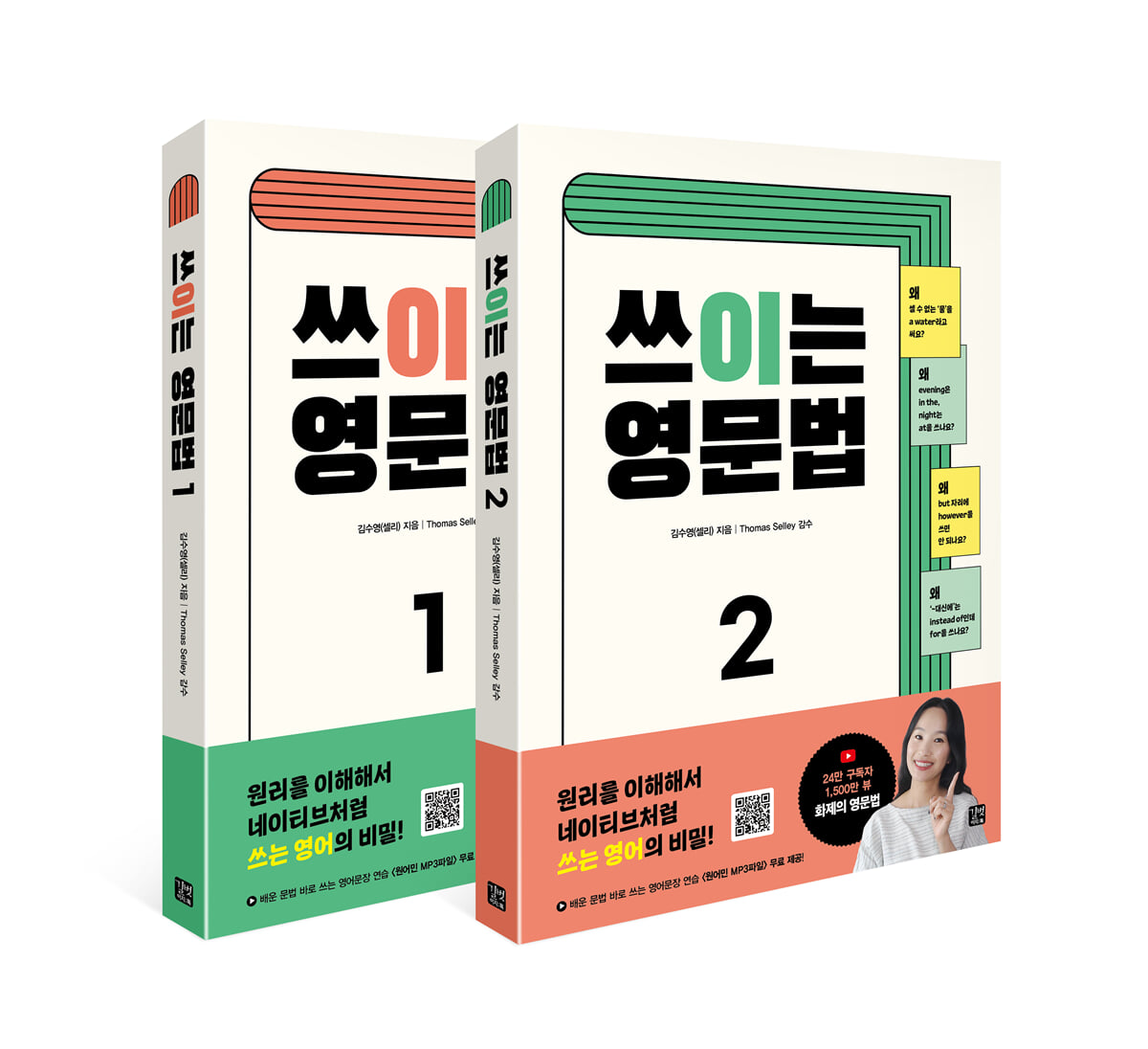
This product is a product made by YES24. (Individual returns are not possible.) [Book] English Grammar in Use 2 240,000 subscribers! 15 million views! The popular English grammar lecture is finally published as a book!! {The Secret to Writing Like a Native by Understanding the Principles} Adult English learning requires going beyond the "What?" to the "Why?" to truly absorb the knowledge. Even if you learn grammar, you can't actually use it in real life because you just memorized the formulas without understanding the why? This book clearly explains the principles of English, such as “why this grammar rule should be applied here,” so you can learn English grammar that is actually used in English conversation and writing. It provides refreshing answers to the questions, “Why are we suddenly using the present perfect here?” instead of “What is the present perfect?”, “Why do we use the infinitive for the verb of perception?” instead of “What is the verb of perception?”, and “Why do we use for instead of to?” instead of “What is the preposition used here?” [Book] English Grammar in Use 1 240,000 subscribers! 15 million views! The popular English grammar lecture is finally published as a book!! {The Secret to Writing Like a Native by Understanding the Principles} Adult English learning requires going beyond the "What?" to the "Why?" to truly absorb the knowledge. Even if you learn grammar, you can't actually use it in real life because you just memorized the formulas without understanding the why? This book clearly explains the principles of English, such as “why this grammar rule should be applied here,” so you can learn English grammar that is actually used in English conversation and writing. It provides refreshing answers to the questions, “Why are we suddenly using the present perfect here?” instead of “What is the present perfect?”, “Why do we use the infinitive for the verb of perception?” instead of “What is the verb of perception?”, and “Why do we use for instead of to?” instead of “What is the preposition used here?” |
- You can preview some of the book's contents.
Preview
index
English Grammar in Use 1
{ CHAPTER 1.
Understanding English Sentences and Verbs
LESSON 1_ The Differences Between Korean and English That Will Make English Easier to Understand
Point 1 | In Korean, it's waist, in English, it's tail!
〈Tip〉The most basic way to expand your English sentences is with the "Tick-Tick" technique.
Review 1 I Practice English by Using Grammar You've Learned
Point 2 | The position of words is extremely important in English.
〈Tip〉Verbs without objects and verbs with objects
Review 2 I Practice English by Using Grammar You've Learned
LESSON 2_ Blocks that make up the word "English" that is different from Korean
Point 1 | Sentence Components
Point 2 | English Parts of Speech
Point 3 | What is a phrase?
Point 4 | What is a clause?
Review I English practice using the grammar you learned
LESSON 3_ The true meaning and role of the verb "be" that will solve half of your English frustrations
Point 1 | Don't memorize 'be verb = ~'
Point 2 | The Unique Role of the "Be" Verb
Point 3 | Things you can only understand after learning the verb "be"
Point 4 | The Pros and Cons of the "be" Verb Finally Revealed
Point 5 | How to overcome the shortcomings of the "be" verb
Point 6 | Things to be careful of when using regular verbs as linking verbs
〈Tip〉The verb be fills the empty space of a verb, and the pronoun it fills the empty space of a noun.
Review I English practice using the grammar you learned
LESSON 4_ 5 New Types of Understanding That Will Open Your Eyes to English
Point 1 | You are perfect even without an object, Form 1: Subject + Intransitive Verb
Point 2 | The unique 2-form with the verb "be": subject + linking verb + nominative complement
Review 1 I Practice English by Using Grammar You've Learned
Point 3 | The three-form sentence that requires an object to be complete: Subject + Transitive Verb + Object
〈Tip〉'~을/를' is not a word that indicates an object!
Point 4 | 4th form with two objects next to each other: Subject + transitive verb + (indirect) object + (direct) object
Review 2 I Practice English by Using Grammar You've Learned
Point 5 | Form 5, which fills in the gaps of Form 3: Subject + Transitive Verb + Object + Objective Complement
Review 3 I English practice using the grammar you learned
LESSON 5_ Understanding the Real Principles Makes English Practical: Understanding Perceptual Verbs
Point 1 | The Special Features of Verbs of Perception
Point 2 | Why the sentence structure of perceptual verbs must be 〈subject + verb + object + verb infinitive〉
Point 3 | Changes in sentence structure due to differences in meaning
Point 4 | Subject + Verb + Object + Infinitive vs.
Subject + verb + object + present participle (Ving)
Point 5 | Subject + Verb + Object + Past Participle
Review I English practice using the grammar you learned
LESSON 6_ Understanding the Real Principles Makes English Practical: Understanding Causative Verbs
Point 1 | What is the exact meaning of 'causative verb' in English?
Point 2 | Why do causative verbs have the sentence structure of “subject + verb + object + verb infinitive”?
Point 3 | Why You Shouldn't Memorize the Verb "Have" as "Sikida"
Point 4 | Comparing the Nuance Differences of the Causative Verbs Have, Make, Let, and Help
Point 5 | Common verbs that can be used in place of have to mean 'to order'
Review I English practice using the grammar you learned
{ CHAPTER 2.
English tenses
LESSON 1_ A general understanding of English tenses that will deepen your understanding of English.
Point 1 | There are two tenses in English.
Point 2 | How to Express Future Events in English
Point 3 | So what does 'hyung (progressive, perfect)' mean in English?
Point 4 | When the tense and time do not match
Review I English practice using the grammar you learned
LESSON 2_ There are only two tenses in English: present and past tense.
Point 1 | The Core of the Simple Present Tense
Point 2 | Various Uses of the Simple Present Tense
Point 3 | The Core of the Simple Past Tense
Point 4 | Various Uses of the Simple Past Tense
〈Tip〉How to Create Polite and Courteous Expressions in English
〈Tip〉Tense agreement: something you should have learned a long time ago
Review I English practice using the grammar you learned
LESSON 3_ will vs.
be going to V vs.
be Ving Devices indicating future time
Point 1 | The most common verb to indicate future events, will
Point 2 | be going to V indicating future events
Point 3 | be going to V vs. to indicate planned future events
be Ving
Point 4 | will vs.
be going to V vs.
be Ving meaning difference
Point 5 | Will be Ving indicating future time
Review I English practice using the grammar you learned
LESSON 4_ Understanding the 'aspect' of English makes writing in English much easier.
Point 1 | There are two types of 'hyeong' in English: progressive and perfect.
Point 2 | The Principle of 'Progressive' Sentence Structure
Point 3 | Core Concepts of the Present Progressive Tense
〈Tip〉There are cases where the progressive tense is not possible.
Point 4 | Comparison of the Simple Present Tense and the Present Progressive Tense
Point 5 | Various Uses of the Present Progressive Tense
〈Tip〉〈be+adjective〉 can also be in the progressive tense!
Point 6 | Core Concepts of the Past Progressive Tense
Point 7 | Comparison of Simple Past Tense and Past Progressive Tense
Point 8 | Various Uses of the Past Progressive Tense
Review 1 I Practice English by Using Grammar You've Learned
Point 9 | Core Concepts of the Present Perfect Tense
POINT 10 I Comparison of Simple Past Tense and Present Perfect
〈Tip〉The Difference Between the Past Tense and Present Perfect Tense, Which Native Speakers Find Too Confusing for Koreans
POINT 11 I Various uses of the present perfect tense
POINT 12 I Core Concepts of the Present Perfect Progressive
〈FAQ〉I'm so confused about when to use the present perfect tense and when to use the present perfect progressive tense.
POINT 13 I Core Concepts of the Past Perfect Tense
〈Tip〉Be sure to remember this when using the past perfect tense!
POINT 14 I Various uses of the past perfect tense
Review 2 I Practice English by Using Grammar You've Learned
{ CHAPTER 3.
'Law' in English
LESSON 1_ There are three types of "laws" in English: Indicative, Imperative, and Subjunctive.
Point 1 | What is the English word 'law'?
Point 2 | The indicative mood that matches facts and tenses
Point 3 | Imperative sentences that assume the other person will follow what I say.
Point 4 | The subjunctive mood, which shows that the possibility is low by dropping the tense
〈Tip〉Why Koreans are often mistaken for being rude when speaking English
Review I English practice using the grammar you learned
LESSON 2_ Understanding the burdensome conditional sentences used in real life
Point 1 | Not all sentences with an if clause are conditional.
Point 2 | Conditional Mood: When stating the opposite of the present fact
Point 3 | Conditional Mood: When recounting past events in reverse
Point 4 | Subjunctive: When the Opposite of a Past Fact Has Present Implications
Point 5 | Sometimes the if clause is omitted in the conditional sentence.
〈Tip〉Not all hopes are the same! hope vs.
wish
Review I English practice using the grammar you learned
{ CHAPTER 4.
English 'tae'
LESSON 1: What is 'Voice' in English? Active and Passive Voice
Point 1 | What is 'tae' in English?
Point 2 | Characteristics of Verbs Used in the Passive Voice
Point 3 | Even the same verb can change its active/passive voice depending on its meaning.
〈Tip〉worry vs. worry
be worried
Review I English practice using the grammar you learned
LESSON 2_ Understanding the passive voice: When to use it
Point 1 | Passive Sentence Structure Principles
Point 2 | Diversifying the Passive Voice's Meaning by Using Linking Verbs Instead of the "Be" Verb
Point 3 | Don't just memorize "be+pp+by noun"
Point 4 | There's a reason for using the passive voice.
Point 5 | Passive voice in a four-form sentence structure with two objects
〈Tip〉When creating passive voice, please consider whether there is any possibility of misunderstanding in the meaning.
Point 6 | Passive voice in sentence structure 5 with objective complement
〈Tip〉Understanding the Passive Voice of Causative Verbs That No One Taught You
Review I English practice using the grammar you learned
{ CHAPTER 5.
} Conjugation of verbs
LESSON 1_ A quick overview of the English part of speech transformations for eating and frying what you have
Point 1 | Various Ways to Change Parts of Speech
LESSON 2_ Understanding the ubiquitous to-infinitive
Point 1 | Understanding the Basic Concept of the To-Infinitive
Point 2 | To-Infinitive as a Noun: Subject Role
〈Tip〉Don't just memorize formulas, understand sentence structure!
Point 3 | To-Infinitive as a Noun: Acting as an Object
〈Tip〉If the object is too long, you can move it to the back.
Point 4 | To-Infinitive as a Noun: Functioning as a Complement
Point 5 | The to-infinitive as an adjective: Modifying nouns
Point 6 | To-infinitive used with interrogatives: interrogative + to-infinitive
〈Tip〉How to say 'method' in English how to V vs.
to V vs.
a way vs.
method
Point 7 | The to-infinitive as an adverb: Expressing the purpose of an action
〈Tip〉The in order to V is too important to be simply emphasized as a purpose.
Point 8 | To-infinitive as an adverb: Expressing result, reason, or degree
Review I English practice using the grammar you learned
LESSON 3_ Understanding the ubiquitous use of gerunds
Point 1 | Understanding the Basic Concept of Gerunds
Point 2 | Comparing the characteristics of infinitives and gerunds
Point 3 | Gerunds as Subjects
Point 4 | Gerunds as Nominative Complements
Point 5 | Gerunds as Objects
〈Tip〉Indicating the subject of a gerund according to its meaning
Point 6 | Changes in the meaning of to-infinitives and gerunds used as objects
〈Tip〉The objects of like, love, and hate must be chosen according to the meaning. 〈to-infinitive vs.
gerund>
Review I English practice using the grammar you learned
LESSON 4_ A Look at Participles Used in Various Places
Point 1 | Understanding the Basic Concept of Present Participles
Point 2 | Understanding the Basic Concept of Past Participles
〈Tip〉Direct action vs.
Actions done at the behest of one
Point 3 | Understanding the Core Concepts of Participle Phrases
〈Tip〉when/while Ving vs.
before/after Ving
Point 4 | Don't be confused by similar shapes! Distinguishing between gerunds and present participles
〈Tip〉~without vs.
~ as it is
Review I English practice using the grammar you learned
Point 5 | Irregular Verb Table
{ CHAPTER 6.
auxiliary verb}
LESSON 1_ English Features You Need to Know to Understand Auxiliary Verbs
Point 1 | English reflects a lower probability of occurrence by lowering the tense.
Point 2 | There are two main types of auxiliary verbs in English.
Review I English practice using the grammar you learned
LESSON 2_ You need to know the nuance to use it freely: auxiliary verbs of guessing and judging
Point 1 | The auxiliary verb must for logical inference and judgment
Point 2 | My guess should be correct for me to be normal
〈Tip〉The auxiliary verb will is different from the must in guessing.
〈Tip〉In the same situation, other auxiliary verbs are also used.
Point 3 | May and might, which are used to speculate on possible events and talk about possibilities.
Point 4 | Could suggests a possibility that could occur
Point 5 | The Basic Concept of Auxiliary Verbs that Reflect on Past Events and Make Inferences
Point 6 | The Use of Various Auxiliary Verbs to Infer Past Events
Review I English practice using the grammar you learned
LESSON 3_ You need to know the nuance to use it freely. Auxiliary verbs of psychological attitude.
Point 1 | Will, indicating strong will
Point 2 | must, indicating a strong obligation
Point 3 | The difference between must and have to V
Point 4 | The difference in meaning between "must not" and "don't have to"
〈Tip〉Purified expressions of must/have to V that can be unpleasant if said incorrectly
Point 5 | Should indicating a soft obligation
〈Tip〉Be supposed to V indicating obligation
〈Tip〉had better V indicating obligation
Point 6 | Can indicating ability
Point 7 | Limitations of can and Solutions
〈Tip〉Why do native speakers use could instead of can?
〈Tip〉can / be able to V / be capable of Organize in one go
Point 8 | Permission Auxiliary Verbs may/can/could
Point 9 | Basic Concepts of Auxiliary Verbs Expressing Present Psychological Attitudes About Past Events
I POINT 10 I The use of various auxiliary verbs to express present psychological attitudes toward past events
〈Tip〉Why is would, which has the same interpretation as will, used so often?
〈Tip〉Would you ~? is not an expression of request.
〈FAQ〉What is the difference between would and used to V, which indicate repetitive actions in the past?
Review I English practice using the grammar you learned
ANSWER Model Answer
English Grammar in Use 2
{ CHAPTER 1 CONJUNCTIONS }
LESSON 1_ A quick overview of the types of conjunctions that change the part of speech in a sentence.
Point 1 | The Role and Types of Conjunctions
Point 2 | Core Concepts and Characteristics of Coordinating Conjunctions
〈Tip〉When conjunctions are used with and without commas (,)
Point 3 | Core Concepts and Characteristics of Correlative Conjunctions
〈Tip〉Why correlative conjunctions are absolutely necessary
Review I English practice using the grammar you learned
LESSON 2_ Noun clause conjunctions that change the part of speech of a sentence into a noun
Point 1 | Core Concepts of Noun Clause Conjunctions
Point 2 | Noun clause conjunctions interpreted as '~thing': that/what
Point 3 | Noun clause conjunctions interpreted as 'who': who
Point 4 | Noun clause conjunctions that modify nouns: what/which/whose
〈Tip〉Why is 'what car' an incorrect expression?
Point 5 | Noun clause conjunctions interpreted as 'whether (or not)': whether/if
Point 6 | Noun clause conjunctions that translate to "when, where, how, and why": when/where/how/why
Review I English practice using the grammar you learned
LESSON 3_ Adjective clause conjunctions that change the part of speech of a sentence into an adjective
Point 1 | Core Concepts and Formative Principles of Adjective Clause Conjunctions
Point 2 | Types of Relative Pronouns
〈Tip〉Continuous usage of relative pronouns as actually used by native speakers
Point 3 | Subject relative pronouns that are eating the subject: that/which/who
Point 4 | Objective relative pronouns that are eating the object: that/which/whom
Point 5 | Possessive relative pronoun that is possessive: whose
〈Tip〉Possessive relative pronouns actually used by native speakers
Point 6 | What is not an adjectival conjunction.
Point 7 | Adjective clauses ending in a preposition
〈FAQ〉Relative pronouns vs.
Is there a difference in meaning depending on what the present participle is decorated with?
Point 8 | Core Concepts and Formative Principles of Relative Clause Conjunctions
Point 9 | Various Variations of Relative Adverbial Conjunctions
Point 10 I -ever-containing conjunctions: whatever, whoever, whichever, however, whenever,
wherever
Review I English practice using the grammar you learned
LESSON 4_ Adverbial conjunctions that change the part of speech of a sentence into an adverb
Point 1 | Core Concepts of Adverbial Conjunctions
Point 2 | Adverbial Conjunctions of Time
Point 3 | Adverbial Conjunctions of Concession and Condition
Point 4 | Adverbial conjunction of reason
Point 5 | Various Uses of That Clauses
〈Tip〉so ~ that clause / such ~ that clause / too ~ to V
Review I English practice using the grammar you learned
{ CHAPTER 2 Articles and Nouns }
LESSON 1_ Understanding the Inseparable Relationship Between Nouns and Nouns
Point 1 | Understanding the Term "Article"
〈Tip〉The seemingly trivial but absolutely not trivial difference in meaning between a and the
Point 2 | Understanding the Concept of Number in Nouns
Point 3 | The Relationship Between Articles and Nouns
〈Tip〉The concept of number of nouns that changes depending on the situation and meaning
Point 4 | Clearing Up the Confusing Concept of Number in Nouns
〈FAQ〉I heard that collective nouns can be treated as both singular and plural, but I'm confused.
〈Tip〉The possessive form is a bit confusing.
Review I English practice using the grammar you learned
LESSON 2_ Understanding Indefinite Articles Attached to Indefinite Singular Nouns
Point 1 | Core Concepts and Characteristics of Indefinite Articles (a/an)
Point 2 | Various Uses of Indefinite Articles (a/an)
〈FAQ〉When do you change a to an?
〈Tip〉The real meaning of There is/There are ~
Review I English practice using the grammar you learned
LESSON 3_ Understanding the definite article attached to a fixed noun
Point 1 | Core Concepts and Characteristics of Articles
Point 2 | Various Uses of the Article "the"
〈FAQ〉I'm so confused about whether to use plural or singular when referring to a general object or person.
〈Tip〉We've compiled a list of nouns that don't use articles.
〈FAQ〉What is the difference between the number one and the pronoun one?
Review I English practice using the grammar you learned
{ CHAPTER 3 ADJECTIVES }
LESSON 1_ Understanding Adjectives That Explain Nouns in More Detail
Point 1 | Various forms of adjectives
Point 2 | Adjectives that modify nouns by attaching to them (limiting usage)
〈FAQ〉Why do we put commas between adjectives?
Point 3 | Adjectives used as complements (descriptive use)
Point 4 | Restrictive vs.
Descriptive usage
Review I English practice using the grammar you learned
LESSON 2_ Adjectives that express the concepts of quantity and number in various usages
Point 1 | Many
Point 2 | Several, quite a lot, considerable
Point 3 | A little, a few
〈FAQ〉I'm curious about the exact meaning of a couple of / a few / some / several
Point 4 | some vs.
any
〈Tip〉Common mistakes Koreans make in conversation related to any
Point 5 | all
Point 6 | Negative sentence of all
〈FAQ〉all people vs.
all the people vs.
What on earth is the difference between all of the people?
Point 7 | All vs. All
whole vs.
entire
Point 8 | most vs.
almost
Point 9 | each vs.
every
Point 10 I another vs.
other vs.
the other
Point 11 I Adjectives made by adding -ly to nouns
Review | English Practice: Putting Learned Grammar to Use
Point 12 I Other adjective forms worth knowing
{ CHAPTER 4.
adverb }
LESSON 1_ Understanding Adverbs That Modify Everything But Nouns
Point 1 | Various forms of adverbs
Point 2 | Adverbs at the beginning of a sentence
Point 3 | Adverbs attached to verbs
〈Tip〉Understanding the Feeling of Adverbs of Frequency
Point 4 | Adverbs at the end of sentences
Point 5 | Order of Adverbs
〈Tip〉Emphasis expressions that seem easy but are confusing: too, very, really, so
Point 6 | Adverbs that look exactly like adjectives
Point 7 | Adverbs that change meaning when you add -ly to adverbs that have the same form as an adjective.
Review I English practice using the grammar you learned
LESSON 2_ Distinguishing between adverbs and prepositions in phrasal verbs
Point 1 | What is a verb?
Point 2 | Why We Need to Distinguish Between Adverbs and Prepositions in Phrasal Verbs
Point 3 | Distinguishing Prepositions and Adverbs and the Principle of Positional Change
Review I English practice using the grammar you learned
{ CHAPTER 5.
comparative }
LESSON 1_ Understanding the Equivalent Comparison to Express Inequality of State or Degree
Point 1 | Core Concepts and Types of Comparatives
Point 2 | The Principles and Characteristics of Comparative Sentences
〈Tip〉Omit redundant or obvious content in comparison sentences.
〈FAQ〉What exactly are the nuanced differences?
He respects her as much as I do.
He respects her as much as me.
Point 3 | Things to be aware of when using equivalent comparatives
Point 4 | Useful Expressions for Comparative Equivalence
〈Tip〉The nuance difference between like and as when comparing two objects
Review I English practice using the grammar you learned
LESSON 2_ Understanding inferiority/superiority comparisons that show whether a state or degree is 'more' or 'less'
Point 1 | The Principle and Characteristics of Inferiority/Superiority Comparison Creation
Point 2 | Changes in the Form of Comparative and Superlative Adjectives and Adverbs
Point 3 | Things to be careful of when using inferior/superior comparative sentences
Point 4 | Commonly Used Comparative Phrases
〈Tip〉“You look old.” is not “You look old.”?!
Review I English practice using the grammar you learned
LESSON 3_ Understanding the superlatives and multiple comparisons that show how many times more or less something is the highest/lowest.
Point 1 | Top-Level Core Concepts and Features
Point 2 | Various expressions indicating the best
Point 3 | Superlative Expressions You Should Know
〈FAQ〉What is the English word for 'second largest'?
Point 4 | Types and Characteristics of Multiple Comparisons
Review I English practice using the grammar you learned
{ CHAPTER 6.
preposition }
LESSON 1_ Understanding Prepositions to Enrich Information
Point 1 | The Concept and Role of Prepositions
Point 2 | Learn about representative prepositions with illustrations
〈Tip〉How to distinguish between place prepositions at/on/in, which are all interpreted as '~에' in Korean
Review I English practice using the grammar you learned
LESSON 2_ You can use prepositions of time well only if you know the concept and usage accurately.
Point 1 | Prepositions of Time: at/on/in
Point 2 | English Time Notation
〈Tip〉Various uses of expressions indicating time zones
[Changes that occur when the is replaced with a in in the morning]
Point 3 | Prepositions of time interpreted as '~while': for/during/in/over
〈Tip〉The difference between the prepositions for and in, which indicate the length of time
Point 4 | Prepositions of time interpreted as '~에': at/for
Point 5 | Prepositions of time interpreted as 'after': in/since/after
〈Tip〉~ Before: ago vs.
before
Point 6 | Prepositions of time interpreted as 'until': until/by
Point 7 | Prepositions of Time Interpreted as "From ~"
〈FAQ〉I'm confused about prepositions when asking about store hours.
Review I English practice using the grammar you learned
LESSON 3_ Various uses of prepositions of hard work
Point 1 | Preposition with
Point 2 | Prepositions indicating 'reason': because of/due to/for
Point 3 | Prepositions indicating materials
Point 4 | Prepositions used with agree: with/on/to
Point 5 | Examples of how the picture changes depending on which preposition is used.
〈FAQ〉I'm confused about whether to get in/out (of) or get on/off when saying 'get on/off'.
〈Tip〉How to indicate a means of transportation (by is not always used)
Point 6 | Prepositions Used with Adjectives
Point 7 | Prepositions Used with Verbs
Review I English practice using the grammar you learned
ANSWER Model Answer
{ CHAPTER 1.
Understanding English Sentences and Verbs
LESSON 1_ The Differences Between Korean and English That Will Make English Easier to Understand
Point 1 | In Korean, it's waist, in English, it's tail!
〈Tip〉The most basic way to expand your English sentences is with the "Tick-Tick" technique.
Review 1 I Practice English by Using Grammar You've Learned
Point 2 | The position of words is extremely important in English.
〈Tip〉Verbs without objects and verbs with objects
Review 2 I Practice English by Using Grammar You've Learned
LESSON 2_ Blocks that make up the word "English" that is different from Korean
Point 1 | Sentence Components
Point 2 | English Parts of Speech
Point 3 | What is a phrase?
Point 4 | What is a clause?
Review I English practice using the grammar you learned
LESSON 3_ The true meaning and role of the verb "be" that will solve half of your English frustrations
Point 1 | Don't memorize 'be verb = ~'
Point 2 | The Unique Role of the "Be" Verb
Point 3 | Things you can only understand after learning the verb "be"
Point 4 | The Pros and Cons of the "be" Verb Finally Revealed
Point 5 | How to overcome the shortcomings of the "be" verb
Point 6 | Things to be careful of when using regular verbs as linking verbs
〈Tip〉The verb be fills the empty space of a verb, and the pronoun it fills the empty space of a noun.
Review I English practice using the grammar you learned
LESSON 4_ 5 New Types of Understanding That Will Open Your Eyes to English
Point 1 | You are perfect even without an object, Form 1: Subject + Intransitive Verb
Point 2 | The unique 2-form with the verb "be": subject + linking verb + nominative complement
Review 1 I Practice English by Using Grammar You've Learned
Point 3 | The three-form sentence that requires an object to be complete: Subject + Transitive Verb + Object
〈Tip〉'~을/를' is not a word that indicates an object!
Point 4 | 4th form with two objects next to each other: Subject + transitive verb + (indirect) object + (direct) object
Review 2 I Practice English by Using Grammar You've Learned
Point 5 | Form 5, which fills in the gaps of Form 3: Subject + Transitive Verb + Object + Objective Complement
Review 3 I English practice using the grammar you learned
LESSON 5_ Understanding the Real Principles Makes English Practical: Understanding Perceptual Verbs
Point 1 | The Special Features of Verbs of Perception
Point 2 | Why the sentence structure of perceptual verbs must be 〈subject + verb + object + verb infinitive〉
Point 3 | Changes in sentence structure due to differences in meaning
Point 4 | Subject + Verb + Object + Infinitive vs.
Subject + verb + object + present participle (Ving)
Point 5 | Subject + Verb + Object + Past Participle
Review I English practice using the grammar you learned
LESSON 6_ Understanding the Real Principles Makes English Practical: Understanding Causative Verbs
Point 1 | What is the exact meaning of 'causative verb' in English?
Point 2 | Why do causative verbs have the sentence structure of “subject + verb + object + verb infinitive”?
Point 3 | Why You Shouldn't Memorize the Verb "Have" as "Sikida"
Point 4 | Comparing the Nuance Differences of the Causative Verbs Have, Make, Let, and Help
Point 5 | Common verbs that can be used in place of have to mean 'to order'
Review I English practice using the grammar you learned
{ CHAPTER 2.
English tenses
LESSON 1_ A general understanding of English tenses that will deepen your understanding of English.
Point 1 | There are two tenses in English.
Point 2 | How to Express Future Events in English
Point 3 | So what does 'hyung (progressive, perfect)' mean in English?
Point 4 | When the tense and time do not match
Review I English practice using the grammar you learned
LESSON 2_ There are only two tenses in English: present and past tense.
Point 1 | The Core of the Simple Present Tense
Point 2 | Various Uses of the Simple Present Tense
Point 3 | The Core of the Simple Past Tense
Point 4 | Various Uses of the Simple Past Tense
〈Tip〉How to Create Polite and Courteous Expressions in English
〈Tip〉Tense agreement: something you should have learned a long time ago
Review I English practice using the grammar you learned
LESSON 3_ will vs.
be going to V vs.
be Ving Devices indicating future time
Point 1 | The most common verb to indicate future events, will
Point 2 | be going to V indicating future events
Point 3 | be going to V vs. to indicate planned future events
be Ving
Point 4 | will vs.
be going to V vs.
be Ving meaning difference
Point 5 | Will be Ving indicating future time
Review I English practice using the grammar you learned
LESSON 4_ Understanding the 'aspect' of English makes writing in English much easier.
Point 1 | There are two types of 'hyeong' in English: progressive and perfect.
Point 2 | The Principle of 'Progressive' Sentence Structure
Point 3 | Core Concepts of the Present Progressive Tense
〈Tip〉There are cases where the progressive tense is not possible.
Point 4 | Comparison of the Simple Present Tense and the Present Progressive Tense
Point 5 | Various Uses of the Present Progressive Tense
〈Tip〉〈be+adjective〉 can also be in the progressive tense!
Point 6 | Core Concepts of the Past Progressive Tense
Point 7 | Comparison of Simple Past Tense and Past Progressive Tense
Point 8 | Various Uses of the Past Progressive Tense
Review 1 I Practice English by Using Grammar You've Learned
Point 9 | Core Concepts of the Present Perfect Tense
POINT 10 I Comparison of Simple Past Tense and Present Perfect
〈Tip〉The Difference Between the Past Tense and Present Perfect Tense, Which Native Speakers Find Too Confusing for Koreans
POINT 11 I Various uses of the present perfect tense
POINT 12 I Core Concepts of the Present Perfect Progressive
〈FAQ〉I'm so confused about when to use the present perfect tense and when to use the present perfect progressive tense.
POINT 13 I Core Concepts of the Past Perfect Tense
〈Tip〉Be sure to remember this when using the past perfect tense!
POINT 14 I Various uses of the past perfect tense
Review 2 I Practice English by Using Grammar You've Learned
{ CHAPTER 3.
'Law' in English
LESSON 1_ There are three types of "laws" in English: Indicative, Imperative, and Subjunctive.
Point 1 | What is the English word 'law'?
Point 2 | The indicative mood that matches facts and tenses
Point 3 | Imperative sentences that assume the other person will follow what I say.
Point 4 | The subjunctive mood, which shows that the possibility is low by dropping the tense
〈Tip〉Why Koreans are often mistaken for being rude when speaking English
Review I English practice using the grammar you learned
LESSON 2_ Understanding the burdensome conditional sentences used in real life
Point 1 | Not all sentences with an if clause are conditional.
Point 2 | Conditional Mood: When stating the opposite of the present fact
Point 3 | Conditional Mood: When recounting past events in reverse
Point 4 | Subjunctive: When the Opposite of a Past Fact Has Present Implications
Point 5 | Sometimes the if clause is omitted in the conditional sentence.
〈Tip〉Not all hopes are the same! hope vs.
wish
Review I English practice using the grammar you learned
{ CHAPTER 4.
English 'tae'
LESSON 1: What is 'Voice' in English? Active and Passive Voice
Point 1 | What is 'tae' in English?
Point 2 | Characteristics of Verbs Used in the Passive Voice
Point 3 | Even the same verb can change its active/passive voice depending on its meaning.
〈Tip〉worry vs. worry
be worried
Review I English practice using the grammar you learned
LESSON 2_ Understanding the passive voice: When to use it
Point 1 | Passive Sentence Structure Principles
Point 2 | Diversifying the Passive Voice's Meaning by Using Linking Verbs Instead of the "Be" Verb
Point 3 | Don't just memorize "be+pp+by noun"
Point 4 | There's a reason for using the passive voice.
Point 5 | Passive voice in a four-form sentence structure with two objects
〈Tip〉When creating passive voice, please consider whether there is any possibility of misunderstanding in the meaning.
Point 6 | Passive voice in sentence structure 5 with objective complement
〈Tip〉Understanding the Passive Voice of Causative Verbs That No One Taught You
Review I English practice using the grammar you learned
{ CHAPTER 5.
} Conjugation of verbs
LESSON 1_ A quick overview of the English part of speech transformations for eating and frying what you have
Point 1 | Various Ways to Change Parts of Speech
LESSON 2_ Understanding the ubiquitous to-infinitive
Point 1 | Understanding the Basic Concept of the To-Infinitive
Point 2 | To-Infinitive as a Noun: Subject Role
〈Tip〉Don't just memorize formulas, understand sentence structure!
Point 3 | To-Infinitive as a Noun: Acting as an Object
〈Tip〉If the object is too long, you can move it to the back.
Point 4 | To-Infinitive as a Noun: Functioning as a Complement
Point 5 | The to-infinitive as an adjective: Modifying nouns
Point 6 | To-infinitive used with interrogatives: interrogative + to-infinitive
〈Tip〉How to say 'method' in English how to V vs.
to V vs.
a way vs.
method
Point 7 | The to-infinitive as an adverb: Expressing the purpose of an action
〈Tip〉The in order to V is too important to be simply emphasized as a purpose.
Point 8 | To-infinitive as an adverb: Expressing result, reason, or degree
Review I English practice using the grammar you learned
LESSON 3_ Understanding the ubiquitous use of gerunds
Point 1 | Understanding the Basic Concept of Gerunds
Point 2 | Comparing the characteristics of infinitives and gerunds
Point 3 | Gerunds as Subjects
Point 4 | Gerunds as Nominative Complements
Point 5 | Gerunds as Objects
〈Tip〉Indicating the subject of a gerund according to its meaning
Point 6 | Changes in the meaning of to-infinitives and gerunds used as objects
〈Tip〉The objects of like, love, and hate must be chosen according to the meaning. 〈to-infinitive vs.
gerund>
Review I English practice using the grammar you learned
LESSON 4_ A Look at Participles Used in Various Places
Point 1 | Understanding the Basic Concept of Present Participles
Point 2 | Understanding the Basic Concept of Past Participles
〈Tip〉Direct action vs.
Actions done at the behest of one
Point 3 | Understanding the Core Concepts of Participle Phrases
〈Tip〉when/while Ving vs.
before/after Ving
Point 4 | Don't be confused by similar shapes! Distinguishing between gerunds and present participles
〈Tip〉~without vs.
~ as it is
Review I English practice using the grammar you learned
Point 5 | Irregular Verb Table
{ CHAPTER 6.
auxiliary verb}
LESSON 1_ English Features You Need to Know to Understand Auxiliary Verbs
Point 1 | English reflects a lower probability of occurrence by lowering the tense.
Point 2 | There are two main types of auxiliary verbs in English.
Review I English practice using the grammar you learned
LESSON 2_ You need to know the nuance to use it freely: auxiliary verbs of guessing and judging
Point 1 | The auxiliary verb must for logical inference and judgment
Point 2 | My guess should be correct for me to be normal
〈Tip〉The auxiliary verb will is different from the must in guessing.
〈Tip〉In the same situation, other auxiliary verbs are also used.
Point 3 | May and might, which are used to speculate on possible events and talk about possibilities.
Point 4 | Could suggests a possibility that could occur
Point 5 | The Basic Concept of Auxiliary Verbs that Reflect on Past Events and Make Inferences
Point 6 | The Use of Various Auxiliary Verbs to Infer Past Events
Review I English practice using the grammar you learned
LESSON 3_ You need to know the nuance to use it freely. Auxiliary verbs of psychological attitude.
Point 1 | Will, indicating strong will
Point 2 | must, indicating a strong obligation
Point 3 | The difference between must and have to V
Point 4 | The difference in meaning between "must not" and "don't have to"
〈Tip〉Purified expressions of must/have to V that can be unpleasant if said incorrectly
Point 5 | Should indicating a soft obligation
〈Tip〉Be supposed to V indicating obligation
〈Tip〉had better V indicating obligation
Point 6 | Can indicating ability
Point 7 | Limitations of can and Solutions
〈Tip〉Why do native speakers use could instead of can?
〈Tip〉can / be able to V / be capable of Organize in one go
Point 8 | Permission Auxiliary Verbs may/can/could
Point 9 | Basic Concepts of Auxiliary Verbs Expressing Present Psychological Attitudes About Past Events
I POINT 10 I The use of various auxiliary verbs to express present psychological attitudes toward past events
〈Tip〉Why is would, which has the same interpretation as will, used so often?
〈Tip〉Would you ~? is not an expression of request.
〈FAQ〉What is the difference between would and used to V, which indicate repetitive actions in the past?
Review I English practice using the grammar you learned
ANSWER Model Answer
English Grammar in Use 2
{ CHAPTER 1 CONJUNCTIONS }
LESSON 1_ A quick overview of the types of conjunctions that change the part of speech in a sentence.
Point 1 | The Role and Types of Conjunctions
Point 2 | Core Concepts and Characteristics of Coordinating Conjunctions
〈Tip〉When conjunctions are used with and without commas (,)
Point 3 | Core Concepts and Characteristics of Correlative Conjunctions
〈Tip〉Why correlative conjunctions are absolutely necessary
Review I English practice using the grammar you learned
LESSON 2_ Noun clause conjunctions that change the part of speech of a sentence into a noun
Point 1 | Core Concepts of Noun Clause Conjunctions
Point 2 | Noun clause conjunctions interpreted as '~thing': that/what
Point 3 | Noun clause conjunctions interpreted as 'who': who
Point 4 | Noun clause conjunctions that modify nouns: what/which/whose
〈Tip〉Why is 'what car' an incorrect expression?
Point 5 | Noun clause conjunctions interpreted as 'whether (or not)': whether/if
Point 6 | Noun clause conjunctions that translate to "when, where, how, and why": when/where/how/why
Review I English practice using the grammar you learned
LESSON 3_ Adjective clause conjunctions that change the part of speech of a sentence into an adjective
Point 1 | Core Concepts and Formative Principles of Adjective Clause Conjunctions
Point 2 | Types of Relative Pronouns
〈Tip〉Continuous usage of relative pronouns as actually used by native speakers
Point 3 | Subject relative pronouns that are eating the subject: that/which/who
Point 4 | Objective relative pronouns that are eating the object: that/which/whom
Point 5 | Possessive relative pronoun that is possessive: whose
〈Tip〉Possessive relative pronouns actually used by native speakers
Point 6 | What is not an adjectival conjunction.
Point 7 | Adjective clauses ending in a preposition
〈FAQ〉Relative pronouns vs.
Is there a difference in meaning depending on what the present participle is decorated with?
Point 8 | Core Concepts and Formative Principles of Relative Clause Conjunctions
Point 9 | Various Variations of Relative Adverbial Conjunctions
Point 10 I -ever-containing conjunctions: whatever, whoever, whichever, however, whenever,
wherever
Review I English practice using the grammar you learned
LESSON 4_ Adverbial conjunctions that change the part of speech of a sentence into an adverb
Point 1 | Core Concepts of Adverbial Conjunctions
Point 2 | Adverbial Conjunctions of Time
Point 3 | Adverbial Conjunctions of Concession and Condition
Point 4 | Adverbial conjunction of reason
Point 5 | Various Uses of That Clauses
〈Tip〉so ~ that clause / such ~ that clause / too ~ to V
Review I English practice using the grammar you learned
{ CHAPTER 2 Articles and Nouns }
LESSON 1_ Understanding the Inseparable Relationship Between Nouns and Nouns
Point 1 | Understanding the Term "Article"
〈Tip〉The seemingly trivial but absolutely not trivial difference in meaning between a and the
Point 2 | Understanding the Concept of Number in Nouns
Point 3 | The Relationship Between Articles and Nouns
〈Tip〉The concept of number of nouns that changes depending on the situation and meaning
Point 4 | Clearing Up the Confusing Concept of Number in Nouns
〈FAQ〉I heard that collective nouns can be treated as both singular and plural, but I'm confused.
〈Tip〉The possessive form is a bit confusing.
Review I English practice using the grammar you learned
LESSON 2_ Understanding Indefinite Articles Attached to Indefinite Singular Nouns
Point 1 | Core Concepts and Characteristics of Indefinite Articles (a/an)
Point 2 | Various Uses of Indefinite Articles (a/an)
〈FAQ〉When do you change a to an?
〈Tip〉The real meaning of There is/There are ~
Review I English practice using the grammar you learned
LESSON 3_ Understanding the definite article attached to a fixed noun
Point 1 | Core Concepts and Characteristics of Articles
Point 2 | Various Uses of the Article "the"
〈FAQ〉I'm so confused about whether to use plural or singular when referring to a general object or person.
〈Tip〉We've compiled a list of nouns that don't use articles.
〈FAQ〉What is the difference between the number one and the pronoun one?
Review I English practice using the grammar you learned
{ CHAPTER 3 ADJECTIVES }
LESSON 1_ Understanding Adjectives That Explain Nouns in More Detail
Point 1 | Various forms of adjectives
Point 2 | Adjectives that modify nouns by attaching to them (limiting usage)
〈FAQ〉Why do we put commas between adjectives?
Point 3 | Adjectives used as complements (descriptive use)
Point 4 | Restrictive vs.
Descriptive usage
Review I English practice using the grammar you learned
LESSON 2_ Adjectives that express the concepts of quantity and number in various usages
Point 1 | Many
Point 2 | Several, quite a lot, considerable
Point 3 | A little, a few
〈FAQ〉I'm curious about the exact meaning of a couple of / a few / some / several
Point 4 | some vs.
any
〈Tip〉Common mistakes Koreans make in conversation related to any
Point 5 | all
Point 6 | Negative sentence of all
〈FAQ〉all people vs.
all the people vs.
What on earth is the difference between all of the people?
Point 7 | All vs. All
whole vs.
entire
Point 8 | most vs.
almost
Point 9 | each vs.
every
Point 10 I another vs.
other vs.
the other
Point 11 I Adjectives made by adding -ly to nouns
Review | English Practice: Putting Learned Grammar to Use
Point 12 I Other adjective forms worth knowing
{ CHAPTER 4.
adverb }
LESSON 1_ Understanding Adverbs That Modify Everything But Nouns
Point 1 | Various forms of adverbs
Point 2 | Adverbs at the beginning of a sentence
Point 3 | Adverbs attached to verbs
〈Tip〉Understanding the Feeling of Adverbs of Frequency
Point 4 | Adverbs at the end of sentences
Point 5 | Order of Adverbs
〈Tip〉Emphasis expressions that seem easy but are confusing: too, very, really, so
Point 6 | Adverbs that look exactly like adjectives
Point 7 | Adverbs that change meaning when you add -ly to adverbs that have the same form as an adjective.
Review I English practice using the grammar you learned
LESSON 2_ Distinguishing between adverbs and prepositions in phrasal verbs
Point 1 | What is a verb?
Point 2 | Why We Need to Distinguish Between Adverbs and Prepositions in Phrasal Verbs
Point 3 | Distinguishing Prepositions and Adverbs and the Principle of Positional Change
Review I English practice using the grammar you learned
{ CHAPTER 5.
comparative }
LESSON 1_ Understanding the Equivalent Comparison to Express Inequality of State or Degree
Point 1 | Core Concepts and Types of Comparatives
Point 2 | The Principles and Characteristics of Comparative Sentences
〈Tip〉Omit redundant or obvious content in comparison sentences.
〈FAQ〉What exactly are the nuanced differences?
He respects her as much as I do.
He respects her as much as me.
Point 3 | Things to be aware of when using equivalent comparatives
Point 4 | Useful Expressions for Comparative Equivalence
〈Tip〉The nuance difference between like and as when comparing two objects
Review I English practice using the grammar you learned
LESSON 2_ Understanding inferiority/superiority comparisons that show whether a state or degree is 'more' or 'less'
Point 1 | The Principle and Characteristics of Inferiority/Superiority Comparison Creation
Point 2 | Changes in the Form of Comparative and Superlative Adjectives and Adverbs
Point 3 | Things to be careful of when using inferior/superior comparative sentences
Point 4 | Commonly Used Comparative Phrases
〈Tip〉“You look old.” is not “You look old.”?!
Review I English practice using the grammar you learned
LESSON 3_ Understanding the superlatives and multiple comparisons that show how many times more or less something is the highest/lowest.
Point 1 | Top-Level Core Concepts and Features
Point 2 | Various expressions indicating the best
Point 3 | Superlative Expressions You Should Know
〈FAQ〉What is the English word for 'second largest'?
Point 4 | Types and Characteristics of Multiple Comparisons
Review I English practice using the grammar you learned
{ CHAPTER 6.
preposition }
LESSON 1_ Understanding Prepositions to Enrich Information
Point 1 | The Concept and Role of Prepositions
Point 2 | Learn about representative prepositions with illustrations
〈Tip〉How to distinguish between place prepositions at/on/in, which are all interpreted as '~에' in Korean
Review I English practice using the grammar you learned
LESSON 2_ You can use prepositions of time well only if you know the concept and usage accurately.
Point 1 | Prepositions of Time: at/on/in
Point 2 | English Time Notation
〈Tip〉Various uses of expressions indicating time zones
[Changes that occur when the is replaced with a in in the morning]
Point 3 | Prepositions of time interpreted as '~while': for/during/in/over
〈Tip〉The difference between the prepositions for and in, which indicate the length of time
Point 4 | Prepositions of time interpreted as '~에': at/for
Point 5 | Prepositions of time interpreted as 'after': in/since/after
〈Tip〉~ Before: ago vs.
before
Point 6 | Prepositions of time interpreted as 'until': until/by
Point 7 | Prepositions of Time Interpreted as "From ~"
〈FAQ〉I'm confused about prepositions when asking about store hours.
Review I English practice using the grammar you learned
LESSON 3_ Various uses of prepositions of hard work
Point 1 | Preposition with
Point 2 | Prepositions indicating 'reason': because of/due to/for
Point 3 | Prepositions indicating materials
Point 4 | Prepositions used with agree: with/on/to
Point 5 | Examples of how the picture changes depending on which preposition is used.
〈FAQ〉I'm confused about whether to get in/out (of) or get on/off when saying 'get on/off'.
〈Tip〉How to indicate a means of transportation (by is not always used)
Point 6 | Prepositions Used with Adjectives
Point 7 | Prepositions Used with Verbs
Review I English practice using the grammar you learned
ANSWER Model Answer
Publisher's Review
Composition and Usage
{Listen to the MP3 file: English Grammar for Listening and Speaking in English}
Grammar is not something you memorize; you have to be able to actually use it when speaking and writing English.
So, all the examples in this book were recorded by native English speakers.
Don't just look at it; study English grammar by listening to it with your ears and repeating it with your mouth.
{Challenge: Knowing yourself is the beginning of learning English!}
Before starting the lesson, we'll have a simple quiz to keep you focused and interested, and to check how well you understand the English grammar you'll be learning.
When a problem is difficult, it is a good idea to try it again after finishing the lesson.
{Why: Why should I learn this grammar rule?}
Adult English must satisfy Why.
Knowing why this grammar is necessary when writing English will definitely help you understand the concepts better than just memorizing the formulas.
Of course, learning efficiency improves because the purpose of learning becomes clear!
{Point: Understand the principles and use English grammar correctly}
A revolutionary English grammar that transforms your wardrobe English into practical English! Rather than listing obvious formulas, it logically and step-by-step explains the differences between Korean and English, starting with why native speakers use and utilize this grammar.
All examples are made up of sentences that native speakers frequently use in real life, so that you can immediately apply the grammar you've learned in real life.
{Tip&FAQ: English Grammar Tips to Avoid Mistakes and Solve Problems}
We've compiled the most confusing and frequently mistaken grammar mistakes Koreans make from a big data set of 200,000 English mistakes into tips with clear explanations.
We've compiled answers to the most common grammar-related questions English learners have in our FAQ.
{Review: Practice using the grammar you've learned in real-life English}
Even if you think you know everything when you read grammar explanations, when you try to apply them in real-life situations, it's not as easy as you'd like. Practice Makes Perfect! Through speaking and writing practice, you can turn your previously half-understood grammar into a fully functional and fluent part of your own!
* Study with the author's YouTube channel, "Writing English"!
With 240,000 subscribers and 15 million views, the popular English grammar YouTube channel "Writing English" offers a variety of grammar videos and additional learning content.
{Listen to the MP3 file: English Grammar for Listening and Speaking in English}
Grammar is not something you memorize; you have to be able to actually use it when speaking and writing English.
So, all the examples in this book were recorded by native English speakers.
Don't just look at it; study English grammar by listening to it with your ears and repeating it with your mouth.
{Challenge: Knowing yourself is the beginning of learning English!}
Before starting the lesson, we'll have a simple quiz to keep you focused and interested, and to check how well you understand the English grammar you'll be learning.
When a problem is difficult, it is a good idea to try it again after finishing the lesson.
{Why: Why should I learn this grammar rule?}
Adult English must satisfy Why.
Knowing why this grammar is necessary when writing English will definitely help you understand the concepts better than just memorizing the formulas.
Of course, learning efficiency improves because the purpose of learning becomes clear!
{Point: Understand the principles and use English grammar correctly}
A revolutionary English grammar that transforms your wardrobe English into practical English! Rather than listing obvious formulas, it logically and step-by-step explains the differences between Korean and English, starting with why native speakers use and utilize this grammar.
All examples are made up of sentences that native speakers frequently use in real life, so that you can immediately apply the grammar you've learned in real life.
{Tip&FAQ: English Grammar Tips to Avoid Mistakes and Solve Problems}
We've compiled the most confusing and frequently mistaken grammar mistakes Koreans make from a big data set of 200,000 English mistakes into tips with clear explanations.
We've compiled answers to the most common grammar-related questions English learners have in our FAQ.
{Review: Practice using the grammar you've learned in real-life English}
Even if you think you know everything when you read grammar explanations, when you try to apply them in real-life situations, it's not as easy as you'd like. Practice Makes Perfect! Through speaking and writing practice, you can turn your previously half-understood grammar into a fully functional and fluent part of your own!
* Study with the author's YouTube channel, "Writing English"!
With 240,000 subscribers and 15 million views, the popular English grammar YouTube channel "Writing English" offers a variety of grammar videos and additional learning content.
GOODS SPECIFICS
- Date of issue: May 15, 2023
- Page count, weight, size: 564 pages | 174*243*35mm
You may also like
카테고리
korean


korean

![GQ KOREA Mark (Monthly): December [2025]](http://librairie.coreenne.fr/cdn/shop/files/8ef265dbbfbf186523ed75ba7319009d.jpg?v=1765340328&width=3840)


