

I'm watching a lot
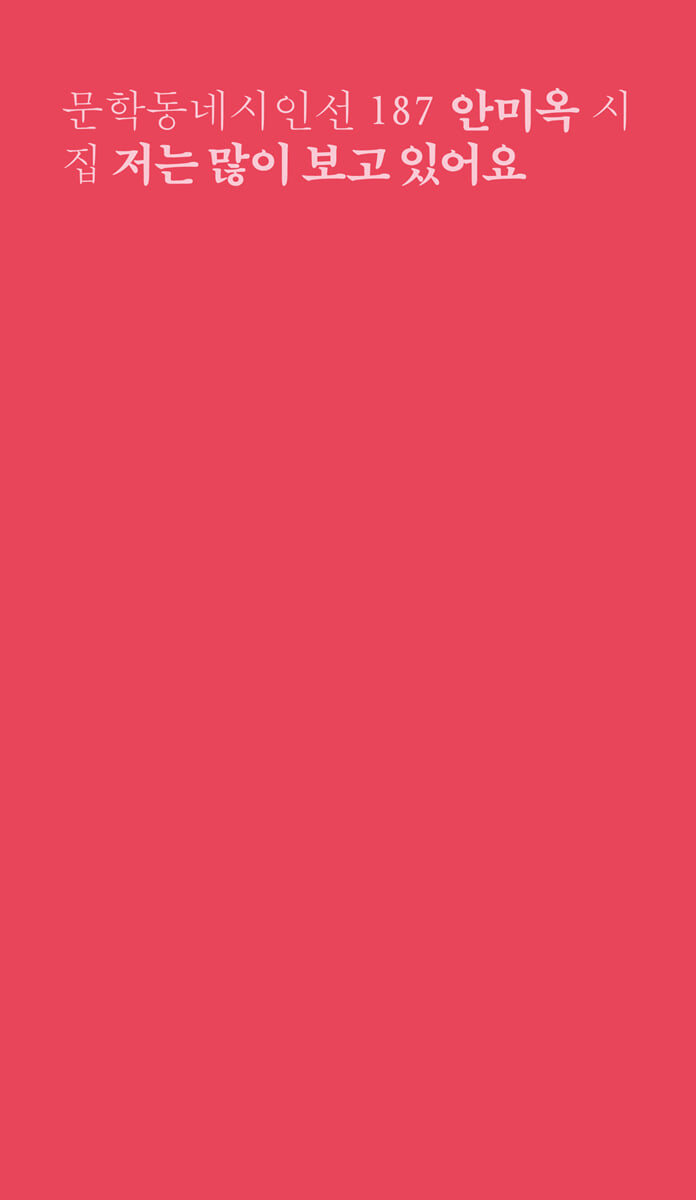 |
Description
Book Introduction
- A word from MD
-
A loving gaze towards a precious beingPoet Ahn Mi-ok's new work, released after three years, has been highly anticipated by both the literary community and readers.
It contains a meticulous gaze toward things that exist.
Even though the book is written in a clear and concise manner, after closing the book, you will be left with numerous question marks rather than a clear message.
It is a fascinating work that you will finally nod your head to after seeing it many times and thinking about it many times.
February 28, 2023. Novel/Poetry PD Nam Myeong-hyeon
Poet Ahn Mi-ok, who debuted in the Dong-A Ilbo in 2012 and published her first poetry collection, “On,” in 2017, won the Kim Jun-seong Literary Award, given to the most outstanding first poetry collection, and then won the Contemporary Literature Award in 2019, earning the expectations and trust of critics and readers alike, is publishing her third poetry collection as the 187th in the Munhakdongne Poet Selection.
It's been three years since the poetry collection 'No Hints'.
“Vague feelings that words could not reach come to me as visible entities, and I am able to imagine in detail the unknown events moving inside my body” (Poet Kim Ki-taek), “The fact that a mind that has touched one’s own life for a long time and has looked at the community to which one belongs for a long time is presented in simple and clear images is ‘An Mi-ok-like’” (Poet Jang Seok-nam), and six other poems were selected as winners of the Contemporary Literature Award, and 46 poems in total are divided into three parts, including “Designated Seat” and “2022 Spring Poetry” and “Sound Book” from the Seesaw Project (Consonants and Vowels), which received the comment, “This poem seems to be creating a new dictionary.”
It's been three years since the poetry collection 'No Hints'.
“Vague feelings that words could not reach come to me as visible entities, and I am able to imagine in detail the unknown events moving inside my body” (Poet Kim Ki-taek), “The fact that a mind that has touched one’s own life for a long time and has looked at the community to which one belongs for a long time is presented in simple and clear images is ‘An Mi-ok-like’” (Poet Jang Seok-nam), and six other poems were selected as winners of the Contemporary Literature Award, and 46 poems in total are divided into three parts, including “Designated Seat” and “2022 Spring Poetry” and “Sound Book” from the Seesaw Project (Consonants and Vowels), which received the comment, “This poem seems to be creating a new dictionary.”
- You can preview some of the book's contents.
Preview
index
Poet's words
Part 1 Everyone has a reason
Home/ Rondo/ Goodness/ House/ Summer Sleep/ Ball Walk/ Reserved Seat/ Do/ Winter Beach/ Chuk─House 2/ Jodo/ Moving Sunlight ◇/ Gardner/ Diving/ Home Visit/ Summer's End
Part 2 I'll give you what I have
Non-Production/ Everyday Today/ Suncatcher/ Tuning/ Momentary/ Home Repair/ Mess/ Tumble/ Jacob (demo)/ Heavy Rain and Yesterday/ Container/ Nearby/ Reconstruction/ Gift/ How to Talk Without Crying
Part 3: See you at lunch. It's bright.
Moroccan Lemon Pickles / Meeting and Writing / Someone's Front Door / A Cut / Hoppun / Silent Reading / A Window / Page Counter / Time to Eat Apples / New Construction / June / The Word I'm Looking for / Continue / Moving Sunlight / Sound Book
Commentary | The Unnamable Existence_Kim Na-young (Literary Critic)
Part 1 Everyone has a reason
Home/ Rondo/ Goodness/ House/ Summer Sleep/ Ball Walk/ Reserved Seat/ Do/ Winter Beach/ Chuk─House 2/ Jodo/ Moving Sunlight ◇/ Gardner/ Diving/ Home Visit/ Summer's End
Part 2 I'll give you what I have
Non-Production/ Everyday Today/ Suncatcher/ Tuning/ Momentary/ Home Repair/ Mess/ Tumble/ Jacob (demo)/ Heavy Rain and Yesterday/ Container/ Nearby/ Reconstruction/ Gift/ How to Talk Without Crying
Part 3: See you at lunch. It's bright.
Moroccan Lemon Pickles / Meeting and Writing / Someone's Front Door / A Cut / Hoppun / Silent Reading / A Window / Page Counter / Time to Eat Apples / New Construction / June / The Word I'm Looking for / Continue / Moving Sunlight / Sound Book
Commentary | The Unnamable Existence_Kim Na-young (Literary Critic)
Detailed image
.jpg)
Into the book
Walking along the edge of the cliff
To find something to eat for the duck
I saw my whole face submerged in water
It could be everything to someone
A very small weight
A promise that is repeated every day
Something that can only be said as a leap
What I barely found among the tasteless souvenirs
---From "Light"
When you're cold and sad.
When I put a piece of honeycomb from a honey jar into my mouth.
It was sweet and warm.
The honey has all melted and the honeycomb has melted.
I thought there would be nothing left.
Even if everything melts, there is something that remains and does not melt anymore.
Something white and sticky like gum.
A door made of such wax.
The door you have seems to be like that.
---From "Summer Sleep"
Sometimes you throw away what you like
Even though I know it will break if I throw it and it falls
I'm going to throw it to a place where it can't fall
If you fold the darkness and put it next to you, you will sleep well.
I fold it smaller and smaller
Fold until you can't fold it anymore
---From "The Ball's Walk"
It's not that I can't use it
Like someone who has left both eyes in zero gravity
Whatever you try to see
Because I can't see as much as I want
So both hands and both feet
If you say that everyone is left behind
If you are experiencing unused time
Do you understand?
---From "The End of Summer"
I want to give bigger tears to those who cry.
Without knowing which one is yours
---From "The End of Summer"
You can try something you've never done before
The attempt is very small
If you roll it, it rolls
If you roll and roll and become a snowball
Even if it breaks or melts completely
Just become water
---From "Momentary"
The fruit vendor
I can't help but watch the fruit rotting.
I often confused mind and soul
With a plausible mind
soul
Experiencing the sphere is
Things that are far from plausible
---From "Home Repair"
There are facts that you only find out later.
That's the talent of later time.
Surrounded by unknown things, quietly waiting for the future.
I wanted to go deeper... I didn't know that going deeper meant creating a large empty space.
I didn't realize that I was sitting alone in a wide open space.
That it's something that can happen in an instant.
Should I leave the side empty?
Because I've never heard of such a full sentence.
The pockets are not full so they are not bursting.
It's flowing out because there's a burst spot.
---From "Container"
We don't know that something is abandoned even when we see it abandoned.
I think someone left it behind.
Why do misery and hope have the same face?
Just talking about poetry, it feels like I'm learning about life.
It's like looking at a plant's tall stem and thinking that it's growing well.
But at lunch, everything looks different.
See you at lunch.
It's getting brighter.
To find something to eat for the duck
I saw my whole face submerged in water
It could be everything to someone
A very small weight
A promise that is repeated every day
Something that can only be said as a leap
What I barely found among the tasteless souvenirs
---From "Light"
When you're cold and sad.
When I put a piece of honeycomb from a honey jar into my mouth.
It was sweet and warm.
The honey has all melted and the honeycomb has melted.
I thought there would be nothing left.
Even if everything melts, there is something that remains and does not melt anymore.
Something white and sticky like gum.
A door made of such wax.
The door you have seems to be like that.
---From "Summer Sleep"
Sometimes you throw away what you like
Even though I know it will break if I throw it and it falls
I'm going to throw it to a place where it can't fall
If you fold the darkness and put it next to you, you will sleep well.
I fold it smaller and smaller
Fold until you can't fold it anymore
---From "The Ball's Walk"
It's not that I can't use it
Like someone who has left both eyes in zero gravity
Whatever you try to see
Because I can't see as much as I want
So both hands and both feet
If you say that everyone is left behind
If you are experiencing unused time
Do you understand?
---From "The End of Summer"
I want to give bigger tears to those who cry.
Without knowing which one is yours
---From "The End of Summer"
You can try something you've never done before
The attempt is very small
If you roll it, it rolls
If you roll and roll and become a snowball
Even if it breaks or melts completely
Just become water
---From "Momentary"
The fruit vendor
I can't help but watch the fruit rotting.
I often confused mind and soul
With a plausible mind
soul
Experiencing the sphere is
Things that are far from plausible
---From "Home Repair"
There are facts that you only find out later.
That's the talent of later time.
Surrounded by unknown things, quietly waiting for the future.
I wanted to go deeper... I didn't know that going deeper meant creating a large empty space.
I didn't realize that I was sitting alone in a wide open space.
That it's something that can happen in an instant.
Should I leave the side empty?
Because I've never heard of such a full sentence.
The pockets are not full so they are not bursting.
It's flowing out because there's a burst spot.
---From "Container"
We don't know that something is abandoned even when we see it abandoned.
I think someone left it behind.
Why do misery and hope have the same face?
Just talking about poetry, it feels like I'm learning about life.
It's like looking at a plant's tall stem and thinking that it's growing well.
But at lunch, everything looks different.
See you at lunch.
It's getting brighter.
---From "Meeting and Writing Poetry"
Publisher's Review
“I think I said everything correctly.
But it's not accurate
“I think it would be more accurate to say that it is not accurate.”
A person who 'sees a lot' quietly and dynamically
A sensitive capture of being alive
Includes the 64th Contemporary Literature Award winner, "Designated Seat"
Poet Ahn Mi-ok, who debuted in the Dong-A Ilbo in 2012 and published her first poetry collection, “On,” in 2017, won the Kim Jun-seong Literary Award, given to the most outstanding first poetry collection, and then won the Contemporary Literature Award in 2019, earning the expectations and trust of critics and readers alike, is publishing her third poetry collection as the 187th in the Munhakdongne Poet Selection.
It's been three years since the poetry collection 'No Hints'.
“Vague feelings that words could not reach come to me as visible entities, and I am able to imagine in detail the unknown events moving inside my body” (Poet Kim Ki-taek), “The fact that a mind that has touched one’s own life for a long time and has looked at the community to which one belongs for a long time is presented in simple and clear images is ‘An Mi-ok-like’” (Poet Jang Seok-nam), and six other poems were selected as winners of the Contemporary Literature Award, and 46 poems in total are divided into three parts, including “Designated Seat” and “2022 Spring Poetry” and “Sound Book” from the Seesaw Project (Consonants and Vowels), which received the comment, “This poem seems to be creating a new dictionary.”
Understanding is wearing wet shoes
Because I run until my shoes dry again.
(…)
You can't just learn it
It is possible to see and learn
I'm watching a lot
_From "Soundbook"
The title of the poetry collection, “I am seeing a lot,” is also the last sentence of the last poem, “Sound Book.”
As you move through the collection of poems, I hope you will carefully examine the questions that naturally arise—who is looking at what and why? Does “a lot” refer to quantity or kind?—and the psychological changes you feel when you encounter the same sentences again after going through the entire collection.
Moreover, I believe that we will be able to confirm that the verb 'to see' is a quiet and dynamic thing that mobilizes all senses, cognition, and reason, and that it fits particularly well with the world of Ahn Mi-ok's poetry.
What the speaker of An Mi-ok's poetry sees particularly often in this collection of poems is 'home.'
In a brief interview with the editor prior to publication, the poet said that 'home' seems to be a place, an emotion, and a time, and further, it seems to be a life and a relationship.
Let's look at two poems that have the word 'house' in their titles and subtitles: "House" and "Axis-House 2."
The speaker of "House" seems to be looking at houses for moving.
It's possible to do strange things like walk into a stranger's house, check out the lighting, and flush the toilet.
Built in 1978, the house has been weathered by time, sunlight, and dust.
There are people who live there.
“The person who sees the house is the one who shows the house,” he said, asking for a call in advance, saying, “I’m at home.”
Both the person who guards the house and the person who comes to check on it are ‘watchers’, and the house is a place where someone has lived and a place where someone is looking for.
And as time goes by, the relationship between ‘home’ and ‘viewer’ will repeat and circulate.
The same goes for "Chuk-House 2".
The “neatly stacked kiwis” on the table in “The House I Went to See” are covered in mold.
The wallpaper is faded and the stuff is piling up.
Things that “became natural because of life.”
Therefore, it is not strange that it is not clear whether the person looking at the large tree beyond the window is “the person who lives here” or “me.”
‘Life’ uses ‘mind’.
It is striking that the title of the poem written about that feeling is 'House Repair'.
The house, with its leaky windows, dented windows, and sink that collapses when you lean on it, is a constant source of worry, and the speaker resolves to “not be obsessed with it anymore.”
I think that a newborn baby does not have a mind and that a mind only develops after a month of birth, so it is possible to live without a mind.
“To experience the concrete/ is to move away from what is plausible.”
An Mi-ok's latest collection of poems is an example of thinking about life spatially.
This life is always about coexisting with someone, sharing everything with the person you're with, suffering from the need for organization and separation, coping with things that can't be shared, always harboring a desire to escape from it all, and continuing to live with even that desire lost until you suddenly open a drawer or turn over a pocket and discover it.
Life is where I belong and where I confine myself.
This is a place where you open the exit and come back again and again.
_Kim Na-young, in the commentary
The speaker who 'sees a lot' dwells in and is absorbed in the house as a space that contains relationships and time, from the house as a place where the inside and outside are separated by a single window.
“Why doesn’t it just pass over?” I wonder, but “Just as you can feel the thickness of the peel when you touch an orange// If you roll your tongue/ I think you’ll be able to feel the thickness of the words.” Looking at the window frames and the corners of chairs, I see countless hands and knees that have passed by overlapping.
“I think/ where the stray hammer struck” (“Designated Seat”).
It is also because I know that “some people will say they hate something they are afraid of” and “some will be left / uninterpreted / just left there” (Winter Beach).
When you ask a question, questions remain.
If you push the question further, questions remain.
Question of questions of questions.
Maybe the door.
Maybe a wall.
Maybe a fence.
Can you tell me?
In the midst of things that you can't know everything no matter which page you open, and things that you can't help but know no matter which page you turn.
The page is like a low wall.
The small tip of a large elephant's nose that cannot climb over a wall shorter than its height.
A place you can barely reach if you stretch with all your might.
In a place that can only be reached that way.
The page is turning.
Leaving only questions.
_In "Page Counter"
Life is full of questions for the attentive speaker.
Seeing through those questions to the end sometimes leads to “something that remains even after everything has melted”, “something that remains in the heart for a long time because it cannot be named” (“Summer Sleep”).
“I think I said everything accurately/ But it’s not accurate/ It seems more accurate to say it’s not accurate.” (「Gift」) The attitude of wanting to see better and see more accurately, but also seeing that it’s not always possible, this is the point where Ahn Mi-ok’s poetry is trusted.
In this collection of poems, a child appears as one of the beings that allows us to see what has been a blind spot until now.
As I climb up the slide backwards, “a child coming down reached out his hand to grab me/ I put more strength into my hands and feet and climb up to the hand that was extended” (“Goodness”). I, who am willing to respond to the innocent and uninhibited mind and actions of the child.
A child who “gets up and rips off his pants even after falling down while running” makes me ask, “Can I do that too?” (“Transferring Sunlight?”). The new and unfamiliar world I learned about through my child makes me rediscover things that were lacking in me or that I once had but have faded away.
The discovery of such a ‘me’ becomes another poetic imagination in Ahn Mi-ok’s world of poetry, and evokes a wider range of thoughts.
“Every night before I go to bed, I think about what I was.
What kind of form did I live in today? (…)// What kind of feet did I stand on today? (…)// I have to treat it with care.
What should I treasure? (…)// I think about what I will become when I wake up. (…)// Today, the cloth is torn in many directions and flutters in a wider area.
“The heart and hands stretch out to their fullest, reaching the tip of the slanted puddle.” (Suncatcher) Together with An Mi-ok’s speakers, who think, question, and in doing so, gradually stretch out wider and longer, we once again “look for a long time / To avoid adding meaning (…) we start from there / We do that enough.” (How to Speak Without Crying)
◎ Mini-interview with poet Ahn Mi-ok
1.
This is a new poetry collection, released three years after “No Hints.”
I'd like to ask you about your thoughts on publishing the book.
I'm also curious about what you thought while preparing this poetry collection.
These days, I'm mostly confused and disoriented.
I think that was especially true while preparing this poetry collection.
The environment surrounding me changed a lot, and it was a time when I had to renew my thoughts about writing poetry.
I often think that it would be nice if the poetry I write could give strength to those who read it.
The power to be yourself, the inner strength to move forward.
Not in a way that fits perfectly, but in a way that is misaligned, twisted, and cracked.
I wonder how readers will read it.
I'm half excited and half worried.
The thought of meeting readers makes me feel pleasantly nervous!
2.
The title of your poetry collection is 'I See a Lot'. Could you tell us why you chose this sentence as the title?
At first, I didn't pay much attention to the title, but the longer I think about it, the more deeply I think about it.
This is the last verse of the last poem in the collection, “Sound Book.”
When readers first see this title, I hope they will be curious and create their own meaning, and when they reach the end of the collection, they will come across the meaning I intended. (Of course, it would be nice to read from the last poem as well.) When you say you are looking at it, you might think of a still, static posture, but to me, it feels more like a violent movement than anything else.
To see is to go there, to live close to it.
I once asked a three-year-old what titles he would like.
He is not yet fluent in speaking, but when I told him the title, he said, “I really want to see it.”
I think that the word “seeing” also includes the word “wanting to see.”
So, I decided on the title because I thought it was a sentence that contained not only my attitude towards life, but also my heart.
3.
There are many poems about 'home' that stand out.
What does the place called home mean to you?
I think home is a place, an emotion, and a time.
I lived an unstable life during my childhood.
I think I've lived under that influence, often feeling a sense of home.
Now, I think that my thoughts on 'home', which started in my childhood, are expanding a little more.
I think that now is a place where all of human life and relationships are contained, a place where the past, present, and future exist together.
Because it doesn't specify a specific location, even if only two people gather together, that relationship can become a home.
I often think about those different types of homes.
4.
Please tell us which poem from this collection you particularly cherish and why.
If I had to pick one, I think it would be "Soundbook."
To me, love and understanding are not soft and beautiful words, but desperate, complex, and painful words that make your blood flow.
Writing about such love and understanding has given me a lot of strength, and I like it because it's a poem that resonates with me differently each time I read it.
5.
Please say a few words of greeting to the readers of this poetry collection.
It's been a while since I've seen you.
It still amazes me to think that someone reads my poetry.
I hope you enjoy reading it.
I think it would be really nice if there was a poem that I could deeply connect with, even just one.
And I hope you stay healthy both physically and mentally.
■ Poet's Note
Hand to hand
I see it opening.
February 2023
An Mi-ok
But it's not accurate
“I think it would be more accurate to say that it is not accurate.”
A person who 'sees a lot' quietly and dynamically
A sensitive capture of being alive
Includes the 64th Contemporary Literature Award winner, "Designated Seat"
Poet Ahn Mi-ok, who debuted in the Dong-A Ilbo in 2012 and published her first poetry collection, “On,” in 2017, won the Kim Jun-seong Literary Award, given to the most outstanding first poetry collection, and then won the Contemporary Literature Award in 2019, earning the expectations and trust of critics and readers alike, is publishing her third poetry collection as the 187th in the Munhakdongne Poet Selection.
It's been three years since the poetry collection 'No Hints'.
“Vague feelings that words could not reach come to me as visible entities, and I am able to imagine in detail the unknown events moving inside my body” (Poet Kim Ki-taek), “The fact that a mind that has touched one’s own life for a long time and has looked at the community to which one belongs for a long time is presented in simple and clear images is ‘An Mi-ok-like’” (Poet Jang Seok-nam), and six other poems were selected as winners of the Contemporary Literature Award, and 46 poems in total are divided into three parts, including “Designated Seat” and “2022 Spring Poetry” and “Sound Book” from the Seesaw Project (Consonants and Vowels), which received the comment, “This poem seems to be creating a new dictionary.”
Understanding is wearing wet shoes
Because I run until my shoes dry again.
(…)
You can't just learn it
It is possible to see and learn
I'm watching a lot
_From "Soundbook"
The title of the poetry collection, “I am seeing a lot,” is also the last sentence of the last poem, “Sound Book.”
As you move through the collection of poems, I hope you will carefully examine the questions that naturally arise—who is looking at what and why? Does “a lot” refer to quantity or kind?—and the psychological changes you feel when you encounter the same sentences again after going through the entire collection.
Moreover, I believe that we will be able to confirm that the verb 'to see' is a quiet and dynamic thing that mobilizes all senses, cognition, and reason, and that it fits particularly well with the world of Ahn Mi-ok's poetry.
What the speaker of An Mi-ok's poetry sees particularly often in this collection of poems is 'home.'
In a brief interview with the editor prior to publication, the poet said that 'home' seems to be a place, an emotion, and a time, and further, it seems to be a life and a relationship.
Let's look at two poems that have the word 'house' in their titles and subtitles: "House" and "Axis-House 2."
The speaker of "House" seems to be looking at houses for moving.
It's possible to do strange things like walk into a stranger's house, check out the lighting, and flush the toilet.
Built in 1978, the house has been weathered by time, sunlight, and dust.
There are people who live there.
“The person who sees the house is the one who shows the house,” he said, asking for a call in advance, saying, “I’m at home.”
Both the person who guards the house and the person who comes to check on it are ‘watchers’, and the house is a place where someone has lived and a place where someone is looking for.
And as time goes by, the relationship between ‘home’ and ‘viewer’ will repeat and circulate.
The same goes for "Chuk-House 2".
The “neatly stacked kiwis” on the table in “The House I Went to See” are covered in mold.
The wallpaper is faded and the stuff is piling up.
Things that “became natural because of life.”
Therefore, it is not strange that it is not clear whether the person looking at the large tree beyond the window is “the person who lives here” or “me.”
‘Life’ uses ‘mind’.
It is striking that the title of the poem written about that feeling is 'House Repair'.
The house, with its leaky windows, dented windows, and sink that collapses when you lean on it, is a constant source of worry, and the speaker resolves to “not be obsessed with it anymore.”
I think that a newborn baby does not have a mind and that a mind only develops after a month of birth, so it is possible to live without a mind.
“To experience the concrete/ is to move away from what is plausible.”
An Mi-ok's latest collection of poems is an example of thinking about life spatially.
This life is always about coexisting with someone, sharing everything with the person you're with, suffering from the need for organization and separation, coping with things that can't be shared, always harboring a desire to escape from it all, and continuing to live with even that desire lost until you suddenly open a drawer or turn over a pocket and discover it.
Life is where I belong and where I confine myself.
This is a place where you open the exit and come back again and again.
_Kim Na-young, in the commentary
The speaker who 'sees a lot' dwells in and is absorbed in the house as a space that contains relationships and time, from the house as a place where the inside and outside are separated by a single window.
“Why doesn’t it just pass over?” I wonder, but “Just as you can feel the thickness of the peel when you touch an orange// If you roll your tongue/ I think you’ll be able to feel the thickness of the words.” Looking at the window frames and the corners of chairs, I see countless hands and knees that have passed by overlapping.
“I think/ where the stray hammer struck” (“Designated Seat”).
It is also because I know that “some people will say they hate something they are afraid of” and “some will be left / uninterpreted / just left there” (Winter Beach).
When you ask a question, questions remain.
If you push the question further, questions remain.
Question of questions of questions.
Maybe the door.
Maybe a wall.
Maybe a fence.
Can you tell me?
In the midst of things that you can't know everything no matter which page you open, and things that you can't help but know no matter which page you turn.
The page is like a low wall.
The small tip of a large elephant's nose that cannot climb over a wall shorter than its height.
A place you can barely reach if you stretch with all your might.
In a place that can only be reached that way.
The page is turning.
Leaving only questions.
_In "Page Counter"
Life is full of questions for the attentive speaker.
Seeing through those questions to the end sometimes leads to “something that remains even after everything has melted”, “something that remains in the heart for a long time because it cannot be named” (“Summer Sleep”).
“I think I said everything accurately/ But it’s not accurate/ It seems more accurate to say it’s not accurate.” (「Gift」) The attitude of wanting to see better and see more accurately, but also seeing that it’s not always possible, this is the point where Ahn Mi-ok’s poetry is trusted.
In this collection of poems, a child appears as one of the beings that allows us to see what has been a blind spot until now.
As I climb up the slide backwards, “a child coming down reached out his hand to grab me/ I put more strength into my hands and feet and climb up to the hand that was extended” (“Goodness”). I, who am willing to respond to the innocent and uninhibited mind and actions of the child.
A child who “gets up and rips off his pants even after falling down while running” makes me ask, “Can I do that too?” (“Transferring Sunlight?”). The new and unfamiliar world I learned about through my child makes me rediscover things that were lacking in me or that I once had but have faded away.
The discovery of such a ‘me’ becomes another poetic imagination in Ahn Mi-ok’s world of poetry, and evokes a wider range of thoughts.
“Every night before I go to bed, I think about what I was.
What kind of form did I live in today? (…)// What kind of feet did I stand on today? (…)// I have to treat it with care.
What should I treasure? (…)// I think about what I will become when I wake up. (…)// Today, the cloth is torn in many directions and flutters in a wider area.
“The heart and hands stretch out to their fullest, reaching the tip of the slanted puddle.” (Suncatcher) Together with An Mi-ok’s speakers, who think, question, and in doing so, gradually stretch out wider and longer, we once again “look for a long time / To avoid adding meaning (…) we start from there / We do that enough.” (How to Speak Without Crying)
◎ Mini-interview with poet Ahn Mi-ok
1.
This is a new poetry collection, released three years after “No Hints.”
I'd like to ask you about your thoughts on publishing the book.
I'm also curious about what you thought while preparing this poetry collection.
These days, I'm mostly confused and disoriented.
I think that was especially true while preparing this poetry collection.
The environment surrounding me changed a lot, and it was a time when I had to renew my thoughts about writing poetry.
I often think that it would be nice if the poetry I write could give strength to those who read it.
The power to be yourself, the inner strength to move forward.
Not in a way that fits perfectly, but in a way that is misaligned, twisted, and cracked.
I wonder how readers will read it.
I'm half excited and half worried.
The thought of meeting readers makes me feel pleasantly nervous!
2.
The title of your poetry collection is 'I See a Lot'. Could you tell us why you chose this sentence as the title?
At first, I didn't pay much attention to the title, but the longer I think about it, the more deeply I think about it.
This is the last verse of the last poem in the collection, “Sound Book.”
When readers first see this title, I hope they will be curious and create their own meaning, and when they reach the end of the collection, they will come across the meaning I intended. (Of course, it would be nice to read from the last poem as well.) When you say you are looking at it, you might think of a still, static posture, but to me, it feels more like a violent movement than anything else.
To see is to go there, to live close to it.
I once asked a three-year-old what titles he would like.
He is not yet fluent in speaking, but when I told him the title, he said, “I really want to see it.”
I think that the word “seeing” also includes the word “wanting to see.”
So, I decided on the title because I thought it was a sentence that contained not only my attitude towards life, but also my heart.
3.
There are many poems about 'home' that stand out.
What does the place called home mean to you?
I think home is a place, an emotion, and a time.
I lived an unstable life during my childhood.
I think I've lived under that influence, often feeling a sense of home.
Now, I think that my thoughts on 'home', which started in my childhood, are expanding a little more.
I think that now is a place where all of human life and relationships are contained, a place where the past, present, and future exist together.
Because it doesn't specify a specific location, even if only two people gather together, that relationship can become a home.
I often think about those different types of homes.
4.
Please tell us which poem from this collection you particularly cherish and why.
If I had to pick one, I think it would be "Soundbook."
To me, love and understanding are not soft and beautiful words, but desperate, complex, and painful words that make your blood flow.
Writing about such love and understanding has given me a lot of strength, and I like it because it's a poem that resonates with me differently each time I read it.
5.
Please say a few words of greeting to the readers of this poetry collection.
It's been a while since I've seen you.
It still amazes me to think that someone reads my poetry.
I hope you enjoy reading it.
I think it would be really nice if there was a poem that I could deeply connect with, even just one.
And I hope you stay healthy both physically and mentally.
■ Poet's Note
Hand to hand
I see it opening.
February 2023
An Mi-ok
GOODS SPECIFICS
- Date of issue: February 20, 2023
- Page count, weight, size: 140 pages | 176g | 130*224*20mm
- ISBN13: 9788954690812
- ISBN10: 8954690815
You may also like
카테고리
korean


korean

![GQ KOREA Mark (Monthly): December [2025]](http://librairie.coreenne.fr/cdn/shop/files/8ef265dbbfbf186523ed75ba7319009d.jpg?v=1765340328&width=3840)


