

The Vanishing Night
 |
Description
Book Introduction
- A word from MD
-
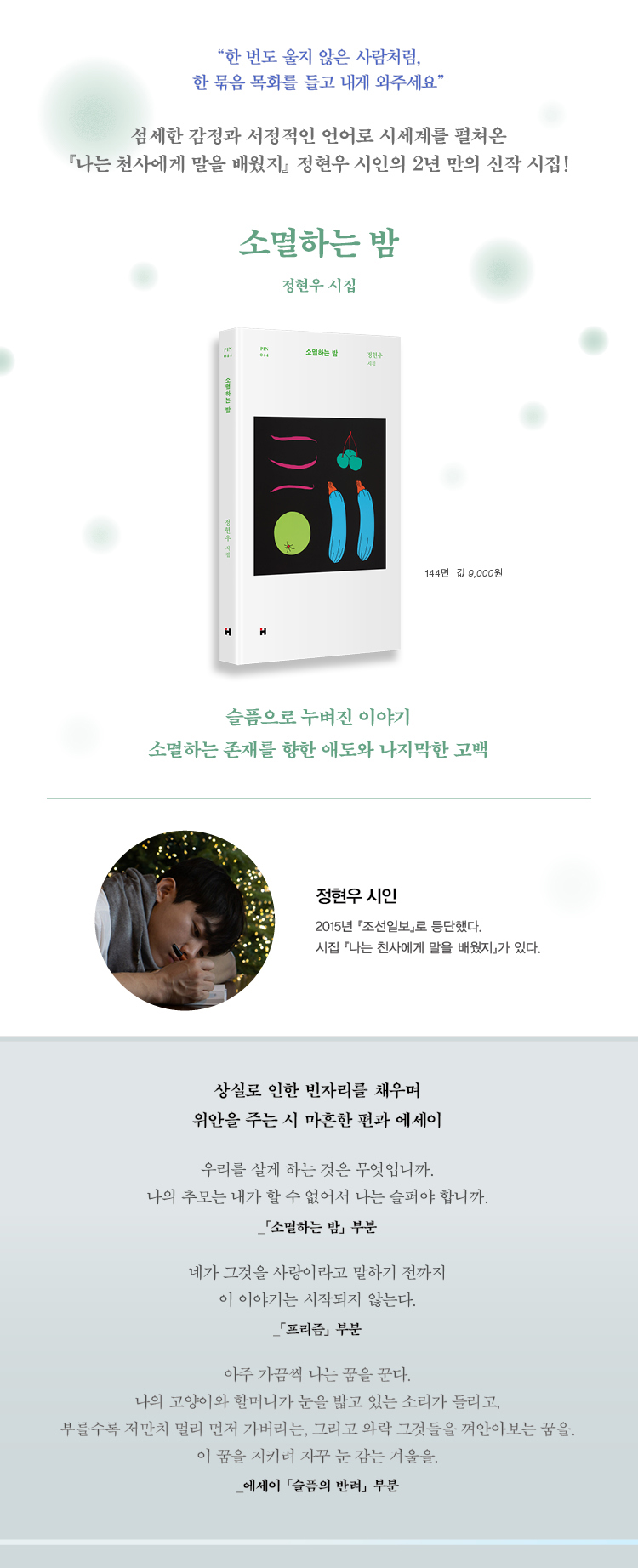
Hearts that have perished but not disappeared"I learned to speak from an angel" Poet Jeong Hyeon-woo's new poetry collection, released after two years.
It contains the poet's words that discovered fragments of the heart that never disappear from the empty space left by death and separation.
The scenes in the poem, which express mourning and self-reflection toward a vanishing being that we were unaware of, will give us a broader view of the poet's world.
February 14, 2023. Novel/Poetry PD Kim Yu-ri
The 44th poetry collection of the Modern Literature Pin Series, a representative Korean literature series, is published with Jeong Hyeon-woo's "The Vanishing Night."
This is a new poetry collection published two years after his literary debut in 2015 (Chosun Ilbo New Year’s Literary Contest) and his first poetry collection, “I Learned to Speak from an Angel” (2021).
(He is a poet who first became known as a singer.)
Jeong Hyeon-woo's "The Vanishing Night" consists of 41 poems that can be said to be a sad hymn and elegy for the death of living beings and all things in the world that are destined to fail, and the essay "The Companion of Sorrow," which can be said to be a mystical duet of life and death that depicts the separation from loved ones like a fantasy fairy tale.
『Modern Literature Pin Series VOL.
Ⅷ』 presents poetry collections that contain the individuality of poets Jeong Hyeon-u, Kim Seung-il, Jeong Jae-yul, Lee Yeong-ju, Seo Dae-gyeong, and Yoo Hee-gyeong.
This series allows you to experience the infinite and diverse voices of Korean poetry through the diverse sensibilities of six poets.
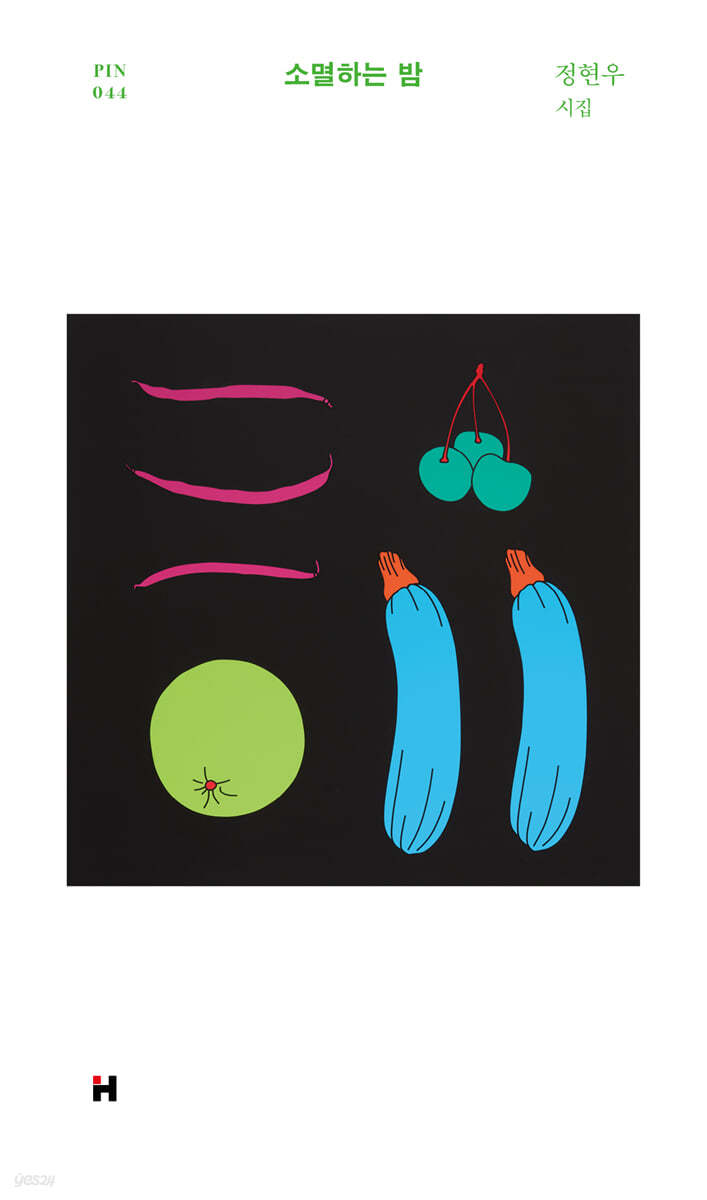
This series expands the horizons of art by featuring the work of Michael Craig-Martin, a master of British contemporary art and a pioneer of conceptual art.
This is a new poetry collection published two years after his literary debut in 2015 (Chosun Ilbo New Year’s Literary Contest) and his first poetry collection, “I Learned to Speak from an Angel” (2021).
(He is a poet who first became known as a singer.)
Jeong Hyeon-woo's "The Vanishing Night" consists of 41 poems that can be said to be a sad hymn and elegy for the death of living beings and all things in the world that are destined to fail, and the essay "The Companion of Sorrow," which can be said to be a mystical duet of life and death that depicts the separation from loved ones like a fantasy fairy tale.
『Modern Literature Pin Series VOL.
Ⅷ』 presents poetry collections that contain the individuality of poets Jeong Hyeon-u, Kim Seung-il, Jeong Jae-yul, Lee Yeong-ju, Seo Dae-gyeong, and Yoo Hee-gyeong.
This series allows you to experience the infinite and diverse voices of Korean poetry through the diverse sensibilities of six poets.
This series expands the horizons of art by featuring the work of Michael Craig-Martin, a master of British contemporary art and a pioneer of conceptual art.
- You can preview some of the book's contents.
Preview
index
Part 1
You don't know
Angel eyes
squall
The Vanishing Night
object
History of Stew
Pieta
Madeleine
swirl
Song of the Fireflies
absentmindedly
Part 2
hydrangea
fixed date
Attic of Light
bokeh
dandelion
prism
share
bell
Bird's eye view
Dandelion Forest
Glass Forest
The Duck and the Blind Forest
Wintering
Shiitake mushrooms
photosynthesis
Part 3
Winter Prayer
Omok
Drawing
Winter Sketch
mother snake
Catchball
harmonica
Ball and bruise
green onion
Ghosts of the Tundra
The person who died yesterday
grave
sowing
Winter's Love Letter
Cherry
Essay: Companion of Sorrow
You don't know
Angel eyes
squall
The Vanishing Night
object
History of Stew
Pieta
Madeleine
swirl
Song of the Fireflies
absentmindedly
Part 2
hydrangea
fixed date
Attic of Light
bokeh
dandelion
prism
share
bell
Bird's eye view
Dandelion Forest
Glass Forest
The Duck and the Blind Forest
Wintering
Shiitake mushrooms
photosynthesis
Part 3
Winter Prayer
Omok
Drawing
Winter Sketch
mother snake
Catchball
harmonica
Ball and bruise
green onion
Ghosts of the Tundra
The person who died yesterday
grave
sowing
Winter's Love Letter
Cherry
Essay: Companion of Sorrow
Detailed image
Into the book
What makes us alive?
Should I be sad because I cannot pay my respects?
---From "The Vanishing Night"
The angel asked me what was left for me.
The unknown dreams that we have
Faces were collapsing, their facial features gone.
---From "Object"
Until you call it love
This story never begins.
---From "Prism"
I enter your snowy forest.
I scooped up a handful of white snow
Hesitating to flutter.
If you block the sunlight with your palm, you can feel the crying.
---From "Share"
Building a house on the heavy snow that covers the sky, what will take my place when the rain rises? A transparent ice letter that covers my face with both hands, the light of the glass that runs away, our time being swept away by the light.
---From "Glass Forest"
Very occasionally I have a dream.
I dream of hearing my cat and my grandmother stepping on the snow, and the more I call them, the farther away they go, and then I hug them tightly.
Winter, when I keep closing my eyes to protect this dream.
Should I be sad because I cannot pay my respects?
---From "The Vanishing Night"
The angel asked me what was left for me.
The unknown dreams that we have
Faces were collapsing, their facial features gone.
---From "Object"
Until you call it love
This story never begins.
---From "Prism"
I enter your snowy forest.
I scooped up a handful of white snow
Hesitating to flutter.
If you block the sunlight with your palm, you can feel the crying.
---From "Share"
Building a house on the heavy snow that covers the sky, what will take my place when the rain rises? A transparent ice letter that covers my face with both hands, the light of the glass that runs away, our time being swept away by the light.
---From "Glass Forest"
Very occasionally I have a dream.
I dream of hearing my cat and my grandmother stepping on the snow, and the more I call them, the farther away they go, and then I hug them tightly.
Winter, when I keep closing my eyes to protect this dream.
---From "The Companion of Sorrow"
Publisher's Review
With the most modern and cutting-edge writers of contemporary Korean literature
The forty-fourth poet in the "Modern Literature Pin Series" has been published!
The Modern Literature Pin Series: Connecting and Illuminating Literature
The 44th poetry collection of the Modern Literature Pin Series, a representative Korean literature series, is published with Jeong Hyeon-woo's "The Vanishing Night."
This is a new poetry collection published two years after his literary debut in 2015 (Chosun Ilbo New Year’s Literary Contest) and his first poetry collection, “I Learned to Speak from an Angel” (2021).
(He is a poet who first became known as a singer.)
Jeong Hyeon-woo's "The Vanishing Night" consists of 41 poems that can be said to be a sad hymn and elegy for the death of living beings and all things in the world that are destined to fail, and the essay "The Companion of Sorrow," which can be said to be a mystical duet of life and death that depicts the separation from loved ones like a fantasy fairy tale.
『Modern Literature Pin Series VOL.
Ⅷ』 presents poetry collections that contain the individuality of poets Jeong Hyeon-u, Kim Seung-il, Jeong Jae-yul, Lee Yeong-ju, Seo Dae-gyeong, and Yoo Hee-gyeong.
This series allows you to experience the infinite and diverse voices of Korean poetry through the diverse sensibilities of six poets.
This series expands the horizons of art by featuring the work of Michael Craig-Martin, a master of British contemporary art and a pioneer of conceptual art.
Jeong Hyeon-woo's poetry collection, "The Vanishing Night"
The forty-fourth poetry collection in the Modern Literature Pin Series, Vanishing Night, is the new work of poet Jeong Hyeon-woo, who has been drawing attention for his lyricism and sophisticated imagery, after two years.
Following the acclaimed first poetry collection, which was described as “a comforting elegy for the wounds of young souls living in a chaotic age” (Byungryul Lee), this collection of poetry demonstrates the power of thought to find answers through sadness, “weaving in the void caused by loss with a tired body and a groping heart.”
The speaker in the poem lives a life shattered like fragments, ignoring the unfillable void left by someone's death.
As the speaker mourns the departed, he realizes “the sin of carelessness and indifference” and “faces the truth that not all sorrows can be perfectly mourned” (Im Ji-hoon).
The world the speaker belongs to is a desolate and miserable space, to the point where “nothing lives in this winter forest” (excerpt from “Song of the Fireflies”).
For him, not only his mother, who appeared in his dreams as a 'little girl', but also the vividly blooming flowers and the dragonflies flying in curves are objects of mourning.
All existence is annihilated, because “disappearance proves the emptiness” (from “Deadline”).
No matter what he looks at, “the back of his mind is always/drenched in a daze” (from “Hydrangea”), and he longs for something that was a part of him but no longer exists in the world.
His mind is littered with memories of the past that he knew but pretended not to know.
The unhealed wounds are covered with guilt, and the sorrow of loss is neither completely healed nor shattered.
As critic Lim Ji-hoon puts it, “‘Sadness’ is the only way to sustain a person’s life, which cannot be filled or shattered,” and no story can begin “until we call it love” (from “Prism”).
“You/Like a letter scribbled at first sight” (from “You Don’t Know”), you stayed for a while and then left, but “some sadness makes us live as it lingers” (from “The Vanishing Night”).
The monologue that resonates in the empty space we face gradually develops into a reflection containing existential reflection.
Warm gazes and condolences permeate throughout, seeking to “understand the unforgiven me” (from “The History of Stew”) and “until the dazzling sword becomes a gentle confession” (from “Sowing”).
Poet Jeong Hyeon-woo, who says that “the meaning of extinction is not only ‘to disappear and disappear,’ but also ‘to combine energy and emit a different form of energy,’” has achieved poetic success through his unique sensibility and delicate language by colorfully expressing the images of ‘extinction,’ ‘death,’ and ‘love’ in this poetry collection.
Pin Series Common Theme: Essay
The essays attached to the poet selection of the <Modern Literature Pin Series> begin as an independent genre that is no different from reading the poet's inner self.
This allows readers to approach the poet's intimate world, which they had only felt through poetry, in a more concrete and in-depth way.
Furthermore, this essay is an invitation to the depths of the poets' inner self, expanding the scope of their free space of thought through the special link of a "common theme" and showing their own unique emotions in different colors and with different personalities, which is a fascinating aspect that can only be found in the Pin Poet Line.
The theme of this volume's essays, which six poets explore with a new sensibility, is 'companionship.'
Poet Jeong Hyeon-woo's essay "Companion of Sadness" begins with a scene of walking silently while holding a cat named Myo Myo on the day of the first snowfall.
His father told him to throw the cat away, but the poet couldn't bring himself to do so and ran down the street with the cat in his arms.
The night he buried Myo Myo, he recalls the death of his grandmother, who had said that “every sorrow has its reason.”
His experiences with death led him to a curiosity about the soul and the afterlife, leading him to church as a young child.
He leaves behind believers whose actions are contrary to what the Bible says and wonders whether cats also have souls.
The poet, who believed that “when a person dies, he comes back to the world as a flower, grass, butterfly, or cat,” harbors the thought that Myo-Myo might actually be his great-grandmother.
The night I buried Myo-Myo, I saw my grandmother and cat walking together on a snowy road in my dream, and I hugged my grandmother and Myo-Myo tightly.
Based on his childhood experiences, the poet overlaps life, death, and the soul, depicting a vanishing existence like a fantasy fairy tale.
The poet's way of mourning his beloved and his longing for reunion provide a glimpse into the source of his poetic world.
This is a warm essay in which inner sadness builds up layer by layer to form a more solid emotional layer.
Contemporary Literature × Artist Michael Craig-Martin
This collection of poems from the Pin Series, which presents a unique collection of poems through collaboration with artists, is a rare and precious perspective that is in harmony with the works of Michael Craig-Martin, a master of British modern art who has been active as a 'first-generation conceptual artist', inheriting the spirit of Marcel Duchamp (1887-1968), the founder of conceptual art.
The "Modern Literature Pin Series" has become an original poet's anthology, an art anthology, composed of a special work of art, along with a cover work imbued with the artist's soul.
The reason each poem has its own unique fragrance and profound artistic charm is probably because of the spiritual harmony created by the meeting of the two worlds of poetry and art.
* Michael Craig-Martin
Born in Dublin, Ireland in 1941.
Yale University, majoring in Fine Arts.
Lived and worked in the UK since 1966.
Over the past 40 years, he has held numerous solo exhibitions and installation projects at leading art institutions around the world, including the Centre Pompidou in Paris, the Museum of Modern Art in New York, and the Kunsthalle Bregenz in Austria.
Representative of the British Pavilion at the 23rd São Paulo Biennale (1998).
Three retrospective exhibitions held at the Whitechapel Gallery, London (1989), the Irish Museum of Modern Art, Dublin (2006), and the Serpentine Gallery, London (2015).
Former Professor at Goldsmiths, University of London and a member of the Tate Trustees.
A key figure who contributed to the rapid development of British modern art, he was awarded a CBE (Commander of the Order of the British Empire) in 2001 and a knighthood from the Royal Household in 2016 in recognition of his contributions.
The forty-fourth poet in the "Modern Literature Pin Series" has been published!
The Modern Literature Pin Series: Connecting and Illuminating Literature
The 44th poetry collection of the Modern Literature Pin Series, a representative Korean literature series, is published with Jeong Hyeon-woo's "The Vanishing Night."
This is a new poetry collection published two years after his literary debut in 2015 (Chosun Ilbo New Year’s Literary Contest) and his first poetry collection, “I Learned to Speak from an Angel” (2021).
(He is a poet who first became known as a singer.)
Jeong Hyeon-woo's "The Vanishing Night" consists of 41 poems that can be said to be a sad hymn and elegy for the death of living beings and all things in the world that are destined to fail, and the essay "The Companion of Sorrow," which can be said to be a mystical duet of life and death that depicts the separation from loved ones like a fantasy fairy tale.
『Modern Literature Pin Series VOL.
Ⅷ』 presents poetry collections that contain the individuality of poets Jeong Hyeon-u, Kim Seung-il, Jeong Jae-yul, Lee Yeong-ju, Seo Dae-gyeong, and Yoo Hee-gyeong.
This series allows you to experience the infinite and diverse voices of Korean poetry through the diverse sensibilities of six poets.
This series expands the horizons of art by featuring the work of Michael Craig-Martin, a master of British contemporary art and a pioneer of conceptual art.
Jeong Hyeon-woo's poetry collection, "The Vanishing Night"
The forty-fourth poetry collection in the Modern Literature Pin Series, Vanishing Night, is the new work of poet Jeong Hyeon-woo, who has been drawing attention for his lyricism and sophisticated imagery, after two years.
Following the acclaimed first poetry collection, which was described as “a comforting elegy for the wounds of young souls living in a chaotic age” (Byungryul Lee), this collection of poetry demonstrates the power of thought to find answers through sadness, “weaving in the void caused by loss with a tired body and a groping heart.”
The speaker in the poem lives a life shattered like fragments, ignoring the unfillable void left by someone's death.
As the speaker mourns the departed, he realizes “the sin of carelessness and indifference” and “faces the truth that not all sorrows can be perfectly mourned” (Im Ji-hoon).
The world the speaker belongs to is a desolate and miserable space, to the point where “nothing lives in this winter forest” (excerpt from “Song of the Fireflies”).
For him, not only his mother, who appeared in his dreams as a 'little girl', but also the vividly blooming flowers and the dragonflies flying in curves are objects of mourning.
All existence is annihilated, because “disappearance proves the emptiness” (from “Deadline”).
No matter what he looks at, “the back of his mind is always/drenched in a daze” (from “Hydrangea”), and he longs for something that was a part of him but no longer exists in the world.
His mind is littered with memories of the past that he knew but pretended not to know.
The unhealed wounds are covered with guilt, and the sorrow of loss is neither completely healed nor shattered.
As critic Lim Ji-hoon puts it, “‘Sadness’ is the only way to sustain a person’s life, which cannot be filled or shattered,” and no story can begin “until we call it love” (from “Prism”).
“You/Like a letter scribbled at first sight” (from “You Don’t Know”), you stayed for a while and then left, but “some sadness makes us live as it lingers” (from “The Vanishing Night”).
The monologue that resonates in the empty space we face gradually develops into a reflection containing existential reflection.
Warm gazes and condolences permeate throughout, seeking to “understand the unforgiven me” (from “The History of Stew”) and “until the dazzling sword becomes a gentle confession” (from “Sowing”).
Poet Jeong Hyeon-woo, who says that “the meaning of extinction is not only ‘to disappear and disappear,’ but also ‘to combine energy and emit a different form of energy,’” has achieved poetic success through his unique sensibility and delicate language by colorfully expressing the images of ‘extinction,’ ‘death,’ and ‘love’ in this poetry collection.
Pin Series Common Theme: Essay
The essays attached to the poet selection of the <Modern Literature Pin Series> begin as an independent genre that is no different from reading the poet's inner self.
This allows readers to approach the poet's intimate world, which they had only felt through poetry, in a more concrete and in-depth way.
Furthermore, this essay is an invitation to the depths of the poets' inner self, expanding the scope of their free space of thought through the special link of a "common theme" and showing their own unique emotions in different colors and with different personalities, which is a fascinating aspect that can only be found in the Pin Poet Line.
The theme of this volume's essays, which six poets explore with a new sensibility, is 'companionship.'
Poet Jeong Hyeon-woo's essay "Companion of Sadness" begins with a scene of walking silently while holding a cat named Myo Myo on the day of the first snowfall.
His father told him to throw the cat away, but the poet couldn't bring himself to do so and ran down the street with the cat in his arms.
The night he buried Myo Myo, he recalls the death of his grandmother, who had said that “every sorrow has its reason.”
His experiences with death led him to a curiosity about the soul and the afterlife, leading him to church as a young child.
He leaves behind believers whose actions are contrary to what the Bible says and wonders whether cats also have souls.
The poet, who believed that “when a person dies, he comes back to the world as a flower, grass, butterfly, or cat,” harbors the thought that Myo-Myo might actually be his great-grandmother.
The night I buried Myo-Myo, I saw my grandmother and cat walking together on a snowy road in my dream, and I hugged my grandmother and Myo-Myo tightly.
Based on his childhood experiences, the poet overlaps life, death, and the soul, depicting a vanishing existence like a fantasy fairy tale.
The poet's way of mourning his beloved and his longing for reunion provide a glimpse into the source of his poetic world.
This is a warm essay in which inner sadness builds up layer by layer to form a more solid emotional layer.
Contemporary Literature × Artist Michael Craig-Martin
This collection of poems from the Pin Series, which presents a unique collection of poems through collaboration with artists, is a rare and precious perspective that is in harmony with the works of Michael Craig-Martin, a master of British modern art who has been active as a 'first-generation conceptual artist', inheriting the spirit of Marcel Duchamp (1887-1968), the founder of conceptual art.
The "Modern Literature Pin Series" has become an original poet's anthology, an art anthology, composed of a special work of art, along with a cover work imbued with the artist's soul.
The reason each poem has its own unique fragrance and profound artistic charm is probably because of the spiritual harmony created by the meeting of the two worlds of poetry and art.
* Michael Craig-Martin
Born in Dublin, Ireland in 1941.
Yale University, majoring in Fine Arts.
Lived and worked in the UK since 1966.
Over the past 40 years, he has held numerous solo exhibitions and installation projects at leading art institutions around the world, including the Centre Pompidou in Paris, the Museum of Modern Art in New York, and the Kunsthalle Bregenz in Austria.
Representative of the British Pavilion at the 23rd São Paulo Biennale (1998).
Three retrospective exhibitions held at the Whitechapel Gallery, London (1989), the Irish Museum of Modern Art, Dublin (2006), and the Serpentine Gallery, London (2015).
Former Professor at Goldsmiths, University of London and a member of the Tate Trustees.
A key figure who contributed to the rapid development of British modern art, he was awarded a CBE (Commander of the Order of the British Empire) in 2001 and a knighthood from the Royal Household in 2016 in recognition of his contributions.
GOODS SPECIFICS
- Date of issue: January 25, 2023
- Format: Hardcover book binding method guide
- Page count, weight, size: 144 pages | 200g | 104*182*20mm
- ISBN13: 9791167901828
- ISBN10: 1167901827
You may also like
카테고리
korean


korean

![GQ KOREA Mark (Monthly): December [2025]](http://librairie.coreenne.fr/cdn/shop/files/8ef265dbbfbf186523ed75ba7319009d.jpg?v=1765340328&width=3840)


